

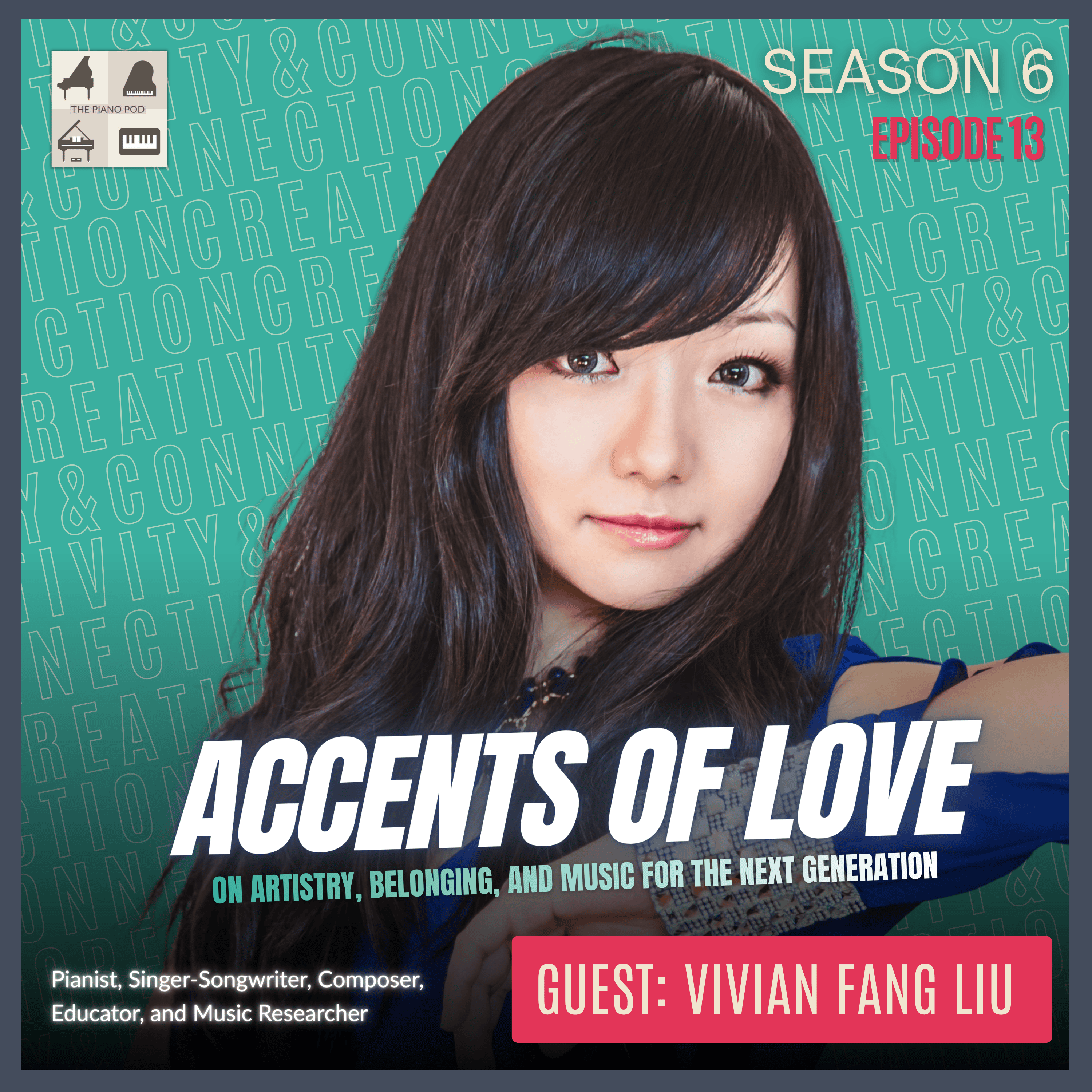
The Piano Pod - a global hub for innovation, education, and connection in classical piano music· Staffel 6· Folge 13
Accents of Love feat. Pianist and Singer-Songwriter, Vivian Fang Liu
Mittwoch, 18. März 2026 · 1 h 33
Kapitelklicken springt direkt hin
Shownotes
Got something to say to this podcast? Send a voicemail, and you might hear yourself on the next episode! (rss.com/podcasts/the-piano-pod/voicemail)
Accents of Love: Vivian Fang Liu on Artistry, Belonging, and Music for the Next Generation
The Piano Pod — Season 6, Episode 13
In this episode of The Piano Pod, pianist, singer-songwriter, composer, educator, and music researcher Vivian Fang Liu (vivianfangliu.com) joins host Yukimi Song for a powerful conversation about identity, creativity, and the role of music in shaping the next generation.
Vivian Fang Liu is a classically trained pianist whose work spans classical performance, cross-genre songwriting, children’s music, and music education research. Her award-winning children’s album Accents of Love (2023) (vivianfangliu.com/accentsoflove) invites young listeners to celebrate their voices, languages, and identities through imaginative storytelling and vibrant musical production.
Throughout the conversation, Vivian shares the inspiration behind her children’s music, her journey immigrating to the United States at age fifteen, and how themes of belonging, cultural identity, and resilience shape both her artistry and her educational work.
This episode explores how music can empower children to embrace who they are while also building bridges across cultures and communities.
Listen to Vivian Fang Liu
• Chinese Pop Original (youtube.com/watch?v=GlZ3SpGS5E4)
Children's Music
• Belong (youtube.com/watch?v=vah951AvhcU)
• I Is Love (youtube.com/watch?v=BqfoSWYdNYY)
• Talk to the Fishes with Your Inner Voice (youtube.com/watch?v=Bxap_T0O_qY)
• Silence (youtube.com/watch?v=SmYJ1nd5bZI)
• All Accents Are Art (youtu.be/DXautLSf4fk?si=xhQjCbUQi_Xf_LxD)
Learn More About Vivian Fang Liu
• Website (vivianfangliu.com)
• Instagram (instagram.com/vivianfangliu)
• Spotify (open.spotify.com/artist/4GFOogDwBS09xjHUSAQG79)
Meet Our Guest: Vivian Fang Liu substack.com/home/post/p-190096545
The Piano Pod
• 💖 Become a VIP Member (thepianopod.substack.com) / Unlock Exclusive Content
• 📫 Join Our Newsletter (thepianopod.substack.com/subscribe)
• 🌐 Website (thepianopod.com)
Transkriptvom Podcast bereitgestellt · Zeitmarken springen hin
Purple is born from red and blue. Water and sun grow the bamboo. Black and white make a great look. Cotton would make the paper of your textbook. Music is made of measures, minors, and earth of colors. Dance on the canvas, try to see the truth. Welcome back to the PianoPod, everyone. This season, we are exploring creativity and connection, highlighting artists who are reimagining what musical purpose can look like in today's world. Our guest for this episode, Vivian Fang Liu, brings a remarkable blend of artistry, scholarship, and creative vision. She is a classically trained pianist, a singer -songwriter working across multiple genres, an educator, and a researcher whose work on music education and culture has
been presented. internationally. What makes Vivian's voice particularly compelling is how these different worlds come together in her creative work. Her acclaimed children's album, Accents of Love, invites young listeners to celebrate who they are, their languages, cultures, and identities through music that is imaginative, thoughtful, and artistically rich. Alongside this project, Vivian has also created Shape of Crowns, another children's album centered on belonging. confidence, and cultural pride. Her songwriting speaks not only to children growing up in multicultural environments, but also to the adults guiding them. Born in Ganyan, China, and arriving in the United States alone at the age of 15, Vivian
understands firsthand what it means to grow up between cultures. That experience, together with her research on Chinese and Chinese -American music education, shapes her artistic mission, using music as a bridge for storytelling, identity, and empowerment. Her work moves across classical performance, pop, songwriting, jazz influences, and children's music, creating a musical language wide enough to hold the complexity of real human stories. Before we begin, I want to thank our listeners for your continued support of The Pianapod.
Your engagement, sharing episodes, leaving reviews, and following our conversations help sustain this community of artists, educators, and thinkers exploring what classical music can become. Here is Season 6, Episode 13 of The Pianapod with pianist, singer -songwriter, educator, and researcher Vivian Pang Nu. Please enjoy the show. You are listening to The Piano Pod, where we talk to the brightest minds in the industry about how they are bringing the piano into the future and thriving in a complex, ever -evolving world.
Vivian, welcome to The Piano Pod. Thank you so much for being here today. And where are you joining us from? Thank you so much for having me. I'm from New York right now. I'm in New York right now. I'm so sorry. No, it's okay. Great. Yes, we are both New Yorkers. Yes, fellow New Yorkers. Wonderful. Now, it feels really especially fitting to... you know welcome you on the show during our season of creativity and connection you really embody the spirit using your imagination musicianship and multi -genre artistry to reach young audiences in such a modern and thoughtful way and of course this conversation was set in motion by donna Wang Friedman, a longtime PianoPod friend and former guest who recommended you with
so much enthusiasm. With all that in mind, when you look at the full arc of what you do, from classical performance to cross -genre songwriting to your children's albums, what would you say is your overall artistic mission? My mission is that use music as a bridge between the cultures. between the generations and between the feelings and the sounds, yeah, to connect. I think that's my mission. And yeah, and also I feel like music to me is so special. I started to play piano because of my mom. And yeah, because I was just like a tomboy and then, you know, always running around and not really like obeying. my Asian parents. And then my mom was like, oh, you need to learn piano. And then she said, because, you
know, she wants me to calm down, be more, you know, graceful. That's what she hoped for. And she told me that if you learn music, if you learn piano, you will always have a friend that is always there for you. When you feel lonely, you can play some music. And when you feel happy, you can play music. And music will always be there for you. You will never be lonely. And I didn't understand that. And I was like, okay, I'll learn. And then I only started to understand that, you know, later on. And I really appreciate my mom that gave the gift for me. And I hope my mission is also to inspire people with music.
And I hope music is a home for everyone. Wow, that's beautiful. That's a wonderful advice from your mom. Now, before we get into your childhood, your training and so on, I want to kind of want to start with your album, Accents of Love, which is the album from 2023, which won Album of the Year and then earned Music of the Year with the last track, I Is Love. Right? Yeah. And then it's a children's album with remarkably high production, polished lyrics, rich musical writing, and imaginative digital orchestration that still carries touches of your classical background as well. And I mean, not to mention your vocal quality is just so superb. It showcases your full range as an artist. pianist, singer, composer,
and producer. So for listeners discovering your work for the first time today, what is Accents of Love about? And how did you envision the sonic world of this album? This album is my, I feel like it's my love letter for my students and children and also parents. I want to empower them with my music. accents of love originally because there's a story, you know, of it. I speak with, you know, accent. I am originally from China and I speak English with an accent. I know it. And I also actually noticed that people treat people who speak English with accents differently.
You know, if you speak with fancy accents like French or British accents and people like, wow. you must be great you know and that if you speak with you know other types of accents that they you know they don't think it's fancy and the research shows that research shows that people think that if you speak with some other accents and you are less intelligent and you are less capable and i was ashamed ashamed of it like you know speak English with accents, and I know how people react sometimes, you know, and I was like, oh, okay, I wish I, you know, until today, I'm still learning English every day. I'm learning Spanish, English still every day, but, you know, sometimes it's actually hard to, hard to, hard
to change, but I'm still trying to, but, you know, until Later on, I learned my lesson. I realized that actually accents are beautiful because accents, you know, are cultures, are, you know, different histories and also represents different people, colors, and also foods. You know, there's so many different stories in different accents. And I started to be proud of it. I was like, okay, this is me and this is unique. And I want to, you know, empower other people with my lessons. So I wrote all the songs on accents of love. And one of the songs is called All Accents Are Art. So I think that's my message from this album. And it's about... inclusion and diversity and difference is our superpower. Absolutely.
And then I know exactly how you feel because I myself was an international student way back then and then struggled with that sort of stereotype ideas from others. And then somehow European accents are accepted, but not my accent. And I worked really hard to get rid of, but why do I even do that? As long as, you know, people can understand you, it's fine, right? So I feel like what you're saying, already we're being super philosophical here at the beginning of the show, but like, I think it's the acceptance.
You have to accept yourself. Yes. Right? Yes. Yeah. It's not the other way around. As long as you accept that. hey, my Japanese accent, your Chinese accents are cool. Yes. Right? Yes. Is that part of the message of this album? Yes. I think everybody's so different, so unique. And also on this album, I talk about self -love.
Yeah, just like you just mentioned. Thank you. And we have to love ourselves first. And that's very important. And as Asians, you know children or people we we were like trained differently we have to work hard work hard work very very hard and our parents actually i mean at least my parents or my friends parents they never told us um anything about besides work hard go to you know, go to college and care about your feelings and things. And I actually didn't know how to take care of myself, my feelings and everything until much later. And I wish I knew earlier.
So that's why I also wrote, you know, the songs and I love and I want to, you know, just share the message with children that self -care is important. You don't need to learn until like much later when you're adults. You actually need to know when you're. little. I think that's very important. Oh, absolutely. But I'm so happy to hear that, you know, we are both Asian Americans, you know, Asian people who live in America. And so having to have that sort of progressive ideas about identity as an Asian woman, oh, I admire that. Thank you. Thank you so much. I think we all have to be brave. Yeah. And if we love ourselves and, you know, we can share the love to other people. Yeah. But how come self -love can be
so difficult, right? Difficult. I'm still learning. I'm learning right now. Me too. Me too. But there's always the demon inside of my head and then telling you the other way around. But, you know, I'm trying. Yeah. It's so hard. Yeah, it is really hard. Now. um each song has as you mentioned you know such uh mentioned a few titles but such a catchy title carries its own message but you know i the album is geared toward children but i actually enjoy listening to to it the album yeah yeah from the beginning to the end and i was on loop so repeatedly Yeah, because it's really well made lyrics, but also I think the soundscape that, you know, there's a pop element to it and a Chinese traditional music element
also is included. But at the same time, you as a classical pianist, that element is included as well. So it's very unique. Anyway, we're going to talk more about that. But can you walk us through a few of them? You mentioned about the eye is love and also all accents are art. But also the first one, talk to the fishes with your inner voice. Beautiful. One stomp at a time, not one step at a time. Yes. In the shape of eyes, I can kind of sort of tell what that is about. And then all accents are art. Superhero even on Mars. Bye -bye pressure. Call us at 520.
And the last track is I Is Love. Yes. Well, thank you so much for doing all the research. I'm so happy that you spent time listening to my music. I'm really, really grateful. So for the first song, The Fishes. So that song, I actually wrote it in St. John on the Virgin Islands. That was my first time ever. learned how to dive you know in the water that's cool yeah and that inspired me so much because the water there is so calm and it's so beautiful um on the surface it's all blue so beautiful but when you dive in the water and you see all the different colorful you know world is so different above is only blue but under is all different things you know, all colorful, all different colors and, you know,
fishes and everything. So, and that inspired me so much that what you see is not what you see. All you see is blue, but actually there's more than that. So that's my, you know, inspiration that what you see in a person or what you hear from a song and what you see, you know, like. of the trees or anything but there's so much more besides what you see but then how do you how can you know more then you have to spend time and you have to really have the heart to get to know the flower get to know the person get to know the music and really spend time with heart to get to know the real truth behind that so that's Yeah, that's my inspiration for that song. It sounds very complicated for a children's
song, right? So my friends were like, oh, do children get it? And I said, of course. Or maybe they will get it later. If they don't get it now, they'll get it later. Like all the favors that we learned when we were little. I didn't understand all of them. Maybe I'm not that smart. But then I actually understand some of the moments in my life later on. But I'm glad. I was glad that I learned that earlier. So I want to plant a seed, you know, in children's mind or, you know, or those have a child in their, you know, inside. So I want them to get to know good stuff first. And then maybe, you know, it will be helpful for them. So that's the first song. Wonderful.
And for One Stump at a Time, also inspired by... a story that from you know like the chinese history book that one step at a time everything on thousands of steps that starts with one step um i changed to stump um yeah probably you can see my personality you know you know okay oh maybe it looks so nice and kind yes i am a that kind of person but um i you know we also we're powerful too you know you feel made up mind and then doing something and you know do it do it with your all you have your energy no matter i'm a small person you know i was like oh my gosh you're you know but but then i said no you don't you don't really know who i am who we are and we have more than you see so the story is about an old grandpa
you know wanting to move the mountains aside And the people laughed at him that, oh, how can you do that yourself? Move mountains, you know, this huge mountain to another side. That's impossible. But the old grandpa started to, you know, move, you know, rock, white rock at a time and then just keep doing every day. And then by generations and, you know, after many, many years, you know, after. his grandsons, grandchildren, you know, all of them, many, many years, eventually the mountains, you know, the mountain was moved to another site. So I think that's a really inspiring story that if we really want to do something, you know, we do it one stump at a time and it just takes time and we know we'll finish it.
Or we challenge, you know, also kind of like insert a message that if we want to, you know change people's stereotype and we do it little by little you know just by whatever power we have and eventually hopefully you know everything will be good yeah beautiful but i love the concept of stomp and there's a one step at a time you hear it a lot and it becomes becoming a you know cliche almost but the stomp has sort of like an intention to it. Yes. Yeah. And also faith.
Yes. Yeah. And bravery. One stump at a time, you know. One stump at a time. So I was singing with my students. I told them, you know, stump. And yes. And they're like, oh, okay, I'll do it. But, you know, sometimes they don't understand. But, you know, and later on, I just, I always. feel like you know we don't expect people to get it right away you know just like one stomach time it takes time it's okay we have to be patient yeah beautiful yeah and tell me about shape of eyes yeah shape of eyes um like during the covid time there was a really famous celebrity um yes on instagram and then she did something really not nice yeah so there's a picture of her that kind of like you know doing like change her shape
like that and you know so and I was like oh my gosh that's crazy this she's so famous and a lot of my students actually love her And she, of course, she said she was just making a joke about imitating the Buddha and all that. And it was a controversial story on the news. And, you know, I couldn't believe it. Even, you know, until today, now it's already 2025, people do that. Especially they're famous. And, you know, it's really setting a bad example to our society.
I want to write a song, but I don't want to put any hatred in the song, you know, because love is not about correcting, you know, it's not about revenge. It's not about anything that is so negative. We need to, I feel like I need to write something beautiful about it, about the different shapes of creatures, you know. Like when you go to a garden, you think it's beautiful because there are so many different colors of flowers, different types of flowers, all the colorful flowers or different shapes of flowers and make the garden beautiful. And, you know, we all look different.
Some people are taller, some people are smaller, some people... have for example have a big face and have smaller face which is beautiful and some people are figures you know just different shapes of people are so beautiful and different you know colors different ages different heights different sizes um of things and really make the world beautiful so that's the song about so i kind of and i'm also from Miao is an ethnic group in China that, you know, wear all different like costumes and big crowns and all that. I'll show the picture. So I used some of the elements of my Miao music, Miao style music into the song.
So it's kind of like beginning. It's kind of like, you know. Something like that. Wow, you're incredible. Sorry, I just got out of the Bible. There's no more of that. And also kind of want to insert my, you know, hometown elements, you know, like the beautiful things that I really love to the song and, you know, to have a message that look at this. The music's different. It's also beautiful. You know, maybe you don't like us because you don't know us enough. OK, let me show you the beautiful parts of us. And also, you know, let you know that we are actually here to help and then to just to be ourselves and then to just be another, you know, friend. You know, we're not here to do anything. bad sometimes
i feel like all the negative comments about you know discrimination and everything maybe i'm thinking from the positive perspective that maybe because they don't know us enough because they only know you know everything you know about us from media sometimes media is not portraying us different well either and you know asian we asian people are the most diverse Group of people.
Yes. Yeah. You know, language wise, even the skin colors. To squeeze into everything. Right. Yes. So it's so funny. I mean, I almost, you know, at this point of my life, because I've lived in the West. You know, the culture for decades. So I almost laugh at them. And I feel so sorry. Yeah. Or, you know, it's there. the limitation and then that really prevent prevents them from learning yeah right i think if we are here to acknowledge the differences between each other and they're gonna be more love you know why not have more love you know i know right what's the core themes or messages were you hoping to impart to children and families maybe you already mentioned but you know positivity and self -image and so on but My core message is
still love and hope and also belonging. I think that's also another message that I want to not share, but also explore with my audiences together. Wow, that's a big word, belonging. So one of the songs is called Call Us at 520. 520, yeah, actually means I love you. So, yeah. So in China, 5, 2, 0, these three letters, you know, the pronunciation of the three letters is very close to I love you in Chinese. So we use the numbers. You know, in China, we don't really say I love you. I don't know if in Japan or it's hard for us even though yeah you know like we don't say I love you to our parents parents don't say that to us either and so we use numbers and we don't say 5 -2 -0 in front of your face but you know we write it
so every year on May 20th it's kind of like a secondary valentine days in china now so they kind of make it like you know a thing now so if you know you love someone you text 520 that's all that means i love you and also you know if you get a red envelope on wechat and it's five dollars and twenty cents and that means i love you yeah so the song was inspired by the number you know 520 i love you um it's a song about a group of detectives they're young detectives so yeah and they are they're you know they're answering phone calls and the phone code the phone number is 520 if you have any troubles call 520 and we're gonna be there to help you if you have your missing hat missing homework missing anything or if you need help Or if there's
your balloon fly away, call us at 520. So that's the song about. And I think I kind of embedded all the message with all the fun stories and into my songs. Yeah, my message sounds a little big and children's music, but I made it fun. So people probably will get it. But, you know, it's amazing. As I said to you, these are written for children, I didn't feel like I'm listening to kids songs like, you know, my baby nephew would listen to, you know what I mean? So I totally enjoyed. So how did you approach writing for children without oversimplifying the musical language? I think I believe children deserve artistry, you know, so because they also can feel the depth. They can feel the feeling, the
music. everything. Sometimes I just feel like we need to believe them and they can do it because I've been teaching for a very long time. Most of them are young children and many of them, you know, they're like four or five or six years old. They're already playing very challenging pieces and perform at Carnival Hall, Royal Albert Hall, you know, like everywhere. And I learned one thing that we treat them as children, as people who are beneath us and you know they will not learn i treat my students as you know equals i believe them you know for example one of the pieces i played for my students a piano piece and then she was like wow i can never play like that i said you can so after a few months and
she did and then you know and it's not just like for her it happened to everyone i feel like if i believe in them and you know guide them with the right direction you know or tailored direction for them and then also they believe in themselves and they put the effort into it and they will be able to do it and for my songs yeah people always ask me oh is it too hard too difficult for children to understand and i test it with my students I think they understand and it takes a little time. But also children, you know, they have different age groups. They have like toddlers, pre -K and, you know, like first grade to like seven, like six to nine, 10 to 12, 14 to the different like, you know, age groups. I think
my music may be. probably doesn't fit for the toddlers because not maybe too hard for them but maybe pre -k from pre -k to like elementary you know or even middle schools i think you'll be good you know for them and yeah so i think i don't want to sacrifice artistry just to you know write easier songs for them but how do they learn about good stuff until later too late they need to know the good stuff when they're little so they know they have standards they know what's good that's how I you know I don't know if it's right but amazing you're right absolutely yeah yeah but um what made you decide to I because this is not the only album geared towards children you have another one uh the title is shape of
crowns so what made you decide to write songs for children also during covid i think covid changed a lot of us yeah yeah yeah yeah so because uh during covid um you know there are like really bad things happened you know um just that one of my little students you know during covid i Right before that, a little bit. Not like before shutdown and everything. Something happened.
So there was a little girl. And then she told me a story. She said, Miss Vivian, my friends, they don't want to hang out with me. And she feels so sad. And I was like, why? Because she's a good student, good person, good girl. And she said, oh, they call me Chinese virus. I was like, oh, you know, they're young kids. They probably heard it somewhere, you know, or I felt so bad about it. And then after that shutdown, everything, all the anti -Asian crimes happened, you know, to the elderly and to everybody, you know, during that time. It was just so crazy. Sometimes between my friends and I, we were talking about, can we still walk on the street without worrying about our safety anymore? Should we wear wigs?
Because they said they can still identify you with your mask because your eyes, your hair color, everything. That was just so ridiculous. And I felt so bad. As a teacher, as a musician, and I'm not a millionaire, billionaire, or anybody who has money or power to change everything, but I feel like I'm a musician. My power is my music. I want to do something about it. You know, just like one stump at a time. Maybe it's not going to be big, but I need to do something about it. So I started to write my... first children's album, Shape of Crowns. And so, yeah, that album, I want to, you know, share the messages with my students or other children who, you know, face the problems. I want them to be leaving
themselves to be proud of their heritage and be proud of who they are. That's how we started for that album. You don't I love all the songs in there, but I love the second track, Belong, which highlights Asian -American contributions. And, you know, also you're blending Beethoven's Sonata Pathétique and hip -hop all by her. Incredible.
Wow. This is your idea, right? Yeah, that's my idea. I love the song, too. Thank you so much. Yeah, and I'm a classical musician, so, you know. And I know my students, they love hip -hop. They always listen to rap songs. They think it's cool. So I'm open -minded. I'm like, okay, let's use something that you like and also that I think is valuable. Combine them, and then maybe you'll be accessible for children to listen to it. It is one of the songs that is very, you know, beloved by the young children. Like, oh, this is so cool.
I want to sing it. And even without understanding it. So I'm not sure if you actually watched the music video. I can share with you later. I did it with my students and there was a story behind it, too. And of course, for Asian children, it's very hard for them to rap. So when they first rap, it sounded really funny, practiced and make them look very cool. And they feel like they're cool. So in the song, we talk about all the amazing things, cultures and foods in Asia. And also all the contributions that Asian -Americans, not just Chinese, but Asian -Americans that have done for this world in medical technology. art, everything. We have done so much. Do you know that there's a Korean surgeon that invented the
medicine? for cancer patients so they can feel less hurting. And we have IM Pei designed so many amazing architectures. We have Verowal. We have so many, so many people, Asian Americans have contributed their talent, time, lives, including the first generation, first generations came here to build the railroad. and everything. So I want the children to see that, see where actually we have so many rich stories and we have done good to the world. Be proud of yourself. Be proud of your skin color. Be proud of who you are.
But when we shot this music video, the parents were like, oh, Miss Vivian, we don't want to wear the Asian. And I said, why? And the mom said, oh, you know, we don't want our children's classmates feel that, you know, we're different. So they might laugh at my children. But then I was like, but you have to be proud of yourself first and nobody can actually. look down to you if you don't really know who you are. So I need to actually, I can't, I couldn't believe it.
The parents are first generation immigrants. I thought they understand the rules. And, but then they, I also understand their worries that, you know, if they are, you know, because young children's mind, sometimes they just don't know enough. They are just worried that their children will be bullied because of this. And even the children, they didn't understand the lyrics at the very beginning. But they started to understand later after I brought them to perform everywhere.
After COVID and many people heard those songs, the New York Senator, John Liu, heard it. and invited us to perform in Albany. And he said, this is what we need. And then he told me that, Vivian, you're not just writing a song, you're writing history. And we need other people, more people to hear about this. So he is advocating for a bill called AAPI Bill. So that bill is about putting more Asian American history contributions, everything. in the history textbook in public schools in New York. And there was a voting that day in Albany. So he invited us to perform right before they vote for the bill. And there were 15 senators there that day, watched us perform.
And the children were rapping and talking about Asian American contributions. And all the senators there, they're a club, you know, applaud. And then like, wow, you guys are the best rapper in the building. And then that day, the bill passed Senate. But there's still like more, more steps to go to pass the bill. And, you know, before I wrote the song or when I wrote this, I never thought. actually music really can make an impact. So that day, my students and me and plus the senators just brought us and then, you know, to every room in that building, legislative building, to tell us about the story of each building and painting and about the sessions, how, you know, two parties are working together
or not and everything. That's a great lesson. And all the children, they were like, oh, wow, we actually, we are important. And so, and after that, and, you know, the Queensborough president and the mayor's office and many, you know, we actually were invited to perform that song almost everywhere. And of course, the Queens District Attorney, you know, so our office. They invited us to perform at their celebration events. And I was like, wow, music can really make an impact.
It's not just for people to enjoy. Yes, to enjoy music is for joy, right? But also we can make an impact through our music. I never thought about it, but I actually, you know. Experienced and witnessed. Yeah, witnessed it. And I feel very grateful and proud. Yeah. Oh, you should be. You should be proud. Wow. And I am proud of you. And as a fellow Asian American, that's so cool. That's so cool. But at the same time, message is strong. Yes. But also the production value is high. You know, that's one of the reasons that probably there was. the power to move people to do something right through your music. That's incredible. Wow. Bravo to you. So, you know, even like in the, I, I know in the song belong,
you named a few Asian American innovators like Eric Yuan, who is the creator of Zoom, right? You know, Eric created Zoom. Zoom is the tool that connected everyone. Yeah. So that's really just amazing. I'm so proud. Every language has a word for love. Love in Chinese is I. I is love. I'm truly awe of your artistry. It's originality and groundbreaking. And as a young Asian woman creating boldly in the United States, creating your own path, you are breaking stereotypes by simply being who you are. and a powerhouse musician with a real creative force. So tell us about your upbringing, how music was introduced, because you also sing. So what your musical training was like in those crucial early years and where
does this singing come from? You have such an incredible voice. Thank you. My parents, my parents, they love singing. I used to have a karaoke machine. They sing all the time, my dad, my mom, you know, and all the traditional songs. And so I just, when I was little, I just sang along with them and without even understanding the words or anything.
I just love singing because I see, you know, the joy that they have when they sing. I was like, I want to do this. So I always sing. So my dad, you know, sometimes they carry me on their shoulders and all that, walking on the streets. I also, I was like, I was not a shy kid when I was first born. Before, you know, I got, you know, go to school and then learn how to behave and all that. I was just not shy.
I just sing, you know, loudly on the streets while my dad carried me on the shoulder. My dad was like, oh. Fang, that's my Chinese name. Can you turn down a little bit? Because he's shy and he felt like, you know, but I was like, oh, I don't care. I'll keep singing because I love singing because the joy that I have when I sing.
And then, you know, as you know, my mom wants to change me. And with piano and all that. So I started to play. uh piano and i started to take lessons and i didn't like to practice that much so but um i still you know did it but not so much for my first uh a few years but my mom didn't give up so i'm glad that she didn't give up on me so um until when i was 12 i took i went to the uh to audition one of the conservatories in Wuhan and middle school. It's kind of a great college here. But that's like you have to go to the school every day for music and all other subjects. So it's kind of serious. So I have to move to another city. So I got into the school.
It's a very prestigious program because they only took at that time 20 pianists from the country. lucky to get into that program and then so I moved to another city for my you know starting my professional training when I was 12 and it was very hard for me because I'm from a small city Guiyang in China and Wuhan is a big city and now everybody knows about Wuhan now and people there they're very smart and many of them are from other big cities Beijing Shanghai and It was hard for me to live in another city without my parents. And it's just always hard. But I practice very hard. I practice like eight hours a day before the election. So everything's about practice. I eat, breathe, and practice. And I
work very hard. I got the scholarship there. The only scholarship, they give like 5 ,000 RMB a semester and they only give one to one student every semester. And I'm the only student to get that scholarship every semester for three years until I moved to America. So I worked very hard and people call me, you know, super woman. You are. But I also very, I was very stressed, you know. Because, you know, from that experience, I learned that I don't want to be the best. Why?
You know, because my parents always teach me that, oh, try your best and do everything your best, which I did. But I felt so much pressure because it's so hard to maintain the trust because you have to give so much extra and your friends don't like you because maybe some of them are jealous, you know, or you just don't have time to hang out with them to build the relationship.
And, you know, I was not that happy. You know, I got, you know, all the scholarships at that time. And so I moved to America and I met my really great teacher, a few teachers, and they're very nice. Did you come to New York first? Yeah, I went to North Carolina first. And then the teacher then recommended me to go to New York.
It's a long story, should I keep it short? Because I came here by myself, and it's an adventure for me. I know I want to go to a good school, but then I need to figure out how to go to high school and everything. So I was very lucky. I found a landlord. It's a Hong Kong family, and they took me in and then be the guardian for me. And so I taught their son, little son, which is actually a few years younger than me, and that piano every day. And they saw the improvement of the son. And then he was my very first student.
And then after that, they introduced their classmates, you know, for me. So I started to make money when I was 15. as a piano teacher and I didn't have time to hang out with my friends and all that and I felt a little sad sometimes because I didn't have time to experience real campus life you know like you know teenager life I was working and studying and because my mom was sick at that time and everything and then you know I have to make start to make some, you know, make living and carry the burden a little bit.
So, but then now I think it's a very valuable experience for me. It's treasure because, you know, I started when I was 15. I have so many years of teaching experience. Yeah. So maybe that also makes me a good teacher because I have so many years of experience. Alrighty. Yeah. And I just feel very grateful that. the parents, you know, believed in me. Even I was just a few years older than their kids and they were so nice, so kind. They always gave me, you know, snacks or food. You know, when I went to their home to teach and I still remember, it's very vivid, the memory that I was waiting for the bus to go to another student's house and it was snowing very hard and it's at night. And I was just a high school student. And I feel like,
oh, this is so beautiful. You know, the sky is so clean. But, you know, I'm a little sad that it's Christmas time. I'm not with my parents, but I'm actually helping my family also, you know, to make money. So I feel proud of myself. And sometimes I wanted to cry. But then I told myself that it's okay. It's going to be okay.
that's I always you know very hopeful no matter what so wow you're a self -made woman yeah what a that's a classic American immigrant story don't you think yeah and thank you it is so cool that's cool because you have two incredible albums and one should you should have won Grammy thank you by the way yeah I'm telling you and I heard that not From someone too. So I swear you should have one, but you know, to do, to be able to get there with your own determination. And that's just so incredible. But now you're using your power and the ability to spread the positive message to young people because you are a teacher. You have been a teacher for a long time, right? Yes, thank you. Yeah, I just, when I look back, everything
is my treasure. I just feel so lucky that I have met so many amazing people, kind people who helped me, you know, along the way. I couldn't make it without any of them. You know, everybody, like all people I know, I don't know who supported me, my students, my parents, the students' parents, my teachers, my friends. They all helped me so much because they all know maybe I was alone here and then they all tried to help me. I feel like the world is beautiful because people are so nice. And some people, they always say that New York is the worst place and people are so bad. But I never felt that. No, I just feel people here actually are nice. I feel the same way.
They're just sometimes being too honest. Yeah. Yeah, but once you create your own pathway and also create your community, New York is the best place, don't you think? Yes, I totally feel that. People are so, I feel like they're real. Yeah, they're real. They don't like you, they like you, you know, they just say it or don't care, they walk away. But, you know. It's efficient.
It is, yeah. But I'm just curious, did you have any vocal training along the way? Actually, I took a few lessons, but I never have degrees in voice. So I think I got it from my father's side, maybe. I just love singing, you know. And I don't think I'm a great, great singer, but I love singing. Wonderful. Now, I want to go back to the theme of identity, belonging, and so on. So themes of those identity, belonging, and then resilience appear throughout your music.
And how did your childhood and moving to the United States at 15 shape the way those themes show up in your work? I think it's in my blood, my journey, my experience. I feel like, I don't know, I just always feel positive. I told myself to be positive no matter what. Maybe I learned it from my mom. My mom is also a very, very strong person, no matter how much she suffered. I probably watched it when I was little, how she deal with things. She never gave up anything, no matter how hard. how life how you know life like kind of like joking with her and all that i just feel like okay if you just keep going if there's a light there so i think that spirit is in my blood and then um when i you know write songs it just
shows you know and also when i teach my students i also tell them to never give up. Even when I teach them sight reading, the first thing, you know, sight reading, children, they don't like it. Many people don't like it. The first message I told them is that don't give up. Sight reading is about just finishing. You can make mistakes, it's fine. But as long as you don't give up, then, you know, and then it's going to be good. So that's the first message when I teach sight reading for my students. And I think my experience, my journey just told me that if you don't give up, it's not going to be too bad. Yeah. And what's the meaning of life?
You know, I've been thinking about that for a very long time. And, you know, everybody's answers are different. Sometimes I feel like it's about helping people. It's about, you know, realizing your goals. And now, I don't know, just at this phase, I was thinking about life is about just living. Just live. You know, if you just keep living and maybe things won't be too bad. Maybe things are bad now. But when you look at... you know, look at it back in one year or two years, you will never think it's a big deal. Or maybe it's a big deal, but then you already passed that. You won't be too bad. You know, there's just always, if you just live and then be yourself, do good things. And that's enough. That's how
I feel. And then also don't be afraid of challenge yourself. And also challenge the things that you don't believe or believe. Like one of my songs is called Bruce Lee Doesn't Like Math. Yes, yes, yes. So, you know, I just want to challenge the stereotypes. Like Asians are all good at math, right? And I'm not good at math. So, yeah.
And Bruce Lee actually found out that he's not good at math either. And he loves poetry. And he's not just a martial artist, but he's a good, you know, writer. He actually wrote a lot of poems about everything, you know, love and everything. And he has a tender heart. And even he is so strong, you know. So in that song, I talk about even Bruce Lee doesn't like math. And then, you know, he loves poetry. And then you can be anything you want to be. So that's it. I just put everything that I learned to my songs and I want to share it with my students and also my friends. I think just like you said, adults can listen to it too.
Now, so I want to talk a little bit about the soundscape that you create. You know, in the background, I hear sometimes traditional Chinese instruments, or maybe that's digital. I don't know. And then sometimes I hear, you know, your piano playing in the background. I'm not talking about your vocal part. And then sometimes I hear more pop, like as if I'm watching an anime, you know, animation. Right. So. Where do all these palettes come from? I mean, are these all your ideas? Or you work with a sound engineer? They're most of my ideas. I also have some engineers to realize my ideas. So I could talk to them about my vision and about the sounds, about the music that I want to... But where does that come
from? I'm just trying to connect the dots. Because, you know, we all have similar classical -trained piano background. But where do you go from there to where you are right now? You know what I mean? You know, I'm a classical pianist. I love to listen to so many other kinds of music. And I'm just so curious about everything. I love pop, rock, R &B, hip -hop, metal. Just, you know, just many different kinds. And also, I know this album is going to be about, you know, promoting the good parts of my culture and everything.
I want to insert the beautiful elements. For example, in All Accents of Art, there's guzheng, you know, the blocking instruments. And I played it. I took, I went to a guzheng teacher in New York. I've even bought guzheng here. I can show you later. I took the lessons. I was learning that part because I don't need the whole thing.
It's very fun. For that, I actually learned how to play guzheng. I want to put that element into... I also have a music video I can show you later to my music. The classical parts, for example, in Coase F520, there's a... a concerto -like message in the bridge. And so I created that concerto part myself. And, you know, because I also want to teach them musical, you know, knowledge through songs. And not many children know about concerto. Even adults, they don't know what's concerto. So, you know, and I, you know, concerto is about a solo instrument or voice with orchestra. So I kind of put that idea into the bridge. And then I played it. I recorded it. And I told my producer also didn't understand
what's concerto. Maybe he was not in classical. So he didn't know. I said, you have to do this as concerto. And then you have to build the strings around it. And I played the piano part. My students, after they listen to it, they ask, oh, what is this? I said, oh, that's concerto. See, that's a way to teach them, too. They learn it without even knowing that we're teaching them. And so I actually have very detailed ideas in my mind before I produce it. And I want to make sure the elements I put in my songs align with my vision. Yeah, but... Also, the ability to write songs, you know? Yeah. Wow. And that's also something that you just explore that by yourself on your own? Yes. Like when I first came here, it was
very lonely. I didn't know anyone. And, you know, I like to take pictures. I still have my camera and then, you know, to record my life. And also I started to write my first songs during that period, because for me, it's kind of a way to, it's kind of like a journal. You just write down things, just, you know, but also I feel like it was therapeutic for me to express myself.
It was healing. So I write down, you know, everything I felt, maybe my stories or also. other stories my very first song i wrote it for my cat yeah and my very first pop song i wrote it um the name was everything's gonna be fine i wrote it for myself so maybe i just i feel like maybe if you just write it from your heart and it's gonna be it's not gonna be bad That's how I feel.
And plus, maybe I listen to a lot of different kinds of music. Did you have any teenage years, so that's back in China, experience in maybe pop songs, like singing in front of the people with pop songs or anything? I never. I was singing in a children's choir when I was in China, but I never actually performed. or anything. You were strictly classical piano training. Wow.
That's incredible. Like, because I thought you had some sort of background like that, you know? No. From my parents, they loved seeing Chinese pop songs. So, but those are old classics, like, you know, Teresa Teng, if you know her. So, yeah, just that. And I just listened, I listened to a lot of Disney music and pop songs when I was little. You know, even like visual things like, you know, for example, your album cover or even the videos that I saw. Yeah, they're great. Thank you so much. Yeah, I'm sure your ideas are put into those designs, no? I designed my very first album's cover. Different shapes. Did you see different colors, shapes? But it's kind of pink related, I think. And also... the um on the cover
there was a two stripes of large so it's larger it's a it's kind of like tie -dye pattern famous from my hometown so i can't believe there and then in the middle there are different shapes of animals and you know just that that's my idea and then i drew i drew it with my crayons and then i sent it to a designer so i just make it you know like nice so it's fascinating to hear all these people's stories where we learn the same piano literature, basically. Yes. From Beethoven Pathétique to Chopin Waltz to everything. Then everybody has their own path. It's just so incredible.
Thank you. Thanks for being interested. No, and thank you for sharing. So now, is it okay if we are going to go more toward music education? Yeah. And you are deeply involved in, I mean, now I understand. And I was like, where does this, you know, connection come from? Like being such an incredible recording artist and then, you know, and also you write scholarly writing or paper and. publish it about music education.
I just couldn't really connect before I spoke to you. But now I see it because you started teaching when you moved here at such a young age. But does that passion of music education come from those formative years as a young artist? No, it's later. I didn't know about research before. So I started piano performance at NYU with Professor Edwards. Oh, me too! Really? Oh my gosh! I love him so much. I love him so much.
You know, he actually supported me singing pop and jazz and rock besides classical music. He was the very first one. Really? A teacher told me that folk is not classical. Everything else is garbage. That was my first teacher that told me that I was wasting time doing everything else. But then when I studied with Professor Halim, he's just so talented, so nice, so kind. And I told him that, hey, Professor Halim, I have a jazz band. I mean, this competition, could you please vote for me? And he was like, yes, I'll definitely vote for you. And then he actually voted for me with his two sons and his wife.
Oh, so sweet. Yeah, he told me one thing. He said, no matter what you do, you love jazz, you love pop songs, I know you love rock. Everything you do, you will always come back to your classical playing. He said, you will be a better. artist do everything that you love and that really just free freed me i just love him so much yeah yeah same he's so awesome wow and continue on please yeah so and after that i went to columbia for music education and because i love teaching and i think you know i i love when uh one -on -one teaching i have enough experience and did pretty well and I just want to improve my classical class classroom teaching classroom teaching that how to teach a group of students or you know
all that I would just I want to improve my teaching I only applied one school and that's that's Teachers College at Columbia and that's the only school I want to go to at that time so I got in and then um but it was very hard for me because I never needed to read so many papers and write so many papers, you know, like in my life, never.
And it was very hard, you know, because language problem and, you know, we never really write papers. Right, right, as musicians. I didn't even read, understand all the... very difficult concepts and everything. And it was very hard, very challenging in the beginning. I started to love it. I started to love research. I was like, oh, wow, this is very helpful. You can actually, you know, try to identify problems and then maybe you can find solution for problems by doing research or understand the problems better if you don't find an answer. So start from. yeah there and I started to love researching you know if I need to if I don't need to work so much I love keep researching and then you know do all the stuff so start from there and
I started to learn about critical thinking you know only during that time about oh you don't need to believe everything right okay wow there's problems and how do we find solutions so All of that inspired me so much. And I look at my own teaching and I see problems, I see conflicts. So most of my students are second generation and the parents are first generation immigrants.
They have totally different, you know, education and they experience different, you know, cultures and many things. They're so different. But there are families. And then you see the conflicts in the education too. What the parents want them to do? What do the students do? What do the teachers do? And I want to find the problem. And I also want to find the solution how to support this kind of dynamic. So I started to survey more than 100. Can you, sorry, can you explore for my audience about the conflict a little bit?
Right. For example, first generation, like immigrants, right, parents, and what they learned are from their parents or grandparents. And the education and, you know, for example, because I don't want to make it too big, just for example, in China, And we learned about group values, not self -centered.
You sacrifice for other people. That's a concept we learned about, you know, being a good person. And here, it's a little more about yourself. You know, it's not self -centered, but you have to care about yourself, which is right. You know, there's good and bad duality. But, you know, the values are so different. The values are different and they're going to have so many conflicts.
For example, it shows in piano learning too. The parents, you know, they sacrifice a lot, really. You know, first -generation parents, they work so hard and they sacrifice their own personal lives and they spend time, energy, money to their children. only because they want to provide a good education, good life for the children.
At the same time, it also gives a lot of pressure to the children. They tell the children that, oh, you have to be good, do well, do well in school and get a good job so you can have a good life. And if you don't obey, you are a bad kid because I sacrificed so much for you already. And then... The children here, they learn different concepts that I don't live for anybody else.
I live for myself and I don't need to sacrifice myself to, you know, to help another person. I need to be good at myself first. This core value are so different, you know, and why do I learn music? Because my parents want to, you know, force me to learn. Many of them say that because also sometimes lazy don't want to practice.
But the parents were like, oh, and that's one thing. And the other thing is very interesting that they want their kids to be successful, right? And they also, you know, they're also very kind of like superficial that, oh, because learning music, playing piano or get awards will be good for the college application for them. even themselves don't listen to music, or they don't take their kids to concerts to listen to music. Only in practice. No, the kids take the exams or go to the competition. And the kids, that's very interesting.
That's most of the parents, they say that, right? Very, you know, superficial. And then the answers from the kids. And then I ask them, why do you want to learn music? And some of them say that, oh, because my parents asked me to. And also, Other answers are that, oh, because I can show off in front of my friends. And I think that's not a bad reason. It's okay. As least you want to play. And there's just one student. I surveyed more than 100 students and then parents and also teachers. And then just one student said, oh, I just feel peaceful when I play music. And then she was only in elementary school. She wrote the answer. That was very funny. and but you know so i feel like the goal the purpose of learning
music are so different and you know if their goals are different you will always have conflict and even including the teachers i surveyed the teachers teachers have different backgrounds they're novice teachers to very experienced julia professors and you know so from their parts of answers they said Most Asian -American students, they work very hard, you know, but, you know, also most of the problems are the problems happened in practice because we only have like a lesson once a week. But, you know, so you practice at home for one week and there are many, many things happened in that week. And if the students, they don't practice with, you know, their mind and goals, if the parents don't support the way it's
supposed to be, and everything will go wrong. And which most of the times, it just, it always goes wrong. And that's a problem. And they also said the problems of the... teachers from the teachers perspective between parents and students parents they they want to see instant result you know the teachers that asian american parents they want to see instant results and then but it doesn't work like that so that's a big thing and then for children you know they have so much pressure to be good how can you enjoy music if you only work for that instant results and for teachers the teachers they some of them are asian american teachers some of them from europe europe some are from america they're all different backgrounds
and has also different cultures so that's a big problem for them too But they love Asian American students because they work hard. But they also see the problem that, you know, how can they help them to be more creative? And from the teacher's part, they also experience problems. Most of them are classical pianists. But the children, they have different, you know, tastes and everything, right? So I actually asked a question about the teachers that, do you teach, what do you see, you know, the repertoire? Do you teach, you know, any other genres besides classical music? And the answers I got, they are very honest. Most of the teachers said, I want to teach them improvise.
I want to teach them, you know, other genres like jazz, anything, but I don't know how to. That's, that's very honest. You know, we're in classical, you know, musicians. Improvisation is not part of our training. It's actually not easy for us. But I feel like if we keep learning, we can learn together with the students. That's how I see it. But for students, like new students nowadays, they've heard so many different kinds of music. If you just play one classical piece, maybe it's not enough. We can teach other techniques from other genres of music, from a pop song too.
Pop song has so many syncopated patterns. You can teach, you know, you actually can teach them syncopation from a pop song. That's how I see it. So I just, you know, research just fascinated me because I see so many, you know, perspectives and different, you know. problems and I was like oh this is very interesting we just need to know each other better to work as a team so amen to that amen sister I've been teaching for decades too and then I understand this core issues where you just all three parties get stuck yeah and they're looking at each other it's like what is going on, right? And one party says this and then another says differently and then another says differently. It's a challenging thing and
you kind of have to come together and meet in the middle and say, hey, this is the reality of music lessons or this is the reality of life and we have to talk it out and what it takes to be, what it means to learn music. What is music? You know, and I totally understand their point of view. We're spending this X amount of money for children's education. We need to see the results. Totally understand that point of view too. Yes. Yeah. But so now what I do is that I just strictly told the parents that, you know, learning piano not necessarily will help the college application. And then the parents are like, why do we learn music then? And I just ask. The parents, one question that do you want your children, you know, in the future after
the work and then go home and just play games and then sitting there doing nothing with nothing to do and, you know, like just live a boring life. You know, they don't say anything after that, you know, because living is not just about making money, about having a good job. And it's really about enrich your life. you know, spiritually too. And music can help that tremendously. I think that's very important. Yeah. And I tell the parents, you should learn music too. We all should. What do you believe the role of the artist is in shaping cultural narratives for the next generation? I feel like people see artists as some people that, you know, outside of regular life. Oh, they're just people who have dreams.
But I think we're very important. We're very important. I think... you know as an artist myself um music is always there for me and i already benefit so much from music so i can say it from my experience that music is important in people's life he saved my life so many times so so many times every time i feel down negative want to give up many other moments sad you know abandoned all all the moments and i started to i told myself okay sing a song sing whatever play a piece write something collaborate with people and it always you know you always lighten up my spirit so i think as an artist our role is to promote music of course and also to share all the meaningful messages in you know through music to people
to connect and also use music to heal music is a therapy it's not just something that for you to um enjoy it is that's very important to make you happy yes that's also one of the you know important aspects of therapy and Music is so important in people's life and we just need to keep doing it and maybe evolve it and have open mind because we never know about artificial intelligence you know like AI how are we going to evolve but I believe you know just like I always do that we can use music to heal people. But we need to have an open mind and thrive with the changes, not stuck in the past. Beautifully said. Thank you. Now it's time for us to promote your work.
So what are you working on now? And also any upcoming projects that you can share with us? I just recorded my piano concerto, a new one, with a composer from Cincinnati. University, Douglas Nguyen's work, Piano Concerto is called Storm, with Bortno Philharmonic in Czech a few months ago. And that was a very amazing experience.
And it was conducted by Mikel from London, and he's an amazing conductor. So I am very excited about this project. I'm also going to record in London next month at Abbey Road with London Philharmonic as one of the featured artists in the new group called String Symphony. I'm very excited about that too. um yeah so these two are biggest projects so far and i just performed at carnegie hall and lincoln center last week so that's why i was like so really and wow what did you perform uh i performed uh my own compositions and i also i collaborated a lot with different types of artists these two are classical projects but i also collaborated with two rock artists with classical music for a, you know, kind of
fusion music. And I also performed the new arrangement from me and the violist, Julia violist, Karen Olson for the Christmas song, Carol of the Bells. I brought my students to sing some of my originals, Love, Peace, Prayer, at Lincoln Center. They also performed with the American artist Grant Malloy and Eileen Sherman's music. Just a lot of things happening. Wow, that's exciting. That's so great. Thank you. Well, thank you for showing up today, despite all the exciting events. you know, coming up for you. I really appreciate that. Thank you. Yeah. So where can people follow you? On social media? Social media. At Vivian Fan Liu. Instagram, right? And then also you have a website, VivianFanLiu .com. Yes. Perfect.
Now, is there anything else you want to say before we do that rapid fire questions? I think. No. Thank you so much. Of course. And by the way, Eduardo's Halim, he was on my show a few years ago. So check him out. I think it's season three, episode two. So he talks about, you know, of course, Horowitz and everything. There's a personal anecdote that he shares. It's beautiful. So I want you to check it out. Thank you so much.
Oh, my gosh. This is a beautiful coincidence. And wow. See, a great teacher. He's a great teacher. Great impact on people's lives. Oh, totally. And sometimes I get overwhelmed with his influence. It's like, he's so talented. What's the main, like, one of the lessons you learned from him? Oh, you know, well, as practical as technique.
Or anything. But also, I think life, like, you know, you can have a beautiful life with styles and I think that's something that the biggest takeaway from him. Yes. He's such an elegant person. Yeah. And his wife is also so supportive and so sweet. Yeah. But he showed me one thing. He asked me one time that, Vivian, you look very graceful. You must have a temper. It sounds like him. Really? How? You know, because I'm always very, you know, nice in the class. And then he said, you know, we all have, we're great, you know, great artists. They should have that. So otherwise you can, you know, how can you express yourself in your music? You know, you just need to have control. Wow. That's cool. Well, thanks
for sharing that. So. Now we have one more thing to do, the Pianopods rapid fire questions. Now we take this segment seriously. You shared your stories and expertise today, but these questions, next questions, carefully curated by my team, which is me, will give our listeners a glimpse into who you truly are. So let's do this. Question number one, what is your comfort food? Oh, hot pot. How do you like your coffee in the morning?
I don't drink coffee. Oh, so many of them. You pianists, don't you? Okay. Cats or dogs? Cats and dogs. Sunrise or sunset? Both. Oh my gosh, so hard to choose. I love both of them. Summer or winter? Summer. Next level. What skill have you always wanted to learn but haven't had a chance to? Flying a plane. Oh, good one. What is your word or words to live by? Love. Favorite venue you have performed in or maybe dream venue?
The Music Fireground in Vienna. I just performed in August. The Golden Pond in Vienna. What is the most important quality you look for in other people? Honesty. Name a composer you wish more people knew about. Myself. That's great. All right. Then last two. Name one piece in your current playlist. The Granados. Poetical. Voices.
Poetical. Fill in the blank. Music is blank. Music is my savior. Oh. Good one. Vivian, thank you so much for joining us today and for sharing your artistry and your journey and beautiful, thoughtful reflections. Your work from classical performance to children's music, education and research demonstrates how music can shape identity, belonging and confidence for the next generation.
It has been a joy to explore your creative world. Thank you so much. Thank you. And to our audience, if you'd like to learn more about Vivian and To explore her music, visit her website at VivianFangNu .com. You can also listen to her albums, Accents of Love and Shape of Crowns on all major streaming platforms. Follow her on social media to stay connected with her latest projects at Vivian Fang Nu. Of course, a heartfelt thank you to all of you, our dedicated listeners for tuning in. If you enjoyed today's episode, please give it a thumbs up and subscribe to the PianoPod on YouTube. Share and review this. episode on your favorite podcast platform and tag us at that piano pod for the latest updates guest news
behind the scenes content and stories that inspire creativity and connection follow the piano pod on sub stack tiktok linkedin we'll see you in the next episode of the piano pod thank you thank you so much
