

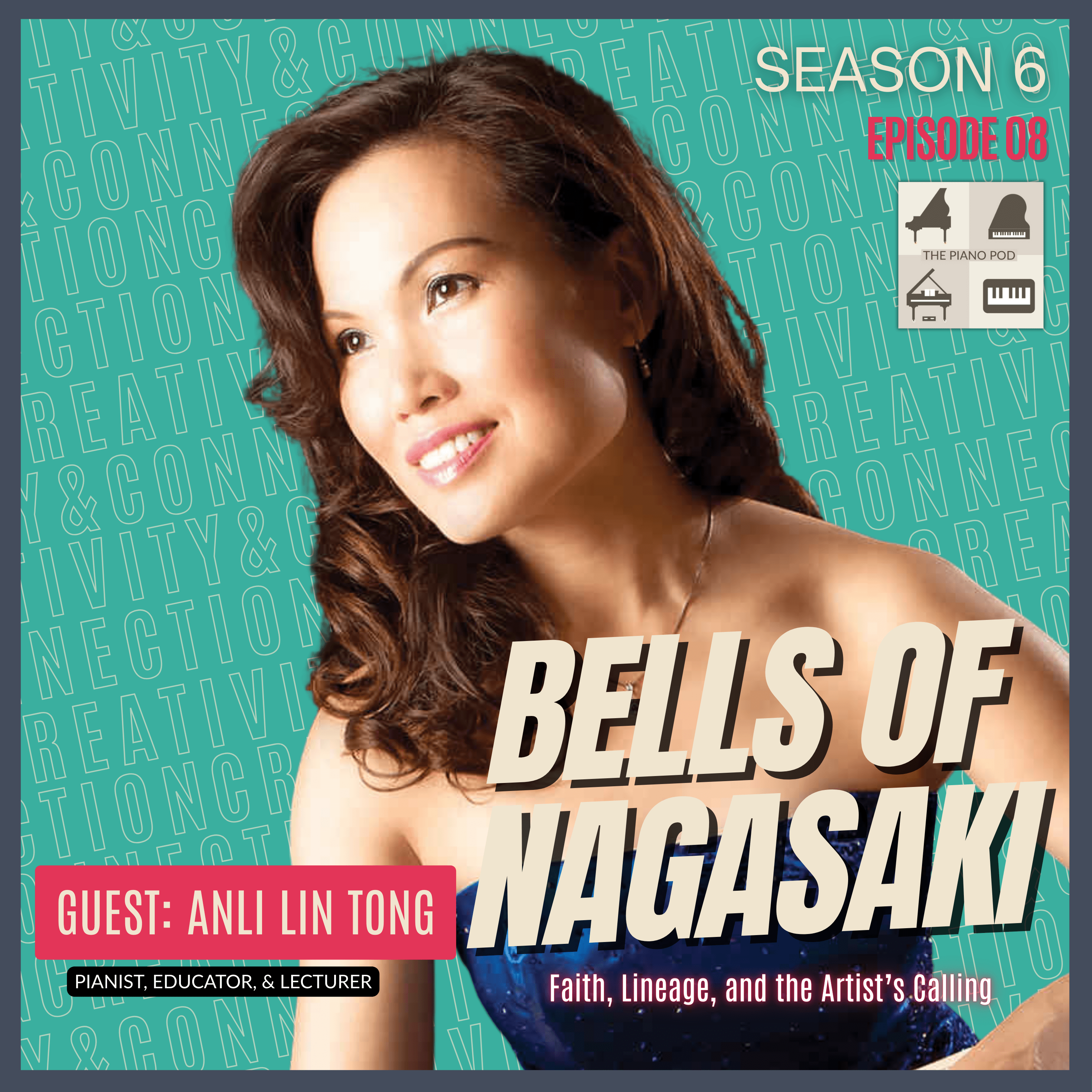
The Piano Pod - a global hub for innovation, education, and connection in classical piano music· Staffel 6· Folge 8
Bells of Nagasaki — Anli Lin Tong on Faith, Lineage, and the Artist’s Callin
Mittwoch, 17. Dezember 2025 · 1 h 34
Kapitelklicken springt direkt hin
Shownotes
Got something to say to this podcast? Send a voicemail, and you might hear yourself on the next episode! (rss.com/podcasts/the-piano-pod/voicemail)
What does a piano recital have to do with war, faith, and forgiveness?
In this episode of The Piano Pod, pianist and educator Anli Lin Tong shares the story behind Bells of Nagasaki: Music for Contemplation (easyreadernews.com/in-nagasaki-cathedral-bells…)—a profoundly moving concert created for the 80th anniversary of the atomic bombing of Nagasaki.
What began as a single song her father used to sing—The Bells of Nagasaki—became a powerful act of remembrance, shaped by the legacy of Dr. Takashi Nagai, a survivor who transformed unimaginable loss into a life devoted to peace.
This conversation moves beyond repertoire and performance into questions rarely asked in classical music:
• What responsibility does an artist carry when history is still unresolved? • How does sound hold memory when words fail?
From the history of Urakami Cathedral’s bells (chroniclet.com/news/441023/the-bomb-and-the-be…), silenced for decades, to Anli’s own journey—moving to the U.S. alone as a child, studying with legendary teachers, and carrying artistic lineage forward—this episode reveals how music can become a moral witness.
It’s a conversation about remembrance, responsibility, and the quiet power of sound to hold history—and humanity—together.
Learn More About Anli Lin Tong
• 📝 Read my blog (open.substack.com/pub/thepianopod/p/meet-our-g…)exploring Anli’s artistry and work
• 📰 Press Coverage: Bells of Nagasaki: Music for Contemplation (easyreadernews.com/in-nagasaki-cathedral-bells…)
• 🎓 Juilliard Feature The Juilliard School highlights Anli’s writing on her teacher Mieczysław Munz (juilliard.edu/news/143761/honoring-beloved-tea…):
🎹 THE PIANO POD
• 🎵 Subscribe to the Season 6 Piano Playlis (youtube.com/playlist?list=PLeBrJAY2RQ_uqBAHXTk…)t — a collection of every piano work mentioned throughout the episodes:
• 💖 Become a VIP Member (thepianopod.substack.com) or unlock exclusive content:
• 📫 Joinour newsletter: (thepianopod.substack.com/subscribe)
• 🌐 Website:thepianopod.com📱 IG: @thepianopod | FB: @thepianopod | TikTok: @thepianopod 🔗 Linktree:linktr.ee/thepianopod
Transkriptvom Podcast bereitgestellt · Zeitmarken springen hin
Thank you. Welcome to another episode of The Pianopod, everyone. This season, we are exploring creativity and connection, highlighting artists who are reshaping what it means to create, teach, and inspire in the modern world of classical music. Today's guest, Anli Ling Tong, is a concert pianist, educator, and lecturer whose work beautifully bridges art, history, and faith. Born and raised in Taiwan during a time of martial law, An Li came to the United States all by herself as a child to study piano at Juilliard, an act of courage and independence that would shape her life and artistry. A Juilliard -trained musician and lifelong educator, she has since dedicated her career to sharing music as a force for reflection,
healing, and human connection. Most recently, Anli organized a deeply moving event titled Bells of Nagasaki, Music for Contemplation, a concert that commemorated the moment when, for the first time in 80 years, both Bells of Nagasaki's historic Urakami Cathedral rang together again, a sound silenced since the atomic bombing of 1945. In our conversation, Anli reflects on the powerful story behind this project. her father's enduring influence, her family's rare journey of faith from Taiwan to Catholicism, and how music became her way to honor remembrance and hope. We also explore her artistic lineage through her mentor, the legendary pianist Mircheslav Muntz, and her insights as a devoted teacher who believes artistry
must be planted from the very first lesson. Before we dive in, thank you to our listeners for tuning in and supporting The Piano Pod. Your encouragement, whether through sharing episodes, leaving a review, or simply listening, helps sustain this growing community of artists and thinkers who are redefining what it means to make music today. Here is Season 6, Episode 8 of The Piano Pod with concert pianist and educator Anli Ling Tong. Please enjoy the show. You are listening to The Piano Pod, where we talk to the brightest minds in the industry about how they are bringing the piano into the future and thriving in a complex, ever -evolving world. Ali, welcome to The Piano Pod. Thank you so much for being here today. Well, thank you,
Yukimi, for having me on. Thank you very much. Thank you. And I'm truly excited to explore your journey, your artistry, musical lineage, and then the deeply moving Bells of Nagasaki project with you. But first, let's start with our tradition, iconic opening question. So you built such a successful career as a concert pianist, educator, and lecturer. What would you say is the core passion or mission that ties all these worlds together? Well, that is such an amazing question, Yukimi, and it's all encompassing. And I think that maybe something that we can save for the end, and it might make more sense how these threads all come together. Yeah, that sounds great. All right, so can we get into the bells of Nagasaki
Music for Contemplation project? Of course. That's great. So this was such a special concert held on August 3rd. So this past August at St. John Fisher Church in Rancho Palos Verdes, which is L .A. in California, and commemorated a profound moment when, for the first time in 80 years, both bells of Nagasaki's historic urakami cathedral rang together again a sound silenced for the since the atomic bombing of 1945 which is uh 80 years ago wow so now for listeners and viewers that might sound simple at first but this story has so many layers and dots to connect history faith family, people, and music. So, Anli, could you start by telling us what was the Bells of Nagasaki concert about, and why did this moment
feel so important for you to share through music? Okay, thank you for the question, and you're right. This is something that just pulls together so many things. History, music, faith, geography. And really, in the end, it's all about the people who receive the message. And we're talking about something that happened, as you said, 80 years ago. But my connection with the Nagasaki Bells began with a song. And I like to say the power of one song. You know, we never know what's something that we come across on a daily basis as innocuous as maybe a word, a phrase, a passing glance.
And in my case, this is just a song that my father sang toward the end of his life. He was living in a senior community outside of Taipei in Taiwan. My mother had already passed eight years before that. And one of his favorite things to do was to go to the karaoke room in the facility. And he would always pick this one song. And of course, on the karaoke machine, you can see the images.
And I see footages of this old Japanese movie. And then my dad would sing the song in Japanese. I do not speak Japanese. So I asked my dad, what is this song about? Because he sang it every day. And after... the karaoke session as we walk back to his room he would tell me the story and then this would repeat every day. So I began to wonder why was this song important for my father because I didn't hear it in the earlier years of my father's life. So long story short let's move to 2025. This year was the 10th anniversary of my dad's passing. And I had wanted to do something with music to honor his memory. My father especially loved church bells. And then I thought about Nagasaki bells. Because in the last 10 years,
I have found out from my own research a lot more about the story. And I thought it would be nice to tie the idea of... The theme of bells in music, and we have many examples of that, right? As well, and to somehow incorporate the Nagasaki bells for the historic dimension. Then I realized that this year was the 80th anniversary of the bombing of Nagasaki. So I started to put this together, but it was just an idea that was percolating in my mind. And I was thinking that I would do it later in the year because I was recovering and I am still recovering from a hand injury that I had a finger fracture in January 2024.
And as a pianist, you know that, you know, these things take a long time. Even when the splint came off the finger heel, but the rest of the hand, I developed secondary injuries. So it wasn't so easy to play. So I wanted to do it. toward the end of the year, but something happened. And I think synchronicity would be one of the themes that could be included into your big question.
What are the things that pull things together? And when you look back in life, I think everyone would have the same, similar maybe thoughts that, wow, something that happened then. I never knew that it would have a certain significance 20 years later, 15 years later. And so the synchronicity of events, one of the first things that came up was I became a Catholic three years ago during the COVID pandemic. So in the last three years, I've been... Also learning about this new faith.
I'm fourth generation Presbyterian. So my family is very, very devoted to the church and from the day that I was born, but I am the first Catholic. So in my desire to learn more about my Catholic journey, I have been reading and then I was connected with an institute that was. founded by the Archbishop of San Francisco, Cordiglione. And he set up the Benedict XVI Institute. And the whole purpose of this institute is to promote beauty in worship.
And I didn't know anything. I just needed to go somewhere and contemplate because I was in Taiwan earlier in the year to... to mark the 10 -year anniversary for my dad. So we had some family memorial that included friends. But when I came back, I was once again sick. And, you know, I'm not a good traveler, so these things.
As I was recovering, I was contemplating a lot about what I would do. And then I thought, okay, I received an invitation to join an artist retreat. near Stanford, San Francisco, that was sponsored by the Archbishop of San Francisco. I had no idea whatsoever what that was. I thought, okay, a retreat is something that I go to, you know, to enjoy solitude, to meditate. And this is about arts and faith. It was very much along the line that I have found myself. on this path in the last three years because of my new faith journey and many, many things in my life. I went through major upheavals in my life in the last 15, 20 years. So these things, you know, it puts one in a mental space. And as musicians and artists,
we're always looking inward. What does music say and what do I bring? to my art. So these have been constant themes and threads in my thought over the past few years. So then I went there and I did not expect to find the amazing, amazing collection of personalities that had gathered. It was a very exclusive group, not many, maybe 15 to 20 participants, but we had the most prominent.
architect in Catholic architecture, a great man who has built the most beautiful Catholic cathedrals and shrines in the United States. We had the poet, a former poet laureate of the state of California sharing his new play on Seneca. It was an immersion, an abundance of riches, and it just stimulated my mind so much. And toward the end of the retreat, we were to share about what we envision as our new projects that we would do to embark on to bring beauty and art together with. you know, worship and faith. And this was something that Archbishop Cordiglione was really wanting to promote and bring back to the church. And the idea of the Nagasaki and the bell concert was so, it's just in a gestational
stage in my mind. And because I went there without any kind of expectation, I did not know that I would have to offer anything, but I did. And to my surprise, Archbishop Cordelion loved the idea. He was very interested in the Nagasaki story. So he greatly encouraged me. And also other attendees at the conference came up and spoke to me after I shared my idea and said, Anli, you must do this. So we're talking about middle of June. I came back and I thought, OK, what am I going to do? The bells, in the meantime, I found out that American Catholics have gotten together under the leadership of a professor at Williams College in Massachusetts. His name is Dr. Nolan, James Nolan, who started to raise
funds in 2024, just a year ago, to build a new bell. To bring to Nagasaki. So here's the Nagasaki story. Would you like me to talk about? Oh, yeah, yeah. So you're talking about Urakami Cathedral, right? So it's a historic church. Yes. Let's talk about the bells first. Yes. Yes. So what happened to the bells? OK, so now we have to go back to history. 1945, August 9th. You know, the. the bomb was dropped over Nagasaki. And Nagasaki has been traditionally the center of Japanese Catholics, which was always a very, very small minority. And Urakami was the main cathedral that had two bell towers. And when the bomb fell, it fell very close to the cathedral.
Many, many Catholics perished on that day. And out of the two bell towers, both of them were destroyed. heavily damaged. One was completely destroyed. The other one was heavily damaged, but they were able to salvage it. So since 1945, the two bell towers, one has been completely empty. And there's just the remains of the charred bell that has been on display and has never been replaced. So Urakami Cathedral has operated with just one bell. And so Dr. Nolan's idea was, well, he had visited Nagasaki. And here's another amazing story. Dr. Nolan's connection to Nagasaki, his grandfather was involved in the Manhattan Project that developed the atomic bomb. Wait, wait, wait.
Dr. Nolan's father? His grandfather. A grandfather. Oh, my goodness. Yes. So he went to Nagasaki and he spoke. This is Dr. Nolan Jr. who is currently the professor at Williams College. He went and he met with the Nagasaki Christians, and one of the faithful congregants there came up and spoke to Dr. Nolan and said, wouldn't it be wonderful if during my lifetime I could see both bells again? And Dr. Nolan was so moved by that, he came back to the United States and began the project, which is called the Nagasaki Bell Project.
Now, I mentioned earlier that these past few years since my dad's passing, I have always regularly Googled Nagasaki Bells, just to learn about what, and this is when I... came across the website that was taking donations for the rebuilding of the new bell. And I wanted to do something, you know, in memory of my father. So I made a very small donation in 2024, just a very modest.
So then a few months later, in April, May, Right before I went to the retreat in June, I received an acknowledgement letter from Dr. Nolan, but I didn't look at things carefully. But when I came back from the retreat, the idea had solidified in my mind that I would do a concert in time for the August 8th. August 9th anniversary. But I did not know at that point that the new bell was going to be installed on that day. It was going to be rung to two bells together the first time in 80 years. So when I heard that, I wrote to Dr. Nolan and I said, I just want to let you know that And I shared with him a little bit about my father's story, how I learned about the Nagasaki bells because he sang the song and
it has stayed with me all these years. And it planted a seed to my becoming Catholic, you know, 10 years later. And I'm giving a concert and Dr. Nolan wrote back and he was very interested in my concert. And so he told me that the bells were already at that point on the way to Nagasaki and the new bell would be. consecrated and blessed at an installation ceremony on July 16th in Nagasaki.
And then both bells would be rung together exactly at the time, 1103, I believe, on August 9. That's the time 80 years ago that the bomb fell. And it just gave me chills when I... Learned about that. So I went to my church. My new pastor had just come in, Monsignor Antonio. He came in on July 2nd. And I said, I would like to do a concert here. Would you approve it? And he loved the idea. So I had, what, four weeks to pull this together. Oh, my goodness. And that's why it was incredible. And this is the genesis of the concert. Wow. It's just so many layers, as I mentioned. It's just so beautifully, like timely, timely wise, like put together. And so I want to know about the song, the song that your father
used to sing. The title was The Bells of Nagasaki, right? So he loved to sing, to sing the song because. He lived in Japan shortly. He studied in Tokyo right around that time. He was a medical student at Tokyo University. And he was actually in Tokyo during the ally raids that bombed Tokyo. So that was in May of 1945, just a few months before the bombs. The bombs fell in Hiroshima and Nagasaki, which brought the war to an end.
But this part of the history, I only learned this year during my research of my father's story. So it just made everything more poignant to me to know that my father was actually in Tokyo. And maybe this is why the bombing, by the time of the Nagasaki bomb, my father had already left Japan, I believe. Because since he was a student in Tokyo and the university, his dormitory, everything was just in ruins, which is nothing but ashes.
And many people died. And there was a phrase that he used in his autobiography about his experience. He said, I had nothing. All that remained was the shirt on my back. So he eventually went back to Taiwan and he did finish his last year of medical school at Taiwan University Medical College. So he did not complete his studies in Tokyo because there was nothing left. So the song was the seed.
And, you know, because of the song, I was able to research about the Nagasaki story. But in terms of how I would. I'm a pianist. I'm not singing. And so again, I went back to the theme of bells and I was able to pull together. I wanted to, I call it the concert, I gave it the title of music for contemplation. It's in the middle of summer. We're in Southern California. Everybody's out. We're going to the beach. Who wants to come?
to hear a concert about atomic bomb i didn't think that i would be able to have many people but i wanted to do it you know as just to to mark the the occasion and to to honor my father's memory um so i i had a piece the um rachmaninoff Prelude in G sharp minor, which I love to play. And I want to talk about that piece a little bit because that piece was used by one of the big churches in New York City during COVID to mark the first anniversary of COVID lockdowns.
And the Marvel Collegiate Church, their wonderful tech department, used my recording and made a video montage. And that was beautiful. And I saw how people responded to that. There's a part in the G -sharp minor prelude when I studied with my great teacher Vitaly Margulis, who was Russian himself. He told me, Anli, do you hear the Russian bells in there? And I did not even think about it. And he was the one that really made me realize that Rachmaninoff loved. Because church bells rang every day to mark the hours in St. Petersburg, in Moscow, the big cathedrals.
So the Russian consciousness is very much, you know, church bells is very much in their recess consciousness. And Rachmaninoff's music is full of the bell. because I wasn't planning to do a big program, again, because my hand had not recovered. So I wanted to open with that. But then I had recently performed the Rachmaninoff Trio Elegiac in G minor, actually about a year ago. That was right before I injured my hand.
And that was a very special occasion also because that piece, Rachmaninoff wrote it when his mentor Tchaikovsky died. So it has that memorial aspect. So we ended up opening the program with a trio and I dedicated to all the lost souls from the atomic bombings. And so we had a very solid opening with the G minor. trio, and then followed by the G sharp minor prelude because of the Russian bells. And then after that, I followed it with a short piece by composer Frank La Rocca, who is considered the most, his Mass for the Americas was commissioned by Archbishop Cordileone. It's over an hour long. And so he's considered the most significant Catholic composer of our time.
And I came across an early work of his before he started writing all this liturgical music. And it's called Meditation. And he wrote it for a friend who passed also. So it fit very, very nicely. It's entitled Meditation. And he actually came to the concert. It was a great honor that he came. Even though the piece was only three and a half minutes, he drove two hours from Claremont to come to my concert and just... It just, you know, it just fits so beautifully. And again, because it was very meditative and also, you know, for a friend to have passed. Then I played also, and it included, do you know the Earl Wilde transcriptions? He wrote a set of transcriptions on Rachmaninoff songs. Oh, I do not know Rachmaninoff.
I studied a little bit with Earl and he helped me greatly, especially with Gershwin's Rhapsody in Blue when I was preparing that piece for orchestra performances. He was the most direct link I could find that's still living back to the, you know, Tim Pan Alley era. And so I was very inspired with what he shared with me. So he gave me...
some gifts, which include his recordings of his transcriptions. So I listened to those songs every day and I fell in love with them. And there was one in particular that I learned right away. It's based on Rachmaninoff's song, Oh, Do Not Grieve. And the poetry is beautiful. It's based on the song by a Russian poet. Rachmaninoff wrote it first as a song. And then... Earl Wilde took Rachmaninoff's song and transcribed it for the piano. It's a gorgeous transcription that I have played many times. So I incorporated it into this program because I wanted the program to acknowledge the loss, to acknowledge the sorrow, to acknowledge all the mourning, but I wanted to bring it from that point on to something more
hopeful. And Oh Do Not Grieve, the text begins with... Oh, do not grieve. Oh, do not grieve. But you must live. It is our part to live. And it is the angel sent by God to wipe our tears. So I want to bring it out of that. And that's actually underlined by Dr. Nagai, who wrote the book, The Bells of Nagasaki. He himself, his wife passed. in the cathedral bombing. And he died a couple of years later. And he's devoted his life to writing about the Nagasaki story and to encourage people to focus on forgiveness and hope. And that's the symbol. That's what the bell symbolizes. It's the message of forgiveness and hope. So I needed to... end on a note of hope so oh do not grieve was my transition and
then i went um into actually our music director is a wonderful trumpet player so he played uh ave maria caccini's ave maria trumpet and i played it with him and you know it's like a vocalese sure No words, but everyone knows the text of Ave Maria. It's a prayer and also a prayer for the dead, as well as, you know, prayer for the hope for, you know, our next life in eternity.
And that was gorgeous. And then I ended my solo part with this, the concert etude in D flat, which everyone knows as Un Suspiro. And I love playing that piece in conjunction with my faith themed recitals, which I began to organize a few years ago. I call it music and musings. I would use either a verse, a Bible verse, or a poem that evokes faith. There's a Bible verse from Romans 8 that says, when we do not know how to... pray, when we have no words to pray, the Holy Spirit is uttering, making utterances or sighs for our prayers. So when I saw the title, this Unsa Spirit, which means a sigh, I loved it. So I used that for my performances with that verse. But for this program, somehow I began to realize that the ending Actually, he wrote
a second ending. You know how lists always have alternate endings to his pieces. He did that, but there's an alternate ending that has a descending bass and the chords in the right hand just ascends higher and higher. And that's not often done in performances. He wrote as an alternate. ending but nobody uses it but for my program it is that ending that just makes all the difference because it sounds like the low bells in the tolling of the low bells and the right hand ascending is the ascend the ascending of hope it's an upward you know We're looking heavenward. And that actually encapsulates Franz Liszt for me as well. I put that in my program notes. Liszt was a man of duality. All his life, he lived as very much
a man of the world, right? But he very much also wanted to be a priest. There's a faith aspect that he was always in this tug of war. Toward the end of his life, he actually went much, much more toward the spiritual aspect. So that alternate ending with the low descending baseline and the ascending... you know, he loved to use augmented chords, right? He would go from diminished to major to augmented, which was his way, his musical language. Whenever he used augmented chords, it symbolizes heaven. So I did that. And that was my transition. And I asked the organist to chime on the organ with the bell chimes. And I explained to my audience that this is, our anticipation of the ringing of the bells that
would take place in Nagasaki on August 9th. So we chimed 10 times because on August 9th, they would ring the bells at the 11th hour in the morning. So that was my prelude to Nagasaki. And just an unbelievable set of circumstances we were able to get. the score, which was very hard to come by, of the song of Nagasaki itself that my dad sang. Yes. And it was actually a theme song of the movie based on Dr. Takashi Nagai. That's the man who wrote the Nagasaki story. Let's clarify a little bit, Dr. Nagai, because it sounds like, you know, the root of this whole project, well, for you, this concert comes from that song, right? So I didn't realize it's the theme song from the movie based on Dr.
Takashi Nagai. You mentioned his wife passed away during the atomic bomb. And he survived. But I think a few years later, he also passed away. He had major health issues after the atomic bombing. But he was writing a memoir or something like that? Yes. He was a radiologist. So he was actually working in the hospital when the bombs fell. And that's why he was far away from the cathedral where that was the center where the bomb had the most damage. So he went back to the ruins. And the only thing he found, because everything was ashes, and he found his wife's rosary among the ashes. And that was how he could identify his wife's remains. And so based on that, he wrote a book of the story. And he said
that finding the rosary gave him a lot of comfort because he realized that meant that his wife had the rosary and she was praying until the moment of her death and that she was most likely very much at peace. And so that was the basis of his book called The Bells of Nagasaki. In Japanese, it's called Nagasaki no Kane. Kane is bells. And that book became the basis of a movie that came out around 1950. The movie was made and became a big hit. So the song, Nagasaki Bells, that my father sang, was that theme song from the movie. So it was a kind of a popular arrangement, you know, that's why it was in karaoke.
And I wanted to, I wanted to find a way to have that song sung, but it has to be sung in Japanese. But first of all, we could not find even my music director, we Google, we could not find even a score of that. song and but somehow you know with with help from my son -in -law who's a music consultant in in New York he was able to find a four -part you know choir arrangement but it's in Japanese so we were able to find an English translation and a kind lady from church then inserted the English translation but it also the Japanese pronunciation right into the score.
So our church choir, none of them spoke Japanese. They were able to learn to sing the song in Japanese. And that became the finale of the concert. And it was an amazing moment. And people were in tears. It was so, so, so moving. And my part was done by then. I just sat in the front pew and I enjoyed. hearing the song. And it was an amazing kind of a full circle moment. So many elements just came together as one. But I think you also have to mention that the church itself had some sort of a meaning, right? The church that you performed at. Is that the church that you belong to? Yes, it's my parish. And so I have been a parishioner only for three years.
And because Because of the COVID pandemic, when I became a church member, I really didn't know too many people. And so to pull this together, I barely knew the music director. But without his help, we could not have made this happen. So Grant Hungerford, who was the trumpet, also the music director, he became my partner in all of this. And also my sponsor into the church, Lenay Belsky, helped me to coordinate a lot of things. So it was just all of these things together.
And I did not know that people were... resonate with the story so much. In fact, another friend came and said, well, this is such an amazing story. We must get the local press to cover it, maybe even just an announcement. And lo and behold, they asked me for an interview and they said, well, just be a very short interview, a very short article, maybe just a mention of the story.
And then three days later, they called me. They said they would make it the cover story. Oh, my goodness. Wow. Three days after our interview, two days before the magazine had to go to print, they called me and said, we're going to make this the cover story. And the writer, Bondo Vistanuski, I'm sorry, I just said it wrong, Vispolsky, Bondo, he did such an amazing article and laid out the whole history. And he included my father's photo.
It says the bells may stop, but the ringing continues. He included a picture of the before and after picture of the Nagasaki Cathedral. And it's just an amazing story that he, as you said, there are so many layers to this story. I don't know how after one hour of interview, he was able to. pull all these threads together. And I have a feeling because I was expecting 75 to 100 people at most, because so many people were either away traveling or, you know, during the summertime.
Yeah, exactly. You know, half of the people that heard about the concert said, I'm so sorry, we had planned a long time ago to be away, you know. So I told the church asked me how many programs and I said, Well, maybe 100, maybe 75 people will come and I'll keep a few extra copies. They ended up printing 300. I guess they knew better.
And the day after the concert, the music director called me and he said, Anli, do you know we ran out of programs? And I said, I didn't know. I could see it was a full house. He said 500 people. The concert. Oh, my goodness. Wow. And so you're talking about a local church with a last minute concert that pulled together. Something touched people about this concert. What do you think that was? You know, it's very interesting. And I couldn't put my finger on it. And even as we got closer to the concert that whole week, and I was going crazy because I was writing the program notes. And then I had my... One rehearsal with my trio, and then I incorporated poetry reading as part of the program. For example, before the
Rachmaninoff, I asked someone to recite, you know, the John Donne poem, All for Whom the Bell Tolls. It's a beautiful poem. So I had asked one of the lectern recitation. We have people that recite. Bible passages. And here's a gentleman, Anthony, who has a beautiful South African accent. And I said, would you kindly do the honor of reciting the poem for whom the bell tolls? And even before the concert, he came to me and he said, Anli, something about your concert touches a nerve in our community. But at that time, I didn't know what he meant. It was after the concert.
And I saw how many people showed up. You know, I don't know where the people came from. And then in the greet and meet afterwards, people were coming up in tears. And then my friends were sending me text messages. They were overhearing things when they went to the parking lot. They overheard what people were saying. It's from these peripheral things that I began to understand the power of music. It had to come through music.
And that was what I could offer. But when you use music in a way that I think goes right back to what Johann Sebastian Bach, one of my... just one of my all -time sources of inspiration for music. He said, and I will read the quote, Bach wrote this in 1738. He said, the original cause of finish and end of all music should be nothing other than... to be for the worship of god and the re -creation of the spirit and i think for me it goes back to that this is you know for pianists our music doesn't go much further back than johann sebastian bach and so all the inspiration i and i share with this with my students all the time that bach his insignia was sdg every piece at the end of a piece he signs his name
with sdg and what does that mean soli deo gloria which means for god's for god's glory alone and that was his purpose for his music and if we go back to that If we're able to use music for that end, the original cause of finish and end of music, this is exactly what he said, should be for nothing other than for the worship of God, only to his, all for God's glory. So I think this was a case where the music and the God element, because it came from What was in my heart and also the message of the bells, the suffering of the Nagasaki Christians, which did not begin with a Nagasaki bombing. Actually, the story of the Nagasaki Christian began in the 16th century when the European missionaries first converted,
started to convert Japanese locals. And the shoguns did not like that. the Catholics were made to choose between their allegiance to the shoguns or to God. And if they chose God, they would be crucified. So there were many, many Christians that were crucified along with the missionaries. And then after that, for centuries, they went into hiding. And in fact, the year after my father passed away, you know, because I kept this idea in my mind, Martin Scorsese. The big Hollywood name director came out with a movie called Silence.
Do you know that movie? No, I'm not familiar. And it means silence. It's exactly about those 16th century Japanese Christians who were crucified. And so when that movie came out, I thought, oh, wow. And I still wasn't a Catholic yet. I was wondering why my father left me with this. seed in my heart. So I paid a lot of attention to anything that fell in line. And I thought, well, you know, one year after my father's death, this big movie that won all kinds of Academy Awards is exactly about that story that my dad told me. He didn't tell me just about Dr. Nagai and Nagasaki. He told me about the 16th century Christians that were crucified. So again, it goes back, and it's amazing how these things align. My father's
song, the stories he told me, and the way the last 10 years unfolded, that takes me right back to 80 years ago, March this year. And I don't know, it's the confluence of events. if you are a christian and this is my perspective everything comes from this perspective is there's the spirit is at work and you know where you think that things are not quite possible because of limitation in time the limitation of my own piano technique you know How could I make this happen? And how did so many people come? Why were they so, so moved? And I kept thinking, it's not about me.
That was one thing that I received, a message that I received. It's not about me. I was just a vessel. Even music itself is a vessel. Right. But how are you processing right now? I still feel the passion and heat. Coming from you, I feel like you're still like maybe processing the event. Yes. So the event, it was almost a way, a door, a new door that opened. Yes, the event is finished and we can't do this because the 80th anniversary of the bombing is done.
So that whole part is closed. But what it showed me was. Very much in terms of my personal, and we can say passion or my goal, my inspiration. And it goes right back to my childhood. And things are now beginning to make sense. When I began piano as a five -year -old in Taiwan as a child, and my family being very devoted Christians in the Presbyterian Church, I was sent very early on to study music in New York. And so I lived on my own since, you know, sixth grade and in elementary school in this country without my family. And it was always impressed upon me by my parents that my music was to serve God. But all these years, I didn't understand how I was to do that. Does that mean just playing as a
church pianist, which I did a lot, you know, even all those years when I was growing up, wherever I was at a church, if we were there for more than a year, I would, you know, help out to be the church pianist. And if I went back to Taiwan, I would play for services. But, you know, I think God has something else in mind because I look back to my life and I said, I didn't have to leave home. to go to a foreign country, to be a pianist, to do that. Plenty of pianists can do that, right? And I think now my life makes sense because of all these things, because of what I have gone through, because of my family background and the seed that was planted very early on, what the music was for, which coincides
exactly with what Bach wrote. It's nothing. for nothing else but for the worship of God. I guess I want to talk about your father now, and he nurtured your talent. And he literally tutored you at the piano, right? So there's a special connection to this concert you mentioned that the inspiration came from your father's singing this song at karaoke, right? But then there is a lot more story with your father's relationship.
So can you tell us about how did you, you briefly mentioned you about... how you started your musical journey and it came to the United States on your own. But let's start with your father. Yes. So my father was by profession, a doctor, a surgeon, and he had quite an extraordinary life. In fact, there are documentaries about him and books about him. Really? Yes. So he, you know, we can consider his life was really. a product of time and place time being the upheavals of world war ii and the subsequent political changes in taiwan which is my native homeland and the so Just to kind of make it short, after he came back from Japan because Tokyo was bombed, he came back to Taiwan and began his studies at Taiwan's, it's the most
elite medical school, the Taiwan University Medical School. But around the same time in 1948, 49, Taiwan had just... was coming out of the Japanese colonial era. And because Japan lost the war, the allies took over Taiwan, but they didn't have a chance to settle the question of what was Taiwan going to be. And China, in China, the civil war broke out between the communists and the nationalists, and the nationalists lost.
So if you remember, in World War II, The Allies included China, the United States, and Great Britain. The Axis included Japan and Germany, you know, and Italy. So Japan and China were opposite ends. For my father's generation, they went through a period. They thought they were Japanese because they grew up under 50 years of Japanese colonial governance. For my parents, Japanese was almost like their native tongue.
And they didn't even know anything about China. And then after the war, that's gone. And a new government came to Taiwan first. was supposed to be a government in exile because when they lost to the communists the united states being allied partners with the nationalists during world war ii wanted to help them so they said come over to taiwan which is under u .s jurisdiction and wait you know and stay here and they were hoping to fight back to recover all of China.
That never happened. So that nationalist government became entrenched in the Taiwanese geography, the territory. But of course, as you know, when you have these forces that conflict, the Japanese made Taiwan a very organized But most people spoke Japanese and the Chinese came. There was a lot of conflict. So out of these conflicts, people were arrested, of course, you know, and the nationalists began 40 to almost 50 years of martial law. It's the longest period of martial law in the world. So there was, you know, it was just they call it the white. terror era.
And during that period, my father with his university medical school classmates, lots of them were all arrested because they participated in reading clubs that they were reading books that were not, you know, approved by the nationalist government. And instead of, you know, looking at everybody's record, they just rounded everybody up. And then all these prisoners, because Taiwan is a small island, so they were all shipped to a remote island. It's called the Green Island. So my father was a political prisoner for seven to eight years.
Yeah, so this was all the time before I was born. So I did not know anything about my father's life. So that's a whole different story. And it's a beautiful, actually a beautiful story that's come out of that. I gave a lecture once, I call it... They sang and sang because I learned later on when I visited my father toward the end of his life that many of those inmates, they were highly educated people, you know, lots of doctors, lawyers. And, you know, my father had his fellow doctors, too. And they were, you know, part of their education. A lot of them love classical music. A lot of a lot of them love music, you know, to begin with. And they would make they would. use wood from the tree and whatever. They
make their own instruments. They created their own band and they love to sing. So singing was one of the ways they sustain their spirit. And so my father, after he retired, he taught himself how to compose. He wrote over 30... Christian hymns. He wrote pieces that had been transcribed for solo piano that I had performed. So this musical seed in him, maybe that's where the seed came from. And he also says that he was able to sustain his spirit because some of the prisoners came out, either they were executed or even if they survived, they never were the same. But my father came out of the eight years of imprisonment.
Not only that, he continued to practice medicine. He raised family. We were all born after that. And he became a church elder. He transcribed the first Taiwanese Bible in his retirement. Oh, my goodness. And he taught himself to compose. He has published music. Incredible person. And what I saw in him was never any bitterness. He never talked about the hardship. The hardships of those prison years, I had to learn from reading other things. But from him, if you looked at my father, he would have big smiles. He loved to talk, but he didn't do small talk. He was always talking about philosophy. Then I learned that his favorite author was, you know, his favorite literature was Les Miserables. And it's the theme
of redemption. Yeah, less than a year before he passed, one of our most profound conversations was about Zhang Baozhan. And the theme of, and that's when he told me, he says, Anli, this is what you need to remember. I sent you away when you were little because your mom and I were told by all the teachers who heard you play that you had a certain talent. And I didn't think that.
You staying in Taiwan, we could give you that environment. And so I sent you away because my father, these were his words. Musicians, artists have a unique role to play. You have a unique ability to help and bring betterment to humanity in a way that politicians, economists and bankers, you know, others, people. They cannot do. But musicians, artists can do that. So that was the conversation that I took from the end of my father's life. He instilled in me that I had to use my music to serve humanity. And I call it his belief in the nobility of the arts. So for the last 10 years, this has been what has been on my mind.
And now with my new faith journey, it's... another dimension yeah but it really does make sense that you came to this point right but I also want to know how in the world you were able to go to the United States on your own as a child I want to know that journey yes and I cannot tell you how many people have told me that I need to write a book and I have never felt ready to write my book because I didn't understand my life I didn't understand it. And as I said, this is the first time that I am beginning to see that my life makes sense. You know, because how many pianists, wonderful, fantastic pianists are there in this world, right? No one has to leave home as a little girl to go to a foreign
country and live by herself, which is what I did. I was put on an airplane. I had a little doll that i chose to be my travel companion and i flew i stopped by in los angeles where i had family and that was the idea was i would go to new york and stay with my father's sister my aunt however and my older sister who was living in Los Angeles, decided to join me once I arrived.
So she went with me to New York. But she got married within three months. So shortly after that, I was really on my own. So I would rent a room in somebody's apartment. And there would be a little piano. My parents, you know, bought me a little upright piano. So my room would be just my bed. and my piano. And I went to two schools. I went to Juilliard Pre -College for music, and I went to a regular school for regular school day. But I did all the cooking, paying rent, all my laundry on my own. So I was living exactly like that. Wow, that's impressive. Wow.
So then there's a story of a very influential teacher. That you met when you were still very small. Nine years old. Nine years old in Taiwan, right? Yes. Yes. His name is Mircheslav Muntz. Of course, he is a very well -known teacher and also pianist of that time. And so he came to Taiwan and you met him. Yes. Yes. I was brought to play for him. And, you know, how these great masters, they travel the world. And they hear students. And then if they like them, they'll invite them to come and study. And Mr. Moons happened to love teaching young students. He was already a professor at Juilliard. He taught at Curtis. He taught at Peabody. He taught at Manhattan. But I think he specialized in bringing
very young talents. As you know, Emmanuel Axe was very young, too, when he started with Moons and studied until he became a great artist. In fact, one of my first lessons at Juilliard Pre College, I remember somebody coming into the studio, and I barely spoke any English. And it was this big guy, it turned out to be Emmanuel Axe, who was... who spoke Polish. And the two of them, my teacher, they were just they were just speaking Polish. And I looked at them. I didn't know what they were saying. But, you know, I was I was his only student at that time in pre -college, which I didn't know, you know, because when you're young, you don't know. I met him. He liked my playing. And after I played for him, my teacher summoned my mother and said,
Mr. Moons wants to talk to you. I don't know what they said. I was just a kid. I went out to play. And then my mother came home and told my father, Mr. Moons wants Anli to go to America to study with him and that he would take her at the Juilliard School. Yeah, back then it was like going to the moon to go from Taiwan. And my parents, because as I said, Taiwan was under martial law. There was no immigration. allowed so there was no question that i had to go by myself um wow i see okay yeah but you your parents you know supported you and you made the move and they here you are today but later in your life you wrote a deeply moving article in search of mere chest love months to ensure that his artistry and legacy would not be forgotten so
what inspired you to write that piece again, it's about the life behind every artist, right? So because I was his youngest, I didn't know much about his life. And then he passed. After that, I was still, you know, a child and I floundered around, moved around, then lived for a couple of years in Ohio with my older sister, but there was not much happening. And I decided that I found a way to get into Interlochen on my own because that would solve all of my problems.
I would get music and I would get housing, right? And that's where I met Dr. Kunrat, who was a wonderful teacher for me. Then I went back to Juilliard after I graduated from Interlochen. And this is before the internet age. I didn't know anything. All these years, I wondered. I remember people have said that Mr. Moons, his entire family perished. in the holocaust because he was from poland and poland suffered greatly especially krakow where he was from so he had no family alive and he married um aniela rubinstein who the who you know for a short period because she then left him to marry um arthur rubinstein and he remained unmarried for the rest of his life so he had no children and then when i realized
as I grew older and I realized that I was possibly his youngest ever student before he passed. And I could never find any information about him. And I felt really sorry because this is before the internet age. Now, I knew Emmanuel Axe was his student, but Emmanuel Axe is a great artist. He's busy concertizing. And Shine was playing everywhere. I didn't know them. We were a generation apart, right? So in 2000... When I started my doctoral studies at UCLA, I began to have to learn how to use the computer and I began to search. And then little by little, I began to find information about my old teacher. So fast forward a few years, I wanted to do something more concrete. So I went back and I did research
at Curtis Institute where he taught. And I researched the archives. And that was the basis of my article. And since then, there's been other projects for Mr. Moons. And there is a documentary. I don't know if you heard of it, but some one of Anne Shine's students who is now a professor at University of West Virginia. Her student did a project on Mr. Moon's, which was turned into a documentary.
So I was invited to be in that documentary and I talked about Mr. Moon's. And what happened was that when I realized that I was his last, the end of the line, and the rest of them were either busy concertizing or some of them had already passed, you know, because we're talking about 70 years. Mr. Moons was 70 years old when I met him. And so I felt like if I didn't do something, who is going to do it? Who is going to remember Mr. Moons' name? And that was the impetus for my research project. And that's why I gave the title In Search of Mitchell Moons, because clearly at that time when I started my research, there was very, very little. And, you know, of course, I mean, I was inspired by Alfred
Courtauld's book, In Search of Chopin, right? That beautiful book, which I love. So I gave the title In Search of Maitre's Moons. And it coincided with the 100 -year anniversary of the Juilliard Pre -College. So I offered this for that. Wow. And I set up a guest artist series at Juilliard in Mr. Moons' name. So they have...
now featured a great artist in the inaugural series. Andra Schiff was the guest artist for the first installment. So I know Mr. Moon's name will not be forgotten. And that was my only wish was to keep his name out there. Beautiful. And I believe that you sent me the link to this article, right? Yes. And also the another article about The Bells of Nagasaki as well. So they are all available as links. So I will make sure to insert that into the description of this episode so that a lot of people can read it and read them.
Wonderful. And so I want to talk about some seminars you led about musical lineage. So what do you hope participants... fence takeaway or uh what do you hope our listeners to take away from learning about your artistic ancestry so uh this kind of came just very innocuous. One of my Juilliard friends, good friend, he's a fabulous pianist, Cheney Wang, who was a student of Anya Dorfman and later on had studied with Yablonskaya, Oksana Yablonskaya. So he's been a good friend. And one day, just out of the blue, he sent me a text.
He says, Anli, The Holy Spirit moved me today to research our past teachers, and I found out that three of your four teachers, he only knew four of my teachers, I can trace their lineage all the way back to Johann Sebastian Bach. And I thought, That's amazing. And he knew about my faith. And he says, and you and I know who was Bach's teacher. It was God himself, because all the inspirations came from God. And so I just love this idea. And then I was approached to do another podcast for Mufa Epsilon. They call it... music talk, music tunes. And I gave him two or three topics to choose from. And the person in charge said, I like the musical lineage because we call it, what is your musical DNA?
Because once my friend charted it out, I was able to go back and add my other teachers, including Dr. Kunra, actually. And I was able to trace everyone. And this is what's interesting. Anybody who's anybody in the Western piano world can trace back to either Franz Liszt or Theodor Lechetitsky. Both of them came from Czerny. So Czerny was a prolific teacher and who, you know, he was, Franz Liszt studied with him for seven years.
So, and you know, how many students then? Franz Liszt had, right? Impact he made on the modern piano technique. And then on the Russian, Eastern European side is Lechetinsky. So the Russians and their offsprings, including Rachmaninoff, Paderewski, they came out of there. So all of my teachers, I can trace back. to either the Russian side, because I had wonderful Russian teachers. My teacher, Martin Cannon at Juilliard, his teacher was Rosina Levine, who came from the Russian side, right? And then Mr. Moons was from Franz Liszt, Busoni. Mr. Moons has studied with Busoni and then me. So I'm only two generations off from Busoni. And then we go all the way back.
So what this... It was just a fun exercise to do this. So what this showed me was that, and I share it with all of my students, if you know where your teachers came from. You can trace it all the way back to the master of masters, Johann Sebastian Bach, who got his inspirations from God himself. Then you know that this is something that you don't just play around with.
There is a seriousness of attitude. We have this glorious inheritance given to us. It's part of our musical. We get our physical DNA from our parents, where our temperament, you know, our physical temperament and our cultural DNA from our life, where we live. And then you put that all together with our musical DNA. That makes each one of us unique because you cannot duplicate anyone the same way. So each of us is unique as a musician. We have something unique because.
The musical DNA, the physical, biological DNA, and our cultural DNA combined together makes us the artists that we are. And so you should all cherish your own heritage. Your parents. Give thanks to your parents for the experiences you had, whether they were good or difficult. Like my life had many upheavals, but that's all part of what makes my life experience a little bit deeper. And that comes out in your art. So that's the whole idea behind this musical lineage.
Yeah. And you're such a, as I'm talking to you, you're such a wonderful teacher and educator as well. And in your lectures on pedagogy, you often talk about how to plant. the seed for artistry from the very first lesson. And you mentioned about Dr. Michael Kumrad, who happened to be on my show a couple of years ago. And he is actually the one who connected me to you. You mentioned that you're fascinating at discussions on nature versus nurture in developing musical artistry.
How do you approach that in your teaching? What does it mean? Nature? I mean, I know what nature versus nurture means, but in your definition in. music musical pedagogical sense yes so i have to say i want i want to give credit to dr shinichi suzuki you know Suzuki Method. So when I first graduated from Juilliard, I didn't know how to teach, but my first job, we had moved to Chicago and I was hired by a music school and all they wanted was Suzuki teacher because Suzuki was so popular and I'm like 24 years old.
I just needed a way to make income. So they sent me to get Suzuki training. But what I found was not so much. The method, which unfortunately I see that is not really applied well. And I feel that Suzuki method is very much misunderstood. But the basic idea of the Suzuki method is really universal. And, you know, Joseph Levine, who was Rosina Levine's husband, he wrote a beautiful little book on piano teaching, right? One of the chapters talks about the beautiful sound.
It has to start with a beautiful sound. The Suzuki method mentions that as the first lesson, but the other thing, it really touches on nature versus nurture. Suzuki believed that every child has the ability to learn music like it's their native tongue. And in this regard, it's very much... Different from my kind of training, you know, Juilliard, conservatory, all the, you know, it's all about practice and talent, right? But Suzuki is the one that believes in the nature of a child. And he equates that with a child's ability to learn the mother tongue. Every child can learn to speak their mother tongue well, but you have to. Repeat. A child hears the word mommy, mommy, mommy. In the beginning, they can't
say it, but after a few tries, they can do it. And that's how they learn words. So it's the repetition of sound and the idea of encouragement. A child, a baby who can't say mommy doesn't get scolded. Right? So as a teacher of very young students, which I ended up with 50 students at that. I had three schools that I was teaching.
Half of them were under age five. So I have a whole crop of very young students, but this philosophy touched me greatly. And it's all about modeling a love of beautiful sound and how to get it, how to use encouragement, not praise. Don't say, oh, you're so good. You're so talented. Say, I love the way you positioned your hand. I love the way you touch the key. Mention, talk about what they do, not who they are. And they will gain confidence. In the end, Suzuki's goal is to raise children to become noble human beings.
And I think that philosophy is beautiful. And it's very much in line with everything that I was raised to believe. And that's why I love the method. Yeah, it's unfortunately misunderstood. But the philosophy is something that I hope that all teachers. Well, take some time and think about that. The nature is the ability to learn.
The nurture is parents, teachers, the environment, making it possible for the child to flourish like a flower that can bloom with the right amount of water and sunlight. There's another quote I would like to share about Franz Liszt. Franz Liszt wrote a manifesto in 1836 called On the... Position of Artists in Society, which is an amazing essay. But he was encouraging people. He says artists and musicians must leave the temple and go out into the world to serve, to enrich, and ennoble your fellow human beings. And this was his words. I could send you the exact quote, but I think I have it here. This is from his manifesto, 1836. He says, Today, art must leave the sanctuary of the temple and expand into the
outside world to seek a stage for its glorious manifestation. Music must recognize God and people as its living source, must go from one to the other to ennoble, to comfort, to purify man, and to bless and praise God. Beautiful. And it's beautifully written. And I came across that quote a long time ago. And it has always inspired me.
So I actually loved doing benefit concerts because in my mind, this is one way that I am serving in the spirit that Franz Liszt encouraged all of us musicians to go out. We must leave the temple, he said. Not just be in the temple for me means the concert hall. Right, right. Or the conservatory. That's what we were trying to do.
Oh, yes. We spent our entire lives working on our repertoire and our technique to play a concert in a concert hall. But Franz Liszt is saying we must leave the temple and go out into the world to enrich and ennoble. I love that word, to ennoble. I am teaching. some gifted students too. And their focus is to really get into schools, certain schools, and which is rightly so. But then some of the students may start feeling anxiety because the focus, the goal is just to this one thing, specific thing. you mentioned about tempo, but then I always try to tell them, think much bigger, wider. It's not about that. Yes, that is important, but it's more important that you involve people and how you make the music resonate
with others. So yeah, that poetry you just read just means so much. It's beautiful. As teachers, we cannot lay it all on them. What I share with you is pretty heavy. And because we're talking as equals, right? So part of becoming an effective teacher, and I felt like I really have my introduction into teaching was trial by fire. you know coming out of Juilliard and I didn't even know how to explain the concept of a quarter note versus a half note you can't just do counting because the beat itself can The duration can vary. You have to make them feel. It has to be a kinesthetic experience. So it was very, very hard for me.
I had many nightmares. I wake up having nightmares where my students are just laying on the floor and wouldn't get up and play the piano because they were all so young. So one of the things is just to keep things in proportion, keep things balanced, make things digestible. For your students, you have to relate to them. For example, even one of the things that you relate to them, when I taught very young students, I didn't stand over them. If I'm holding their hand and they're only this high, I would be almost kneeling down so that I'm showing them their hand position and their eye to eye. on the same level. And I feel very sad when I hear sometimes we have transfer students and they come to me and the
parents say, oh, my child is just not that talented. I know you have great students. And that hurts me when I hear that kind of talk because no, no, no mother, no father should be saying my child is not talented because the child then goes home and repeats it to himself. I'm not talented. It doesn't even enter my vocabulary when I'm working with students. And so about my faith and all my core passion, that's me personally.
But when you deal with students, it has to be very practical. It has to be in digestible doses. And the teachers. I'm also working with teachers who teach other students, and I require them to bring the pieces that they're teaching. I said, are you practicing what you're teaching? So if you're teaching even a Clementi Sonatina, you have to play it for me. Because if you don't play it, you think that student is doing something and you're correcting them based on paper or based on what you think. But if you actually work it out. on your own, you realize a certain fingering just doesn't work as well, especially size of the hand is different. So my adult teachers who are students, I mean, my adult students who
are teachers, I asked them to play what they're teaching for me. And one of the lectures that I just gave to our local music teachers group, I said, please use your morning hours before your students come. Practice. You have to practice. We're coming to closer to the end, but I want to ask two more questions. One is going back to the first question I asked about your mission and passion. So now it's time for you to maybe putting all these things together. Yes, I think my mission and my passion, again, so the three aspects that I've kind of talked about in a very broad way. Faith, music, and my life. The life was given to me by my parents. The faith is from God. The music is this gift, really from God,
and also a skill that we spend our lives cultivating and perfecting as much as we can. So the three quotes, or the three main philosophical quotes that I share, the one from Bach about music, the only reason. is to worship god and then that is the faith part the cultural part is what list told us to do get out of the temple the temple we spend our lives practicing a hundred hours on one etude and you play for a select select group of people who don't may not even understand it. And does your plumber, your gardener, can they appreciate what you do? No, we can't be so elitist, you know? Come out of the temple.
What does he say? Music, to seek a stage, to expand into the outside world, to seek a stage for its glorious manifestation. And so the purpose of my music is to do all of that, to bring the music out. And then... my life part is just gratitude for my parents and for even though they sent me away very early on it was a difficult decision for them and i went through a lot of hardships but these are these are my lessons and they come back in my art you know life gives you the fuel the lessons that you need to refine yourself as a human being and art can only come as a result of that otherwise there's no art it's just empty yeah absolutely yeah yeah so um what's next for you is there anything exciting project or yes
that's coming up Well, you know, as I said, I'm kind of taking it easy. I have things planning, and I have projects in mind, and I hope that someday we can have another conversation about some of the projects, which I'm very excited about. But again, it will be kind of in alignment with what I talk about. Beautiful. Just to give another concert playing, you know, Hammer Clavier.
which actually is not in my repertoire, but you know, but you know what I mean? Yes. Trying to aiming for the Mount Everest, which is fine. And it's wonderful. You know, I just watched the Chopin competition. It's very inspiring that these fantastic, very young pianists, they're giving their life to achieve, but I hope that all of them will then live life so that their art will deepen. So, yeah. So, you know, these amazing pianists can go on and give those concerts, but I hope that my music and my life will come together in such a way that, you know, I can give something a little bit more unique. And how would you like your artistry and legacy to be remembered? I know you're still very young,
but what kind of connection, what kind of artistry and legacy to be remembered? I think. Maybe someday one of my students will remember me as I remember Mr. Moons. Wonderful. So this is the end of our conversation, but we have one more thing to do. But is there anything else you want to mention before we go? I am just in awe of people like you. Like I said, I'm so social media shy, but you are someone that represents. you know, the current and the future, you are able to bring technology into service of the arts. So I congratulate you. Thank you so much. Thank you. Yeah. So before I let you go, we have one more thing. It's called the Pianopods Rapid Fire Questions. And we take this segment very seriously. I didn't expect
this. We've shared your, you've shared your stories and expertise today. And, but these questions carefully curated by me, we'll give our listeners a glimpse into who you truly are. So, but let's really make it fun. So we'll start with the first question. What is your comfort food? Tofu. All forms of tofu. Yes. Same. How do you like your coffee in the morning? Black. Black. Cats or dogs? I've had both. Okay. Sunrise or sunset?
I'm a sunset person. I'm not a morning person. I appreciate sunsets, but I'm never up at that hour. Sunsets I enjoy every day. Great. Summer or winter? That's a good one. I'm not sure. It depends on what location, right? You're right. I think I can enjoy elements of summer and facets of the different. I think that's important in one's life to have the different seasons. You're right. Yes. All right. Now, next level. What skill have you always wanted to learn but haven't had a chance to? Swimming. Oh, okay. What is your word or words to live by? Gratitude. Favorite venue you have ever performed in or any dream venue? I don't have one, but I love playing for small audiences, the salon situation. But I also
had a really fun time playing in a big amphitheater. It's like a mini Hollywood Bowl. And that's when I did the July 4th Gershwin Rhapsody in Blue. Oh, wow. And it was, you know, there were thousands of people there and they were, they were a rowdy crowd, but in that way it was fun. And they were supposed to have fireworks, but that year, because of all the fires in LA, they didn't do fireworks, but they did laser show afterwards. And that was so much fun. Oh, that's cool. What is the most important quality you look for in other people? Honesty. Name a composer you wish more people knew about or play. You know, for piano, really. Everyone that's played is pretty much, you know, we have Chopin, of course, Rachmaninoff,
Mozart, Bach. I think I would like to hear more Bach. I don't know why in Southern California. I discovered, you know, when I was doing my early music training at Juilliard on the East Coast or any college auditions, they require Bach. But that's something I'm finding kind of missing in California. I would love to see more of that.
And I think if more people can play Bach and study, a lot of things will be right. Yeah, absolutely. Two more questions to go. Name one piece in your current playlist, if you have one. In my current playlist? Name one song in your playlist. It doesn't matter. It doesn't have to be classical. Surprise us. You mean recorded or something that I play? Something that you listen to. Oh, something that I listen to. I love Piazzolla. Which one?
I play the Four Seasons on the piano, but I love Oblivion. In fact, there's this channel that has Oblivion for three hours, and when I'm cooking... You know, making Chinese dumplings. I have that on and I'm dancing and making my dumplings. Oh, that's nice to know. Yay. Yeah. The last question. I want you to fill in the blank. Music is blank.
Music is heart. Beautiful. Thank you, Anli. Thank you so much. Beat, right? It has to pulsate. Yeah. okay beautifully said thank you so much for joining us today on the for sharing your artistry and journey Thoughtful reflection with such openness and kindness and grace. To our audience, if you'd like to learn more about Anli's recent Bells of Nagasaki project and also another article she wrote, you can find links to related articles in the show notes. And of course, a huge thank you to all of you, our dedicated listeners, for tuning in. If you enjoyed today's episode, please give it a thumbs up and subscribe to the PianoPod on YouTube. Share and review this episode on favorite platform and tag us at The Piano
Pot. It's one of the best ways to help our community grow and we love hearing your feedback. For the latest updates, guest news, and stories that inspire creativity and connection, follow The Piano Pot on Substack and TikTok and Instagram. We'll see you in the next episode of The Piano Pot. Thank you, Anli, once again. Thank you very much, Yukimi.
