

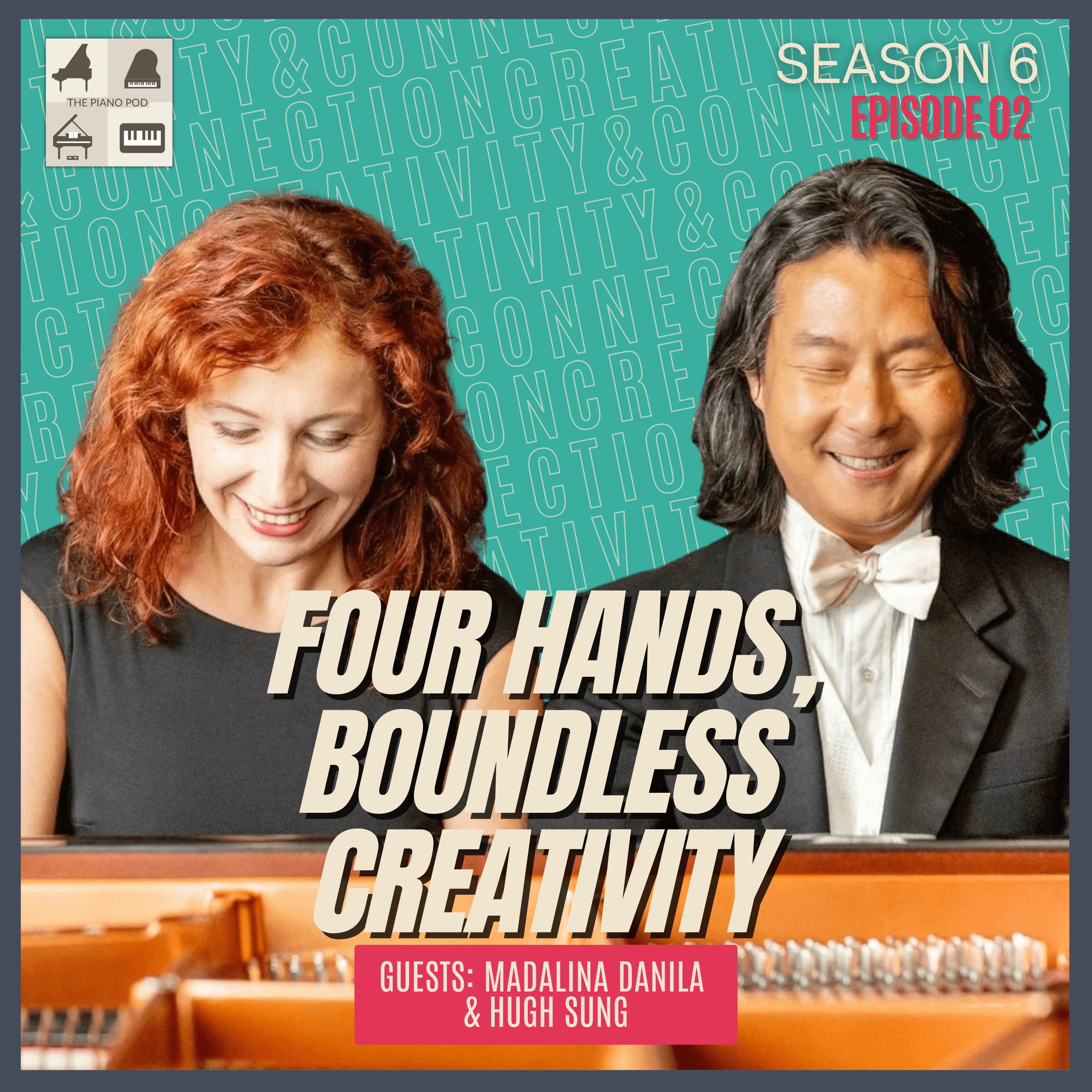
The Piano Pod - a global hub for innovation, education, and connection in classical piano music· Staffel 6· Folge 2
"Boundless Creativity" feat. Mada & Hugh Piano Duo on Love, Life, & Artistic Freedom
Mittwoch, 24. September 2025 · 1 h 53
Kapitelklicken springt direkt hin
Shownotes
Got something to say to this podcast? Send a voicemail, and you might hear yourself on the next episode! (rss.com/podcasts/the-piano-pod/voicemail)
🎹🔥 What makes a four-hand piano duo so powerful, intimate, and endlessly creative?
Welcome to Season 6 Episode 2: Four Hands, Boundless Creativity — Mada & Hugh, the Award-Winning Duo on Love, Life & Artistic Freedom
In this captivating episode of The Piano Pod, I sit down with the award-winning Mada & Hugh Piano Duo — Romanian-born pianist Mădălina-Claudia Dănilă and Korean-American pianist Hugh Sung. Known for their electrifying four-hand performances, imaginative arrangements, and engaging video productions, Mada & Hugh are redefining what it means to collaborate in classical music today.
In our conversation, they open up about:
• The artistry and intimacy of four-hand piano playing
• Their daring arrangements, from Romanian folk gems to Sweet Child O’ Mine
• Behind-the-scenes secrets of their video production and vlogs
• Mădălina’s journey from Romania to the U.S. and her research on George Crumb
• Hugh’s entrepreneurial path — inventing AirTurn and pushing the boundaries of music tech
• The risks they’ve taken to reinvent themselves and the courage it takes to build a new artistic life together
👉 Stay tuned until the end for rapid-fire fun, candid reflections on creativity and connection, and exclusive performance excerpts — including Suita din Dobrogea and Silence and a Face from Christian Mecham’s Three Omens.
[Mada & Hugh Piano Duo]
• Website (madahugh.com):
• YouTube Channel (youtube.com/@madahughpianoduo)
• 🎼Download their amazing 4-hand arrangements HERE (patreon.com/madahughpianoduo)
[The Piano Pod]
• Subscribe to TPP on Substack (thepianopod.substack.com/subscribe) for free or unlock exclusive materials with a paid subscription
• Subscribe to our Sounds of Inspiration (youtube.com/playlist?list=PLeBrJAY2RQ_uqBAHXTk…) – Piano Works from Season 6 playlist
• Latest News (linktr.ee/thepianopod)
• Website (thepianopod.com)
Transkriptvom Podcast bereitgestellt · Zeitmarken springen hin
Music is the universal language. Well, if it's a universal language, we have a syntax problem because most of the people just don't understand what we do. I would say our mission as a duo is to bridge worlds and to make the world we connect to more beautiful. We come from very different cultures. And the fact that we come together as a four -hand piano duo sharing one piano, and we have to make things work, and making music to share with people, I think sends out the message that music truly connects people, regardless of their background or cultures. I think the piano in particular is one of those unique instruments that has truly... been able to bridge so many cultural barriers. This remarkable
machine, 300 years of development, pieces of physics and art and engineering has come to be so beloved by so many different cultures and peoples around the world and that it's truly a piece of art that helps us to find a common voice. Hello, friends, and welcome back to Season 6 of The Piano Pod, our season of creativity and connection. I am so excited for today's episode because our guests really bring those two ideas to life. You may know them as Mada and Hugh Piano Duo, Romanian -born pianist Madalina Danila and Korean -American pianist Hugh Sung. But let me tell you, they are so much more than a four -hand ensemble. Their performances are electrifying, their arrangements imaginative, and their videos
pull you right into a world where tradition and innovation meet. What makes this conversation especially meaningful is their story. These are two artists from very different backgrounds who dared to take risks, reinvent themselves, and build something entirely new together. From Madalina's deep dive into George Crumb and her Romanian roots, to Hugh's pioneering work in music technology like co -creating Airturn and entrepreneurship, they have created not just a duo, but a shared artistic vision built on resilience, creativity, and love, with their dog Zeus often by their side. In our conversation, you will hear about their artistry, their bold arrangements, the unique challenges and joys of four -hand piano
playing, their entrepreneurial spirit, and what it really means to bridge cultures through music. Before we begin, I want to pause and thank you for being here. Every time you hit the thumbs up, leave a rating, subscribe on your favorite podcast platform, or share an episode with a friend, It helps this work continue. It truly means the world to me, and I am so grateful for your support. And I also want to remind you about something special. The Pianopod Live in Concert at the Stiefel Hall, presented in partnership with Mattis Prep at The New School, a pre -college music program offering comprehensive and nurturing pre -professional training. Please join us on October 4th. for an unforgettable evening of
music, conversation, and community. So with that, here is Season 6, Episode 2 of The Piano Pod with the award -winning Mada and Hugh Piano Duo. Please enjoy the show. You are listening to The Piano Pod, where we talk to the brightest minds in the industry about how they are bringing the piano into the future and thriving in a complex, ever -evolving world. Maralina and Hugh, welcome to The Piano Pod. Thank you for being here today, and you are a truly captivating duo, and I'm so excited that you're here, not only for your artistry, but for the way you've... build your brand and life together and performances that bridge cultures and generations and the repertoire spanning classical masterpieces to your own well
crafted arrangements of, you know, pop tunes and so on. And your videos and podcast, you know, we are fellow podcasters here and are super educational that really invite audiences with clarity. warmth and joy. I'm so looking forward to exploring your individual projects as well today and then entrepreneurship also. So as we begin, I'd like to start with this question. If you were to describe your mission or passion in a few words or in a sentence or two, how would you describe it?
So for me is making music, living an artistic life and sharing my talents and my gifts. and what I believe in with people and making this place better as much as I can. Beautiful. Yeah, I think it's a wonderful statement. For me, I come from a place where I'm very conscious of the fact that what we do as pianists, as musicians, is very, how should we say, very disconnected with the modern world in some ways. And I remember very much as a child growing up, not understanding the musical language at all and um struggling with you know being forced into this world of playing and and playing all these wonderful masterpieces but having no idea what anything meant so for me my passion my personal passion has been to
connect with audiences and really Help them to feel welcome, to learn about what we do, to share how beautiful music can be, and to understand that there can be a lot to absorb and to try to make what we do as presentable in a way so that our art is as welcoming as possible to as many people as possible, not just art for its own sake. Well said. Thank you. And would you like to say as the mission as to? as a duo i would say our mission as a duo is to bridge worlds and to make the world we connect to more beautiful yeah first of all we we come from very different cultures extremely different cultures and backgrounds they cannot emphasize different enough and the fact that we come together as a four -hand piano
duo sharing one piano so it's not even you know two instruments so two pianos but one piano and we have to make things work we have to collaborate at all possible levels and making music to share with people i think sends out the message that music truly connects people regardless of their background or cultures or ways of thinking or political ideas you know etc and Yeah, I think our goal becomes their goal. So it becomes a unified. I think the piano in particular is one of those unique instruments that has truly been able to bridge so many cultural barriers. This remarkable machine, 300 years of development from Cristofori's first pianofortes to what we have today. it's just amazing to see how this
this complex one of the most complex pieces of physics and art and engineering has come to be so beloved by so many different cultures and peoples around the world and that it's it's truly a machine from intents and purposes a piece of art that helps us to find a common voice so i would say if we were to make it a marketing speak maybe four hands one piano One world in one piano or something like that. Four hands, two hearts, and one world. Yeah, exactly. That's beautiful.
That's beautiful. Now, the hardest question of the day is over. So well done. Yes. We really need to spend some time. That's a great, great mission statement question that I think we still need to work through. But thank you for getting us to at least think about it. That's a great question to think about. Exactly. No, thank you.
But, you know, it's nice to have intentions to anything we do. And actually, you both are actually doing it. So that's why I thought this question to start out with would be really appropriate today. But I can't help but notice this little baby here. Can you introduce us? For those who are listening, we have this little puppy on the screen that Madalina is holding. So can you introduce us? So this is Zeus. He is a 10 -month -old cotton detulier. I know that for many people, this breed can be pretty unknown. And it was unknown to us before we found out about it. Well, yeah, I think he is the glue between us. So I would...
One of the many glues. One of the many glues, yes. And I would say that he's also a very important part backstage in terms of our duo and in terms of our communication skills. And I would... I'd like to add that, you know, as an individual, that one of my life's goals is to have as many puppies as possible. I love puppies. Enjoy life.
He was like, no, no, no. But we do have Zeus on stage with us as often as possible. You know, it's interesting, as young as he is. And this particular breed is very friendly and very sweet. Just got the most wonderful disposition. And folks are just amazed that he will sit on stage with us just quietly. He enjoys the music. We take bows together with him, travels on the plane with us. He's been a wonderful travel companion, stage companion. He loves it and he loves people, you know, and just the most remarkable. remarkable dog that we've I've ever met yeah so to have him in our life and he has a such a I don't know such a good look you know he may say so I think so too he's just got this he doesn't look real
he's like yeah he doesn't look he looks like a doll yeah he's on batteries or something yeah that's true well welcome Zeus so now I want to continue our conversation from you choose as a duo together. So, you know, forehand duo playing is such a fascinating genre, you know, rooted in tradition. However, it's so innovative and creative at the same time, right? In your case, I've been taking the artistry really further, adding visual elements and choreography with cross the hands, you know, and then even percussion effects like catatorians, saber dance. Oh, so tell us about this four -hand duet thing, the artistry of four -hand duet. Why you were so attracted to do it? Well, you know, obviously
it's more practical than two pianos. Two pianos, of course. Yeah, tell us. Well, I mean, I think there will be opportunities for us to, and we're actually looking into doing a two -piano program later on. Again, whenever the opportunity is there, we can certainly fill that in. But pragmatically, for most of the concerts that we are booking, one piano is just easier. to get concerts for, just pragmatically speaking. I think he wants you. Oh, okay. It's my turn. So certainly Anderson and Rowe have been very influential in terms of their physicality. And I think I just admire so much how they brought a lot of innovative ways to blend forehand technique. on just another level that I had never seen before. And it's
interesting, we're in the process of doing a retrospective on the history of forehand piano playing music, you know, and it seems to have, there were some earlier works, but Mozart and his sister Nannerl were really the first to, you know, they wrote for themselves. They were the first to be the sensationalized duo as children.
For so much of that time, there were zones, polite zones. The male secondo, the lower voice on the left hand, would be in his zone, and the female primo would be on the upper part of the piano. They would stay in their places for the most part, and then not until we get into more of the romantic era that we start to see. Noddy hand crossings. So, you know, just to summarize what Hugh described, basically the development of the four -hand piano duo had to do a lot with the social environment and cultural environment and the changes that... a lot of big changes that came after the classicism, right, when Mozart was at its peak. And then, like you said, when he was a child, he would play a lot of four -hand
duos with his sister, who apparently, and I read something about it just the other day, was just as talented as he was. Mozart in many of his letters to his father praised her a lot for her abilities as a pianist, as a composer. Yeah, unfortunately, their duo didn't continue. But it also had to do with, I think, the physical development of the piano. Back in Bach's time, the piano was simply not wide enough. It wouldn't be practical for two people. Not to mention that women had all those garments, which is impossible to sit closely. So there were physical barriers to having... forehand duets i mean certainly there were multi -keyboard ensembles of two pianos there's the three three even four four harpsichords
right yeah but you know in box time but in terms of two people playing on one instrument it was really due to just the physical limitations of having you know 60 some keys as opposed to the 88 we have now you know and as the piano developed then the forehand developed really as a great marketing tool for Brahms, who recognized the power of it, to have people in their homes to preview his symphonies or to preview larger works.
Even Liszt, you know, arranged for four hands. Also, you know, Beethoven's symphonies made a lot of arrangements. And then, you know, Grieg. as a great way of getting the word out of such and such an opera, such and such a symphony. People could try it out at home and then they could experience the orchestra version. So the forehand. repertoire uh was a great marketing technique and of course then list people like yeah and also you know if you think about it four hands playing so two people four hands um all of a sudden becomes more achievable right to to transcribe to arrange uh an opera or a symphony for keyboard rather than two hands right it's just right it's uh logistics here right so everything you can fit everything um more
easily into four hands rather than in two So, yeah, people started to prefer that. Maybe you already have answered, but what is it about four hand piano versus two pianos or solo that makes it so powerful and special to you? Well, I mean, I think for each category, there's special requirements. There are limits, of course. So, you know, pros and cons. I think when it comes to four hands.
to one instrument, I think four hands can easily bring out the potential of the instrument. So it becomes much more powerful than in the situation of just one person playing. And then for two pianos, a Rachmaninoff. started to fancy the two piano formula, right? And also, you know, you have to think about that concert venues started to become bigger and bigger. So all of a sudden, like two pianos made more sense, right, to have on stage. And sonically, it was a completely different level than just having one piano, so four hands. I think for me personally, even though I was trained as a soloist at Curtis, I always had more fun playing with friends. All my friends would say, hey, can you help me with this lesson,
that? I loved it. I was more comfortable being with other musicians. Maybe it was an insecurity, who knows, but I never felt comfortable just promoting myself. So I always felt like I would rather be part of a team. And I've always enjoyed that aspect of teamwork where if I could be around people that would inspire me, people that were different from me, that could challenge me, I felt like I could become a better person rather than living a soloist's life, which can be very, very lonely and very. very challenging. Be careful what you wish for in terms of, you know, people to challenge you. But that's, I think for me, it has been just the, the, what the ability to bounce ideas off of her, of somebody else. And
to, I love that extra added creativity of somebody else. working together so for me it's just that that unique variety of teamwork and um and it's just the forehand rep press so interesting yeah so i think uh the core of it it's the idea of chamber music right collaborating with people forming uh micro this micro society right micro family right either two or three it only comes to trios or quartets um And as opposed to solo, right? This is very different. That's why I said before that there are different rules for each category. Of course, what I've learned from playing chamber music is very, very much transferable to solo playing. It helps a lot, at least, you know, I'm speaking from personal experience.
It helps a lot in terms like how I hear music, how I approach music, how can I make my two hands sound not like two hands, but more, not like. this percussion instrument but like completely like a um a human voice or an elbow or a clarinet um so you know maybe one hand is playing a noble line yeah or and and the the other one is playing um a bass, for example, like if you think of different textures and the way to orchestrate, right? Learning from a string quartet is very helpful for pianists, for example. So that's why I'm saying like chamber music can be so, so influential on solo playing and indeed is more fun to play with people as difficult and challenging it can be as it can be sometimes,
right? On stage, it is that... back and forth game. It's like a tennis game, right? It doesn't make sense to play tennis by yourself. You can play, actually. I learned tennis with the wall, just bouncing the ball against the wall. But then, you know, it's no fun. It's very limited. But I see this successful duo as siblings. you know, twins. Yeah. Yeah. And a married couple.
Yeah. So it's, it's really fascinating, but that's how much also it takes time to put, put the craft, you know, craft that our artistry. Right. And it just doesn't happen very, very quickly. to coordinate no it doesn't and the fact that you know you mentioned siblings playing together or a married couple um i think is similar because you you live with the person you live with that person that you you also share a professional life with and you i think you learn about their idiosyncrasies and you learn about their way of thinking, the way they approach life. And even if you don't consciously think about all these things, I think it's just they get somewhere, right? They accumulate somewhere. And I think
it's easier in a way when we are, for example, in front of the instrument and start practicing, we know each other or we should know each other. And I think we can solve problems a little bit more efficiently, or at least we're trying to, right? After some time, if you really want to make things work, you have to find an efficient way to save time and energy and sometimes even the relationship, the partnership. One of the things you were alluding to at the beginning of the podcast was how challenging it is to play four hands on one piano and just, again, You're absolutely right. I do a lot of work in my, I still do a lot of work with collaborative piano, which is what I've done for most of my professional
career. You know, 19 years director of instrumental accompaniment, Curtis. So I played with every instrument and helped a lot of the folks in the Philadelphia Orchestra get their jobs with the auditions. But somehow working in this capacity is the most difficult. that I've ever experienced. And I think a lot of it has to do with just the nature of two people on one instrument. Yeah, two different entities. When you have two different pianos, and I've accompanied other pianists.
For some reason, that doesn't seem as difficult, but one piano, wow. I mean, just the precision of making sure we land together, that we start together. it's much more amplified when you're both sharing one instrument so this is exactly the the reaction that our dear uh professor orcas had i i remember when i when i told him oh you know you know we're trying to develop this forehand oh i i don't want to hear about it like this i find this the most difficult thing and he's he's been a collaborative pianist almost his whole life. I mean, he's known for this, a chamber musician, a phenomenal chamber musician. But when he heard about this combination, he's like, oh no, I've only done it like a few times and
that's it. Because it requires a lot of energy and time. And it is difficult. Like I said, two different entities in front of the same instrument to make it sound as one, right? To combine ideas. and music making and make it sound like one, it is, I think, the most difficult partnership and ensembleship, I think, when it comes to chamber music. Well, but when I see you perform and on the video, it just looks so easy. We're talking about what's going on backstage. I'm sorry. We're talking about backstage stuff that people don't know about. My final product is just so beautiful and so fun. Now tell me about your arrangements.
Wow. Moonlight with Schubert's Serenade. Moon River. Oh, my gosh. Those combinations just blew my mind. Oh, thank you. Yeah. And then the iconic rock song Bohemian Rhapsody by Queen. We didn't do that one. We adjusted the arrangement a little bit. The others we did. John Williams, for example. We are particularly proud of that one. The very famous rock song, Guns N' Roses, Sweet Child of Mine. That's yours. I think that one was the first one where we... tried out some crazy choreography.
That was the most... And actually, it started as an experiment. We did it in three days. We just threw something together really fast. Nothing to lose. And Billy Joel's lullaby is your arrangement as well. My favorite is, of course, Sweet Adin... Dobrze. Yeah, and that's an incredible arrangement. I really enjoyed it. So this is the compilation of folk tunes from Romania, right? Certain regions of Romania. And I know you, in the video, you also explain the region and also how complex Romanian culture is actually. can you tell us about the arrangements but also the historical background and how also you guys arranged this together well in terms of um um historical background you described it very well i mean it was um it
was a region quite um conquered well this is a region specifically in the south southeastern part of romania romania is in the shape of a fish Right now. Right now, the Sabah fish. And what's interesting about that particular region is that this is actually where a lot of Madalina's family comes from, the southeastern part. And it's a close proximity to Turkey. And there are eastern and western influences that are commingled in that region, which lends to the spiciness.
of this suite yeah predominantly eastern influences predominantly turkish because that region was for three centuries even more um under turkish occupation so a lot of the architecture music cuisine just came right there of course and before um way way back before uh he was under um roman empire right there still we remember like two years ago We visited some ruins that are still there from the Roman Empire time. Still there.
It's really fascinating. I mean, learning history as a child just didn't strike me as fascinating as it does right now, finding out all these details that constitute my country. So, you know, of course, meeting Madalina and, you know, I'm from South Korean heritage. I was born in the States, but my family came from South Korea and I had never had never dated a Romanian before. I mean, instantly there was this instant mystique, everything from her accent to. And I, you know, want to know more about this. beautiful, mysterious woman and where she came from. What is this place called Romania? The only thing I had reference to was that. You had to look it up on the map, huh?
Well, not just look it up on the map. All I knew was, you know, for her teacher would say, ah, Ceaușescu, Dracula. It is, you know, the home of Transylvania. I mean, all these are true, of course. Of course they're true. It's just stereotypes. Of course they're stereotypes. But, you know, I love the fact that, you know, they love it. They just laugh it off. Sorry, I have to interrupt. and you saw this the other day i was re -watching some episodes of seinfeld of seinfeld show and there is one episode where jerry dates a romanian gymnast this is a an allusion to nadia who won the perfect 10 right history of gymnastic and then he mentions the name of of uh what what am i going to talk to her about
i love the accent by the way so I think the most interesting thing as getting to know her, I was interested also in her culture. And so we spent a lot of time. One of the things that I remember when I was first being exposed to South Korean. culture that i instantly wanted to understand the folk music so i got a lot of cds at the time of the traditional instruments things like the kayagum which is this equivalent to the koto the japanese koto string zither instrument or the tegum which is the the flute that has the the membrane skin membrane gives it a soul those instruments really struck my heart and so i wanted to do the same kind of deep dive for romanian music so i just spent all in search online apple
music is fantastic by the way just to look up as many authentic ethnic romanian albums as i could find and it just became this beautiful journey of of the folk music of the different dance styles and hearing different regions and how they all differed and then suddenly i found two recordings of the same suite One was recorded, I think, in the 1970s or so. He's getting tangled.
First recordings in the 1970s, and I think the more recent one was done either the 90s or early 2000s. And what was interesting was that it was thematically the same dances, but in a different order and improvised slightly different. I recognized the piece like, well, that's a completely different way of playing such and such a piece. And I shared this with Madalena. She got excited. And then we started, I think the first step was just the base transcription, just listening. And since there were two different sources, just trying to decide which one we liked of each of them, because there was no printed sheet music of this.
So it was really just simply laying down the raw transcription. And then from that raw transcription. We would, so the way I like to work is I'd like to work in a kind of a three staff system. I do the raw transcription in the middle, and then I add a staff above, a staff below for her part, my part, or whoever's going to do it. And then deciding which elements are more predominantly going to go to the primo, which elements are going to go predominantly to the secondo, and then finding fun ways to mix them, you know, to say, okay, well. This is boring. Let's, and then she would come in and say, well, let's, I want to improvise this. This sounds boring.
Let's do that. So it was a very, maybe I would lay the framework and then she would come and lay all the Romanian sauce on top of it. You know, when I do my arrangement and I've done some solo arrangements, I just, I don't know. My way of working is very different. First of all, I have to be at the piano because I want to try out things and I don't work like beginning till end. based on whatever reason, I just, maybe I start in the middle or I start with the ending and I just sketch. First of all, I sketch something that sounds at the moment the most important.
And then basically I fill out the rest. So we have different techniques of arranging things. Yeah, but it went through several, I mean, once the framework was out, it really took a lot of... playthroughs, experimentations. And then she has a very improvised, and that's the nature of Romanian music. It's very improvisatory. So getting her feedback in terms of, we really should do this or that. And, you know, maybe she changed her mind, but we would annotate as much of that as possible too. It's just a fun, fun process.
Yeah. I mean, you know, speaking of improvisation, there are two types of people, right? Some write their improvisations down before. Every concert, even if they do something different each concert, they write it down. And now there's just, well, I'll see what I feel inspired to do on the spot. So, yeah, I mean, I like to come up with different things each time that we play this piece. And we've been playing this a lot. And I think it has been featured in every single concert that we've had. And last year we played it in Romania for the first time and we're going to play it again in September, coming back there. How was the reception? It was very well received. First of all, no one seemed to know that particular
suite. So I don't think anyone had ever heard that because there's no score for it. This is a very important thing. There's no score for it. I think any folk music has been preserved. without any sheet music, right? Just the oral tradition, yes. And I think what's interesting too is that the Romanian classical community, they have a very strong contemporary component, very strong contemporary composers. But there seems to be a disconnect. And there's a very active folk music community. I mean, people, they play weddings, they play, you know, parties, community gigs, you know, all the time. There's not much overlap, which I found very opportunistic, you know, because, you know, again, one key thing
about being a surviving musician in any age is finding what makes you unique, right? And I'm always trying to think of how can we... find interesting gaps to fill. And I thought, you know, Romanian folk music in the classical sphere, I think is a wonderful thing. The music is so good and not many people know it. So it's just a wonderful opportunity just to share that with the rest of the world and connect two different worlds together. Yeah, yeah, yeah. Well, which you're doing an amazing job. I really enjoy the video. Speaking of video, you know, you're venturing.
into the virtual world where you know the podcast and vlog and you know all the videos that you make especially the one that i enjoyed watching was that sort of like a tutorial where you show us the squeegee thing uh that you used for what is it the winter morning But I really needed to see the video. I never knew you were using the squeegee. I thought you were just using the hands. And then obviously there was a reason.
I have to say, I mean, it was not our idea. It was Professor Ork's idea. But it's also, you know, we do a lot of our shoots. So I'm actually vice president at Cunningham Piano, which is one of the oldest. piano stores in America. It's been around since 1891. And we have the tremendous privilege of being able to walk into the store after hours to shoot on Busender for pianos, Yamaha pianos, I mean, the top -end Yamahas, you know, rebuilt Steinways and Petrov pianos.
We get our pick of the best pianos, you know, around in great condition, brand new. But one key thing is, you know, and I tell this to our customers, don't touch the strings. Because the oils in the palm of your hand can cause the strings to rust, which is why when she wanted to record this, I said, we can't touch the strings. We've got to find another way. Hence, the squeegee idea. Yeah, Professor came up with the idea.
Well, you know, because he had played a lot of contemporary music, like a lot. And he knows, I think, every trick that's in the book for certain situations when you're not allowed. Because in a lot of venues, presenters might be a little bit reluctant. When you touch their pianos inside strings or put different foreign objects between the strings for certain effects. Yes, it sounds cool. But at the same time, it might damage the instrument. So he had this very good idea to use rubber squeegees. Yeah, it works. But also you are explaining in such a way that it's so engaging. It's like, aha, you know, for those who especially. are not familiar with classical music or even contemporary you know music and
how does that even sound does the sound coming from piano but there's an explanation to how you do it and also you talk about Air turn. So we're going to talk more about the air turn. And then I actually have it in my hands. I'm so proud of you. We're going to talk more in details. But, you know, you talk about how to use this air turn for two people. I never knew that. I thought it was an individual thing. And you showed us how to do it. you know the video is really uh inviting and and even for those who do not know how to play the piano people really want to see that you know how do these pianists do do you do all the music production audio to visuals i i mean i can see you you are tech savvy one of you right and then so do you
guys do all the production like video audio and editing yeah starting starting with the outfits and Hairstylist and makeup and everything. I take care of the visuals. She insists on putting makeup on me, which I can't stand. But, you know, it looks good. And, you know, recently we've done this. short, this reel on our favorite video game music, Baldur's Gate 3. And yeah, we had to really go the extra mile there with costumes and makeup just to look as realistic as possible with certain characters. So that's a lot of fun.
Yeah. And for me, it's really kind of everything else. So yeah. Everything else, yeah. You know, I've been interested in making videos. Oh gosh. My YouTube channel is 19 years old and YouTube just turned 20. So I guess it gives you an idea how long I've been. experimenting with videos and that's just for fun again just for fun i just it's it was a hobby i i loved experimenting with editing software and over time you start to pick up this piece of equipment that piece of equipment and um nothing nothing terribly expensive but just you know i you start to and also the fact that i recorded so many albums, you know, with other musicians. So I have a lot of experience being in studios, being in production
and seeing the equipment that those people use, how they use that. And I, we go to the recording session, I'd be more excited to meet the engineer than actually record the music, you know? So I love learning about recording techniques, you know, how do they edit, you know, how do they keep track of all the takes and everything like that. The challenge, though, has always been, up until recently, I've only been in situations where we had a very limited window of time to set up the equipment, record the music, and tear everything down and get out of there, right?
So you have to think about planning out. And sometimes the space is very limited because especially if you were shooting in a piano store, it's crowded. There's lots of pianos there. It's not like a stage. So it's very challenging to find the right angle, set up the lights correctly so you don't have shadows in the wrong place. But the beautiful thing about making videos is that every video you make, you learn something new. And that's definitely been the case every single time. I think, you know, maybe next time I'll do it this way. Maybe I learned a lesson that this didn't work, you know. So that's been a fascinating thing. And then microphone wise, I have the great fortune of, again, working with some other musicians.
I worked with one of the country's best piano tuners and technicians. And he happened to do also audio recording on the side just as a hobby. And he saw my equipment. He said, you know, can I make some recommendations on some other gear to get? And he made a recommendation on some microphones. And I said, I wish you didn't tell me that because now I'm going to have to buy them. They're very expensive. And there was only one set left. They're not in production anymore, but they happen to be just like the perfect piano microphones. And I've been using them now for a couple of years. And I think our production, it's just been really. fascinating just to dive into bootstrap ways to make a video to make it
as you know look as nice as possible make it sound as nice and just having that creativity in fact tonight after we do our podcast interview with you we have a video shoot she wants to shoot two more pieces and so it's nice to be able to think you know anytime we have a come have a musical idea oh let's go make a video not only just musical idea but you know something that a product that you've been working on and you want to share it. I'm actually more excited about the outfits, to be honest. Because again, it's part of the show, right? It has to be. Do we get to see the video later sometime? Oh, of course.
It's always a combination of things that we do together or, you know, I'll shoot her solo thing. She still does a lot of solo stuff. Yeah. So, yeah, whatever production, crazy production. But, you know, I don't know if we want to talk a little bit later on. We just finished a production with a young composer, Christian Meckham. And this was, for me, this was my dream video project, believe it or not, because, as I mentioned. We never have enough time. It's always a rush. I'm limited with the cameras I can use. And for the first time, we had a young composer approach Maddalena about a piece that he wrote in memory of George Rockberg. Krum. George Krum. Excuse me, George Krum. Very, very, very big distance.
George Krum, who Maddalena actually specializes in. Her doctoral work has been on George Krum's Macrocosmos series. book one last year and this year she'll be doing book two and somehow through the grapevine this young man was reaching out to the music community and they all pointed to her and so he approached her to record this set of three pieces it's called three omens three little movements called the rabbit the storm silence and the face and um so he approached her with the idea of making a video project he wanted us to work together because he liked the videos that we made so he wanted her to be the pianist they wanted me to be the videographer and initially he was going to have his his girlfriend
create animation so it's going to be a hybrid live video and animations mixed together to tell this visual story of the music It was a lot of brainstorming at the beginning. I remember we met for drinks, meals a couple of times, and we just started throwing out ideas and see what sticks. And eventually it turned out that just making the animations was just too time consuming.
It was never going to get done. But the nice thing was that he gave me a blank slate in terms of however I wanted to shoot the video. And so my idea was, okay, let's get the audio done first. So we recorded the audio, you know, at Cunningham on a Cunningham piano on a beautiful nine foot Bissendorfer 280 VC. Imperial. Not an Imperial.
This is a 280 VC. Imperial is a different piano. But we recorded on that piano. So we got the audio down and that was the backbone. And then I was able to use what we call pre -visualization software. So if you've ever seen. documentaries on how they make Star Wars or how they make the latest Marvel movie, you'll see many times that they'll have these storyboards. It looks like cartoon strips where they draw in what the scene should look like and what they're saying at the moment. I did a similar thing using 3D software where I could have a virtual model of her, a virtual model of the piano, a virtual model of the stage, place them wherever I want, set the lights virtually where I want the cameras. For
the first time, I'm like, I can use my best camera and I can have any angle I want, any lighting that I want and shoot it just the way I want it to kind of measure for measure. And, you know, the music became a script and I would lay out the cuts according to what the music was telling me. it would be the changes lay out the storyboard sent the storyboard animated to the composer you know he approved and then we shot it over two days which is unheard of you know just to be able to have two whole days to get it yeah the visuals out that was great he was also he was also a big help for getting a stage to allow us to to unfold like this um we shot that millersville university there was no one there we basically
had the the stage for us for eight hours for two days but you know being able to treat um the recording very much like a movie movie set it was very much a movie production you know with the way and i loved it i mean for me and i'm very grateful for christian to giving us the opportunity she played of course she played brilliantly this absolutely brilliant performance and then of course she came up with different visual elements and ideas The mask at the last moment was her idea, which I thought was just genius. And just, you know, the collaborative process. And it really felt like we were making quite literally a movie with just music and a piano and lights. That's all. I just, yes, that was a great idea with the mask. But the idea
came from George Crumb's Fox Polini, of course, that the piece, the very famous piece that premiered in the 70s for three players that. requires for all of them to wear masks, to depersonalize them. So George Brown really inspired the production, not just the music. It seems like you guys both share, although... coming from very two different worlds almost, but then they share so many things.
One of them is the creativity. So, you know, before we, I want to focus on your individual work and so on, but I kind of want to know how did this duo come to life? As in, did the playing together come first or the life together came first? I think they went hand in hand. Really, they went hand in hand. I never felt a separation.
No. I mean, it's kind of obvious when two musicians, even if they are dating or they're already together, it doesn't matter if they're two pianists or different instrumentalists. It seems natural to start playing together at some point. Unless they really hate each other. In terms of, you know, what they do professionally. Well, that would be really weird. But we are not there.
I think it just started as, well, let's play together. Let's just play together. We went one evening to Cunningham and let's just side read through some stuff. Well, I remember I received an invitation from a good friend of mine to come out to play a concert in Paris. And this is very shortly after. meeting Madalena. I thought, well, rather than me going out, I was like, hey, hey, want to go to Paris together? Yeah, but that was not why it started. No, no, it wasn't, but it gave us a good reason to give our first concert.
And it was not even the goal of, oh, let's start a four -hand piano duo. It was not even that. At least that's how I perceived it. I don't know. Yeah. Dr. Buechner, Sarah Davis Buechner, have anything to do with your duo? Yes. Because last year around this time, I was interviewing her. Yes, I saw your interview. She's wonderful. She's the GOAT. She's unique. She's unique. She's unique.
And I, you know, speaking of creativity, I don't think I've ever met such a creative person like she is. You know, I've been. Her student, I've been around her, I think, more than six years. Yeah, more than six years. And the influence that she's had on me as a person, as a musician, it's just, I can talk for hours. Really, I can talk for hours. And she's really one of the human beings that actively has been influencing my life. And, you know, I think yours too. So the story is Sarah Davis Buechner and I have been friends for many years, ever since she came to Philadelphia. We connected. really through her needing a piano. And then we were Yamaha piano dealers. We are piano dealers. And connecting
with her initially there. And we just hit it off. We became very, very close friends. And during the pandemic, I helped her a lot with helping her set up streams for her concerts and a couple other things. So everything, if you remember that time, we were all streaming from home. So I set up cameras and microphones and helped her with a couple of productions. And then... She was putting together a one -woman show in New York called... On Pigs and Pianos.
On Pigs and Pianos. Oh, yeah, that's right, that's right. I thought it was of whatever. On Pigs and Pianos. And she wanted me to be the videographer, just to record a version of the show that she could shop around to presenters. So I came with all my equipment. And that was really just... She basically hired me to be there for a week.
to do shooting and, you know, capture everything. And at the end of that week, this woman came to one of the after show. I was busy editing and then finally came out for the last show and met her. And that's how we met. So, yeah. Hi, friends of the PianoPod. I want to invite you to something very special. On Saturday, October 4th at 1 p .m. We are stepping out of the studio and onto the stage for our very first Pianopod Live in Concert at Stiefel Hall, presented in partnership with Manus Prep at The New School, a pre -college music program offering comprehensive and nurturing pre -professional training. This won't be just another concert. It's a one -hour, one -of -a -kind experience featuring four of
our past guests, pianists, who are reshaping the classical music world. Dr. Jihoon Kerska, building opportunities for children through keys to success. Eleanor Bindman, opening doors to Johann Sebastian Bach's music with her bold and innovative transcriptions. Dr. Nana Ogwo, celebrating Black composers and honoring cultural legacy through Juneteenth LP. Donna Wang Friedman, award winning pianist, producer, and filmmaker, creating projects that amplify immigrant and underrepresented voices. Each of these female trailblazers will perform, then sit down with me for an intimate conversation before coming together for a panel that ties it all back to our theme, creativity, connection, and community. The PianoPod has always
been about bridging the gap between classical music and today's audiences. This event brings that mission to life. You won't just hear extraordinary performances. You will leave inspired by the stories and the vision behind the music. The concert is open to public and it marks a huge milestone for us. Don't miss the chance to be part of this moment. Please visit thepianopod .com slash liveevents to reserve your seat and, if you are able, support this project so we can continue creating experiences like this together.
Join us for an unforgettable afternoon of music, storytelling, and connection. So let's focus on the individual work. So I want to start with Madalina. You mentioned that the work of George Crumb's Macrocosmos, and I watched, I think, yeah, you have a YouTube video out there, right? Yeah, I watched. Are you still working on your DMA from Temple University? Yes, yes. Is this part of your research? Yes, it's supposed to be. So I'm entering my last year. And it's wonderful because I discovered the music of George Crumb through Professor Orkes, who known George Crumb intimately. He premiered Little Sweet for Christmas.
They were very good friends. And in one of the modern music classes with Professor Orkes, I... first heard his music, I was not familiar with it. And I remember, even now, I remember the shock that I felt. I was very intrigued because I felt that that music really spoke to me. And I think this is a very important key element when it comes to not just contemporary music, but any kind of music from any era. If people feel that a certain music speaks to them, they should trust that. They should trust that instinct.
And not to mention for players, if they really feel that, oh, I have this urge, this impulse to play a certain composer, they should really follow that. So this happens with George Crumb. And looking around, I realized that there were not so many people. I would say no one. that were interested in in his music and i just decided to uh give it a shot and started exploring it and um i i'm grateful and lucky that i have professor orcas as a mentor you know to show me all the the um tricks right in in the book because he had played a lot of george crumb and um had talks with him and we we have also recently uh reached out to other friends of george crumb who had known him as a composer and as a friend uh and
it's like for example uh jennifer higdon she was one of his studio students at the upenn um interviewed as professor orchis we tried to reach out to robert shannon that's still pending um another favorite pianist of George Crumb. Who else did we... Marc -Antonio Barone. Marc -Antonio Barone, yes. We interviewed him as well. Also another promoter of Crumb's music. Yeah. So, you know, getting this direct information from people that had worked with the composer, it's also very useful in my own understanding of the music, right? Besides of... my let's say you know subjective manner you know what what what do i get from this music i get all that knowledge right from from the outside that contributes
to um the general um outcome and uh yeah i so far it's it's it's been a wonderful uh journey exploring that and it's still not done i'm working on the second um macrocosmos book and uh i've learned a lot about contemporary music technique in terms of what kind of sound effects can be obtained from the piano. How should I obtain that without damaging the instruments, since we were talking about that earlier with the squeegees.
All these elements for extended keyboard techniques. I think every pianist should know about. I think it's a very important slice of piano repertoire. Yeah, so I feel very fortunate to play this music. And, you know, when I've played it, I also played it in Romania last year as well. People love it because they understand it, you know. And I think it has to do with the fact that I love it and I understand it. And then, you know, I share. here's what I think about it. What do you think? And so far, the feedback has been positive. It's an incredible conceptual art.
Yeah. And it's very creative. I mean, George Crumb was a complex human being, complex, although at first glance, you wouldn't say that. I mean, if you hear him talking, there are lots, lots of interviews of him on YouTube. But he had this diverse, colorful, even dark, I would say, to a certain extent, universe inside of him, inside of his head. I remember Jennifer Higdon, when I interviewed him, she was so baffled because knowing him, she said, well, he was very quiet.
He wouldn't talk much. He wouldn't talk much. But then if you hear his music, where are all those... powerful, violent sounds coming from, because he's not like that. So there's a big difference between George Crumb as a person, George Crumb the person, the human being, very gentle, very gently spoken, you know, like I said, the tone of voice, very mellow, and George Crumb the musician, George Crumb the creator, I would say. He's a creator in the real sense of the word. Now, you grew up in Romania, so your training, earlier training was in Romania.
So did you discover this sort of experimental avant -garde style of playing when you came to the United States? No, no, no, no, no. I had experimented with a lot of contemporary music before coming to the States in 2019. I had... If I may say so, I had been at that time for many years, I had been one of the primary pianists in Bucharest, just like the capital where I lived for 10 years. So one of the primary pianists that actively was actively involved in playing contemporary music. And I just like to do that, first of all. Also, from a pragmatic point of view, it was work that I could get. And also because I like the idea of working directly with the composer. How I wish to just pick up the phone and call Mozart or call Brahms or call...
you know, defy us and supplying that and ask them, hey, what did you mean by this? What was in your head when you wrote this down or something like that? But we can't. So the idea of working with living composers, it's very appealing. You know, when I read about Brahms composing his violin concerto for Joachim, basically Joachim laid down the violinistic part, right? Right.
It's an incredible bond between composer and performer. Right. Um, so yeah, I've always wanted to, to go through that. Um, and it's wonderful when I come across composers that feel to trust the performer, they feel to trust me and they allow me like, like Christian, for example, right. Um, Christian Meckam with Three Almonds. He, um, remember he was not so pretentious in terms of, and picky. no pretensions but picky in terms of you know how to do certain things um he trusted me and um yeah it worked out he i think i think it paid back uh quite nicely and i'm honored when composers do that when composers trust the performer you know um yeah and also i think it also has to go the other way around the performer
has to trust the composer so you've been in the united states no Too long. It's been like 60 years. Yeah. Yeah. How do you like it here? I know there's a lot going on right now, but there's a lot going on. There's a lot going on. I found a very refreshing. So if I had to summarize the whole thing in a phrase, I found a very refreshing.
point of view in approaching music through the people that I have worked with and through the people that I have encountered and have guided me. And we mentioned already two of them, Professor Lambert Orcus, Sarah Davis Buechner. I can mention, for example, Dr. Joyce Lindorf in period instruments and harpsichord. I've done a lot, a lot of work on harpsichord and period instruments. And that helped. shaped, that actually has shaped a lot my perspective on, for example, music from classicism, like music of Mozart or of Beethoven, because of the exposure to period instruments and to reading materials and to audio materials and to other people that are considered specialists, like, for example, Robert Levin. giant in forte
piano, for example, and I had the privilege to work with him for a little bit in a masterclass. It was powerful. I will remember that masterclass for the rest of my life. And just recently, speaking of masterclasses, just two weeks ago, I think, we were in Delaware. We were invited to teach a masterclass at the music school in Delaware as part of their summer piano program. And we only had, I would say, about 20 minutes for each group, right? So it was a masterclass, right?
But I was hoping, now I can confess, you know, before it started, I was hoping that at least for one group, at least for one people, we could make a difference, you know, because I think that's what masterclasses do. They should make a difference. They should be influential. So, yeah, there's a lot going on. And that's exactly why I came here. I came here to get a new life.
And that's how short I can summarize it. To get a new life, to get a new perspective. And, yeah, I think overall to be more creative, to learn to be more creative with my life. And by that, I mean to experiment. to be playful, to know what I want, to know what I want to add in my life and to what to hold on to, what to let go.
I think that's what being creative, since we mentioned this word so many times already, I think that's what it means at least. That's actually one of the words for this season, creativity and connection. So, yeah. Well, thank you, Marilina. It's such a joy to hear your story and how you get here and so on. So, Hugh, now your turn.
So your path has taken also many turns and from Curtis and collaborated with Hilary Hahn and so on to and inventing Air Turn, the famous, you know, pedal. This, you know, for those. who are listening piano pedal comes in the regular, you know, three pedals on down at the bottom of the piano. Each one has a different function.
And then now this is like the 21st century version of pedal, which we use this for page term. Right. So, and you are part of the co inventor, right? Yeah. Yeah. So how does this, entrepreneurial, innovative curiosity come from? Well, I think a lot of it came from growing up watching shows like Star Trek. It was my first love. I loved...
This vision of the world where technology was so pervasive and solved so many interesting problems and was able to transport your imagination to different worlds. And I love that. I love that aspect. And I've always been drawn to fantasy elements, you know, whether in books, reading through the Lord of the Rings before the movies came out, you know, or any of those kinds of things, just wonderful exercises in imagination.
One of the curious things I can look back and I think at first I was ashamed of it, but now I'm actually glad I have this, was this innate curiosity, you know, about how things work. I remember coming to Curtis very young. I was 13 when I started there and attended a couple of recitals and I was just baffled. You know, I would sit there. I mentioned this at the beginning of the episode. Like, I don't know what's going on. I would ask my friends, what do you hear when you hear music? And they had a hard time explaining. And then here's a great example.
So when I came to Curtis, I came in with Eleanor Sokoloff. She was my main teacher. But then George Bullett, who was teaching at the time, one of his students was not coming back. So he actually, he was the head of the piano department at the time. So he went to Eleanor Sokoloff and said, I'd like to audition your students. I'd like to take one of your students to add to my class.
She wasn't happy about it, but she didn't have a choice. So all of the Sokoloff students played for him. I remember playing for him. And anyway, long story short. I became his student, but she wouldn't let me go so soon, so I had two lessons with her and one lesson with him every week my first year. Well, one of my first lessons, I brought a piece in, and then Mr. Bullett kind of went, well, who told you to do this or that?
I said, well, Mr. Sokoloff. No, no, no, no, don't do that. Do this. He would change a couple of details. Well, I changed the details. Well, I went back to Mr. Sokoloff with the same piece, and she yelled at me, who told you to do this? Mr. Paulette, don't do that. And that became the very first conundrum. Who's right? They're both my teachers and they're taking the same piece of music and saying completely opposite things. Who is right? And that question really perplexed me. And I was probably a very annoying Curtis student because I kept asking that question.
Well, why? Why are you doing it this way? Why are you changing your mind there? Well, someone says it does it this way. Why are you doing it that way? And the puzzling thing was that many people couldn't answer that question. They would just say, just do it. Just follow your heart. Why? How? So for me, I think the entrepreneurial question came from seeing that there was an assumption that as a classical musician, you just know.
You're just supposed to know everything. I didn't know everything. And I wanted to know everything, but nobody was giving me answers. So I think a lot of that came from just being honest with my ignorance. I don't know. And I want to know. And eventually, I'm not ashamed of owning up to, I don't know. I want to learn. And so that came from that, I think, from that mindset. And that also helped me to see, well, I'll tell another story. The entrepreneurship, I think, came more out of seeing, number one, this breakdown in communication between artists and audiences.
Right. Yes. I heard all throughout my upbringing, music is the universal language. Well, if it's a universal language, we have a syntax problem because most of the people just don't understand what we do. Again, pragmatically speaking. i experienced that i would go to a concert i'd be bored out of my mind and somebody somebody would play something suddenly and my heart would race and i didn't know why and i wanted to really try to be better at explaining that phenomenon first to myself but then more importantly to other audiences how can i make the music that i love so much now that i understand it better How can I pass that understanding to other people and get them to fall in love with this incredible
art that is able to truly connect? But we just need to do, I think, a better job of conveying that connection a little bit more clearly. And the other parts of the entrepreneurship really came from practical things. Being at Curtis, after I graduated, they asked me to come on faculty. And then in addition to becoming the director of instrumental accompaniment, I suddenly became the director of student recitals when the person in that position died. Well, that's a full -time job. And this is back in the days when we were using lecture typewriters to type out programs and make notes. And it was just horrifying. And I thought, there's no way I can do this and still play with all the students. Luckily at that time,
Computers were a new thing. I'm really dating myself here. So I was the first one to use a computer at Curtis because I just brought my own home computer there. First I used, and then I thought, if I could figure out a way for the computer to automate the process of making programs, that would be great. So I tortured myself, but I learned how to make what's called a relational database. A relational database. Simply being where instead of me typing Beethoven's name and then typing his year, birth and death year, dozens of times, or individually typing those pieces, these tables could refer to each other. One table would be Beethoven's table. The other table would be his repertoire table. The other table would
reconnect to a student name, instrument name. And all those tables would come together. And then I found a way of creating programs instantly. I can go into that for hours and hours. That was a transformational moment for me. Suddenly I saw the power of computers, how that could change the operation of an entire program. Went from this being a full -time job to something I could do in three minutes. Instead of spending two weeks writing a report, instantly just spit out a 300 -page report. When I saw this, I realized, wow. Now, what if, this is back way before we had anything called a tablet, right? We all had laptops, you know, but what is dreaming? Wouldn't it be amazing if, because I was, you know, carrying
lots of music in my bag and thinking. Oh my goodness. I was forgetting music in my office, forgetting music at home. I can't tell you how many trips. One time I flew out to, I was the pianist with Aaron Roseanne at one point for many, many years. And one time we flew out to St. Louis, opened up the bag and I was missing music. There's no music store. There was no internet to download the music at the time. It was just paper music.
And the smoke that came out of his ears and just the shame I felt of not having my music with me. My dream was, Wouldn't it be amazing? This sounded like a crazy dream. Wouldn't it be amazing if I could have every piece I play in one device and just carry everything with me? That was my real dream. And then when Microsoft came up with the tablet PC in 2001, the first time that a computer could show a full page of music vertically instead of just the half screen we see on a laptop, that was my aha moment. That was it. I bought one, spent lots of money at the time. They scan some music, use the pen to draw notes. It was like, this is it. My dream has come true. This was before iPad. Oh, way before. The iPad came
out in 2010. So now I'm thinking, how do I turn the pages? Because I can now only see one page at a time. That's where the idea came for creating a pedal, a pedal system. I jury rigged so many different pedal systems. everybody at school laughed at me they were like who is this crazy guy walking on stage with these machines and cables and pedal contraptions and playing music it just looked more like a science experiment than a classical musician but you know that led to um somebody coming sitting in the audience one day seeing my crazy invention running up to me afterwards and saying We've been looking for you for five years. We finally found you.
She flew me out to Colorado to meet my business partner, Lester Karpis. And he said, we've been looking for you. Let's start a company. Just like that. It was crazy. But again, I think a lot of it was just this hunger to know, hunger to answer questions, and a hunger to think outside the box. The other thing I've always been very concerned about is Again, coming at it from an administrative point of view and seeing how dependent on the economy a lot of these nonprofits were.
If the donors aren't there, that operation lights out. And everything from the Philadelphia Orchestra to Curtis Institute of Music to any other institution, they're very fragile tenants holding on to whatever the economic situation of any given environment is and thinking, there's got to be a better way.
there's got to be a better economic model for all of this. So for me, the entrepreneurship is really a quest to find a better business model for being a musician, for organizations, for presenting concerts, for connecting people and music and musicians. So it's just an ongoing experiment with everything involved with making what we do sustainable. This has been an exciting journey. Well, I personally want to thank you for creating this wonderful tool. Very welcome.
Yeah, yeah. I made it for myself. But this is like my second one because the first one, you know, living in New York, you just to and fro, you lose things. And one of them was obviously I lost this. So then I had to just quickly buy something cheaper. Just in the meantime, and I try that. So compared to Airturn, this cheaper version was obviously terrible. You know, what happens is like once you, you know, tap once and then just you go 10 pages ahead, you know, like that. But this one has this own like, I don't know, the perfect resistance and super intuitive. told me uh for in the video that you know by doing the forehand duet so you have two different tablets but with this one can you tell us yeah so that's what's what really unique and
actually um this is something i discovered as the need was there but apparently um several app developers have built this in the app that we use for our music reading is called fourscore but there i know they're the music is another one, N -E -W -Z -I -K, French developers. They also have this capability where one iPad can be the master and it can actually connect locally, directly to other iPads and change all their pages. So it's designed really for orchestras and ensembles and things like that. But we use Fourscore. It's an option called Q, C -U -E, where one iPad can be the master and the other iPad's the slave. You can determine whether you open music together or just turn pages. And that's
what I have it set to. So I'm the page turner and her iPad works with mine. And it's great because that way. Even with scores where we have both parts of one page, she can have her markings on her version. I can have my markings on my version. So our scores are really our own scores and we can optimize that and we don't have to worry about page turns. You know, speaking of page turns, in Delaware two weeks ago when we taught the master class for the Piano Institute, a lot of the time we spent on teaching the kids how to page turn. And none of them had any iPads.
None of them, I don't think they had ever heard of air turn, but we got back to the old fashioned way. And we, I think for every single duo, we emphasize that over and over the fact that it's so page turning, deciding who turns when is as important as playing the notes. Because if you can't do that, then really you can't play. I mean, right. And to me, it was it was it was a joy to to teach that to them because I was taught to turn my own pages. And I know that he doesn't like that, but I do not use air turn.
I have used it a couple of times and it was not a success. It always it failed. Something happened on stage and I decided that I should trust my. skills to practice the real funny thing is her you know she's she's younger you know and she's more old -fashioned than i am i'm the guy that wants to get all the tech toys in some in some ways yes and in some other ways no but it's funny yeah to to observe that um but it was you know i think it was quite interesting to to go back to the Primitive? Yes, to the primitive, because this is where things started. You have to know where things started. You have to know history, right? You have to know the past. So it was quite extraordinary. I mean, at the end of the program,
at the final concert, they all did a great job, you know, just turning pages and flawlessly, I would say. reminded me of the days when i was learning how to turn pages in in such a way that it didn't disturb music and and it's a skill to be practiced and yes i agree that air turn saved a lot of time um and uh effort but i'm just saying there are still people that prefer the paper the paper and yeah yeah I remember a student a long time ago, a young student come to my office and I had invented the air turn.
She's like, but I love the smell of paper. And I'm like, clearly there's a difference between where my brain is, where everybody else's. It is great. I mean, when you get a new book, right? I mean, this is what I do and I'm not ashamed of it. I smell the book. It's great. The smell of new. book of paper. So I think what's really interesting is finding ways of connecting the old and finding new ways of presenting them.
That's an interesting tension between us. It keeps me on my toes. Yeah. That's so cute. So now this may be too personal. If that's the case, just let me know. But because, you know, I ask every guest to fill out the form, guest form. So that I can create a meaningful, you know, topics of conversation. And your questions are amazing. Oh, my goodness. Yeah. Thank you. Thank you. Thank you. But one of the things that you mentioned in the form that you both came from experiences where you lost everything and had to discover how to build a new life completely from scratch, a life where you had to develop.
courageous creativity. So that really stuck with me. And somehow I'm able to connect with you in very complicated ways. But, you know, this is not my story. So if possible, if you can share even just a little bit of what that means. Sure. You want to go first? Yeah. I mean, when I first came to the States, all I had, literally all I had, were two luggages and $500. That's all I had. And I had to carefully select the things that I had in my luggage in terms of clothing and stuff because I couldn't afford buying. And it was basically starting from scratch. Literally, I knew no one here. I was 29 years old. So at my age, I had former classmates that had married, even had kids or were already with a job. Oh,
and one year before the final move, I was a freelancer. I had never tried that. I had never been in the position of being a freelancer in terms of, you know. Leaving off concerts, leaving off gigs. And that taught me a lot about keeping cool, about not freaking out and about making connections. And this ability to make connections extended when I came here. And I learned even more about that. I remember the feeling of insecurity that was there every day, because wanting to make this big move made me give up the security of finding a job, the security of settling, I guess.
For example, I started my DMA in Bucharest, but then... you know, I just decided I don't want to do that. I don't want to do this. And I realized that it was not me who started it. It was not me who was convinced to do that. It was someone, it was people around me. It was my teachers that wanted me to go into DMA there. But that was not me. It was not what I wanted to do. And then luckily, opportunity presented itself and I met the right person to determine me to make this big move and bold move and um except my mom there was no one to leave behind it was just her if I you know if I had to think of someone to leave behind and that was just her so um it was hard because Coming to a new place where you don't
know anyone, you don't have any friends, you are on an extremely tight budget and you don't even know how economy works. You don't know anything about dollars. I mean, I was like, what bill is this? I couldn't even figure out the coins. And I'm still having a hard time sometimes. But yeah, it was challenging. It helped me. helped me understand better how the world works and how I work and how can I adjust myself into this new environment. It taught me a lot about myself, what I can do, my strengths, my weaknesses, not to mention that pandemic hit four or five months after my arrival, this pandemic hit. So I was trapped in my dorm room and, you know, classes went on Zoom, of course. I had a very old laptop
that didn't work whatsoever. So the one that I brought with me from Romania, it was five or six year old, not even updated. I couldn't have Zoom on it. And so I borrowed a laptop, an Air Mac, sorry, Mac Air. from a temple which offered that so you know in a way um i could see that um conditions to learn conditions that temple university provided were were way better than what i what i had for example in romania like no one prepared me for this right so um and then and then i started um looking around for um churches romanian churches and i found a church on brown street i think 20 minutes or so away from temple and i started going there because i felt the need for romanian community i still wanted to
you know be able to speak face to face with with people to speak my own native language we think yes So that was helpful. That was helpful. But remember the first probably three months or so were very, very difficult. I remember at some point after a month, we had just finished a studio class night. Dr. Bugner has, even now, she gathers all her students once a week and we play in front of each other. And not to mention that the pace of learning things is more accelerated here overall.
You have to really be quick. Like there's no way to linger. There's no way to take it easy. After that, you learn and you adjust and then you can slow down a bit. But at first you have to, or at least that's how I saw things. I had to prove myself. There was no time to come up with excuses. And I remember, so after that night studio class, I don't know, what i played but it was it didn't go as well as i wanted and i i felt that you know i'm gonna say that there was no encouragement i just i i didn't feel um that i was adjusting there um as i had hoped so and um i was um on the stairs in front of a rock hall building and um i just i started I just lost it. I think it was the first time when I felt to just let it out, you know, in
form of tears. And I saw that at that point, everybody had left home and Dr. B came out of the building and told me what's going on. And I told her, like, I'm so sorry. I messed up and everything. And there was so late. I couldn't call anyone here in Romania. I mean, it was late because of the seven hour difference. So it took me a while to, to find the pace. It took me a while, but as difficult as it was. And like I mentioned, there was a pandemic that added up to that. I would do it all over again, because I think this is how you, find answers, a lot of answers. And this is how eventually, eventually you start feeling good about yourself. This is the only way, you know, just sobbing and staying
in an environment that it's just clearly doesn't work anymore because that's what was going on before. It was not working. Things were not working for me. You know, I think that's the only way. as paradoxical as it sounds, just take the leap, take the leap and see where you land. You have to land somewhere. You have to. And before that, the preparation for it, because Temple was not the only option that I had, I decided to, so I had tried three times to come to the States.
So first time, I think it was Houston. They wanted to give me a scholarship, but then something happened and they just canceled it. And then I tried, I think it was Michigan, same thing, but I didn't go there to audition. I didn't audition in person. And then the third time I said, I'm going to do this right or I'm not going to do it at all. It was the third time and that's it.
And I auditioned for 10 universities. I prepared and Hugh still doesn't believe it, but I kept the notebooks and the planners and everything. i prepared auditions for 10 universities across the the us and i raised money myself and i prepared everything like every single document that that goes with it the toefl exam the um you know having your diplomas legalized and sent over and researched for universities and program and repertoire and it was it was a lot of um a lot of work that i did by myself no one knew absolutely no one knew except my mom but she wasn't quite sure that i was gonna do that anyway um so it in a sense it was it was very exciting right to prepare for something like that like something big um
and i was pretty much aware of what implied right but like i said it you really you really have to be really desperate to to do that and i think yeah um that that's why i i said i would do it over again just yeah because right now um i'm very grateful for how things turned out um because i've learned a lot something that i i'm sure i could not have learned being back in romania you know at some point you just have to feel when it's time to move on really you just have to feel and just have to go with that and and i'm i'm i was happy to discover similar situation that hugh went through you know in terms of we we could share and we could understand each other you know that there was a time when that was
the bottom of course very very uh different experience unique experiences right right right but the core of it was was was similar you know so that's the common thing that you shared. More than music, dual music. Yeah. Equally, I don't know. Maybe equally. And the fact that, you know, I grew up in the 90s right after the revolution when Romania was opening up and it was opening up very, very slowly. And for the first, I would say, 10, 15 years, it was still the aftermath of communism. And, you know, I could see that we do have more things in common. than we think.
Even if I'm younger, it doesn't matter, but we still have certain life values that make us think like, boy, it's like we grew up in the same place at the same time. Yeah. Well, thank you for being candid and sharing this beautiful part of your story. So now, Hugh, it's your turn. Well, I'll share a story, actually much younger, when I was invited by a local orchestra to do a tour to perform Rachmaninoff's, no, no, no, it was the Beethoven Emperor Concerto. They do a tour, local tour, and at the time I was studying with Seymour Lipkin. And I remember coming up to him, I was so excited. Seymour, or Mr. Lipkin, I'm going to play the Emperor Concerto with such and such an orchestra. And he looked at me and
said, No, you're not. You're not ready. I was so devastated. And he just said, call the conductor, cancel the tour. You're not ready. I'm not going to permit it. I remember feeling so angry, so disappointed. I was in shock. I mean, I was never told I can't do something. There's an opportunity, you know? And so I did something very interesting.
I drove out to the local hobby store back when we had hobby stores. I bought a model of the USS Enterprise. And I stayed up all night. I didn't get any sleep. I just stayed up all night. Building this model enterprise, the decals, I was so angry. And the only way I could get this anger or this emptiness out was to build something.
It sounds strange. By the morning, I had this beautiful model of the Starship Enterprise. Kind of worked out my anger. And I decided, you know what? I'm going to do it anyway. I played the concerto. I performed with it. And I've gone since. had a chance to perform that Ampere Concerto many times afterwards. And, and I'm really glad that as a youngster, I had the courage to defy my classical music. You never defy your teacher.
I, you know, I just, it was, I thought that was the wrong way to do it. You know, for me, I'd rather perform and make a mistake. Then he was the kind of person, he was kind of teacher that was so afraid of, he, he would play a concert. And we'd be just like, oh, Mr. Lipkin, that was incredible. That was wonderful. And he'd be just like beating himself up and just couldn't allow himself to enjoy the beautiful music he made.
I'm like, where is this coming, this self -masochism, you know? And it just, I couldn't do that, you know? Fast forward, you know, many years there have been situations where, yes, and I've had my share of beating myself up too. One of the patterns I've seen. There was one, there was one particular incident where, well, one episode of my life where just everything was gone. I was very, I was just kind of rock bottom. And I decided to go and start a business. Another separate business. Okay. Just all in this whole new business. And it was a collaboration. And at first it was great, you know, and then it just, you know. Took my mind, you know, focused my energies. And, you know, I felt a lot of loss,
but I felt like I was building something new through this. Well, a few months into it, we had a big, big disagreement in terms of how things should run. Clearly some miscommunication because it was quite successful. We had this miscommunication. And then I, and again, here I am again, rock bottom. I'm about to lose this whole new venture that I just spent all this time and energy investing myself in. What did I do? I started a podcast.
I threw myself in. This is my old podcast called A Musical Life, and I went on to interview some pretty amazing musicians. I interviewed people like Peter Schickley before he died. PDQ Buck. PDQ Buck, and also... Yeah, time for three when they were just getting started. Yo -Yo Ma. Yo Yo Ma. Actually, yeah. Sony Productions actually reached out to me and just said, you know, they were inviting podcasters to come out and interview the Silk Road Ensemble. They were releasing a new album. So I thought I would be, you know, one of, you know, dozens of people in the room or something. But I went up to New York City.
I was the only podcaster. Yeah, it's a really new thing. Yeah, so I was the only podcaster. I got to interview like two or three people in the radio station. Then they brought me into the radio booth where I got to set up my camera and interview Yo -Yo Ma. Oh, wow. It was kind of cool. Yeah, he's a great guy. So the podcast went really, really. So I've had these, if there's a pattern that I've noticed in my life, when things are taken away from me or I'm very, very disappointed. My therapy is just to go on a creative binge. And again, I don't know how I would teach this, but some of the best creativities have been when I've been forced out of absolute desperation or despair or just frustration, just a feeling
like I've hit a brick wall in something. And then my brain just goes and just latches on to, maybe I'll just start a new hobby. I remember starting to teach myself how to shoot a bow, you know, the recurve bow just from scratch. Out of nothing, you know. And these kinds of creative, I think there's a lot of validity to some of the greatest art comes from our greatest loss or our greatest moments of despair where the creativity becomes a healing mechanism. You know, where something, you know, if you feel like something beautiful, something positive is coming out of all this desperation or all this frustration. That's just been the pattern of my life. I've seen this over and over again.
Not that I welcome the terrible, desperate, awful times. No one wants that. But I think when you're an artist, and I'm going to even put this out there, even for folks who don't think that they are artists. There are always artistic venues that anybody can reach towards to channel, you know, channel this frustration, channel this despair, channel the loneliness, channel the loss. You know, we can do it destructively. We can drink a lot. We can ingest things. We can, you know, really take things that either numb us, right? And I've been in that period of time too. I've been too. Or we can take that. and then rechannel it into something that, you know, it can be learning something brand new for the
first time. Thank you so much. I mean, we are coming toward the end of the conversation. So what I want is let's promote. The floor is yours. So tell us what you have coming up and where our listeners can experience more of your music. Oh, so this is coming out at the end. At the time of this publication, it's the end of September.
We have... Just to check our website. And one of the things that we're being more active with is certainly getting our newsletter ramped up. We haven't actually done a newsletter in a while. We're getting that back up again. So I encourage you to join our newsletter list and go to matahew .com. There's a whole list of the concerts that we have coming up. We've got a number of concerts already booked at this point, and we're going to continue to be booking more things. more projects in terms of video projects. We're going to be doing more forehand videos and stuff. So there's always going to be something, but be sure to sign up because we may be coming to a town near you. So check out our concert tour list on our
website at matahew .com. Sure. And then you're also active on Instagram, TikTok. I mean, I got a message from you. He's on TikTok. I'm on Instagram. Yeah, we share that. Great. And the Facebook and so on. So that people can connect with you. Yep. Great. Now, before the rapid fire questions, is there anything else? Are we good? Can we move on to that? I think we're good. I mean, I think the thing to be looking out for is we're going to be working on a series of educational content.
Oh, wonderful. That's developing. Yes, we're developing actually a history of forehand piano music. We're going to be looking at, I think partly we were just so inspired by being guest teachers at this piano institute and running into so many interesting compositions. that were so expertly curated by Lotus Cheng, who was the director of the program there. I mean, I was so impressed with how she was able to find such disparate pieces that matched the levels of the kids. We want to do a deep dive to sharing more of the repertoire, not only from the classical period, but also what's being published now that's worth for, you know, we want to become a resource for teachers. so that we can help teachers and
publishers and composers. And so we want to try to be a nexus for folks who want to explore the forehand literature more. So that's going to be an ongoing project. So a lot of resources we're developing for that too. Yeah. And also a new repertoire to learn. We have a work by a Hungarian composer, Peter Wolf, very good friends with Sarah Davis Bugner. Oh, I remember. Yes.
Yeah. some of his Wolf tempered clavier pieces. Oh yeah, that's right. Yes. Very imaginative and creative music. And yeah, he wrote, I believe he wrote a forehand piano piece for us that we have not recorded yet. So we have to do this. We have this, this, this little bucket list of repertoire pieces that we have to. dive in any of your arrangements available as a score yeah actually curiously enough if you come to our patreon page our patreon page is where we usually post our arrangements Not all of them, but many of them. We have to be careful because I know with the John Williams estate, we're not allowed to post our John Williams arrangements. To monetize, actually. But if you become a Patreon supporter
on our Patreon page, I mean, first of all, we would really appreciate it. And that's where we distribute all of our, you know, what we can. We distribute our scores there. Great. Well, before I let you go. We have one more thing to do, the PianoPod rapid -fire questions. Now, we take this segment very seriously. You've shared stories and expertise today, but these questions, the upcoming questions, carefully curated by my team, me, will give our listeners a glimpse into who you truly are. So let's do this. What is your comfort food? Cauliflower pizza. Curried ribs. How do you like your coffee in the morning?
Medium roast with homemade almond milk, cinnamon, and cardamom. Recently discovered this new mushroom coffee. So now it's going to be black coffee with her homemade almond milk. She makes an amazing homemade almond milk and mushroom coffee all mixed together with some agave. Wow. Very specific, you guys. Yeah. Next question. Sunrise or sunset?
Sunrise. Sunset. Summer or winter? Summer. Winter. Level two. What skill have you always wanted to learn but haven't had a chance to? Dance. Romanian. Romanian. Oh. And we're still working on it. I'm still not very good. I can say one sentence in Romanian. I can say, That's great. Did you understand? Yeah, they are. No, she is my friend. Oh, my friend. Okay, cool. That's so cool. I had a Romanian roommate in college.
Oh, there you go. Yeah, there we go. Right. What is your word or words to live by? Carpe diem, music making, you know, stuff like that. Depends on the mood and day. Create something. Favorite venue you have ever performed in. Carnegie. Carnegie. Carnegie's Ankle Hall, that's for sure, yeah. What is the most important quality you look for in other people? Creativity and craziness. Sense of humor. Name a composer you wish more people knew about. George Crumb. Mel Boni. All right.
Two more questions. Name one piece in your current playlist. Doesn't matter the genre is. Wait, I'll retract my answer. You go, you go. I want to think about it. Hey, hey, we're the monkeys. I don't know. Thunderstruck. ACDC. Okay. All right. There we go. All right. Last question. Fill in the blank. Music is blank. Music is the most expressive and powerful tool to connect people. Music is food. Music is food. Oh, this is the first one. This is a very pragmatic. Ding, ding. Congratulations. Well, you know, it's something, like I said, I... I didn't realize those three years that I was in a drought. I didn't realize it until I was actually fed again. And then I realized how hungry I was and how much I needed.
So, yes, for me, music is food. Great. Madalina and Hugh, thank you so much for joining us today. Oh, my goodness, Yukiko. Thank you so much for the wonderful questions. Yeah, your podcast is just incredible. I think I don't know anyone to do this. And to edit it and to do, yes. This kind of depth. The depth of your questions, yeah, and discussion. Yeah, but, you know, just like what you do and creativity and so on, and then you just obsess and you do it, that sort of thing.
And it's the same thing for me. And then this is giving me, a lot of, you know, many, so many things. So it's just being able to talk to artists. I mean, without this platform, I would never have met you guys to begin with. And then this has been a really wonderful conversation. Yeah. It was because of Dr. Buechner in a way because she was, yeah. But hopefully next, hopefully next time we were in Brooklyn, if we get a chance, we'd have to grab some dinner together. Oh, yeah.
Sounds great. We're not too far each other. So we need to hang out. Yes, definitely. Yeah. So anyway, going back. So, I mean, we really appreciate you being here and sharing your journey and really being candid with your stories and opinions. So to our audience, if you'd like to explore more of Mada and Hugh's work, visit their website at madahugh .com and follow their YouTube channel at Mada Hugh Piano Duo for the latest performances, arrangements, and so on. with them on Instagram, TikTok, Facebook, and support their work through Patreon. You can find all the links in the show notes. And of course, a huge thank you to all of you, our faithful fans and listeners for tuning in. If you enjoyed today's episode, please give
it a thumbs up and subscribe. I saw a lot of thumbs up popping out. I didn't know what they were. I know, right? It's just a platform thing. Yeah, I have to figure it out. But please share and review this episode on your favorite social media platform and tag the Pianapod. It's one of the best ways to help our community grow and we love hearing your feedback. For the latest updates, the guest news and stories that spark creativity and connection, follow the Pianapod on Substack, TikTok, and LinkedIn. I'll see you in the next episode of the Pianapod. Thank you, Mara and Hugh. Thank you. Take care. Thank you.
Say bye. Oh, bye. Bye. Bye.
