

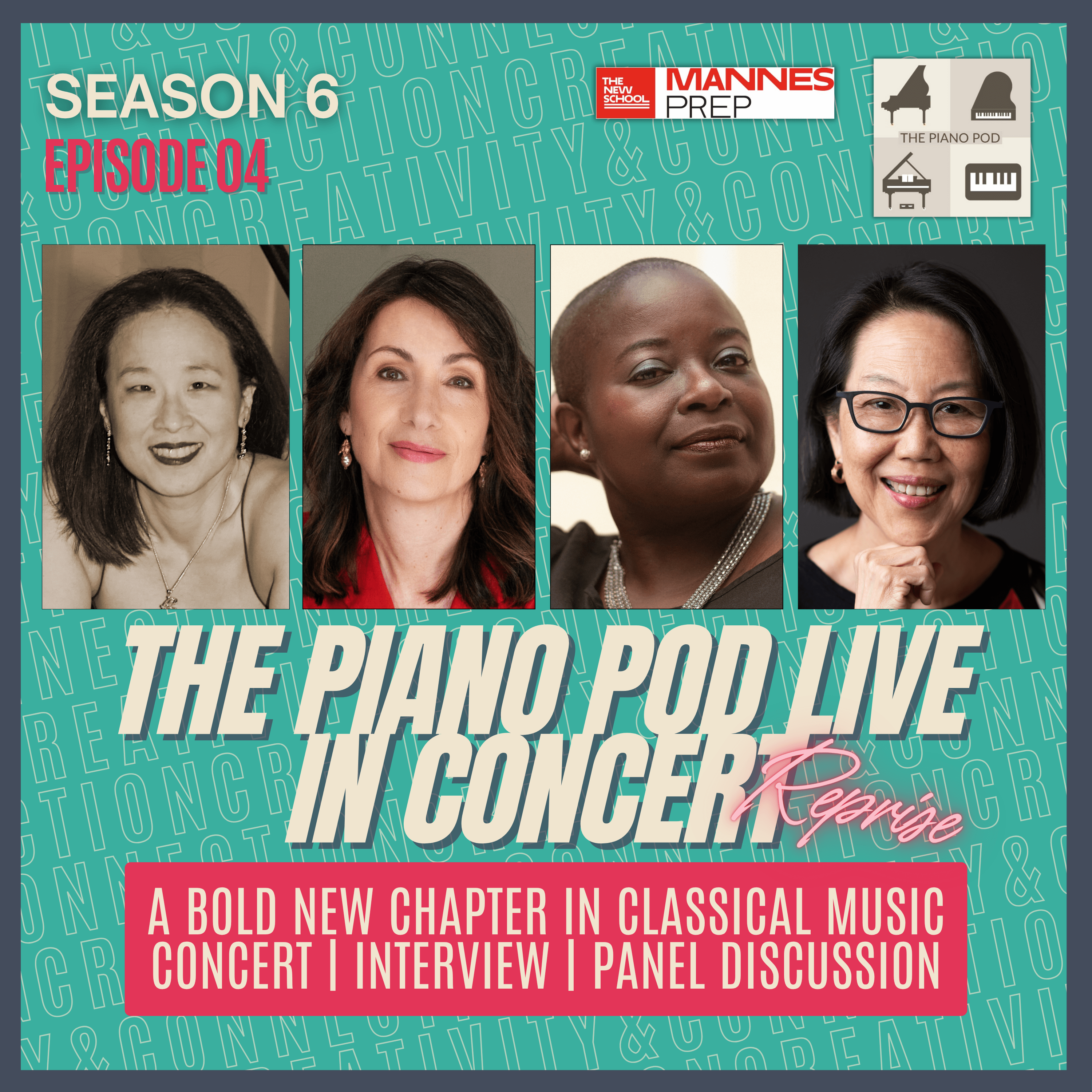
The Piano Pod - a global hub for innovation, education, and connection in classical piano music· Staffel 6· Folge 4
🎬 TPP LIVE IN CONCERT REPRISE | Recorded Live at Mannes Prep, The New School
Mittwoch, 29. Oktober 2025 · 1 h 36
Kapitelklicken springt direkt hin
Shownotes
Got something to say to this podcast? Send a voicemail, and you might hear yourself on the next episode! (rss.com/podcasts/the-piano-pod/voicemail)
The Piano Pod Live in Concert: A Bold New Chapter in Classical Music marked the first-ever live event for the award-winning podcast and YouTube show The Piano Pod, conceived and hosted by Executive Producer Yukimi Song. Presented in collaboration with Mannes Prep, a pre-college music program offering comprehensive and nurturing pre-professional training at The New School, this milestone concert brought the show’s signature format — music performance, interview, and panel discussion — from the digital space to the stage.
🎹 Featured Artists
• Dr. Jee-Hoon Krska — Prelude in G-sharp Minor, Op. 32 No. 12 by Sergei Rachmaninoff 🔗 keystosuccessnewark.org
• Eleonor Bindman — her transcription of Bach’s Brandenburg Concerto No. 4 for piano four hands (Secondo: Yukimi Song) 🔗 eleonorbindman.com
• Dr. Nnenna Ogwo — The Sun is Rising by Black American composer Consuela Lee 🔗 juneteenthlp.org
• Donna Weng Friedman (@donnawengfriedman9968 (studio.youtube.com/channel/UCrvHls4j5_NPU00C01…) ) — Fantasy on The Wizard of Oz by William Hirtz for piano four hands (Secondo: Yukimi Song) 🔗 donnawengfriedman.com
🎙️ About the Event Filmed live at Ernst C. Stiefel Hall at The New School, this 90-minute event blended world-class performances with an engaging interview session and audience panel discussion. The artists shared personal stories, insights on collaboration, and visions for keeping classical music vibrant and relevant today. 💬 Special Guests Caroline Sonett-Assor, Director of Mannes Prep, The New School Audience members and artists in conversation
• 🎥 Video by: Scott Chiu, Portable Recording Studio (portablerecordingstudio.com)
• 📸 Photography by: Vin Carvalho (thephotoartstudio.com)
✨ Presented by: The Piano Pod — Where tradition meets innovation. In Collaboration with: Mannes Prep, The New School Produced by: Yukimi Song Studio LLC
#ThePianoPod #MannesPrep #LiveConcert #ClassicalMusic #PianoPodcast #ConcertAndConversation #PanelDiscussion #CreativityAndConnection #DonnaWengFriedman #NnennaOgwo #EleonorBindman #JeeHoonKrska #YukimiSong #TheNewSchool
Transkriptvom Podcast bereitgestellt · Zeitmarken springen hin
Hello friends, welcome to a new episode of the PianoPod. And this one is a little different, because it comes straight from our very first live event, the PianoPod Live in Concert, which took place and was recorded on October 4, 2025 at Stiefel Hall at the New School in collaboration with Manus Prep. This project had been cooking for over a year, and it finally happened. For me, it was truly a dream come true, a moment where I could bring together all parts of my background in piano, education, and journalism broadcasting. Those live hosting chops had to be dusted off, but after years of producing this show, I felt completely at home on stage again.
And oh boy, so many people showed up. The hall was full of energy with artists, educators, students, and longtime listeners coming together to celebrate creativity and connection through music and conversation. A huge thank you to Manus Prep and their director, Caroline Sonnet Asser, for their partnership and generosity in making this collaboration possible.
And of course, to Donna Wang Friedman, who was not only one of our featured guests, but also one of the show's biggest supporters for connecting us and helping us this wonderful collaboration come to life. If you are new to The Piano Pod, please visit thepianopod .com and follow us on YouTube, Spotify, or Apple Podcasts to catch more inspiring conversations and performances.
And now, please enjoy this special episode, The Piano Pod Live in Concert, a bold new chapter in classical music. You are listening to The Piano Pod, where we talk to the brightest minds in the industry about how they are bringing the piano into the future and thriving in a complex, ever -evolving world. Good afternoon, everyone, and welcome to the PianoPod Live in Concert, a bold new chapter in classical music. My name is Yukimi Song, and I am the host and the creator and executive producer of the PianoPod. It's an award -winning podcast and YouTube show that I started in 2020 that amplifies candid conversations with leading artists exploring how classical music stays relevant, human, and connect it to
modern audiences. It's such a joy to see all of you here. I can't believe you guys are here. It's a dream come true for me, and you are making the piano part history with me. So thank you so much for being here. And I also want to make a quick shout out to those who are tuning in later when this event becomes an episode. You are definitely with us in spirit. Now, years ago, I was teaching piano door to door, literally running around this neighborhood like a crazy maniac person. And at one point, I had over 40 students a week. It was survival, and I survived.
But it gave me the front row view of how music education was perceived. And I couldn't notice the disconnect that I felt. And as musicians, we understand that the discipline and daily practice lead to growth and ultimately transformation at any level of learning. But to many families, the piano lessons are simply an after -school program for their children. So in the meantime, I also kept hearing among fellow musicians, fellow pianists, that, oh, classical music is dying.
It's dead. And also, I've read a few articles expressing that sentiment. So those contrasting perspectives, what I was witnessing as a teacher and hearing from my peers, made me question whether my vision was outdated. And you know, in our field, often we... feel detached from everyday life, and then the voices of educators and performers like myself can easily go unheard. So out of desperation, in 2020, with a microphone in my hand, with one mission, I launched the PianoPod and hoping to get some answers from my fellow pianists and then fellow music educators. I also wanted to merge my background in piano and teaching and journalism into a space where musicians can share stories, struggles, and passions without
any judgment. And my goal was, and still is, to bridge the gap between classical music and modern audiences, making what we do relevant, impactful in the communities that we serve. Since then, I conducted over 100 interviews. From Grammy winners to Steinway Yamaha artists to innovative piano pedagogues to neuroscientists. And, you know, what I discovered is that this industry is very much alive. It's not dying at all. It's actually evolving to something different or maybe keeping the same tradition but presenting in different ways. Buzzing with... daring and inventive voices, that discovery, inventive voices. And then that discovery truly encouraged me profoundly.
And then today I'm standing in front of you after five years of dreaming about this and for the first time live event, and I'm so grateful. And where I get to share that daring and inventive spirit with you. through extraordinary artists on stage today. I also want to thank you Manus Prep, a pre -college music program offering comprehensive and nurturing pre -professional training in the new school for hosting us today. And then I have been amazed by the state -of -the -art facilities throughout this building. And look at these fine instruments and the acoustics are amazing. So I walked around this building and then all the practice studios. have fine instruments, and the interior design of the school is so modern.
I love it. So discovering this truly brainwashed me, my excitement, to partner with Manus Prep today and as the school demonstrates their commitment to music education. Special thanks to Caroline Sonnet -Asser, director of Manus Prep. for her invaluable support, as well as other menace personnel I've got to work with in prep for this event.
Now, lastly, a shout out to Donna Wing Friedman. She is the honored faculty member here whom I adore, who is one of the great guest artists today for helping to facilitate this collaboration. Now, today, what we do is we bring together four pianist thought leaders. starting with Dr. Jihoon Kerska, Eleanor Byneman, Nena Ogwo, and Donna Wang Friedman. I have interviewed all four of them in the past, and each artist today embodies creativity, innovation, and a deep commitment to community. And those qualities are the very heart of our current season's theme, Creativity in Connection. Now, we'll start out with the four. performances back to back afterwards we'll sit down i'll sit down with all four artists
on stage and we'll have have an interview session afterwards now you get to participate by asking us questions so i want you to stick around till the end i won't i'm not going to make you uh stay for a long time so it's going to be a an hour event so please stick around now of the hall you'll find a table where you can find postcards and flyers from each artist as well as from the pianoforte please feel free to take them on your way out it's a fantastic way to learn more about what we do what each artist is doing and also to stay connected beyond today Now, let's begin our concert finally segment with Dr. Jihoon Kerska.
Her journey has taken her from Juilliard training to MIT, pursuing a career in electrical engineering. While she has also collaborated with world -renowned artists like Yo -Yo Ma, she is also the founder of Keys to Success, a program that provides free piano education to young people in New York. When I first spoke with her in Season 3, I was struck by her story and her vision, especially her powerful words on inclusion and what it means to truly connect with people, which had a profound impact on me, and that conversation remains one of the most memorable episodes of The Piano Pop.
Today, she will perform Rachmaninoff's Prelude Op. 23 No. 2 in B -flat major, a fiery piece perfectly suited to her passion. Please welcome Dr. Jihoon Kerska. her story, please visit season three. I believe it was episode 11 or 12. She talks about her organization and her life story. It's beautiful. Now, let me ask, how many of you are pianists here today? We'll play the piano.
Great. Wonderful. Now, how many of you love playing Bach all day long? Oh, great. One person. Yes. Thank you for being honest. I love the laugh. Well, I love Bach music too, but sometimes pieces like, you know, to be honest, the Volta and Proclavia is not always beginner friendly in terms of like listening. So, and then also learning to fugue is very difficult. Now, this is where our next guest, Eleanor Bynum, shines. Through her innovative Bach transcriptions and her widely followed YouTube channel, she has reintroduced Bach's most beloved works from the orchestral suites to the cello suites. to pianists worldwide. I'm especially delighted to join her on stage today to perform her transcription of Johann Sebastian Bach's
Brandenburg Concerto No. 2 for four -hand piano. Now, Brandenburg Concertos are among Bach's most celebrated orchestral works, filled with joyful energy and inventive interplay between instruments. And if you are not familiar with the term transcription, it simply means reimagining a work for a different ensemble. So today, please enjoy Brandenburg Concerto No. 2 arranged for four -hand piano.
Please welcome Eleanor Bindman. It's a challenging but fulfilling field. If you ever are interested, please talk to us afterward. Now, next artist shows us just how powerful music can be as a bridge to community. Dr. Nena Ogwu, who joined me in season four, is the founder of Juneteenth LP. Since our conversation, I've attended several of her concerts in New York, culminating each June 19th is a powerful celebration at the iconic venue, Joe's Pub. To truly understand what it means for classical pianists to connect with their audiences, you must experience Juneteenth LP's events in every June. Today, Nena performs The Sun is Rising by Consuela Lee, a trailblazing black composer whose work she champions. Please
welcome Dr. Nena Avro. Donna Wayne Friedman, who is no stranger to this Manist community as an honor faculty member here. And beyond her brilliance as a pianist, Donna is a storyteller who uses music and film to bring people together. Through projects like Never Fade Away and A Silent Cry, she has transformed deeply personal and cultural narratives into works that resonate far beyond the concert hall. She is truly a leader in our field. with a bold, innovative vision for how music can be used to tell powerful stories.
She and I will close this program together, performance part, with William Hurt's Wizard of Oz fantasy, dazzling forehand work based on beloved themes from the film. Please welcome Donna Wink -Friedman. At Manus Prep, we offer pre -college music training for students ages 4 through 18, from beginners just discovering their love of music to advanced young artists who may be preparing for collegiate music study. Each Saturday during the academic year, our recital halls and classrooms are filled with students rehearsing and performing in small and large ensembles, studying theory and ear training, practicing their instruments, and exploring electives such as chamber music, film scoring, musical theater, composition, As an all -Steinway
school, our young pianists can expect a practice that performs on the finest instruments. In addition to our curricular offerings, we program a wide variety of extracurricular opportunities for our students. We have regular workshops, recitals, master classes with esteemed guest artists, and hold yearly concerto competitions and faculty adjudicated creative showcases. What makes Madness Prep truly special, though, is our community.
create, collaborate, and discover their own artistic voices in a supportive and inspiring environment led by dedicated faculty. Our students are really incredible and they go on to do amazing things in this world. Whether you dream of dedicating your life to music or you simply love to make music, Madness Prep is a place where you can belong, learn, and thrive. you get to ask the question. I have one who is asking a question to each guest. So Jihoon, when you appeared on my show three years ago, what stood out most was your candid discussion on inclusion. You also spoke openly about witnessing stark disparities in access to quality music education in your area, not just limited to your areas. But even
between, you know, neighborhoods so close to each other, you see the stark difference. So what was the missing that pushed you to create Keys to Success? And what drove you to take that step? So maybe just what I consider my formative moments in my life growing up. So I was born in Malaysia. I'm an immigrant, came over when I was 11 years old. And just like most immigrant parents, my parents came over with huge dreams for what they wanted for their kids. And so my mom called up Juilliard and got us in touch with a wonderful woman. Her name is Olenia Fuski.
She was the director of the pre -college program back then. Ms. Husky is actually the person that made my immigrant story unique because she intercepted my life and put it on a trajectory that I wouldn't have been on without her, really. So with that background, fast forward. 30 years later, I'm very comfortable living in New Jersey with my beautiful family. When my first son was born, I realized that I started to realize the differences in people's experiences in America based on the zip code. I realized that I wanted my kids to know me. the way I grew up. And so we just started going to church in Newark, you know, where the airport is, which is only like 10 miles away from our neighborhood. But here's the difference.
In our neighborhood, New Providence, my kids were getting free music lessons starting from pre -K, instrumental music starting very early on, almost semi -private coaching, all free. And if we wanted to pay, We just went down the street. And there was, you know, well, private studios everywhere, for sure. But also community music schools that were real good. Meanwhile, in Newark, there was none of that. Under state control, all the music had been stripped out of the, and arts, actually, had been stripped out from the school system. And I saw the effects it had on the kids, starting at a very young age. You know, even first grade, there was differences in reading and math levels. And by third grade,
the levels in math and English were like several grades apart by that time. And so I also noticed something else in cities like Newark, which is that there's actually a lot of money going in for scholarship programs and building. state of -the -art concert venues, which is all very, very, very important. However, programs like that only reaches the top 1%, those that seem naturally talented. Meanwhile, 99 % of the 40 ,000 kids that grow up in Newark are not developed to their full potential. So I wanted to stress something different, something that addresses the 99%. After working in electrical engineering for 20 years, I changed paths and started a nonprofit, Keys to Success. Then tell us about Keys to Success
and what's so unique about the organization. So, I mean, on the surface, there's nothing that unique about it. We give free piano lessons in a group setting. We go into public housing. Maybe that's a little bit unique. You know, we go there every day. The reason we go into public housing is because there's a lot of kids there and there's a lot of other programs serving there. So it makes it, it's a captive audience. So as it turns out, I think most of us know, you know, the 10 ,000 hour rule, you know, you just need to practice and then you get good at it. So on the surface, that's what we do. But we're really not strictly a piano program. We're really about developing leaders. So the goal of our students in our program
is to become urban fellows within our program. So urban fellows are the teenage high school interns that work with us. They don't just fill out papers for us. They are actually the primary teachers that we utilize. Because, you know, for me to go into public housing, you know, when I don't live there, the barriers that come up, these kids are a little bit afraid. They don't know who I am. But when you have teenagers that grew up side by side with the younger kids and their moms know each other, the barriers, they don't exist. And the kids immediately learn.
And they also see themselves as they see the possibilities in another person. So that's one thing that's true. I would say it's unique about what we do. The other thing that goes hand in hand with that is we partner. And so you can kind of see that as mirroring my life. In my life, my parents were my champions. Actually, my mom, who never played above like a grade three level, and her sister were my primary teachers for three years. Teaching is at home. And then, you know, partnering with Miss Husky, who is a world -class pianist, opened up doors for us.
So it's like both the at -home concern and world class partnerships. Yeah, and then you can learn more about, I mean, I wish we had more time to hear her story, but you can check out season three, episode 11 or 12 that she appeared, and you can go to thepianopod .com. And also, if you want to learn more about her organization, please go to keysnewwork .com. Thank you, Jihoo.
Thank you. So Donna, Thank you so much for playing today with me. Oh, yeah, always fun. I'm so sorry. I have to go teach, which is why I'm going next. Now, Kuju, I know I interviewed you in season two, and since then, so much has happened to you and wonderful things. Yeah. Yes. But can you tell us about this multi -award winning film, Never Fade Away? I know you hinted the idea in that episode we discussed, but can you tell us?
Well, Never Fade Away is my father's immigration story. I never intended to make a movie because I'm not a filmmaker. I'm a musician. But during the pandemic, a lot happened. I think hate crimes against our AAPI community were rising. I was assaulted in the park while walking my dog. And it became very important to me to share stories.
of heritage, not just of Asian Americans, but of everybody's, because I do believe that these stories connect us. Our stories of heritage are the ties that bind, because we all come from somewhere else, and we have, whether it's your mother, your grandfather, your aunt or uncle, their bravery, their courage to come to a country where they didn't speak the language, didn't have any money, And they made sacrifices for all of us so that we could have better lives.
That's what this country is all about. So during the pandemic, when all these things were happening, I started creating programs with WQXR, the National Women's History Museum, to share stories of underrepresented musicians, musicians from underrepresented communities, women, our BIPOC communities. And then finally I started sharing my father's story, and I was overwhelmed by the response. People were writing in to me. I was doing this online, virtual performances, and people were writing in to me, that's my father's story too, that's my grandfather's story. And so the story involves, it's basically about how he came to this country with nothing but his hopes and dreams, and how a radio and a waltz
changed his life. And that waltz became pivotal because that was, you know, our connection. It was a very special Chopin waltz. So when the doors started opening, I started telling his story and playing the waltz. And then through my dear friend Stefania DeKennessey, who is here today, the composer, I went to hear one of her pieces performed, choreographed by Ariel Grossman with the Ariel Rivka Dance Company. And it was so breathtakingly beautiful. I asked Arielle, I said, would you consider choreographing the waltz so I can tell the story with dance? And, you know, Arielle's amazing and she only really choreographs for living composers. But when I told her the story, you know, it resonated with
her too. So she did that. We started doing that in person. And I think that's when we first met, right? You came to one of the first concerts. And then after one of these concerts where I told the story and had the dance and it was beautiful, a woman came over to me and she said, you really have to make a film about this. She was a filmmaker.
And I said, oh, well, I'm not a filmmaker. She goes, no, you really should think about that. So I started thinking about it. And I started thinking, okay, well, I'll just do the story and maybe film the dance. And so I started setting up, you know, a space to rent out the space. And the dancers, I asked the dancers who had been working together with me if they could do it. And the male dancer, Jesse Obramski, who portrayed my father, who was phenomenal. He couldn't do it that day. He was on tour. And I'd already put the deposit down for the space, and I was going, oh, my God. And then I thought, you know, why not ask my friend who is the pianist for New York City Ballet? You know, at my age, I'm
not afraid to get no's. So I said, do you think you could make an intro to me to Chen Wei Chen? Chen Wei Chen is the first... ever uh principal dancer of Asian descent at the New York City Ballet in 75 years they never had one so he he he is it and he dances like oh my god it's so beautiful but so Alan said sure made an intro we had a lovely conversation and Chen Wei said send me the script and I did and then two days later he called me this is my story too I will do this And after I gained consciousness, I realized that if I have someone like Chen Weichan on board, I better not make it this four -minute little thing. I better expand it a little bit. But, you know, expanding it means funding and all
that sort of thing. So I did. So I literally made this little film from the back end because the dance comes at the end. And then I put in the story of why my father left China. the reason why he was forced to flee. And then I added another little beginning part about my mom and some very fun personal things. And I asked Chun if he would kindly improvise the middle section when my father is first in this country, and he did. So it was the most personal project I've ever, ever made, I think. I cried every single day because my parents are not with me. And it was like bringing them home again. And I wanted to do a good job for them. I'm sorry, but it's so emotional. So every single day, putting this together was like
a rollercoaster of emotions. And finally, it was screening at NYU. for the world premiere, and I told my husband, I said, I'm pulling it. I'm not going to have it shown today because I'm not a filmmaker, and why would I think anybody would want to see a film about my family? And my husband said to me, this may be your first film, but you've been telling stories all your life through music. And that's what you do. And everyone has a story, and you need to share this tonight. And you can't back out. And he's been such a great supporter. So anyway, I went through it. I don't even know if I breathed, but got through it. And I'm very proud of this little film, because since then it's won 46 awards and
film festivals worldwide. It's streaming on PBS, Rhode Island, so you can see it on Arts Inc. if you like. It's only 12 minutes. Again, I'm not a filmmaker, but this story meant a lot to me. Then I was just literally blown away when I had received this invitation. Now, Never Fade Away is archived at the Statue of Liberty at Ellis Island in perpetuity. That shows you who you are, and then that filmmaking bug got you, and then you've made another one in Silent Cry.
I know you have so much to say about the film, but as of now, when we were in the back room, she was like, oh, I won another award. What I do want to say about Silent Cry is I never meant to make a film for this. It's just that the music was so great. And I do want to talk about, just for one more minute, about the music. I recently recorded Microvids by Stefania DeKennessey, who is with us here today. And she wrote Microvids during the pandemic, too. I think a lot of us became very creative during the pandemic. We had space. Yeah, we had space, but we also had motives. We had motivations. Stefania's motivation was she was thinking about young people. Teens and tweens, how they were coping during the pandemic.
Very tough time, you know. And so she wrote 19 miniatures, each one reflecting a different emotion that we were all going through that time. But, you know, in particular for this age group, I call it classical music's answer to TikTok because each miniature is 20 seconds to one minute in length. In any case. We have this album. It's on Spotify. And the 15th one, Clouds, the first disc, we had the great, great violinist Curtis Stewart, who is a Manus Prep alum. And he, six time Grammy -nominated violinist, improvises like nobody's business. And I said, Curtis, would you improvise with me on this album? And with Stefania's blessing, of course. And it's outrageous.
It's so beautiful because he adds jazz. It's like a mixture of classical and jazz, what he does so well. Number 15 is Clouds. I could not get it out of my head. I just couldn't. It was just so powerful that I decided to put some visuals with it. My daughter is in AI, and I saw her post something on Instagram that was interesting.
I said, can you create this into a globe, a spinning globe? So I started with that imagery, and then I was reading about different things about saving the planet and our equilibrium in the Appalachian Mountains. And I started reading about these stories and I said, you know, I really want to just have a little message here. And if there's nothing else to say, it's about the importance of preserving what is irreplaceable in this world.
And so I put together this two -minute little film. I call it A Silent Cry. If you ever see it, you'll understand why. And I did it just because I felt like it. And a week later, I put it into, just for fun, a film festival. And it won. And on Thursday, it received its 30th film festival award in three months, which is crazy.
And it's up for, well, it's been submitted to the Grammys in the music video. section, which, you know, I have absolutely no expectations. I just want to raise awareness that classical musicians don't really, you know, are not really part of that category, and we should be part of every category. So my little film in my name was right underneath David Byrne, Coldplay, Rihanna.
It's kind of cool. I'm proud of you. Thank you so much. Thank you. Thank you so much. Elena, thank you so much for performing Brandenburg with me. It's her transcription. So you've dedicated years to arranging Bach from, you know, Brandenburg duets to cello suites for piano to stepping stones for Bach. Could you briefly introduce your Bach transcriptions? What drew you to transcribe his orchestral instrumental music for piano in a specific niche? I'd love to do that, Yukimi, but before that, I'd like to take an opportunity, in case it doesn't arise anymore, to thank you.
We know how much work you put into this event and how well you've done, and that's in the middle of all of the other podcasts and scheduling December ones and everything else that you do. playing with you with a sheer pleasure. You're amazing. So it's just unbelievable how much talent and how many hats you wear. Thank you. Thank you.
And as far as my work, it's funny, I'm not tempted to talk about my heritage because I'm also an immigrant. But the Bach work is very much a part of my cultural heritage, starting in the Russian piano school back where I'm from. and my transcriptions came about just out of a very selfish desire to be able to play them. I've done transcriptions prior, and of course, as many classical musicians have done, Rachmaninoff transcriptions, Liszt transcriptions. I always enjoyed the feeling of transmitting other instruments, and preferably an orchestra, just a very different feeling than just playing something written for piano. It's almost a different, not almost, it's a different mindset. And I also loved playing duets, and
I had a piano duet partner with whom we tried the existing transcription of the Brandenburgs, which just unfortunately, much to my really shock, it just was not playable. Well, it wasn't, yet it was on people's shelves, and since having done the Brandenburgs, I've had many kindred souls write to me and say, yeah, no, you just can't play the rigor. I thought that we really need this body of work for the piano duet repertoire by Bach, the six concertos done. And long story short, I ended up redoing them. And it took a very long time, but it was extremely gratifying to play. And in between the three years that it took me, between starting and making the recording, an adult amateur friend of mine asked me about
a particular... beginning of one of the cantatas called gotes zeit which a lot of people play and she said i just can't find a transcription that i like they're either too hard or they're too easy or i don't like them so i looked and i didn't find anything either and i did a little two -hour thing and then i played that and it was really satisfying to play and That really gave me an understanding that what was missing in the repertoire, especially transcriptions, is our ideas about transcriptions are that they're either virtuosic, thereby only playable by 1 % of the piano elite, basically, who usually make them for themselves. or they're too simple and they're missing the essence of the work,
or they're, you know, quote -unquote cheesy. So I ended up also, as far as COVID, I did my stepping stones to box set, which made me appreciate how much people needed it because as people were in lockdown, I had these 48 one -page transcriptions of box. excerpts from his cantatas or other instrumental works and I made them available to people from my mailing list so every week there was a new piece that they could practice because there wasn't that much to do and I got so much great feedback and so much appreciation and that made me realize that there's a hole in the adult amateur repertoire for pieces, not only by Bach, but especially by Bach, that they can play without having to work very hard, without all the frustration
of putting the counterpoint hands together. And in general, I began to understand how important adult amateurs are in the music business, you know, in the classical music. because they're the concert goers, they're the ones who are listening, they buy the records, they collect. And yet, as far as literature, they very often feel very frustrated because they cannot be as good as Horowitz or Yuja. And it's just kind of the state of mind. So that took care of that. There were a few other cycles I kind of got going, and it felt, like the ladies were saying, it felt to me like it was the right thing to do. It was not anything that I set out. Then I did the cello suites, which turned out to be the most interesting
focus into Bach's writing for one line at a time and really gave me so much insight in his structure. So I never looked at his keyboard. real keyboard works with the same eyes because it gave me a huge understanding. And I understood that there's also a shortage of simpler Bach repertoire that's even easier than the depart conventions that people could enjoy playing. So then there were the orchestral suites as a sequel to the Brandenburgs and then the lute suites which just came out this March. So that's my... Bach transcriptions.
And I really enjoyed playing your transcriptions. And by the way, Eleanor generously printed out a score of orchestral suite. The Badinuri, very popular movement from orchestral suite. For you to take home and you'll find them. You're welcome to take that home. Yes, and then you can try them. And if you try, I want you to video record it and tag the piano part so that I can just watch it. All right. Now, one more question for you before. You know, you are reaching out to adult amateurs, and then I got to know you through one of the biggest fans of yours, and he recommended me to reach out to you. So how do you reach out to these markets? So what are some creative tools, approaches you use to help adult amateurs connect
more deeply with the music? Well, the transcription themselves, and that's something that is kind of... two -way street because they already know and love the music and they're able to play it. And I create playlists of the originals of those transcriptions so that they can listen on Spotify or they can listen on iTunes or however they listen because all the recordings are streaming and they can... take part of that. And, you know, finally, I have this little Bach action figure that really makes my videos extremely popular.
And I think adults see that and, you know, whatever childlike quality we all have, it kind of brings that up and they just enjoy things more. So I think, you know, using this, the idea of enjoyment, which is, we all could use a little more of these days as opposed to this. you know, very serious and sometimes a bit of drudgery of practice before you actually get somewhere is just something that I think we're lacking. And also for piano for younger students, as you were telling me, a lot of times young students are, they think it's very serious to play Bach and there's no emotional connection. So it's the emotional connection that Bach's other pieces are so different from his keyboard music. Yeah, absolutely. Yeah, more
melodic. more melodic and the brand he wrote he was very young and he wrote them for fun he didn't write them for church service it's just a very different body of work it sounds so different and then you told me he just like me he wore lots of Hats, right? Yes, he wore a lot of hats and wigs. Oh, that's right. Oh, I don't wear wigs. No, no, unlike you. Well, you know, I'm comparing myself to Barbara. I shouldn't have done that. Anyway, well, thank you. If you want to learn more about Eleanor, please go to EleanorBindman .com, right? And then also, I forgot to mention that DonnaWangFreedman .com if you want to watch her films, and then also you can... Check her out, her films on YouTube as well. All right,
Nena, finally. Oh, my goodness. Now, I want to know a lot about Juneteenth LP, but before that, just quickly tell us about the piece that you performed, Consuelo Lee. The powerful performance. Oh, my gosh, that piece was amazing. It's a beautiful piece. I do a lot of work with... The American Composers Alliance, I've become dear friends with their executive director, Gina Genova. They have a wonderful, dedicated staff that has been doing amazing work preserving and archiving and engraving the works of Black composers of the 20th century that are in their archives. And so she introduced me to Consuela Lee's work.
And she told me to check out Ray of Light and this piece, which is a transcription of a performance that was done in, I think, the early 80s at Baruch. And I played Ray of Light maybe two years ago at Joe's Pub. And I was fortunate that her daughter was there. And she gave me a rare recording of her mom's. And she told me a lot about her mother.
And the transcription was interesting because, you know, with transcriptions, and especially as pianists, you know, when you have a recording of, you know, Ravel playing Ravel or Rachmaninoff playing Rachmaninoff, you know, there's a thing attached to that, right? But it's Rachmaninoff and then there's a score that he wrote. But this was a transcription of an improvisation. And we know that there are bits and pieces of paper with these ideas in her estate, in the collection of her papers, but we have not yet found a completely written out score. So this is effectively a jazz improvisation that is, we have this transcription.
And so there's a recording of this performance. And so what do you do with that? And I was so cognizant of the fact that it was a very specific kind of thing that I was going to be doing. And then I was going, and I had heard it, and then I said I was never going to listen to that recording again. Because what I didn't want to do was copy what she did. Because even though that is absolutely how she wants it to be played, I also felt like...
If I was going to respect her as a composer, I actually should do the work of interpreting her compositional intent. Because she's actually a brilliant composer, and I have her actual written compositions to attest to that. So what I did was I looked at the score of it and started to say, okay, what do these melodic figures mean?
How are these harmonies moving? How does she develop ideas? How does she move? How does she structure these things? And then I decided what that meant. And so if you listen to her recording versus what you heard me do, it's actually very different. But I think that I rendered her intention. I believe that I rendered her intention. It's just that I played it differently, as one should, because I am not Consuela Lee. I also don't have her jazz chops at all. And I think that, and that's one of the things that there's going to be another edition of the score that comes out where I actually talk about the unique space that this particular piece exists in where the pianist that chooses to play this is going to
have to, you have an added responsibility of, you can't be lazy. You have to actually interpret. I mean, you could copy what she does. But I would hope that we're raising pianists to do more and better than that. But it was a real joy to engage on that level. Brilliant, brilliant piano piece and brilliant performance. Thank you. So let's talk about Juneteenth LP. I've attended so many events, the Juneteenth LP events. Wow, incredible.
The last one was last June. It was the 10th anniversary at Joe's Pub. I mean, I don't usually go to the concert raising my hands, that kind of guy, but I was doing it all by myself. It was so good. So tell us about Juneteenth LP, what you do, what's your mission? Our mission is to change how people experience classical music. We want to make... classical music more accessible to as many people as possible. And because I'm a black person, I want black people to show up in concert spaces. But that doesn't mean I only want black people to show up in concert spaces.
But I'm keenly aware of the fact that I spent my whole life being the only black person in a classical music hall and the only black people in the audience were my relatives. Unless there was one other black person performing, and then it would be also their well -being. But what I think is interesting is that classical music, for me, was something that I grew up with because my mother grew up with it, and my parents met at Howard University, and that was all very exciting.
But my father was a very interesting Nigerian immigrant. He took a musicology course, an introduction to... Musicology. And he fell in love with, of all things, Renaissance counterpoint, Bach, and Beethoven. Those three things. Like he landed on that and he landed hard. So I grew up listening to Lasus and Palestrina and Bach and Beethoven.
I knew all the symphonies by the time I was five or six. And I knew, I didn't know how much Lassus and Paulistrina I actually knew until I was taking a two and three part counterpoint class. And I was like, why do I know this? And my mom was like, oh, you didn't know that your dad actually played motets all the time? And I was like, no, I don't know that, but okay. And so, I got a little distracted, I'm sorry. My point being that, so I grew up with those sounds, but what I find is that when you grew up listening to classical music radio stations, you know, they're very much like, you know, this is the most wonderful music in the world, and, you know, great music, everybody loves great music. And I'm like, yeah,
no, not all classical music is actually music that everybody loves. Some music is really clearly visceral. And everyone does respond to it. Like, it doesn't matter who you play the Rite of Spring for. Everyone goes, what is that? You know, like, because everybody responds to the sort of, like, tribal, earthy, we're going to sacrifice some blood today. You know, it doesn't matter where you come from. It's very clear someone's going to get killed because spring is coming, right?
There will be blood, right? You know, I'm sorry, you can play a Clemente Sonatina and that's just not going to reach everybody on the planet. Like whatever Clemente is trying to offer you, it's not going to reach everybody. But if you grew up with Clemente and you love it, then of course that speaks to you. And so I wanted to sort of create this environment where I explain to people that no matter what it is you love. We're going to find a way to bring you to this music. And you're going to understand that there are all these avenues by which you can appreciate it.
So if you grow up, if you're a grandma that grew up loving Stevie Wonder and Marvin Gaye and Gladys Knight and the Pips, we'll play some of that. And you're going to understand that. You're going to understand that. that the other composers that we play that are writing classical music, these black composers, they also grew up loving that music, or their parents grew up loving that music, and that they actually like... They write and they actually write that stuff into their music. Not literally, but they're feeling that and they're writing like blues inflected music and soul inflected music. And it's not obvious necessarily, but sometimes they'll slip in like a little refrain from a spiritual or a little
refrain from a, you know, whatever. And sometimes I'll be rehearsing with my friends and I'll be like, does this baseline remind you of, you know? of this Delphonics tune, and we'll be like, oh my gosh, it does! And we don't know if that's really what's happening, but we're kind of listening with this. All of the people that we love, these black composers that we love playing, we realize that they actually grew up listening to the music that we grew up listening to. So when we program, we're actually, we're sort of making it an educational experience, and we're saying, these people love the music that you love. And they're actually relatable in all of these ways. And we program it so that they get to experience the music that
they love, and they get to hear a little bit of Lizzo, and they get to hear a little bit of, you know, Chateaubriand, and they get to hear a little bit of Duke Ellington. And on a multi generational level, they get to have this concert experience that's sort of wonderful and kind of wild and crazy. Like, I remember, I mean...
I remember one year playing Lil Nas X. And it was kind of wild because people were like, what are you doing? And we were like, you like that, don't you? Because back then it was pretty fresh. Yeah, but the great thing about it is that all the musicians are classical musicians. And they're playing all these wild, wild music. Oh, so great.
The Afropop. Thank you. If you want to learn more about Juneteenth LP, please go to juneteenthlp .org. And every June, she has this amazing event. So please attend her crazy, amazing events in June. And then, yeah, a couple years ago, I remember particularly at the Metropolitan Museum of Art, you performed. It was so great. Anyway, I know we have more time. I wish we had more time. You're right. It goes 90 minutes. I was wrong. So anyway, if you have any questions to an artist, I can give you the microphone. Do you have any questions to anyone? Yes. Excuse me. Thank you so much.
I really recently read a text that was talking about what makes language memorable. And there was an emphasis on credibility. And there was an emphasis on surprisingness, right? Something unexpected. And what you said about... Our reference with music really captured me, and I would love it if you would just kind of reflect on how we can make music more credible to people. As a teacher or as a performer? Hearing in what you're saying that you're developing a different level of reference for music for people as part of their experience that can really last over time.
And I would just love to hear a little bit more about how you're creating that experience. Well, I know that for me, I feel like programming needs to hit on a lot of different levels. And it depends on what you have available to you. So, for example, our Juneteenth Festival, we do a lot of different kinds of performances. Like we will do a completely classical performance at the Dementa Center.
But we're also starting this creative intersections concert series where we will perform. For a brief bit of time, like 20 minutes. But we're going to invite, we're inviting a writing workshop facilitator to come. And it's actually her idea. I'm not, I didn't think this up. It's her idea to use our performance as a writing prompt. And so the guests, our concert goers are going to have the opportunity to use our performance as a prompt for their creative writing exercise.
And then we'll play for five minutes, they'll write, and then we'll play for five minutes, and then they'll write. And then what they'll have an opportunity to do is take the microphone and read their writing. And so what we'll get is this really great interaction where, I don't know if any of you guys have read John Burr's, is it Burr? Ways of Seeing. Well, he posits that we don't have control of things after we send it out into the world as artists, right? And so you can intend something to be received in a way, but there's no guarantee that that's what happens. And so now what we get is this opportunity for artists to respond creatively to what we just did. And so we're going to have that, and
then we're also going to have them a different concert where they get to be. respond um artistically like they get to draw or paint and then what we're going to do is we're going to play some of those pieces at the dometic concert and then we're going to display their art and their writing at joe's pub in the vestibule so we're going to create this like creative community that grew out of responding to our performances and then we're all going to be in community at the final show which is new for us right but we feel like in that way we get to like lessen the distance between performer and audience, which I think is also important because there's a lot of like, oh, the artist, and then we're out here and we
pay for a ticket. I think that's one of the ways that we can do that. But I also feel like every season we're trying something different. I don't know if that answers the question. Thank you. Sure. Anyone else? This is for Eleanor. So you were saying that when you were transcribing the cello concertos, you understood something about Bach. I want to know what that was. Thank you.
I would have talked about it, but we're short on time. I was actually describing the cello suites by Bach, and they are essentially very bare bones. It's just, as you can imagine, the cellist usually plays one note at a time, and then there will be some double, triple stops as chords. There are six suites, so there's a total of 36 movements, and it fills up a whole CD. So also because I was recording them, not only transcribing, I really needed to, as you were saying, to internalize them. I needed to understand what they are and how I can transmit them on the piano. So Bach's music essentially is best defined by structure. What we respond to with some Some people don't really respond to Bach because it really takes a certain region
of the brain which really understands structure and symmetry and non -verbally. So the complexity of Bach is usually overwhelming when we hear it, when there are many voices. But when you look at one voice, you can see how he structures one voice. and you see the smaller building blocks of each voice, and you see how it already contains the hidden counterpoint and the complexity. So for a pianist, as we're used to seeing a lot of notes, when we're looking at Bach, we're trying to manage everything, but as a pianist looking at his cello works and really just zooming into one line, it's really amazing. how much he does that way and then when you blow it up and play music that has more layers happening it just
gives you a completely different understanding and also a different level of attention that you bring when you play because we look at music And very often we don't really pay attention to what's going on because we're often thinking about what we're going to have for lunch or who's pinging us on our cell phone. But when you understand what every little nook and cranny in his lines really contains, then when you play more, it's really like more of your brain lights up, I guess, as they say in videos. Did you look at the chaconne when you were... Yes. The violin. People tell me I should do the violin works, but I don't like the higher register. I don't think people could go through a CD's worth of higher registers.
I love the cello suites and that particular timbre. Just one suggestion for your audience. I'm one of them. I would love to hear more about this. Hear what? This explanation? I have recordings of all of my sets and on my website I wrote extensive booklet notes to every CD. So I actually... The cello suite's booklet notes were the hardest thing I feel I've ever done as far as writing because I felt I had to justify... playing them on the piano. I actually had a rash for like three weeks, literally, because I didn't know why I had it, but it was because I felt so daunted to explain what this is. So it is there, but thank you for asking. Did you mean like a podcast?
Did you mean like a podcast? This question is for Dr. Kerska, but potentially for all three of you. So I grew up playing classical music, not piano, but violin. And one thing that I found is that most of the people that I played with, even those at a pretty high level, there came a day when they turned 18 or maybe 21 and they kind of stopped playing. And so I wonder for you and maybe all three of you, how do we get people to continue to play? if they don't pursue it professionally? That's a good question. I think music has to mean something to you. I do think the way classical music has gone, it's become very technical, and I find it unusual to find a person who will actually have a story going on in their head that is meaningful to
them when they're playing a piece. I think, and it does, I mean, at least for me and my daughter also, who's right here, it comes a point when it has to mean something to you. When it means something to you, then you won't stop. But if it's just about competitions and, you know, that's, you're going to get tired and you're going to be so relieved when you don't have to do it anymore.
May I say something? When I first get a child and we're at a grand piano, the very first lesson is I put them on a little step stool and I open up the piano and we compose a piece using the inside of the piano. And we bounce balls and we, you know, the pedal and paper and we, you know, thunder and lightning and this, or we make a spooky Halloween story or whatever. And the first thing they learn is that you... You can make a story with this instrument in all kinds of wild and crazy ways. And their eyes get really big. And all I say after that is every piece that you play is a composer trying to tell a story. And your job is to help them tell the story, like make the story come to life. That's
what your job is. Loud sounds and soft sounds, that's what your job is. And all of a sudden they have all of this reverence for the act of music making. And our job as piano teachers is to make that feel special and alive and exciting every single week. And to work with whoever else they're working with, their choral teacher and their composition teacher and their theory teacher.
And we should be like making them like improvise from then. And I can't tell you how hard it is to get that to happen in these institutions. It's very, very frustrating. But I think that's how you do it. Like, we should be, kids should be improvising from the very beginning. From the very beginning. Because you can't, why are we having them, like, learning how to improvise to blues, a 12 -bar blues, like, when they discover the blues? They should learn it, like, at six.
It should be fun from the beginning. Why can't you rock out now? You know, why does it have to be later when your parents tell you about the Beatles? Come on. It's all fun. All of it. Sorry. I think related to, you know, what Nana was saying and also what you said earlier about making music in community. Yeah. I think when we discover that music actually connects us to other people in more interesting ways than we would possibly be doing without music I mean that's inspiring too and I could just briefly add something I wanted to there was a different question but we didn't get time but it's also playing together in the community I remember when I was five and I couldn't play yet and everything
was just like black and white what do I do I learned some little piece and my piano teacher just got up and she just started playing three hands with me right because I was playing with one hand and that moment of like Everything changed for me because I had no idea what I was doing, and I was like five. And then all of a sudden, there was music happening because she came and we played together. And that's my gripe with piano teachers is I know it's hard to schedule, but you need to have the kids play together, even if it's something different. And piano duets are very special because you're sitting with somebody right there, and it's just so much more joyful than... being the solitary, you know,
morose pianist who needs to practice for hours and hours. It's a different world now. You know, pedagogy needs to just open up to, you know, a new dimension. Thank you. Now we're coming to an end of this event. Thank you so much for really being an active participant today. Wow, I'm so impressed with this crowd, and thank you so much for coming. I hope you enjoyed the recording from the PianoPod Live in Concert, a bold new chapter in classical music. So what did you think of blending what the PianoPod does bi -weekly, music performance, in -depth interviews, and adding a live audience with a Q &A panel discussion?
It was such a joy to see everything come together in one afternoon. I truly hope to do this again next fall. And I am already in touch with several educational institutions, both within New York City and beyond, to make it happen. If you would like to support future live events like this, please consider making a financial contribution by tapping the PayPal link in the show notes.
Every bit helps us continue bringing music and conversation to more people. Many thanks to Manus Prep and The New School, especially Caroline Sonnet -Asser and Mary Catherine Blazek for their incredible support. Heartfelt thanks also to the entire Manus team for assisting us behind the scenes. And to Scott Chu and Brian from Portable Recording Studio for their expert audio and video work. And to Jenny Bai, my heroine of the day, for page turns and stage transitions. Special thanks to our photographer, Vincent, for capturing every beautiful moment of the event. And of course, to our extraordinary guest artists, Dr. Jihoon Kurska, Eleanor Byneman, Dr. Nana Oguo, and Donna Wang Friedman, whose performances, insights,
and presence made this concert unforgettable. To explore more, Simply scan the QR code on your screen, which will take you to the live event tab at thepianopod .com, where you will find each guest's story and bio. Season 6 of The Pianopod is just getting started under the theme Creativity and Connection, featuring more extraordinary guests and conversations ahead. Thank you for listening, and until next time, keep creating, keep connecting, and keep the music alive.
