

Kapitelklicken springt direkt hin
Shownotes
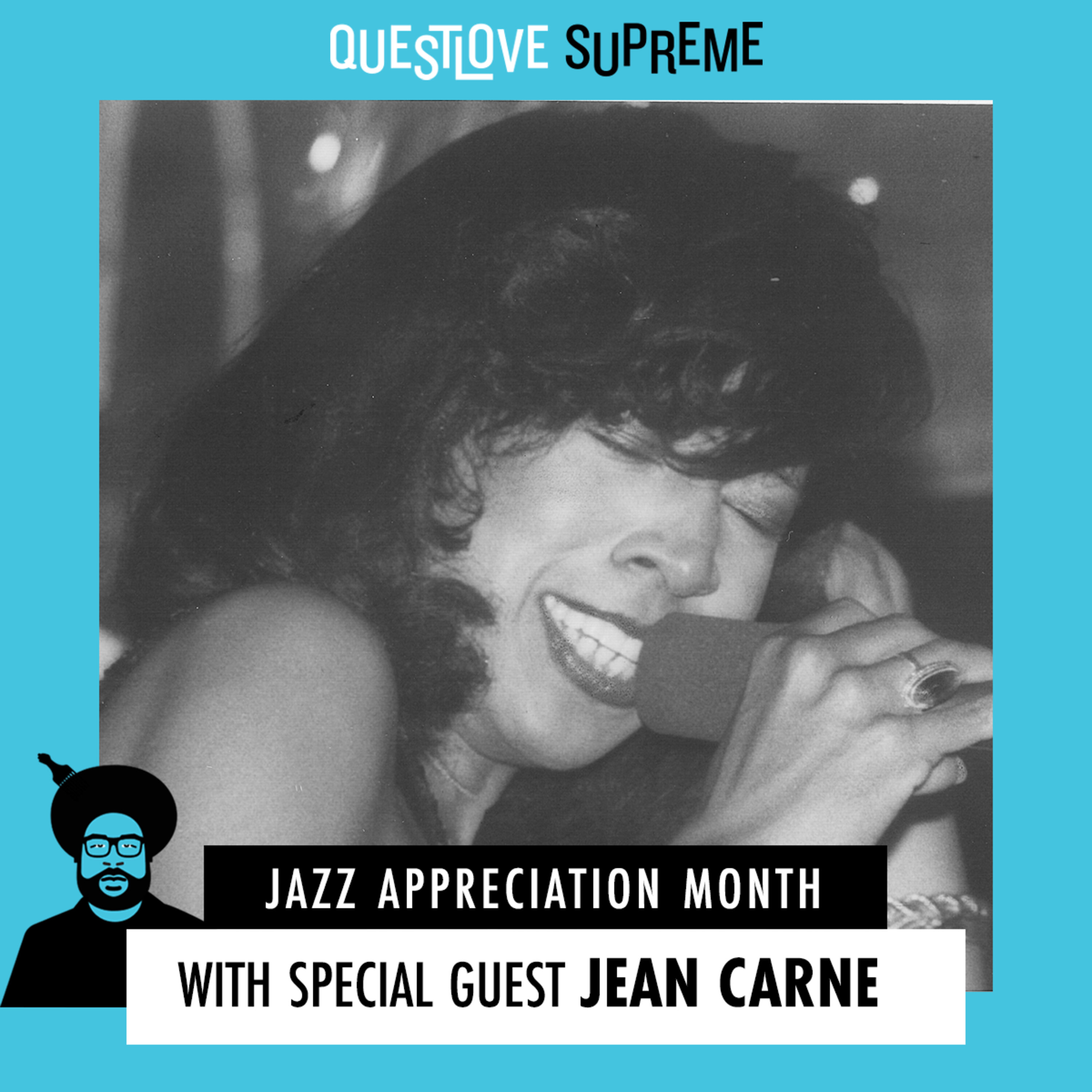
As part of 2023's Jazz Appreciation Month, the incomparable Jean Carne joined Questlove Supreme. She reflected on her Atlanta upbringing and growing up around figures like Dr. Martin Luther King Jr., as well as creating Spiritual Jazz in the early 1970s with her former husband, Doug Carn. Jean also shared stories from working with Earth, Wind & Fire, Phyllis Hyman, and Norman Connors—and recalls providing valuable vocal guidance to a teenage Michael Jackson.
See omnystudio.com/listener for privacy information.
Transkriptvom Podcast bereitgestellt · Zeitmarken springen hin
Questlove Supreme is a production of iHeartRadio. Hey, what's up, y'all? This is Questo, and you're getting another classic episode of QLS. So back in 2023, we spoke with the legendary Jeanne Karn. Jeanne is not only one of the greatest voices in Philadelphia, she's also been an incredible mentor to some of the many voices that we've loved throughout the years. And she talks about her journey... including her time in the spiritual jazz space, running circles with Earth, Wood & Fire, and so much more. Jean is really kind and gracious and an awesome talent, and she'd never let any of that go to our head. Get it? I love this convo, and I hope you do too. This is Jean Karn on Questlove Supreme Classic. Are you in like a 19
room mansion?
Stop saying that. This is my house. Just the last time we spoke, I was somewhere else.
But you have more artwork than any human I know.
Yeah, you've met my parents. So, yes, I do.
I got, shoot, I'm.
Surprised I don't got a picture of our guest on my wall somewhere.
Yeah. I see. Your dad gave me one at Bethesda.
Of yourself.
One of your Aunt Deanna and your dad and Melvin Lindsay. Ooh. Ooh.
Mystery voice.
Okay.
Who was that mystery voice? Hey, Steve, how are you, bro?
You know, if you delete something off an iTunes playlist, all you got to do is hit Apple X and it all comes back. You know what Apple X? You know, Command X? I mean, help your brother out.
Anyway. Oh, delete.
I leave early one day in 14 years.
Steve, yes.
And somehow a playlist gets deleted.
In the history of The Tonight Show, Sugar Steve has been a constant presence almost every day. And the one day he leaves, things don't fall apart. I kept things together. So, yes.
Oh, that was so cute. Things don't fall apart.
What's up, everybody?
How y'all doing?
Hey, Miss Jean. What up, Fonte?
It's a nice song title.
It was a good album title as well.
Fonte, hello. What's up, brother?
What's going on, bro? What's going on, Miss Jean? It's very nice to meet you.
Lovely meeting you.
Yeah, my aunt, she was a big fan of your records. And I would always go to her house and play your stuff. And I just always remember just your album covers. You just always look really classy, really pretty. And just always just a really classy singer. So it's really an honor to sit with you today. I appreciate it.
Oh, it's my pleasure. And I appreciate your aunt educating you.
Yes, ma'am. Absolutely.
Absolutely.
Ladies and gentlemen, our guest today is an extraordinary singer and artist, especially for those who grew up around the Philadelphia International Sound. I'm one of those people. I went to school right next door to Philadelphia International Records on Broad Street, way, way, way back in the day. Basically, our guest today, you know, I was introduced to her via my father's illustrious record collection. A lot of jazz in there. And of course, you know, the black jazz label.
And I will say that all the albums of our guest today and her former husband, Doug Karn, definitely played a major role in my personal growing up. Basically, just some of the best, what I call spiritual jazz. I mean, there's so many titles for it. Some people say fusion, spiritual jazz. I don't know what you call it. But there's also a point in the 70s when our guest today, became part of the incredible stable of artists that contributed to the sound of Philadelphia, helmed by Kenny Gamble and Leon Huff, with such legendary songs as, you know, Free Love and Don't Let It Go to Your Head and My Love Don't Come Easy. And then, of course, you know, the immortal Close and Then Close. Not to mention my
song was The Flame of Love. Like, there's so much to talk about. But, you know, April is Jazz Appreciation Month. And basically, our guest today, she makes jazz, she makes R & B, she makes disco, she does it all. And she's worked with all the legends. All the legends work with her. Kenny Gamble, Leon Huff, Jerry Butler, Eddie LaVert, Phyllis Hyman, Earl Garner, Billy Paul, Dexter Wanzell, The Temptations, Grover Washington Jr., Rick James, George Duke, just everyone. Ladies and gentlemen, please welcome, so overdue, Our guest, the incomparable Gene Carr into Questlove Supreme. Thank you very much. Yes, yes.
Thank you for coming. How are you?
I'm wonderful. How's everybody?
Doing well. Doing well.
We're great. Massive fans of yours, and I thank you for doing this. With a lot of our guests of late, just how the music industry is built, mostly celebrating... a certain type of mainstream artist and really not giving light or shine to artists of, I mean, I don't want to sound like the old grumpy music lover, but a lot of artists that have substance or something extra to give, you really don't read that much. I don't recall ever reading in-depth interviews with you at all, but I'm so familiar with your work, but you don't get to see you're artists in some of these mainstream publications that do music.
So I thank you for, uh, finally granting us the, just the honor of, of getting to interview you. So I'm going to ask a lot of questions. Number one, Ms. Karin, could you tell me your first musical memory?
My first musical memory? Yeah. Perhaps. Oh, um, I guess in church, um, Greater Mount Calvary Baptist Church, maybe singing solo in front of the adult choir. I must have been four then, because I remember, I think the song must have been, yeah, because I think Mahalia Jackson had done it. One of these mornings, one of these mornings I'm going home. To live with God. And I was just a little kid, you know. But I think that might have been my first public memory. And I did a lot of stuff. I remember a lot of stuff at home that I would do when somebody would visit us.
My mother said I would give them a concert. She said I'd put on my ballet slippers and I'd stand in a plie position with my hands like this. And I'd give them a concert if they, you know, if my folks asked me to.
So that was just a typical occurrence because you hear that a lot. You hear about like Cecil Franklin waking up Aretha Franklin at three in the morning, like entertain the guests, like saying something for them. But so your parents were like that a lot.
Yeah. Yeah. And I didn't mind, you know, so yeah, they were cool like that.
What city were you born in?
I was born in Columbus, Georgia. I was raised in Atlanta. Okay.
It is weird. Like a lot of, um, Artists that represent Philly International, in my mind, they're always from Philadelphia, even though they just record for a Philadelphia label. So, you know, it's kind of.
Yeah, I've always been a part-time Philadelphian. Well, for 50 years now. So.
You live there currently right now? You still live there?
Half the time here and half and the rest in Atlanta.
Okay.
Okay. So you never lost touch with your home roots or any of those things?
Oh, no, no.
So having been raised in the church, especially with Down South, what is your relationship with secular music? I know that there's a lot of generational Blacks that grew up in households in which secular music is somewhat taboo or not allowed in the household. Was your household sort of that way?
You know, I've learned that that's the case with a lot of A lot of singers. But thank goodness it wasn't the case at my house because my dad loved music. You know, big band, New Orleans jazz, you know, preservation jazz, R & B. So I was never pigeonholed where music was concerned. I started collecting records, you know, with the little record player in the little box with the little snap on there. Right. I started collecting records at, I guess, five-ish.
And they never limited the records I could buy.
What were some of the records you were buying at that time?
Oh, gosh. Well, my dad had a record store on Auburn Avenue. It was with a cab company and a moving company and an employment agency.
All in one?
Yeah, in one building.
Okay.
Yeah, it was right down the street from Big Bethel Baptist Church, and it was two blocks down from Ebenezer Baptist Church. And so I got to sell records, too, because my brother and I would come and work for my dad. Sometimes I was dispatcher, you know, for the cab company. And then sometimes I sold records. And, you know, it was just a whole plethora of activity that we got to do. But I don't know. I think selling records was the most fun for me because if somebody comes in and asks for a record that we didn't have, I had to write down the artist. And my dad would pick it up. there were one stops where the record stores would, you know, they got the press records from, I think then they had a pressing plant in Canton, Georgia.
And that's how we, you know, that was the chain of command for doing records. I think that was the most fun, the most fun growing up. And it was down the street from the Royal Peacock. It was like two doors down from the Royal Peacock. So when artists would come to perform the Peacock, I would slip out and go see their sound checks because the owner of the Peacock was, you know, a friend of my dad's.
In fact, I remember talking to Ruth Brown and telling her that I saw her do a sound check because her son saying he was, He was a guitar player a few years ago on one of the nighttime shows. And he had this amazing voice because he did a demo that I eventually recorded. And so Ruth Brown and I got to talk because he put her on the phone.
And I told her, you know, I remember you, you know, when Mama... He treats your daughter mean was, you know, it was a big song for her and she loved it. She absolutely loved the fact. Cause I was, I was a little kid.
Wow.
Okay. So I'm wondering, aren't I?
No, no, no, no, no, no. I was thinking.
That's what this is literally what our show is about. And I'm glad you mentioned for the longest, I couldn't figure out the proper title. So whenever I, uh, whenever people ask me about my record collection, I never knew the proper title of those dealers were called one stops, but, um, oftentimes like when people ask, like, how do you collect so many records? I think they think that I go out and actually purchase like individual, like 200,000 records where now, you know, a lot of those owners of those ones stops, um, either their widow widows or, you know, or their family don't know what to do with them. So, usually there's like 30 or 40,000 pieces lying around and then maybe a guy like me will purchase it if, if it
seems interesting enough and that sort of thing.
So. If you can get to them before the British come, cause they.
A lot of Brits come to.
America every year to, to, you know, get the, the great.
Records, you know, Japanese dealers, British people, like every place, but the United States really treasures, like, you know, I mean, there's some people in the United States, but, for the most part. But that's also interesting.
You know how we are with our treasures sometimes.
Yeah, I know. We're a disposable country. So, okay, so that makes a lot of sense to me because normally when our guests come on the show, the common denominator is that a lot of guests on the show are DJs and that's how, at least the producers that we've had on the show. So the fact that you've worked in the record store explains a lot of your you know, of, of your illustrious range, as far as like the world of jazz, the world of soul, the world of blues, like all the music that you sing.
Does it also mean that like your dad was a man because like record store owners were the man in the streets, right? Like they had a lot of respect and access and whatnot.
Yeah. Well, the street that my dad's business was on Auburn Avenue was the seat for that part of town of black business. In fact, okay. Gladys Knight's sponsor, Mr. Alexander, TM Alexander, was his realty company. He and Mr. Calloway's realty company was right down the three doors down from, you know, from my dad's business. And I remember, you know, we knew from the inside that TM was Gladys Knight's sponsor.
And I knew of her. And then I got to see her on Ted Mack's original Amateur Hour.
Yeah.
Yeah, I remember the first time we got a request for their record, because I had to write it down. It was every beat of my heart. And on the B side was Darling, which was only the Pips. Ah, OK. Yeah, and Darling was just the Pips, and on the other side was Gladys Knight and the Pips. So, yeah, yeah. But I didn't know that was part of the hierarchy that, you know, record company owners were the man. The man in the streets. Because there were businesses all the way down the street on Auburn Avenue.
How long did Did he keep that business up? Was that a majority of your life?
I remember when I was 12, that was when I ordered Darling. I must have been 12 then. And then up to teenagehood, I performed at Big Bethel Baptist Church, which is, like I said, two blocks down from Wheat Street Baptist Church. And one block down from Ebenezer Baptist Church, which was Dr. King's church.
Did you ever get to see him in person?
To see who?
Dr. King.
Oh, yeah, yeah. In fact, my brother, Dr. King, my dad had a cab stand, you know, at Big Bethel Baptist Church. And that's where you pay for slots for your cabs to sit. So that after church, after choir rehearsal, all those places, all those events, people can come out of the church and cabs waiting. They're like they do at the airport.
Okay.
But Dr. King could park anywhere. And my brother used to wait for him to park when he would park at Big Bethel. And he would walk him down two blocks to Ebenezer because he was, you know, he was. Now, he was the man. And I remember my brother was so thrilled because this was before, a couple of weeks before the March on Washington. And my brother, I mean, he was literally shaking when he told us about the fact that Dr. King had told him where to meet them to be on the bus to go to the March on Washington. So, yeah, to answer your question. Wow.
You got to see him. That's incredible.
Oh, yeah. Yes, yes. After he passed away, I did numerous, Mrs. King would call on me to do numerous activities, singing, you know, on Ecumenical Sunday when they would, you know, honor him and to sing, you know, at the church, et cetera. Yeah. And she invited me to the second march on Washington.
Your vocal style, you have a very, very rich, rich, rich tenor. Yes, you can sing highest of the highs and the lowest of the lows. Who was your inspiration as far as your singing style? Who did you gravitate towards?
Oh, it was different periods of my life. I was influenced by various and sundry singers and horn players and keyboard players. I remember seeing Aretha. She was traveling with her father, Reverend C.L. Franklin. And they were at the city auditorium, which belongs to Georgia State now. And she sang a song called In a Land Where We'll Never Grow Old. And by then I was playing piano for church choirs. So I put that in my repertoire and always remembered her for that song. And I've sung it at funerals from, like I said, from the time I was an early teenager till, I guess, a couple of years ago. I sang it at a funeral as well.
So you were just the go-to person?
I guess.
But Atlanta was so full of wonderful singers. Whoa. Yeah, I was just one among so many extremely talented four.
Were you at all somewhat hobnobbing or crossing paths with any other future legends that we might have known of at the time period?
Well, let's see. But you never think of it that way. Right.
Or who started out? That's what I was just thinking. When you were in Atlanta, who were the singers in Atlanta?
Well, there were lots of blues singers. Okay, the Tams. As we stroll along together.
The Times.
Oh, that's the Times. That's my uncle. What?
Billy Jackson. Billy Jackson who produced that song. That's one of my uncles.
Last date I did with where Billy Paul performed. It was in London. The Times were on there.
Oh, okay.
But I think the Tams were an Atlanta group, but I gave them the wrong song.
The times of Philadelphia.
Okay. The times of Philadelphia. And what kind of fool do you think I am?
Yeah.
Yeah. That's them. Yeah.
Okay. But for you though, like when did you, was it a thing where you just out the womb singing or like what, what, how old were you when you made, the decision that this was going to be your profession, this was going to be your calling?
You know, I guess I never really made that kind of decision because I did sing, my mother said, before I could remember. I remember vaguely some of the little concerts I did for folks that would visit us, you know, relatives and stuff. And I remember. Being in the church choir and singing solo before the church choir. But I never made a decision. It was, I guess it was.
Even in college, right? Like even in college, you were, you were singing.
It was made, the decision was made for me because I got scholarships, you know, music scholarships and academic scholarships. The school that I chose, Morris Brown, I got a scholarship for academics and And I got one, a vocal scholarship, a music scholarship. So I was going to be doing that for the rest of my life, whether I knew it or not. I never made a decision. I think it was just God.
I hear another thing that we have in common that you and I would have been former Juilliard students. but we had a different calling. So what was your decision to not go to Juilliard?
I fell in love with Doug Karn, and we eloped to Hollywood and got married. And that's when we.
How old were you.
Guys when y'all did that?
20.
Youngin'. Babies. No, we were late teens, but we started the family. I was 20.
Okay.
Wow. So you had that kind of fate.
As well uh yeah i was uh at least my dad planned on me going to either juilliard or curtis he he wanted me to be in classical music because he thought that was.
That's what my folks thought a respectable.
A respectable art form like.
Yeah because i i sang classically you know all the major arias and stuff you know the messiah and seven last words and and and So it was understood that I would probably teach music in a college.
What is this Russian thing? I'm sorry.
I know that's in there too. I did not know this about you. That started early on when you were younger too, the Russian singing?
We were in high school. We were in a special experimental program of study in high school and Our foreign language was Russian. So I took Russian all during high school. Then when I went to Morris Brown, that was the first year they had a Russian course. So I did three years in high school and then two years at Morris Brown. And you speak it proficiently. That was decided for me, too. I used to. Same. You do?
Amir, you speak Russian proficiently?
In the first grade. I only think I remember it now.
You got to respond, Amir.
Okay, okay.
What did she say, Amir? What did she say?
Dude, that was 45 years ago. The type of school I went to, we learned four or five languages. We had to know. Like, from first to fourth grade, I was fluent in French, Russian, Spanish, Latin, English. and Ebonics.
Oh, that's hot.
That's a good answer. Yes, it is hot.
Whoa, that's so cool.
I'm just fascinated.
I'm like, most people take Spanish and French their whole life. They're still not proficient. Y'all take it for three, four, five years, and it's like... Yeah, well.
I got a little proficiency in some languages because when I perform in France or in Spain or elsewhere... I had Berlitz books and cassettes, and I would learn to talk to the audience, introduce songs through my books and my cassette tapes. In fact, my second husband thought I was fluent in Spanish and French and Heathenian. In fact, he's told people I was fluent in those other languages, but I could just, you know, I could order food.
I could introduce my songs. I could ask for directions because I didn't want to be anywhere where I was that compromised. So I always learned proficient, you know, just travel, travel French or travel Spanish.
So you were always prepared.
I tried to be. Yeah. Yeah.
In your high school years, did you have any sort of dalliances at all with pop music or just modern soul music at all?
Oh, yeah. Yeah. Absolutely. I loved R & B. In fact, I just found out yesterday from Laia that Lee Andrews was your father?
That's my dad, yeah.
That's amazing.
Yeah.
That's my dad. That's my dad. Actually, here's a minor fun fact. We're jumping way into the timeline. But, you know, he basically ushered me into show business because, you know, by 12, I became his band leader. But I'll say that my very first professional gig non-nepotism, you.
You.
Gene Karn?
Wow.
Gene Karn. So you had a musical director named Donald Dumpson.
Donald was a sort of a prodigy. Yeah. Because he could yuck us when we'd do places like Carnegie Hall and Avery Fisher Hall. I could throw in an aria because Donald was proficient at, you know, he knew all the arias. In fact, I remember when Pavarotti came to Philadelphia and Donald was the pianist that he asked for. Wow. Yeah, Donald Dumpson was, still is, the man.
Mr. Dumpson, absolutely. I was going to say, and so I went to the high school of creative and performing arts. Now, the thing is, when I thought about it this morning, that is highly, that's a highly unusual request. Like, I'm trying to figure out I mean, I get miffed when my band asks of me to let an established artist spit a hot 16 or 24 over a song. You know what I mean? Blah, blah, blah is in the audience.
Let him get on the microphone. And yet, all I remember was that Mr. Dumpson was going to have three of his choir students, and me, and I think at the time, it was supposed to be me and Christian McBride, but I think Christian couldn't make it, so only I could drum, and we were going to be like special guests.
You did a, I think we had to play Free by Denise Williams.
Wow.
And we backed you up. And I was thinking like, how that must have been an unusual request, because I'm trying to figure out like, how did he even make that happen? Like, yo, okay. Miss Karin, I got students at my high school. We're doing this gig. Can they come up and sing a song with you? You didn't have to say yes, and yet you did.
I always... welcome anybody on my mic.
See, I feel bad, because even established rappers, I won't let them on my stage.
But she's a natural born educator, too.
That's personal, then. That's personal.
I get it, I get it.
Touché, but Donald did the same thing with Boyz II Men.
Mm-hmm. Actually, at the time, Mark Nelson was one of the three. Tamika Patton, who at the time. Like Tamika Patton was, you know, she's the, not was, still amazing singer, gospel singer. I believe that at the time she just signed to Manhattan Records when it was on Capitol. And then Mark Nelson, who was still in Boyz II Men at the time, was the second singer.
And I believe Verdeem Brown, who's like gospel legend, singer extraordinaire like she was the the third singer but i remember you you had a van you picked us up from school we've been rehearsing free all.
Day why is she picking you up from school why is gene carpe.
Do you know whose car that was.
That van whose van was.
It it wasn't it was red wasn't it.
It was i believe it was a red yes it was a red van yes that.
Was deanna williams car Wow.
That's crazy.
Now, didn't I hear Deanna say that you used to be her assistant or her.
Yeah, I was her intern at IAM.
He interned at IAM.
Yeah, absolutely.
That's where we met, Jean.
We met at IAM.
That's where I met him. Yeah, at IAM.
Oh, that's wonderful. I want to thank you for making that the most normal way of you telling that story because... Yeah, I did.
I just left it there.
I left it there. Yeah, thank you.
Anyway.
Oh, that's darling. It brings for life.
Yes.
Yeah.
Absolutely. But no, I want to thank you for that. Like, I've only, I can say, you know, you were my first gig. Phyllis Hyman was my second. And I think, I forget what my last gig was before I got a record deal. But you were definitely very encouraging, very nurturing. It was easy.
Aww Phyllis was hard.
On us though Phyllis was hard on us not you though yo I gotta I'm serious.
Phyllis was not fuzzy.
I'll be honest with you um you know at that time I think back when I was following my dad's path for me you know okay I'm gonna go to college I'm gonna go to Juilliard like In his mind, he wanted me to be somewhere between like the next Bernard Purdy, like the in-demand session drummer.
Purdy, Purdy, Purdy.
Purdy, Purdy, yeah. And basically, in his mind, like, you know, if I get a job with an orchestra, like if you're good, then you can easily, you know, You could make six figures a year. You could work your way up to $ 150, 000 a year. And Matt to him.
Was like, now I'm washing lettuce.
I'm trying to make that a night. Not a year.
Not a year.
Yeah, so first of all, was your work with your former husband, Doug, was that your first foray into the professional singing world, or were you recording before that, or?
That was my second foray, if you will, because, okay, after Doug and I, when we eloped, we ended up in Hollywood in the same building, well, complex. It was an apartment hotel complex as Earth, Wind, and Fire. They had come from Chicago. They made that sojourn west. And we all lived in the same apartment hotel complex. And everything surrounded the pool. It was hotel or it was apartment.
You could stay for a day. You could stay for a year. You had maid service. And the residence manager, the guy at the front desk, had been on gun smoke. So most of the folks he let in there were entertainers. Right.
Okay.
Yeah. So I met everybody from Reverend Ike to, in fact, I subbed for his piano organist. He came to Atlanta. I was a teenager then. And I subbed for his organist pianist. when he came to Atlanta, you know, they had those, those tent things. Yeah.
The revival.
Those revival, tent revivals.
Can you explain to our listeners who Reverend Ike was? Cause right about now there's like.
Yo, straight up, straight up.
Okay.
So there are right now, the only connection to Reverend Ike that most New Yorkers have is his former church is still way up in the Heights, like right before the Bronx. And so, Whenever a venue like Radio City Music Hall is out of commission, then you're going to have to go to what was formerly known as Reverend Ike's Church, which is like this large sprawling building that can hold about maybe 7,000 to 8,000 people. So it was kind of weird. There was a point where Radio City Music Hall was shut down for two months. So in order to see Adele or Bon Iver, you would have to go to the Bronx or to the Heights to go see them at Reverend Ike's former church. And people, you know, some of those photos are still up. So
I would just listen to comments of them trying to figure out like, wait, are we in a black church? Like what?
Right.
Why are we seeing like a rock show there? But can you explain who Reverend Ike was to those that don't know?
Well, he was an evangelist. Um, and his, his philosophy was prosperity, a prosperity philosophy and, And he traveled all over the country doing his crusades, if you will, usually in a big covered tent style, or sometimes they did them in large auditoriums. And everybody knew his name because he was just very flamboyant. In fact, he lived for a good part of a week in our complex. And so everybody got to see him with, you know, he would come out with his guards, you know, and you have to walk the length of the pool to get to the front, to the front office to go outside.
He was a star. He was an oddity, if you will, because he, you know, he had full length mink coats and stuff and. and bodyguards and stuff.
Was he a pimp, though?
I picture Daddy Rich, Richard Price.
Yeah, from Car Wash.
Yeah, that's in my mind.
On a megachurch level.
Is that a real question, Amir? Was that a real question?
Was he a pimp?
Was that a real question?
Well, I mean, because when I see photos of Reverend Ike, like, his hair was laid back.
Yeah, yeah.
You know, he was.
He had his pride dyed and laid to the side, you know. And he was very flamboyant.
You were saying that your work with Doug was your second foray. What was your first, as far as recording?
OK. Doug and I were, our whole philosophy was to put lyrics to a lot of our favorite jazz classics.
Vocalese.
Yeah, yeah, because I knew all the melodies. I knew the intros. I knew the heads of the songs. And, you know, I sang with the, you know, with the horns. These are our records, you know, at home. So we put lyrics to those classics. Acknowledgement of Love Supreme.
Which you studied the solos as well?
Oh, yeah. I did the solos note for note for note. Wayne Shorter, who just passed away, Infant Eyes was the title tune of our first album. Wow. Horace Filber, peace. We put lyrics to peace. In fact, Horace put lyrics to peace, and Doug took it before we moved to New York.
York.
Doug took our version, went to New York to show Horace what we had done with it, because he liked to get permission. Andy Bay did the lyrics on Horace Silver's version of Peace.
I was going to ask you, when you do that Do you have, because I've heard like Eddie Jefferson might have a version of a particular song and then like John Hendricks might have his version of a particular song.
Yeah, Hendricks and Ross, yeah.
Right.
So is like once lyrics get applied to a song, are those the definitive lyrics or is there just a world, is there a rule in jazz that a vocalist artist can add their interpretations of what they think that song should be? Lyrically, at least.
Well, I don't know what the rule is, but I know on the credits, Doug's name was added as, you know, as writer. Okay. So I don't know what the rules are, but he wanted to give the Lee Morgan. He was going to, we put lyrics to search for the new land. Right. Okay.
This is this album with this beautiful afro with you and Doug and Jeannie. Is this the.
You know, we took that picture. Oh, no, not the one with Jeannie. But there was one of the... It was a promo picture. I don't think it was an album cover. A promo picture. We took in a Japanese garden. And it was in Philly. I'd love to know where that is.
Oh, in Fairmont Park. Maybe it's in Fairmont Park at the Japanese house. They have a whole thing.
Maybe. Doug is ready to fly to New York. Lee Morgan was performing at Slugs, the small jazz club in the village that had peanut shells on the floor. It was famous for that. And that was the week that Lee Morgan's wife came.
Into the club and blew him away.
We don't mean jazz. Oh, no.
You got to watch that documentary.
Please, also because of my daddy in it. Yes, yes, yes.
Oh, cool.
Yeah, I didn't know if you noticed that. Yep, he's in it. He's one of the only people who took a photo of Helen.
Wait, your dad's in that?
My dad's in the documentary.
He has his photo and he is commentating in it because when Helen went to jail, she called him.
Wow.
Because the whole story about Helen Morgan is she didn't stay in jail for too long, even though she killed a man in front of a bunch of people.
She sure had witnesses, yeah.
Yes, she did. Yes, she did. Oh, wow.
Because I think Leon Thomas was singing on that gig. You know, Creator has a master plan.
Yes, ma'am.
That's right.
Yeah, because he did that with Pharaoh.
He would do the yodel thing. He would do the yodeling thing.
Yeah, and you know, he said he learned that yodeling from listening to recordings of pygmy, African pygmy rituals.
What?
Yeah.
Really?
Yeah, that's what Leon told me.
I've never heard us get credited for yodeling. I've never heard Black people get credited for yodeling.
But the yodeling that Leon taught us.
Banjo yodeling?
It wasn't in the mountains in West Virginia yodeling. It was this yodeling where at times it sounded like he was singing two notes, like Layla Hathaway can do.
Layla Hathaway.
Yeah, yeah. So his was not your.
Typical.
West Virginia yodeling.
Right, right.
Under no circumstances. Yeah, it was almost, it was mystical.
So at the time that you moved to Hollywood, you know, what are your impressions? You mentioned Earth, Wind & Fire. I assume that this is the time that they also were working on Sweet Sweet Becks.
Their first album.
Oh, I'll tell you about that. After Sweet Sweet Beck or... When they signed to Columbia.
This was before Sweetback, because their first album, they won Warner Brothers. Right. For their first two albums, The Need of Love and Earth, Wind and Fire.
Right.
And one day I was rehearsing lyrics that Doug and I had put to infantize to one of the tunes on, maybe it was, I don't remember which song, but Maurice knocked on the door. We lived upstairs, and everybody had a patio. And you never close your sliding glass doors. And so Maurice introduced himself, because this dad never recorded either.
He introduced himself. He said, I heard the voice of an angel, and I followed it up the stairs. And then he introduced himself to me. Wow. And he came back after Doug got home. I told him, you got to meet my husband. And it was that meeting that made Maurice invite both me and Doug to record on their first two albums at Sunset Sound. That was the first studio I've ever recorded in because that was the only one I knew about. Doug had done an album on Savoy when he was a teenager, an organ album.
on Savoy records when he was a teenager, but I'd never recorded before, except there was, okay. There was an album that Morris Brown did of our choirs called, Oh, clap your hands. And I would love to have a copy of, you know, it was a 33 and it was called, Oh, clap your hands. I, if anybody out there has, you know, has a copy.
Or just, just already on it.
I got you.
Oh, thank you. That would, that would, Complete my life, I think, you know, if I could get a copy.
Gene Brown, I'm coming to you, bro. Gene Brown can find anything.
Yes. Okay. But that's why Doug and I ended up recording Infant Eyes in Cali, you know, in Hollywood at Sunset Sounds. Because that was the studio at the time.
Yes.
That's where Maurice did those two albums.
Did you guys own the Black Jazz label or.
I've read that, that Doug was president of Black Jazz Records. Gene Russell, a musician himself, started that label. And Doug was approached by Gene for us to come and sign with them. Yes, he was the head of Black Jazz. Black Jazz Records. And Black Jazz Records was a division of Ovation Records. Dick Shorey out of Chicago was the head of the parent company, Ovation Records. And Black Jazz was a custom label. So Doug never owned it. And I ended up not signing with them because Russell offered both of us a contract. But but Doug thought, well, let's see how he treats him. Because the like the first album, I think on subsequent pressings, they put my name on it, but it was just Doug Korn infant eyes.
Right.
And subsequent pressings, they featuring the voice of Gene Korn.
Right.
Yeah. And Doug said, well, let's see how he treats me. And then, you know, if this first record, you know, works, okay, then, you know, then I would sign. But we, you know, we broke up and got divorced and stuff like that. So, but we did three albums. And then Doug did a compilation, like, after I left the group. When I went with, because I went with Norman Connors. performance-wise, and I produced the vocals on all of his albums. Yes, you did. That's how I got to work with vocal coach Phyllis, because Phyllis used so many of my musicians. It was so cool.
She didn't even have to ask after a while. My horn players, she just loved my musicians, and I got to work with her vocally. She said, Amir, you'll appreciate this. She said that she had no lower register. What? Until she heard Infini. She said that let her know she had to develop. And she did it on her own.
She developed this lower register on her own. Yeah. She said, because there's a line in Infini's, and always keep them in your heart. love for us will teach you to care, et cetera, et cetera. And she said that line from Infinize was her inspiration and her incentive to develop a lower register. And she really, she did a great job because I worked with, you know, with her on all of the albums that Norman Connors wrote. on her and and the ones that she sang on uh the songs that she sang on on norman's albums okay yeah.
You know when i when when we had those records i was five six years old um so naturally i thought Norman Connors was the singer, not knowing like Michael Henderson and all those people.
Everybody did. Everybody did.
However, I got to ask you now, were you there for the So Much Love sessions?
I think I know which song you're talking about.
So one thing you're going to know about me is while people are into the hits, I'm a guy that's into the filler. You're into album cuts. Yeah. I'm a cut filler guy. And so, so much love is basically, it's like buried at the end of side two on you are my starship, but it's basically him doing a drum solo, but he's also singing and kind of quasi yodeling.
It wasn't my dad's favorite song, but you know, I was a drummer back then. So I used to always play it. My dad was like, It was to the point where it was like, Amir, no much love. Like, no more that song. I can't take it no more. No much love.
Yeah. So you got to research this. We did a cover of My Love.
You make me feel brand new?
You make me feel brand new?
Yes.
Yeah.
Oh, what's her name? Eleanor Mills. She was Stephanie's sister-in-law.
Oh, okay.
Fabulous singer. Fabulous singer. She was slated to do the vocals on the song. Norman insisted on singing that first line, that first little section until the only, I guess that's a bridge.
Yeah.
Maybe that's a bridge.
The second part. Russell's part. Right.
Exactly. Where Russell comes in. And you got to listen to that. Now, your dad didn't want you to listen to So Much Love, right? Yeah. Yeah, because your dad was saying that wasn't up to par for him, right?
Right, exactly.
Your dad, well, of course, your dad was a visionary. So if you find that tune, Norman's cover of that tune, I'm ready for it. I thought he was just joking. Because it was like, I'm going to, you know, who are we going to get to sing, you know, that first line. Pitchy is being kind. Okay. Okay. It was comparable.
And I love Quincy. Because first thing he told me when Stevie introduced me to Quincy.
Right.
Quincy said we were recording down the street from each other. Stevie came to see me in the studio and we walked down the street and Quincy was recording. This was in Burbank, maybe.
OK.
It was in Cali. And the first thing Quincy said to me was, our birthdays are a day apart. And I said, oh, so you're there by the Ides of March because mine is March 15th. And his was the 14th. Why, thank you, thank you. Laia insisted that I keep celebrating for the whole month, and I'm doing just that.
Yes, ma'am.
It's been a year, but you know.
Hey, why not? Why not? Yeah, yeah. Quincy did a section on a song that he produced on somebody, and he and Norman were comparable to each other delivering a vocal. Wow. You've got to find, you make me feel brand new.
Oh, I will look for it. I will still look for it.
You know what?
It's just hitting me. Now that you mentioned your relationship to Maurice, was the Earth, Wind & Fire connection the reason why? It just hit me. The first week I spent in, when I moved to London, there's a DJ named Giles Peterson. He played me.
One of my favorite folks. One of my favorite.
He's responsible for us getting a record deal. The Roots getting a record deal. You guys do a cover of Mighty Mighty, I think on the Higher Ground album. But a really hip jazz version of it.
Yeah.
That was the album that it had some stuff that was in the can. And Doug did all of that by himself after I left the group. And he found a singer, her name's Joyce Green. That was her doing the newer songs on Adam's Apple.
Okay.
Yeah.
Oh, okay. But that's you on Revelation, correct?
Correct.
Oh, definitely. Like I said, some of the songs he took off of the previous albums.
I get it.
Previous three albums.
Yeah.
Yeah.
Time is running out. It's one of my all-time favorite songs.
I love this one. Oh, man.
I just really wish we could play music on this podcast. Man.
I know.
I'm trying to keep up.
I'm hitting mute and listening. Oh, shout out to everybody that's listening. Just hit pause when you need to.
Yeah, exactly.
Hit these records.
Yeah. Sorry.
Next, we're going to have to do playlists specifically for all the songs. All the songs we've mentioned. So at the time, and considering you a serious jazz singer or a serious singer, I'm left under the impression that serious jazz musicians try to make it happen in New York, and New York sort of looks at LA as sort of like a joke when it comes to serious jazz musicianship.
I mean, Crusaders aside or whatever, but I know that the East coast has a very snobby and you know, it's that way with hip hop as well. Like we're more intellectual, more, you know, strategic with our work. But I mean, for you getting, getting to Hollywood, did you feel like, all right, I can make this work. Like, um, like what were your goals? Was your goals to just be like the next Sarah Vaughan? Or were you like, no, I want to be on the top of the charts or what was your personal goals? Singing.
I just like to be challenged. I just like to sing horn lines and duel with a piano and stuff. So I never had a path or anything. Because on the Earth, Wind, and Fire stuff, I did the high stuff. Because that was before Philip. And before.
Jessica Cleaveson.
Jessica Cleaves. And, you know, Patty and I decided, I guess it was one day at dinner, we were saying, we're going to produce Jessica Cleaves because she had the most beautiful voice on the planet. And so Patty and I said, yeah, we're going to produce Jessica Cleaves. And the whole dream just went down the drain because I understand she was married to or partners with a, with a drug dealer and that, and she, you know, she inspired, expired behind that, but she was the first high singer for earth, wind and fire because Jim Brown, you know, the football guy managed earth, wind and fire. Yeah.
Oh, wow.
And he managed friends of distinction. So he took Jessica out of friends of distinction and, and put her in Earth, Wind & Fire. Songs like Keep Your Head to the Sky and stuff. That was right up Maurice's alley, you know, the spirituality. In fact, he showed me what all the symbols were on all their literature, album covers, on the sleeves, everywhere.
There must have been maybe a dozen of them. He said, well, everybody knows the interpretation of these, but there were four. He said, now these four, just you and I know. And he said, and we'll talk about these in Nirvana. When I get there, we're going to have a big discussion. Wow.
That's amazing. Can you tell me about the transition to you becoming your own artist where you're not working with Doug anymore and you're on your own? Can you talk about the process that led you to start your solo career?
Oh, okay. Well, after the Revelation album, we moved to New York. because we were getting offers for performances there. So we moved to New York. And Doug and I were working at the Village Vanguard. And Norman had just left Pharaoh, Pharaoh Saunders. And he was starting his own group. He had his promo pictures, you know, and he came in the Vanguard. And I remember he gave me a picture and, um, he said, I'm starting my own group, you know, after I, um, I was totally through, you know, with Doug's situation. Cause we split in, in New York. Uh, I was trying to decide I wasn't ready to go solo per se. I worked, I did a, I did a short tour with Duke Ellington and, And I wrote down three. He was looking for a high soprano for
what became his last spiritual concert. Okay. A friend of mine and I sat down, and we were trying to decide who I wanted to go with. Okay. The choices were Thad Jones and Mel Lewis, big band. Wow. Rosson Roland Kirk.
Oh, wow.
And Norman Connors. Okay. And I got in touch with all of them. I think Thad and Mel were going to Russia, somewhere in Europe, like in a week or two weeks. I didn't even have a passport at the time. And there was so much material. I didn't think I could do it justice. So I crossed them off. And then Rastan and Dorthan, his wife were good friends of mine and Doug's. So I wondered if, you know, you know how, when a couple breaks up, what team.
Who from the, who gets the, who wants the kids, who gets.
The friends, you know? So I said, I don't know, you know, but Dorthan and I are still friends. She, she's amazing. So Norman, Norman got it by default.
Wise choice.
I agree. I agree. Yeah, yeah, because for vocals, you know, he became totally dependent on me to voice train him if need be and take him in and do he would have the tracks done. McKinley Jackson did most of the arrangements and sometimes he would even ask if they could sound like thus and so. Can you make him sound like he wanted me to make Eleanor Mills sound like me. Yeah.
So he would want you to morph or he would leave it up to you to decide the vocal direction of each artist?
Well, yeah, because he would have the tracks done and he would tell me who the singer was going to be and Like you do an instrumental arrangement. You know your ranges and your transpositions for your various instruments. I would become familiar with the singer and know what to do with them melodically. And a lot of the backgrounds and stuff I did anyway, because it was hard to find singers to blend and all that jazz. So you just stack it. And I learned stacking. In fact, Maurice White called it multi, because they were just starting to overdub.
Yeah, multi-track.
Yeah, when they did the first two albums, the two albums I recorded on.
So yeah, yeah.
And I got to work with some wonderful folks, Glenn Jones and Phyllis and gosh, And Michael, Michael, Michael. Yeah. At rehearsal, he'll tell because I've done numerous dates with him and he would tell the musicians, you know, you got to listen to Miss Corn because she taught me.
All right.
Yeah. So that was a good period. That was that was just a period of growth for me.
You've mentioned this twice, but I just really need to know about how a session goes with Phyllis Hyman and how she takes direction and how, what does that collaboration feel like?
She gave everybody what for, except me. She wouldn't even curse around me. And I never, I never asked for that. But I think, and I'm so grateful because I, you know, I, I just couldn't have, you know, that would have been it. We wouldn't have been friends, you know.
Yeah.
Because she could talk like a platoon of soldiers.
She was tough.
Very, very tough.
But I have a feeling you didn't have too much conflict, though. I feel like you were that woman.
No, we never did. We never did.
Period, though.
Like, you were the person I feel like that people went to that it was never a beef with Gene Karn.
Like, you're beefing with Gene Karn?
How? How? Right. I don't, I don't be.
That's good to know. Hey, I have a question. So, you know, this, this is sort of a paradigm shift for you. Well, at least in the world of jazz, especially in the mid seventies and what you're seeing a lot of quote, serious jazz musicians transfer to more adult contemporary sounds or that sort of thing. I mean, for it, Norman Connors to come from the world of Pharaoh Sanders and whatnot, and then start making pop hits, you know, was there any trepidation whatsoever in terms of like, Hey, we're sick. Cause I always, you know, when you, when you see the Motown story, you hear like the funk brothers talk about like, ah, man, we're serious jazz cats.
And you know, we, we got to play this like pop music to pay our bills. And even with, um, James Brown's cats, like, those guys thought that, you know, we're serious jazz musicians and, you know, the boss just pays us good money, but on the side we're doing jazz. So for you, was there any trepidation whatsoever or was it just a natural move? Like, okay, it's time to move to the middle at least, left to center and see what we can do.
No trepidation at all because I, since I was a little girl, my dad loved the big bands.
Okay.
So if there were if there was a big band anywhere within a hundred miles of Atlanta, my dad, my brother and I, we'd get in the car and we'd find that concert. So I loved, you know, and he took, my dad was from New Orleans. So jazz, you know, preservation jazz was, you know, was a mainstay where he was concerned. He played a little piano by ear and stuff.
And so it was, it was all, There were no lines of demarcation with me for styles, styles of music or genres. And with Norman going from pharaoh to pop, as you call it, that was during the fusion era. Roy Ayers was doing fusion. They were the godfathers of fusion. So it was just more growth and more stretching for me.
It was delightful because I never liked being him then.
So was it new to suddenly hear yourself on radio? Was that like a thrilling moment or was it just a shrug like, eh, whatever?
Oh, no, it was always thrilling. Yeah, yeah. I never listened to my product. I still don't listen to my product. I loved it when they played it. Because when you listen to your own stuff, do you proof listen?
Only when it's time to make the next record, I will do a deep dive and like binge listen. But I don't listen to my music just like, hmm.
Just sit down for relaxation, right? You don't do that, right?
Nah, not really.
Me neither. Me neither. Because I'm proofing, you know, saying, oh, I should have done this. I should have, you know, I should have put three more background, you know, stack three more backgrounds because one on my Motown album, was it Motown album? Yeah.
Yeah.
I did this, this tune written by Reverend Oliver Wells. He wrote a spiritual tune for earth, wind and fire. They took him on a couple of tours. And, I did 30 voices. I had the engineer to bring in choir risers. And I would imitate.
You stood in each of those altos.
What?
No.
I did my own bass. Yeah.
Yeah.
And I did some of the voices of the elderly ladies, you know, that wore the hats every Sunday, who had the big, wavy vibrato, the ah, ah, ah vibrato. I just remember it back, you know, and And the engineer said, this will not work because you're going to sound like 30 versions of yourself. I said, no, I have references all the way from 12 years old to put down.
She's singing in character.
Yeah, yeah. Which song is this? It wasn't on the Motown album, come to think of it. It was... I it's never been released. Okay. It was a project that I did. It was a version of lift every voice and saying that I did as a fundraiser for the apex museum, which is on Auburn Avenue down. Well, it was technically across the street from where my father's business was and a block and two blocks from, from Ebenezer Baptist, um, And I did that for them. It was 45 when I did it, because I think I did it in 80-something.
And then I went back to the studio and digitally remastered it. Yeah, it was a cassette first, and then we did it as a CD. And it was. Lift Every Voice and Sing. And Julian Bond did a soliloquy on the flip side, talking about James Weldon Johnson and his brother, Rosemond Johnson, who wrote the song. That's where I had the 30 voices. Okay.
All right. So I'm ready for the story. What brings you to Philly International? What's the steps that brought you there?
Okay, Eddie Green, an amazing keyboardist from Philly, one of my favorite keyboardists, got in touch with me. This was when I was still recording and performing with Norman, Norman Connors, got in touch with me and said that he was calling me for getting in touch for Kenny Gamble.
Okay.
He wanted me to come to Philly and talk to, you know, they wanted to talk to me about joining the label. Because I had been, I had performed in Philly at the Bijou and places before that, you know, because although I wasn't a soloist as such, but I had an audience somehow. Because I remember seeing Larry Maggot at an event This was just before the pandemic. And he was talking about, you know, how, I guess I had, well, I know I have pictures. I think he said he had pictures of when Patty came to sit in with me and Amy LaVert. So I went to Philly to the 309. Rest in peace. Yeah. Yeah. Oh, They're doing biopic, and we got to go there. They interviewed a lot of the former artists, and we did it in 309,
which is now a hotel.
Yep.
I haven't even went over there. It's a hotel.
It is.
Oh, yeah. Yeah. Because for a long time, every time I passed by there, first there was a big hole in the ground. And I would just cry because, you know, that was my history. Yeah.
Yeah. Yeah. This is the recent documentary, right? This is the Sam Pollard.
I don't know when it's coming out. Yes. I think they're going to. That's what it is. Yeah. Because they're going to add some more to it. And strangely, when when I did my my my interview. My godson, Gamble's son, Khalif, his firstborn, was the camera guy. I was proud of that, of course. But during my entire interview, my voice trembled.
And I thought it did. And then I didn't realize that was really the case until we finished, they put me in my car downstairs and I answered my phone and the voice and the tremble was gone. So I don't know if there were visitations there or not. Cause I was wondering, am I gonna feel Teddy? You know, any of the guys, you know, Yeah. Any of those folks that, you know, that I got started in the business with, you know, who were my buddies. So, yeah. Okay.
What was I answering? I digress.
Oh, no, no, no, no, no. No, just coming to Philly International. What brought you?
Okay. I get there to talk, to meet with Gamble. It was on the night of an Ali fight in A.C., Everybody had left the building and we were going to talk for 15 minutes and Gamble was going to, you know, I don't know how he was going to get there. But then I, you know, I never, I don't like fights, you know, boxing, any of that stuff, bustling, boxing and wrestling and stuff, not my stick. So, but we ended up talking through the whole match. And, and, and I dare say that was one of the best, decisions i've ever made because it was it was it was magic it was magic.
So what is the process now i mean at this time you're you're joining the label in 76 when they're at you know when they're at the true like height of their powers so what's the i guess you know when you join is can you run us through like the process like is there an anr is there Are you deciding which songs you want to sing from them?
Are they like, hey, we have a song for you? Are you allowed to say, I don't like that one? Or can we change this? How much leverage do you have in terms of you being an artist there? Or are you just on the conveyor belt of proven hit makers?
Well, there was total respect. Okay. Gamble respected my musicianship. And in the building, there were the producers, the writers, you know, McFadden Whitehead, Dexter Wansel, Linda Creed, and Tom Bell, who we just lost. And when I get there, Gamble would tell me, you know, first of all, don't sing anything that you don't want to sing. Don't be goaded into, you know, or persuaded. You know, you know what works for you. You know what fulfills you. You know what works with your philosophies. And so I would go to, they will have written stuff for you. Like McFadden in my head, they would present their songs with magic. I mean, they were fabulous dancers. And pulling the flowers out of the sleeve.
They had a presentation for you. They were selling it. They were selling it.
They were a riot. I just adored them. Yeah. And each of the producers who had written for you, composers who had written for you, presented their songs. And and you know, I'm there for probably a month, maybe more just doing songs and, and I over-recorded. So there's still stuff in the can, maybe a couple of albums in the can. Cause, and when the, the tunes that Kenny and Leon wrote for me, when we first started, they were in the, in the room, you know, in the boardroom while I, you know, while I did the, did the songs while i recorded the song after that they um let me do the recordings and then either they bring in we bring in barbara and yvette and and um carla the sweeties right to to do the backgrounds
or i would stack the backgrounds And when I was finished, I would take it in the office and let Kenny or call them in the studio and let them hear what I'd done on this song and give me a critique. And it went like that.
One of my favorite songs, Your Philly debut record was No Laughin' Matter.
Wow, yeah.
So what are your memories of just that first album?
It was an adventure. I remember the tunes that Dexter did were all experimental.
Can you talk about him as a producer? Because I don't think many people know that.
Dexter Wanzel.
Yeah, Dexter Wanzel was really like a futuristic, always felt like, being under that umbrella of Philly International almost limited him a bit because what I knew of what he was capable of, he really wanted to be Afro-futurist, damn near Sun Ra level of experimentation. But they honed him back a little bit. But if you listen to a lot of his solo stuff on his records, you can see that.
But can you describe him as Like as a producer and a musician?
Dexter is a visionary, truly a musical visionary, because you remember songs like Life on Mars?
Yes, ma'am.
He's been telling the world that there's life on Mars for, what, 50 years now.
Right, right.
Yeah, his songs should be played for all the launchings. should be a part of the music that the astronauts hear when they go into outer space. He was just, well, is such a genius. It's amazing. Like, okay, when he and Cynthia Biggs did Nights Over Egypt, Cynthia did the research on that over in the East.
Over pyramids in Giza.
There's a sky in the east. There once lived a girl. She ruled the world. Then down the Nile, he came with a smile. She was the queen and he was the king under the moonlight.
Under the moonlight.
Yeah, your eyes won't believe and your mind can't conceive. Yeah. Knights over Egypt, they were talking about Cleopatra, of course. And it was... Everything that Dexter did has roots. I mean, very deep, like you said, Afrocentric roots.
Yeah. I didn't really think about that until y'all said that. That's deep about Dexter.
You're right.
Every song.
So in being in that cyclone of Dexter, McFadden and Whitehead, and all those writers, is there a story of a tune... that you wanted that you couldn't get because another artist had it or in a song that was offered to you that you might've passed on that became bigger for someone else?
Oh, the only tune. And I, I guess it wasn't big for her, but McFadden Whitehead wrote a, um, wrote a tune called, I don't know no one else to turn to. And I, uh, You know, I'm a grammarian, and I didn't.
Want to do it.
You were trying to correct him.
It was just too many double negatives.
It had a double negative in it. And I remember McFadden said, he said, okay, Karn, this song is going to be so big that you're going to say, hey, McFadden, write me another double negative song.
Right.
And strangely enough... I love Love Don't Love Nobody. Always loved it. But I didn't want to cover it because it had double negative.
Dang.
Dang. But I covered it. It's become a theme song of mine. I have to do it every performance.
I'm so glad you said that. For the longest, I was afraid to ask in public if that's grammatically correct or not correct because, you know, Once the song becomes a staple, I just leave it alone.
So.
You're a stinkler? No, I'm not. But for me, every time I heard love don't love nobody, I was like, I think that's only a term that we say. Like, you know, I wanted to make sure that... I never asked, but always in my mind when I was a kid, I always felt like that wasn't grammatically correct.
And so... You're so correct.
Yes.
Nevers compensating.
Nevers compensating.
Yeah.
Because you arrived to Philly international, uh, in 76 at the, uh, in 1976, at the same time that the, the Jackson's had relocated to Philadelphia. Did you have any run-ins with them? Like doing that whole recording process?
Absolutely. Um, we were recording at the same time. Um, and they, there was such, such nice kids. Um, they, they, My then-husband, Khalil, they would snickle in the corner and look at Khalil because they said that he looked like their neighbor, O.J. Simpson.
Oh, wow.
That's what he really does. I had never noticed it. So they liked Khalil. And Michael was having voice change problems. Okay. And he was, he was what? He might've been 20 then. I don't, I don't know how.
Old he was. 76.
He was 18, 18. Okay. But he, his voice was changing and there were, and we were all in the same hotel at the Latham, uh, on, on what's that? Walnut.
Okay.
Yeah. On 17th at Walnut. And, and we, we all lived in that hotel.
That's where my prom was.
We lived in, in one, um, part of the hotel and they had the fire doors closed, you know, cause we had instruments in our room and stuff. So, so Michael was always in my suite and, uh, he confided in me that he was cracking certain, certain notes on certain songs that he would crack. And so we, we worked on that, you know, cause I've been a vocal coach, like, since I was 12, working with those choir voices. Oh, wow.
So we worked on his changing the enunciation sometimes, changing where he placed notes. And I tried to convince him to just change the notes and the phrases, you know, because he was full of ideas, full of musical ideas. Right. But he was so stubborn about, you know, instead of this figure, why can't we change it to another figure?
And it conveyed the same idea. But he was just stuck on certain, you know, certain figures that he had contrived in his, you know, in his head as part of his plan.
His muscle memory.
Yeah, yeah. And that's when I discovered he He was a pediatric insomniac because my mother was a pediatric insomniac. Children who don't sleep well at night.
Oh, kids. Okay, children with insomnia.
Yeah, all the way through adulthood. My mother took naps during the day because she was just roaming around the house at night. Wow. Yeah, because when he'd come into my room after we'd finish our little sessions, I remember the first time he said, he said, I'm going to take a nap. And he pointed to the floor on the other side of my bed. And I'm a germaphobe. Forgot.
So I wouldn't even let my kids, you know, when they grow up and travel with me, they couldn't even walk barefoot on a hotel floor. Oh, no, no, no, no, no.
Better yet, your face.
I started getting angry. the housekeeper to leave me sheets and pillowcases and stuff. So when he, you know, when he come over to take a nap, he'd sleep on the floor. And I remember hearing when they were accusing him of, of the, of the, the children thing I was saying, and he, and he mentioned one day to them, he said, no, I never slept in the bed with them.
He said, I slept on the floor. I said, yes, I know he does. You know, That just blew me away. Wow. It hurt me so badly. But that's what was happening when we were all recording at the same time.
So you helped him develop his pre-Seth Riggs. Wow. You were a vocal trainer for him.
Yeah. You know, all singers should get checked by songwriters. Riggs.
Oh, no doubt.
Yeah, yeah, yeah.
Checked.
He's pretty old now, so hurry up.
There's enough lessons on YouTube that we can just go there.
Whoa, that's heavy.
Yeah, there's a 45-minute session of Michael Jackson and Seth Riggs doing vocal exercises.
Oh, that's so cool. You know, Maurice had some issues, and he would come up, and I would work with him vocally. And I remember after Doug and I had moved to New York, I heard changes, you know, I go to see them a lot when they perform live. And I would ask him about stuff, you know, that he was doing. I said, well, you know, where'd that come from? He said, actually, he said, I went to Seth Riggs. I said, okay. And he said, and I said, well, so it worked, huh? He said, yeah, but thing is, Everything you told me and taught me, Seth Riggs told me and taught me, he said, but I incorporated it because I had to pay him.
You're not a paid vocal coach.
I'm not always coaching.
Not for my friends, not for Phyllis, not for Michael. No, I was, I was getting.
She's looking out for the cookout.
Yeah.
But they was paying somebody.
I know, but in 76, we weren't. I know.
Yeah, but, you know, Michael was... We weren't there yet. He wanted me and the kids to take him to Six Flags, you know. Wow. And my mother, you know, told me, you can't take this 46 like they just opened. She said, because you don't have security, and his security wouldn't work, you know. Right. You just can't do that. So, no, he was like a family member. My mother... went to one of their concerts and I could never get my mother to go to anybody's concerts, but mine and Patty.
In fact, she said Patty's was the best concert she had ever gone to. Oh, I almost got jealous.
Second best.
No, no. She said, um, Ms.
Jean, I wanted to ask you about, uh, recording, uh, two particular songs.
Um, was that all it was? And, um, But of course, don't let it.
Go to your head.
But was that all it was? Do you remember that session and what that was like?
I do. I really do. Jerry Butler, the coolest guy in music. That's why they call.
Him the Iceman.
He literally is. He wrote that one. He gave me that one. And it was a ballad. And it was so odd hearing that. hearing the demo with Jerry Butler singing. You know, I'm used to hearing him do those smooth ballads, you know, except stuff like Western Union Man, but that was still smooth and cool and icy. So it was just so odd hearing him sing, Was That All It Was?
And this was at the beginning of disco.
Yes, ma'am.
Although we didn't, I didn't choose it for that reason, but when it was, it was one take too, because I'm not a, I'm not a one take girl. I like to do the scratch vocals. I like to live with them a couple of days and then come back in and perfect it, you know, get it, live with it. And then, then get it like I really want it.
And I had, I had finished the, the take and Jerry said, Well, that's the take. And I said, are you sure? Because, you know, my old habit was to live with it and then do it over.
All right.
Perfected. John Ushry did the instrumental, did the orchestration. That was a masterpiece of the orchestration.
It was fantastic.
It was really good. And it was so cute seeing them in the studio, the two of them. Jerry's all cool, you know, and icy, like I said, and mature. And John Usry couldn't sit still. He had, you know, one of those type A personalities. And he was all over, all over the room.
For the When I Find You Love album, what was happening at CBS Live? At that time, because I felt like that album should have been way bigger. Was that all it was? Is a club staple?
Yeah, we didn't realize it was going to be so embraced by the disco world. But the discos started calling the label asking for a 12-inch. They obliged, of course. But there was a conflicting... period there with, with CBS and, and Philly international, um, and, and was, was, you know, was in that came out during that period. So I don't, it might've been part of that, that conflict because Gamble and Huff were powerful, very powerful. And there could have been rumblings of, of, Envy, you know, that kind of thing.
Too much power.
So what led to the journey to Motown?
Gamble was deciding to do other things. He came to me and said, you know, he wanted to do other things. And he brought his nephew, Chuck Gamble, that had the label. But before that, he formed another label and put, I know he put me on there. And he put the OJs on there and maybe, maybe Teddy.
And the stylistics. TSOP.
Okay. Okay. Yeah. Yeah.
Yeah.
And he was, he was contemplating doing other things at the time.
Is this when he started doing the real estate stuff? Yeah.
Okay.
Okay.
Yeah.
Yeah. Building, you know, building communities and stuff. Yeah. And he asked me what label would I like to, you know, to go with. because our executive vice president did my deal with Motown. So it was handing your niece over to another family.
I see.
Yeah, so that's how that happened.
Another one of my favorite songs of yours, Miss Jean, I want to talk about. It's a duet, I'm Back for More.
How?
Do you remember that session?
That's right. She did do that.
Yeah.
Yikes.
That's the one.
Yeah, that was on a production of Norman Connors for Al Johnson.
Al Johnson, yeah.
Yeah, and they had finished Al's album, and they didn't have a hot single. So they called me. They recorded it in LA. And so they called me. We started looking for a clincher song. Yeah. You know, strong, strong first single. And we found I'm Back for More on an old Tavares album. Wow. Oh. Yep. And so I thought we should do it as a duet. So I was going to use Sybil Thomas, one of Rufus Thomas's daughters.
Okay.
Because he's got some singing daughters, boy. But Sybil had moved to New York at the time. So I ended up doing it as a duet with Al. And that song has been sampled more than anything combined that I've ever recorded.
I was just about to ask y'all that. Like, what are the samples? I hear the samples in the song.
I was like, what are the songs that we know from this album?
Oh, God.
Who sampled it?
Well, yes.
Yeah. Will did it. And there are, when you look on who sampled, there are names of rap groups that and rappers that I don't even know. So, so a lot.
Of the, we don't know him either.
Same there. Okay. So badly then. Oh, okay.
You must've took sampling well, because since you said that you're on a steady evolution and you're fine with music, with growing and going through whatever changes when they started sampling and using it for hip hop, you were, you were cool about it, right?
Oh, I loved it. Yeah. Yeah. Okay.
Cause don't let it go to my head. It's like, you know, everybody loves that brand new being song.
Yeah. Well, don't let it go to your head. You know, one of those, those message things that, that Kenny and Leon were famous for and surprisingly little known fact. They, I remember when Kenny gave me the song, he said, cause he gave, gave it to me as a demo with him playing guitar and singing, you know, and, Huff did a little piano on it and so when I he said this you might like this one and he said don't worry Huff and I had the background and I thought that's cool you know so when I finished putting down the lead vocal the final vocal I went in his office and I said, come on, we're ready for the background. And Gamble said, oh, that's okay, Gene, you got it. And I said, oh, no. No, no. No, no.
Y'all got to come sing this with me. Really?
That's them in the background? Don't let it go to you?
Yes.
No, no, no, no. Who's the, who goes, no, no, no.
That was me doing all the work.
I'm sorry. I'm sorry. I knew that. I'm just, wait.
Okay. So this is one. I don't even know if that's rolling chambers playing guitar with you on that guitar scatty thing at the end. But when you want to incorporate your scatting whatnot, and you know, we haven't interviewed the whispers or George Benson yet. So you're probably the first pop scatter that I can ask this to, um, What comes first? Like, are you singing your, and I'm talking about the thing that you do at the end.
Most folks can't hear that I'm with that. You know, don't even know that that's under me. Cause what I did was I was just, I was thinking of ad libs. Well, that was in the middle, but like it ended up, you know, being like, like an ad lib section. And I did. And I don't know if it was Roland or not on guitar then. But yeah, I imitated the, don't ever, never, never let it, don't let it go to your head.
So that was you first and then they followed you. No, I was.
Imitating, I was imitating his, his solos.
Oh, okay.
Like we did on Infant Eyes, you know, going back to that period. Because like on Infant Eyes, every note in the solo, in Wayne Shorter's solo, Someday you will grow up, you'll grow up and have your problems. Little girl, you must try to be strong. That was us putting lyrics to Wayne's solo.
Okay.
Yeah. So it was the same, the same habit.
You decided to do, uh, if you don't know me by now, which the irony of it is that you're not on Philly international anymore.
And that's what Motown said too.
Was it your idea to do it? Was that Motown like, Oh, we have a legacy artist from Philly international. So let's bring some of that over here or.
No, it was, it was, it was my, my idea. In fact, when, um, When I made, who was it? Okay, Iris Gordy and Raynona Gordy were, you know, over that project.
Yeah.
They, when I said, I want to do If You Don't Know Me By Now, they, the scuttlebutt was, well, you've already left that label. So they gave me about five. long play albums with samples of Joe Bette music.
Okay.
Cause it was like, what about us? You know, well, they didn't say that, but I, I, I got it. And from those, I chose my baby loves me. Oh yeah.
I did that.
Um, and I did another, another Motown tune. Uh, but yeah, but, um, if you don't know me by now, I remember telling Teddy that, that I wanted to cover, you know, to cover that. Well, what I wanted to do at first was, I miss you. Oh, I miss you.
Right, right.
And Teddy said, that doesn't fit you, he said, because think about the lyrics, he said, because it's got drinking, drinking. He said, you don't drink. Why are you going to do that?
Drinking, drinking, drinking.
That's when I went to, if you don't know me by now.
Another genius move on that album. And this is kind of weird. I think the way that I discovered classic songs is I discovered the cover first. I knew your version of Completeness first before I knew Minnie Riperton's version.
Minnie Riperton, yeah, yeah, yeah.
Oh, wow.
Yeah. You know, that was the only thing that she had recorded that I could do.
Oh, because she just started flexing.
Everything else of hers was out of my stratosphere. And the week that she passed away, she came to see me at the Roxy. I did maybe three days at the Roxy. And it was just a few months before she passed away. Because she was telling me how she was, she said, I'm putting you all down. Because she was on CBS. Right. And she said, I'm going to do my own thing. She was telling me about a clothing line.
This was way after she had had the mastectomy. And those two nights, George Duke came to see me. Stevie came to see me. Sarita came to see me. came to see me. Chaka. Chaka was just pregnant with her first child then. There was so many folks that I didn't know came to see me at the Roxy. It's right on Sunset, right at the Beverly Hills line at the sign. Yeah, yeah.
I know that for you in 86, you know, one of the best comeback stories in music was you achieving your number one single with Closer Than Close.
Right.
And again, Flame of Love is one of my all-time favorite songs of yours. Generally, what was happening in 86 for you? Were you expecting this at all? Because I think a lot of times when artists are on a lot of labels and they record and record and record and the desired results. I mean, sometimes it's like a stalled car. Sometimes it's not, but this, this really truly felt like a victory lap for you. Like, can you talk about just the whole process of making that record and what your expectations were and how did, how did it feel to come with those two hit singles?
Well, it was so such a pleasure to, to work with Grover.
Yeah.
Um, Yeah. Cause a friend of his, um, what's his name? He used to be on the news, uh, here in Philly. I knew him. He does, he does an ad now for a legal firm and his name will come to me, but he went to Morehouse and I met him, um, in Atlanta, you know, when he was matriculating and he, he hooked, it was his idea for me and Grover to get to know each other. So he, made the introduction.
And it was like we were separated Siamese twins, Grover and I. We were so compatible. It was just amazing. In fact, Closer Than Close was the first song we chose because he produced two of my albums, the two on Atlantic. And we just thought so much alike and he, he just loved playing on, on my product. You know, he played on just about everything on those two albums.
In fact, on the 24th of April in Atlantic city, the national R and B music society is, is in conjunction with the mayor of Atlantic city is installing the first class of of artists on the Atlantic City Walk of Fame. And I know the Delphonics are on there. James Brown will be installed and Grover Washington Jr. So, you know, and I've been in touch with, you know, with his daughter and his son and his wife, Chris, and they're going to be there. And the grandchildren. Yeah, so.
I had to mention that. But my then manager had put me on two labels. Sugar Hill Records was one, and Boston International Records with Maurice Starr. Sugar Hill Records had Sylvia, Sylvia Robinson. And he was in such a hurry, we'd get half an album done, and he was saying, well, They're not, you know, they're not doing this quickly enough.
So he would get me. He made me leave the label and got both Maurice and Sylvia to to grant me, um, unconditional releases from the label. But, but of course I, I stayed with, with, um, Sylvia Roan for the two albums on, on Atlantic. It was we had been, you know, Electro Asylum, Atlantic and Warner Brothers.
Once the 90s come along, how do you feel that the industry, especially with black artists, I guess with the process of, you know, with hip hop coming in and whatnot, and you're seeing like another generation of artists come into the system that's kind of far away from the traditional style of what soul or singing or jazz music or whatever, like, how do you not get discouraged by that? I think because a lot of artists could easily fall into bitterness and anger. For some reason, I don't feel that from you at all. How have you been able to maintain your cool and sort of a steady pace throughout your career?
Yeah, you're very astute as an observer because it never affected me negatively at I like the fact that they they sampled me a lot, you know, and back when, you know, when the when the lyrics were wholesome and cute, you know, and positive. I, you know, I embraced it as well. And and they they used vintage music anyway, you know, on their music. So I liked the fact that they were introducing the young listeners to the vintage artists and the vintage sound. So I was cool with it.
And the fact that I had a jazz audience, a strong, sturdy jazz audience, and the R & B side, so I could perform well. everywhere, you know, and in Europe, you can, you can perform in Europe for the rest of your life. They know more songs than you know.
Absolutely.
So I was, I was cool.
Can you also talk about too, because I remember a time and I'm, these are from my childhood memories, but I remember a time when you became, you got into education and.
You were teaching, weren't you teaching at Howard and you were teaching vocal?
Oh, I got offers from several universities.
Yeah.
To join their faculty. Yeah. Yeah.
Yeah.
But, It was a bit too confining. Okay. In fact, a couple of universities offered me, they said, okay, you can pick your days that you'll have classes. And they had replacements for me, subs for me, when I had to go to work this week. And it was cool like that. But I just didn't, you know, because I was still raising the kids then. And that happened with some Broadway offers as well. Because I couldn't bring the kids to New York.
What did you say no to?
My mother did not want to live in New York.
Oh, well, yeah, that part. No. It's very different than Atlanta.
Yeah, yeah. But the fact that I had those two kids. very diverse audiences kept me, kept me afloat. And I, you know, I, and I'm glad a lot of the rappers have grown up. Your vintage rappers have grown up and, and changed their lyrics. And I'm thinking that's going to happen down the road for the younger ones, you know?
So there's hope. That's right.
I have one more question. So can you talk about, um, your work on the Jazz is Dead series with Ali Shahid and Adrian?
Oh, that was quite an experience. I hadn't done anything like that since I appeared on an album. And you mentioned M2 May. Right. Years and years ago, I think it might have been. No, it wasn't his first album. It was called Life Cycle. And he recorded in Boston at the New England Conservatory. And he had Andy Bay, Dee Dee Bridgewater, Ron Carter, so many of the top jazz artists on this project. And what he brought was a skeleton, skeleton, you know, skeleton tracks. Cause it was an album and we basically, he gave us titles, themes, um, patterns.
And we basically, it was extemporaneous for the most part. And not since then had I been able to do that until I got with, with, Ali Muhammad Shahid and Adrian Young. Because I get there in the studio, they hadn't sent me any music, no ideas, no titles, nothing. And Adrian plays me some changes. Pretty avant-garde changes for most of those tunes, which was very appealing to me, you know, like sitting in with Pharoah Saunders or Thelonious Monk, you know, sometimes.
Right.
So that was cool by me. And then I had to go on mic with no idea as to what I was going to sing, which I hadn't done, like I said, since the M2 May album. Right. I composed my lyrics. I composed the melodies, just listening to the chords and the titles of the songs were all extemporaneous and off the top of my head with no prior notice, no prior conceiving and didn't even know that was how it was good. It was a stretch.
Like exercise, right? Like, did it feel like exercise?
Yeah. Yeah. Yeah. Yeah. It was like calisthenics for, for a whole album.
But you did it.
It made you stand on your tippy toes.
That's good.
Yeah.
Well, you know, I, I want to thank you for, um, taking time out to, to, to speak with us and, you know, we're lifelong fans of yours and, you know, definitely one of my favorite singers. And I thank you for, uh, taking a chance on an unknown drummer. And that had a massive effect on me.
Tell them the circle back story, Auntie, that you do now every day, every night.
Oh, absolutely. I didn't remember you from the performances.
OK.
I started, who was your guy? Your late night guy that you're Jimmy Fallon.
Yes.
I never watched his show. I passed by his show, you know, channel surfing. And I saw you and your guys. I tried to like his part, you know, his jokes and his guests. And it didn't work. So I started recording your show, his show, y'all's show. Uh, and I would, I would fast forward to when y'all broke for commercial to you played, you know, on the fade for the commercials.
And when you came back and that I loved, and I, I guess I, I, I, it was because cellularly I remembered you. Oh, nothing for me.
See, Oh, wow. Well, I guess we're leaving the show now, Steve.
Watch tonight's show. I heard it's a hot mess.
Shut up, man.
The music.
No, especially the music. Thank you. Thank you once again. On behalf of Unpaid Bill, get well, bro.
Absolutely. Get well, Unpaid Bill.
Steve, We thank you. And this is another classic episode of Questlove Supreme. And we'll see you next week on the next Go Round. All right, y'all. Peace. Questlove Supreme is a production of iHeartRadio. For more podcasts from iHeartRadio, visit the iHeartRadio app, Apple Podcasts, or wherever you listen to your favorite shows.
