

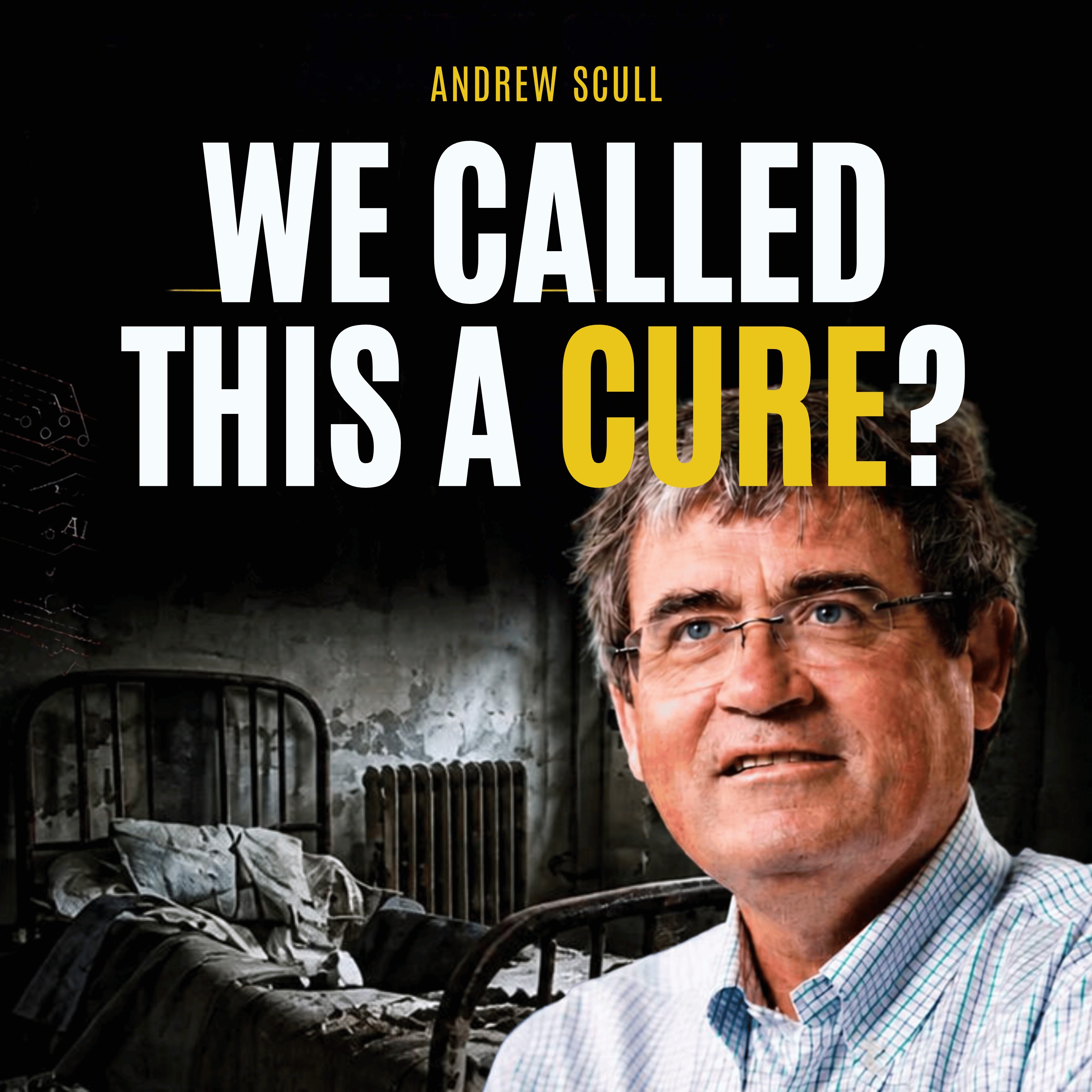
The Smart Cookies podcast· Staffel 1· Folge 99
Asylums, Lobotomies and ECTs - The Horrifying History of Mental Illness “Cures.” With Prof. Andrew Scull
Mittwoch, 30. September 2026 · 1 h 39
Kapitelklicken springt direkt hin
Shownotes
What do lunatic asylums, lobotomies and electroconvulsive therapy have in common? They were all desperate attempts to cure mental illness. Long before the advent of pharmacology, "maverick" psychiatrists proposed different theories on what caused madness - from germs and infections to abnormal pathways in the brain.
These ideas gave birth to a host of horrific "cures" that often left the patients worse off than before... if they managed to survive them in the first place.
place.Inhis acclaimed book Desperate Remedies: Psychiatry's Turbulent Quest to Cure Mental Illness, historian of medicine Prof. Andrew Scull traces the turbulent past of this new medical science that spurned on some of the most well known horror cliches ever...
In this haunting conversation, we talk about this dark history, but also about Freudian psychoanalysis, the wartime birth of psychotherapy and the poor state of psychiatric care today.
Transkriptvom Podcast bereitgestellt · Zeitmarken springen hin
He wants to become, as his daughter put it, the Henry Ford of lobotomy. You want an assembly line lobotomy. So how the hell are you going to do that? He reads about an Italian who's developed this technique to peel back the eyelid, stick an ice pick in with a hammer, bang through the bone, wiggle the ice pick about, repeat on the other side, Bob's your uncle, two black eyes.
You've been lobotomized in a few minutes. How do you stay still for that? Well, we give you two or three ECTs first so you're unconscious. many books titled such as Madhouse, A Tragic Tale of Megalomania in Modern Medicine, Madness in Civilization, A Cultural History of Insanity, and the latest, Desperate Remedies, Psychiatry's Turbulent Quest to Cure Mental Illness. These are all great for some light reading before bed, as will probably be this conversation, which is my favorite type of conversation. Andrew, welcome to the program. Very glad to be here with you. Thank you for having me. I want to delve primarily into your last book, desperate remedies, but I would be remiss not to at least ask you what was happening before that. How did
ancient cultures conceptualize mental illness or madness, as I imagined I called it, before the advent of asylums, which we're going to talk about later on at the beginning of the 19th century, I believe, because you write about that in your earlier book, as I said, in madness in civilization. Yes, I do. It's an enormously complicated story that's very hard to, you know, boil down even within the pages of that fairly long book. There are lots of twists and turns. And, of course, one of the things I would stress is that in every society known to me, madness exists. And it doesn't come to be called mental illness until quite late on. although medical involvement attempts medically to explain people acting in aberrant
ways, losing touch with the emotional life and the cognitive life most of us share. That you can see as early as ancient Greece, and you can see it in ancient Chinese and Indian medicine as well. But it's part of a very conflicted landscape where very often madness is seen in supernatural terms as either a punishment from God or the result of being bewitched or possessed or the work of the devil. All of these things survive, indeed some of them survive, even into the contemporary world, albeit not as the dominant discourse as it once was. So always in negative terms, never like this person might be enlightened or inspired by the gods. Yes, that's not quite true, because yes, indeed, there are examples of madness being
seen in rather more positive terms. a form of divine inspiration, for example. The Hebrew prophets in the Old Testament behave in ways that to many people seem so far out of the ordinary as to seem psychotic, but are often interpreted in that context as speaking for Yahweh, for speaking for God. and certainly the idea of fools or the mad having some privileged access to another reality. is one we can see coming through. And you can see it actually as late as the 1960s, where somebody like the Scottish psychiatrist R .D. Lange announced that schizophrenia was a kind of super sanity. It was the world that was mad at the schizophrenic who was seeing things in a kind of novel fashion. These things come
and go, but the general history, I would say, of serious mental illness is for people like that to be highly stigmatized, often treated extremely badly, exiled, beaten, locked up, chained. Generally, life for such people was nasty, brutal, and quite short. And it's interesting because if you look today at the statistics, If one has serious mental illness, chances are you will live 15 to 25 years less than the rest of us for a complicated series of reasons. But obviously, the fact that serious departures from the universe, the rest of us, the common sense universe, the rest of us think we share. is something that is not conducive to good health and longevity, let's put it that way. I like how you put it,
we think we share. Well, you know, the reality is that we think we're all sharing the same universe, and most of us behave in ways that seem to reveal that we do. And some people see things or hear things or experience things in such radically different ways from the rest of us that we regard them as being in an alternate universe almost.
Or, and there's another large group of people who fall within the psychiatric ambit these days. People who have become demented, who lose most of the consciousness and the thinking ability that the rest of us share. So, you know, on the one hand, you have people whose cognitive abilities and whose abilities to relate to other people are badly damaged. You have people whose emotional life is so very different and fraught that others have a hard time coexisting with them and they often have a hard time with life itself, sometimes ending up killing themselves. And you have people whose... cognitive and emotional life is becoming increasingly stunted and increasingly unrecognizable to the rest of us and there's a vast array of
things that fall under this label and to lump them all together is often uh to misunderstand a lot of what's going on and Part of the problem, I think, even with contemporary psychiatric diagnosis is that its categories tend to push together under a single label things that are actually quite heterogeneous. We once used to talk about cancer as though it were a unitary phenomenon, and we now recognize there are many, many different forms of cancer. The one underlying... commonality is the proliferation of cells in an uncontrollable fashion. But when we look at the categories that we usually use these days to talk about mental illness, bipolar disorder, major depression.
schizophrenia, when we're talking about the major categories, all of those, it seems to me, encompass a vast array of things. Eugen Bleuler, who was the Swiss psychiatrist who coined the term schizophrenia, actually referred to what he called the schizophrenias, plural. And I think that's quite revealing. Genetic research in recent years, which has absorbed a great deal of money in the last 35 years or so, has actually tended to show there's a great deal of genetic overlap between these different categories that psychiatrists presently use to categorize mental illness. But actually, the other interesting thing that's happened with those genetic studies is there was an assumption since It's long been an observation going back
centuries that mental illness seems to run in families. The expectation was in the 1970s and 80s when the genetics of mental illness finally revived that we would discover a pretty strong genetic link between the different forms of mental illness. and people's genetic inheritance. And in fact, that's not what genetics has found.
In fact, mental illness seems to be one of the least genetically ordained illnesses, if you like. So it's a real puzzle. There's no Mendelian gene or even a handful of genes that, for example, account for schizophrenia. genetic abnormalities that taken together account for about 10 % of the variance statistically and don't explain in a straightforward fashion why people become schizophrenic. It's very clear, it seems to me, that mental illness is an enormously complicated phenomenon which has both some biological component to it, and a lot of social and psychological components to it as well. And the artificial separation of those two things is, it seems to me, profoundly misguided. And it's one of the
problems with contemporary psychiatry, that is psychiatry over the last three, four decades, that it is focused so singularly on brains and brain abnormalities, and assuming that's going to unlock the whole picture here. And I think for a whole variety of reasons, that's far too simplistic. And psychiatry over the 200 years, roughly, that we can talk about it existing, has issued lots of promissory notes, lots of claims that it's got the cure for mental illness, and it's repeatedly dishonored them. it hasn't right speaking of true interesting you would say that because that was my next question uh but let's start on maybe more hopeful notes aside zombies which you've also uh mentioned before i don't think there is a more tired flock to
death horror movie cliche than an asylum The war just conjures up eerie images of screaming, emaciated people in white rags, languishing in dark halls, being subjected to inhuman experiments, and then usually turning into ghosts and haunting the place forever. But surprisingly, as you demonstrate in your book, asylums didn't start off that way.
They were in fact places of genuine desire that... That people who suffer from mental illness could be treated differently in a much more humane fashion, not like you said before, they were beaten and locked up in ancient times and so on. Right. Which would also result in them getting better, right? So tell me about this nicer beginning.
Yes. So we can find examples of buildings that contained mad folk in small to medium -sized numbers, 50, 100. Going back quite a long way, the most famous one in the English -speaking world was known as Bedlam. It was actually Bethlehem Hospital. It was originally a monastery. And the monks became specialists in handling patients with mental troubles. And over time, that evolved eventually into a medical institution. But these were relatively rare institutions. There were very few of them. In the 18th century in England, England becomes the first rich commercial society, a market economy where lots of things enter the marketplace. You can learn how to dance. You can learn how to fence. You can hire somebody
to dispose of a dead body. You get undertakers coming on the scene because that's a very stressful, distressing, unpleasant experience. So all kinds of things enter the marketplace. And one of the things that enters the marketplace is the idea that somebody will take your mentally ill relative off your hands. You've had to lock them in the attic or lock them up in the pigsty at the bottom of the garden or throw them in jail. So we get private madhouses that are set up to make a profit.
immediately acquire a very unsavory reputation. One of the things they do is, of course, remove a potential source of scandal from public view. And mental illness is almost always stigmatized, as we've already discussed. But what's going on behind those closed walls? Well, actually, in reality, a rather big mix of things. People are learning how to cope not just with a single lunatic, as they were being called back then, but with several or maybe 50 of them. And that requires developing skills of handling them.
It may be skills of chaining them up, putting them in straitjackets, beating them, those kinds of things. But some people also experiment with more subtle ways of dealing with mental illness. And it's out of that context that there emerges the idea that the environment, if it were arranged properly, and if the mentally ill were treated as not wholly deprived of their reason, but still having some semblance of humanity that could be built upon to bring them back to some sense of... more normal existence, that kind of notion begins to gain ground. And most famously, in an Anglo -American context, a Quaker institution in York in North England, which is called the York Retreat, develops things it calls moral
treatment that involve both an environment that doesn't create the impression of a prison. that allows for flexibility in handling of patients, that rewards them for behaving well and doesn't beat them for behaving badly but deprives them of certain privileges, that doing that and creating an environment where, for example, they have pets to pet so that they're drawn out of themselves, they're rewarded if they behave nicely by sitting down to an English tea with the head of the institution.
and learning how to behave themselves in that setting. That sort of thing emerges and moral treatment becomes something that it is claimed will restore people to sanity. And it is out of that that the movement in the 19th century to create asylums emerges. Mentally ill are being locked up in attics and pigsties. They're being locked up in jails. The conditions are horrendous.
And along come reformers who say, look, we have this model institution that not only treats them humanely, brings them back into the human race, if you like, it cures them and it doesn't impose those things. So the asylum is born. in a moment of almost utopian optimism, that environmental cues and psychologically astute handling of people can coax them back from the abyss to join the rest of us. And did this nicer form of early asylum, did it produce any sort of tangible results?
Well, it's of course extremely difficult. after the fact for us to go back. But I think the answer is yes, in the case of many of these early institutions, which were quite small. We're talking 30, 40, 50 patients, a charismatic figure running the institution, attendants who are highly motivated to treat, to turn the other cheek, if you like, to treat patients as suffering, not as... people who need to be beaten when they don't conform.
And I think, yes, there's probably something to that. The difficulty is once you start to try to generalize that, and particularly once institutions start to grow in size to 100, 200, 300, 500, 1 ,000, eventually 10 ,000, you can't sustain that kind of individual attention to patients, nor can you reproduce the early enthusiasm that I think produces a very positive placebo effect, if you like. And so once we start building asylums on the assumption that we're going to produce a great deal of cure, The early asylum proponents were saying, we're going to cure 60 or 70 or even 80 % of the patients as long as we get them in here early. Well, they can't live up to that promise. And then things start to
move by the time we're into the last four decades or so of the 19th century. We have larger and larger institutions where fewer and fewer patients are getting better. where the overwhelming bulk of the patients in the institution have been there for years, if not decades. And instead of a positive placebo effect, you get a nocebo effect, you get a negative effect. People begin to assume that madness is a condition that can't be cured. And indeed, when... The people running these institutions, whom we can now, by the latter decades of the 19th century, call psychiatrists, they have to explain, why is it that you promised a 70 % cures, and we look at the numbers, and, you know, maybe a third of the patients who come
in in a given year emerge better. What gives here? Well, increasingly the answer to that in an era when we're moving towards a belief in evolution is these patients in whom evolution has worked in reverse. They are degenerates. They are physically inferior to the rest of us. Biology's gone wrong. It's gone backwards. They have left the rest of us behind. They've become almost subhuman. Sounds a lot like eugenics.
It's what, at the end of the 19th century and into the 20th century, does produce eugenics. The idea that something is irretrievably biologically wrong with these people, it produces in the early 1900s in America a movement towards compulsory sterilization of the mentally ill. Mental illness removes the... The self -control that it's presumed the rest of us exercise so we don't breed like rabbits, these mentally ill people don't have those internal controls and let loose on society.
They can produce even more mentally ill people. So one solution to that is to lock them away so they can't reproduce. So that becomes the justification for these homes. But that's expensive. So a secondary idea is, well, let's sterilize them. There's a lot of opposition to that. Much of it religiously motivated. The Catholic Church in particular. is vociferously opposed to those kinds of measures. And while the state I usually live in, I'm presently in London, but much of the time I'm in California, California was one of the states that took the lead in sterilization and was still sterilizing mental patients as late as 1960. So there was some of this going on, and the Supreme Court was asked to consider
whether it was appropriate to involuntarily sterilize the mentally ill. That was in a case known as Buck v. Bell. It reached the United States Supreme Court in 1927, and the Supreme Court issued an eight to one decision saying, yes, the state had a compelling interest in snuffing out the reproductive capacity of these tainted creatures.
Three generations of idiots is enough, said the chief justice. The state can proceed to sterilize people. Well, fortunately, in a democratic society, there were lots of constraints on that. And so while it happened. It didn't happen on a vast scale. Where it did happen on a vast scale was in Nazi Germany. When Hitler came to power in 1933, pretty soon he passed a sterilization law, which was devised with the help of leading German psychiatrists and permitted the mass sterilization of tainted, mentally ill people. And that took place on a big scale. And then towards the outbreak of World War II, the Nazis said to themselves, why are we keeping these useless eaters, as they called them, alive? They're not contributing
anything to the Reich. They're sucking resources. They're never going to get better. Why not kill them all? And indeed, the program that was called T4 after... the number of the house in Berlin where this program was hatched. The T4 program involved the murder of up to a quarter million mentally ill people in Germany. And it was there that the technology that became part of the death camps. the extermination of the Jews and other undesirables as far as the Nazis were concerned.
That's where it was developed. That's where gas chambers disguised as showers, for example, were built. And Germans knew damn well what was going on. The buses that took the mentally ill to the mental hospitals where the crematoriums were belching the black smoke, where their bodies were being burned, were known by the locals as killing crates. They knew what was going on, as indeed their course did with the concentration camps. So the mentally ill were the ones that pioneered the final solution. It's a terrible story. And the Germans boasted that they modeled their mass sterilization bill on Californias.
The superintendent, a woman incidentally, at Stockton State Hospital in California in 1937, said how delighted she was that Germany had taken her policy and adopted it on a nationwide scale. This is a terrible time. And that's one way in which the decline of the asylum until it became seen as a kind of holding pen for... um people who otherwise were socially problematic um that's one one way one direction in which it could go of course what we should understand is the following it was the asylum that gave birth to psychiatry in the modern sense of the term initially some of these asylums were run by lay people but medical doctors managed to persuade the lawmakers that they could add medical treatment to moral treatment,
and that would be better than either taken on its own. And they were the only ones that could provide the medical treatment, so ergo they were the ones who should be running the institutions. And that indeed is what happened by the 1830s and 40s and 50s. In a way, it's a sort of chicken and egg problem. Psychiatry is born out of the asylum that's being built in the ways we've described for utopian reasons. On the other hand, the asylum doctors are the ones that provide the legitimacy for the asylum, that provide the claim that it's a treatment facility, not a prison. And indeed, they try to treat patients. And it is important to note that Although the image of the asylum by the 1870s and 80s was of a place where you
emerged only in a pine box, that wasn't quite true. In fact, when patients came in in a given year, perhaps 35 or even 40 % of them within a year or so came out improved or, as they thought, cured. And maybe they were. removal from poverty, from grinding circumstances, maybe better diet, who knows, or maybe just some relief from the social conditions they were living in. But what that means is some people died, right? Roughly 10 % mortality out of that cohort. But that left half or more of them behind. And if you didn't get out in the first year, you probably weren't going to get out. So over time, what that means is asylum populations grow and grow the size of the asylum. That means conditions for the
patients get worse and worse on the whole. But it also means if you look at... the asylum most of the patients are chronic patients they've been there for years and years and that becomes the image of mental illness and that's what feeds into these ideas of degeneracy and eugenics okay but the people who are going into psychiatry For some of them, it's just a cushy career if they can get to be the superintendent of these institutions, largely an administrative job with a nice house and servants and so forth. But for the more ambitious among them, for people who go into a healing profession wanting to actually do something that improves a lot of the people they're treating, that's a very unsatisfactory
state of affairs. So what we've talked about so far is how this movement towards a heavily biological view of mental illness in the late 19th century could lead to these horrors, involuntary sterilization, death camps. It also might lead in another direction. Perhaps if it's biological, if it's something wrong with people's bodies, we can fix what's wrong with their bodies. Now, remember, that same period, the last third of the 19th century, is when medicine discovers germs and germ theory and bacteriology and the laboratory and the idea that disease is caused by infection. They don't really know. I have a slight suspicion we're going to be talking about focal sepsis soon. Yeah, fairly soon. But
we're going to be talking about a bunch of these things, yes. So what happens here? In general medicine, that first has an impact through surgery, where instead of regarding pus as a sign of healing, we begin to go, oh my God, we don't want that, right? So we have antiseptic and eventually aseptic surgery. We try and keep a bacteria out of the operating theater, out of the wound. And we are able to... when you couple that with the invention of anesthetics in the 19th century, that means we can start operating for things that were previously fatal. If you had an appendicitis in 1850, it's going to burst your appendix. You're going to die of focal, you're going to die of sepsis horribly, right? No antibiotics, you're dead. Now we can
move the appendix and miraculously you're better. So that does something for the prestige of medicine. The next thing that does something for the prestige of medicine, Robert Kennedy Jr. notwithstanding, is the infection of vaccines. Vaccines against something terrible called rabies. Vaccines against, for example, tetanus. Vaccines against diphtheria.
You and I, being male, probably didn't read Little Women as we were growing up, but the girls probably do. And there's a scene of a leather -like thing growing over the throat of one of the children who dies. Imagine as a parent watching your child die like that and being helpless. And then a vaccine comes along. It's a miracle. So even though initially the rise of bacteriology, the laboratory, the notion that disease was caused in that fashion didn't provide the sorts of breakthroughs we think about with penicillin, for example, it did mark a real improvement in what doctors understood about disease and in some instances what they could do about disease. As is often the case, when you have a breakthrough like that,
you tend to think it's the solution to everything. So germ theory dominates everything. All sorts of disease must be the result of germs. How about mental disease? Well, there's initially something that actually gives extra credence to that idea. You and I were around, I think, looking at you, when the AIDS epidemic happened. Suddenly, we have this terrible sexually transmitted disorder that kills people horribly and does terrible things to their bodies. The 19th century equivalent of that was syphilis. And one of psychiatry's early diagnostic triumphs in the 1820s in Paris was the identification of a subset of people with mental illness who suffered from something called general paralysis or general paralysis
of the insane, or GPI for short. These were people who, as that term suggests, gradually became paralyzed, lost the ability to walk, lost the ability to talk, lost the ability to swallow, usually died on ingesting their own vomit. or from the bed sores they developed because they couldn't move anymore. That was sometimes thought in the early 19th century as the kind of end state of all mental illness. But that wasn't right. As the century wore on, people began to wonder about it. Was it somehow connected to sexual excess? That was right, because in the early 20th century, we finally discovered that people suffering from GPI were actually suffering from tertiary syphilis. Syphilis is a really nasty disease in that when you first get infected,
it's visibly obvious you're in pain, you have sores, you have serious discomfort, but then it goes underground. And then it disappears, right? It disappears. It goes underground, sometimes for decades. So particularly in an era when... Middle class men married late because they had to establish themselves before they could marry.
They resorted to prostitution, which was rife in the 19th century. They contracted syphilis. They thought they'd got over it. They became bankers and lawyers and ministers. And then in their 1840s and 50s, they dropped dead of a heart attack. That was syphilis. They didn't know it. at the time, but that's what it was. But sometimes syphilis attacks the central nervous system, the spinal cord in the brain. That was GPI. So you had on the one hand... uh these neurological symptoms but you also then thought you were jesus christ reincarnated you were napoleon you were mary the mother of god if you were a female version or sometimes even if you were male you had these bizarre delusions as well as these other symptoms
so this is not a rare condition About a quarter of male admissions to asylums in New York, for example, in 1900, were suffering from GPI. One quarter. So when you find one major form of mental illness that by 1912 you know is an infectious disease, and the idea of infection being the cause of illness is everywhere, the natural leap forward is to say, gee, maybe the rest of mental illness is an infectious disease. And that's what a handful of psychiatrists, most notably a guy named Henry Cotton in New Jersey, but also, interestingly enough, the leading German psychiatrist of the late 19th, early 20th century, a man named Emil Kraplin, believed. that psychosis had a toxic origin. It was a germ that had caused the
problems. If you believe that, what the hell are you going to do? Well, you don't have penicillin. You don't have sulfur drugs. You don't have anything that can attack and remove and cause bacterial infections to go away. So what do you do? You engage in what Henry Cotton himself called surgical bacteriology. This is where things get really dark. Yes, this is where things get the stuff of nightmares. You go in and where do you think, well, you know, this person's got bad teeth.
Let's pull them out. That's obviously, it's very close to the brain. It's poisoning the brain. We pull teeth. So thinking there might be like a slight infection in the teeth. You've got chronic infections that are leaking. toxins into the bloodstream, into the lymph. They're getting into the brain, poisoning it, hence the madness.
So teeth. Wait, even though you couldn't physically see anything, if you were Dr. Henry Cotton. Now you have a laboratory. You can take x -rays and see the teeth are decaying, right? You can culture the bacteria from the mouth and you say, see, they really are. So this is modern science being brought into the asylum. See, pull the teeth.
They don't get better. Wow, what could be going on? Well, you know, the tonsils, they're also very adjacent to the brain and they're often infected. So let's slice out the tonsils. Let's do tonsillectomies. Tonsillectomies were being done on a mass scale when I was a kid. If you had sore throats, even after the advent of penicillin, lots of times you had your tonsils removed. As kids, we thought, oh, you're lucky you get to eat ice cream. Not really. But that was part of this focal sepsis notion. The idea that if you had a chronic, low -grade infection in your body that was being overlooked, it was leaking poisons into your system. And some of those poisons were ending up in your brain. And that was making
you mad. Moving tonsils doesn't work. Should we abandon the theory? Nah. Look. Your mouth is full of toxic bacteria. You're swallowing them. Where are they going? Stomach. Colon. So Cotton starts removing people's stomachs. He says a stomach is like a concrete mixer at a building site. It's not essential. We can take it out. Colons, you could do without colons.
We'll remove them. And I'm curing 80 % of the people I'm treating. And rich people from all over America come to be treated by cotton in this great new fashion. The New York Times proclaims this great breakthrough has happened. Oxford and Princeton University presses publish cotton's lectures in a series that's largely devoted to Nobel Prize winners. Actually, 45 % of the patients who received the abdominal surgery are dying.
And when an outside investigation is done, it's headed by somebody who had trained Henry Cotton, who sends his young female assistant to study what's going on. And she, after 18 months of work, reports back, this man is killing patients. The more treatment they get, the worse the outcome. And what does Adolf Mayer, America's leading psychiatrist at America's leading medical school, Johns Hopkins University, do? He suppresses the report, kicks her out, and allows Cotton to proceed.
And when Cotton unfortunately dies of a heart attack at his club, Adolf Mayer writes... An obituary in the American Journal of Psychiatry lamenting that this great psychiatric pioneer has died too early before the results of experiments can be fully known. I'm sorry, let me ask you this really fast. I'm sorry to interrupt. Let's say you're Dr. Henry Cotton. Somebody comes to your clinic suffering from, let's say, schizophrenia.
You proceed to remove their teeth or a vital organ, and they obviously get worse or they simply die, like you said. Obviously, you didn't achieve a great result. quite the opposite. And then this story repeats on hundreds, maybe thousands of patients, I don't know, over decades. How come nobody is saying anything? You talked about this investigation that was quashed. What about the families of these people? Well, yes, there are a couple of times where scandal threatens to erupt. A rival of Cotton in New York, a man named George Kirby, and his young PhD assistant, a man named Nicholas Kopeloff, try this technique, not going so far as to do the abdominal surgery, but they tried the teeth and the tonsils. And
they report that those patients fare worse than a comparison group. Does that change the narrative? No, it does not. Kopeloff is not an MD, so we can discard his results. And there's no overarching mechanism to control cotton and people elsewhere adopt his techniques families start to clamor for them they're told the alternative is life on the back wards of the asylum and this will give you a chance of a cure and It's astonishing to me. The same thing happens in Britain to a lesser extent. There's a man with a rather unfortunate name who runs all the mental hospitals in the Birmingham area in the center of England. His name is Thomas Chivers Graves. And Graves, indeed, is where some of his patients end up. This does
persist. Cotton goes to the United Kingdom twice. once in 1923 and another time in 1927. In 1927, all the leading figures in British medicine and surgery lionize him as the new Lister. Lister is the man who introduces antiseptic surgery. He's the one who's brought science to psychiatry and rescued it from the notions of Freud, or fraud, as they prefer to call him. Here's a real medical treatment. So it's astonishing that the teeth and the tonsils, Cotton's disciples continue to run Trenton State Hospital, where his base was, all the way until 1960. And they continue pulling teeth and tonsils all the way to them.
I interviewed the dentist who, starting in 1918, had pulled literally hundreds of thousands of teeth. to cure these mental patients. He stopped doing it when he retired in 1960, and he still believed that Henry Cotton should have won the Nobel Prize. Really, it's fairly amazing. And we should talk then about some of the other biological treatments that emerge in this same era. Because Cotton's thing does die away, it's fair to say, by the late... 1930s most places have discontinued this and no longer believe it but ambitious mostly men in psychiatry are now looking for other ways in which biological interventions might cure mental illness yes and of course another fun one on the list is also one of the most horrifying
procedures we've ever come up with with as species of course is lobotomy which was apparently A Nobel Prize winning idea. What on earth happened there? Well, so first as background, people had tried putting people in comas using insulin, one of the great breakthroughs in 20th century medicine, to put people into a coma and claimed that repeated comas of that sort, which could eventuate in death, you might not come around, were curing 80 % of schizophrenics. Sorry, what was the reasoning behind this, Matt? Well, if you can call it that, Sackle himself thought that what was happening, people said to him, you know, what happens when people go into diabetic comas like this, the brain's being deprived of
oxygen? He said, yes, what's happening is the recent cells are dying off first, and those are the schizophrenic cells. So that's why it's going to cure people. People going into these comas often seized, had things that resembled epileptic seizures. Some other bright spark, a man named Maduna, the Austro -Hungarian emperor in Vienna, says, well, you know, You can't have both schizophrenia and epilepsy. That's false, but that's what he believed. So if we could artificially induce epilepsy, we'd drive out the schizophrenia. How are we going to do that? Well, he started injecting them. with a variety of substances. And then he happened upon one that became known in Europe as Cardiazol and in America as Metrazole. When
you inject it, now imagine you're in a straitjacket, you're brought in, a guy with a stethoscope and a white coat brings out a big syringe and sticks something into your arm. What happens next? By Maduna's own account, you feel as though you're about to die. You're petrified. And then if you're lucky, A minute or two or five minutes later, you have a massive seizure, which may end up breaking bones in your back or breaking your hip socket because of the extremity of the contraction of your muscles. But it's going to cure your schizophrenia 80%. That had severe drawbacks because of all these fractures and because of the fact that it was so frightening. And he claimed people were amnesiac, that they didn't remember
this fright. But who knows? People looking for a more humane alternative in Italy, Solletti and Beni, think about, well, maybe we could use electricity for this. They try it first on dogs, and they try one on the head and one on the anus, and the dogs die. Then somebody says, you know, you should go to the Rome slaughterhouse. They're killing pigs. And they dangle them from the hind legs, and as they come by, they stick electrodes on their heads, and they zap them, and then they're unconscious, and then they slit their throats.
So they try it on a transient they pick up in their own train station. And that's where ECT comes from. ECT is cheap and very quick, and it doesn't require a lot of... Electroconvulsive therapy. Initially known as electric shock. And then since we don't like that shock thing, we call it electroconvulsive therapy. Or then we really prefer ECT because that even moves it further. What a nice euphemism. And it turns out, I mean, ECT is the only one of these desperate remedies, as I've called them, that survives into the present. It's still used on so -called treatment -resistant depression. That is, cases of suicidal depression. where people don't respond to antidepressants some psychiatrists prescribe
it some swear by it some swear about it some patients swear by it some swear at it some claim it creates memory problems which it almost certainly does it does seem at least in the short to medium term to alleviate the depression for a number of people so it's there um and Reasonably reliable studies recently seem to suggest, for reasons we don't understand, it in some cases makes a real difference. So then you come to lobotomy.
So there's this string, and there are others that we haven't had time to talk about. But if we're convinced that something's wrong in the body, where is it that mental illness resides? pretty obviously in the brain and a portuguese neurologist named i guess moniz uh in 1935 comes up that with the idea that one of the problems with people with mental illness is this perseveration the persistence of these hallucinations these delusions these tangled emotions and ideas that are going on and that they must have their root in the frontal portion of the brain the most developed part of the brain, the thing that most distinguishes us from the rest of animal creation.
Now, on one version of the story, what leads him to think up the operation we call lobotomy is experiments in a primate lab in Yale University, where they're experimenting with chimps and rewards and punishments. And one of the chimps named Becky becomes almost uncontrollable. She can't solve the problems. She responds by throwing her feces at the lab as technicians, generally behaving badly. And Carlisle, the chief of the lab, goes in and severs her frontal lobes, and she becomes tame. She also becomes somebody who, were she a chimp in the wild, would promptly die. loses the ability to do things chimpanzees would need to do to survive. But what's notable when he presents that finding at a neurological
conference in London in 1935 is that she, her bad behavior has ceased. On one version, that's where Moniz gets the idea. He says no. And There's some reason to think that he indeed was thinking along these lines quite separately from these Yale experiments. Regardless, what happens? He goes back to Lisbon. He gets hold of a bunch of asylum patients. And he persuades a neurosurgical colleague to conduct this surgery. He can't do it himself because he's crippled by arthritis.
And besides, he's a neurologist, not a surgeon. So he begins by injecting alcohol into the frontal lobes of the brain. Then after a while, he cuts them. And he reports miraculous results in the medical literature. We now know those miracles didn't happen. But that's what was reported. Gets picked up by an American neurologist named Walter Freeman, who has... As luck would have it, one of the few then -trained neurosurgeons in the country, neurosurgeon is a very scarce specialty at that point because there's not much neurosurgeons can do. When they try to remove tumors from the brain, even if they're so -called benign tumors, it generally is catastrophic, if not fatal. So Walter Freeman and James Watts,
who's trained at Yale where this primate lab was, start doing lobotomies. And in 1936, they report their first results. Let me guess, miraculous. Claiming it's miraculous. Freeman is a master at getting publicity, and he invites a couple of journalists, New York Times, The Washington Post, in to report on this medical miracle. A soul is saved by this simple operation on the brain. You transform a lunatic into... Sober person. Actually, when those results were announced in Baltimore, where Johns Hopkins is, there's uproar. Many of the psychiatrists in attendance shout him down and up steps Adolf Mayer. Now, Adolf Mayer is a Swiss -American who's highly trained, is America's leading psychiatrist in
these years before World War II. And Mayer says, I believe in these gentlemen. They are scientists. We should let this experiment proceed. And that's a key to the thing actually continuing because it might otherwise have been stopped in its tracks. So Freeman and Watts now continue to do a lot of these lobotomies. One of the early ones in 1942 is the daughter of Joseph Kennedy. who had been the United States ambassador to Britain and a Hitler sympathizer who was eventually removed because of that. I just read that story that they, due to fear of embarrassing the family name, she was put into a psych ward by her father, Joseph Kennedy, and then lobotomized, which left her incontinent, unable to walk and speak. Correct.
Incontinent, basically unable to walk and speak. hidden away for decades, not spoken of by the family. Apparently they said she lives as a private citizen somewhere and she doesn't want to be disturbed. So really, really terrible story. Now, lobotomy continues. It attracts converts rather as Henry Cotton did, but on a relatively small scale. And then after the war, two things happen. 1949. Moniz is awarded the Nobel Prize in medicine for this wonderful invention, 14 years after the first lobotomy, when you would have thought enough negative cases would have accumulated. Now, one thing to say here, if we use the analogy of a stroke, when people suffer a stroke, it injures portions of their brain,
to a small degree if they're lucky, to a catastrophic degree if they're unlucky, and somewhere in between. And the brain is a remarkable organ in that it sometimes manages to sort of rewire itself, to recover function that initially are lost. Lots of therapy, eventually people sort of return. Something like that was true. Lobotomy had hugely variable results because although Freeman and Watts called their operation a precision lobotomy, the irony is just too much. In fact, what they damaged each time was highly variable, and some patients did survive it, and in a handful of cases were somewhat improved, although they had deficits that often had to be overlooked. But many lobotomies were catastrophic in their results.
So one thing is Nobel Prize legitimizes the operation further. The other thing is... Walter Freeman is impatient. Neurosurgeons are scarce. The operation, when a neurosurgeon does it, takes an hour or two. It's an extraordinary process because Freeman would sit there while Watts was severing the brain tissue using something like a butter knife.
And he would talk the patient through the operation. In other words, the operation was done under local anesthetic. You talk the patient through it. Why would you do that? Because by trial and error, Freeman had concluded when you started to get confused, that was when you'd stop cutting the brain. It's that primitive. So when you stop being able to count back by sevens from 100, 90. Sounds like Dr. Hannibal Lecter. Yeah, sounds awful, right? And we have transcripts of this because he was proud of it. And some of them are quite awful. There's one I quote in my book where the patient says, stop, stop. And they ignore him. Freeman, as I say, was impatient.
This took too long. He was convinced this was a miracle cure. He wants to become, as his daughter put it, the Henry Ford of lobotomy. You want an assembly line lobotomy. So how the hell are you going to do that? Well, get rid of this. neurosurgery crap. He reads about an Italian who's developed this technique to peel back the eyelid, stick an ice pick in with a hammer, bang through the bone, wiggle the ice pick about, repeat on the other side, Bob's your uncle, two black eyes, you've been lobotomized in a few minutes. How do you stay still for that? Well, we give you two or three ECTs first so you're unconscious. Freeman travels the United States with his kids in the back, some of his kids, proselytizing for this operation, going into
state mental hospitals, showing people how to do it. Nothing but contempt for psychiatrists who he regards as third -rate doctors. He says, I could teach any damn fool, even a psychiatrist, to do this operation in 20 minutes. And sometimes he does 20 at a time. And even hardened nurses and doctors faint and collapse when they watch this heck going on. It's one of the reasons tens of thousands of lobotomies get done. It eventually falls into disuse in the 1950s, in part because of the advent of the drugs that we were talking about way back at the beginning of this broadcast.
And Freeman moves to California. He sort of retires out there. He continues to lobotomize patients. I took part. in a PBS documentary called The Lobotomist that you can still view online. And one of the fellow participants, very sadly, was a man named Howard Dulley, who, as an 11 -year old, his father divorced and remarried, and his stepmother found he was being a pain in the ass. I mean, he's an adolescent. He's got a stepmother.
now his mother's gone away he's acting out she persuades his father to have him lobotomized by freeman and he undergoes this ice pick procedure and obviously he was still alive he'd managed a career as a school bus driver and it was one of the great sadnesses of participating in this documentary we were never personally in the same space But I could see this really shell of a person really is enormously sad. One of his last victims, I would say. So yes, there's this period where biology rules and biology leads to all these processes. And then curiously, something happens in the United States that's unusual.
Freud and psychoanalysis. occupy a large part even now of many people's intellectual universe but freud for most of his lifetime was a prophet without much honor in mainstream psychiatry mainstream psychiatry wanted nothing to do with his ideas but there were a small group of people who were attracted to them certainly hollywood playwrights novelists artists and some and certainly some patients who thought of analysis away as reconstructing their personalities and solving various neurotic problems. How did that very small network of psychoanalysts, which was amplified in the late 1950s, late 1930s, I'm sorry, in America, by the advent of psychoanalysts fleeing Hitler?
many cases Jewish. This was Jewish science. If Hitler got his hands on them, they were dead. So they fled. Freud and his daughter flee to London. Many other analysts flee to New York. But we're talking about an analytic community at the outbreak of World War II of maybe 600 or 700, counting the 200 or 300 American analysts.
And that means they could treat, if they're treating and remember an hour five times a week or even three times a week a few thousand patients there are over 400 000 patients in america's mental hospitals in 1940 over 500 000 by 1950 right because freudian psychoanalysis entails that it's very intense right you have to spend a lot of time with a lot of time five times a week it's not a casual thing and it's going to last for months, years, sometimes decades. Woody Allen, I think, has been in psychoanalysis for 50 years.
So it's a very long process. And you might think, well, it's a niche thing for only the very rich can afford such thing. And indeed, that's its present day status. But during the World War II, something very powerful happened. We all know about World War I and shell shock. We know the trench warfare and all the psychiatric casualties that came about from that. Among the American military, psychiatric casualties were two to three times as high in World War II. Two to three times as high. Now, going into the war, There were about 2 ,500 psychiatrists in America working in mental hospitals primarily. By the end of the war, the army alone had about 2 ,500 psychiatrists.
As the war, America, as you will recall, enters World War II a bit late. America's psychiatrists persuade the government that if you want to avoid having all these shell -shocked soldiers around, which is damaging for morale, hugely expensive, catastrophic if you're trying to organize troops. We need to psychiatrically screen everybody who's being drafted into the military. So they do.
Hundreds of thousands of people. They screen out 1 .75 million people as psychiatrically unfit. So we won't have problems. We've weeded out the ones who are vulnerable and we won't have any problems. What happens? as i said two to three times as commonly as in the first world war soldiers facing combat even sometimes anticipating combat break down and uh how are they treated they're treated using short -term psychotherapy if we can call it that there So talk therapy. Talk therapy, sometimes with a little aid of drugs, but basically talk therapy. Mostly it's relabeled as combat exhaustion or combat fatigue, not shell shock. So that suggests a little bit of rest and recuperation and you'll be all better. And
as long as you're treated close to the front lines. The therapists are able to persuade them. They're letting their fellow members of their little unit down. You've got to be a man. You've got to go back. You've had the arrest. Go back and fight. Oh, yeah. A little bit of peer pressure will do the trick. And so if they get more serious treatment than that, if they get sent back away from the front lines, that's generally catastrophic.
Those soldiers don't recover. And after the war, you have... a huge number of veterans who still suffer from psychiatric disorders. Some of them are on pensions for psychiatric disability. Many of them are consigned to newly built veterans hospitals with psych wards in them. One of the problems when you need more manpower, I said you start out with 24, 2 ,500, but they're working in mental hospitals. There's only so many of them you can pull out to become an army psychiatrist.
So you've got to train people really fast, right? You take MDs, you give them a few weeks of training and turn them loose. But even doing that, you can't train enough people fast enough. That's one of the problems of highly trained manpower. created overnight, just as America's discovering it can't create enormously sophisticated missiles when it's used them all up in the space of a few weeks. So that's how psychologists get involved for the first time in psychotherapy. As far as the medical men are concerned, psychologists can be kept under the thumb of the doctors. because of military hierarchies and they kind of get invited into the tent and that's where we see the origins of clinical psychology the profession
that these days is the major deliverer of psychotherapy to patients because most mds don't do that anymore because it's not financially rewarding enough It takes, you know, you can do one patient for an hour, or if you're seeing people every six or ten minutes, you can churn through a lot more in the space of an hour dispensing medication, right? So that's where that comes from. And after the war, you've got two sets of problems. The mental hospitals, which were in dreadful state in the 1930s, partly because of the Great Depression and the cutting of state budgets. Were they still asylums? They were called mental hospitals by now, but they were still basically asylums. And they were in a particularly dreadful state after
the war. Some of their trained men and women power had been drafted out to deal with their military casualties. They'd been starved of funds. In the case of English and French mental hospitals, patients were literally starved. Many of them died of starvation during the war. But in any event, they were ripe for journalistic exposes.
And indeed, those were forthcoming. One American journalist had visited Buchenwald and Dachau and the death camps and came back and wrote a piece after he visited America's state hospitals, which he titled America's Death Camps. And he likened American mental hospitals. to the Nazi concentration camps he'd just seen. Albert Deutsch, who was a journalist who had written the first sort of popular history of America's encounter with mental illness, also visited state hospitals in these years, and he was generally a sympathetic observer. He wrote a series of articles which became a book called The Shame of the States, which published photographs. of naked patients lying around in midst of pools of urine and feces
and just deplorable conditions and described the state hospitals as cesspits, really. He was trying to get more money injected into the system. He wasn't trying to destroy the hospitals, but to get them rebuilt as therapeutic places. But it helped damage the legitimacy of the hospitals a great deal. So you have still vast numbers of patients coming into America's mental hospitals.
As I say, by 1950, over a half million. By 1955, which is the peak year for American mental hospitals, on an average day, 558 ,000 patients in the mental hospitals. American population is more than double what it was in 1955. So there ought to be, if we hospitalized at the same rate, well over a million patients in mental hospitals. How many are there these days? Less than 40 ,000. Something's happened. We can talk about what's happened, if you like. But so that's happening. There are America's veterans. in the veterans hospitals suffering from psychiatric disorders, some of them getting lobotomies, huge need for trained professional manpower. And this is a period where America transforms itself. The war has meant
mass mobilization, the breakdown of the constraints on the federal government, the advent of a massive... intervention into the economy and into everything else. The birth of the modern research university. Vannevar Bush, who's the science advisor, writes a very famous book on the need for big science, the need for the government to invest in science.
Science has contributed to winning the war, most obviously. in the atom bomb, but in radar in all kinds of ways. And so we get the National Science Foundation. We get the National Institutes of Health. And in 1949, we get the National Institute of Mental Health. And we get the Veterans Administration, which is also funding a lot. It's the second or third largest medical system in the world.
the Veterans Administration. It's a huge complex. So there's a lot of federal money flowing in, some of it flowing into training new nurses, social workers, psychologists, and psychiatrists. Some of it flowing into research, more and more of it flowing into research. And that becomes something that American universities become addicted to. My campus regularly ranks in the top five in the country in terms of federal research dollars it gets, although with the current administration in power in Washington, that may be changing, particularly because we're one of the hotbeds of climate science research. So there's this big transformation. The guys who have worked in the military branch of psychiatry think that
psychotherapy and early treatment is the answer, and they persuade these new federal guys to underwrite that. And so what happens in America after the war is psychoanalysis achieves a position dominating American psychiatry. Two vital areas. First of all, in academic psychiatry, which becomes increasingly important as money flows into the system. And secondly, in this new market for outpatient psychiatry.
And by as early as 1958, the outpatient psychoanalytically oriented people vastly outnumbered. the psychiatrists toiling away in the mental hospitals. They're state employees. They're badly paid. They're often imported from abroad because no one wants those jobs because they're so awful. Meantime, psychoanalysts are coining it. Psychoanalysis in the 50s and 60s is more lucrative than most medical specialties, and it attracts the best and brightest recruits to the profession. It dominates medical school faculty in the field.
And so that's quite unique to the United States. May I just ask just quickly, we talked about these horrible biological interventions that usually not only did not produce results, they mutilated people, basically, and made them worse. We talked about asylums at the beginning, and you told me it was really hard to go back and measure whether people actually got better after leaving them. How about psychoanalysis in the 50s and the 60s? They had a huge problem. They resisted the idea that they had to show demonstrable results. They resisted the idea that they have to show results. That's a very humorous position.
Well, ultimately, that leads them into trouble. I wish that worked in school when I was going there. We wish it worked in a lot of life, right? Exactly. But, yeah, for a while. You see, it becomes culturally dominant whether you look to movies and plays and novels or you look to the social sciences. Freud is everywhere. And then suddenly Freud isn't everywhere because in the 1970s things begin to turn. And then in 1980, something happens that spells the death knell of psychoanalysis, really. It takes a few more years for that to have its full effects.
But it's a bit like Lewis Carroll's Cheshire Cat, a little bit. You know, the Cheshire Cat gradually disappears until all that's left is his smile. In the 1980s, psychoanalysis disappears, except all that's left is a bunch of fractious... disciples who are busy squabbling with one another and have fewer and fewer patients. The average psychoanalyst these days has something like one and a half patients a week. That doesn't work very well. So this resistance, they go, you know...
We're transforming whole personalities. It's not easy to measure that. So you'll just have to trust us that this works. For a while, that sort of gets by. Eventually, particularly as once the insurance companies get into funding some forms of treatment, they're not going to fund years and years of psychoanalysis on this.
They say that gradually these people are going to be transformed human beings. And in fact, many of the children of psychoanalysts that I know are more screwed up than most people. It's just not. It's a complicated story, obviously more complicated than we have a chance to really get into here. What's interesting is the drugs revolution happens in the despised part of the profession, not in the universities, not among these private practice psychoanalysts and fellow travelers who call themselves psychodynamic psychiatrists.
It comes out of the mental hospitals where you have this half million and more patients languishing. That's where Thorazine, the first of the antipsychotics, gets introduced in North America. And that's where the antidepressants gradually come in, and then they migrate out of the asylum. But the psychopharmacological revolution of the 1950s bubbles away beneath the surface. The psychoanalysts still have this very lucrative private market for a while. And remember, Americans are used to paying for medical care in a way that most other advanced industrial societies don't do.
When the collapse happens, it's like watching the collapse of the Shah's regime in Iran or watching the collapse of the Soviet regime. It's a bit like what it was Hemingway's comment about bankruptcy, right? It happens slowly, slowly, slowly. It happens gradually and then suddenly. And suddenly all at once it collapses. And it's a reflection of a number of things. Drugs revolution, obviously, powerfully. Managed care. the involvement of insurance companies, the beginnings of insurance coverage for some sorts of treatment for mental illness, primarily drugs. But if it's going to be psychotherapy, it's going to be the type of quick and dirty focus on removing the symptoms treatment, cognitive behavioral therapy, that's
developed principally by those clinical psychologists I alluded to when we talked about World War II. That's a heavily feminized profession. I'm not much of a sociologist these days. I'm more of a historian. But if I can venture a sociological generalization that holds up pretty well, when an occupation becomes heavily feminized, it loses prestige and it moves down in terms of rewards.
Clinical psychologists don't get paid at the rate of MDs. That's why MDs won't. deliver psychotherapy on the whole except for this very small niche psychoanalytic market um whereas clinical psychologists will and they for the for the psychoanalysts during the 50s and 60s the idea that you would attack the symptoms somebody was experiencing i have panic attacks so i would like something that reduces my panic well No, your panic attack is a symptom of your underlying psychodynamic problems that we've got to address. And if we try to suppress it, it'll just pop up over here as a different kind of symptom, right? It's whack a -mole time. The clinical psychologists go, you have anxiety, you have problems going to
school, you have agoraphobia, problems going out, you have problems getting on an airplane. because you're afraid it's going to crash. We have tools that will solve that problem for you in a matter of a few weeks or a few months. Bingo. And it has some lab support, so it's science. So that's what happens. You see in the 1980s psychiatry swinging back to biology very, very quickly, aided by the fact that if they do...
Genetic research, neuroscience, psychopharmacological research, there's big bucks to be had in the form of research grants. And they get rewarded in their careers because they're bringing in those dollars to the greedy universities. And on the other hand, there's a different group of professionals who are moving into the space for people with milder kinds of genuine problems of one sort or another, which can be treated symptomatically. And that's the universe that we see today. The other big thing that's happened, of course, again in these same years, is beginning very slowly in the late 1950s, really accelerating in the late 1960s forward, those mental hospitals, those asylums we started talking about, simply
disappear. And we're told we're in the new era of community care where patients are going to be welcomed back into a community that is happy to see them in its midst and is going to absorb them and they're going to be cared for in a more humane fashion outside the asylum. And what, in fact, has happened? There is no community care. There's no community. There is no care.
To the extent there's any care, it's the prescribing of drugs, maybe via injections that last for a while. The mental hospital has been replaced, but by what? The three largest places of inpatient care, if that's the right word, for mentally ill people in the United States today are the Los Angeles County Jail, the Cook County Jail in Chicago, and Rikers Island in New York. That's the largest collection of patients in inpatient settings, and it's a prison. So the asylum was set up to rescue patients from the prison. We get rid of the asylum. We stick them back in the prison. If they're not in prison, they're a large part of the homeless population, the sidewalk psychotics that have become such a feature
of the American urban landscape. Or they're in so -called board and hair care homes and flop houses. They are abandoned to their fate. And we spoke at the beginning about the life expectancy of people with serious mental illness being 15 to 25 years less. Those social circumstances are a large part of the reason they die so much younger. They don't get medical care for their underlying medical problems. Some of the drugs they're on, if they indeed take them, produce, for example, obesity and all the problems that come in its wake. And so we have moved into an era where I think public psychiatry has largely vanished. People with serious mental illness are extremely hard to live with. Families sometimes
try to cope, usually over a or even a decade or so, they throw up their hands in despair because it's so impossible. And then they're out in the street. Or we have horror stories like Rob Reiner and his wife being shot by their schizophrenic son, or the person you alluded to at the beginning, who's put on all these different pills as a human.
guinea pig being experimented along with if this drug doesn't work perhaps this one will and if we add this one maybe it'll work no no i thought of the following because i see it as a kind of like the main thread of this conversation my ex -girlfriend was a medicine student when we were together and i still remember how she said that there was a little joke going around the school when students were choosing their specialization apparently saying when something like this, I hope I'm not going to butcher it. GP, so general practitioners know a lot, but they can't do anything because they're just writing referrals and stuff.
And then surgeons can do a lot, but they don't know anything because they're basically butchers that they don't diagnose people, right? And then psychiatrists, not only they don't know anything, but they also can't do anything. So there's, I wouldn't call it like an inferiority complex, but an awareness. Right, that you won't be able to help people as much in this field. Do you think that that made psychiatrists more eager to try out something they see as a silver bullet?
Because we talked about the silence at the beginning. They didn't really work as they intended. We talked about ice picks and lobotomies and injecting people with insulin. And yet these people at the positions of power, these psychiatrists, these doctors were clinging on to these theories, even though it was obvious they didn't produce results. Do you think they just really wanted to help people at least in the beginning? Or was it all about hubris? If I can turn you into a psychoanalyst for a second. Human motivations are extremely complicated things. And obviously, I think what you'd have is an array of people.
There were people in it for... um disreputable reasons and there were people in it who the the problem is that um being a true believer it doesn't protect you right so if i could go back to your to your joke what i would say about that is like it's a good joke on one level and if it relies on of course um hyperbole exaggerating for effect General practitioners indeed can do a great deal for many of their patients, although a lot of the time they have to confess the limits of their knowledge and refer them on. One of the things that's troubling about the prescription of psychiatric drugs these days is most of them are prescribed by general practitioners, by primary care doctors, as we would say in America. And they've usually
had about six weeks of training in psychiatry. That's it. Some very smart... And very well -motivated people that I know are engaged in psychiatry. They very much want to produce breakthroughs. They persuade themselves that they're on the brink of these things. When I talk with psychiatric geneticists, oh, we're about to do this and this.
When I talk with people into neuroscience, well, it hasn't worked out so well so far. In the next 10 years, when I talk with some of the leading folks in these fields, these are the things you get. And one has to hope they're right, but the history suggests that we'd be somewhat skeptical. And we need to, I mean, the real message, I think, if there is one to take away, is the need for humility. the need to be aware of the limits of our knowledge, the desire not to get swept away with the next big thing that's supposedly going to be so great. Right now, psychedelics.
Well, Ibogaine. Yeah, there's all kinds of stuff swirling around out there. Transcranial electrotherapy. Joe Rogan wrote a text to Trump if they can fast track Ibogaine for PTSD and apparently they did it. These guys, I mean, you know, if you're taking medical advice from Ronald Kennedy Jr. or from Trump who wants you to inject bleach, you know, you're a lost cause. He does have that fantastic theory that we have a finite energy in the body.
And the more you move, the more you use it. So it's best not to move. Otherwise, you can drop that prematurely. Because in the 19th century, people often believed you had a finite amount of nervous energy. So you shouldn't waste it too much. If you overworked your brain, you were going to be in trouble. That sort of thinking always attracts people. And one of the things I would say about this, this is a fantastically complicated subject. Some very smart minds have tried to solve this problem. And it's not that no progress is made. And so we shouldn't throw out the baby with the bathwater. We shouldn't say, no, we can't do anything. But what we need to be aware of is. how finite, how limited our
present knowledge is. If you ask what causes schizophrenia, what causes bipolar disorder, what causes major depression, the honest answer to that, which you will get from very good psychiatrists, we don't know. We have some clues. We don't know. Until we know. It's kind of a stab in the dark to be doing things. That's not a counsel of despair, but it is a need to be realistic about the limits of what we can do and not to jump on the latest bandwagon, be it focal sepsis or lobotomy or drugs or psychotherapy of one sort or another.
Not that none of those, not that... Drugs and psychotherapy don't, for some people, improve things, but none of them are surefire cures for what is a very distressing, very disabling thing, something that destroys the lives very often, not just of the sufferer, but of the people around them. To have a schizophrenic spouse, a schizophrenic parent, a schizophrenic child, or an autistic child, is a devastating thing. And we shouldn't lose sight of the suffering that's there, and nor should we minimize the importance of trying to improve on what we know now, what we're able to do. So, for example, one of the problems I find with this overemphasis on neuroscience and genetics is as Tom Insell who ran NIMH for 13
years said he said look I funded all this cool cool science and scientists I spent north of 20 billion dollars and the lives of people with serious mental illness haven't improved one bit that's an indictment we should have research that moves in more than just two directions. Last question, Andrew. One thing that always struck me with psychiatry and also psychotherapy is that doesn't seem to take our environment or the system we live in into account. that much because i would say that the way we organize society is extremely pathological in itself and becoming more so you know this sort of fast -paced stress -inducing urban hellscape where you're constantly rushing to work to make ends meet while any sense of community is being replaced
by addictive digital simulations people point people pointed to that in the in the late 19th century they said look the advent of rail travel people are moving at these vast speeds telegraphs you know ambition the constant churn of the economy. Those ideas have been around for a very long time. I would say there's a lot of epidemiological evidence that fractured families, poverty, living in hellish surroundings have very bad effects on people's mental well -being. That should be no surprise to anybody. But that social side of things started to be neglected heavily. when Reagan came to power. Jimmy Carter had just had a commission on mental health that took a very broad view of things. Reagan, who had been a
prime mover in scrapping California's mental hospitals, told NIMH, stop all this research on social and psychological crap. Focus on medicine. That's where the answer is going to be. Focus on biology. And biology, at least until the Trump administration came along, seemed to be a fairly apolitical science, if you like. Although these days, it's not so clear. I see their attempts to have a political group of commissars. decide which nimh grants should be allowed to proceed and which ones are too woke to be allowed i don't know it's a you know i i spent more than 50 years in this field and sometimes i i wonder as i think some of my um psychiatrist friends have been in a field the same at the time wonder about
in many ways it's a very depressing subject but it's a very important subject it's one that touches so many lives is so profound in its effects it is universally around us it is part and parcel of our civilization and of every civilization i know and it meant it brings in its train immense suffering and tremendous social losses so trying to get a handle on it remains vital thing and I hope the history, at least to some degree, partly providing cautionary tales and partly providing the evidence that we need to constantly be aware of larger contexts when looking at this problem. One of the saddest things that happens now for me is I get emails from family members who are in the midst of some of this awful travail
asking for advice and i have to say to them i'm not in a position to give advice it would be highly inappropriate for me to do that but i have deep sympathy for what you're experiencing and i'm well aware of just how heart -rending it can be to be confronting these problems so i've enjoyed talking with you we've gone much longer than i anticipated Yes, likewise. Thank you so much, Andrew. I really appreciate it.
Thank you for listening. Please subscribe to the Smart Cookies Podcast on YouTube. Follow and rate on Spotify and Apple Podcasts. It really helps. But you know what would help even more? If you'd consider supporting me on Patreon or becoming a member on YouTube. That way you're going to get all episodes early. They're going to be ad -free and there's also going to be bonus ones available only there. Also, you'll feel kind of good knowing you're supporting a smaller, truly independent creator. It feels really good.
It feels nice. you know who else feels nice my existing patrons the absolute legends kings and queens doing the lord's work out there seriously peeps without your support i would have given up long ago and you should know that because it's the truth so my eternal gratitude goes to That's awesome.
