

Kapitelklicken springt direkt hin
Shownotes
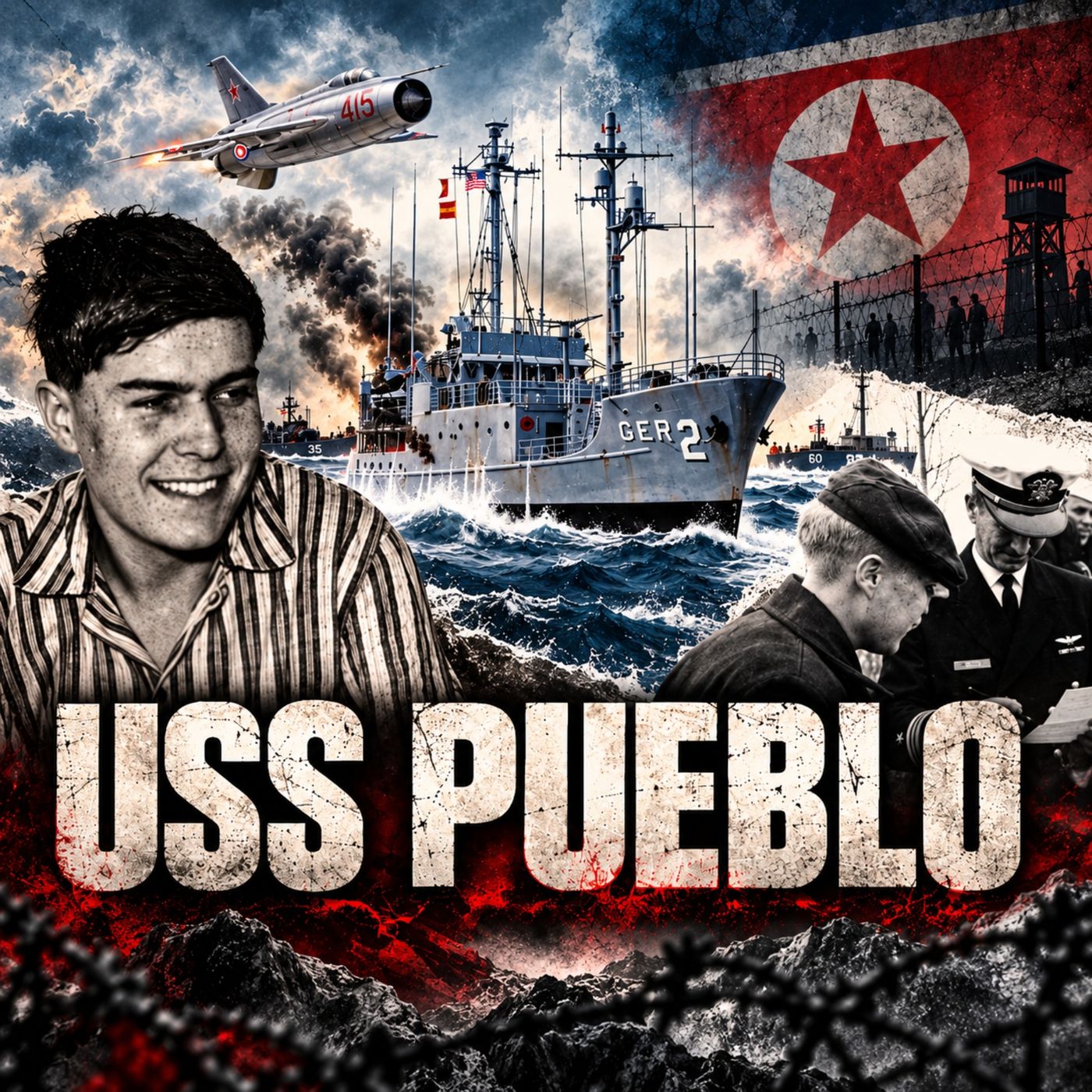
Steven Woelk recounts his service aboard the USS Pueblo, its 1968 capture by North Korea, and the brutal 11 months he and his shipmates spent as prisoners. We also discuss the crew’s resistance inside captivity, the injuries and abuse he endured, their eventual release, and why he wrote Pig Fat Soup to keep the Pueblo story from being forgotten.
Get Steve's book here: a.co/d/0j4rcW1x
Today's Sponsors:
VAER Watches ⬇️
vaerwatches.com/theteamhouse
get a free watch roll with your purchase.
20% for active duty, veteran, leo, & first responders
GhostBed ⬇️
ghostbed.com/house
FOR 10% off!
Blue Chew ⬇️
bluechew.com
Get 1 month free when you buy 2 of BlueChew Gold with code "HOUSECALL"
Ultra Pouches ⬇️
Don’t sleep on @ultrapouches. New customers get 15% Off with code HOUSE at takeultra.com #ultrapouches #ad
For ad free video and audio and access to live streams...JOIN OUR PATREON!
patreon.com/c/TheTeamHouse
To help support the show and for all bonus content including:
-live shows and asking guest questions
-ad free audio and video
-early access to shows
-Access to ALL bonus segments with our guests
Subscribe to our Patreon! ⬇️
patreon.com/TheTeamHouse
___________________________________________________
GRAB JACK'S NEW BOOK "THE MOST DANGEROUS MAN"
⬇️⬇️⬇️⬇️⬇️
penguinrandomhouse.com/books/803651/the-most-d…
Subscribe to the new EYES ON podcast here:⬇️
youtube.com/@EyesOnGeopoliticsPod/featured
Jack Murphy's book "We Defy: The Lost Chapters of Special Forces History" ⬇️
amazon.com/We-Defy-Chapters-Special-History-eb…
Or make a one time donation at: ⬇️
ko-fi.com/theteamhouse
Social Media: ⬇️
The Team House Instagram:
instagram.com/the.team.house?utm_medium=copy_l…
The Team House Twitter:
twitter.com/TheTeamHousePod
Jack’s Instagram:
instagram.com/jackmcmurph?utm_medium=copy_link
Jack’s Twitter:
twitter.com/jackmurphyrgr?s=21
Team House Discord: ⬇️
discord.gg/wHFHYM6
"Karl Casey @ White Bat Audio"
– Start
– Stephen Joins the Navy
– Assigned to the USS Pueblo
– The Pueblo’s Intelligence Mission
– The Blue House Raid & the Road to the Pueblo Crisis
– USS Liberty & the Vulnerability of Spy Ships
– How Poorly Armed Was the Pueblo?
– The North Koreans Close In
– General Quarters
– Trying to Destroy Classified Material
– Why the Pueblo Couldn’t Destroy Its Secrets Fast Enough
– North Korea Opens Fire
– Stephen Is Hit by a 57mm Round
– Losing His Friend During the Attack
– North Korean Forces Board the Pueblo
– Being Taken Off the Ship
– The Crew Enters North Korean Captivity
– Wounds Become Severely Infected
– Surgery Without Anesthesia
– Transferred to a North Korean Hospital
– The North Korean Doctor Who Treated Him
– Forced Propaganda & Confessions
– Commander Bucher Refuses to Sign
– Life Inside the POW Camp
– How the Crew Resisted Their Captors
– Giving North Korea the Middle Finger
– The North Koreans Discover What It Means
– “Hell Week” Begins
– The Worst Beatings of His Captivity
– Did North Korea Try to Brainwash the Crew?
– Leadership Inside the Prison Camp
– Planning an Escape From Pyongyang
– Was U.S. Intelligence Watching the Prisoners?
– Signs That Release Might Be Coming
– Crossing the Bridge of No Return
– Fear of Returning Home to Face the Navy
– 11 Months in North Korean Captivity
– The Negotiations That Finally Freed the Crew
– Returning to the United States
– Telling His Father What Happened in North Korea
– The NSA Debriefing
– Leaving the Navy
– Building a Life After the Pueblo
– Why Stephen Wrote Pig Fat Soup
– Why the Pueblo Story Has Been Forgotten
– The Meaning Behind “Pig Fat Soup”
– Losing 55 Pounds in Captivity
– Life Today & Helping Other Veterans
– The Painting of the Pueblo Attack
– Final Thoughts
Become a supporter of this podcast: spreaker.com/podcast/the-team-house--5960890/s….
Transkriptvom Podcast bereitgestellt · Zeitmarken springen hin
Hey, Jack.
What's going on?
Guess who our new presenting sponsor is. Tell us about it.
We've heard a lot over the last few years about whether it's possible to build things in America. Our presenting sponsor today, Vera Watches, is putting that question to the test. Vera was founded in Venice, California in 2016 with a simple goal, to rebuild U.S. watchmaking while producing watches tough enough to withstand the toughest outdoor environments. Today, Vera is the largest independent watch assembler in America. assembling watches in California, Arizona, Rhode Island, and Alabama, while also manufacturing its leather straps in Illinois and Florida. Every rear watch is built for active use with a guaranteed waterproof warranty, scratch-resistant sapphire crystals, and high-quality materials and components throughout. That combination has helped
Vair earn more than 10,000 five-star customer reviews, including thousands from people who rely on their watches every day in demanding professional environments. All of us here at the team house have been wearing our Vair watches for a while now, and you can check mine out right here. This is the Meridian Diver watch in navy blue. It's a very classy watch. And this is the actual rubber dive watch band if you wanted to take it in salt water.
But it also comes with a normal silver band and a nylon band if you prefer that. And D, what kind of watch are you wearing there?
I have the C4 Tactical Field Watch. It's solar powered too. I'm loving it. And it's funny because I had this laying on my coffee table the other day, actually. And my homie came in and to watch football or whatever. And he's a watch guy. And he's like, Oh, is that that fair one? He, I'm not even making this up.
Like I'm not even bullshitting. I'm like, Holy shit.
Yeah.
Like they're going to be presenting sponsor for the team house. And they sent us all a bunch of watches. Like, yo, I love this watch. And I, I literally sold the watch. I sent them the link, the team house link. And I'm like, yo, buy a watch from this, from this link. Because if you do buy a watch from that link, which is very watches.com slash the team house, you want, you purchase a watch, you get, A free watch roll that you could fill up with three watches so you could travel with your watches and stuff like that. It's really cool. It's leather.
Yeah.
And I was so excited when he was like, yo, is that that Vare watch? I see it all the time. I was like so amped that he came up with that.
Yeah, it's nice. I really like the like nice big watch face.
You can find them at vairwatches.com slash the team house. That's V-A-E-R watches.com slash the team house. And if you use our link, you'll get a free watch roll with $ 59 with your purchase. Also, Vair does offer a 20% discount for active duty military veterans and law enforcement and first responders. So you could check that out at any time if you are any one of those. Yeah, I'm excited about the sponsorship. So I really hope people go and check out Vair. Yeah, absolutely.
Absolutely.
Hey, folks, welcome to the team house. I'm Jack and we are here with today's guest, Stephen Wolk. He is the author of Pig Fat Soup, which is a memoir about primarily his time on the USS Pueblo and an incident that has been largely forgotten by American history. I don't think most kids get taught about this in high school.
They should I.
The Pueblo was captured by the North Koreans in 1968, and Stephen was held as a prisoner. I went through a terrible ordeal in prisoner of war camps in North Korea before being repatriated to the United States. And it's an incredible story. So Stephen, thank you for joining us on the podcast today. And thank you for writing your memoir.
Thank you for the opportunity.
So, Stephen, let's start at the beginning. You know, your book has some pretty interesting information about, you know, your upbringing and how.
You joined the Navy. Let's talk a little bit about that.
Yeah, I didn't. There's three of us my age. We really didn't want to be drafted. So we thought, you know, the Navy would be the best way to go. So we joined right out of high school. I think it was October of that year we went to boot camp in San Diego. And we were all 18 just turning 19, you know, and eager to get to going, I guess.
But when we, of course, we went through the boot camp, and then my first duty station was the Pueblo in Bremerton, Washington. And that's when it kind of all started for me. The Pueblo was then being retrofitted to house 30 communication technicians for our mission, which was spying out of a crew of 83 total. The rest of us ran the ship.
30 communication technicians took care of them. They were the spooks. They took care of the surveillance.
And what was your job on the Pueblo ship?
Well, being right out of boot camp, I wasn't given a school. So, you know, I was at the mercy of whatever the Navy wanted to hand me. And I wanted to be electrician's mate. That position was already taken. So I just standing engine room watches basically until something come along later on, which it did right before we were captured intercommunication technician. I might've went in that direction, but...
That didn't happen.
Tell us a little bit then about the Pueblo's mission and that deployment that you went on with the ship.
What was the mission? Yes. We were, of course, none of us regular guys knew our mission at all. We were just along for the ride. We didn't associate with the communication techs that much, and, of course, they wouldn't indulge what they were up to anyway. So we really didn't know. You know, until we were setting off a coast of some country, I didn't have any idea. And then, of course, when the ships come up and the flags are flown, we understood where we were.
Mm-hmm.
Mm-hmm.
Because of the compartmentalization of this intelligence program, you know, guys like you weren't read on to, you know, the, I guess the bigger picture, the larger mission.
No, no.
Um, and I think there's a little bit of a backstory, um, that I'd like to ask you about kind of leading up to, uh, the event, the attack on the Pueblo, um, the blue house raid and also the USS Liberty, you point out in your book, happened just seven months prior to the Pueblo being captured. And all these things are sort of interrelated in an interesting way. And I was wondering if you could talk a bit about that.
Yeah, the Blue House raid, of course, is a raid to assassinate the president of South Korea. I don't remember how many guys came across the border, but they got right up close to their base. the Blue House, it's called, where the president stays, before they were stopped. It is kind of a theory that that may be why North Korea come after us. You know, it was payback. We were sitting out there all alone and no help in sight, so we were easy pickings for them. But yeah, it sure seems like the Blue House raid had a lot of influence on us being captured, being taken, seized.
The idea being maybe, or theoretically being that the North Koreans feared that the United States would retaliate for the Blue House raid. And so they wanted to take some American hostages.
Yeah. Yeah. Yeah. That, That part was written up by my co-author, Robert Lofthouse, and yeah, I didn't really deal into that, a lot of specifics on it, but there is, he really explains it well in the book, you know, on how they came across and how many there were, and the one that did survive and gave the, the army a lot of information, you know, on how that was all set up and where they came across the whole mission, basically, and how it failed.
And there's also a mention of the USS Liberty and it being attacked about seven months prior, and some thought that that may have informed what the North Koreans did.
You know, if if nothing else, the Navy should have kind of realized that, uh, these types of ships are vulnerable. Um, and the Liberty, they had the firepower, you know, they, had the capabilities, we didn't. So, you know, that whole program, it really needed to be looked at a lot closer than what it was. There was a ship USS Banner, it had been out on a mission, same type ship, as a Pueblo and also the Palm Beach. There's three ships in the Banner class. And the Banner, it was out on station and really didn't have any problems. You know, you get harassed from the Russians, you get harassed from the Chinese, but there was really no harassment from the North Koreans as far as I heard anyway. So, you know,
that program should have been looked at a hundred times A lot closer on the assignments or on the missions that we were set out to do.
And just to emphasize that, the Pueblo was unarmed, you're saying. Did crew members have small arms? Was there even that?
There were small arms. I think there was a couple. 30 caliber submachine guns and some handguns, you know. But the main gun was a. 50 caliber machine gun. Had two of them. One was stored below. As far as I know, the other one was mounted on a handrail with no armament around it. It was wintertime, so there was a canvas on it, and it was covered with ice.
Wow.
So, you know, to get to something like that, you had to carry your bandolier of ammunition over your shoulder across 20 feet of open deck up an eight-foot ladder, cross another six feet to the. 50 caliber and take off the canvas and load it. And while you're under fire, it's suicide, suicide mission.
Could you walk us through the day of the attack on the Pueblo, kind of what you were doing that early in the day, going about your duties to when you started to realize something was wrong?
You know, we'd noticed a North Korean trawler the day before and really didn't think that much about it. Of course, we used radio silence and really wasn't talking to anybody from my understanding. And then the next day, the ships started coming in, the planes started coming in. And of course, you don't jump to conclusions right off the bat. And Booker was told... before we ever left, you know, don't go out there and start a World War III in North Korea. You know, don't show any signs of atrocity.
So you don't just jump out there and man the machine gun just because they're coming up and act like they're threatening you. You don't know. But I was off... duty at the time. And, uh, there was several of us looking out the, uh, forward hatch at them coming in. So, you know, I saw the flag and saw the, the, uh, soldiers on board with their, uh, AK-47s all drawn and ready. And, uh, then, uh, Commander Booker ordered everybody stay inside. Don't, uh, shut all the hatches and, uh, Don't let them know how many people we have on board, basically. And then shortly after that, General Quarters was called, and I went to my General Quarters station, which was the auxiliary engine room.
And we should point out here also that the Pueblo at this time is in international waters. Whatever the legal, it's like 20 miles off the coast or something like that, right?
Yeah. You know, I've heard several different things. I've heard it's 12-mile, and we were more than 14 miles off the coast. And to my knowledge and to the guys that I know who were in the pilot house, we were never in their water curse. We knew better than that.
What happened after you got assigned to general quarters?
Went down to the auger. auxiliary engine room. My best friend was down at Dwayne Hodges. We just was watching the generator that supplies power to the sod hut, which is where the communication techs are all located and all the equipment. And after down there, we couldn't hear anything. You know, the noise of the engine just didn't know what was going on. We could hear some planking on the side of the ship, but didn't put two and two together until later on with machine gun fire. But we were called up, or Dwayne was called up individually to help in the destruction of top secret and classified documents with two other guys. And once he was out of there, I was actually replaced by another engine man and, and, uh,
I went up to the same place Duane was. So there was four of us trying to destroy just tons of documents the best way we could. So my time on general quarters was very short. Then I was ordered to go up and start the destruction of the materials.
And you write about in the book how the facilities and the resources that you guys had on the ship for the destruction of classified material was wholly inadequate, um, that there's like one incinerator, but it wasn't big enough or even close to big enough to, uh, do the job.
No, no, we, and we, we were using the standard government, uh, trash cans and the metal trash cans. And of course, in order to get any type of paper to burn, you have to tear it up and you can't just pile it up and write it on fire. Uh, And it's very time consuming. And like I said, we had mounds of it to destroy. So it got to the point where just starting fires all over the ship on the deck inside interior deck to just try to get rid of what we could. Of course, the smoke was unbearable.
I was sitting in front of the captain's safe and I was pulling documents out of it. So I was kind of by myself there. an adjacent corridor from the rest of them. And what I'd pull out of there, I just handed to the other three to start burning it and determine it. There were weighted bags that was filled as much as they could, you know, and try to jettison over the side. But when you're under fire, that's really difficult to do. I think there's, from what I was told, there's a couple of them that were thrown overboard, but very little was destroyed.
And so as you're trying to destroy these documents, what's going on outside as the North Koreans approach the Pueblo?
Well, Booker was trying to stall for time. They, through the signal flags, you know, he too, for boarding party and Booker, you know, no thanks, we're leaving the area and So we tried to take off, you know, and every attempt we tried to take off, they'd fire at us. And then it got to the point, you know, he'd stop, try to give us time to get rid of what we could, and then they'd start firing on us again.
They just riddled the pilot house with machine gun fire and 57-millimeter rounds, trying to disable the ship that way. it appears that they took aim on our area with the 57 millimeter round that come through the side of the ship where the four of us were working. We opened up a hatch so the smoke could get out, you know, and I don't know whether there's any in that area or what, but yeah, they really, they were firing from all sides. And of course we had the two Russian MiGs overhead too that were threatening them. But it was, of course, all we could hear was just, like I said, the plinking of the machine gun fire on the side of the ship. And we kind of thought we were safe. Had the ship's metal side to
protect us. No big deal. The machine gun fire wasn't penetrating.
Just to.
clarify did you or do you know were the migs being flown by actual russians or were they russian migs flown by north.
Koreans i have no idea that's probably written up in the in the books somewhere whenever all the documents were declassified in washington there was a couple really good books that came out about you know the what the government did what they did do and nsa did and didn't do, and Navy. But there's a lot of information there, but I don't know whether I ever knew whether it was Russian or North Korean or Chinese.
Yeah, right.
And you, and I believe from what I read in the book, there was three of you total who were hurt pretty substantially. How did these injuries come about? I mean, was this while you were in the pilot house getting shot up by machine gun fire?
No, really wasn't in the pilot house. We were on a main deck just outside the officer's boardroom and our captain's quarters. Yeah, we were... The other three, they were in a short passageway, and a 57-millimeter came through the side of the ship and exploded. Dwayne Hodges, he caught a majority of the blast. He must have been right up against the side of the ship. We had two Marines on board. One of them was with us. They were trying to destroy material, too. He was wounded in the leg. Shrapnel came up the passageway and caught me in the waist, blew me over backwards. The horrendous blast, you know, and smoke and fire. The third guy, he had flash burns up and down his leg. I couldn't move from my waist down. People were kind of tripping
over me. up and down the corridor or passageway. So I pulled myself around to the officer's mess and got out of the way. I could pull myself, but I couldn't walk. I couldn't get up or crawl. But we were, we were on the main deck. We, we weren't out on the pilot house.
What happened when you, after you pulled yourself into the officer's mess?
It wasn't too long after that, that there are, Schiff's corpsman, Doc Baldrige, he brought Duane's body around and put him just outside the door. And I was on the inside, and Doc, he got in between Duane and I, and he tried to comfort Duane as much as he could, you know, with what little supplies we had on board as far as bandages and morphine. I got one syretta of morphine to ease my pain, and of course, Dwayne, he needed all he could get. He probably didn't survive more than a matter of minutes, as bad as he was wanted. But Doc did the best he could, you know, trying to patch me up and, you know, He told me later, you know, what saved my life as far as not bleeding to death, I was laying on my bandages,
which helped stop the blood. But then after they boarded us, they came on board, they took the bodies away from us, or from me. So I was there by myself. Uh, and there's a long period of time that, uh, before, uh, Korean guard came in and, uh, uh, they put me up on, on the, uh, uh, dining table. And, uh, so I was there for, I don't know how long, but it was a long period of time before I was ever taken off the ship.
Did the North Koreans at this point attempt to communicate with.
You at all?
No, no, there was, uh, If the officer that was with them spoke English, he did not speak English to me. It was just mainly the guards that were, they'd stick their head in the door. But that was basically it. They'd take watches and rings and whatever. They were after the trinkets more than I think what they really realized they had, that they just wanted.
Right.
I think, didn't you say they took your watch, but they left your high school ring?
Yeah, yeah, surprisingly. They took it, and then they gave it back to me. Oh, really?
Well, that was decent of them, I guess.
Yeah, yeah. Don't understand that.
Hey, guys. I want to thank Ultra for sponsoring this episode. If you're anything like me, you've probably leaned pretty hard on caffeine or nicotine at some point just to stay focused and get through the day. The problem is eventually you're dealing with crashes, feeling overstimulated, or constantly reaching for the next one. That's what I've done and continue to do, and I'm trying to fight it. That's why I started using Ultra Pouches. They sent us this a couple weeks ago, and I've been using it. I love this tropical one.
It smells so freaking good. Tastes so freaking good. They're basically instant focus in a pouch. The big difference is they are completely nicotine and caffeine free. Ultra partnered with neuroscientists to formulate them with nootropics and adaptogens like Infinity PX, L-Phanine, Alpha-GPC, and vitamins B6 and 12. The idea is smooth and steady energy and focus that lasts around one to two hours without that nicotine or caffeine crash. For me, it's a much calmer, more consistent kind of focus. I keep them with me by the computer or I have some in the studio too. They come in five flavors, Cool Mint, Wintergreen, Tropical, Watermelon, and Blue Raz. I'm going to say Tropical is definitely my favorite. I love it. Just the smell alone, it
smells unbelievable. And it tastes pretty good too. You're not worried about it tasting weird or anything. It tastes so sweet and delicious. Ultra is the ultimate guilt-free pouch delivering instant focus and mental clarity without nicotine or caffeine. New customers can use the code HOUSE and get 15% off at TakeUltra.com. That's TakeUltra.com with the code HOUSE and you get 15% off. And after your purchase, they'll ask you where you heard about them. Please support the show and tell them we sent you. Thanks, Ultra. Shopping for a mattress can get overwhelming fast. Too many options, too many opinions, and no clear way to tell what's actually right for you.
That's why Ghostbed built their online mattress quiz. It's quick, it's simple, and it helps narrow down the right Ghostbed mattress based on how you actually sleep. You answer a few questions about things like your sleep position, whether you tend to sleep hot, and the feel you prefer. And the quiz... gives you a clear recommendation from the GhostBed collection.
And if you're shopping with a partner, you could take it together. The quiz factors in both of your preferences, so you're not guessing or compromising blindly. It's an easy way to land on a mattress that works for both of you without overthinking it. Behind the quiz is a family-run brand with more than 20 years of experience making high-quality mattresses. Plus, you'll get these best deals with GhostBed because the mattresses are priced up to 50% less than comparable brands. And there's no pressure either. Every mattress comes with a 101-night sleep trial and long warranty and fast free shipping. Most orders arrive in two to five business days.
Right now as a team house listener, you can take an extra 10% off your order. Just go to ghostbed.com slash house and use the promo code house at checkout. That's ghostbed.com slash house code house for an extra 10% off site wide. Some terms and exclusions apply. See site for details. Ghostbed, we love you. Thank you for sponsoring this show. Boner alert. This episode is sponsored by Blue Chew. Guys, what do women want and need? Stability? Reliability? Be her rock with Blue Chew. They're sponsoring the episode today. And they're sponsoring your bedroom performance. That's right. With Blue Chew, you're not just having sex anymore. You're putting on a show.
Your wiener is no longer just an organ. It's a star athlete. You're like a slugger in the 90s, juiced up and ready to knock it out of the park. Break a record with your piece. Your penis is basically Mark McGuire in 1998. Blue Chew Gold is better sex than a tablet. They combine four ingredients in one powerful solution.
Two ingredients get you rock hard physically, and two support arousal and desire in the brain. It works fast, and it lasts. Guys, have a complete experience in the bedroom with Blue Chew Gold. There's a reason Blue Chew is the number one brand for better sex. Experience it yourself at bluechew.com. And we've got a special deal for our listeners.
Right now, when you buy two months of Blue Chew Gold, You get the third month free with promo code Housecall. That's promo code Housecall, H-O-U-S-E-C-A-L-L. All one word, link in the description. You also receive an additional 10% off plus free overnight shipping on your first order. Visit Bluetooth.com for more details and important safety information. We thank Bluetooth for sponsoring the pod and your bedroom.
So, I mean, you're, you know, riding that cloud, I guess, a little bit as far as the morphine until that wears off. But what do you recollect of them actually picking you up and moving you? Because now they have to put you on a North Korean vessel and transport you to the mainland.
We were docked in Monsanto. They apparently put a pilot on board and pilot us into Africa. in the, in the far end of the Harbor. So when we dock, I don't know, you know, I, uh, there's only one small hatch in the wardroom and I couldn't see out. So I had no idea what was going on. I could just hear the roar of the main engine and, and, um, It was a long period of time. There was no foot traffic up and down the corridors other than the North Koreans. Then all of a sudden they came in and wrapped me up in a plastic tablecloth that was on top of the table and pretty much drove me off of the table and onto the deck. I really thought they were going to throw me overboard. I didn't know we had docked. A lot goes through your mind
in a matter of 15 seconds of going up a corridor, you know. And you know about how far it is to the outside and where the water's at. But when they put their foot on the gangplank, I recognized it and knew, you know, we were docked somewhere. And then they drove me across to a waiting bus. Apparently, everybody had been taken off and were either on the bus I was put on or another bus. They put me between the seats on a stretcher. I could look out, and we were all blindfolded, and our hands were tied, so we really couldn't see what was going on. But you could... twist around and look through your blindfold, you know, and I could see a bunch of the crewmen that were sitting beside me. And then we took off then.
And I really think I was probably the last one to leave Pueblo. Because when I got on the bus, it took off.
Now, where did they take you initially?
We went to a train. Then we spent the night on a train there. the night on a train to our first place, which was a dingy, dark room. And they put the three of us wounded together with another crewman, which why they didn't give us the corpsman, I don't know. But our help was tremendous. fellow crewman who, the only experience he had in first aid was through Boy Scouts, but he did a tremendous job of taking care of us.
And the other two were, you know, they could help too. As far as me, I couldn't, I couldn't, like I said, I couldn't move from the waist down. And so I was pretty much helpless. But yeah, it was a terrible, dirty, dark, cold room for the four of us. And We just didn't know what was going on. Then the next day, we were taken to another building, which really wasn't any better.
Still dirty floors and just a single light bulb, dim light hanging down from the ceiling. But this is where, after 10 days, they started to tend to our wounds. but they didn't really do anything for us up until that point.
Did you guys were dealing with like infection and things like that? After I imagine 10, 12 days.
Yeah. Yes.
After that many days, you know, and you can just tell by the stench in the room, you know, it was, it was just, it was almost unbearable for us, but we were around at 24 seven, but the guards, they, they'd come in and put a bandana around our, face so they didn't have to smell it. They didn't bother us that much because of the odor we were putting off.
But yeah, the infection had to be setting in pretty bad. I know if they hadn't started tending to us, I was probably going to be the next one to die. It was that bad. Was it like a North Korean medic?
At what point was it.
That you actually got transported to the hospital to receive proper medical care?
Well, I went through surgery first. They did the surgery right there in that second place we were taken to. They come in one night and wrapped me up in that plastic tablecloth again. I'd been on it since I left the ship. And I went into this little room. It almost looked like a kitchen. It had cabinets on the wall and just wasn't that big a room. It was not set up for surgery that I recall at all.
They put me on a table and tied my legs down. And there was a doctor there. He had a mask on. There was nurses, too, and guards there. Of course, I was tied. I was still tied. My legs were tied together. Well, at that point, they untied my legs, but my arms and my hands were still tied together and still blindfolded.
And they stripped me of my clothes, and they started removing shrapnel and bone fragments and infection, you know. And they, I ended up, I only had just, a very small amount of shrapnel. There was a couple pieces went through me. One of them took out my right pubic bone, took out half of it, and took out half my tailbone at the same time. It hit my testicles. The shrapnel damaged my testicles. They were also removed surgically at the same time. And, uh, But all this was done without any anesthetic. They just started cutting away with the scissors.
Good God. It was just, the only way I could stand it, I'd just scream as loud as I could. I never did pass out as far as I know, because I can still remember the pain. And probably, the operation probably didn't last 10 minutes, but it felt like it was hours in there. They took me back to the room and I just passed out. I don't remember the rest of the night, but then they took the Marine in there and he had a piece of shrapnel in the inner thigh, about the size of a silver dollar and a quarter inch thick. And they just took some forceps and jerked it out. No anesthetic. And, you know, sutured him up just like they sutured me up with what looked like kite string or the string that you see And it ties up meat, you know, white cord-like.
That was their suture material. It was effective, I guess.
It's like Dr. Frankenstein stuff, though.
Yeah, yeah. But, you know, you think the Korean people, more than likely, that's the type of medical treatment they would get, too. Yeah, yeah. Now, the military, they probably, I'm sure they treat them a lot better. Of course, their officers, they're treated like, get whatever they want, I suppose, as long as they're loyal. But, you know, I feel for the American, or not the American, the Korean people have to live under those conditions. That's just terrible.
Yeah, I'm sure you're right that they were treating you with the same materials and the same resources that they would have had for their own people.
Yeah.
So you wake up the next day and where are you guys transported to next?
Well, after the fourth day, I wasn't getting any better. So that's when they came in, they wrapped me in a blanket. I had no idea where we were going. but this was just me that was leaving, not anybody else. They took me out of the building. I mean, it was extremely cold around in February, actually, and it was 14 days after we were seized. Threw me in the back of a Jeep, laying in the back, blindfolded again.
I couldn't see. I don't know if it was dark I could see the stars but they took me to the North Korean hospital there I'd spend 44 days recouping and by the end of the 44 days I was able to walk across the room you know and and, uh, but, um, that was about it. It took me a long time to recoup.
Could you tell us a bit about the North Korean doctor? Because it sounds like he's sort of the first person, first North Korean that you had some semblance of a relationship with.
Yeah. Um, you know, he, he seemed to always, uh, have a smile on his face. Of course, he wore a mask all the time. And I couldn't understand a word he was saying, of course. The only time they would bring in an interpreter is when they wanted something. So that was very rarely they'd come in with an interpreter.
So it was by showing or sign language or whatever to get it pointed across what he was going to do or what one time, I'll jump ahead, one time they brought in, I was getting daily injections and one day they came in with a vial of what looked like penicillin to me, a milky looking substance in a vial and I'm allergic to penicillin so it took me some doing to convince them that I And they didn't give it to me. But no, he seemed to be an okay guy. And I'm sure he was probably the one that operated on me too, but you can only do what you're allowed to do. So I can't fault him for that. It wasn't him, it's the regime. But no, the nurses, that's another story. I'm sure if they were left alone with me long enough, they'd just as soon
cut my throat. The only time they would laugh or giggle was, I'm sure, they was laughing at me for some reason, you know, not, but it was probably my injuries, they were laughing about that, but, you know, they, They showed no remorse whatsoever towards me. They were scary.
Yeah, because of the brainwashing, the propaganda that they get indoctrinated with.
Absolutely. From the time they're able to comprehend, it's just brainwashed into them. Hate Americans, kill Americans. They're Their army's the best. Their economy's the best. Everything they do is better than anywhere else in the world. You're not going to take that from their mind very easily. No coup's going to go in there and change the minds of the whole population. It's not going to happen. Right.
Kim Il-sung single-handedly won the Korean War on their behalf.
Yeah, yeah.
You mentioned that they would bring an interpreter when they want something from you. They did take that opportunity while you were in the hospital, right, to make a propaganda film and put that document in front of you?
Yes, yes. I didn't realize what the crew had went through. Of course, I had no idea. what any of the crew went through until after I went back. But, um, they, they wanted me to sign this document and, and, um, uh, I signed it because I, I saw all my friends' signatures on there and recognized their signature. And so I went ahead and signed it. But, uh, yeah, it, like I said, when they, when they want something, they'll bring the cameras in and they'll bring, uh, potted plants in and set them there and magazines and everything, throw it out there and they might throw a fruit, some apples in front of you, you know, like they're fresh cigarettes or something. They're just all for show. And then when
it's all over, it's all taken away.
And with this letter, the, you know, so-called confession that you were in North Korean waters and being aggressive or such and.
Such, Yeah. Of course, the crew didn't want anything to do with it. You know, Commander Booker absolutely refused to sign. And, of course, they started beating on the crew tremendously. Commander Booker, they nearly beat him to death trying to get him to sign. And it just got to the point where... You can only take so much, but when they come in and tell you, you know, we're going to start killing your crew the youngest first, that, from what I understand, that pretty much did it. He went ahead and signed that and instructed the crew to do the same.
Yeah, it's not worth dying over.
Right, right.
And when... You were eventually discharged from the hospital. Was that when you were brought to what was like an actual POW camp?
Well, it was a three-story building. It was better than the other two by far. It was still, you know, dirty walls and dirty floors and a single light bulb from the ceiling. But the hallways were like marble or And the walls, it was like, there was also a large soccer field outside. So it was almost like a sports complex for visiting teams, maybe from other nations. So there was individual rooms. We were put eight to a room at that time with eight beds and a little nightstand and a table in the middle of the room for, um, um, hard playing or whatever, you know, to, uh, um, kind of take our time during the days, uh, when they weren't beating on us. Um, but, uh, it, it was, it was better. Um, of course you're, you're still restricted
that you can't do anything. I mean, you, you have to watch what you say, watch what you do, uh, You're just under constant watch, basically. You have to really be careful. We were allowed to go outside about 15, 20 minutes a day when the weather permitted out on the soccer field. Some of the guys, they played touch football and some had a soccer, not soccer, volleyball. Some played volleyball. But a lot of guys just kind of walked around and talked, you know, and that's when we could converse amongst each other and kind of come up with different ways to be a real pain in their ass somehow, which we did. We did. We made it hard on them at times.
What were some of the techniques of passive resistance that you and the crew members enacted in the camp?
Yeah, sarcasm went right over their head. Commander Bucher was just so good at writing up something or doing speeches and trying to say what they wanted him to say, but yeah, it meant something else. Just for instance, like, uh, I think, I think it's a French word. It's, it's peon. And, uh, one of the phrases Booker used in one of the speeches, you know, peon, the, the North Koreans, uh, peon Kim Il-sung, you know, and it went right over their head, you know, it is, they, they interpreted as, as being, uh, just praising him. That was kind of neat. Little things like that he'd come up with. When he would address us in group meetings, you know, it's sometimes so hard to keep a straight face some of the comments he made.
Like I said, sarcasm just went over their head. The censored letters that we were reading forced to ride home, a lot of little things were put in there, like tell Uncle Joe hi, Uncle Jeremiah died 20 years before, or tell Aunt Jemima hi, you know, or just things that they could not verify, but the U.S., families would know, the government would know that this isn't right.
Right, that you're being held under duress and these confessions are coming out of torture and so forth.
Right, right.
You guys also came up with a funny code signal. flipping the bird in the propaganda photographs that they took of you.
Yeah, that was our biggest highlight, I guess. Somebody noticed in one of the propaganda films they showed us that a bystander was giving the cameraman a finger. And we thought, yeah, if he can do that, maybe we can do it too. So the word got spread, you know, that, um, try using it. And, uh, uh, we started using it in the photographs. And, uh, I suppose every one of the, the group photographs of, um, uh, room photograph before there's taken eight, um, eight of us at a time and photograph is somebody in that photograph was given a finger.
So it was, uh, well-documented and, um, it went right over their head. They had no idea what it meant. The suspicion got the best of them one time and they asked what it meant. And somebody told me it was a Hawaii good luck sign, you know. No big deal. And then some energetic journalist in the U.S. decided to tell the world what it meant. That's when all hell broke loose on us over there. It got pretty bad real quick. Go ahead.
I was just going to say, this famously happened in the Hanoi Hilton as well. There's that photograph of, I believe it was in Newsweek, where the guy giving an American POW giving two middle fingers and to censor it in the American press, they like blurted out and it looked like it's, you know, I remember a story where like his, his niece or his daughter thought that the Vietnamese had chopped off his fingers.
It's like, no, that's not.
Oh, I hadn't heard that.
Yeah.
Yeah.
But, um, so tell us about this, the retaliation that you guys, uh, were subjected to, um, when they, when the North Koreans found out about this.
They put, uh, before there was eight of us to a room, then he put 10 of us in a room, 10 beds and 10 chairs were put at the end of each, a chair was put at the end of each bed where we would sit with our chin down on our chest, you know, and our hands on our knees and have to look straight down all day long unless we went to the bathroom or went to eat.
And there was just enough room for the guard to come in between us, between our knees. And when you're looking down like that, you can't see him coming. And he would just come in and knock somebody out of their chair. With either his calloused hands from martial arts. I mean, their hands. I got hit in the neck and his hands just felt like a tube before hitting me.
They were like chop you in the neck.
Yeah, yeah. and the rifle butt you, you know, or just hit you with their fist, knock you out of the chair. And what they couldn't understand is we would get right back up and get set right back in the chair. We feared if we laid on the floor, they'd kick the crap out of us, you know, and we didn't, none of us wanted that. Some of us got it anyway, but our room, you know, If they knocked us out of the chair, we'd just get right back up and sit back down. But what's really nerving about that whole deal was you'd be in your room, and the doors were always open to all the rooms.
Of course, we couldn't see any other rooms, but we could hear what was going on. You could hear chairs being thrown across the room and screams and hollers and screams. slaps like people were getting hit. And you don't know whether they've got a room just set up across the hall that's empty and they're doing that themselves or they're doing it to the rest of the crew. Well, most of it was done on the rest of the crew, especially to the guys that were given the finger. They'd come down on hard on them and come down on hard on Commander Booker, too, for letting it go. So it was hell week for uh, about a week. It lasted about a week.
And I think you wrote that that was probably the worst beating you took the entire time you were there.
It was for me.
Yeah.
I can't answer that for the rest of the guys. Cause I don't know what they went through on the confession letter, but, uh, that was for me.
It's something I wanted to ask you about was, you know, um, It's somewhat famous or infamous, I suppose, that American POWs during the Korean War were subjected to communist propaganda and indoctrination sessions and things like that. I want to ask, did the North Koreans ever attempt that with you guys?
No, they really didn't. They provided magazines. You know, they were heavily anti-American and, again... how great they were, but no, there was no attempt to try to convince us, you know, to come over to their side. We knew better than that. No, there wasn't any of that. There wasn't any type of brainwashing as far as I know on anybody. That's interesting.
And throughout this ordeal, I'm kind of curious, um, how your captain, how the commander and, uh, other leaders, um, in the, amongst you, amongst the prisoners, what did they do to kind of like step up and show leadership and kind of keep morale up amongst the crew during this time?
Okay. Commander Booker was the commander. He, he was the one that, uh, was in charge. There was the senior enlisted officer in each room was in charge of the room. So if the rooms cleared up, the non-commissioned officer, he'd get whapped, you know. But the officers were kept in charge in solitary confinement by themselves. Each had their own room.
Commander Bucher had his own room. So it was kind of one-on-one with them. But, you know, when we'd eat, there'd be, they'd take several rooms at a time. And we were able to converse a little bit. And if one of the crewmen was in contact with Commander Bucher, messages were distributed that way, you know, or out on a, when we'd go outside, you know, conversations would be what he wants or what's going on, what he knows, or this is happening, you know. And so he kept us informed that way. But it was, it was, and I don't recall if they ever took the guys that were in charge in individual rooms and met with him. Um, I, I don't know. Uh, I don't remember if they did that or not.
Did, uh, you ever plan, uh, for escape at any point during this?
We did in our, in our room. Um, there was a couple of guys that was ready to go. We had the two Marines in our room and, um, I'm sure they would take off at a heartbeat. But we were kind of a disadvantage being in a Pyongyang and white guys in an outfit. We kind of stood out.
A little bit, yeah.
But it would have been nearly impossible. The only thing that we could take as far as food was dried squid, and I don't know how many times we got that. I only remember one time, and we stored what we could under the floor. We found a loose board in the floor, and we'd put whatever we could down underneath there to store it. If the time would come that we would try to get somebody out. It would have been pretty much impossible. There's a lot of miles to cover.
Yeah, I was going to ask Did you have any sort of sense of where this camp was actually located in North Korea? Like how far from Pyonggang, how far from the DMZ? Did you have any sense of that at the time?
The magazines that they gave us, one of them had a monument of a flying horse. And if I remember right, out of our window, way off in the distance, we could see that monument. Interesting. So we kind of had an idea. We were in the city in Pyongyang, and those guys, you know, they're smarter than me. They could figure out what direction to go, I suppose, from that. But, yeah, that was an indicator of at least what city we were in.
Yeah, yeah.
So, yeah, it would be quite a trek to get to South Korea.
Yeah, yeah. Unless you had somebody... you know, watching us. Of course, we had no way of knowing anybody was watching us from the South. So we would have had any way of contacting anybody to help us in any way in getting out. So, yeah, it would have been pretty much, we would have been on our own.
You did find out in retrospect, right? Um, way down the line that you write in your book that you believe the American government had some intelligence source watching you guys.
When, when the hell week stopped, like I said, it stopped all at once. Um, and there was no reason for them to do that. Uh, uh, it wouldn't have surprised any of us that they would have, they would have killed several of us. And I, I've thought over the years and I've asked several of the other crewmen, you know, you think somebody was really there possibly watching over us, you know, that the, they knew the condition we were in and, and when hell week really got to going, the word got out, you better get them out of there and get them out of there now.
And the, We believe that that kind of hurried up things in the U.S. to get something done, get us out. When it stopped, Hell Week stopped, they started cleaning us up, gave us fresh clothes. That happened once before in October. And we found out afterwards that the negotiations were going pretty good and they're possibly would have been a release then, but that fell through, if that ever was the case, but anyway, we were cleaned up, and then we were put on buses, and there's paper covering over the bus, some guys say we were on a train, and then we're on a bus, I just remember the bus ride, because so many things are going through your mind, you're, everything's kind of normal, you know, you get through this
normal routine for about eight months or so. And then 10 days come along, you're getting the crap beat out of you. And then all of a sudden it stops your minds in a, in a, you know, in a daze. You just, you don't know what to expect. You don't know how to react. And so we're, we're, we're all kind of in a, what's going on or we've got to, are they dressing us up to execute us or? are possibly going across the border. Maybe they're moving us north further from the DMZ. You know, we didn't know. But anyway, come to find out, we ended up at the 38th parallel, the bridge no return to be released.
Tell us about that moment, crossing the bridge and sort of how that interaction took place.
Well, Booker come on the bus and said, when you're walking across, don't look back. Don't say anything. You know, you got the rest of your crew behind you. Don't screw it up for them. And it could have. I mean, one of us could have turned around and flipped the bird off and it shut the line of us going across the bridge right there. But that didn't happen. They spaced us out, I don't know, 15, 20 feet apart.
and walked single file across the bridge. It, again, you know, I don't remember walking across the bridge. It just, it's that, your frame of mind is still in a daze. You just, you don't know what's going on. Yeah, you're getting released, but you're still, You still just don't know. And some of the guys, and this thought never crossed my mind, but some of the guys were concerned. You know, we're walking out of North Korea, captivity right back into the U.S. government, captivity because we gave up the ship. And you just don't do that.
Yeah, they were afraid they'd be prosecuted.
Yeah, yeah.
But.
That didn't happen as far as the crew was concerned. That walk, of course, you get over to the other side and there's a photograph in my book of a lieutenant commander signing us off one at a time coming across. And maybe it hit me then, you know, hey, I'm released. But still, there's still a lot ahead of you in the months to come. Yes. Rehabilitating yourself and your mind and some got through it and some didn't. It's a tough transition.
What was the total amount of time that you spent in enemy hands when all is said and done?
11 months. Wow. From January 23rd to December 23rd. Wow.
And subsequently, what have you learned about those negotiations that led up to your release? How did that come about and why?
When the negotiations started, right after we were taken, the Navy was going to use a Navy officer to do the interrogating, or not interrogating, the communicating between the the North Korean, and I think they had, they might have had Chinese there too. I don't remember that. But anyway, the North Koreans and the U.S. government, the U.S. military.
But the Army said, you know, you have no idea how these people communicate, how they negotiate. It's too much of a learning curve for you to jump in this but they had an army, General Woodward, I believe was his name, he had experience with negotiating with them and knew how much of a pain in the ass they were, so it was decided to use him. Well, when it come down to, you know, all year long, the North Koreans, they may come to the table and just get up and walk out, or might not even show up for a scheduled. They were very unpredictable. But when it come right down to the final thing, the hardest thing for the U.S. to admit was we were in their waters.
That was the big step. And from what I understand, from the books that I have read about the incident, wife of one of the generals on, said, well, why don't you just do a public appearance and say you'll be signing this confession to release the crew and to release the crew only. And then go ahead and sign a confession, you know. So that's what they did. They presented that, they did an interview from what I understand and said, you know, This is to release the crew.
And they signed it. In North Korea, they bought off on it. That's how it took place. It's interesting.
And then what was the journey back home like for you from the moment you crossed the bridge to being fully repatriated?
Yeah, that's again, that's getting your mind focused on getting back to life. When we got back to San Diego, we were treated like heroes. Of course, you're Vietnam vets, they got, it's sad what they were put through when they got them back. We weren't. San Diego just opened up their arms for us. So you're treated as heroes.
And I never really considered myself a hero. You know, I just, doing the job and, you know, So it's... There's that part out there, and then now you're going home. And it starts all over again. I come from a small hometown, or a small town in Kansas, and again, you're treated like a hero. That's got to stop someday. Right.
And then what do you do? Well, I... I had decided, you know, that I'm going to get home, get my life started, get trained in a job I wanted to get trained for and go to work and go from there, you know, and that's kind of what I did. So, but still your mind, you can't forget all those times, you know, from a year before in 68, and then the release, and coming back home, and getting the treatment you got there, and it's hard to cope, it really is, unless you really try, and It's tough. And some guys can, some guys can't.
In your book, there is one really poignant moment where you're at the family dinner table and you kind of, you and your father excuse yourselves because you don't want to talk in front of your mother about what happened in North Korea. And you have that conversation with your dad about what you endured. And as I recall, I mean, he cried. And then you guys never talked about it again.
No, we didn't. You know, nobody really talked to me about it. A lot of guys I've worked with, people in my small town I was from, of course, they knew what I'd been through as far as being in captivity for 11 months. but they never really knew exactly what I went through, and I never really told anybody.
My frame of mind was nobody would believe what I went through anyway. But nobody asked me, so I just went on. But Dad was the same way. I wanted to let him know exactly what happened, and it hit him hard, and I just left it up to him to tell Mom. because they went through hell, too. They really did.
You were also pretty thoroughly debriefed by the National Security Agency, right? Because the Pueblo was on a National Security Agency mission?
Right.
What was that debriefing like?
Well, it was, for me, not being associated with any of that... work as far as the CTs were concerned. They were more concerned with what was destroyed, especially out of the safe I was emptying. And they were concerned about one piece of equipment, and I don't even remember how he described it, but I told him I did not see it in the safe.
Oh, it's the encryption equipment.
If it was destroyed, we didn't destroy it. somebody else come along and pulled it out of the safe and destroyed it. But it had to do something with the decoding. But most everything in there was just classified documents and top secret documents.
And so after that kind of like return home, I mean, you decided to get out of the Navy, right?
Yes.
And... I wanted to be an electrician, but I needed to be trained. I was E3 when we were seized. They gave me E4 when I got back. Then about the time I was getting ready to leave to go separate ways, they said, we'll give you E5 if you pass the test within a year. Well, I didn't. I put in for a school, you know, to be electrician's mate.
And I got to thinking, you know, here I'm an E-5 going to a school that start training guys right out of boot camp. And they probably knew more about electricity than I did. And I thought, yeah, I'm going to see if I can get a medical discharge. That's what I did. I talked to our corpsman. I said, you think I have a chance to get the medical discharge?
You won't have any problem at all. So nobody brought to my attention, you know, you can get medical discharge if you want to. So that's the route I took. So I retired military as an E-5 electrician's mate and never did a bit of electrical work.
What did you do after the Navy?
I went to trade school, took electricity, went to union apprenticeship school for four years, become an electrician, and electrician for 13 years and the construction industry kind of fell apart. So I went to work for the army corporate engineers as a electrical inspector and that's where I retired. Wow.
And throughout your life, I mean, I, I imagine because you wrote this book, I mean, it sounds like you're trying to move on with your life, but at the same time, this like pivotal moment in your life is something that you can't just brush aside and forget about. Is that why you wrote the book?
I wrote the book, I started, well, I won't call it a book when I started, because a friend of mine years ago, he said, you need to write a book. And I said, no, because, you know, my part of the Pueblo is very small. That don't fill a book. I mean, just a very small portion. But a biography of my life for my family, that's different. And so that's how I started it. And I had some, over 300 pages written up, you know, from when I was a small kid up to the point where I was, well, still writing, basically. And then a friend of mine had started a book of different veterans in the Kansas City area and telling their stories, you know, and he asked me to tell my story, so I did, and he said, you need to write a book, and so that got
me kind of off a dead center, and I looked into a publisher and a storyteller publishers, so that's kind of where the book part started, and then that was kind of about a two-year process on that, because I'm a terrible writer. I'm... My punctuation and I just don't write very well, but the story was there. I just needed somebody to kind of make it understandable, I guess.
Well, I mean, the book did come out really well.
I read it on my Kindle for folks that want to find it on there or it's a hard copy is available also. But I mean, it came out great. I think it was a really interesting book.
Well, I, you know, I wanted mainly to get across what the crew went through and, of course, what I went through, too. But I have people that will see my purple hard hat I wear and, oh, where are you wounded and where did you serve? You know, Pueblo. I've never heard of it. That kind of upsets me. You know, there's more people that have never heard of it than there are that have, and of course the people that have heard of it, they know it well, they lived it back then, but there are several guys on the crew that wrote books. But that's been several years ago. And then there were several, like I said, when the documents were declassified in Washington, then several other books were written and some very good books. But there
hasn't been one written for a good many years. So, well, there's time to do it. And, uh, so far it's doing okay, I guess.
And the title pig fat soup is because that's primarily what they were feeding you in the camp.
Yeah. Yeah. When I, um, on the first meals that I recall that there was this white chunk of something floating in this, uh, oil slick and, watered-down cabbage soup and rice. They gave us rice about every meal. And it had something prickly sticking out of the top of it, just snow white in color. And I had no idea what it was. And from Kansas, we never seen anything like that. Well, it turned out to be pig fat with the hair still on the... on it. And of course there wasn't a bit of meat on it. They cut all the meat off. Um, I don't ever remember eating any, eating that, uh, some of the crew may have, but I never did.
Delicious.
And we, like I said, we had rice, uh, our meal and, um, they'd feed us, uh, fish, uh, which we saw the fish being dried down below our window outside, uh, like on clotheslines. And when it was dried, it wasn't too bad, you know. But when it reached its expiration date, it wasn't edible. And we called it sewer trap because it was so bad. But, yeah, I lost 55 pounds.
I was a little overweight anyway. But the only guys that didn't lose weight was the guys that were really skinny. really skinny, but, uh, everybody lost a lot of weight. Yeah. Just not much nutrition in what they fed us.
And you mentioned, uh, you've been retired, uh, after being an electrical safety inspector. What do you, what are you up to nowadays? Do you do like speaking engagements talking about.
Yeah, I've been speaking, uh, for past several years, even before the book, um, um, was, uh, was written. And, uh, but I, I, I, I try to play some golf. I use that golf word loosely because I'm not that good, but I really enjoy playing and I do woodworking. I make military plaques and I do some, uh, scrolling, scrolling work for the church. And, um, so that's kept me busy over the years and, um, I've been fortunate enough to, I've looked into these nonprofit organizations that provide hunting and fishing events for veterans. And I encourage anybody that likes to hunt or fish, look into these nonprofit organizations, because they really treat the vets, really spoil you on a hunting trip or fishing trip. Some of them you might
have to pay your way to get there, you know, or drive yourself. But once you get there, everything's taken care of. The guides are paid for. The lodging's paid for. The food's paid for. And they just give you the best treatment in the world. So I've done that over the past years and been on some spectacular hunts from western Kansas to red stag hunt in Canada to Canada.
fishing trips and just got back from Lake Michigan and fishing for king salmon and coho and steelhead and just absolutely wonderful and that was that was a non-profit organization Foundation for Exceptional Warriors they're just they've they've really been good to me and Also, the Wounded Warrior in Action Foundation, they're another outfit that provides hunting and fishing events for veterans.
That's really cool.
It is.
Yeah, I'm glad you bring some attention to that. I hope people go and look into it.
They should. Like I said, if you like to hunt, you like to fish, whether you have mobility issues, they can help you with that. They can they'll get you to the hunt. They'll get you on the boat. They'll get you whatever you need. They'll take care of you.
And speaking of which, can you tell us about the painting behind you?
Oh, the painting? That painting is done by an artist out in San Diego, Richard Derossi. He's been painting... the Pueblo pictures for many, many years, and this is one of the first ones he did. It really shows what we were up against. The number of ships, the identifications on the ships, the numbers on the MiGs, that's all authentic to what it was, the types of ships. And so we were, we were surrounded and we were being fired on from all sides. It just, you take one look at that and you, wow.
Yeah.
Yeah. It's incredible.
Yeah.
And the, the, the painting or the, the cover of the book, I was going to use the, the painting that's behind me, but that was used in another book just prior to, to me coming out with mine. But the, the artist, he said, I'll paint you one for your book, before your book, and I said, well, let's do a different angle on it, let's do it from the aft, you know, and show the name of the Pueblo on it, and well, I guess the one in the back is that one, I'm sorry, I've got two This is the one that's on the cover of my book. Gotcha.
I was going to say.
In the background. It's from the back of the ship. I'm covering up the name of the ship on the bottom of it. But it just gives a different perspective of how it was. But he's been a great artist. He goes into great detail in what the ships look like and how it really was.
Stephen, thank you so much for telling us your story and this ordeal you and your shipmates went through. Before we wrap up, is there anything else you'd like to mention that we didn't get to in this interview?
I don't think so. I just really appreciate the opportunity to come on this podcast and tell the story. You know, I'm... It's... getting harder and harder for me to, to talk and think of words to say and, and, uh, try to explain things the way they should be, should be explained. But, uh, I do, do try my best.
No, no, you did great, Stephen.
Thank you. It does get harder the older you get.
And, uh, I hope people will go and check out the book, Pig Fat Soup by Stephen Wolk.
And it's available now.
You can go find it on Amazon or, Wherever you go to find books, we'll have some links down in the description to this podcast also.
One thing I do ask, if somebody already has the book or does go online to get it, please leave a review on Amazon. They'll take any review, but please leave a review on there. It really helps me to know what direction I need to go. Thank you.
Absolutely.
So thank you everyone who joined us tonight and we'll see you next time.
Hey, Jack.
What's going on?
Guess who our new presenting sponsor is. Tell us about it.
We've heard a lot over the last few years about whether it's possible to build things in America. Our presenting sponsor today, Vera Watches, is putting that question to the test. Vera was founded in Venice, California in 2016 with a simple goal, to rebuild U.S. watchmaking while producing watches tough enough to withstand the toughest outdoor environments. Today, Vera is the largest independent watch assembler in America, assembling watches in California, Arizona, Rhode Island, and Alabama, while also manufacturing its leather straps in Illinois and Florida. Every VeriWatch is built for active use with a guaranteed waterproof warranty, scratch-resistant sapphire crystals, and high-quality materials and components throughout. That combination has helped Veri
earn more than 10,000 five-star customer reviews. including thousands from people who rely on their watches every day in demanding professional environments. All of us here at the team house have been wearing Arvera watches for a while now. And you can check mine out right here. This is the Meridian Diver watch in navy blue. It's a very classy watch.
And this is the actual rubber dive watch band if you wanted to take it in salt water. But it also comes with a normal... a silver band and a nylon band if you prefer that and uh d what kind of watch are you wearing there i.
Have the c4 tactical field watch uh it's solar powered too i'm loving it and it's funny because i had this laying on my coffee table uh the other day actually my homie came in and to watch football or whatever and he's a watch guy and he's like oh is that that ver one I'm not even making this up. Like, I'm not even bullshitting. I'm like, holy shit, yeah, like, they're going to be presenting sponsor for the team house.
And they sent us all a bunch of watches. Like, yo, I love this watch. And I literally sold the watch. I sent them the link, the team house link. And I'm like, yo, buy a watch from this link. Because if you do buy a watch from that link, which is verywatches.com slash the team house, when you purchase a watch, you get a free watch roll that you can fill up.
with three watches so you could travel with your watches and stuff like that. It's really cool. It's leather. Yeah. And I was so excited when he was like, yo, is that that Vare watch? I see it all the time. I was like so amped that he came up with that.
Yeah, it's nice. I really like the like nice big watch face.
You can find them at varewatches.com slash the team house. That's V-A-E-R watches.com slash the team house. And if you use our link, you'll get a free watch roll with $ 59 with your purchase. Also, VAR does offer a 20% discount for active duty military veterans and law enforcement and first responders. So you could check that out at any time if you are any one of those. Yeah, I'm excited about the sponsorship. So I really hope people go and check out VAR.
Yeah, absolutely.
