

TheThinkingAtheist· Folge 908
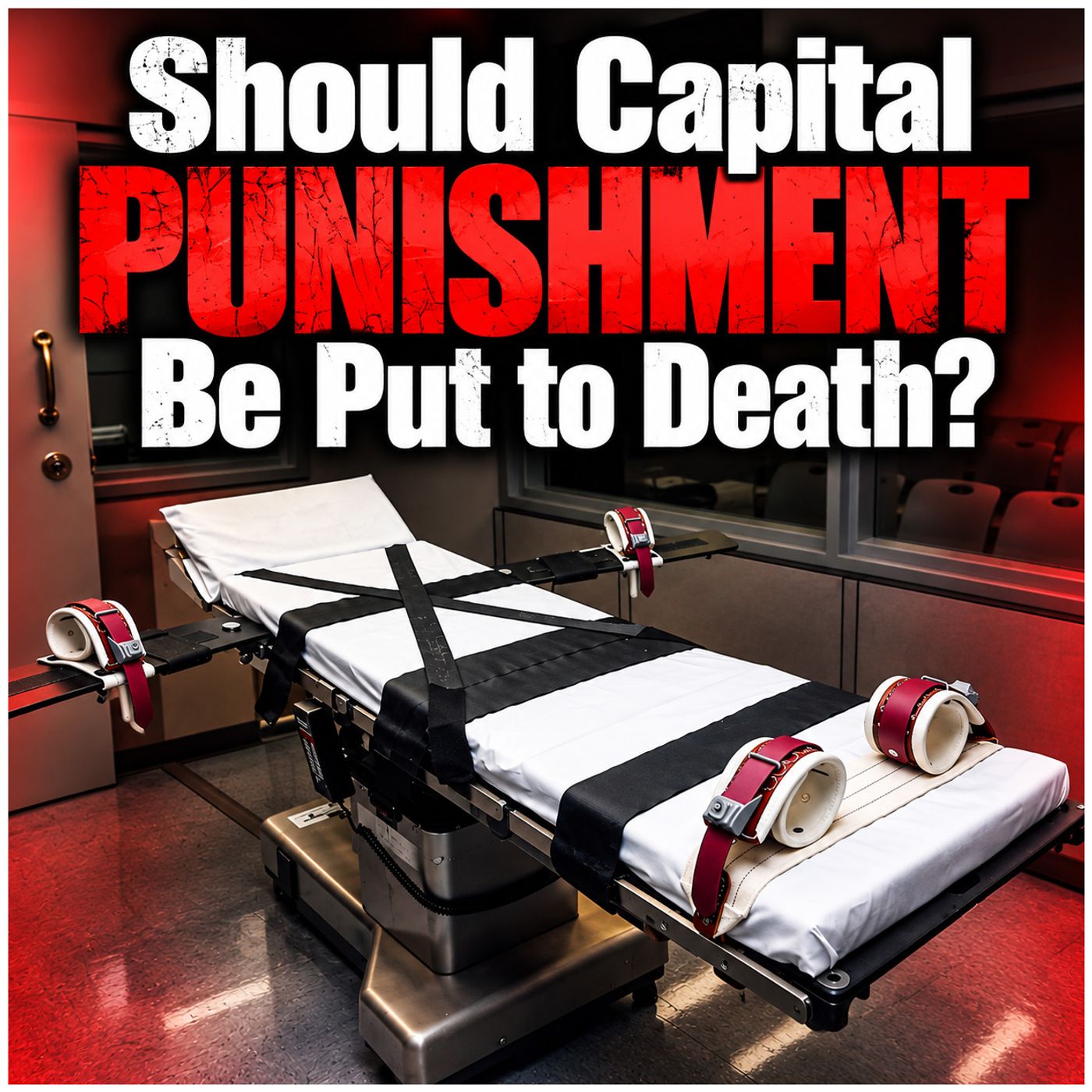
Should Capital Punishment Be Put to Death?
Dienstag, 13. Oktober 2026 · 1 h 07
Kapitelklicken springt direkt hin
Shownotes
After the botched execution of convicted murderer Christa Pike (bbc.com/news/articles/cxvgd65m735mo), we're again having the conversation about crime, justice, and the death penalty. What's your take?
Become a supporter of this podcast: spreaker.com/podcast/thethinkingatheist--32703….
Transkriptvom Podcast bereitgestellt · Zeitmarken springen hin
Here we go.
Stand by.
Three, two, one.
The thinking atheist. It's not a person. It's a symbol. An idea.
The population of atheists in this country is.
Going through the roof.
Rejecting faith. Pursuing knowledge. challenging the sacred if i tell.
The truth it's because i tell the truth not because i put my hand on a book and made a wish.
And working together for a more rational world.
Take the risk of thinking for yourself much more happiness truth beauty and wisdom will come to you.
That way assume nothing question everything and start thinking this is the thinking atheist podcast hosted.
We're having a national conversation about the death penalty again in the wake of this botched execution in Tennessee. For those unfamiliar with the story in a nutshell, and it's pretty gruesome, But a young woman named Krista Pike, when she was 18 years old back in 1995, was suspicious that another young woman was interested in her boyfriend. And so Krista Pike and her boyfriend lured a woman named Colleen Slemmer into the woods in Knoxville, and they tortured her to death. And that torture included a box cutter, including slashing her throat, And ultimately, as the victim was pleading for her life, she tried to escape one last time.
Krista Pike slammed a rock into her skull, crushing it and killing Slemmer. Krista Pike found guilty in 1996 of murder and sentenced to death. Now, in this country, an automatic appeals process kicks in when you receive a death sentence. And this is, of course, appropriate. And in this country, that often takes decades. And that's what has happened here.
And finally, this week, by the way, Krista's boyfriend was 17 at the time. He was an accomplice, but he was given life while Krista was given death. Krista Pike goes into the lethal injection chamber. Pentobarbital is injected into her body. It's supposed to kill her, but it does not. And people in the room realize something is terribly wrong.
She is whisked off to the intensive care unit. She was unconscious for a few days. At the moment that I am sitting down at the microphone to have this discussion, she is reportedly awake and speaking. But this has prompted a national conversation about whether or not the death penalty is just or whether it is barbaric. I want to have a conversation about your perspective on the death penalty.
We This is a nuanced conversation that needs to be had by adults. So I'm going to cheat a little bit because I have written extensively about the death penalty, and I like the way I said it the first time. I'm going to read from a book that I published a few years ago called Confessions of a Former Fox News Christian, and I'm going to talk about the death penalty from a chapter where I sort of lay out both sides of the case and then make my own.
The switchboard is wide open if you would like to sound off, and I'll set it up with this. An eye for an eye, American justice and the death penalty. Far-right conservative pundit, attorney, and author Ann Coulter penned an April 14, 2014 column with an account of the botched execution of convicted killer Clayton Lockett, and she was delighted by it. Lockett, 38, had been sentenced to die by the state of Oklahoma after being convicted of murder, rape, sodomy, kidnapping, assault, and battery. His crimes had been unimaginably cruel. In 1999, when he was 22, Lockett had kidnapped a 19-year-old named Stephanie Neiman, bound her, shot her multiple times with a 12-gauge shotgun, and buried her alive in a shallow grave.
Sixteen years later, Lockett spent the better part of an hour writhing on the execution table. Thirty-four minutes into the execution, Lockett, who should have been unconscious from the start, lifted his head and in obvious pain said, something's wrong. The attending doctor then realized that the phlebotomist had misplaced the IV and that the poor connection had failed to administer the proper dose of lethal drugs. With no more drugs available, he halted the procedure. While prison officials tried to decide what to do next, Clayton Lockett had a massive heart attack and died on the table. Given the heinous nature of his crimes, it's difficult to have sympathy for Clayton Lockett.
For Ann Coulter, sympathy wasn't a problem. She contrasted Lockett's abusive and brutal past with his paltry 35 minutes in the execution chamber, declaring, Actually, I'm not that horrified. It sounds like he suffered a bit, which is nice, and he's dead, which was the objective of the whole enterprise.
Coulter blasted the New York Times for its critical reporting of the failings at Oklahoma State Penitentiary, asserting that the death penalty hysterics do not care about the victims of crime. She then lamented the lengthy and expensive appeals process for convicted murderers before suggesting that justice-seeking Americans could volunteer for firing squads to streamline the process. She finished, I'd pay for the opportunity, especially if they promise my gun won't have a blank. Twenty years ago, when I was a right-wing Christian, I might have joined her. For all their talk about the sanctity of human life, many American Christians have an Old Testament sense of justice. My grandfather held a string-em-up attitude about convicted murderers. I've met conservatives who
expressed admiration for Islamic nations that punish thieves with a machete to the wrist. The biblical reference to eye for an eye is carried out literally in Saudi Arabia. Wounding someone in the eye might result in a sentence of reciprocal eye gouging by authorities. When criminals are flogged for breaking various local or national laws, their torture is met with pious ambivalence by the justice crowd. Comedian Ron White famously joked that his home state of Texas was streamlining its capital punishment system by advancing the executions of murderers who had at least three eyewitnesses to their crimes. White said, The audience cheered. From my more distant vantage, I can understand why the crowd was so enthusiastic about the execution
of killers, and I completely understand why Stephanie Neiman's friends and family had no pity for Clayton Lockett. And Lockett's videotaped confession, his cold, matter-of-fact remorselessness, chills the spine. Neiman had witnessed Lockett's break-in of a man's home, and Lockett decided not only to eliminate the witness, but also first force her through a hell of torture that defies description.
His execution wasn't mere justice. It was vengeance. An eye for an eye. Contrast that notion with the story of Vicki Scheiber. Scheiber's daughter, Shannon, was brutally raped and murdered in 1998. The killer, Troy Graves, was arrested four years later, and authorities discovered that he had a long history of rape and assault. However... Vicki Scheiber, along with other victims she'd contacted, decided not to seek the death penalty. Scheiber became convinced that capital punishment was morally dubious, economically wasteful, unevenly applied, and a profound burden on the victims' families, as each death penalty conviction brings a mandated and often lengthy appeals process. Graves was given the sentence of life
without parole, which he is serving at the Colorado State Penitentiary. Vicki Scheiber is now an anti-death penalty activist, and she wants capital punishment eliminated nationwide. Both camps, pro and con, make valid points. Despite the common string-em-up mentality among binary thinkers, we can't escape the reality that there are monsters among us.
Those who are forever dangerous, who will never be rehabilitated, and who represent a net loss in the human moral equation. We can't forget the immeasurable pain of the victims and those they leave behind. And we shouldn't discount legitimate attempts at punitive equilibrium that require a life for a life.
The message is compelling. If you murder a precious human being, you forfeit your right to exist. This is an attitude held by 55% of Americans, according to Pew Research. Rush Limbaugh and other right-wing radio hosts fuel these fires with statements such as this one, quote, Liberal opponents of capital punishment glibly argue that the death penalty provides no deterrent to the commission of capital crimes. Well, how on earth would we ever know? Only if we have swift and certain justice will we ever have an opportunity to test the deterrent effect of the death penalty. Limbaugh's message echoes Old Testament America. Quit pussyfooting, stop coddling criminals, nix all this courtroom nonsense, quickly exterminate the bad guys, and let's
see how the murder rates react. This attitude reflects understandable frustration with a clogged legal system, and in many cases, a legitimate desire to give potential murderers a moment to pause while providing victims some semblance of justice. I have had death penalty advocates ask me how I would react if my wife were horribly murdered, and I had difficulty responding.
Others ask if I thought that Adolf Hitler would have deserved the electric chair, and I struggle to justify notions of clemency against his extermination of millions. If anyone deserved to be eradicated from this planet, Hitler did. And while I hold strong liberal views, I don't fall into the all-human-life-is-precious camp. This is the hard reality. There are some people who bring only pain, destruction, and horror. They're a constant threat to public safety and a blight on the face of humanity. And at least in theory, there is merit to the idea of removing them from the planet.
If the killer suffers at the end, his suffering is a faint echo of the suffering he inflicted on others. Those against capital punishment rightly protest a common conservative feed-them-to-the-lions mentality. I'm reminded of the homemade souvenir t-shirts sold outside the prison at serial killer Ted Bundy's 1989 execution. The glee on the faces of the mob reflected the attitude many Americans had about Bundy's death in the electric chair. The t-shirt said, Burn, Bundy, Burn. He had killed at least 30 young women and disqualified himself from the human race.
As such, moral people rationalized treating his execution like sport, and without any reverence or reflection, the crowd cheered and waved banners as if they were at a football game. This vengeance as entertainment attitude is revealed in deeply troubling videos of the Bundy demonstrators. Beyond notions of recreational killing or necessary justice lie serious concerns about the system. Pennsylvania State Senator Daylon Leach, a former criminal defense attorney, has joined Vicki Scheiber in opposing capital punishment, repeatedly introducing anti-death penalty legislation in the Senate based on several points listed in a 2018 Joint State Government Commission Task Force report.
In summary, the commission found the following. Capital punishment is significantly more expensive than life sentences because of the mandatory appeals and lengthy overall process. Several condemnees had confirmed psychiatric problems unaddressed by the courts, meaning that states were executing mentally ill or intellectually disabled people. Some sentenced to death were exonerated of their crimes after the discovery of new evidence.
How many genuinely innocent inmates have slipped through the cracks is unknown. The process is arbitrary, as race and ethnicity often play into the application of capital punishment, with racial bias often present within the communities where trials are held. According to the report, in a very real sense, a given defendant's chance of having the death penalty sought, retracted, or imposed depends on where that defendant is prosecuted and tried.
The objectivity of juries varies. Political bias, religious conviction, and a lack of education introduce potential problems with fairness. The quality of legal counsel is inconsistent. Many defense attorneys are simply ill-qualified to properly manage a death penalty case. There's no process for proportionality. Murderers in one case may receive death, while murderers in an identical separate case may get a prison sentence. Provision of county services to the victims is difficult to sustain over lengthy appeals, and the emotional toll to families is often compounded. The appeals process isn't consistent in readdressing evidence on death penalty cases. A board of pardons may unanimously recommend a governor pardon, but a governor's
final decision is largely arbitrary. And research doesn't convincingly demonstrate that the fear of potential capital punishment deters homicide. The Pennsylvania Committee's arguments are compelling, and they echo those of organizations such as Amnesty International. which invoked the case of Cameron Todd Willingham, a father who was executed in Texas for murdering his children before exonerating evidence was discovered. Texas had killed an innocent man. Out of the more than 1,500 executions in the United States in the last 50 years, how many of those inmates deserved a fresh look at the evidence? What are the costs of rushing to the lethal injection tables? Execution is a bell that cannot be unrung.
Beyond the potential for false positives stands the recent consensus published in the Journal of Criminal Law and Criminology that the death penalty does not add any significant deterrent effect above that of long-term imprisonment. Findings by the National Academy of Sciences agreed. Statistics get tossed around on both sides of this argument, but at the very least, there's enough reasonable doubt to give us pause. Human lives are at stake, and as Amnesty International has noted, you can't take it back.
Such concerns do not trouble Ann Coulter. In 1989, five black and Latino men were accused of brutally raping a jogger in New York City's Central Park. The crime got national attention, and shortly after the assault, Donald Trump took out a full-page advertisement in four New York City newspapers bearing the all-caps demand,' Bring back the death penalty. Bring back our police.' Note his conflation of government-sanctioned executions and law enforcement, which is telling. Trump gleefully admitted that he hated all murderers. Quote, I'm not looking to psychoanalyze or understand them. I am looking to punish them. Understanding what happened in the case of the Central Park Five proved important, however,
as another man, serial rapist Matthias Ries, ultimately confessed to the crime in 2001, his confession corroborated by DNA evidence. The five wrongly convicted men whose original confessions had been coerced were released. and they subsequently sued the city. Their story was featured in the 2019 Netflix film, When They See Us. In 2019, from his position as president, Donald Trump remained unapologetic and defiant, convinced of the men's guilt, evidence be damned. Echoing his troubling statement about good people on both sides after the deadly 2017 white supremacist rally in Charlottesville, Virginia, Trump addressed the Central Park reversal. You have people on both sides of that. Q. Ann Coulter
and her July 25, 2018 column, Central Park Rapists, Trump Was Right. Coulter lamented that a politically correct horde of social justice warrior liberals was eager to exonerate youths of color, her words, against the assault of a, quote, privileged white woman. Coulter was and remains completely oblivious to the phenomenon of police coercion and false confessions. She also shares Trump's defiance of the evidence. Punish them. I think the Trump-Coulter attitude provides some insight into hardline conservative thinking on crime, strength before consideration. If some unfortunate souls get crushed under the wheels of justice, they are just necessary collateral damage. The important thing is that America is, quote, tough on crime,
a notion soapboxed by countless politicians fueling their campaigns with promises of greater public safety. Taking things slow, extracting the data, and considering the moral, emotional, and financial costs equates to weakness and surrender. Beyond the problems with the system, I'm struck by the issue of dehumanization. This is profoundly slippery ground because many people think that an attempt to understand a killer automatically translates to empathy or sympathy. sympathy for the killer and a marginalization of the killer's victims. If we focus on a murderer's upbringing, environment, mental capacity, and any other influencing factors, we take the focus away from the precious son, daughter, spouse, friend, or neighbor left rotting
in a ditch. We feel like we're rationalizing, deflecting, and excusing. And strong justice demands firm condemnation and swift retribution. A binary world is simpler and in many ways easier to navigate. Good guys punish the bad guys who cares why they're bad. Should we be content to embrace Donald Trump's eagerness to reject understanding? Doesn't solving a problem demand that we follow it to its roots? Or are we content to build our halls of justice upon mere indignation? In my conservative youth, indignation was enough. If I may use her name as a verb, I had Ann Coultered my brain. I'm not saying I wasn't interested in reversing injustice. More accurately, I was uninterested in the driving forces behind harmful behavior. As such,
my culture was constantly swatting its symptoms and ignoring the roots. Any attempt to analyze the criminal brain, the damage of childhood abuse or behavior-molding environmental forces felt like hesitation. Such hesitation was the domain of weak-minded moral relativists who couldn't commit on an easy good and evil question. The solution to crime was to teach biblical morality and use tough, decisive, even lethal force against society's rogue elements. There is some truth to this second notion. The hostage-taker must be neutralized in the name of public safety, and sometimes law enforcement's best first option is the trigger. But American conservatives seem awfully eager to lean toward good guy violence as seen
in its thriving gun culture. There is often little reverence or reservation about taking a life as long as the dead guy is a, quote, bad guy. Dead criminals simply mean fewer villains on the planet. Why did they become villains? Who cares? I think we should care. And as we resist the dehumanization of others, we can ensure that we don't breed glib, callous indifference within ourselves. We don't have to shovel away the soil of our own high ground and devolve into an exuberant mob compensating for one grave by dancing on another. We don't have to become killers to defiantly oppose and decisively prosecute killers, not when there are so many flaws in the process. Our resistance to the death penalty shouldn't be about the murderers. It should
be about ourselves. This stance requires that we examine whether we want justice or mere vengeance, and that we make a commitment to remain civilized in this often uncivilized world. It also requires a realization that in some cases, killers are made not born, and society must address the precursors to violent behavior. The 2017 National Institute of Justice study revealed that child abuse and neglect have been shown to increase the risk of later forms of antisocial behavior, including violence, perpetration, and crime in adulthood. The study found that in middle childhood, females more often responded to childhood physical and emotional abuse by exhibiting depression, anxiety, and social withdrawal. Conversely, males were
much more likely to externalize behavioral problems with aggressive displays of hostility and delinquency. Researchers at Duke University published their finding that individuals who had been physically abused in the first five years of life were at greater risk for being arrested as juveniles for violent, nonviolent, and status offenses.
The study showed a clear correlation between child maltreatment and subsequent violent behavior, with many children developing biased patterns of processing social information, more often assigning hostile intent to the outside world, and more likely to respond aggressively. These antisocial behaviors are often compounded in those with social and psychological problems.
Adults who spent their formative years in an abused, confused, anxious, and fearful state can experience a distorted perception of reality and broken moral cognition. A few extreme cases of this type of criminal are serial killers. Richard Ramirez, Henry Lee Lucas, Donald Gaskins, and John Wayne Gacy, all of whom were horribly abused as children. Eileen Wuornos was abandoned by her mother and raped by her grandfather. Ed Gein was raised in isolation and indoctrinated to be terrified of the evil world outside. Another intriguing case is mob hitman Richard Kuklinski, known as the Iceman. Kuklinski was analyzed on camera by renowned psychiatrist Dr. Park Dietz in the 2003 HBO documentary The Iceman and the Psychiatrist. Dietz revealed that Kuklinski was
born with a genetic predisposition to fearlessness that might have resulted in pro-social behaviors had it not been for the loveless home and intense abuse that Kuklinski endured as a child. An abusive or unstable childhood is a common denominator for a great many killers, rapists, abusers, and perpetrators of violent crime.
As unpopular as the notion may be, targeted analysis of murderous behavior shouldn't be considered a betrayal of victims. Sociopaths come in many shades. They're products of nature, nurture, or both. Examining the basis of their behavior isn't a cheat. Bypassing the evidence is a cheat. As with scientists who treat cancer while also researching its root causes, we must navigate through our revulsion to reverse engineer the crimes and the killers, and understand that the solutions to punishing murderers won't fit on an NRA bumper sticker. With this critical information, society can do more than merely treat the symptoms of violent crime, and we can dial into the precursors that often mold the monsters among us. Advocacy for abused and potentially abused
children seems a good place to start as we work to safely remove children from abusive homes that science shows can develop murderous criminals. Let me close the chapter with some good news. The FBI has recently reported that violent crime, including murders, continues a decades-long overall decline in the United States.
The Pew Research Center revealed new data confirming that violent crime has fallen sharply in America over the past quarter century. There are certainly spikes in a few cities, such as Washington and Philadelphia, but the big picture is encouraging. The U.S. is experiencing fewer violent crimes. Despite the facts, the American public still wrongly believes that the country has become a more dangerous place in the last decade, rooting its perception in emotion over the data. President Trump has been quick to capitalize on those fears. In December of 2019, Trump's Justice Department asked the Supreme Court to allow the resumption of executions by the federal government. At the time of the writing, it is still unclear if the court will
take up the case. By the way, the Trump administration just approved a new execution by firing squad. That's a whole other story. Trump's rallying cry from 1989 continues. Bring back the death penalty, and let's not bother with the pursuit of understanding. It's time to reject this rejection of understanding.
It's time to commit to being informed dispensers of justice. While we should remain strong and vigilant, we must also remain educated and enlightened, countering life's inhumanities without surrendering to them. We can identify the threats to life and limb, remove them from society, and if necessary, throw away the key.
Our prison systems present a host of headaches all their own, but they still present a more civilized, cheaper, less burdensome, and less potentially calamitous solution to America's murder problem. Ann Coulter may squeal with delight at the torture and execution of another, but I stand with Vicki Scheiber. If Vicki can see past her unspeakable grief to help evolve society's notions of justice, you and I certainly can. And that is from my book from 2020 called Confessions of a Former Fox News Christian, which you should purchase immediately. It's in hardcover, paperback, Kindle, and of course I read the audiobook.
I break down the rise of Roger Ailes, the precursor to right-wing media, radio, television, Fox News, the origins of Fox. We talk about the Reagan Revolution and the rise of the moral majority and the Heritage Foundation. We get into the Pledge. manufactured persecution, gun culture, patriotism, the Bible and its influence on America's right wing, wedge-issue narratives that warn about the quote-unquote gay agenda, and so much more. Confessions of a former Fox News Christian. Thank you so much for supporting the book. Quick break. I will be back with your calls after this. Just a quick note that Forrest Valky and I are going to be keynote speakers for the Rocket City Reason event in Huntsville, Alabama. It's
going to be at the Huntsville Marriott at the Space and Rocket Center. What's really cool is after the event, The next morning, we all get to go and take a tour of the Space and Rocket Center. How much fun is that going to be? We'd love to see you there. If you cannot make it to Huntsville for the weekend of October 23rd through the 25th, they are going to stream it virtually online, and you can get a virtual ticket. So go to rocketcityreason.com. Capital punishment, the death penalty. Is it real justice or is it inhumane?
We're talking about that on the show today. Anne is dialing in from 951. Anne, can you hear me?
I can hear you. How are you today?
I'm well. We're talking about capital punishment. Do you have a perspective for us?
Yeah, I do, because my son and I have been talking about this with the botched execution, and she's awake now. And we were like, the death penalty is wrong. Like my son has never got it. And I've always gone back and forth on it. But then like the more I think about it, the more I don't like it. I don't see how the death penalty makes the state or people who support it any less bloodthirsty than the actual killers. And what you were describing and you were talking about Ann Coulter and Trump and Rush Limbaugh and all the horrible things they were saying. I mean, it reminded me of these old photos I had seen of lynchings from like the 40s or whatever. And it was mostly black men being lynched. But there was people standing
around in the crowds is like smiling. Like it was a party, like it was an event, a family event. Like people would take their families to see people getting lynched. And I'm like, how is this any better? And then my other problem with the death penalty is if somebody kills two or more people, whether it's only two people or millions of people. They only die once. So is the state saying that all those lives add up to that one person's life? You can't die for every person you killed. So to me, I guess the math doesn't math on it. But I just am finding it more and more immoral.
It does seem like a spectator sport. It certainly doesn't seem like a mature and considered approach to life and death decisions and our notions of justice. Anything else before I move on?
No, I just kind of wanted to get that out, and I appreciate you taking my call.
It's nice talking to you. Thanks for being a part of the show. We'll see you. Gary is dialing in from area code 313. Welcome to the show, Gary. Are you there?
I'm there.
The death penalty hit me. What do you think?
I do not think the state should have that ability because too many mistakes are made. You can't say, oops, sorry, we'll take it back. Because you can't take it back. And too many innocent people have been put to death.
Would you have given Hitler life in prison? Or do you feel like Hitler would have been or should have been executed had he not offed himself?
Well, you know, the one thing, good thing you can say about Hitler is he killed Hitler. But no, I'd have put him in prison. Like the previous caller said, you can't get back millions of life for one life.
I mean, I wouldn't have mourned Hitler at all, not one iota, but I would like to have seen Hitler sentenced to the worst time for the rest of his life on the order of decades. I would have welcomed that.
Well, he wouldn't have lived that long, but yes, I understand that. Personally, when it comes to prison, I kind of like the Finnish model.
What's the Finnish model?
Clearly not working. They treat people like human beings. From what I've seen of them, the prisoner gets a decent-sized single bed apartment, not a cell they never come out of. They get fresh air. They get work. And they're back in society a lot quicker because they're treated like human beings.
Somebody's a murderer. I don't want them back in society.
I was about to say, there are some people you cannot let back in society. Those you have to unfortunately put in a cage, but it doesn't have to be a cage that drives them crazy. And that's what solitary confinement does to human beings. We are social creatures. If we weren't, we wouldn't be having this talk.
I agree. I mean, if you treat them like animals, you're simply going to exacerbate the problem. There are those who are like, they are animals. By the way, we're all animals. Don't be pedantic. But you know what I'm talking about. You understand the spirit. Everybody who's listening and watching. But this idea that we have.
The way I see it, it's less, it's not just what did they do, but it matters what I do. If I treat that person in an inhuman fashion, that reflects on me. And if the state does so, it reflects on all of us. What kind of people do we want to be seen as? The kind that take revenge?
It's not that I want to play devil's advocate, but if somebody murdered my child and that person was executed, I wouldn't shed one tear. But I think my hope is I would take a more somewhat distanced perspective of the system itself. and say, I don't want to participate in a broken system. And until that system is fixed, this conversation needs to happen differently. I don't know, Gary, I do appreciate your perspective. I'm going to see what everybody else has to say, okay?
Okay.
Okay, he has provided a springboard for us to talk about Finland and its model for prisons. I'm not very well aware, so I've just pulled up on a Google search here what we're talking about. Open prisons. Nearly half of Finland's prison population lives in minimum security, open facilities with no barbed wire, high gates or locked cells. Inmates can leave during the day for work, school or shopping.
I'm guessing not murderers? Like, if you've been convicted of homicide, they're not going to just say, hey, go out, put in an eight-hour day, and here's the keys to the car. I doubt that, right? Inmates can leave during the day for work, school, or shopping, and they often live in dorm-like housing or apartments. Inmates wear their own clothes, cook their own meals, and have access to the internet, cell phones, and computers. Prison guards study for years in communication and psychology.
acting more like counselors or social workers than security enforcers. Facilities feature secure in-cell digital terminals for e-learning, healthcare, family video calls, and vocational training, including AI data labeling and tech courses. They include child-friendly visiting rooms and multi-day family apartments to maintain parental bonds. Finland maintains one of the lowest prison populations and incarceration rates in Europe. Roughly 33% of released Finnish inmates return to prison within a few years, a significantly lower rate than countries like the United States.
The average adult prison stay is about 11 months. Life sentences average around 15 years. I'm not sure I understand how it's a life sentence if you're out in a decade and a half. According to an article that was published a few years ago by Natalie Moore at the Pulitzer Center, that's pulitzercenter.org, I guess the story originated at WBEZ, she says mass incarceration, racism, and punishment define the U.S.
prison system. which has the highest prison population in the world. Since 1970, it has grown tenfold to 2 million people. Meanwhile, Finland has one of the lowest prison populations in the world. The number hovers around 3,000, and one-third of its prisons operate as open. Wraparound services include a social worker and classes on substance abuse or anger management. Now, this is interesting.
The Finnish penal system doesn't make a distinction between violent and nonviolent crimes the way the U.S. does when doling out second chances. Open prisons are for those who've committed white-collar fraud and homicide. While many US politicians continue to run for office on a platform being tough on crime, very few politicians in Finland will build their political career around crime. Gun crime. are low in Finland because guns have to be registered and licensed on a per-gun basis.
Most guns used for hunting, firearms used, and just 14% of homicides. The most common weapon for murder is a knife. Now, There's so much other stuff going on that I think may inform the difference between Finland and the United States. We have more guns than citizens in this country. 400 million firearms. And so, of course, gun violence is rampant.
So now we're talking about something else, a whole other piece of the pie that we have to get into. This epidemic, the worship of the firearm in the United States and the gun culture that's fueled by the National Rifle Association and MAGA evangelicals. I do like the idea that integration into society and humanizing human beings is actually part of a solution that results in greater success. I'm not sure that I want people convicted of homicide to be given essentially a hall pass to be able to just come and go from an open prison. That gives me great pause. But isn't it true that if we look at our prison systems, it does seem like we're swatting its symptoms and not trying to solve root problems.
And then you've got prison for profits and this idea that if we tuck them away and stick people in a cage, then they're out of sight, out of mind, and you and I can get on with our lives and we don't have to worry about how to solve a root problem. We wash our hands of it and don't have to deal with it any further. This is often very much the American way. Interesting. Ben is dialing in at 435. What's going on?
Hi, Seth.
My view on the death penalty, and it's probably going to match most people in here, is I'm very much against it. But how I came to be against it was, I don't know how different it is, but for me, it felt kind of singularly unique because I didn't hear anybody else talking about this. And that was the West Memphis Three. I was only in my 20s at the time when the news broke that they had been let out of prison, and I knew nothing about these guys.
I start reading into it, start reading into just how they'd used Satanism as the reason that saying these people were like satanic worshipers and they murdered these boys in some kind of weird fucked up cult ritual, right? But then you start looking at the evidence, and it's all very contrived. There's nothing actually tying these three men together.
where they were boys at the time, to the murder of the two little boys. And these guys were on death row. And if some people hadn't come out and say, hey, there's something wrong here, they probably would have been executed for something they didn't do. And that was kind of the straw that broke the camel's back about the death penalty for me.
What year was this?
Okay, so they were let out of prison, I think, in 2012. And they were convicted sometime in the mid-90s. I think it was 94 or 95.
So this was right on the tail of the satanic panic of the 80s and 90s.
Correct.
It was just three teenage boys that got accused of being murderers. And they were basically just the outcasts.
I do appreciate the input. I'm going to take another look at the West Memphis Three real quick and kind of do a refresher. It's been a long time for me as well, okay?
Thanks for taking my call, Seth.
Take care, Ben. We'll see you. The West Memphis Three, three freed men convicted as teenagers of the 1993 murders of three boys in West Memphis, Arkansas. Damian Echols was sentenced to death, Jesse Miskelly Jr., life imprisonment plus two 20-year sentences, and Jason Baldwin to life imprisonment. During the trial, the prosecution asserted the juveniles killed the children as part of a satanic ritual. Due to the dubious nature of the evidence, the lack of physical evidence connecting the men to the crime and the suspected presence of emotional bias in court, the case generated widespread controversy and was the subject of several documentaries. Celebrities and musicians held fundraisers to support efforts to free the men. In July 2007, new
forensic evidence was presented. A report jointly issued by the state and the defense team confirmed that there was no DNA found from the three convicted men, further stating that some unidentified DNA recovered from the scene cannot be attributed to either the victims or the defendants. Following a 2010 decision by the Arkansas Supreme Court regarding newly produced DNA evidence and potential juror misconduct, the West Memphis Three negotiated a plea bargain with prosecutors. On August 19, 2011, they entered Alford Pleas. Never heard of that. A-L-F-O-R-D. This allowed them to assert their innocence while acknowledging that prosecutors have enough evidence to convict them. Judge David Lazar accepted the
pleas and sentenced the three to time served, They were released with 10 years suspended sentences, having served 18 years. Our callers have much more to say. We continue after this. if you want to support this show the platform your host become a patron thank you so much for my patrons who are with me every single month a few bucks a month makes a big difference and if you want you get the show early and commercial free most people don't care about that they just listen to the regular stream on their normal podcast apps they just want to be a part of that family and uh So it really does help. Patreon.com slash Seth Andrews with my thanks.
I've got a web caller dialing in. I don't see a name. Hi, are you there? Web caller, tap on your phone just in case it went to sleep as you were on hold. Minnesota? Dial me back if you would. I'm sorry about that.
Um.
I was kind of hoping I would get a pro-death penalty advocate, somebody who would dial in and tell me because, I mean, this is not a hostile forum. I don't think there's any reason we should be pointing and shouting at each other. I think this is a conversation adults can and should have with each other. Maybe that's just the nature of a humanist, progressive, and yes, liberal platform and community, largely the community that we have. I do have a few right-wingers that sort of do drive-bys in the comments section and will occasionally bleed into the switchboard.
But I don't think you have to be a right-winger to be for capital punishment. I think many people come to many conclusions for many different reasons, and I would be very curious as to why you have your position. 320, thank you for calling. Who's this?
Hi, Seth.
I'm Blake. I tried to call through the web. It didn't work.
That was me.
I apologize.
It's all good. Blake, what are you thinking about all this death penalty stuff?
So, I think I have a pretty different opinion from most callers that you have. I'm actually kind of pro-death penalty in very specific cases. in my opinion, and I understand other people are going to feel very differently about this, but I do think that cases of treason are valid cases where the death penalty can be pursued.
Define treason for me. That word's been thrown around pretty loosely these days.
So, for instance, if you have an organized armed revolt against the United States, like, say, the Confederate States of America is a good example. I think it would have been valid to take, say, some of the heads of the Confederacy, try them for treason. They can get the death penalty. And I don't think many people would necessarily argue with that, that that would be a form of treason.
So I'm reminded of the Rosenbergs. They were convicted of, I think, giving state secrets, and they were convicted and executed for treason back in 1953. Do you think that warrants execution?
I think the Rosenberg case specifically is a bit more complicated, mostly because of the fact that if I remember correctly, the brother of the wife later came out and said that he threw her under the bus entirely.
Let's say that she was conducting espionage. Let's say she was spying for another country. She was working against the interest of the United States. Do you think that would warrant her execution?
In my opinion, espionage wouldn't be a capital offense. you would probably just go to prison for life. I don't think that actually raises the bar where it actually deserves capital punishment. You just get segregated away from the populace for most likely the rest of your life.
Well, let's do a situational. Let's zoom out to the macro and say that during the American Civil War, the Confederacy rose up and essentially engaged in armed insurrection against the government of the United States. Would that have warranted the death penalty for Confederate soldiers?
I don't think any individual soldiers necessarily should have been put to death, but the leadership are the ones who bear that responsibility.
Robert E. Lee could have been executed and it would have been justified.
In my opinion, yes. And I understand not everybody's going to agree with that.
No, I don't need the caveat. I get it. I mean, we're just talking... It's all good. So then if treason at that level, would you say that the January 6th insurrectionists who perpetrated violence against police officers, et cetera, on January 6th, would they qualify for some sort of a hardcore punitive life-ending measure?
If we're just talking about, like, the actual guys who ran into the Capitol building and assaulted police officers, I don't think any of them should necessarily be facing the death penalty. I do think they, especially the ones that did end up killing that officer who was there, should be in prison for the rest of their life. But for the actual, like... I don't like using this term, but the foot soldiers, so to speak. They aren't the ones who should be getting capital punishment. The leadership are the ones who knew and spurned people into doing these things.
And that's what I think the responsibility actually lays with.
Of course, I'm thinking instigator. And I'm trying to decide exactly how much I'm going to give language to, given the surveillance state that we are in. I'm not going to go there, but I think we're all talking.
All right.
All right. You and I are going to just dance around this.
Okay.
We're just going to dance.
We're not talking about that.
We're not going to do. We're going to dance all around this for now. So then if a murderer is found guilty and it is confirmed in a court of appeals and They tortured and killed someone. For you, then, that would be a no-brainer, right? You've killed a human being. We will kill you in return.
So, no. In most cases, I don't think murder is necessarily really... Because I know to most people this is going to sound inconsistent, but to me, I don't think murder being followed by murder is actually just. Because at the end of the day, you are still making somebody be a murderer for the capital punishment. And it's kind of a volume of effect, I guess, at the end of the day. Even a serial killer can't necessarily come to the same volume of death and destruction that, say, to go back to the example with the Confederacy, ended up unleashing.
I'm going to make sure I understand you. So let's say I engage in an uprising against my government. And I'm going to secede from the union or I'm committing acts of domestic terrorism in protest or a coup or whatever my motivation is. That, do you think, would warrant a death sentence for me?
I guess it ultimately comes down to the volume of damage and destruction and overall terror that you end up causing in the process.
And who determines that? Would it be a Supreme Court decision or.
I would think that it would be just like any other criminal case. They would have to present evidence against you in a court of your peers. Unfortunately, that is a thing that I believe in very strongly is that every crime could be tried by a jury of peers.
We have conversations all the time about juries, how educated they are, especially about whatever they are adjudicating on. We have bias, whether it's cultural bias, whether it's family bias, whether it's racial or gender bias, whether it's a bias against someone who is an immigrant or a person of color, etc. So, I don't know. I'm terrified of a jury of my peers.
I was doing a show with Dr. Elizabeth Loftus years ago about eyewitness testimony. and how unreliable it is in a court of law because people's memories are malleable and there's so many other factors. And the idea that people, witnesses would be determining my guilt and then jurors who are, let's face it, like me, emotional bags of animated meat.
We're all meat covered skeletons. We are all primates. They are going to determine whether or not something is true or not, especially in this country. It kind of terrifies me. Now, I know that a lot of great people with moral centers and functioning reasoning centers do serve on juries, and I do believe there are many good judges who understand the law and enforce the law. So, I'm not saying the whole system's screwed, but it's screwed enough that it gives me pause. So, does that make any sense when I talk about how I hesitate to It.
Makes complete sense to me, and I completely understand that hesitancy and fear. And I will be honest, my honest opinion is I'm just a bit more optimistic about juries than I probably should be, probably a bit more optimistic about the system as a whole than I should be.
It's funny, Natalie was chiding me because a few years ago I did, I'm a sucker for true crime documentaries. I watch forensic files. Anytime I travel to a convention, I usually can't sleep at a hotel very well. So when I wake up at one or two in the morning, there is always a network that's showing 24-7 episodes of forensic files from the 1990s. And I just watch episode after episode. And I'm like, honey, I know how to get away with a crime. I know how to get away with murder. I would do this. I would do this.
I can't believe criminals try to get away with that. That's stupid. Here's a strategy. Here's how you conceal your identity. Here's how you don't leave fingerprints. Here's how you change your shoe size. Here, here, here. And she's looking at me like, I am broke. You are a very broken man. And so I did an actual podcast about how I would get away with it. And then afterwards, she's like, you idiot. If anyone ever accuses you of murder, now the jury will have an entire episode that showed how you thought through subverting the system. She might be right.
Maybe I totally hosed myself. Did you have any other final thoughts before I move on?
No, I think that's everything.
Thanks for having me on, Seth.
I appreciate your perspective so much. Thanks for calling.
Thank you.
Yeah, we'll see you later. The perfect being the enemy of the good. Human beings, flawed as we are, will have to be a part of whatever system of justice, right? It is a society. How do we have society without societal laws and guidelines? This is just a necessary part of the soup. Necessary ingredients. Human beings with all of our flaws and weirdness and biases and issues. But I do agree that that a lot of good people genuinely do want to do the right thing. You know, I was called for jury duty four times. I've been called four or five times in my life for jury duty.
And they go through a selection process where the attorneys are vetting everybody and asking all of these qualifying or disqualifying questions. And I never get chosen to be on a jury, ever. First, it was because I was a member of the media. What do you do for a living? Well, I'm an FM radio broadcaster with KXOJ 100.9 FM. Okay, thanks for coming. You're gone, right? Which I think might be kind of a waste. I mean, why would I be less qualified than somebody who might look at a defendant, somebody accused of murder, and say, you know why I think they did it?
The devil.
Like, if I don't have that thing to worry about, I don't bring that baggage to the courtroom, if I'm able to be about the evidence, wouldn't I be a better juror? I feel discriminated against. But I guess my larger point is that no system can be perfect when imperfect people are such a big part of it. I've got Casey dialing in. Casey, are you there?
Yes, I am.
Welcome to the show. We're talking about capital punishment. What do you think?
Thanks.
First of all, I appreciate you very much. Anyway, as a bit of a follow-up to Gary's advocating for finished prisons, he kind of steamrolled you when you were about to reply about solitary confinement. So I was wondering if you can recall several minutes ago now.
I do.
I remember the conversation. I think he was just eagerly speaking on the subject at hand. What's your perspective? Like, I think solitary... I'm not convinced that putting even killers in tiny six by nine cells with a metal toilet and a tiny mattress is the solution. But I don't have a great answer on that. What's your perspective?
My opinion would be that, you know, we do have several levels of prison for different categories of crime.
Who's we now?
I think I agree.
Sorry?
Who's we? The United States or.
Yes.
Okay. Well, we were talking about Finland, and I want to make sure that you weren't calling from.
Yeah, sorry.
Okay.
You're doing great. The United States, we have several tiers, and.
I agree that solitary confinement approaches cruel and unusual punishment, but I wouldn't be interested in furnishing a studio apartment for them either.
Yeah, I agree with that.
But I understand that for people who are in for possession of marijuana or something like that would be fine with me, you know. And like we've said that some people are beyond help, so they can get less hospitable treatment, but not on the level of inhumane.
Now, you and I have to acknowledge in front of everybody before they give us grief. Solitary confinement is sometimes mandated for the protection of other inmates. If you have somebody who is that dangerous, you cannot put them in the general population. or even a limited population because they will lash out harm and potentially kill someone else. In that instance, that's understandable solitary. confinement. I was speaking about it from a purely punitive perspective. I think you were as well, right?
Yeah.
Kind of sucks to live in a country that wants to imprison people for weed. I just don't get that. Like alcohol, roughly half of all traffic fatalities that happen in the United States involve alcohol. It's totally legal. Weed apparently is the villain of the day. And I just don't understand that double standard.
Yeah, that's a travesty. But yeah, that was pretty much what I had to talk about.
Appreciate you so much. Thanks for calling this show.
Thank you. Take care.
You bet. I've got a call from Scotland. Is it Ewan? How do I pronounce your first name?
Ewan.
No, you got it absolutely spot on.
Welcome to the show. Let's talk. What's your perspective?
So I think it's been an interesting discussion. And, you know, as you've Rightly pointed out, you can understand the ethos behind some people advocating for the death penalty. It's something that's been banned here for the last execution was in the 60s. It was technically still on the books until the 90s for treason. But I think there's a real danger around where you can exonerate someone, but it doesn't do much good after someone's been killed.
But There's also.
Some evidence from various cases about people with learning disabilities that have been manipulated into either committing crimes or admitting to crimes that they've not committed that's resulted in execution. I worked in social care for a number of years and unfortunately had to deal with some cases of people that had been people with learning disabilities that had been sexually abused by carers. And I've obviously got that volition in me where I've thought that violence would be a solution to people like that. But on reflection, I'm not convinced that people should get away that easy, if that makes sense. You know, that there's maybe value in them actually experiencing punishment for a longer period of time. By
the way, if my accent's too thick, just tell me to shut up.
No, you're doing great. I'm actually many times I will struggle with a thick Scottish accent, although I love it. Then I find myself using the closed captioning on my television. I was watching Broadchurch and I had to do that. I was like, I'm going to need some help. But no, you're fantastic. What do you mean by getting off easy?
You mean sending them to the chair or lethal injection would be too simplistic a solution? It would be us just sort of washing our hands of it instead of dealing with a root problem? Did I understand that correctly?
Yeah, I think it's more about it being almost performative punishment rather than actual justice. It's about appeasing the sort of more base desires of kind of being for blood almost, rather than actually being about as recognising what allows those. Because, for example, in the instance of people with learning disabilities that have been abused, that's typically a result of multiple failings across multiple agencies.
So if we were to punish.
One individual, I think that's almost putting too neat a bow on it rather than recognising what the reality of the situation is, that someone's been let.
Down by multiple people in their life. As much as the older brother of someone with a disability, if something.
Like that was to happen to him, I may be guilty of extrajudicial behaviour without putting too fine a point on it. But that's not necessarily what justice is.
I can't say it any better than that. Well articulated. And thank you for being a part of the conversation. It's so great to talk to you.
No, not at all.
And I thought the description of this year's Halloween decoration sounds particularly excellent.
I look forward to it every year.
I appreciate you saying that.
Particularly brilliant.
All right, my friend.
Yeah.
Thanks very much. You look after yourself, mate. All right.
Take care. Yeah, there's a digression. Yes, I did finish my Halloween decorations. Yes, we did a western town called Dreadwood. Yes, I have photos on the Seth Andrews Facebook page. And then here we are in the month of October as Donald Trump has ordered the use of a firing squad to execute former U.S. Army Major Nadal Hassan. He's the guy who in 2009 went on a shooting spree in Fort Hood, Texas and killed 13. So his execution is now scheduled to be by a barrage of bullets to the chest. And then I can hear the argument inside my own skull over it, because I don't feel any sense of emotion or grief. about this guy dying at the end of a firing squad. I don't have that response.
And part of me thinks, hey, eye for an eye. Code of Hammurabi. You killed over a dozen people with a gun. We're going to kill you with a gun. It's a net positive for humanity, right? We know that you're not going to be any good to society. I don't think that person deserves an open prison sentence in Finland, okay?
And then I look at Donald Trump and I see his eagerness to attach himself to violence against other people. He gets off on the idea that he approved an execution by firing squad. He gets to play soldier in that way. I have a resentment about that. Don't even get me started on Pete Hegseth's declaration that the Fort Hood shooter's execution is going to be live streamed. Is that on brand for the Trump administration, which masturbates to any notion of violence against anyone who is not them?
It was not a straight, white, hetero, evangelical, Trump-supporting, MAGA, fascist, you know what I'm saying? You know, I just think, what are you going to do? Are you going to sell online tickets for it? You're going to put some sort of a paywall? Are you going to advertise, hey, we're selling sponsorships for the execution? Of course, we know it's going to be rampant, and anybody of any age anywhere is going to be able to find it, and that's just fine with Donald Trump, Pete Hegseth, etc. And given all the rhetoric that Donald Trump's been guilty of for years... You know, he fantasizes about the execution of anybody he calls a traitor. So now the next step is, what happens whenever he decides a member of the media
who is critical of him or the radical woke left or whoever, right? They're an enemy of the people. Let's execute them and sell tickets and live stream it. It is unbelievable. Whether it's a public execution or not, whether he's a terrorist or not, whether it's the Trump administration or not, I must oppose the execution in any form because the system itself has so many problems and we don't have to kill him to punish him and to protect society from him. That's where I fall. And I know that many people disagree and I respect your disagreements.
And I'm so thankful that we have a forum today for adult conversations about a very serious subject. Thanks for having the conversation with me. Take care of yourself, and I'll see you next week.
Follow The Thinking Atheist on Facebook and Twitter. For a complete archive of podcasts and videos, products like mugs and t-shirts featuring The Thinking Atheist logo, links to Atheist pages and resources, and details on upcoming Freethought events and conventions, log on to our website.
Thethinkingatheist.com
