

Unicorn Bakery - Wie Startup Gründer erfolgreiche Firmen aufbauen
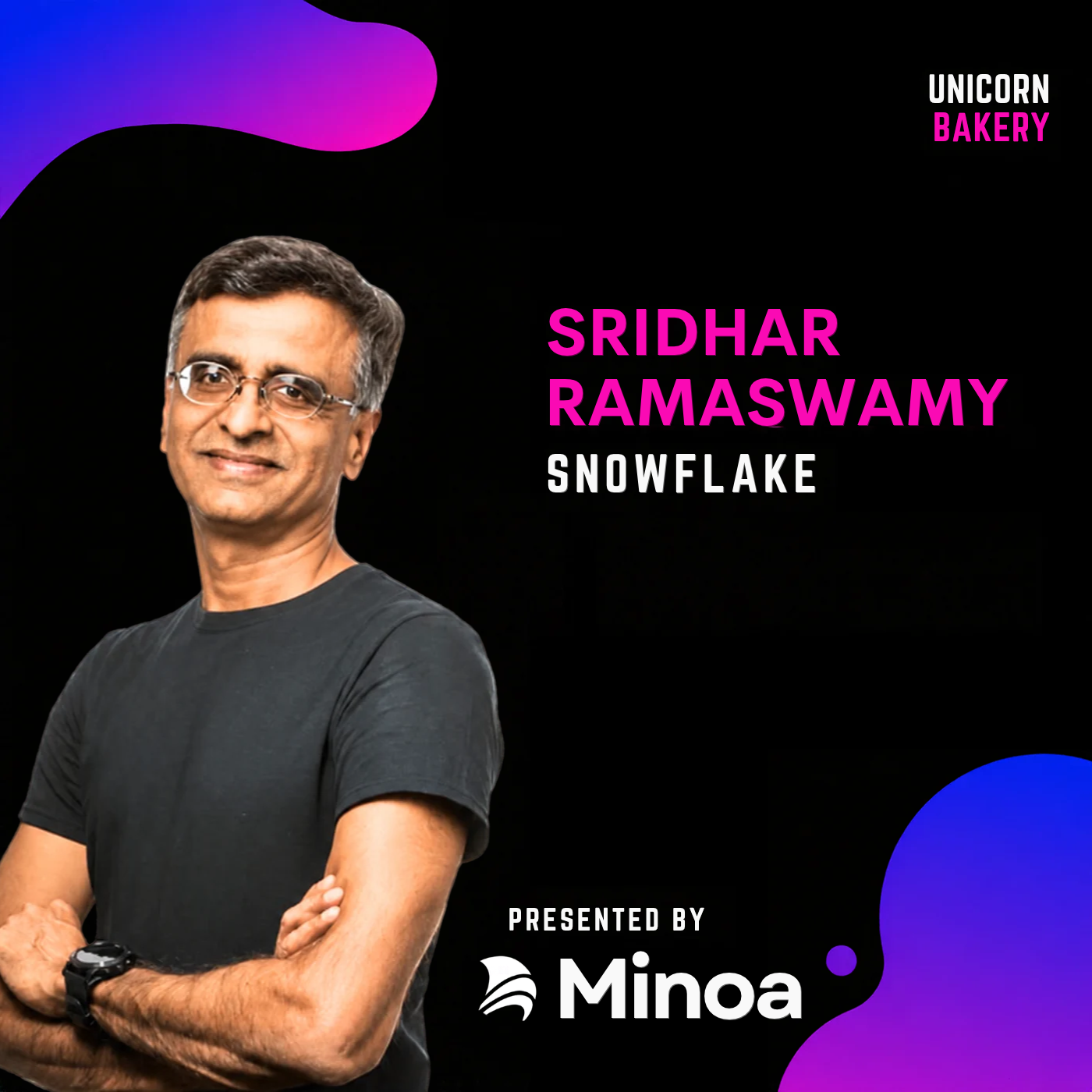
Snowflake CEO: "All leaders today are leading teams they don't understand" (Sridhar Ramaswamy)
Freitag, 30. Oktober 2026 · 39 min
Kapitelklicken springt direkt hin
Shownotes
Fabian talks with Snowflake CEO Sridhar Ramaswamy about what AI changes for managers, how he hires, how his vision for Snowflake grew and why outcomes are replacing hourly services.
This episode is presented by Minoa. Software companies are moving from selling products to owning their customers’ outcomes, and that only works if you can prove them. Minoa grounds every business case, ROI and use case your team shows a customer in your own data, then measures the value you actually delivered after the sale. Snowflake, Cognite, Vanta and Datadog run on Minoa.
Find out more at unicornbakery.de/minoa
Click here to view Leapsome's Workforce Trends Report 2027: unicornbakery.de/leapsome
What you'll learn:
Leading teams you don't understand
• "All leaders today are leading teams that they don't understand"
• To stay relevant, managers must relearn what "amazing" looks like in their team's craft
• Unchanged: give credit for wins, take the blame first, be the safety net
Hiring and first-time management
• He hires for intensity, mental agility and team play – not raw intelligence
• His favorite interview question: "Tell me something really hard that you have done"
• Grow autonomy: check-ins every four hours, then daily, then two-week projects
From Neeva to Snowflake CEO
• First AI bets: an AI layer close to the data, unstructured data, text-to-SQL
• His board pitch: a data platform better than the one behind Google Ads
• "A great vision is separated from a good vision based on whether you succeed or not"
Forward deployment and execution
• Customers hate hourly billing: "Customers want outcomes"
• Snowflake's Frontier Engineering Team bids fixed prices for business outcomes
• "I commit, and then I engage" – and why Neeva wasn't different enough
EVERYTHING ABOUT UNICORN BAKERY:
zez.am/unicornbakery
More about Sridhar:
LinkedIn: linkedin.com/in/sridhar-ramaswamy
Website: snowflake.com
Chapters:
() Teaser & intro – manager or founder?
() Planning for 9,000 employees – and testing every feature
() Leading teams you don't understand
() What hasn't changed – credit, blame, safety net
() Advice for first-time managers
() Calibrating autonomy – the intern rule
() His favorite hiring question
() From Neeva to CEO – planning to leave after six months
() Snowflake's first three AI bets
() Coding agents and CoCo – a vision in waves
() The board pitch – a data platform better than Google Ads'
() Good vs. great vision – proof of the pudding
() Forward deployed engineers – why software avoided services
() Blurring lines – outcomes over hours
() The Frontier Engineering Team – fixed-price outcomes
() "I commit, then I engage" – why Neeva failed
() Small teams of five or six in the age of AI
Transkriptvom Podcast bereitgestellt · Zeitmarken springen hin
You've built the ads business to a hundred billion in revenue. In the end, became CEO of Snowflake. I wanted to create a search engine from scratch and want it be way better than what Google was but i don't think I or Vivek had great idea. how is that? we are going to be dramatically different? And so took us three plus years.
you have plans discussed to leave snowflakes. after six months Indian ended up becoming co-of company. I talked them about my ambition To create as large companies. What would you say differentiates a mediocre or good vision from an exceptional vision? I also have a depressing answer for you. In the end became CEO of Snowflake, which is a function that you're here with in-in that case.
To what extent would he say? You are manager or founder?". Today's episode was presented by Minoa and I invested in Minoa early And i've known Max one of the founders for long time. One idea from my conversation with Shrita really stuck With me Software companies are moving From selling A product to owning The outcome their customer wants.
But you can only own an Outcome if you can prove it And in most companies, that proof lives on a few top reps' heads. A pile of spreadsheets and RI numbers. someone pulled out of Claude or Chetcha BT did. nobody can back up. Once the deal closes Nobody checks whether their customer ever got an outcome.
That's what Minoa fixes. Every business case, ROI & use-case your team puts in front of our customers is grounded into your own data. After this sale, Minoa measures outcomes you actually delivered. Snowflake is currently onboarding three thousand reps on it and Cooknight uses Minua to track a goal of one hundred billion dollars in customer value by twenty thirty-five.
The burden of proving outcomes has shifted the vendor, and Minua is how you carry out. Find more at minua.io or message me. I'll introduce you to Max. You can also find link into show notes. Being a manager always meant that you were removed from the details. You could not possibly find time to understand any of the data.
and finally enough I actually became a manager at Google because it was very atypical place, i used to use all our products play with code write prototypes well into you know, running a two-three thousand person team which is unheard of elsewhere. But Google had no rules for how people behaved. I remember becoming a manager there because it was like oh here's the place that won't tell me what to do and so i could be a highly technical manager Which I really liked?
I liked the act of creating. To Me That's What Software...that's what attracts me to software And thats whats really attractive. And at Snowflake right now, absolutely I lead a large team. So we just went through the process of annual planning for nine thousand employees which is pretty wild because you have to deal with concepts like what's the overhang run rate?
It how much have you hired this year? so that if did nothing other than spend on January thirty first twenty-twenty seven How much would you be spending more next year anyway? Because growth is not at the beginning of the year. Yes, I have to do things like that and then Do five-year internal plans for where we want our revenue to be or figure out how to be gap profitable.
but on the other hand AI makes it possible test every feature that my company releases. It's actually quite joyous. or I'm doing a bunch of research projects, I am collaborating with the few people in the team on what it takes to create a harness for very long-lived agent one who can survive for weeks working on some task and so its blend.
but having said all of this Im a public company CEO And doing their job well is Job number One! I feel Fortunate that the world of AI gives me other options as well to deal with both technology and innovation at a much closer level than I ever thought would have been possible. When I'm thinking about large organizations and steering them, it's always about how to find vision.
How to translate that into the organization And then how to provide a leadership That everybody else can translate that forward into. the last line of defense What would you say? because you said at Google there were no rules? But a lot of things changed on the one hand since Google and at same time through AI.
What would you say? are leadership principles that once were applicable but not anymore because of AI? The first and foremost, it's not a principle...the first and foremost change That every leader today has to internalize is that they no longer understand the craft of people who work for them. Let's say you're a software engineering manager or director, how... You got to become a manager and then a director likely because your are good coder at some point.
And displayed capabilities that would benefit the team. Your'e good at organizing ,youre good at motivating .You know I will talk about those kinds of things in a second but also had this intrinsic view what was easy versus difficult versus what the different personalities in your team were, or how code work got done.
It changes all of that. and so what has changed very dramatically is that our leaders today are leading teams but they don't understand. I think there's a pretty profound change And i think every manager who wants to be relevant needs make an extra effort to understand. So How Has The Craft Changed? What does it mean to be amazing in today's world?
And how do I get more of my, How do i even recognize It? and how Do I Get More Of My People To Think Like That.I think that is a big change that everybody has to go through. but on the other hand The important principles of leadership Starting from..How You Organize Yourself To Take On Cohesive Goals That Can Further your team ,that can further you company.
That's an act of thinking, that is a act of planning. Yes it's collaborative exercise but has not changed how you communicate this vision and have it be motivational powerful inclusive. so bring the people along in your team. I don't think that has changed. And people are complicated. How you're present as leader for them?
How conduct yourself? good times bad time. A good leader always gives credit to their team for things that go well. I think it's a big change for what do you expect as leader from your team? A few things to dig into. First one, like...I'm first-time manager. Like i have a few people. um..i did a lot of crucial mistakes over the last months with the first people.
and What would be YOUR advice after tens years management experience To someone like me who is starting out with let say five people Yep! Who do you pick to be part of your team? I would think about that. And at an individual level, i like working with people That have intensity or willing To make a lot Of effort for the things they decide are worthwhile Because At time change Like this You need that passion, that Intensity and willingness.
We're all competing with people that are spending as much time as you and I, or if probably more. And so the willingness to commit time That willingness to be dedicated something is really important. in my opinion It's a non-negotiable. Similarly The willingness To mentally agile To adapt To change Is equally important at times When technology is producing changes that appear to pretty much be a steep cliff.
So at an individual level, I look for both of these and I will often ask people blunt questions about okay But tell me how you have done something really hard that i can relate to.I think For a team You also need People That Understand That Being A good Team Player being Good With Others Around You Whether It Comes To Collaborating whether it comes to giving credit or simply making people feel welcome and good, even as a colleague not as manager.
To me that social skill is an important part of building a team. many people make the mistake looking for things like raw intelligence without looking into if there's somebody intrinsically. So. I would take these three ingredients of do they work hard? Do they have a basic amount of capability in what it is that you want.
Do they work harder, are there mentally adaptable to the world that's changing? and then we're willing to be part team on working together as A-team. this about just team composition And beyond. You might be covered a little bit of this being. A good manager is all about Being able to first of all come up with the vision for what do you want?
To get done conveying This in a way that makes sense to your team and patiently explaining What it, Is That you Want to Get Done Your Vision to them And Bringing Them Along. For First-Time Managers There Are Often Skills Of How Do You Calibrate People make them more and more accomplished. And you know, similar to AI I think that people's capabilities are roughly in terms of how much autonomy can they be given?
Yet have confidence that they will do the right thing. For example i worked with lots of interns. My advice would always be The first few days your job is come talk to me every four hours about what we're doing. After a while, it'll be like no. No you can do... You can work for the whole day and then just tell me what to do at end of the day.
And I would tell them if by the end of their internship we could do two week long project with Me giving your description in beginning of this week and getting done maybe once or twice. To me that's big accomplishment. It is similar people and teams which are how they get people to have degree of autonomy That know when communicate collaborate but then collectively able to get things done far larger than what any one person can do.
And bringing, as a manager you're bringing these people along People who go through bad times. You want be there for them. Being a manager is not just about telling people What To Do. Sometimes it's simply being There When Things aren't going well For Somebody and making sure that they are a lot more Than some problem That They Have Run Into.
These Are The Things You know you can think about, write down a bunch of them. There are increasingly better and better tools for it but this is also something that comes to your with practice time. We're talking lot abut vision And I'm coming back in the second. But one question before that. Do have favorite questions?
In hiring process as always asking Oh i had one or two. Tell me some things Really hard That u've done Ideally in past few years. I tell people, ''I will take any version of heart.''. One person told me that they're working for a manufacturing company and They said...they had unending problems with the supply chain software That they were using.
What they have on factory floor was not what this system said And it drove them crazy because their manufacturing was being held up. It's in different state. He has to solve all these problem. I went and camped out on the factory floor for two weeks inspecting everything under our software till we got Our problem solved.
Oh my this is somebody that said, i will do whatever it takes. Ask people tell me something really hard if someone were to Tell Me you know um...I couldn't Really run And over six months I uh..I taught myself To Run a thirty mile race like well take It There's nothing easy about doing anything Like That!
I lost forty pounds over a seven month period. It's just hard, uh...I look for that? What have you changed your mind about something you believed in? how have you adapted? and so those are two questions That i always like knowing from people because it is the combination of willingness to put in time.
Willingness To Put In Time Is Just Another Way Of Saying This Person Figures You Know Knows How To Invest For A Future Because that's what like. putting in time without knowing, What the outcome is means most of the times these outcomes aren't guaranteed. I want people that can look forward That feel confident enough about themselves.
So they make a supreme effort? i also looked for People that know when something that They hold To be true Is now false because Of some reason and what they did About it. Will the new hire really be a top performer? Because you only win with your best talents. and still, many companies are involved in blind flight because recruiting & performance data is not effectively connected.
With love for recruiting changes things. You understand what makes up your top performer and that's exactly how it works! For this purpose, personal administration, onboarding, performing and entertainment on one platform plus career agents for the fleissarbeit. Hosted by Frankfurt DSGVO Conform and more than two thousand customers like Notion and Paloa.
When it's decided until December the thirty-first of December for Liebsam, the Agendic HR Accelerator Program will receive a value of € twenty four thousand gratis. In addition to that HRIS base package if you buy a module called Talent Suite e.g. Recruiting. The change makes you happy in two weeks and still puts you into an old contract that takes over the rest of your time for Liebsam.
As far as I understand, did not have direct reports but has been SVP-AI. So you were the person thinking about AI inside Snowflake? You had plans discussed to leave Snowflakes after six months and in the end ended up becoming CEO of a company so that they needed to develop vision for companies where you intended to leave.
How does this happen and what differentiates good vision from an exceptional vision? This is a great question and I don't have a simple answer for this one. We are fifteen minutes from now, that's not problem! Because things evolve. Snowflake made its name clearly as an amazing analytics company And no-one could really understand what AI would do to data or the software engineering And at that time, we actually worked on only three problems.
That are important components of future AI and Snowflake but they're not the whole story. Part one was creating an AI layer that sat very close to data. Snowflakes has this notion for deployment something typically within a cloud service provider boundary, that says this is where Snowflake runs. And it also defines the security perimeter for our customers.
and so whether a services inside deployment or outside is kind of big deal for Snowflakes because we make a lot guarantees when you say data never leaves their deployments unless they tell us We don't call any services which are not part. So we created an AI layer close to in this deployment because you said there is going to be benefit from applying, being able to call AI from different parts of the snowflake stack.
That was part one and then we also laid down primitives for how do you access large scale unstructured data? From within Snowflake. This was the basis for many things like rag chat bots And uh... We also created a project You can think of it as text to SQL, which is another way saying people should be able ask natural language questions and you should return structured data back.
And the good thing about Snowflake was that... People who necessarily have a background in AI like our founders Ben Wan Theory they understood this vision. They gave me and my co-founder Vivek who now heads engineering at Snowflakes the leeway to pursue this. And so, this was beginning of what is possible with AI and subsequently things like models being able do really well in software engineering with coding has become more than normal.
The harness products like cloud code or Codex or Coco, which is our coding agent. The harness has become a really important piece of software. those are all things that came along but the core vision was AI should make it possible for our customers to get a lot more value from data. That's what we started on back in twenty-twenty three and as every new wave we upped our ambition and vision for what is possible.
And coding agents translated into CoCo, which was a data coding agent that ships with Snowflake. That's the other part of AI Vision for Snowflakes Which is that coding agents can make it possible to get things done with snowflake A whole lot more! Thats how the vision came. It didn't come in one shot because the technology was not ready.
And to be honest with you, part of that reason why I got the CEO job is...I talked on board many conversations but also did a presentation where i talk about my ambition To create as large company in the data space, as we had done say with search ads at Google. I felt that the market was as large because it is such a horizontal.
every company on the planet needs an amazing platform and The vision that I set out Was one that of creating a data platform for Every enterprise customer. That was better than the data platform that powered google ads which was one Of the best platform teams that there ever was. And that's part of what attracted them to me, even though I was not a public company CEO.
They saw the confidence and their relentlessness... ...I had about making Snowflake into an iconic company.. ..and thats why they gave my job! The main reason i took this job is also because i worked on data most of my life.... ....and felt very happy at home at Snowflakes. I met a lot of Snowflake customers and they all loved Snowflakes.
We can talk about how we want to be entrepreneurs or independent, but at the end of day... ...we wanted value! And here was company that its customer absolutely valued. It is an area where i had spent large portion my life. My side ledger for why i wanted to be snowflake CEO.. ..was i felt this as a company whose products I related to, which also had a lot of impact on customers and i thought it could have a lot more impact down the world as well.
And what would you say differentiates mediocre or good vision from an exceptional vision that then also drives people towards you is a new CEO? Because like my hypothesis as an outsider person that came in through an acquisition, and then not being C level before at the same company. You need to have even better way to communicate the same vision of somebody who already has the buy-in from a company.
so thats why I'm asking specifically for them. It's good question And i will try but also have depressing answer which is a great vision, separated from good vision based on whether you succeed or not. For enough? That's the problem with vision... ...which means that you can articulate something but proof of putting in the taste and I would say collectively outside world has embraced what we want to become.
Precisely because products like Cocoa and Co-Work have been so successful, but people feel oh okay these guys are more than the analytic database And I actually don't think there's anything wrong with it. This is similar. You know you work a lot of startups. The thing that really took away from my startup And one that I really try to live by even at Snowflake is creating product market fit, which you can roughly think of as does the thing To me, that's what... By the way there is a large element of luck in all this.
There are lots of timing for it But I think similar to that A vision is successful only by virtue Of creating at least first version of success. And then what happens with these situations is success begets more success. Once you get some success your team is excited they're succeeding They put more effort into and can become positive feedback.
It's no flake. a company that was always known for being very structured an amazing sales team with the great product but like meticulously Followed, like. That's our plan and delivered and overdelivered And it was already at a size. and then AI came in. things change Like now. one of those most Discuss term that I hear at the moment is like forward deployed engineers For example.
there weren't a thing, few years ago. So how do organizations need to adapt the change that's currently happening? and what does this mean? or did it mean in past for Snowflake? As you know implementing software within companies was very difficult for a long time. there is always degree of customization needed to happen.
plumbing needs set up between different systems And the amount of value that you could create doing work like that wasn't that high. I'll give an example, roughly employs eight hundred thousand people. there's a lot of people and they make about eighty billion dollars off revenue per year. in that ballpark it's got one hundred thousand dollars per person And Snowflake, you know is about nine thousand people.
Let's just say that this year roughly we will make six billion dollars roughly and if he do the math like six over nine million which was like six hundred sixty-six something thousand six times. so a lot of tech companies hesitated to create services teams because in order to get worked on, you would need to have many times more services people than you had people creating software.
You just created a very different kind of company. You became a service's company that happened to produce a little bit of software as opposed being a software kinda company. and while we can say like what is the difference? These things actually end up exerting powerful gravitational force within a company It becomes, it gets down to like what is your primary goal as a company?
And the company that has ten services person and one software person Is very different dynamic from something. just has the software person. That's The whole part. I think What is happening with AI is that many traditional lines are kind of disappearing. for example i would argue in AI, the line between an engineer and a product manager is super blurry.
And similarly, the lined-between what a data platform is... ...and what software it's. especially with data platforms like Snowflake…. …and certainly with the likes of AWS you know? It's easier to write or maintain software. so that line is very blurry.. ..and AI also makes it possible take much more active role in implementation.
Most product engineers never thought about things like migrations. It's something that somebody else did, these poor services people. But I think a lot more is possible precisely because of AI. you can write code faster. You could also write code in English using things like skills That you would not normally think off as code but clearly it's alot faster to be writing skills.
So i think all the lines are blurring. And what was also true Is that the service industry has evolved on a model of charging by the hour that customers hate it. Customers want outcomes, they don't want to pay open-ended by the hours. and all this is creating perfect storm where increasingly there's much more possible than the current combination of tech players plus services as they know Can can do and this is where this motion comes into play.
these There are a set of companies. that small small company obviously Palantir's the most famous example They're pre AI to give them incredible amounts off credit. We just approach business very, very differently. But at snowflake we call them their frontier engineering team. but idea roughly Is that start from our business outcome?
That the customer wants quickly figure out what are the different pieces of technology that need to be put into place in order to drive that outcome and essentially submit a fixed-price bid for getting that work done. And, put your best product as well as implementation team in place to get their project on.
It's early but we have number really good collaborations going with people at Westpac With people who spoke at Snowflake Summit and many others. I see this as setting a new standard for how outcomes, or functionality is delivered to customers And i suspect that some set of system integrators will quickly adopt the model because customers first want it they love And I actually think that it'll end up working fine for the system integrators, switch over to this model because they will get a lot more work done faster.
But i think its collapsing of boundaries thats creating opportunities For me. come you and say ,i can be in charge othe outcome u want here is what roughly going take. lets figure out how to do very quickly. are relevant from this conversation. The most important question, I think that stands out for the last one is you said a great vision as measured by achieving it or not?
So what's your way That you want to leave with the audience To make A plan? Yeah Out of a Great Vision Then acts Is actionable enough to be succeeded With? There is a famous quote is sometimes attributed to Napoleon, but I think precedes him. It's in French which i won't attempt. it's roughly translated into... What people would ask about all of these ridiculous battles that he wanted and they should not have?
And what your secret? His answer was this You wholeheartedly commit You bring along a certain set of capabilities. His armies were famous for how maneuverable they are, How quickly they could communicate? How quickly They could reorganize themselves. But he would engage like live and to me That is one of the most important qualities which was yes you start with why You're different Why your taking on a problem while you think you will achieve success and you go all into it.
You live, you breathe but remember that your also operating in a dynamic world And the more you are able to iterate an adjust as things change As the World changes The More I think you stand a chance for realizing these visions. For example if i go back Why was Niva not successful? No! I wanted to create a search engine from scratch.
I wanted it to be way better than what Google was. It's fine, these are perfectly fine things to wish for but i don't think i or Vivek had a great idea. how is that? we're going dramatically different and so took us three plus years on the arrival of original GPT models pre-chat gpt mind you which when light bulb went off in our eyes no one wants click on link everyone want answer.
given As you think about it, chat GPD has carried on that vision. But It is based On this incredible new technology That happened to be just right for the purpose. And so thats an example of having a vision but not A way to execute that kind Of a vision. and For every founder I would say absolutely You have To Have The Vision and product market fit is among the most elusive things.
That all of us speak of it as though its something that we can all will into existence, but Frank Slutman my predecessor at Snowflake used to call it a life force like you know when you see it? But you just cant like will the existance off that And so being adapted about the environment adjusting to have this clear North Star of what is the piece of magic that you can have in your hand.
That's probably among most valuable things, and this how increasingly I approach innovation even at Snowflake. We shoot for teams who are never too large – five or six people almost too many. We agree, we argue about the direction. But after that it's also a little bit of letting go and telling them That's fine.
You tell us if you have questions for me For Us The management team ask us but is up to you To achieve this success. Thankyou Swinna. Todays episode was presented by Minua And I invested in minua early and i've known max one Of the founders for long time. One idea from my conversation with swina really stuck With Me Software companies are moving from selling a product to owning the outcome their customer wants, but you can only own an outcome if you can prove it.
And in most companies that proof lives on a few top reps heads, a pile of spreadsheets and RI numbers. someone pulled out of Claude or Chetcha BT did nobody back up. Once the deal closes Nobody checks whether your customer ever got the outcome. That's what Minoa fixes. Every business case, ROI and use-case your team puts in front of a customer is grounded on their own data And after the sale, Minoa measures the outcomes you actually delivered.
Snowflake currently onboarding three thousand reps on it and Cooknight uses Minoa to track our goal for one hundred billion dollars in customer value by twenty thirty five. The burden of proving out comes has shifted to the vendor... ...and Minoa is how we carry them. Find out more at minua.io or message me and I'll introduce you to Max.
You can also find the link in the show notes.
