

Kapitelklicken springt direkt hin
Shownotes
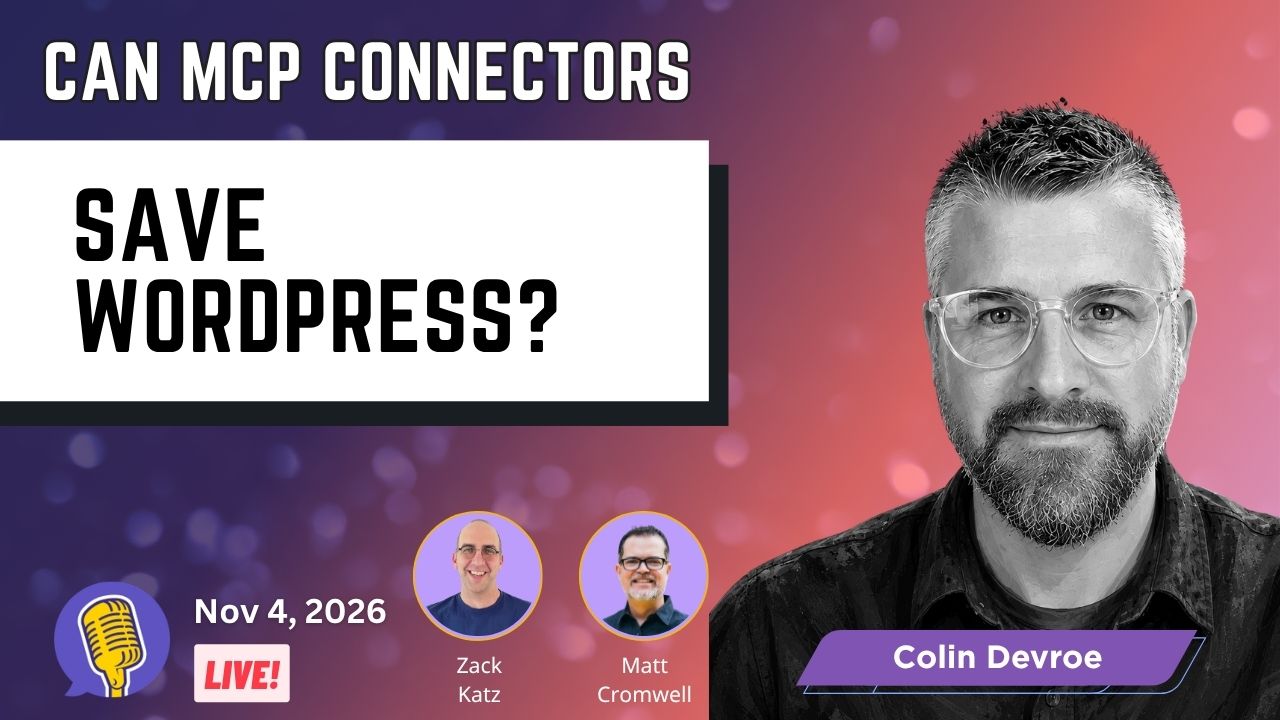
AI is changing how we work with WordPress, but what happens when AI tools can do more than generate content or answer questions? On November 4 at noon Eastern, Katie Keith and Zack Katz welcome Colin Devroe to WP Product Talk to explore how Model Context Protocol (MCP) connectors could open up new possibilities for WordPress businesses. Drawing on real-world experimentation with MCP and AI workflows, we'll dig into what happens when AI can connect directly with the tools and systems that power our work.
Could WordPress MCP connectors help streamline workflows, improve productivity, and unlock new ways to build and manage WordPress products? We'll discuss the opportunities, challenges, and practical lessons emerging from these integrations, including what it takes to make AI genuinely useful in a WordPress business. Whether you're a plugin developer, product owner, or agency professional, join us to explore whether MCP could be a meaningful step forward for the WordPress ecosystem.
Transkriptvom Podcast bereitgestellt · Zeitmarken springen hin
ep156-wppt-audio
[00:00:00] Katie Keith: MCP connectors let AI plug directly into the tools and the systems that you use every day. For WordPress businesses, that raises two big questions. How can MCPs change the way you run your business? And also, should you be building MCP connectors into your own products? That's what we're gonna talk about
[00:00:28] Matt Cromwell: This is WP Product Talk, the place where every week we bring you insights on product marketing, business management and growth, customer experience, product development, and more. It's your go-to podcast for WordPress product owners by WordPress product owners. And now, enjoy the show
[00:00:56] Katie Keith: Hey, I'm Katie Keith, founder and CEO at Barn2, and I'm standing in for, uh, co-host Matt Cromwell today 'cause he's not well. I expect he caught something at PressConf, so get well soon.
[00:01:08] Zack Katz: And I'm Zach Katz, uh, Zach AI Katz today, 'cause we're talking AI, baby. Uh, and I'm, uh, I r- I'm with Gravity Kit.
[00:01:18] Katie Keith: Yeah, I know that's always your favorite topic.
[00:01:22] So if you benefit from WP Product Talk, we'd love your support. The easiest way to make a difference is just to subscribe right now. It only takes a second, and it really helps us.
[00:01:35] Zack Katz: Yeah. And a huge thanks to Freemius for being our exclusive growth partner, and if you aren't familiar with Freemius, uh, they help software makers grow, monetize, and succeed.
[00:01:44] They're a merchant of record platform, which means they handle everything around selling software. They do checkout, payments, subscriptions, licensing, updates, global tax compliance. Blech. Let Freemius handle it. You can focus on building amazing products.
[00:02:00] Katie Keith: Okay. Well, let's jump into the topic of MCP Connexes and WordPress.
[00:02:05] For that, we've invited Colin to the show as our guest. Welcome, Colin.
[00:02:11] Colin Devroe: Thanks for having me.
[00:02:13] Katie Keith: Well, thank you so much for being here. Uh, could you tell everyone a bit about yourself and what you do?
[00:02:19] Colin Devroe: Sure. And I... By the way, I wanna get Zach to do a couple ad reads for me, 'cause that was pretty good. Uh-
[00:02:24] Zack Katz: Anytime.
[00:02:26] Colin Devroe: So I've been on the internet since I was 14. I've been working on the web pretty much since then. I've been around since WordPress was called B2, so I'm an old man of the hills here. Uh, and yeah, I work at NerdPress, nerdpress.net, which is a, a support company for WordPress that feels like family, and we help large online publishers keep their websites up fast.
[00:02:55] They don't have to worry about it. They can focus on what they do best. And this year we're really digging into AI. So not only have I, uh, changed my title to head of AI to help us apply AI inside of NerdPress for the whole organization, but we also have a, uh, a product for our clients that's called the Guided Agent Connector, which I hope we get into a little bit.
[00:03:19] Uh, so we've learned quite a bit about AI over the last, I would say, four years. Um, I've been with NerdPress about three years, and everyone knows that everything kinda went parabolic around November of last year till now, so it's been just about a year now since everything's changed dramatically, and so kind of excited to talk about it a little bit.
[00:03:39] Zack Katz: Yeah. Well, I am too. And for those of you who are watching live, please, uh, leave your comments and questions or feedback or whatever, uh, in the chat, and we will highlight your comments and questions, and we'll discuss on the show. We are live.
[00:03:53] Katie Keith: Yeah. So let's get started then. Uh, Colin, could you tell us about the specific MCP type things you've been working on?
[00:04:01] Uh, maybe cover the internal side of things and also what you've released, uh, to the public for your products
[00:04:08] Colin Devroe: Sure. Um, as with anybody getting spun up with AI, you quickly learn that AI is only good, uh, with the information it is given. So it gets better and better and better the more information you can give it.
[00:04:22] So NerdPress is a-- has a really great culture of documenting, uh, our processes or internal questions or, um, you know, anything that comes up inside of the business. Not only for the team, but even for the work that we do or for our clients. And that had real benefits when we started to apply AI inside of the company.
[00:04:41] So you can imagine a knowledge base of sorts that we have. Well, giving the knowledge base over to our AI tools was one step change for us. Going from Claude, let's say, knowing everything to Claude knowing everything that we know, which is a very big difference. And then all of our disparate tools that are spread across the business, be- from handling support to our analytics tools to our, you know, our, uh, point of sale system to...
[00:05:12] You can imagine anything that we had, we started to build connectors for them, 'cause a lot of the stuff that we use is stuff that we've built internally. Some are off the shelf. We use Slack like everybody else. Uh, we use Help Scout for our support system. Uh, we use Guru for a lot of our documentation. So these are things that are off the shelf, but a lot of the other pieces we built on our own.
[00:05:34] And so we had to build connectors that, and that's what MCPs are, uh, that allows Claude to draw from all those different sources of information, and then we really saw it able to get to work. So that's even at just the read-only level. You know, uh, if you just give it the information, it can help you have so much insights.
[00:05:54] So something that used to take us a few hours to research for a customer or something could take just minutes because all of those separate systems can then be called upon to give us context in what we're working on. Uh, but then when you add the ability to start doing work or writing or changing these platforms, then Claude can be an agent at that point in your behalf to do things.
[00:06:21] So we've kind of made that probably what every other small business has been doing these last 18 months, I'd say, is learning all of that, learning how to do that well, um, learning how to get better results for less, uh, token usage. Um, NerdPress is a certified B corporation, so we do our best to benefit everyone else, and one of those things is to not use-- to use the least amount of energy as we possibly can, to keep our cor- carbon footprint as possi- uh, small as we possibly can.
[00:06:52] So That usually seems like it would be antithetical to using AI, but the, the truth of it is, is you can use AI reasonably and sensibly, and if you focus on that, you'd be surprised how much you can drive down the amount of usage that you actually end up using and still get the best insights that, uh, that we've never even had access to, quite frankly.
[00:07:13] So yeah, we've gone through that same kind of trajectory that a lot of other businesses are doing, and we're connecting things together, and the team is able to be very productive as a result
[00:07:24] Zack Katz: Yeah, we've been on the same journey, Colin, um, at GravityKit, and w- it's been the, you know, Opus, Cloud Opus 5.5 has just been incredible.
[00:07:34] It's so powerful, and I feel like that's really unlocked the tooling that we had already put in place, where, uh, we use airbyte.com to sync all of our data sources into one BigQuery database. And that one BigQuery database, each of the team has their own access token, and then we can have our M- like, we can have our MCPs talk to that one database that has all the information about everything.
[00:07:58] And that has unlocked our ability for the team to answer any questions they have about our processes. We've been building standard operating procedures into our, like, a shared AI skills repo that we, we have, uh, synced out as a plugin on the, uh, like, we have our own plugin marketplace. Um, and that those, that combination of having a synced skills repo that everybody uses and enhances and builds upon, and a common source of knowledge, uh, in the database that has everything, um, has just made it so that everybody is now doing everything.
[00:08:32] And, uh, you know- ... the QA person is able to do a pull request because they're using the same prompts and the same skills that our developers are also using. And the marketing person is able to do something on our demo site, uh, for server configuration because all of that is also documented and, uh, understood how to work on.
[00:08:50] So, like, having the shared knowledge on how to do something, but also, uh, the shared database for, like, the actual data, those two parts are really, are really helpful to have together.
[00:09:03] Colin Devroe: Yeah, for sure. Yeah, we, all of our- And how about
[00:09:05] Zack Katz: you, K.D.?
[00:09:06] Colin Devroe: I'm sorry. I was just gonna say, all of our internal repos have new contributors this year, which is awesome to see, to be honest.
[00:09:13] I, I really appreciate that
[00:09:17] Katie Keith: Yeah, picking up on what Jack's, uh, what Zach said, I think it's really interesting how people's roles have expanded, like how anyone can build software now. Uh, in terms of, um, actual products that we release to the public, um, probably not. Uh, that should still go through the qualified developers, and then they should be using AI, of course.
[00:09:39] But for example, myself and my marketing specialist are both writing quite complex internal tools for things like content marketing, analysis, reporting, all that kind of thing. Um, Rob and Lou's like a huge list of internal tools that we've built in, uh, just using AI now. And yeah, I hardly ever log into stuff anymore because I just have Claude do it all for me.
[00:10:05] Uh, s- even like our website and, uh, I d- you don't need to log into the WordPress admin very much, you can just have the AI do that for you. And, uh, since, well, yesterday, uh, after PressConf last week, people were talking about GrokBot as an alternative, so I've just started experimenting with that. So I've already connected it to all the same things that Claude had access to, you know, yeah, Help Scout, GitHub, whatever.
[00:10:32] There's a huge list. Uh, but, uh, I like the idea of that because you can access it from anywhere 'cause it's in the cloud. And one thing I feel has held me back with things like Claude is having things on your computer. I wanna be able to do stuff from my phone and everything like that. So that's quite exciting.
[00:10:50] But, uh, it's interesting that Zach said about that you're bringing all the data, um, using the method that you mentioned. Um, 'cause we're mostly doing that through AutoMem from Very Good Plugins, um, where I've actually got two AutoMems. One for me and my personal stuff, m- uh, the, the work that only affects me.
[00:11:11] And also we have what we call the Barm II Brain, which is another instance of AutoMem, which all of my team have access to through their own AIs. And so when one of us do something, that gets saved to AutoMem so that the other team members can have their AIs retrieve that where that's appropriate. And we had an example that I really loved of that, where I just started working on something, a new tool that I haven't told my team about, and independently one of my team members decided to build the same thing.
[00:11:43] And the Barm II Brain told him, "Uh, Katie's already building that. Maybe you should ask her about it." And so he did. And I said, "How do you know about this?" And he said, "The Barm II Brain told me." So the system works. But a question I have for Colin is when you need an MCP, um, 'cause for WordPress, I've just been using the application password method, um, that doesn't, rather than an MCP, and it can do everything I want.
[00:12:12] Similarly, for email marketing, we use FluentCRM on a different WordPress site, and that provides MCP connectors. But why do you even need that if you've just given it access through the other method? So I'm curious to know when you should use an MCP and when something else does the job.
[00:12:32] Colin Devroe: Well, that's good.
[00:12:33] I mean, that's a good question. I, you know, we're all just learning. It's g- it's very early days in all of this, so there's probably not really any solid one single answer. Obviously, there are millions and millions of WordPress sites, so everybody has to kinda make their own decisions for some of these things.
[00:12:49] But, uh, if you're concerned with the level of access that you give an agent, which at NerdPress we really are ... I mean, we, we take care of thousands of people's businesses, and so we're very careful in what an agent can see, what an agent can touch, what an agent can change. Uh, and so for, like, something like a personal blog, maybe you're willing to go YOLO and let it have access to everything, and with a, uh, a business, a point of sale, a sh- a store, uh, you might, uh, be a little bit tighter on that and just be a little bit more measured in what you, uh, allow an agent to change.
[00:13:29] So with something like an application password that is on your user, then your user is an admin. Well, that obviously has certain privileges that you may not want to give to an agent.
[00:13:40] Katie Keith: Uh- Yeah, I've been creating a separate account with the relevant privileges, and you can use, like, user role editor plugin and so on to create those privileges.
[00:13:50] So I'm interested in what the absolute kind of pros and cons are if you're controlling the permissions
[00:13:58] Colin Devroe: Well, that, that's good that you're doing that. Um, by controlling the permissions, presumably it wouldn't be able to jump into doing something that it can't do because the user that it's using, uh, wouldn't be able to delete something, as an example.
[00:14:13] Uh, so with an MCP, you can kind of control that a little bit more. Some of these plugins that have, uh, a token, you know, OAuth-based system that will generate a token that's held by both systems, and then that way the token becomes what is privileged and has specific permissions rather than a user, let's say.
[00:14:32] Uh, also having a second user on the site, you may not want the site to be, or the content, let's say, that you're maybe manipulating. Maybe you're not, you're not creating content with an agent, but maybe you're, uh, updating it, formatting it, changing layout, things like that. You may not want that user to be attributed to that content, so you might be able-- You might wanna have it attributed to your user.
[00:14:55] And there's, so there's several things like that that, that could come into play as far as, like, what your preferences for that would be. But your, uh, your, you know, your question of, like, which one is better really depends on what you're doing. I'll give you one more example and, and then I know, Zach, you wanna j-bump- jump in.
[00:15:12] Is the... You can have an MCP connection to your site where one agent is able to do a very limited amount of things for the work that you do every day, things like publishing your podcast and things like that. But you may have other things behind the scenes like updating plugins or updating core or making backups and things like that.
[00:15:34] You might be able to give a second agent different level of access that just does those things. So that's what's kinda nice about being able to control the permission levels.
[00:15:43] Zack Katz: Yeah. And, you know, and developers sometimes criticize MCP, uh, because it's essentially the same thing as API. Like, it's an, it's just giving programmatic access.
[00:15:55] It's, it's a different type of API, uh, application programming interface. But MCPs are nice because if you didn't have an MCP, then your, uh, y- um, your AI will-- might, like, write some code and then run it and try to do it in a persistent, or in a consistent way. And it might end up having to come up with a whole, like, script to run the same thing that the MCP has already defined how to do, uh, more efficiently.
[00:16:20] MCPs also can, can broadcast their capabilities in a different way that, that makes it easier for AIs to understand what they can and can't do. They can return things, um, uh... They can return responses with, like, hints for what to do next. So they ha- the, the A- MCP framework allows for AIs to more efficiently communicate without having to recreate the wheel every time they try to do something on the website.
[00:16:43] Colin Devroe: Yeah. I mean, you know, I don't think that's a really great debate to have about APIs and MCPs, honestly. Right. Um, because what you would expose through an API so that someone can build an app on top of WordPress, let's say, is very different than what I might want an agent to do.
[00:17:01] Zack Katz: Right.
[00:17:01] Colin Devroe: Uh, you know, the tools that come with an MCP can be crafted in such a way that it helps an agent get work done, and the API endpoints would be created in such a way that you can build an app on top of something.
[00:17:17] So they're very different problem spaces. I don't think... I think, you know, I think some of the criticisms of MCP as they're updating the spec have gone away. Again, these are very new things. Um, you know, the verbosity of an MCP, I could understand why some don't like how verbose it is, because tokens aren't exactly cheap at the moment, but they're getting cheaper.
[00:17:39] Um, so that may go away, and there's some things that we've learned internally on how to, uh, reduce the number of tokens that an MCP soaks up. So e- every time that you ask an MCP what capabilities it has, as an example, it kind of gives the agent this huge laundry list of things. And on a WordPress site, if they have 80 to 100 plugins or something, let's say it's a really big site, there's gonna be a lot of tools that is gonna be told to the agent, and that might use up someone's $20 a month Claude account really fast.
[00:18:09] Zack Katz: Mm-hmm.
[00:18:10] Colin Devroe: Uh, so we've kind of created and developed some ways internally that reduce that a lot so that our users, again, because we're a B Corp and we're always focused on this, is allowing their agents to only know the tools that they need to know, as one example. Or be able to search through a tool list rather than being given the entire thing, those kinds of things.
[00:18:32] So, um, this is all new. It's fun, uh, to see MCP take shape. It's already been... The specification for it has already been updated several times to kind of fit what, uh, what AI agents are doing. I think I'm pretty excited about, uh, some of the UIs that we'll be able to deliver inside of an agent. So if you're using Claude and you're, you ask for the weather through a weather MCP, rather than it just telling you the temperature, it could give you this really nice UI, uh, of...
[00:19:00] that's branded by the Weather Channel or WeatherKit or whatever you're using to, to, uh, gather that information, and it can have clouds that are moving by and whatever. So it'll be really interesting to see where MCP will actually end up going.
[00:19:14] Zack Katz: Yeah. Um, y- you mentioned earlier, Colin, that you, uh, one of the downsides of having an application password is that you would have to...
[00:19:24] The, the edits would be attributed to that user of the... Like, if, if you created a new user specifically for your AI agents. Um, how do you deal with, however you thought about the attribution, um, issue when you have AIs acting on somebody's behalf? Because that's something that we've run into, um, with our Block MCP.
[00:19:45] Uh, there is a way for the Block MCP to create the edit under its own user account, but then still reassign it back, uh, when the edits are done so that the edit... Like, we ha- WordPress doesn't really have a, a concept for, like, acted on behalf of- Right ... other than the application password. So, like, how do you, how do you think about that?
[00:20:06] Colin Devroe: Well, what we've done on our side is we have an activity log for everything that an agent does with our connector. So the NerdPress guided agent connector, which if you go to nerdpress.net, there's a little link on the top of the website now that links to a page that describes what it does. But we have a, we, we've kind of created our own activity log that shows you which agent and which user created that connection to that agent.
[00:20:30] So it would say, "Claude, on behalf of Colin, did this thing."
[00:20:34] Zack Katz: Right.
[00:20:34] Colin Devroe: Uh, and we save every single thing that it does. We give you the capability of undoing many of the actions. So if you say, "I want you to update 500 posts with this brand-new tag that it didn't exist before," and you made a mistake and 250 of them shouldn't have it, you can go in and click one button and it will...
[00:20:53] And the agent can do this too. But you can click one button and undo, uh, that action so that you can get back to where you were. Um, so that's how we've handled it so far. I'm hoping that some of the primitives of WordPress maybe will be updated over time, uh, to kind of, uh, handle a, a more agentic workflow.
[00:21:13] I'll give you an example of something that you mentioned, Katie, that I've been thinking about. I'm always thinking of, like, different analogies to help describe the era where c- we went from and now that we are to. And one thing that, like, I thought about was a control room. Software over the years- has become, you know, WordPress is old really in, in terms of software.
[00:21:35] It, it became this control room, like if you could imagine NASA launching a space shuttle or something, with so many gears and knobs and screens and warnings, and I mean, it, it's really unbelievably overwhelming for new users. Um, for us that's been around a long time, we love it. In fact, I would love to work at NASA and be in the control room turning every single knob and looking at every single screen.
[00:22:00] Th- those knobs are
[00:22:00] Zack Katz: the best knobs in the world, yeah.
[00:22:02] Colin Devroe: Exactly. I mean, and we all know they use the Gordon typeface for the, the, the, the letters now. So, um, yeah, I think that would be... That's awesome. That was a great state of software for a bunch of nerds like us, but for new users coming into it, it's very overwhelming.
[00:22:18] And now we're moving into this where there's a clean field now. There's, like, no user interface. In fact, it's all just the English natural language or whatever language you speak. And so now, you know, your words become the features that are behind the software. It's very interesting to see this shift from very sophisticated, feature-packed, in fact maybe even bloated you could make the argument of, software to now that doesn't matter anymore.
[00:22:46] What the admin looks like won't even matter perhaps. Uh, and so allowing these agents, just giving, giving the agents the tools to be able to get your, your work done for whatever your goal is, uh, that's what matters the most, which is very interesting to see this shift happen.
[00:23:02] Katie Keith: Yeah. Well, let's talk about whether or not to be providing MCPs with our WordPress products.
[00:23:08] Um, so yours is kind of about, uh, mainta- updating the entire WordPress site, so using the AI instead of having to access the admin. So let's talk about other types of products. I know at Bantu I've been a bit slow with this, largely because I feel like when you connect your whole site to, uh, work- to your AI, then you can also manage your plugins.
[00:23:34] So for example, I have used Claude to, um, update the content and create product options in my WooCommerce product options plugin. It's created filters in my WooCommerce product filters plugin. It's created documents in my document library plugin. So without having to release MCPs for these plugins, I am already using AI to manage them.
[00:23:58] So what would be the benefit of releasing dedicated MCPs for specific WordPress products?
[00:24:06] Zack Katz: So Katie, you are, uh, have taken a lot of time to learn how to do this, but your customers aren't, haven't necessarily done the same pro- process of learning how to use it. So, um, we at Gravity Kit are building out a better way to integrate with MCPs that is like one click, get it set up, and you don't need to worry about it.
[00:24:26] Um, and instead of having to provide your website access credentials so that, and like path, like a, a way that your Claude account can like log onto your website server and see, and modify files directly or whatever it is that you're doing to like directly manipulate the software, your clients don't, your customers don't need to know how to do that if you provide an MCP.
[00:24:48] You can just say, "Hey Claude, you know all the chats we've had where I've customized a bunch of stuff and it's been way better? Turn that into an MCP so that the, without having to do anything," um, the, the customer base has access to the same functionality that we have been developing So that's my take Yeah,
[00:25:08] Katie Keith: and how will the customer know about that in order to set it up?
[00:25:13] I know in FluentCRM- Well, that's the beautiful thing- ... there's like a page with all those connectors and, uh, on. Is it, is that the best way?
[00:25:20] Zack Katz: So WordPress in 7.3 is finally going to be tackling this head-on, which is really exciting that, that that's coming. In the meantime, I think it's up to each one of us plugin developers to really decide for ourselves what's the best user experience.
[00:25:35] Um, and the we are thinking of having it be part of the onboarding process when people, uh, start to use the plugins. And I've seen Gravity Forms added an MCP tab to their global settings screen, for example, uh, where you can configure permissions there, even though the permissions also exist in other places if you have the MCP adapter.
[00:25:55] And, like, there are so many different places in WordPress for everything, and one of the things that we're realizing at the Gravity Kit side is we're going to need to reproduce some user interface in order to make it easier for the customer to understand, and make sure that they don't have to ask questions of, like, "Is this the right place?
[00:26:10] What else do I have to do?" No, you have to click a button and follow the steps that your AI agent has, um, you know, uh, already knows about. Because hopefully your, uh, your AI agent has written good enough instructions for how to set it itself up that, uh, your customer won't need to know how to do anything it- themselves.
[00:26:33] Katie Keith: Yeah. WordPress being slow on this is one reason I haven't added
[00:26:41] Buttons in... We're talking about using like Claude or, um, Codex or whatever to manage site. Uh, option is to actually be adding AI within your, um, settings interface so that people can, like, click on an AI and type in what they want. And purpose
[00:27:03] Be part of Word, um, like, uh, Shopify Sidekick allows you to do anything in Shopify, so I'm kind of waiting for that. But I think this is a totally separate topic, allowing people to use their MC-
[00:27:15] Zack Katz: You know-
[00:27:16] Katie Keith: Their
[00:27:16] Zack Katz: separate clients
[00:27:17] Katie Keith: to do it ... Katie, I think the, the
[00:27:17] Zack Katz: command palette has great potential to become that, and it already is where WordPress initially thought that the, um, abilities API would be expressed.
[00:27:27] So, like, Command K, and you can maybe chat to AI and have it do things. Um, I feel like that's probably where they're gonna, uh, where they're pointing. Colin, what do you think about, like, the user experience of using AI inside WordPress and connecting it and, like, the flow of the onboarding? Talked, it sounds like you've done a lot of thinking about this.
[00:27:48] Colin Devroe: Yeah. Uh, hopefully you can hear me a little bit now. Hopefully it's not as bad as it was before. Sorry about that. Uh, so You know, everyone having their own way of implementing AI inside of software can get kind of tiresome, I think. Um, yes, it is useful. Uh, sprinkling intelligence throughout a user interface where you might need it is very, you know, can be extremely useful in context because, um, it could be fast, use very few tokens, um, be very purpose-built.
[00:28:24] So you can imagine if you were going to just like, let's say, you had a, a, an AI feature that just helped you write an excerpt for a post that you already wrote, rather than WordPress just choosing the first few hundred characters or something like that, and you wanted to say, "You know what? Help me create this, this little summary or something."
[00:28:45] Well, then that would be very purpose-built because you can click one button, it can go off to a model, get that work done, and come back, and it could be, like, use very, very, very, very specific instructions, great instructions written by a professional, um, that would help to distill that summary down. But that would require the user knowing that that feature is in there, and it's right above that specific text area and all that.
[00:29:06] And so I think that sprinkling it in through the UI is something that we're gonna see in every single app. We've seen it probably now for two years. Um, but eventually, where people primarily work with UI is going to win out overall, unfortunately. It's just the... I think that's just the reality of it. So bots probably will be the next wave.
[00:29:29] They already kind of have been, so you're using Grok Bot, like you said. Uh, OpenAI's Dots, uh, Ch- Claude's Duet app. Um, uh, there's probably others that I'm... Muse from Meta. So any of those bots that are, you know, I guess a graduation from agent are probably gonna be the primary use of AI for a lot of people, probably hundreds of millions, if not a billion soon.
[00:29:57] So, um, I think that people aren't gonna look at UIs anymore, uh, as much as they used to. So yeah, I think, I think it's a good thing to do that because it... Again, I just wanna reiterate my point, which is that it is laser-focused and laser-targeted and very purpose-built, which is a useful thing. But for everything else, uh, for the user, we, we need to make sure that our software is on the surfaces that they are using the most: the phone, voice, probably glasses at some point, all those kinds of things.
[00:30:28] Zack Katz: So one of the problems of this is that m- different people at different layers of expertise have different expectations. The people who are creating the website, um, may or may not be the people who are using the website. Um, and, uh, there is an echo now, Colin, if, uh, you could mute that. Thank you. So, like, I'm, I'm about to speak with a consult- I have a consultation call coming up after, after WP Product Talk today, and the people who have set up the website are Gravity Forms users.
[00:31:00] They know Gravity Forms inside and out. The people who are actually processing the data that Gravity Forms, uh, generates, uh, they take the CSVs, they combine them into Excel format. They do, like, charts in Excel and then, like, email those charts to other people. The, the chain of, um, processing that is happening throughout every one of our cr- our customer's web- like, websites before we got involved was antiquated, and surely, you know, AI will replace everybody's flows eventually, I feel like.
[00:31:33] It... But it's a generational shift, I feel, rather than something that's just a couple of years. I think there will be enough people who don't wanna use AI or aren't comfortable using AI to edit a website and just wanna, like, look at something and click something. I feel like the, the point-and-click paradigm for computing is not gonna go away completely because it's a visual representation when you go to a website, so you wanna have a visual, like, way to interact with it.
[00:31:59] So I do agree that m- so much will be moved o- over to AI, but I do... I don't think it's gonna completely get rid of the user interface side of things
[00:32:13] Katie Keith: Yeah, I'm sure you're right, particularly because we are in a bubble and we're, even me, probably the top 1% of AI users are constantly laughing at me for how much I use it. Like, it's unusual. I'm thinking, well, think about all the people I work with, like Zach is way worse than me. Um, but so we need to accept that we are the minority, and the average website owner who might be building their own or maybe isn't using AI for everything yet.
[00:32:47] So we need to facilitate things for those who are so that users might want to use their AI client, uh, to access your product directly, but also they might want to do it within the word, um, UI, where they know to look for the AI prompts, uh, the little robot pictures all over the place and all of that. And you- Yet at the same time, traditional UI isn't going anywhere for a really long time, which I guess creates a lot more work for us as products pe- people because we have to
[00:33:24] Colin Devroe: kind of access and update our products.
[00:33:25] Well, maybe, maybe we can make this episode of this podcast be a time capsule, and we will look back at this in six months, 12 months, 18 months, 'cause what I'm seeing on the ground may be very different than what you're describing. So most of NerdPress' customers are website owners that are using their websites.
[00:33:44] They did not build their websites. Somebody else did. And they are, there are hundreds of them that are using AI every single day to do everything on their website. Uh, my wife is running an e-commerce business using only ChatGPT, and she uses ChatGPT that's connected to a second laptop, that the laptop does all the work for her, and she's doing everything on ChatGPT.
[00:34:09] My mother, who's 80 years old, is using ChatGPT every single day. So I'm seeing that maybe there is a generational shift and it's gonna take longer, but I think that every timeline that we're used to... I've been in this business since 1994, and it used to be very easy to predict how long a new technology that you saw would take to get to the masses.
[00:34:33] It would be like, oh, if I'm using it today, then in 18 months everyone else will even know what it is, and then in six months after that, maybe everyone will have one, something like that. Now, all those time dilations are crunched it seems like. Every single thing that I hear about on X or another social network on Saturday, by Tuesday the stock market is being affected, and by Thursday my mother's asking me about it, and that's not normal.
[00:35:02] Uh, and so what- I don't know what that means. I, I just know that everything seems to be having a less of a, of a pickup time. These, these are also much easier products to use than anything we've ever seen before because it is a chat and everybody knows how to chat. Uh, where before it would be like, oh, well, you know, RSS is the new thing.
[00:35:24] Well, go ahead and explain RSS to somebody even today, or logging into WordPress, like I was saying before. You log into the dashboard as a new user on day one and say, "Go write a blog post."
[00:35:38] Zack Katz: No
[00:35:38] Colin Devroe: thank
[00:35:38] Zack Katz: you.
[00:35:39] Colin Devroe: Well, yeah, no thank you. Go make columns on this one landing page and put an image in the third column on the right.
[00:35:46] No, thank you. No one wants to do that. Uh, but say those words that I just did to an agent and it happens, absolutely anyone that has, like, they don't even have... They can, all, all they have to have is a phone. So I do... Let's make this little time capsule. We'll see where we are in 12 or 18 months, but I do think that, uh, these bots or at least agents from all of these main players are going to be in the low billions very fast.
[00:36:14] Zack Katz: I, I agree completely with that take. Um, I also think that we overestimate the speed- We always do ... of change when it comes to, like, I, I had a meeting with, uh, the town manager the other day, um, and, you know, I'm, I'm helping write and update our town code to improve dog regulations, right? So of course, I'm using AI to scrape every successful dog regulation in the entire country and, uh, make sure that it's only for the towns and villages that are about the same size as ours and see what the problems were with the process, et cetera.
[00:36:48] Uh, I show up and, like, you know, she, she's taking handwritten notes and, like, the, the pro- asking, calling in to the other room and asking questions about how things work, uh, to somebody behind a door. Like, the, the level of, of digital, uh, digitization, um, is going to take a while to seep in. I think, like, still people don't have websites when they start a new business and that Claude and, and ChatGPT will help with that, and I think that the websites that they create will be managed pretty much exclusively from AI.
[00:37:24] But for the existing WordPress sites, I do feel like that's a longer, uh, runway. And I agree, like 12 to 18 months, I think we're, like, certainly the people in the know, um, I'm already, you know, AI pilled. I think people are gonna be A- AI pilled more and more, but I think WordPress and the existing sites, uh, will be a longer, uh, path to AI pill.
[00:37:50] Colin Devroe: I hope you're right because that's how I make my living, so I do hope you're right. But I, uh, uh, I think it's, it's going to be an interesting next few years, for sure.
[00:38:08] Katie Keith: Yeah, it's just things have changed so quickly. Like, the way we all work is radically different from a year ago, and I can't remember any time in history that that's happened. Even things like going from using paper on your desk to having a computer was really quite gradual. There was a long period where people might have had a computer or not, and the smartphone thing, pe- it was relatively slow compared to what we're seeing now.
[00:38:35] So, um, I don't know if that will continue into-
[00:38:40] Zack Katz: So I wanted to-
[00:38:41] Katie Keith: Curve and radically ...
[00:38:42] Zack Katz: talk about for a little bit, like some specifics in terms of our implementation because, um, like the, the overall AI revolution, I think we're all i- in agreement on that it's, it's gonna change everything. It's already changed everything.
[00:38:55] Um, I- one of the things that is a concern when you, when you are dealing with AI is having people set up their own API keys, right? And, like the WordPress AI connector screen is a huge pain in the butt. Like, people have to click in and sign in and sign up and do... Like, it's, it's too many steps. It's too much to understand.
[00:39:15] And one of the things that we're working on rolling out soon is, um, our own AI-connected service where you don't need a password. You just, you just chat with it, right? The key is, is that it's not for excerpts. It's not for general responses because that can be used by people to, as like a free AI. Like, uh, you know, people go to mcdonalds.com and chat about writing code when you're ordering a Big Mac in their AI chatbots.
[00:39:42] We don't want people abusing it. So one of the things that I've built out and we're continuing to work on is, uh, having a Cloudflare worker be the inter- intermediary, uh, where all the requests go to that. It is the one thing that communicates with Claude, and Claude responds with, to the worker, and the worker responds back to the, to the request.
[00:40:02] And the request response is only JSON, like only data that can be used by our software configured in a way that is not something that people will just be chatting about. It's the configuration for the Gravity Kit app that they're trying to build. So we can provide it for free. We can provide it for cheap because the volume is gonna be low enough because people aren't gonna be abusing it.
[00:40:25] And so that's how we've been re- uh, thinking about approaching things where we don't need to gate it behind setting up an MCP, setting up an API key. If you're in the WordPress app, um, you can use directly, uh, our chatbot and like have it configure your app for you. Or if you have an MCP, point it at that, and it will respond, uh, in the same manner as well.
[00:40:47] Uh, what, what about you, Colin? I, I understand you've been doing some pretty cool, uh, technical stuff.
[00:40:54] Colin Devroe: Yeah, that sounds like a good implementation of that. Um, it, it kind of reminds me of something that I was working on several months ago, which I think all the Frontier Labs already kind of are working on, which is to, um, look at a prompt and use some kind of heuristics to say, "Where should this go?"
[00:41:14] Um, like if you're asking what the weather is currently in San Francisco, you may not need to use the best model in the world to give you that information. But if you're folding proteins, you might wanna use, uh, a much higher model, right? So, um, I, I'm really hoping that this very confusing state that AI harnesses or apps are currently, super confusing for people.
[00:41:41] Which mode do I use? Do I use chat? Do I use work? Do I use code? Which model should I use? What speed? Ultra-fast, what is that? Like, there's a lot of choices right now that users shouldn't have to use. Um, and so I'm hoping that all that kind of simplifies, and you can just send a prompt to a chatbot, and it just figures it out for you, and based on maybe your goals of the least amount of token usage or the most knowledge or whatever it may be.
[00:42:06] Um, so I'm really hoping that that happens. Uh, but it kind of sounds like with what you're building in there of being able to kind of figure out what the user wants and then return it in a way that cannot be gamed is a, is a great, uh, way of doing that. For us on our side with the, with the public products that we're putting out, meaning that our customers use it and not internally, um, we've tried to Make it as open as we possibly can, but still be very NerdPressy about it.
[00:42:38] And what I mean by that is we want our clients to be very empowered. We never want them to feel like they can't use our solution, that they must use another one to get their work done because we're too limiting in what we offer them. But it comes with guardrails. So if you ask an agent to do something to your site that we have deemed risky or not a good idea at all, we deliver guidance to the agent that says that what they're doing is a little bit risky.
[00:43:13] Let the user know this is risky. Um, and then it can go so far as to make them approve it with their password. They don't type their password into a chatbot. They actually have to click a link. It goes over to their website. They enter in their administrator password, and then in- the agent knows that they've approved that specific action.
[00:43:33] We can catalog that they've approved that specific action, and then the action can take place because they know better than us what they want to do. So that's been a nice kind of balance between giving people the ability to do almost anything but holding their hand while they're doing it or going so far as to make them explicitly say that they want to do something.
[00:43:55] And then the last thing is that we do block some things, and we tell them though that we did. Like, it's not a technical problem. We're just trying to save you from yourself or save you from an agent doing something it shouldn't. We're gonna block this action, and if you want it to be taken, you can email us, that kind of thing.
[00:44:12] Um, but that has been working really, really well, where you can imagine if someone asks it to, asks an agent of theirs to update 2,000 posts at a time on their site, that might be something you want them to approve first. Because what if the agent just decided to do that, which has happened. I do think these, some of these problems are gonna go away as models get better, as agent harnesses get better.
[00:44:35] Some of these problems will go away. Hallucinations are definitely down compared to six months ago, uh, but they still happen. And so we're just trying to give us the proper tools to make it so that, again, we're, we're trying to approach this in a very NerdPress way. We want to empower our users. We do not hold anything as precious to us, but we try to make sure that what they're doing is done well.
[00:44:59] It can be backed up. They can restore from things, that kind of stuff
[00:45:06] Zack Katz: That sounds great. Yeah, and I completely agree that, uh, the, the level of authorization should be commensurate with the level of change and whether or not it's undoable. So if you, if, if there's a destructive act, and MCPs have a way to def- declare whether or not, uh, an action is destructive, um, but like you can-- you should be very much more careful when, uh, when things are not undoable
[00:45:35] Colin Devroe: Yeah, and then, and don't trust the MCP necessarily to always...
[00:45:39] I mean, we're using our own, so we can kind of trust it, I suppose you could say. But if an MCP doesn't f- flag whether or not it's destructive, assume it could be, that kind of thing. So there's some things in that as well. Again, the, the specification is changing over time, so hopefully the specification will get even better at informing the agent what it's about to do or how to string together multiple tools and not be, and do it safely, that kind of stuff.
[00:46:06] So we have worked really hard on our, our guidance for the agent so that it can work safely, meaning we, uh, we have a lot of documentation and procedures, I mean, some, you can call them skills, that are delivered to the agent so that it knows, you know, this is what you do first, second, third, make sure of this, ask the user that, those kinds of things.
[00:46:29] And that has been, uh, really, really fruitful. I, uh, I can give you some statistics, um, where we're seeing people do, you know, tens of thousands of actions on their site over the course of the first week that they connect our connector. And you might say, "Well, what is somebody doing?" Um, they have a backlog.
[00:46:48] If you have a, a, a published website for the last 10 years, there is a lot of stuff you wish that you could have done over those 10 years, but you never found the time. I have categories that have the single word form and the plural form, and I, I went back and forth when I was doing my posts, and I totally forgot about that.
[00:47:08] Well, you can clean those kinds of things up. I have images that don't have alt text in them, 'cause I just didn't do it 10 years ago. Go back and clean all those things up. Um, and so, and then you might say, instead of publishing one post per week, which I do all the time, man, I wish I could publish three, but it's too much work to create all the social media materials for it and to, uh, add all of the relevant SEO information for it.
[00:47:35] Well, you can have an agent do all of that. You can focus on the content, what you're, what you're publishing, have an agent do that, and now your publishing can go from one unit of whatever it is that you do per week to three units. I'm sure you're seeing that with your podcast if you're using agents. You guys can probably get podcasts done better and more efficiently than you've ever been able to do, especially with transcription and all these things.
[00:48:00] So, um, that's what we're seeing on our side, and we're seeing like a... It's almost like a boon for everyone that attaches the agent connector now, where their sites are getting cleaned up, they're publishing more, they're doing more than they ever did before.
[00:48:19] Katie Keith: Yeah, it makes a huge difference. I love some of your examples, like the image alt texts that, um, it, it used to be a massive job to go through thousands of images, and now you just get AI to do it, and you know they're all done. Um, we have a comment, um, from Miranda, who says, "Where I think WordPress has a chance to grow is that as a platform it can help alleviate the sameness caused when sites are created 100% with AI.
[00:48:47] It's easy to pick out an AI site right now." That's interesting because it is ... If you think back five years, a lot of people said, "It's easy to pick out a WordPress site," because they all look like a WordPress theme. And so I love that now WordPress is kind of more unique than the AI sites. Uh, what do either of you think about that?
[00:49:10] Um, I
[00:49:10] Zack Katz: think that, uh, sometimes I visit a site now and I'm a little taken aback when it's not AI generated. Like, uh, oh, I, I kind of have to adjust when it's not numbered with zero- leading zeros, and when it doesn't have the fingernail border. It's like there are so many things that I just kind of assume are gonna be AI, uh, designed and developed now.
[00:49:33] So I think AI going from, like, the what looks wrong to what looks right has already kind of happened into my, in my head, even though, um, I'm kind of disappointed. Like, I think that one of the things ... I was talking about this with somebody, I think, uh, I said that the surprising love thing for AI d- designed websites is that it is so consistent.
[00:49:57] Everything is so consistently good that it's un- unrealistic, because AI, um, doesn't have the sedimentary layers of a website. When you have an old WordPress website, and you make a change in the theme, and you add some CSS to a, to a specific page that looks a little bit different from the other pages, you just build up sediment over time that makes it look like an, a handcrafted website.
[00:50:22] And AI just, like, writes it, and updates it, and it's all the same. So I feel like that's part of it, is the internal consistency. Anyway, I think that, uh, the world will come to expect that, and that's just what websites look like now.
[00:50:37] Colin Devroe: Um, I, I don't know what to expect. Um, 'cause if you look back just 12 months what AI was designing back then compared to what it is today, it's really unbelievable difference, uh, the capabilities.
[00:50:51] And then I also think of, like, small businesses that only had, you know, $1,000 to put a website together, so they handed it to a developer. The developer could only spend a few hours on that, so they grabbed a theme off the shelf, they put some content in it, they gave it to them. And so then every website looked like the themes, to your point.
[00:51:09] Um, but now a few prompts to an agent and you can create a homepage that looks like someone spent 10 years on it. Um, and so it, it'll be really interesting to see where the, the web such as we know it goes with how things look, how things are interactive, um, what's made... 'Cause it might, it might get to the point where the website's for the human, right?
[00:51:38] Right. We, we, we, uh, we, we've always made it for the human, but we might change what we think about the interactivity of a website to being, no, we're delivering a special interactive experience for a human, but we have this other door that agents go through to book flights, to book a hotel, whatever it may be.
[00:52:01] And, and that's gonna be very interesting to see how that shifts as well. Uh, so yeah, I think, I think small business websites might look like they were done by a, you know, $50,000 designer soon.
[00:52:14] Zack Katz: I agree
[00:52:16] Katie Keith: Yeah, that's true. And I think you're right that we're going in that di- their website, or it's probably not even a website for the AIs, but that's a whole nother episode, which I'm sure we'll do.
[00:52:29] Um, now, we wrap up every show with a quick roundtable question. So Colin, you first. What is your best single piece of short advice for anyone thinking about how best to take advantage of MCP?
[00:52:43] Colin Devroe: Connect everything that you possibly can think of to your agent in a safe way. Only give it the access that you are comfortable doing, so read-only.
[00:52:53] Start with read-only. Don't give it anything else. And write really good prompts right now. I have seen so many people that only write five words, and they send it to the agent. Get- use your voice and talk and ramble. It's very good at figuring out what you're rambling about. And talk for a minute about what your goals are, what do you want to get out of whatever you're trying to do for the day.
[00:53:20] Give it as much information as you possibly can, and you'd be surprised the difference between that and just asking it very, very short, terse little prompts
[00:53:31] Zack Katz: Yeah. Uh, my best advice is when you're developing an MCP, uh, it's easy to have the MCP not always get it right. Um, and that is something that you can train. So, uh, have a bigger model like, uh, like Opus or Fable write the MCP, and then have it, uh, use the Haiku model or a smaller model, a Flash or whatever, to try to use the MCP, and if it gets it wrong, then have the, the AI clarify the prompt that is in the MCP itself.
[00:54:03] So have it iterate, iterate on itself and come up with a test suite for the MCP to make sure that it's usable with smaller models, because we wanna optimize for the dumbest models possible, and, uh, that I've gotten really good results with.
[00:54:19] Colin Devroe: That's a really good advice. Having created probably 15 MCPs this year or more, uh, it never gets it right the first time.
[00:54:28] An agent must use an MCP in order for the MCP to improve, so definitely very good advice
[00:54:39] Katie Keith: Yeah. Um, mine is that if you're thinking of adding NTPs to your products, then think about what would be genuinely beneficial to the user and how to communicate that with them so that they know it exists, whether that's in your onboarding emails, in your settings pages, UI. Um, so think about how to really make it part of their workflow to communicate that it's even possible, 'cause it may not even occur to them that they can use their AIs to interact with your products.
[00:55:08] It's all so new. Well, that's a wrap. Colin, thank you so much for joining us. Just go to nerdpress.net. Where can people
[00:55:17] Zack Katz: find you online? That's easy. Yeah, thank you, Colin. Um, and for those listening and watching, if you are enjoying our shows, please do us a favor and hit that subscribe button on YouTube. It is free, easy, and helps support our work.
[00:55:32] And special thanks again to Freemius. Uh, check them out as well
[00:55:41] Katie Keith: Absolutely. Well, well next, next week we'll be talking to P.N.G about exploring WordPress block themes, AI, and the future of site creation. So that, now put it in your calendar. Now, thanks for watching. Bye.
