

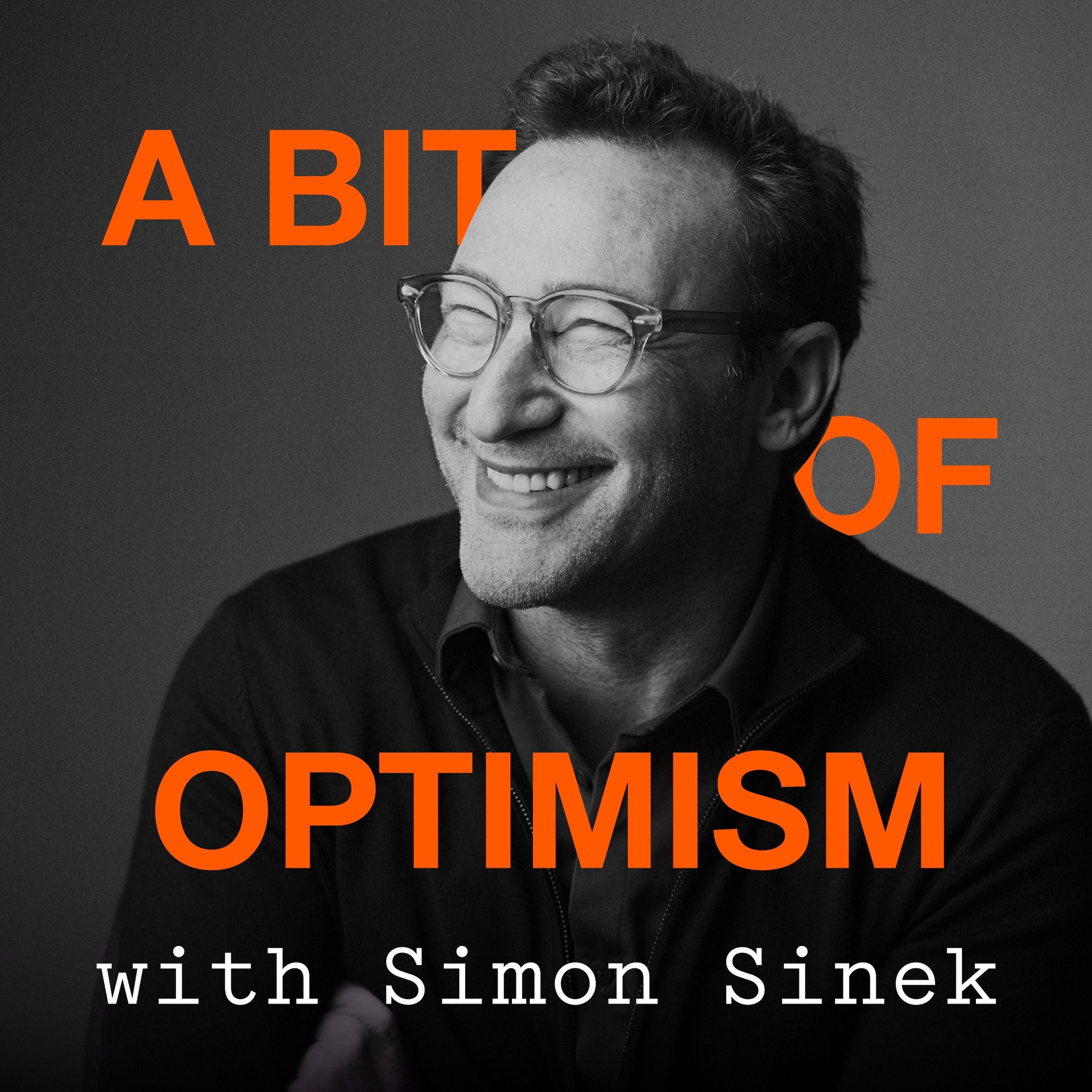
A Bit of Optimism· Folge 197
The Smartest Way To Be Stupid with comedian Matthew Broussard
Dienstag, 11. November 2025 · 1 h 05
Kapitelklicken springt direkt hin
Shownotes
If you feel stupid while learning something new, you’re doing it right. But if you keep doing the same thing over and over hoping it’ll suddenly make sense - that’s on you. The trick isn’t to push harder; it’s to find a new teacher, a new explanation, a new way in.
That’s exactly how Matthew Broussard approaches comedy - and everything else. A stand-up comedian, math nerd, and former financial analyst, Matthew is obsessed with learning and cracking the formula behind how things work. He treats every joke like an equation, testing, refining, and solving for laughter.
He’s the creator of Monday Punday, a puzzle webcomic and app, and has been featured on The Tonight Show with Jimmy Fallon, Conan and Comedy Central’s Roast Battle. He’s also made appearances on The Marvelous Mrs. Maisel and The Mindy Project. His storytelling, including his viral tales about his mother-in-law, proves that logic and vulnerability can live in the same sentence.
In this episode, we explore the overlap between comedy and leadership—the art of experimenting, iterating, and connecting through honesty. We talk about the hidden work beneath success, the difference between purpose and perfection, and why laughter might just be the purest form of optimism.
This is A Bit of Optimism.
---------------------------
This episode is brought to you by the Porsche USA Macan
---------------------------
Check out Matthew’s Youtube page for his full comedy special “Hyperbolic”: youtube.com/@mondaypunday
---------------------------
Transkriptvom Podcast bereitgestellt · Zeitmarken springen hin
My love for math and my love for comedy and science, I don't think they're separate entities. I was not an artist by training. I think an artist creates things whose value is measured subjectively. Stand-up comedy specifically sits at an odd intersection in that you could almost not qualify it as art because every decision I make is focus grouped in real time.
It's empirical. It's extremely empirical. I think that was my draw to it. And instant results. Instantly. Like math. The solution is revealed in that moment. Yes. And comedy, the solution is revealed in that moment. Hypothesis, conclusion, in a heartbeat. In a heartbeat. In a heartbeat. I was surprised when I invited a comedian on the show that we would spend so much time talking about math.
But it's to be expected. Matthew Broussard is a former financial analyst who, let's just say, got forced into stand-up comedy. I found his work on Instagram a whole bunch of years ago and am a huge fan. He's also the creator of Monday Punday, the official name of his channel that is chock full of comedy and, thank goodness, not much math.
This nerd at heart taught me an invaluable life lesson. At various times, we all feel stupid, which very often results in us actually believing we're stupid. I, for one, always thought that I was bad at math. But as Matthew explained it to me, I'm not stupid. I was just taught badly. In this episode, we talk about curiosity, finding good teachers, and mothers.
This is a bit of optimism. This episode is brought to you by Porsche and their new Macan. And when they reached out to us and asked if I would be comfortable to talk about the new Porsche Macan, well, let's just say I already owned one. That's actually my car. So the simple answer was yes. So I discovered you on the Instagram.
Because comedians pop up in my feed. Apparently the algorithm knows I like funny things. And so you were randomly thrust into my day. And I went down the Matthew Broussard rabbit hole. Like you like one and then all of a sudden. I'm in your face. An hour later, I'm like, shit, I should start work. You are exceptionally smart.
Thank you. I appreciate it. I have to imagine that somebody has said to you at some point, you're too smart to be a comedian. What are you doing with your life? My parents have definitely said that. I was, I've, yeah, my parents didn't want me to pursue comedy. I was told from a very young age that I had above average math skills specifically.
And that was a very employable skill to have. And that skill was luckily fostered quite strongly. And I was able to learn. I was also very curious. I was pretty self-motivated with it. I went to college for it. And it really wasn't until I tried an open mic that I even conceived of the notion that I could do anything else with my life besides use math to make money.
Because you talk about math principles in your comedy sometimes. So we know that you know math. You also seem to like science. and you have an exceptional grasp of other things, like I guess it's part of memory. You just, I mean, we were having coffee before when you arrived and we're talking about the oxidization of coffee in a metal container.
I mean, the fact that we're having this conversation is ridiculous, you know? Yeah. And it went beyond taste better not in metal. You know, like the point is, I'm so curious how you picked the path of greater risk? More joy, perhaps. That's a question, I guess. Yes. Thank you. Like, is this a conversation about do the thing you have aptitude for versus follow your dreams and follow your passions?
So I was, I think, more pragmatic about it than most. I had my first job out of college. I was working as a financial analyst, but not Wall Street, like easy hours, not the craziest pay nine to five i made spreadsheets for the most part um i didn't feel a sense of uh pride in what i did it was it was private wealth management my job was to make rich people richer and i didn't have a product i created so some part of me felt a little empty doing that perhaps if i had been an engineer or a coder and there was an actual product i was creating i could have taken more pride in that um but i started doing open mics and i saw just just Just for fun.
Just for fun. Well, I mean, I thought, wouldn't it be cool to do this full time? But I knew the odds were very low. And I said, let's try it. And the information was muddled at first. But there was an overall positive trend that I might have been towards the higher end of aptitude for a beginner. And I told myself, just keep noting where you stand against the ranks and how that extrapolates towards a career in this.
but hold on for dear life to the career path you've worked very hard to have because I was still young but stepping away from that could hurt and I mean I could never potentially get back to the same level that I was on track for. So you were parallel pathing it until one path revealed that this is a risk worth taking.
Yes. Well, what actually happened was comedy cost me my job in finance So I was kind of burning the candle at both ends and threw some mistakes on my part. Because comedy happens late at night if you're an open mic guy. Yes. And in California and trying to do more and more. And it was because comedy was going fairly well that I was trying to move and trying to do more than I should have been doing.
I ended up fairly losing my job. And that was the worst day of my life. I think it was October 4th, 2013. I was in California. I didn't have a place to live. I was staying with a friend. Everything I owned was in my car and had to figure out what I was going to do. And I said, well, my bank account is now my shot clock, so let's really go for it.
And honestly, not that harrowing. Things kind of worked out within like two months. I started booking college gigs. I'm always fascinated by people who – I mean, show business is a hard business. And I'm curious if the internet has made it easier or harder for you. Because, yes, exposure is easier. I mean, case in point, here we are because of the interwebs, because of social media.
But at the same time, there is so much. There are so many open mic night, you know, little, some talent too. There's some talented people. But there's, so is it better or worse or just different challenges? there's a lot to unpack there comedy is stand-up comedy is the beauty of it is there's low barrier to entry yeah the horror of it is there's low barrier to entry right meaning you are fighting through swarms of people an actor at least gets goes through acting school and has some audition process hopefully musicians have to have the aptitude to play an instrument or sing uh anyone can do it and now anyone can post it online comedy is like anyone can stand on the stage and perform Yes, and there's also no training for comedy besides getting on stage and performing.
There's no school or class you can go to. You have to be good. You have to be on stage a lot, but to be on stage a lot, you have to be good. So it's a very difficult track to get started in. The internet, though, the interesting thing with the internet was I was very fortunate in the early days of my stand-up.
I was favored by the industry, Comedy Central, Conan. I got put on a lot of shows, which was nice. it didn't translate into having a fan base. Those were the waning days of media. Not for me, at least. Some luck, some recognition, but I wasn't selling a ton of tickets off of that. Social media wasn't the way comedians were exposed back then.
And then the pandemic hit, and then that was really the end of that. Those things don't make stars anymore. I've never been on Netflix. That might be a route, but even that's becoming less of a sure thing. Things changed for me on the business end when during the pandemic, I realized Comedy Central was asleep at the wheel in terms of copyright issues.
So I went back, I took my half hour, I took my Conan set, I took every set I did on television, you pulled that footage off of YouTube, and started cutting it up into Instagram reels and TikToks. And that's when people started knowing my comedy and sharing my comedy and recognizing me. So it was an interesting lesson.
And rather than say feeling defeated by this, looking at it as an opportunity to use that footage to, you know, I believed in this thing I'd already done. And then I thought maybe if I can just get people to see this, I could start making an audience for myself. And that worked to an extent. To an extent.
Why is it, and obviously talent, that's where the wheat and the chaff separate because you get more likes, you get more forwards, the algorithm favors you, you'll do better. You'll get a following. I have a theory that I think comedians make great actors. you know you look at people who with backgrounds in comedy that became great actors you know Jim Carey um uh Robin Williams um uh Jamie Foxx these are comedians Michael Keaton Michael Keaton really was a stand-up was he really yes uh uh Tom Hanks started doing comedy not a stand-up but that was his it was so all of these especially the ones who did stand-up Michael Keaton didn't know especially ones who do stand-up, I think they have the ability to become great actors
because they get, this is my theory, because vulnerability and humiliation are something they're attuned to. Like they have been, every comedian has bombed, every comedian has been humiliated, every comedian has stood there knowing that it is going incredibly badly and you have to finish your set. And what a great actor has to tap into is the ability to be that vulnerable, that sort of person to persevere and comedians just have a good training to be good actors comment can i disagree of course it's a theory it's a great theory i theories are to be tested i think you're right and the the beauty of comedy is the humiliation is the vulnerability i think i really don't think great comedy can last very long without that without that um
typically yet vulnerability that makes other people feel less alone here's what i think separate stand-up comedy potentially and potentially why i'm not as good of an actor because of being a stand-up comedian if you were giving someone a massage and they were just completely silent would you know what you were doing you might be good at it you might not what if they were telling you that's the spot go harder there and even moaning or going ow when you hit hit uh bad spots which person do you think you would give a better massage to right the the vocal one um i like if i can be a bit long-winded here my love for uh math and my love for comedy i and and science i don't think they're separate entities i i am i was not an artist by training
uh i think an artist creates things whose value is measured subjectively um stand-up comedy specifically sits at an odd intersection in that you could almost not qualify it as art because every decision I make is focus grouped in real time. It's empirical. It's extremely empirical. I think that was my draw to it.
And instant results. Instantly. Like math. The solution is revealed in that moment. Yes. And comedy, the solution is revealed in that moment. Hypothesis, conclusion, in a heartbeat. In a heartbeat. In a heartbeat. And then you can iterate endlessly. I didn't, I'll change one word. Yep. I'll change one word and I'll try three different words in the same joke and go, okay, based on a lot of data, noisy data, but data, I know this word is the funniest.
And that's not the whole process. Obviously, you have to trust yourself more than that because there's too many variables. But that process is really wonderful to me. And I think it allows maybe the most artistically inclined people to be somewhat better at stand-up because someone tells you when you're good and bad.
The reason I struggle with acting, especially film acting, is because I don't know when I'm doing well or poorly. And when my brain hears silence, it panics and thinks it's doing something wrong. I think theater actors, the other side of that is stand-up comedians and theater actors also have had lots of time knowing when they're doing well and knowing when they're doing poorly and then it starts to become craft.
Yes, and unconscious competence, the highest level of the four. Right. So that's very neat to me. And just looking at it more of a science and empirical feedback loop. Little end narcissism, not big end narcissism, but there's a little end narcissism to that, right? Which is feed me, feed me, feed me.
Right? I think a lot, yeah. I think a constant need for validation. And is that an insecurity or is that is it a bug or a feature? Oh, both. Yeah. I think if I could properly validate myself without external sources, I don't think I would need to do stand-up comedy. I think it's a need for validation.
I think it's a whole and I think it's probably common in other entertainers and potentially even business people. Would you agree that it's something on your side? Some of them. I think the ones that are more money-driven, the ones that I've met that are very, very money-driven, for them, the amount of money that they can achieve or the stock price they can drive, whatever it is, is a direct validation that they're good, smart, etc.
Even though there may or may not be that correlation. It's the only yardstick they can find. And it's an empirical yardstick, and it's a measurable yardstick. It's a yardstick that they can hold up to somebody else and be like, see? Right? And somebody goes, I disagree. They're like, but you're wrong, because here's what it says on the spreadsheet.
So this plays to the trope that comedians are all a little broken. Yes. Yeah. I think that's a little... is maybe overstating it, overstating it, but that need for... A need for out-validation. That need for external validation. But who doesn't have that? I guess it's just, is the need for validation higher than the fear of failure?
And I guess for comedians, that's because I think a lot of people, I guess a lot of people are very afraid of stand-up, but to me, the result was so juicy that it was worth falling on my face. Right. Right. Yeah. The benefits outweigh the risks, which is why you do it. Do you get a rush out of speaking publicly?
Is that like, you must enjoy it. I think there's no avoiding the adrenaline. Standing in front of huge audiences sometimes, there's no avoiding the enjoyment of the adrenaline. And I think what separates the good ones from the mediocre ones is, for some, that adrenaline translates into fear and anxiety.
And for the good ones, we've learned to translate the adrenaline into presence and energy and focus and it's all about you. So the adrenaline is my friend. Yes. It makes me better at what I do. But I mean, of course, of course it feels good. Nobody can deny that. And of course, I like it when I get it.
The question is, do I need it? And I don't. What is the part of what you do that is the most satisfying? So I am driven. And the hard thing for my work is, and you make the difference between sort of the scientist and the artist, you know, the empirical versus the subjective, which is, though I have empirical metrics, you know, I have views of videos and I have forwards and I have, you know, book sales.
And those things are indicators to me. But the thing that drives me is impact. What means the most to me is that I'm undoing everything Jack Welch ever did. like I want to reverse everything that men broke in capitalism the why yeah yeah but like I have a I have a I'm chipping away you know and and like the people that drive me and inspire me so like the all the founding members of the American women's suffrage movement all died before the first one voted none of them none of them none of them lived to see a woman vote the reason that inspires me is they still never gave up it was never in their grasp yet they continued because their metric was momentum not result they obviously wanted the result they would have preferred it happened in their
lifetime of course we know all these things but the ability to measure momentum and have the peace of mind to know that upon my death others will take this torch and continue without me and that means my work was worth it that to me is super inspiring that's very noble that's really wonderful i think my ego is too strong that i i need to see it and get credit for it anything i'm a part of so i'm not a good person but that's lovely like it's like generational starships that's like i read a lot about like in sci-fi it's like uh it's a common thing in sci-fi a spaceship will take off towards whatever other star and the original inhabitants know they will die before it gets there but their children's children might see
the new world. Don't get me wrong there's no nobility here. I like instant gratification I like results I like all those things it's not an either or it's a both and the mindset, the infinite mindset that's required to have that has some very different standards which is I have no choice but to rely on people, need people trust people.
I have no choice I can't be a lone wolf. Then it would never work. And so, and again, not better or worse, and I think the opportunity for all of us is to understand where we're selfishly driven, totally fine, and where we're not. We interrupt this episode to have an ad with authenticity. This episode is brought to you by Porsche and their new Macan, which is my actual car.
I had it before they called. I didn't want to make some ridiculous over-the-top car commercial. So instead, we went out to a closed track to have a little fun. And just to keep me humble, they brought along race car driver Patrick Long. And if I'm really honest, it did get a little over the top. so i'm not gonna lie right so i have a porsche macan 4 an electric porsche and it has three modes it has comfort sport and off-road i thought the off-road setting was a joke it's a freaking porsche it's a race car pedigree like they put it there i don't know in case there's some wet leaves on the road and you know but we're now about to do an off-road test here where i'm going to drive up an extremely steep dirt road and so i think we'll get that we're going to come
down that that's ridiculous i'm about to eat my hat so basically the radar is um flashing because it thinks i'm going to hit another car that's how steep this this road is that i'm going up where's my handles. The fact that I'm going up a hill and I can't see anything but sky, and I'm convinced that I'm gonna go over the top here and die, but here it goes.
This is amazing. We're about six, eight stories up in the air right now. This is ridiculous. I'm just looking straight down at the ground. This is so ridiculous. It's wild. Ridiculous. So wild. That was incredible. I'm not gonna lie. I thought the whole thing was a farce, and it's not. Like you said, the grip.
I feel like there's these claws or like a spider, how it sort of just grabs whatever it can as it's coming up or down. That's super cool. You did a great job there. Oh, thank you very much. Do you still do math? Yes. Like for fun? I tutor. Oh. Which is great. At what level? uh i'm lucky there's there's there's this volunteer organization i work through uh college so i uh greedily go for kind of the classes at very much the end of my range uh because those are more fun than going back to the earlier stuff but a college a lot of like engineers um calculus calc 2 calc 3 linear algebra wow those are the fun stuff i'm trying to do something i think it's like maybe like a partial differential equations this semester and i'm like
really happen to catch up between sessions on stuff i didn't learn that well the first time so it is amazing how opposite we are you don't like math um i don't dislike it i i don't have an instinct for it like i can i can i never i'm very proud of this actually i've managed to go through all of high school and college and never took calculus so i don't know anything about calculus I don't know what it is.
I understand algebra. I understand geometry. And trigonometry, you start to lose me. Trigonometry sucks. There's some bad stops along the way. It's like a series. There's going to be episodes that are duds, but you look at it in its entirety. Calculus I know nothing about. Calculus is a function. The function is you put an X, you get a Y, right?
And you can get a curve with that, right? Yeah. Calculus is just, well, how steep is that curve? That's it. And what's the practical application of calculus? The steepness of a curve would represent oftentimes the speed. If you're looking at position, the steepness is the speed. So the application is physics and things like that?
Physics, chemistry, a lot of stuff. Finance, and then speed, and then acceleration. If you go another level deeper, it's acceleration. But if you reverse that process, if you have the graph of speed, then you take the area underneath it, and that gives you the distance. That's basically calculus in a nutshell.
I have to say that's interesting. Now, I could really – this is what I'm really passionate about. If I could restart and didn't have to do comedy and wanted to do another dream, it's that math education is – we're doing it very wrong. What good mathematicians, I believe, possess is the ability to hold big pictures in their mind and manipulate them, which is a good gift and it gives people some abilities.
but what I think is needed is just making those pictures. Those pictures don't exist. Those videos don't exist. There's concepts I learned in college that I thought I knew and I went through the process and I struggled to learn them and I applied them. And then now, 20 years later, I'll see a 10-second video on YouTube and I go, that's what that was?
That's what was happening? You never showed me that. You never showed me in three dimensions with colors and moving images what was happening. And now that I see that, everything I did is unlocked. If you just had those visuals, not everyone's going to understand math, but if you had the proper, we're teaching math with a static image drawn on a chalkboard.
It should be done by the people at Pixar. It should be dimensions of time, three dimensions of space. And yet we're limiting to zero dimensions of time, two dimensions of space. Here's what I'm taking away from this. This is, and light bulbs are going off, right and now i realize we're actually more alike which is what you and i both do is we take complex ideas and we make them that people understand it either so you have clarity or you can find the humor in the thing right because it's the kind of the same thing right which is you're you're you're pointing out the absurdities of life the absurdities of your mom you know and and you it's presented in a way like what makes a great comedian from an okay comedian is that you're presenting in a way
that there's that i can relate to the story which is why i find it funny it's not just the story right it's not just the funny thing that happened the telling of it matters and and math and and and adjacent subjects have always been for those who have the math mind quote unquote it never occurred to me that it was just being taught badly that if you taught me math the way you tell jokes or the way i explain an idea because because i people people think that i'm joking when i say this but i think of myself as an idiot and i i mean that 100 i mean there is not a an ironic nothing there's nothing ironic about that which is uh as a kid with adhd in in high school i struggle to read, I struggle to study, I couldn't learn by rote.
And so I still got to pass high school. So you have two options, fail or figure it out. So what I learned to do was be really good at asking questions, get really good at listening. I had to attend class. I couldn't cut school because if I cut... And when I was in college, I had to choose professors who were good at explaining because I could never rely on the book to catch up.
And that skill of learning to survive and turn my ADHD into an advantage rather than a deficit gave me this capacity in the future, which is when I hear complex things that people are trying to explain to me, I have no fear. I can't have any fear. It's a survival thing. It's not a courage thing. I have no fear to say, I don't understand.
Can you explain it differently? And then they'll try again. I'll say, is this what you're trying to say? And I'll say it in simple terms that I can understand. And I go backwards and forwards and backwards and forwards and backwards and forwards until I'd be like, and I'm drawing little pictures and using metaphors and analogies simply because my little brain is trying to understand this complex thing that you're trying to explain to me.
And eventually I understand it because I've boiled it down to something very, very simple. So simple that not only do I understand it, but I can then tell somebody else and then they go, got it. And I get all the credit, which is not fair for being the, but I was just trying to understand the complex thing in the first place.
And where it fails is when the person is trying to explain it to me and they can't, then I can't understand it because I don't have that analytical kind of mind that just understands sort of math and equations. Don't understand it quickly. This is, I think, the great myth of people who – No, no, people do.
People can do math in their heads very easily. No, no. This was said by someone else. I think it was said by Matt Parker of Stand Up Maths. But he said that anyone who studies math is constantly bombarded by frustration, but you embrace the frustration. You know that you're going to feel pain and you're going to feel anger.
And then in one moment, all of those negative feelings are going to snap to positive feelings. And that's the moment of understanding. And what people who pursue any kind of field of study know is that you have to look it in the face and not back down. That's the moment where – Where can you adjust? So like when I see – when I look at financial information like for the company, right?
I always ask the finance person, show me a chart and a graph. Like show me – I want to see the visual. I want to see the trend. I want to see the profit and loss done in pretty pictures because then I can understand it. When you just show me huge spreadsheets of number, I just gloss over. Sure. I struggle.
But some people, like they look at those huge spreadsheets and they're like, ah, you're one of those people. No. I mean, well, the analog for me would be I'm constantly trying to learn new things in math. and the first read will always feel make i'll feel like an idiot but i know like you should feel stupid yeah feeling stupid is part of it and admit that you're stupid admit you don't know and i will i will look at one thing read ago i don't like that and i'll look up seven different ways of explaining it until the seventh one like this time i get it and i'll also have to read it over and over again i i i don't think that that it's it's necessarily some people just inherently get it they're just willing to admit they're stupid and like you're saying i love it keep simplifying
it until there's one aspect of it you get and then what's the next thing you can add to that what you just said was absolute genius i no no no too much but no no no what you just said was absolute genius which is a perfect like which is what we do when we feel stupid is we watch or read the same thing over and over and over again to try to understand it each time blaming ourselves for being stupid what you're saying is and this is the genius show me seven different ways to explain it until I understand it.
Which is, whether it's a leadership concept or a financial concept or a scientific concept or any kind of concept that you're struggling with, it's okay to feel stupid. It's okay to maybe reread it once or twice, but then go seek out, and this is where the internet is the greatest gift. It's wonderful.
Which is you can go down a YouTube rabbit hole and you can hit play and be like, and you can hit play until somebody, it makes sense to you and then you'll understand this difficult concept. And by feeling a little less stupid in that moment from that explanation, A, you're learning how you learn. But B, now you have the grit because you're not blaming...
The patience and the humility. Because here's what we're doing, right? I feel stupid. It becomes a story to ourselves. I am stupid. And then you just... I don't do math. I don't understand math. I'm no good at math. What the story should be is I have yet to find somebody who can explain math in a way to me that I can understand it.
Yes. That is the correct mindset. Plus some patience. Plus rereading it. I, like, people thought that we were going to be funny. We have Matthew Broussard and we're going to talk about learning. But no, but this is, I never want anybody to feel dumb again. This is going to be my mantra. I'm going to say.
Or we're all dumb. We all feel dumb all the time. But the mantra is, don't blame yourself. Blame the way you're being taught. Yes. And have patience with those teaching. And you're talking about communication. Learning takes someone who's patient enough to learn and someone who's patient enough to teach.
And again, I'm very familiar with concepts. Can you tell me a different way? Can you tell me a different way? Can you tell me a different way? Because what might unlock it for me might not for another person. I've been doing something lately that's been something I didn't do in college which but I'm sorry the internet comment I think about that so often of when I was in college and I was trying to understand a concept and one of my harder classes singular value decomposition let's say that one because it sounds smart I would the only thing I could do was go to Wikipedia and read the page for it you know who wrote that page my professor my professors in college wrote all the Wikipedia pages for the concepts we were learning because it wasn't widely shared knowledge
at that point. Now if I wanted to understand that, there's seven YouTube videos I could watch. And perhaps the fifth one is when I really get it because they did a good job with the visuals. I've also been reading math textbooks just to learn things I've always wanted to learn at a snail's pace. But something I didn't realize was I thought I was just not good at reading math textbooks because I'll read one page, think I get it, and the second page my brain goes to mush.
Like the endurance over two pages, it's like when you're bad at swimming and you try to swim, you get across the pool you're like that was easy and then you can't make it to the next wall and then i talked to someone who was a math phd they go that's how it is one page a day is a great rate it's just that hard wow and and the people who accomplish it forget how hard it was or want you to think they're smart and it's that hard for everyone i feel that way about comedy every every line i have that makes the crowd laugh feels like a miracle and it's like i think how rarely i write two jokes in the same day yeah like every every punchline you hear is one day of my life and that was the accomplishment for that day even if it's just like three words they get like a
chuckle it's such a it's what's what's who's famous line if you saw the work put into it it would not be impressive at all yeah yeah i i think for me maybe for other stand-ups maybe not it's just not an easy process it's laborious but that's what it takes to make something that's uh engaging and i I imagine you feel the same way about your work.
It's just not easy. My process is a little different. I'm curious. Are you good at crowd work? No. Okay. No, I need to learn how to listen better. I think that's the problem. Okay. Because the people who are good at crowd work, when they're good at it, it's a thing to behold. It's cool. It's a thing to behold.
They're patient. That's like a real zen state. You have to be calm. You have to make the crowd feel like they're okay. You have to take what they're saying. know when to ask another question or know when you have enough stuff to put together. Yeah. And when to have emotional responses, when to try to be clever, when to just try to repeat back what's happening.
I would love to be better at it. One thing that I love about your work is, first of all, super vulnerable. Like you share things. I don't know if they're jokes or if they're true, because I know there's some truth. But I also know that, you know, when you get on a good idea, you can play with it. But I just watched a bit about your inability to please your wife.
That is 100% true. Yeah, that is. I mean, like, does she want that out there? I understand that you don't mind. I understand that you don't mind having it out there. There's two players in this game. She was a very good sport about that. For a while, I was like, can we talk about this? She was like, oh, that's a lot.
And then I think at one point she was just like, you know what? It's a good thing to share with people who feel the same way, both men and women who struggle with that. And it might make people feel more comfortable about themselves, more comfortable in their relationships. So it's a good thing to share with people.
I love vulnerability. I love, to me, it's my favorite part about comedy is when you can share something that you're embarrassed by. And now instead of being embarrassed by it, you feel a sense of community with other people who feel that. Or even if that doesn't work, then you've made people who don't have that vulnerability feel better about themselves for not having it.
Right, right. So everyone wins. but it is it is the quintessential court gesture right which is I'm going to say the thing that everybody's thinking but I'm going to make it okay I'm going to make it okay make people feel less alone I have to believe that a lot of your bits started conversations that were for good and it's only because your work I'm astonished how often you are so vulnerable whether it's about yourself your upbringing even talking about you know racism and hot topics you'll go there and and I just find it very impressive.
I've so enjoyed and I kind of remember how long ago it was when I first discovered your work. But I your work is getting, for whatever it's worth, it's getting better and better and better. Thank you. I really appreciate that. Thank you. That's very kind. Were you always that kid that didn't mind being embarrassed?
That didn't mind being vulnerable? So how did you learn it? Kind of through stand-up. Early on in stand-up I was just trying, when I started I wanted to be brash and offensive because I thought that was cool andrew dice clay style yeah and and i i kind of realized later that was more that was not me being tough and edgy that was me actually being weak and insecure needing to put others down to to feel some sense of superiority um did it get laughs sometimes yeah sometimes in front of other people who liked who liked that um i of all people james comey's memoir uh was was uh it really shaped me there was one chapter uh i i can't imagine a less funny person than former fbi director james comey but he had uh i think it was it goes to speak of how not funny people can
sometimes have the best observations about comedy um he had a whole chapter talking about the sense of humor of the three presidents he worked under right which is bush uh bush jr obama and trump And he said all three were notably funny guys, very funny people. Bush Jr. and Trump would often make laughter at the expense of others, which did not equate to good leadership, versus Obama would make jokes at the expense of himself, which would uplift others and bring out the best in them.
So, sure. Maybe. But anyway, moving on. Ignoring the politics of that. Ignoring the politics of the comment. I get it. The idea that, and that was also for me a great thing of, a learning experience in that if there's going to be a victim to the joke, why not me? I'm the consenting party. Right. It's fun for everyone.
It's a victimless crime. Yeah. And not just victimless, it helps other people. I think I somewhat possess a bit of status that a comedian wouldn't typically possess. You take a picture of a comedian, you often think of like a dirtbag, someone down and out. Yeah. Um, uh, I've had, I think to see me take a tumble is, is, is, is maybe a little more satisfying.
Right. Cause I started falling from a little higher. Yeah. Yeah. So do you remember the first joke, the risk, the first risk you took at self-deprecation, this new style? Do you remember it? Uh, yeah, it was, uh, it was, uh, uh, I was doing jokes about looking like an eighties villain and it was getting a laugh.
And then people came up to me after the show and you get a lot of great feedback from just drunk people. Not just empirical feedback during the show, but drunk people will come up and just really say blunt things and some guy was just like yeah you look like a douchebag and i didn't like you and then you started talking about looking like a villain i'm like oh this guy's not bad and i'm like what if we just what if we instead of trying to do that with tricks just say exactly what he's saying and i think i was at sacred heart college and i was doing a show and i just said i look like a douchebag i'm guessing you already didn't like me before i started talking and that was like oh i'm cutting straight to the chase there right i'm acknowledging what they think of me before they've
even put it together themselves right and now now they're more malleable because i've kind of maybe subverted their expectations and shown awareness that they're like you take the reins actually if you if you're on top of things you maybe you know what you're doing we'll let you you've taken yourself down a peg in a way that we find satisfying um yeah keep going huh and now it's and and does your mom know the way you talk about her yes uh she's uh fortunately very uh she doesn't mind it she sounds like an absolute caricature i've i've barely painted the picture with my stand-up of how how well she is i've included the parts that are uh digestible uh she likes she doesn't mind anything the basic part was the i
don't know if you saw the airport story oh i saw the airport story that's i i can't stress how true that story is do you want to tell the airport story for those who haven't seen it on the youtube i'll give the introduction i was i was dropping her off at the airport and uh had to uh shortly thereafter come back and pick her up uh she went to check in uh they were giving her trouble over paperwork for bringing a dog in the plane and she forgot the i swear to god she forgot the word manager and said let me speak to your master and that was that was where the story starts yeah um she signed off on that i said are you can i talk about that yeah it's funny it is funny yeah i'm like you're you sure about that she was like yeah the one thing she doesn't like is the birthday
card which i recommend uh i can't do it here but yeah a birthday card she sent to my my wife um i i said mom this this note's really funny i'm gonna read it on stage she goes sure no one's gonna laugh and then she saw me do it live and people laugh at almost every sentence yeah as i read it verbatim yeah and she goes why are they laughing i don't like this what are they laughing at i had to explain to her i'm like they're not laughing at you they're laughing at the vulnerability at you saying things we all think yeah but keep to ourselves yeah uh what's next what what's the ambition the i'm not ambitious do you have vision or do you just keep doing the thing you love and it keeps going in the right direction i'm not good about all the things you
profess which i don't have the the infinite game i just have the next special and wanting to just kind of branch out a little bit at a time perhaps i'd be farther along if i had a bigger vision but what do you mean farther along like like what does that even be on tv and be on a tv show and is that a thing but is that i mean it's like but you don't want to act i would love i love acting i just find it challenging okay okay i love acting okay i would my i mean my dream was to do stand up and put out specials okay and i've really accomplished most of that i could there's room but if i if i if me when i started saw where i am now they'd be like you're doing it uh i'd love to be on a sitcom that's always been my dream okay because those those those perhaps shaped my life
more than stand-up did and i shouldn't admit that but like 30 rock parks and rec community and then cartoons futurama adventure time those those things hold such real estate in my heart to be involved with any of those would be the other like the other box to check and obviously i want to keep making specials that would be really cool to keep putting out long form stand-up content is is is stand-up comedy um could you ever walk away from it i don't think so i really like it i really like the feedback from people and getting to go up there and say things and feeling less alone i think our phones make us feel very very isolated it's the synthetic connection, these empty calories of human interaction that make us feel more depleted
afterwards, the human to human part of it, I'd feel starved. It's kind of a last frontier, right? I mean, where you can interact with each other. And when I say each other, I mean, it's up and down, you know, it's comedian to audience, but it's also audience to audience. We laugh next to each other. We look at each other.
We elbow each other. we point you know it's different than theater theater is a very lonely experience because you sit by yourself nobody can see you because you can't see anybody you can only see the back of people's heads the script is set the script is set and so it's very different than theater and to your point which is where we come for entertainment and we do put our phones away and we have a couple drinks and we're forced to have a couple drinks and forced to order some food because that's the business model and it is I don't think comedy is going away and I don't think live comedy is going away I don't think live anything is going away we just don't have the substitute for we think that because we can look at something and hear something
that it's the same of just even being here in person versus Zoom it's just more dimensions it is more dimensions what's next for you? how do you look at growth? and how do you balance growth with already feeling like you've done enough? Okay, there's multiple questions there. I think of my work like an iceberg, right?
So when I was starting and I was just an idiot with an idea, like literally accomplished nothing, no books, no TED Talks, no nothing. Nobody knew who I was. Nobody knew my ideas. All I had was a theory of what the world could be like and what business could be like, which is basically an iceberg completely submerged.
I'm the only one that can see it. And like the ability to explain it to a couple of people. So they go, oh yeah. It's kind of like a tiny bit of iceberg sticking up. And so when people pay me compliments, what they're looking is what they can see above the ocean. When I think about what work I have to do, I still can only see what's beneath the ocean.
And so no matter what I've done or accomplished, people will say nice things to me. Look at all the things you've done and look. and I'm sort of always a little bit sort of like taken aback because I don't think about it because what I think is like oh I still have so much to do you know and it's kind of like the way you talked about feeling stupid with the math which is I like learning curves I like difficult problems I like problems I struggle to wrap my head around I like finding different angles to it and to me what the iceberg represents is I still haven't cracked I haven't cracked it yet I've just sort of made some steps towards it.
But for me, it's all about what still lies beneath. And like I said, undoing everything Jack Welch did, that's a real fricking, that's a job, right? So that's how I think about career and sort of accomplishment. But I also have a very, very different way of going about sort of my whole life. Every performance review I ever had and every job I ever had, every single one of them said, you're unfocused.
and I believed it because everybody kept telling me, even growing up, studying, you're so unfocused. And my work is semi-autobiographical. It's me trying to solve my own problems. And so the discovery of things like the why and the discovery of things like the infinite game helped me understand that I am actually one of the most focused people I know.
I'm just focused on a different horizon than most people. And so the way I would describe it is most people are obsessed with the route. I'm obsessed with the destination. For example, you walk outside your front door and you see your neighbor packing their car. And you say to your neighbor, where are you going?
They go, vacation. And you go, cool, where are you going? They said, vacation. I'm like, no, no, no, no. Where are you going? I told you, vacation. And you're like, fine. How are you going to get to this vacation? And they say, well, I'm going to take 95. I'm going to drive 150 miles a day until I get there.
And what they're telling you is the route. And that's what most people have. I'm going to get this kind of job. I'm going to make this amount of money. This is my career path. They have fixed routes, but not 100% clarity of where they're going. Right? And so the route is everything. I have been very different, which is, let's say we're in California now.
Where are you going? New York. How are you going to get there? Don't know. And so it's very opportunistic. And so when a lot of people, for example, they're offered a job that pays more money, they're like, I'll take that one. It pays more money. And I go, well, will that one help me get to New York?
No. Well, then I'm going to turn that one down. And so I realized where so many people are focused on the route, I'm completely agnostic. And if you're focused on the route, that means you're agnostic on the destination. And I know too many people who spend a whole life climbing a ladder only to get to the end to discover they climbed the wrong ladder.
This ties back to calculus. Say more. Okay. Multivariable calculus and then the classical optimization. I think about this a lot. You're trying to find the highest point. That's what optimization is. Yeah. You can walk north or west, right? You're just trying to pick based on two directions. Where's the highest point?
Let's say you're walking on a hilly field at night and it's foggy. So you can't see when you're at the top. You're going to know when you're at the top because your feet are going to be flat on the ground. Maybe you're at the bottom, but you're going to, right? So what is the search algorithm? The search algorithm is you're going to walk around.
And when it feels steep, you can feel your ankles bend a lot. You walk in the direction of the steepness. The more steep it is, the longer of a step you take, right? If it starts to flatten out, then you're near the top. That is what we do mathematically. The steepness, again, that's the slope and calculus.
That is actually the math of it. But the problem is, what if there's another hill next to you that's higher? You need to wander off the hill to potentially find the highest point. You need to be able to go off that path and potentially explore other ones. So are you finding a local optimum or a global optimum?
I think a lot about that when we're, and what we're optimizing for, what we're trying to maximize. Sometimes we look at, we were talking earlier about the empirical feedback. if we say, oh, these results mean I'm doing well. I'm getting a lot of views on my Instagram reels. That's an indicator that I'm doing well.
What if you get it wrong? And a lot of people do. What if I'm doing well because I'm, what if you flip it? Those views are the measure. And now you do everything you can to optimize that. You're going to do a lot of things that are. Clickbaity things. Bad things. Just not in the intention of what you wanted to create originally.
And you're optimizing. You're seeing higher and higher numbers and you think that means you're doing better, but you have to kind of like get the, like you're saying, the destination in mind. Right. Not the path. So you are more visionary than you give yourself credit because you won't do anything just for the view.
I try to keep, I try to, I will obviously be corrupted by all of these things because I will look at the data, but I will try to reorient back towards what are you trying to make. Right. And that's just what I deem a quality product based on, I hope the crowd laughs and I, as long as I believe in it, that's what I'd like to keep making.
This is an interesting question, right? Which is for, and I think a comedian is a metaphor for a lot of people, right? Which is, I want to do something and I want to be rewarded very quickly to know that I'm good. And social media can hijack and corrupt that system, which we know, right? Because of measurement.
Right. It's the same feedback loop and it's instantaneous. You get a like, you get a forward, whatever it is, you get a view, right? It's the same thing as a laugh. It's instantaneous. and the comedian who's obsessed with the laugh to the point of hurting themselves or hurting others versus having a point of view or some morality.
So what system do you have to not be hijacked by the click, the like, the view? The laughs per minute even, you're right. Because even your act can be, even in the room be corrupted by just trying to make those people laugh as hard as you can. and you want to do better than the comic before you, and you're willing to do things that aren't your own standards.
So what checks and balances are there to ensure that, yes, you're getting more laughs per minute, but there is a framework within which you're willing to operate, and you're not willing to go outside, even if you could get a bigger laugh? Esoterically, my own moral compass, my own standards, right? That's harder to measure, though.
More concretely, the respect of my peers, and making other comics laugh. The respect of the peers that you respect. Yes. Medians had a moment where someone goes, hey, great joke. You're like, thanks. And you look at who says it. You're like, I should cut that joke. So it's the respect of the peers you respect.
Uh-huh. The people you look up to liking what you do. You can't make that your whole thing. Right. Because that can also be an unstable solution to this equation. Right. because now you're serving their moral compass, their needs, their tastes, not yourself. At the expense of the crowd and at the expense of your career.
Which is the equivalent of I'm going to do what my boss likes. I mean, again, this all translates to math for me. You have three different outputs, right? Respect of your peers, laughs per minute, and let's say career success. And you need to put weighted coefficients in front of each one of them and then maximize that balanced equation.
And then how do you factor in the hard to measure your own moral compass? the one that you refer to as the esoteric one that's harder but because that can also you can also is that just gut is that just feeling is that gut and feeling is that your wife coming going like revisit your earlier self and what your what your old standards were but also don't be so precious you don't i don't owe things to my 25 year old self he didn't have better taste than i but see this is now this is where math fails me sure which is which is we both acknowledge that the esoteric, the intangible, the ethereal thing matters, but it's harder to measure.
Nobody else can see it but you. How do you ensure that that thing has the correct weighting, which should be quite a high rating? Weighting, I mean, it should have quite a high weighting. Because we see it in the world, which is when stock price and profit and revenue are the only metric we see ethical fading happening all over the place because the waiting is like i believe in objectivity i i don't know i don't know i will steal one page from a great comedian named mike lawrence who said something to the effect of in comedy you're as successful as the biggest thing you say no to and saying no to things is really me starting to really value the moments i say i don't want to do that because I don't like that.
That's not what I represent. And that's a corruption of what I'm trying to do. And I'm going to say no to maybe it's a branded deal or maybe it's a comedy festival somewhere. I guess saying no to things also that isn't answering your question, but like saying no oftentimes for, for principled reasons is a really good exercise.
but do you have an answer how i i'm also curious because i feel like we're we're losing our souls a lot of us through that that ethical fade can i do an experiment please i may be able this may or may not work love the scientific method um uh tell me a festival a joke uh uh anything that you were involved in in your comedy career that you absolutely loved that if everything you ever did from this point on was like that thing you'd be the happiest person alive uh my gut instinct is when i did conan for the first time i was very proud of the material i chose and i was going to be happy either way because i did it and then it had a pretty big positive response which was just icing on the cake so having both those things go my way do um doing the set i wanted to do with no
restrictions without having to to to dumb it down or water it down in any way and then also getting rewarded for that that was that was one of my happiest moments in comedy if that answers it but you've done things before that you were proud of you've done things where you had control over the set you've done things that had a bump you know um maybe even a bigger bump than conan what was it about that experience that stands out from all the ones that are very similar with very similar metrics that makes you want to talk about it now it was early um it wasn't my first but it was early it was a show where a lot of comics i really respected uh were booked for so when i saw who did it i'm like those are people i want to be like those are people who are pushing comedy to
new places um i also got to do a set that probably would have been very much rejected by any other late night booker and i was surprised that conan allowed i said i said vulva eight times in a row and that was neat to me that the joke had information that people learn people learn things that they didn't know from it while while i think getting decently high laps per minute probably the to really answer your question because it was the first time i did that and it paid off and I feel like I've tried to do that every time since and then I think maybe if there's another time my set uh from 2021 I was wearing a denim shirt with floral embroidering on the back that's the only way I can distinguish the set but I also did material that was bold for the time in
terms of politically being more honest at a time where that could potentially get me in trouble and saying how I really felt in a way that I think other people agree with but were afraid to say and again I put it out there knowing it might not make a splash at all but it also might really connect and I felt it connecting as a result.
Tell me an early specific happy childhood memory something I can relive with you not like we went to my grandparents every weekend but something specific that I can relive with you. I went a 21-23 in my 5k on a road race I've been running a lot and the road race happened to be right in my neighborhood so I knew the path I'd run it most days and i went to best time on a on a course that i was very familiar with so it's middle school like of all the things you did that you could have told me what was it about this run that i worked really hard for it and i got a result i wanted and also might have might have just dipped under one of my rivals prs or something like that so there's a competitive You are competitive.
Yes. Any other outside of comedy, anything stand out? From my childhood? No, childhood or even your financial analyst career. A happy, happy moment. Just something you loved being a part of, something you absolutely loved being a part of. I draw and I sculpt a little bit, but I rarely step out of the boundaries of those two media.
but I really liked I made the sword from Adventure Time I really like Adventure Time and I looked up the tutorial and I got poster board and made like a really big sword and took days to make and lots of cutting and painting and stenciling and when it came out it was the biggest piece of art I've ever made it was large and that was really fun and just a weird thing to do and no one pushing me to do it and no real reason to do it and I did it.
Okay. So here's a thread. What's interesting in all, all three of those things required a lot of work, right? And it required a lot of self-motivation and there was no particular pressure on you for any of those things other than yourself, right? It's a hundred percent driven by you and the hard work that you're going to do is going to make that set good or bad.
And in each one of those cases, you're willing to do the work to the point where you find grace, great satisfaction in that you did it your way and you did it for yourself. You said it was my personal best for this run that it, you know, this, uh, it was a, it was a, uh, it was, there was familiarity.
There was, there was a learning curve that got you there. And in all of those, there was, there was absolutely accomplishment, but you, you're not like, it seems to me that you're not trying to accomplish just for the sake of accomplishment. You're not driven simply to win or be the best or outdo others.
It's you like, I think the reason you like a metric, it's a validation not of you or how good you are or how smart you are how funny you are it's a validation of the work was worth it right and i think even the way you talk to be a talk to me about calculus which is and the way we the way you talk about find somebody who explains it to you in a way that you can understand find a better teacher you're not dumb you just need to find a better teacher which is which is do it's not just about grit because i think the way a lot of people talk about hard work.
It's just about grind. You're not talking about grinding. You're talking about being smart the way you learn. And if you accomplish something, all of that effort of learning is worth it. And that to me is the interesting dichotomy, which is, yes, you like the validation and yes, you like the laughs permitting.
Yes, all of that. But all of that is actually a recognition of the hard work that you've done. You even talked about the quotes that you've made here, which is if you knew how hard it was to get here, you know, if you knew the effort that it took to get here, you'd be very unimpressed by whatever the quote was.
And even the way you talk to me about, like, you love tutoring because you want to teach people in a way that helps them access something and when they get the A on the exam or the B or whatever it is they're striving for. When they understand the concept right there in front of me, that's the best moment.
When they go, oh, that's it. It's the epiphany, and it's whatever the spark is that goes that was worth it the ethereal part for you seems to be in the ballpark of you will know that you've done good work for yourself when whatever the world's metrics are look at you and go that's good, well done look at your time and that will inspire you to want to keep learning keep pushing, keep doing more because you'll discover that it's not the it's not the result that becomes intoxicating it's earning the result it's doing the hard work to get the result that becomes intoxicating yes which is the difference between what you're doing and winning lotteries yeah i feel very considerate that was very astute i that that felt very good to
hear you say all that thank you can i note a way in which i think we're actually kind of different and i want to see if we could reconcile this yeah and then i have to conclude but yes yes okay i was watching your thing about bios and people putting their biographies yeah and you said i want to be how did you phrase it it's not how i want to be recognized yes you want to be recognized for yourself and not for your work the thing that i said was too many people uh confuse their identity with their job or their accomplishments and you can easily see it when you read someone's bio when it says CEO of or Oscar winning actor, blah, blah, blah.
And they're telling you a position they hold or an accomplishment they had 20 years ago. The problem is those people suffer from identity crises. Like without the job, without the responsibility, they literally have an identity crisis. And so I'm fine with accomplishment and I'm fine with ranks and position, but that's not your identity.
And so when I write my bios, I put who I am, then what I've done, optimist and author of. So I want to know, because no matter what I don't do, I'll always be that. That's wonderful. What advice do you give people who are told don't give up on your day job? Don't, don't hold onto it as long as you can, because that's going to be what makes you interesting.
You think being a musician or an actor is what makes you interesting. No, the part of you people want to hear about is those salad days and when you struggled. So I would say you are you are building who you are as a person through that struggle and and money is a real thing and you need to have a way to pay your bills because if you become financially desperate your art will be compromised instantly yeah any life hacks that you have that help you be more efficient more productive personally professionally anything that you any tricks tricks that you've learned along the way that are now yes um biggest one for me is uh I subscribe to Gabor Mate's kind of musings about ADHD, that it's a lack of ability to validate yourself,
not a lack of focus. So one thing that really helps me every day is when I sit down, I have a to-do list and I write a list of all the things I'm doing well. And they don't just have to be work, anything. Am I recycling? Am I exercising? Am I stretching every day? Am I creative? What all of it, no back, nothing backhanded.
Well, at least I'm not doing a bad, No, no, no. I'm doing well at you're doing great is the name of the document. You're doing great is the name of the document. Write all those things out. Then start writing my to-do list. And not only will you enter that task with momentum of feeling good about yourself, the thing you're always driving towards is that validation.
You'll already have that. And you work better when you like yourself. Everyone thinks they work better when they hate themselves. No, when you like yourselves, when it feels fun, and you feel good about yourself, you do your best work. you also then start to get that Pavlovian rush that when I sit to open my computer I'm already feeling good because I know it's coming and then I don't dread starting my day I look forward to it that's been a huge hack for me genius thank you I've stolen it from many people I'm gonna start that one Matthew I could talk to you forever what an absolute joy to meet you this is great it was super fun and it like I said kind of a personal throw because I've gotten to know you so well from your videos
it's really, really fun to sit across from you. I know your voice so well. Yeah. Thank you so much for coming in. Such a joy. So much fun. A Bit of Optimism is a production of The Optimism Company. Lovingly produced by our team, Lindsay Garbenius, Phoebe Bradford, and Devin Johnson. Subscribe wherever you enjoy listening to podcasts.
And if you want even more cool stuff, visit simonsenic.com. Thanks for listening. Take care of yourself. Take care of each other.
