

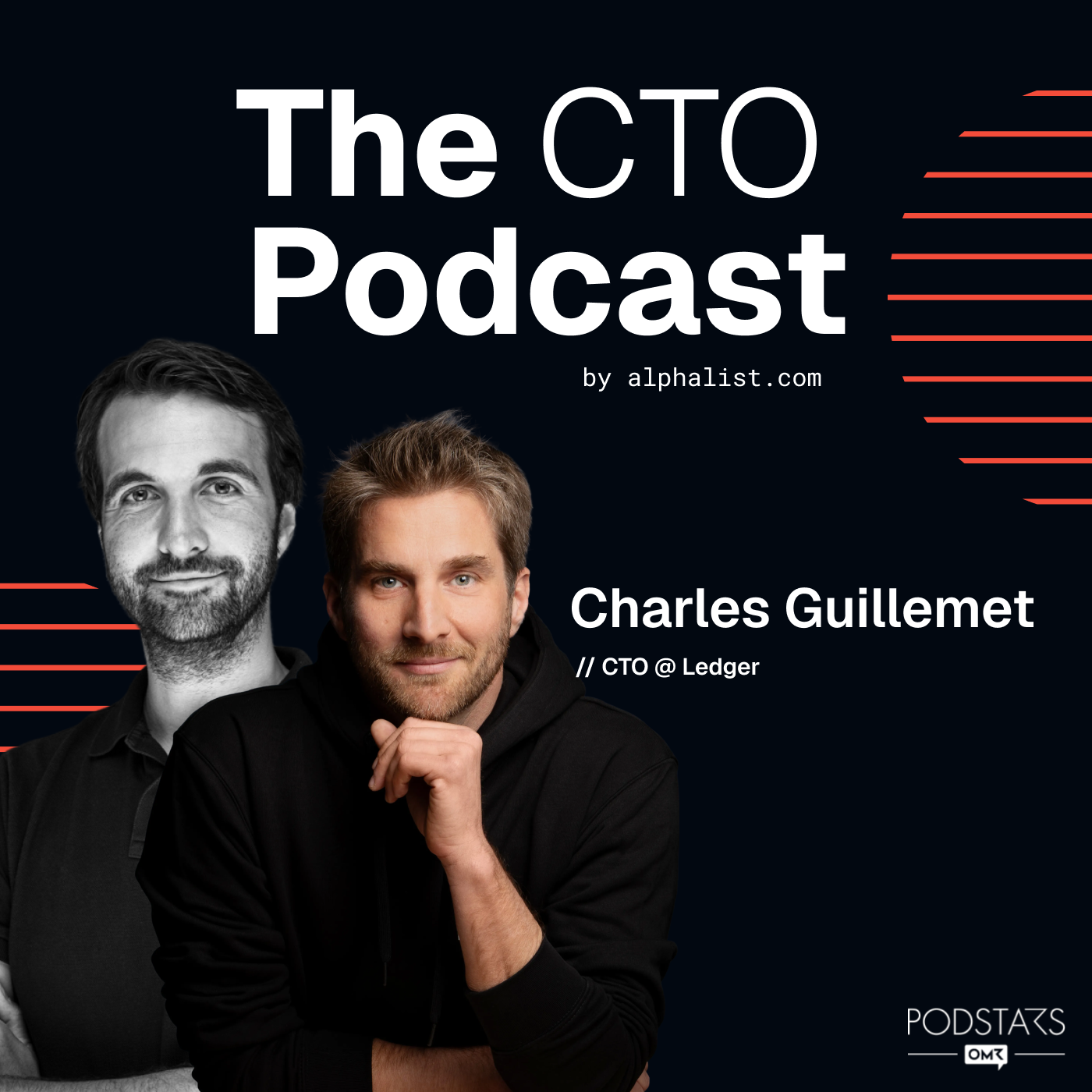
alphalist.CTO Podcast - For CTOs and Technical Leaders· Folge 146
#146 AI Found What Nine Years of Security Research Missed with Charles Guillemet // CTO @ Ledger
Donnerstag, 17. September 2026 · 54 min
Kapitelklicken springt direkt hin
Shownotes
Ledger's CTO on vulnerability discovery, security-by-design, key management and AI-native engineering.
Charles Guillemet started hacking at 12. He sold his piano to buy his first computer. Nine years ago, he built Ledger's offensive security team from scratch; today, he's CTO of a company protecting a fifth of the world's crypto, and he just watched AI find vulnerabilities his team spent almost a decade not finding.
Topics covered:
• The economics of security — and why AI is breaking them
• Ledger's three layers of security, and what The Donjon actually does
• Turning a security problem into a key management problem
• Charles's recommendation for restructuring engineering teams around AI and "harness engineering"
• Zero trust, bus factor, and protecting a company's "crown jewels"
• Using AI to build a threat model and cut noise from production signals
• Why Charles believes the CISO function should stay independent
Timestamps:
[] Intro & guest welcome
[] Charles's nerd origin story — hacking at 12
[] From software hacking into hardware security
[] Ledger's security org today: hardware vs. software
[] The three layers of security at Ledger — and The Donjon
[] The AI vulnerability that broke 9 years of research
[] Security as economic asymmetry — and why AI is collapsing it
[] Why blockchain attackers already spend big to break in
[] Is prompting AI to "find vulnerabilities" enough?
[] Security-by-design and turning security into key management
[] Does AI kill the CTO/developer job — or redefine it?
[] Rebuilding an SDLC: Charles's small-team, harness-engineering recommendation
[] Building a threat model with AI
[] Zero trust, bus factor, protecting the crown jewels
[] Using AI to cut through noisy production security signals
[] "Average is better than nothing" — the Wikipedia analogy
[] Why Charles thinks the CISO function should stay independent
[] The Easter egg question — advice to his 2017 self
What you'll learn:
• Why the old economics of security are breaking down — and what that means for your own threat model
• A concrete way to turn any security problem into a (much easier) key-management problem
• Charles's recommendation for restructuring engineering teams around small, AI-native pods and "harness engineering"
• What zero trust looks like in practice when developers bring their own devices
• How to use AI to build a threat model and cut through noisy production security signals
Quotes:
⭐ [] "The cost of finding vulnerabilities is trending towards zero."
⭐ [] "If they think they will continue writing code, yes, they will lose their job."
⭐ [] "If you just prompt like crazy — implement this database, implement this feature — and at the end just prompt, 'please find vulnerabilities,' it's something, but it won't solve the security problem."
[] "Security is a matter of creating an imbalance, an asymmetry between attacks and defense."
[] "More and more attackers go through the developer door, trying to compromise the endpoint of one developer and then leverage his access to production."
[] "Some people say AI is only producing average results, but sometimes average is better than nothing."
[] "If a human has full access to a system he doesn't need, that also means the malware running on his computer has the same access."
(All quotes lightly cleaned of stutters/filler — verify against final audio.)
Links:
• Ledger: ledger.com
• Ledger Donjon (security research team): donjon.ledger.com
• Meet Cerberus — Ledger Donjon's AI security harness: ledger.com/blog-cerberus-donjon-ai-harness
• Charles Guillemet on LinkedIn: fr.linkedin.com/in/charles-guillemet
Want to keep talking about this with other CTOs? Join over 600 tech leaders in our Slack community — go to alphalist.com to apply.
