

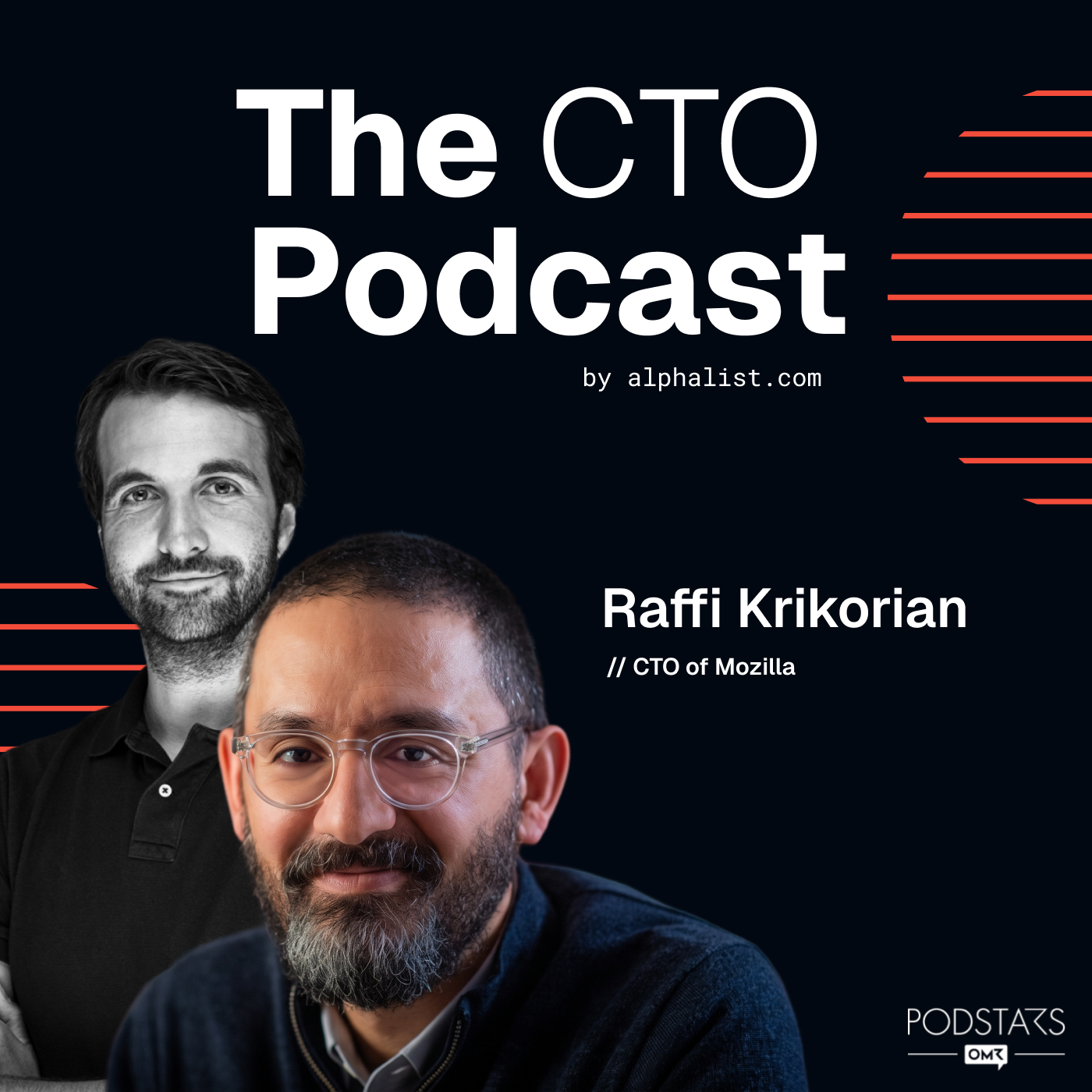
alphalist.CTO Podcast - For CTOs and Technical Leaders· Folge 148
#148 Git Is the Wrong Tool Now: Rewriting the Social Contract of Agentic Teams with Raffi Krikorian // CTO @ Mozilla
Donnerstag, 15. Oktober 2026 · 1 h 09
Kapitelklicken springt direkt hin
Shownotes
Raffi Krikorian ran 600 engineers at Twitter and 1,000 at Uber. Now he thinks solo agentic coding has broken how teams build software, and that fixing it takes more managers, not fewer.
Raffi Krikorian has built teams at scale: platform engineering at Twitter, Uber's self-driving center, and the Democratic National Committee, where he was its first CTO. Today he's CTO of Mozilla, working to make AI as open as the web, and on the side he runs three rotating Claude Max subscriptions and a GPU in his closet.
Tobi and Raffi look at what agentic coding has done to engineering teams. Writing code used to be a social contract: coordinating with other teams, negotiating requirements, sharing work. Now one person with agents does all of it alone. Raffi argues that Git, built to commit bytes, doesn't fit a world where nobody types the bytes anymore, and that the tooling, processes and roles for working as a team still need to be invented.
The conversation then moves to Mozilla's strategy: building an open source AI ecosystem without owning it, convincing CTOs and CEOs (not just developers) that open-weight models are safe to deploy, and pushing for standards like portable memory so switching providers stays possible. CTOs will come away with a clear argument for building leverage into their AI stack before their teams get locked into a single vendor's playbook.
- Why Git may be the wrong tool for agentic teams
- Why we may need more engineering and product managers, not fewer
- Raffi's personal setup: a local Hermes agent, rotating subscriptions and a sandboxed Claude Code
- Mozilla's plan for an open source AI ecosystem and open standards
- Memory as the new lock-in, and a portable memory standard
- Why chatbots should be measured by usefulness, not engagement
- What Raffi would tell his 2009 self about shutting down the Twitter API
Transkriptvom Podcast bereitgestellt · Zeitmarken springen hin
Hello friends, this is the Alphalus Podcast. I am your host Tobi! The goal of the Alphalis podcast is to empower CTOs with the info and insight they need to make best decisions for their company. We do that by hosting top thought leaders and picking their brains for insights into technical leadership and tech trends.
If you believe in power of accumulated knowledge to accelerate growth Make sure to subscribe Plus, if you're an experienced CTO. You will love the discussion happening in our Slack space where over six hundred CTOs are sharing insights. or visit one of all events. just go to alphalist.com to apply. Welcome to The Alpha List podcast.
I'm your host Tobi and my guest today wrote a sentence i cannot get out off my head. he said He doesn't want seven AJI's won for each of the big tags? he ran Uber self-driving center. He was the first CTO that the Democratic National Committee ever had, and also did a tech podcast that charted way higher than mine ever did.
so I'm a bit nervous! Welcome Rafi, welcome. you're the CTO of Mozilla right now which is great. um really like. i think we can learn a lot today. well Toby thank you for having me my Like let's say famous question. I asked every guest, what is your personal nerd path? So when did computers actually enter your life and why do they stay?
yeah no it's a great questions. so my grandfather said you know i'm half Armenian have Filipino And My mother father Actually started one of the first radio stations in The Philippines like back In the nineteen fifties. and What he Did? So he was the tinkerer of the family. What he did is, set up a radio station in this small village called Kagean de Oro that's right on water next to mountains.
What he did is they allowed all the farmers who would come down to that radio station, to their farmer's market every day. To get on the radio to broadcast it. I'm coming home so that they could send a message and their families could hear them back up in the hills before they started the multi-hour journey home.".
So i think about that a lot because... In a lot of ways my grandfather was probably what started My path on tinkering and computers, stuff like that. He bought me my first computer. I remember when he brought an Apple clone in Hong Kong When you went to visit there from Manila. it was called the Pineapple.
They bought me a first x-aid six computer. they bought Me my first CD ROM drive with had an encyclopedia on? if so In a lot of ways It Was That. And then i would go To The Library And you know, when I was a young child. Oh it borrowed books of like computer basic programming and my typing skills weren't so great.
So i'd recruit My mom to actually type in all the programs so that I can try to run them Try to modify them stuff Like That! And I guess there's some gaming involved also in a certain stage or never truly. I mean, I had every single Nintendo system because i always wanted to get into Gaming. my grandmother My grandfather is up my grandfather's wife brought bought me my first video game systems.
She actually bought me as super Famicom back In the day from Hong Kong. So like you know all of my First video games were Actually Like You Know Donkey Kong and Japanese Or Things like that. but You know, I wanted to play video games like my mother bought me a Nintendo. I bought myself a Super Nintendo.
My kids now have Nintendo switches but Video Games never really got to be there. the video game i do Play constantly is Kerbal space program because then I can Like launch small rocket ships into Space But like besides from that like I Never Really Truly Got Into Gaming. Okay, okay. Interesting because most people kind of had that as a way like an entrance barrier?
No I mean... Because I went to MIT as an undergraduate with the full intent of becoming an architect and so i took a whole bunch for architecture classes but also by luck happened to register it from my freshman seminar at the MIT Media Lab. And the MIT Media Lab is sort of like what really taught me, Like The Power Of Computers.
Because amazing thing about the media lab Is that they just live ten years in a future. So you walk into door and have all these technologies regular people don't have, but they probably will in ten years. So like when I first got there as an undergraduate, I was assigned this SGI workstation and no one had three D on their desktop.
so i had a three D at my desktop where we were playing with what could do to the three d. And you know A couple of years later We all had three d printers that are media lab. That's before anyone even heard about ThreeD printers. Now There is a three d printer sitting next To me Here In My Flat Um...so..I think it was those type of formative year.
It wasn't really gaming Just this idea of just like being thrust into the future. and then what can you do? What can you backport to the present. Now I'm curious, what happens in the media lab today... Yeah! ...what is there that i don't have?! No they were doing a lot. so actually on board at the Media Lab..I am very lucky in that way.
They've been doing a lot of biological computation, so one of these amazing professors is working on small little circuitry that can cross the blood-brain barrier and then you not augmentation but repair brain damage by these small little circuits that are crossing the blood vein barrier and you activate them using magnetic fields on the brain.
There's another person, Hugh Hare who builds this incredible prosthetic limbs. like most people train a prosthetic limb by using AI models to figure out which way the ankle should bend. His answer was like, why don't we just jack it into a nervous system so your brain can control. That's the kind of world that media lab is living in these days.
you should still go visit this great okay cool yeah. then let me and how did she? I mean, you have a very exciting history of companies. You've been CTO at or participating in leadership etc., like Twitter Uber. DNC Emerson can tell me which connective tissue led Mozilla now? Like why are with Mozilla?
In a lot ways...I could tell both the short and long arc is, you know I was at Emerson Collective and yeah i was thinking a lot about how technology impacts society. How have the technology impact affected populations? And then what surveillance technology could do to people, how data extraction was actually happening.
How all these pieces of technology were actually causing potentially philanthropic problems like things that philanthropy might have to go and try to fix in the community years later? We saw this in mobility again. we saw some surveillance ,we saw this at data harvesting . And we see this just on education in general.
most communities don't get access to technology first so they're always perpetually behind. But then I started watching what AI was doing across all these different communities as well. What disinformation, disproportionate access and things like that. And I was starting to become of the opinion that AI, you know this is years ago.
It's going be transformative force. if not distributed equally or people didn't have equal access then it could became one big problem in our time. and so coincidentally on board a Mozilla. but my life work should actually doing this working just governing the works like a lot of my work at Mozilla thinking about How do we have access to all this new intelligence systems, not just have it solely concentrated in the places of a few big companies.
But how can we truly democratize? How could we truly diffuse all that technology and the way you know... The web has done but Can We Do That Again In The AI World?". So maybe there's like the short way. look at is I've always been interested You know, I joined Twitter because we naively thought that things like Twitter could flatten the world.
Like anyone can talk to any one which at a time with always was good idea might have been bad idea. in grand scheme of thing's. The reason i joined uber self-driving Was or and led it for awhile this? Because if you had self driving cars you just fundamentally changed architecture cities. Right now twenty percent of major cities is parking.
That how the landscape is used. What If That Could Change All Of A Sudden? The DNC people participating in democracy. So Mozilla, I think a lot about like how do people participate? In this new revolution of technology coming down the pike and not just one. whatever is next whether it be quantum computers or something How can people participate in that?
okay then we talk about your view on AJI later. Let's start. maybe let's go bit deeper on your personal AI journey. so quick check that I want to ask every guest from now on, because it's quite interesting. And everyone is experimenting like hell right now? How does your personal harness look like? what do you personally each day?
and yeah let's start with... Oh my life isn't a constant flux right now! Like i'm trying new things all the time My primary harness that I'm using is an Hermes agent. That's...that i named Zora, that has access to all my things and like-I like that better than using say dots or one, or grok bot. Or whatever because it means that I can run at all effectively locally.
so i'm running that have a dgx spark in one of my closets. That's running the model that I'm running for it. So I'm trying to do everything as locally as they possibly can. Because like that's The experiment that I want to try to push. and now once while you know? I let It have access To something Like A fable or an opus when You Know When a glm Just Can't pull it off but most day maybe eighty percent Eighty five percent Of it.
I'd like Maintain low on that harness just running in my closet. But for me, develop an environment. I have like you can't see my desktop but five different terminals open right now and one of the biggest experiments. so i'm a big both Claude code also open-code user. And what are the experiments? I've been doing with Claude Code although the anthropic people probably not gonna like.
this is Like. I've Been writing code to try To manage multiple subscription accounts because actually Im really concerned. we're going get into world. Subscription pricing is going to die in a post-op API world. We're all gonna move the token price except try and maximize The amount of use I can get out that subscription.
so i have like three different subscriptions That are automatically rotating behind the scene, so none Of my agents actually know it. And So Like i've been doing that for A lot of My work you don't Use the original Claude harness but You used something like open code or so? And then switch the models image In the background.
So i use OpenCode as an experiment For how i Can be using both kimi & glm from my end stuff like that for most of my day-to-day. But when I actually need to really, truly write code and want them know it's good in going work for a while then using Claude with Opus but again i have twelve different projects given time.
so even the twenty Xmax subscription is not enough. So just three twenty X max subscriptions and they're all rotating behind me. And your meta harness basically runs multiple tabs then? Yeah, so it's actually running multiple subscription accounts and is trying to keep track of the rate limits at any given time.
So you can switch between whichever one has the most rate limits open in them. as part of this I should open source. Most of us like that when they call rota which gonna rotate all the rotate All the subscriptions. but Then i have another piece a code They called the corral box around Claude code. So there, like I actually control network access file system access we actually like cheroot it into a jail.
so then that way i can be explicitly sure that nothing is jumping outside the boundary without my permission kind of thing. .So I've been really curious about all this. and Then you use YOLO mode inside or what? Yeah exactly because I don't care. yeah Because It's stuck Inside The Jail And Im Not Worried About It.
So honest feedback on Hermes, I try to do it as well for a while. Like I have like one or twenty-eight gig unified RAM computer at home and run GLM right now And i don't know... For me the quality of the Frontier models is still so much better that not only a trend, but the future. But I think it's like for me that still takes awhile.
and then with Hermes...I don't know! I always fall back to cloud code because i realize okay do you really need it? Like you have this tool called Agent Deck very simple open source tool which basically orchestrates all my sessions And has a pattern super-tool they call Conductor Which can watch multiple sessions etc.
It is kind of helpful And I realized that don't need more. So, like ten tabs open. and then what do you productively with Hermes? It's basically running most of my calendaring meeting briefings all my scheduled jobs. that needs to run in the background so i can wake up just get going. I take your point that for like interactive sessions, i find it a little slow and especially because im trying not to run on the frontier models.
It takes more turns in order for it to like finish its job. So that's why, and a lot of ways all my briefings... Like if you go into My Calendar I'll show your screenshot one these days but AllMyCalendarEvents has a corresponding calendar event next week which says here is everything about this person.
Here are the summaries on emails. so ALL THAT RUNS. WHILE I'M SLEEPING! Which is fine because at that point i don't need an interactive session And so exact kind stuff that I'm amazed with just running for me all the time. Okay. Yeah, I mean for me it's kind of the same as one running and it has access to my WhatsApp et cetera.
so uh... And it summarizes stuff that happens also in family life like hey you need to arrange this for your kids or so It is kinda helpful. but i also extracted into a family asana let say That also have an inbox where all these things are arranged etc. which was explicitly written. Maybe im bit of control freak.
still I know i have control about this and understand basically how is it built or not. I want it to be repeatable. Yeah, well i view this as sort of like the same way that i talk to companies who use AI Of just there's an experimentation phase then There is a deployment phase. so yeah...I spend A LOT OF time in this Experimentation Phase.
they're just like..i have this idea. let us tell it to Hermes and lets see what happens. We'll tweak it we will do all things And THEN at some point something might graduate. Now I know enough. Like now we can just build it for real and let it run in the background, so i've done that a few different tasks like something used to be in our maze... We could make a tool!
And understand what this needs? In some ways product discovery life cycle has changed. instead of me sitting down really thinking about it. Just work rapidly prototyping live with it for days then get better understanding. Yeah, that makes sense. That make sense. and what is your like? I have a friends in my office.
Like every day i come in i shout loud like hey Can you believe this? This Is What Just Happened right? Do You Have Like Any Aha Moment For You That Recently Happened Where You Said Like Hey This This Can't Be True Like This Is So Magic. So let's go back to when I was talking about three D printers. My wife is a big hiker, she takes me and my family hiking all the time.
you know we recently scaled the largest thing technically on mountain in Wales. not that means small compared other countries um And so we had the GPS track of it on my Apple watch. Clawed code access to the Apple watch gave it the GPS track and told that I want like a model That has like they the terrain And them in the map of like where we hiked.
And then A few minutes later, It's spit out as three DMM model i uploaded To my bamboo printer. a day Later i have a physical thing Sitting here which is sort of like the app? Like i'm just like now. We've jumped from Just writing codes. you're like real things are showing up into The world. so for me yeah For Me that's it.
Okay, that really is magic like this intersection between physical world and a prompt. I used to build self-driving cars but now because i just did that im getting very excited. my kids start doing three d printed robotics. we can from a prompt create motion device then program. Yeah, yeah. This is magic.
I also had a funny moment yesterday. i want to tell you um...I have a coffee grinder in an Italian coffee grinder okay? Um and..i don't think that Italians uh or italian coffee companies should do software but it has the display for whatever reason. It has a display to tap between like one And two shots right like espresso.
um and i discovered it Has a usb port so You can firmware update it. But What's wrong with it? The clock is broken. Whenever you turn that off and on, the clock is like two hours late or so.". I don't know...I thought they must have fixed this through some firmware update where we can just flash via USB there.
All firmware updates! Nothing for years. And yesterday i downloaded that firmware again gave to Claude. What's this?! It figured out everything, which chip it is how it works etc. And then I said okay now i don't feel YOLO enough to kind of flash it right? It fixed the clock problem seemingly. um can you build me an emulator and guess what happened?
That's amazing! Yeah yeah this really amazing. like in your browser...it runs an emulator. that's so cool When it stops the grinder when the grinders on I mean, it's nothing special in a way. Right? But no my ten year old has been vibe coding video games. So if you go to like cute and stinky dot productions, all these video games he's just been vibe-coding.
but one of them in a similar way... He wanted the vibe code at Tamagotchi. Like remember back in the day when we have those virtual life pets? Um so he too! Like as a tamagochi simulator that he uploads firmware or two then it sort of changes on the web. It is so wild That's really wild. yeah I think this is like a window of opportunity now until all the vendors really lock down their systems, right?
Because yeah. It won't stay secret. you can hack everything. basically let's see. and what do you thing? it's effect on software from your perspective? i mean also produce software with Mozilla kind of I would say also very special distribution mode, right? But what's your view on the software development lifecycle at first and software distribution.
No i've been actually worried a lot about this software development life cycle because if you just think about like social aspect of writing code...I used to run large engineering teams. The twitter engineer team was six hundred people ,the uber-engineering team is one thousand working in the car. And so like a lot of it are social contracts.
Like writing code is not just the matter hitting things on a keyboard, It's coordinating with another team or figuring out a requirement and stuff like that. but all these tools have now increased the power of single individual. we haven't really figured what that social contract can look like which if you start looking at open source pieces software that has been vibe coded their product skills are crap.
It's because they've dumped the kitchen sink of features into them, I have twelve different command line flags that you can now toggle on and off. so software engineering in this world has become a very solo thing like single person is doing all these craziness. what we need to figure out? How do teams work together again in this agentic model?
What does an SDLC really look like when you have multiple people who are agentic coding, and I think honestly the tools are not there. For example... I don't think, we all rely on Git as the mechanism if you're working on teams. But I also think Git's the right tool anymore in this agentic world because like git is about committing keystrokes or committing bytes not to compiled code.
but these days no one's typing those bites and more they are typing prompts. so what's a tool that we need? share the prompts across all of our team? So i'm actually really worried...I think were going through this moment where just generating shit when it comes to software and we need to sort of like reform our tooling, reform our processes.
Reform the social contract so that you can start writing code again properly. We're seeing this in an open source ecosystem Like for whatever reason OpenSourceness is still staying true In a world where people don't have to collaborate anymore To write code...we are still sharing all these stuff. So I still have a glimmer Of hope That would make it work.
We got it. I think a lot of people claim that in this world, we're not going to need engineering managers anymore or product manager anymore.". The exact opposite is true! You might actually need more engineers and products managers until you settle down the social contract again? There's an infinite appetite for software as well which there are so many Wanted to have software that weren't able to have somewhere.
That wanted to build something they were unable to afford the developers, etc. This is all changing now so I hope it's also like The results. but to their point Like, you know a dentist can now vibe code their own website. But like that website is going to have five different security vulnerabilities and all my PII's gonna get hacked out of it kind-of thing.
so... Well at least right now I mean the knowledge gap. i think its closing, its shrinking. if u look at opus vifive now really very good quality. So we need better tools. The tools needs to catch up into regular. people doing this can work together on it. Yeah, I think that's the state of where we are.
but coming back to then teams or software engineers? I agree there is no... It became in a way single player environment again right? But for me i anyway like as well To be honest when.. The best time and software engineering was when I was working with three great individuals that were just like super productive, they didn't need any tickets.
They don't need a requirement engineering in the deeper way. but it's about letting flow and having fun! And i think this just returned anyway. I think the challenge is really like to find the right three individuals to work with, right? Well maybe you and i should just vibe good together. Probably! And what do other people now know about AI?
One big issue that AI in a way an accelerator of the Good & Bad. so it also leads to dramatic... No, I mean experience and taste matters. And like i think that like experience in tastes don't come from tools just rapidly accelerating. they come from the though baffle wounds that we all have of Like. I tried that before it didn't work or like That thing is really ugly.
I've seen thirty versions of that ugliness but this Is a one good one. so experience and tastes still matters? We need to figure out how To spread experience and Taste because now The Tools are making us Have This super power kind Of Thing. I think it's also the ability to change flight level, right?
And this is something that you kind of decompile your coffee grinder from where. You know there are such a thing as emulators! To actually ask for the right things and have the right wishes is super important, from my perspective. I also teach like how to think bigger in a way which has an issue of software engineers that used to receive basically linear tickets for awhile.
now everyone has become one who writes their ticket and this fundamental issues And you need know when it's the right tool or thing. Sometimes you need like, sometimes a screwdriver. Sometimes he needed jackhammer but they're not interchangeable. so we just need to know Yeah yeah But let's talk Mozilla bit right?
So what is your... What does the big plan make it? billions of AJIs instead of five or seven Or however big text we are seeing in the near future? Like what's the plan? Yeah, I mean so. we started the year or we started actually in middle of last year trying really hard to boot up. The open source AI ecosystem with a theory that when more developers are using Open Source AI then they'll have a proliferation of both different models but also different applications etc.
like you know if we look at this concentrated world we live and right now there're two maybe five big players big AI and the best products that we've come out of, except maybe recently with news or stuff like text boxes. So like, so I want to live in a world where we have like a proliferation of amazing applications.
similarly how the web worked? Like no one predicted that you could have Twitter or TikTok but someone was allowed just do it and then sort of took over what that website looks like! So i'm hoping this same thing can happen with AI if we get more technology into hands as many developers as possible possible.
So that's where we started last year, um and the world has caught up to us. I'm not gonna claim any credit for it but Developers worldwide are talking about open models. And in fact, like a lot of the data shows that developers aren't using OpenModels right now. so The question now becomes how do we continue that proliferation?
and I think next step is to not just convince the developers but you have to convince their bosses. So Right Now People Like You & Me We Can Make The Honest Trade. If i want To Write Some Code I Could Use Cloud Code Or I could use OpenCode But When We Go To Business Level At Next Level. Some of their bosses, some of their CEOs are still skeptical.
Who am I supposed to sue? What is the true cost of doing this? because it's not just a credit card and token costs like how that all going go work?". A lot of what Mozilla has worked. right now if you assume that the developers are starting to talk... How do we basically soften the ground? so there CIOs, CTOs, CEOs will be okay with as well.
We're spending time talking You know, the equivalent of the Fortune-Five Hundred. We're talking a lot to governments for investment purposes... ...to try and explain them…. …and tried to soften the ground to make it possible for open source—open weight models —to be deployed And bring technology around.
that To make it easier or more possible. But isn't also Like bottom up a good strategy here. I mean, we were talking about open code. should you just acquire OpenCode? So the beauty of open source is that i don't think need to acquire them. I think i need to build an environment where they can thrive in the grand scheme of things.
So like a thing, Like A lot Of what Mozilla did is you know when we came To The Web? Is We Didn't Necessarily Need To Take The Entire Web. In Fact We Didn't And In Effect Our Usage Share Has Diminished Honestly. But We've Still Won and Keep A Web To Be Open. Because The Existence Of A Firefox because It Exists As One Mozilla.
The web is run on open standards and no single company can control it. Like when Google decides to make a proposal, the way that something works with MCP etc. Mozilla Can Stand Up And Be Like. That Is Not that it seems to be biasing the Google way. That doesn't bias toward making the web open, so like we can force those conversations to happen.
and I don't actually need all of power in a single place. We just have lots of voices that when bandied together push back And make sure that this technology is accessible and open to everyone. So we could go acquire an OpenCode, but I don't think i need too! I just need to make sure there IS an Open code...I need to Make SURE THERE IS AN OPEN WAIT MODEL!!!
I THINK TO MAKE SURE There IS An Open Harness That Can Be Used!! And Sure We can Have a Rebel Alliance Where We All Talk To Each Other, Make Sure We're Coordinated But WE DON'T NEED TO ALL BE UNDER THE SAME COMPANY In order For It To Be Successful. provocation. I mean, you're also backed by Google big time right?
Yeah, the Google revenue stream desk does pay for a lot of it right now, but in a lot ways that percentage is constantly going down. The nice thing about Mozilla is we are able to experiment and try lots of different revenue sources. so the Thunderbird team has a different revenue source than the Firefox team had when you started a Mozilla data collective company which has a difference revenue source.
like we're diversifying ourselves as well. I would also say there's big chance other big players in the market, right? As long as this user interface. The browser exists that you can embed others as well probably and I think there's also more chances than yesterday. And now i think There is a future for what does the browser look like they in the agentic world Is actually pretty important thing.
In fact Like the vast majority of traffic we're starting to see is from agents. So using something like Firefox From an Agent Actually opens up A lot Of opportunities. And how do you concretely then make sure as Mozilla that an open code exists, for example to stay with that example? Like what are you doing and What Are You Doing For The Open Weight Models.
Yeah so like we published something That We Called the State of Open Source AI Report a Few Months Ago. It's a living document it said stateofopensource.ai. Every few months we updated To have the latest set Of information on How the open source AI ecosystem is going. And so, and a lot of those we've mapped out what the space looks like.
We've mapped our. What do you think that open source AI stack? Looks like mostly for the inference side not to training site but will get to training at some point. So once since we have that now ,we can do both targeted investments . But also direct others. The nice thing about being Mozilla is governments call us up companies all the time when they ask us where should go due were able then help them and direct them.
So the government of Canada was asking how we can proliferate, compete as a middle power country in this new AI world? And so like we pointed them toward an opportunity to go build an open stack in collaboration with Miele when another company contacts us We could talk about you should do investment in XYZ because that will both help keep your ecosystem open.
I wouldn't say traffic cop, but maybe a router when it comes to investment purposes of just what does that map look like and make sure money is distributed across the map. It sounds a bit like foundation or, I mean Mozilla at its top is US nonprofit. And so we do have subsidiaries which are for profit companies the corporation being one of them.
but you know We're driven by a mission to keep the web with the internet as open as we possibly can. We have to be sustainable to do it Which was why we need a revenue stream and what's why were very grateful For Like The Google Revenue Stream As well as other ones. But No! We Are A Non-Profit mission and money driven.
And are you then also involved with the core products that you have at hand? Like, Are You Involved With Mozilla or Firefox? Yeah! My job as a CTO is to like think about the big overall technological arc we need to operate in. each one of the companies has their own engineering team so Bobby is the CTO of The Firefox Team.
It's because of Bobby's team that the web is open. And so like now we're booting up other teams to work on making sure that data sets are opened and make sure developer tools are open, to make sure you were doing the right investments. We have a whole Mozilla dot VC Team That just does it as investments into the Open Source business ecosystem.
So I think about across all the different levers How do we pivot us in this moment toward AI? But also how do we look around the corner Of what might be coming down the road next? So for example, the foundation has been doing a lot of work for me to think about what would open quantum computers look like.
And so we can start thinking about those longer term arcs as well. Okay, okay. Interesting. and is there also a plan to also boot up new products in that AI era? Yeah! And actually build on models etc.? Well we probably won't be the model but we've invested into model building companies. so like you know we were investors at Hugging Face.
There's an woman named Sarah Hooker from San Francisco who started a company called Adaption Labs. What they do if they built really easy recipes to rapidly create fine-tuned, custom small single purpose models for your domain. And then what they open source is the recipes in order to make those models.
so we probably won't ourselves but I'll build our own frontier model or OpenModel. But you know We're in conversations with people that do them. So like we talk about the Apparatus team all of a time here In Europe Um...but i think About The Entirety Of This Stack. If You Think On The Application Layer The team behind Thunderbird, our email client has built something they call Thunderbolt which is basically their chat client.
Which have access to your context and calendar as well as history so you can then chat with all of them personal information in some way. So we'll be releasing things like that. Firefox has smart window, there's been slowly rolling out to provide AI-like functionality at users choice. they can select the model They cannot use it and you can use but so today they could have a I functionality as well.
into Firefox. We are building more and more consumer products. You know what? Well getting their we have a lot of work to do were not very yet by any means. What is your honest take on the future of the UI? I mean, if i look into my cloud sessions or chats. I sometimes think like should i deinstall my email client?
honestly how does that look from your angle? and this would also raise the necessity to build an alternative for those UIs. right Is there also a secret plan or not? That's the secret plan to do that. Well, I can say that from my own personal usage like we talked about their amazing agent would talk.
well stuff that i do. yeah i could tell you that My personal browser usages down Like i use it browser less every single day because Every surface is now computational, computationally smart in some way. So I don't need the browser to do it. but the browser still maintains a core place and my like everyday workflow whether it be for infotainment purposes or watching movies are playing games or whatever It might be.
And the browser has its place when it comes to agents Still needs ways interact with the web. if most of the Web is built around these web-like technologies The browser's one of best interface conversion layers that they can go Do. But i hear you that like, well we need to be thinking about these things.
Like what I mentioned Thunderbolt was just like. What would new access? To That kind of information look like? how do We make all surfaces smart in some way shape or form again? so we're using our venture team to do a lot of that exploration for us select. We've invested and companies are doing generative UI interfaces like imagining the world where HTML is not sent you by server anymore but instead just information as coming.
my client needs to assemble it and render it for me somehow. So where the venture team is doing a whole bunch of this exploration, like what would a personal GPU look like so you can enable a whole ecosystem of wearable devices? We're trying to figure out what that all could look like but we do have to maintain this core technology that does keep the web open for all of us.
Trying to straddle that line as part of my job looks just keeping a toe in future by making sure the openness that we've already won in the web today. Right now, it's also easy to imagine you probably don't need those interfaces in a cluttered way anymore but want them centralized like looking at artifacts and clawout or so Do sometimes feel like hey shit we missing that.
or i mean you obviously like doing your research and here you're doing investments there. but does it sometimes feel at this could be also the end of all user interfaces, I mean, not overly. We're...I think we'll get to the world of a single user interface to rule them all. Again multiple computing services like when i'm wearing my earbuds versus looking at phone vs sitting in car vs wear VR goggles or whatever it might be and so many ways.
because people talk about taking gecko rendering engine. Gecko is fairly lightweight. It renders really well, can we use that in a car scenario? Can we use it as an airplane scenario or the smartphone scenario?". I think our technology has sort of like going to all these different places which gives us a foothold and make sure those pieces stay open as well.
so i think we'll be continuing to proliferate because don't believe you get into single place. every surface is smart enable all those services are up and down the computing stack in order to pull that off. I see me chatting with my coffee grinder already. We'll go back to the days of smart refrigerators!
Yeah, let's see...I mean i think we will see that at a certain point or at least one device that basically observes your refrigerator and then um.. But there is a world where it looks like my phone isn't an accessor gateway for all these different things. but I also assume not everyone loves their phones.
what does this mean in that interim period? of just like, what does the world mean? What is a user interface in Sub-Saharan Africa look like versus an interface in Amsterdam looks. So I think that global view...I think there's a world where we designed for San Francisco and now I think about mostly like.
We need to prototype because San Franciscans live in the future. but then we need to figure out with the realities on the world. make sure you're hitting those too. Like The beauty again of Firefox as it works all these different computational, like it works on the cheapest browser in a Raspberry Pi all the way to my Mac Studio Pro that we're talking about right now.
And so I think we need to figure out what means across everything not just the future only.". So do you think design actually still matters? What's an ideal user experience? and how is that influenced by what we call Design Now & The Looks? if we look at my Raspberry Pi that just spits out text and it feels like magic because this text is...
No, I think we're in this interim period. Like i-i-I Think like we somehow gotten to this place where We think the best possible user interface is a text box. that's on my screen and that just crazy In my opinion. like. I think that like we...we Just need to like. That's one of the reasons we need This all to be open because we Need more people playing and tinkering?
Like we need students at design schools! We need hobbyists in The corner..We need big companies all just tinkering and trying things at putting it out in the market, seeing what sticks. And I don't think we get that in a world of closed AI. so i want to open up for this rapid experimentation cycle because design does matter!
People do want elegance, convenience or slickness whatever that means. But I can tell you right now, we don't have it. Like none of this stuff in the AI world is elegant or slick by any means. like You and i are fine with it because like...I'm also very happy to pull open a zish prompt then just do stuff but my mom isn't My mother-in law isn't.
We need to figure out how make that all work better And I just don't believe That having one company think about It Is The Answer! It started off with one, you could say. And now many are thinking about it and also many individuals are thinking of how to do that. I think ultimately we see this changing... For Google for example its absolutely logic That you will produce some sort of dynamic applications that make things easier.
If i want a book travel then need an application which is perfectly Which perfectly fits my needs, which maybe looks similar than a few other applications out there but really sits if it's my need of traveling from here to France with my EV car. Having the perfect stops having hotels booked etc. all that and its actually also I would say from Google perspective huge uplift in conversion, right?
I mean looking at from where they come form like now clicks. You can stay with clicks even you don't need to cover the risk of the transaction really. but having an application that goes end-to-end is a kind of logic for it... Yeah i want think about this. we just truly rethink what it means to serve a person's needs.
I want to know where my kids are and whether my kids or safe, like wether they're on their bus coming home. And i don't wanna have them go through five different clicks to figure out the...I just wanted somebody tell me that They made it on a bus so the bus is gonna be here in ten minutes. So because every service is about to be computationally intelligent Because all this stuff being networked some ways There are real opportunities to really re-envision how we get that information the people.
Now, I just want make sure it's also done in a way that peoples' privacy is preserved and our agency has preserved all of this stuff. but i think like... We're on the cusp of living in a Star Trek world about. these computers interact with us. And what do you thing will that do? This idea of having a wish machine at home where you can just like express, hey I want this and then it's there.
It really likes Star Trek-like right? What does that ultimately do to us?". I don't know. so i wrote this piece for the Atlantic year ago called The Validation Machines Where was talking about how all these machines due to way they flatter us Due To Way They Say That We're Smart And That Were Brilliant Eventually ends up with our democracy falling over.
because like it means at some point if you ask this machine who should I vote for? and as opposed to you thinking about a critically yourself. And so, look i do worry about that world but think we want. one of the ways to avoid that word is to decentralize not to central eyes. until they can have competing incentives, we can have different people's perspectives come into play.
Whereas in a centralized world where renters are not owners of how that information comes at us. and so I think about what the tension should look like? We need to figure out ways for this technology to maintain human agency. Being able to build whatever I want is giving me agency. But being out, but telling me I should go vote for someone is not giving the agency.
But give me the information could be so like? We need to. we need to understand all these different ways to build interfaces before a waste of present formation. Different ways to be challenged kind of thing Like. I want to build a chatbot that just shuts up right now. Chatbots don't shut up because they are measured by engagement.
in my imagine world that didn't have to be measure by engagement That there measured by like their write information at the right time. So they're just quiet. ninety nine point nine percent of the day, no one could build that right now because none of the business models work. But someone could. but we need to experiment and play to get there.".
Maybe you can built that with Mozilla? That would be cool! In Germany as a kids book I have to think about when we talk about this it's called Das Samms animal which is discovered by some guy that has dots in the face. The guide just discovers I can wish everything and it's just happening when that animal is close to me and then one dot goes away with every wish.
And almost all dots were gone, he had wished really crazy things than a wished-wish machine! I always compare AI to the wish machine now... Ultimately yeah i'm with you on this side as well? You've just described probably, right? Like that this will lead to other inventions. That maybe don't measure are measured by the wrong things and ultimately I hope for the same.
but i sometimes feel like reminded of the time when I traveled with my dad. he asked me how did you get here? And I remember we drove to Italy in my childhood. He had a big book with him. I don't know for driving. it didn't spoil us really right apart from as not knowing how we got there. Right, i don't now how its for general thinking also critical thinking right and the risk of being influenced by opportunities here in a think we need to enable people to think them through like no life often wanted to go build a playlist generator for music and podcasts.
that looked at my location. And so like as I'm going through the world, it's telling me interesting things or telling me a podcast about the place i'm driving though... There aren't opportunities here! The problem is defies the business models of people who are currently building these technologies. So, that beauty in the open web was when we were able to experiment and try even if it didn't make sense at the beginning.
so I want to get into this world again like trying all the crazy shit. then something interesting might show up a contextual podcast changes depending on where i'm running in the world. That could be super cool! Then remember where you went. But isn't that the phase we're in right now? I mean, we all have that wish machine.
And through this subscriptions every day which whatever you want and it's happening won't we discover like a new open web? two point O on the way... Isn't what will happen? I think if we go back to what was said before is lot of these technology forces people into their own bubbles. But like what we need to figure out is how do we still reconnect together as a society and reconnect?
Together, as people. And so none of this technology's enabling us to talk with each other. So I'm building all my own apps. you're building on your own apps but when did we share them? When Do We Talk With Each Other? How does that work again in some way? I think we are getting close by having broken through the strong desire to show off what we've done in the world.
There's a reason why we do show and tell when were young children at school, that is the reason why open source software worked so well for a while. as people just want to show off then collaborate these technologies have a tendency cause us go into our bubble? We need figure it out! That one of hard things I think.
if you're looking for something you could be pessimistic about like don't figure this out...we can all live on our own bubbles after. But isn't that in a way also something the big labs have to think about? I mean, they all have that problem as well. Why do the Big Labs care about it? The Big Labs only care you and Toby are using my technology.
No! They want to suck your in as company. That's the big topic right? That is Entrophics mission i would say company and they have to make the whole company more productive. it doesn't help if some guy some random guy produces some software that no one uses. They have to get to adoption of this software as well, they had to also do something for distribution.
otherwise at a certain point people just say hey I can use the Chinese stuff right or i can use whatever um... And uh... This makes us ultimately aligned in golds anyway? And I would say it's kind of the next step, right? Like right now. I don't know if can produce a perfect to-do list for myself but i have to produce The Perfect To Do List and the payroll tool For my whole company otherwise It doesn't work long term.
I understand what you're saying in like...I guess that doesn't help us though on this societal aspect But I think it helps inside single company Right! How do we then move together as group Of folks? not just each companies are like figuring it out for themselves. I think maybe there has to be in a way that people just reconnect and real life at a certain point, yeah?
And have those moments hey look what I've built Hey Look What I've Built and challenge each others. but Yeah i'm with you That this is kind of worrying um...and really something To solve would Be cool. if You can solve This With Mozilla Maybe It would be an honor to try. Let's, let's try it. so coming maybe to a few advices that you will give to other CTOs and ideas that carry on before we come till the end.
So two years out from your perspective which roles in engineering look really different? And Which ones do think looks exactly same? is there none All or i mean, I think they all change. I think like our complete definition of just what software engineer product manager product designer sre looks like?
I think all gets completely upended So it's really hard to predict. I thing Like what we need to do in two years. I think We need to look at it more like an incremental level and so like. I think the thing I would tell cto is today is to start really thinking about both. what does AI penetration look like on your teams right now, but also what's your backup plan?
What do you do in the case of how do you make sure that you're not wedded into a single provider. How do have multiple providers and bring in multiple perspectives or tools? so you are actually evaluating it all yourself. I used to build data centers as part my job at Twitter. You would never allow just one power line because A squirrel choose that line.
It's gonna be a bad day for the squirrel in The data center, but like you need to have two You needed to have Two lines coming in which then gives you choice. it Then give you leverage. same thing happened when we had cloud right? Like everyone built AWS and an aws jack this bills And them its hard-to-leave.
so now Everyone uses like terraform or something That allows him to have abstraction I can move my code Which gets me negotiation leverage. So i think where cto is today Like literally right now, I would think about what gives you leverage in this world. Not just leverage and the sense that like it makes your team more productive but leverage in a sense that when your team is more productive and they're addicted to these tools how do you make sure that you can move?
How are we assured that you change?". And then having that kind of leverage allows you have more control over what happens over those next two years as opposed the anthropic recipe of what your team should look like and just having to run their playbook because you're locked into that tool system. But isn't it in a way also, What happens right now?
The technology is too simple so that you can almost always switch on. Isn't that in away or still big problem? off the labs I mean but its not super simple But it's not. I mean, so memory is one... It's the big example right? Like as if i use Claude for a week and then switch to chat GPT like talking to an amnesiac because Claude knows everything in chat, GPD doesn't.
So already right there they're creating some form of lock-in. and then I'm right now like you know, Claude has their ability to share a session with another user so that they can take over your cloud session or work there. They are ready trying to lock you by having you upload all the data into their system?
Could we have abstraction layers? That means that memory is on my side or you're reading data off of my file system, not out of your filesystem. Like how can that all work? so then choice remains in the site of this CTO?". Yeah I think it's obviously true like...I mean i try to avoid uh-all of these right..i tried to avoid using memory as good as possible by using Claude's memory And try to really like stick term markdown files, etc.
I guess you. What do you then, like the same or? Well I mean... The benefit of running local models is that there's no place for memory to go. That memory is just being written either as Markdown or HTML onto my local file system. but it's a question at the big frontier labs. they're incentivized and can provide better products.
i'm not faulting them but they are incentivize for that memory to be sucked in. But so yeah, for me one of the projects that we're working at Mozilla is a portable memory standard. Of what it would look like to actually have memory. and then how? all the different characteristics that you want? Like How do You Have The Ability To Turn On Or Off Different Memories?
Do YOU HAVE THE ABILITY TO FORGET SOMETHING LIKE? WHAT DOES THAT REALLY LOOK LIKE? So like those are one of collaborations were starting across industry. how should we build systems like that, which then enable us to move between providers relatively easily. Okay okay yeah I mean it absolutely makes sense.
and there are also a lot of more experiments on the long-term memory side right? Like for example Gbrain i don't know if you know but all of that is helpful. And really space has something bigger as well. Really works, right? And that really brings value. Yeah I'm not convinced to be. all end-to-all are markdown files like.
i think they're the good clues for Right now. But you know is it a world where we're training our own model as our memory? Like...I don't know what architecture looks like but It just seems this isn't even gotten into the database world. We still in the plain text world kind of thing and so there's still a bunch of iterations on the memory side.
Okay And what else like memory, I guess an open code right? Like you would recommend as a standard. What standards do you want to set? Yeah! There's still questions about what the gateways look like and there are still questions of what do RAG systems looks for storage questions about what tool calling, execution environments.
All the stuff that we sort of taken for granted because-because to close systems have provided it all? We need to sort of recreate that in that open ecosystem. Thankfully lots of people are doing it. this is not just a Mozilla problem. Lots of people working on What Open Toil Tool Calling, What Open Sandboxing...all That Stuff Looks Like..What Needs To Exist Is Just A Little Bit More Glue To Make It Really Easy For You To Just Like app get installed, something and have it all show up on your servers.
I think the good side is or The good thing this time also that there are like a few standards That actually being created On the way right? We could debate now. It's mcp vs cli Like what other benefits? but Also i mean There at least some ideas And standards already created everyone can use, right? Yeah.
So I think like tool calling is one i think execution environments as well and MCP will be another one the interface between model and everything else. mostly open streams guys but that's one of them storage layers. so we start to create what a lamp stack or an OSI stack looks like each layer needs. I'm not naive in saying that we need to do what the web did.
That were gonna have a whole bunch of people with white hair on their beards arguing about standard, and i think like We will build And then from there? Will abstract out What that interface looks like similar Like. that's what happened open streams right like. we basically took the chat gpt the open AI model interface and standardize that, then start adding extensions for things they couldn't do yet.
So I think as we're starting to build all these pieces of glue, standards will start to emerge because people are going want it be like...I like how two systems are plugged together but my own bespoke system is just gonna swap them out. Yeah, looking forward to have more open standards around it. So you just said one sentence connected to.
I think renters not owners and your writing a book owner's not renters can tell me what this will be about? It is not finished yet right? or- Not finish yet. so i mean the book is sort of exploring. Is What Does It Mean To Be? Have Technology That'S On Your Side Versus Someone Else's Side. Social media is one example.
I think what the AI system's another example, but this happens in the physical world all The time right. so like John Deere tractors and the US are a good famous example Like people are buying John Deer tractors from the nineteen seventies Right now because they can fix them. So like i paid couple hundred thousand dollars And I can fix him But if I buy it john deere tractor From yesterday?
I can't fix It. as something goes wrong I need to bring it To someone Because They don't publish specifications There's no way to open under the hood. um is the whole fixed revolution that's sort of like broke down somewhere. So what does it mean to live in a world? and how? who are the people that are building that world?
Of technology, That you can truly own? we're seeing this on streaming media right Like You go to Netflix And then one day all my favorite tv shows Are gone because their licenses disappeared when there was This whole push To get to owned media again. if People actually starting to create their own DVD libraries again, because they don't want that stuff taken away from them.
And so like how do we get back to the world? How did you get it right? balance of things being owned versus rented?". But I think AI is actually going help us there. look at my coffee grinder example. My coffee grinder could be just another device that's bricked by some manufacturer because they have been acquired and now.
They don't operate the platform anymore or whatever, right? And I can...I dunno what ever has an ESP-XXXII chip i can own Right? Sure! Or it could be that model you use refuses to do it Because Dave's determined is against their terms of service To do that kind with a decompilation and recompilation Of the firmware..i dont know That why i like to open models because i can just download them under my control.
Yeah. As soon as that happens, Claude denies to decompile this or that I would also switch right? That's common knowledge now and i think it will be quite exciting. a lot of modern things can become owned again because the world is so complex. you can dramatically simplify through AI. I'm not saying that the world we live in is bad or good.
We're at a time of massive flux, and so like we need to figure out how to resettle down into whatever values we want to be in the world? And then i wanna be in a world where you own things but don't rent things! Like you said...I don't know exactly what path it's gonna take us there But first thing we have to do is agree on owning without renting.
Once we get there..we can start to plot the path. Let's agree to that fist bump. So, um little surprise for you. Somebody on the firefox team told me there is a hidden page almost nobody outside of mozilla knows about and You basically have to type about rewind into your url bar And you get it date picker styled like the original phoenix ui?
And you type a year and It takes you there. so We are now sending you back to two thousand and nine when he was starting as a VP of platform at Twitter. And, You know have the chance to whisper something into young Raffi's ears what would it be? Yeah I Would talk to him A lot about What It means To Have Open Platforms.
like in Two Thousand Nine we were opening up The entire twitter API to the world And then what happened two years later is we basically shut it all down again. We took away access to the Twitter platform because it got in the way of advertising, so meant that people could build clients and not see ads.
So actually had to shut it down again. What I would have told Rafiq in. Actually, what we did was reduced innovation in the ecosystem and we traded that for short-term profit on advertising. What instead? We should have done is kept open as open as possible an even more open than we were doing and figured out a way to monetize.
there are so many different business models That at that point we were locked into trying to do the Google Business model but on Twitter And we needed it not get stuck in that mindset. We need to be creative and embrace what openness could have done, like the goodwill through a developer ecosystem... The opportunities to iterate in twelve hundred different places were all taken away because we're trying to follow one model of Google And so that's the thing I would've talked to Raffia about just Like.
What does it mean? To shut down an open API? or what can happen instead if you keep this open for the world And I mean, you're always smarter if you look through the rear mirror. Right? It would have kind of probably saved Twitter as well If you look at their history. right. Yeah i don't...I can't..i dont' have enough hubris- I've built one in the version of the API.
So saying that with me is my work. save twitter but im not going to say it. But like a lot more interesting opportunities will shown up that will allow Twitter to expand in a bunch of different ways, and it was just constrained because we're following the Google Playbook. Makes sense! So don't follow the big text.
do your own thing? That's the key message today. Raffy thanks for being on my podcast here. been a lot of fun. And let's see what follows the coffee grinder or... Yeah, check with me in a year and we should talk about our coffee grinder! Let do that. have a great day Raffi! You as well Bye. Thank you for listening to The Alphalist podcast.
if you like this episode share it with friends. I'm sure they love it too. make sure to subscribe so you can hear deep insights into technical leadership and technology trends. Also, please tell us if there is a topic you would like to hear more about or technical leader whose brain you'd like us pick.
Alphalist is all about helping CTOs getting access the insights they need make best decisions for their company. Please send suggestions to cto at alphalists.com. Send me a message on LinkedIn and Twitter. Afterall The more knowledge we bring to CTO's ,the more growth we see in tech. Or as we say an alpha list accumulated knowledge to accelerate growth.
See you in the next episode!
