

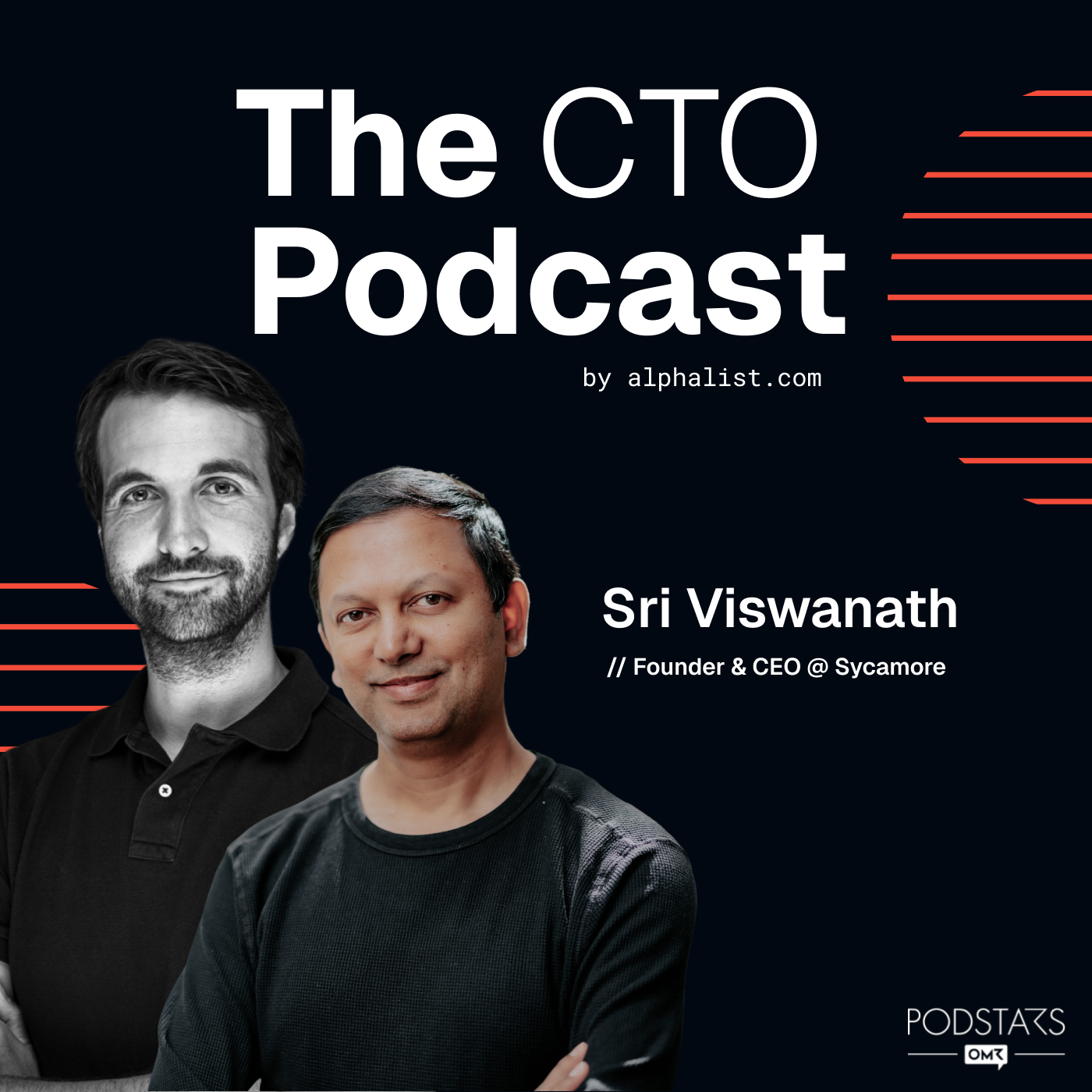
alphalist.CTO Podcast - For CTOs and Technical Leaders· Folge 149
#149 Governance Gives You Speed: Why AI Agents Must Earn Trust with Sri Viswanath // Founder & CEO @ Sycamore
Donnerstag, 29. Oktober 2026 · 1 h 05
Kapitelklicken springt direkt hin
Shownotes
Atlassian's first CTO explains why agents should never be autonomous on day one, why software starts decaying the moment you ship it, and how trust becomes the thing that lets enterprises move fast.
What does it take to trust an AI agent with real enterprise work? Sri Viswanath spent six years turning Atlassian into a cloud company. Now he's building the trust layer for agents at Sycamore, and his answer is that governance doesn't slow you down. It's what lets you go faster.
• From Atlassian's first CTO to first-time founder
• Software decay and living software
• Progressive trust and agents earning autonomy
• Agent security: sandboxes, PII and zero-trust identity
• PLG vs. enterprise sales in the agentic era
• Systems thinking and the engineering org of the future
Timestamps
Meet Sri: Atlassian's first CTO turned first-time founder
How Sri got into tech, and doing everything as CEO and CTO
A 25-person company where nobody writes code by hand
What an agent operating system for enterprises is
Why software decays after deployment, and customers on version 50
Why Atlassian needed a CTO after 14 years: the move to cloud
Will AI replace software? Why large enterprises are different
Bending Spoons, Evernote and the end of the enterprise as we know it?
Progressive trust: why agents are never autonomous on day one
7,000 engineers for an issue tracker and a wiki?
The future of Jira and a central source of truth
What he'd never build again if he inherited Atlassian today
Five features instead of 500, and why bolt-on AI doesn't work
When agents delegate work to humans
Trust but verify: Sycamore Forge and Sycamore Guard
Is PLG over? Enterprise land, self-service expand
Sandboxes, PII and the new security dimension of agents
Governance gives you speed
Systems thinking and what forward deployed engineers really do
Lego blocks, fractals and MCP at every level
Kubernetes, five-second tokens and builds that run for days
Do you still need to read code?
Deciding what to build when you can build everything
The engineering org of 2028 and the human-to-agent ratio
Advice for young engineers: become a systems thinker
Worst decision at Atlassian: the "five alarm fire"
Toby's surprise: an old Jira ticket
Why every CTO should build something with AI themselves
What you'll learn
• How to roll out agents with progressive trust instead of blind autonomy
• Why governance and verification increase delivery speed rather than slowing it down
• How to secure agents with sandboxes, default-deny networking and short-lived tokens
• Why systems thinking beats automating one workflow at a time
• How engineering roles and org structures shift when every engineer manages ten agent sessions
• The lesson from Atlassian's cloud migration about pausing feature work after a big move
Quotes
"As soon as software is deployed, it starts decaying because requirements change." – Sri Viswanath []
"They shouldn't trust any agents on day one. And the agent should gain trust over time." – Sri Viswanath []
"The more governance and trust that you have, the faster that you can go. So governance gives you speed." – Sri Viswanath []
"Even if you are just out of school, you are a manager now. You're a manager of agents." – Sri Viswanath []
Links
• Sycamore: sycamore.so
• Sri on LinkedIn: linkedin.com/in/sriviswanath
• Join alphalist: alphalist.com
Join alphalist
alphalist is the biggest community of CTOs in Germany. If you're an experienced CTO, join 600+ peers sharing insights in our Slack space and at our events. Apply at alphalist.com.
Transkriptvom Podcast bereitgestellt · Zeitmarken springen hin
Hello friends, this is the Alphalus Podcast. I am your host Tobi! The goal of the Alphalis podcast is to empower CTOs with the info and insight they need to make best decisions for their company. We do that by hosting top thought leaders and picking their brains for insights into technical leadership and tech trends.
If you believe in power of accumulated knowledge to accelerate growth Make sure to subscribe Plus, if you're an experienced CTO. You will laugh at the discussion happening in our Slack space where over six hundred CTOs are sharing insights. or visit one of all events. just go to alphalist.com to apply.
Welcome to The Alphalists podcast. my guest today is Shri Vishanath and Shri was first ever CTO at Atlassian Hired right after the IPO and over six years he took the company from about five hundred million to two-and a half billion in revenue. And engineering too. over seven thousand people, he left at the peak of twenty two end this spring.
for the first time in his life you became a founder is building a company called sycamore an operating system for enterprise agents with sixty five million dollar in seed And he is CEO and I assume CTO at the same time. Shree, welcome! inert or at least a geek, right? And how did you become one like why... Why did you get addicted to computers.
Yeah no that's a great question. so I've always been a techie from a long time undergrad in engineering masters At some point uh i also did my management degree just to get a broader sense of what it is but deeper in technology. And it's been such an exciting time over the last twenty years to see like, that cloud transformation mobile transformation and now AI is literally changing everything everywhere.
so even In The Last Six Months you said as a CEO and CTO I-in A startup You Literally Do Everything Including Taking Out Trash. So Anything That We Need To Do To Make It Work? we make it work. Then what do you have to make work right now? Like, What is your current biggest challenge I guess. I mean building up a startup like.
for me this Is the most exciting time when You can fill in multiple roles that you don't didn't feel full and in Your company. What does it look at? the role you're filling Right Now? essentially we've been building For A year. We Have Some Many Customers In Production Lots of Customers That We are Working With.
We Work with Large Enterprises so Lots of customer meetings, customer interactions go to market. Lots of hiring like we are growing or adding lots a few months and agents so... Lots and lots of hiring, lot's interviews takes up alot time And of course building. I've always been building. in fact for the first six month i wrote a lot of code.
When you say i wrote alot of code my agent wrote alot Of Code You generated some codes. okay There ya go. But that's the future, we'll talk about more on how it is all going to change but now I focus a lot more on go-to market and strategy. Just overall technology architecture in product direction. Okay so you are still deeply involved with tech?
The sales role of technical founders always an important piece especially if your have very technical organization like yours right Totally. Yeah, no it's very important especially when things are changing so fast. Literally every few months the whole landscape changes and as an organization We need to be changing And we need to adapting to whatever is coming.
The new models come in new frameworks come in being implemented recursive self-improvement There's a whole bunch of things that end there. level of chaos In the system is much higher. So anything that We need to make sure that we can actually deliver in the changing environment. Right now, how many people do you have?
How many of them write or generate code?". So there are about twenty-five people on the company who will be at around fifty by end of year and they're hiding a lot. I would say. none of them writes any codes themselves but All of them write code because of their agents. like most of them are engineers We are based in Palo Alto on the Stanford research campus.
So we have Good teams from Stanford and PhDs really strong team in terms, so we built The whole stack including infra. we build all the AI you call it operating system Because of all the services and applications that runs on it And also the agent layer, we call it the agentic apps which are agents workflows and traditional applications with front-end back-ended dashboards.
We can build all those autonomously so there's a lot of surface area to build in terms of what you need to achieve. Basically if I step back our vision is to build an agent operating system for large enterprises Which basically means that how software is done for large enterprises with agents. So what we had to do for this, was take the best of the SaaS world and all the customization that consulting and SIs were doing previously... ...and trying to bring it into enterprise without bloat?
And also you get a compounding value which is what we focus on And which is why we call it the Agent Operating System, because you can deploy lots of agentic apps on top of this platform. So that's basically a Model View Controller framework or something like that? Like some deterministic form of agent-built systems that I can again interact with.
AI. Or Is It A Bit Like An Air Table For Agents? Yeah, so what we have is a super easy way with natural language to build custom SaaS solution for large enterprises. So all the features including... For example I built Jira and Confluence. All of the enterprise products are there in VMware and Sun Microsystems Bunch Of Places And every large Enterprise expects you be secure, compliant, auditable Features that the Enterprises need.
Our autonomous builder automatically builds that into every single app. That we built and building is the first part And once you build, We can also deploy on. the deploy goes to the same CI CD pipeline that The enterprise great their customers can customize and have their own security standards and everything goes through CI CD Pipeline.
we deployed Into either our managed cloud or customer sweep PC and not just deploy. but then How do you do version two and version three, and version fifty? So that updating and changing afterwards is our true value prop. If you look at the history of software as soon a software is deployed it starts decaying because requirements change And it doesn't do things and there's issues.
It takes a long time to change the software. Our premise is Because we have The full loop closed We can be changing and instead of decaying, we actually grow. And become better after we deploy right? So our customers some of our customers are in v-fifty version fifty of the application because you can easily change it and It goes through same standards and there's confidence that we can write.
for agents We have evals that runs four test cases verification security auditing. all That happens behind the scenes under the hood. but A human is involved building the agent and product. The agents are rated as far as I understood, like you kind of get a grading for quality so that you can judge... Correct!
...but the rest is human-built basically. So there's no self improving loop Like hey have you thought about this? This what i haven't done? Oh No..so we want humans to operate. Is business owner or product manager And not an engineer? They should figure out what the problem is. How do you make sure that they can solve, right?
Problem in the company and interact with our system using that. And we do have proactive intelligence built-in. so every so often it analyzes The system uh, and that's fully configurable and comes back With. I Can Make this update if there are these five things That being done manually. Uh ican write This software agent And it automatically closes that loop.
So we do have the recursive self-improvement built in at various different levels of the system. Okay, okay interesting but maybe before we dig deeper Let's Maybe take a bit into your Atlassian history because I can't. kind of an interesting company and also i guess you learned a lot Also through this whole bump from five hundred to two and half right?
That's quite a lot. and managing seven thousand engineers so Atlassian ran fourteen years without a cto to technical founders. then you joined. What why did the company at that time need a ct-o? what do we add? Yeah, so there are lots of things that were really good at Atlassia right and it's still good.
The culture is really good people amazing. they had built a product that most many companies used uh... And he was always on prem. So what they wanted to do at that point is to move the cloud, right? Which was my main agenda in terms of where joining Is can we make Atlassian a Cloud company? so and I had worked previously At few places which were cloud native.
So My charter was Can We Build A Cloud Native Company? And The Way i approached it is To Make It AI-native. We have to change the Operating Model Completely Right on. Prem is great in terms of. you have like, support ten different databases and lots of different types of UI. There's lots of ways to do this whole... When we move into cloud You don't need all those right?
You can support one database but then the running piece requires a lot of different skills with SREs making sure that there are pagers. So what did was We essentially split the organization on-prem and Cloud And we rebuilt the whole stack and did a massive surgery to move what we had, build everything on cloud.
We went AWS native at that point... ...and built lots of services. As we added service, we could hire people make those services much better. We created a platform with all these microservices plus products.. ..we also have acquisition including Trello and few others. so brought it onto the platform over there.
And if someone would now come in as the CTO, she or he will most likely say hey this is horrible. It's a mess right? I think and it kind of interesting how things come in waves totally that way software decays as soon you build it so...and infact this time its even worse because If you zoom forward five years, the way that software stack will be is completely different from what we have learned and built in last twenty-five years.
All things... I guess AI will ride on all previous waves because of cloud or mobile. Adoption is much faster than AI. however the stack that we need to build and processes engineering and rest of the company completely changes. And it's not going to be the same in the next five years, which is why I started to come over because... ...I was a VC happily investing in AI companies.
but this transformation is bigger than anybody can imagine! It touches every single company, industry or human. So there are kinds of things that we need to do for the next few years in terms of transforming these companies as massive. So, are you with Elon Musk who says like in a few years we'll all watch the customized video stream instead of any software and this will be what we're interested.
And then this was off all our issues an all of our needs that would just express but we want it to be there or is it? I do think there's general consensus here saying... It's just a timeline question right? Yeah! We keep getting better. so even Just compare from last year to this year, you can literally say go to Cloud Code.
Go to Codex and say build me this app And it'll build you the app. It's like amazing that won't have any issues. Well at least not on the first side. Even I think software slop even degraded quite a lot With table etc. Exactly, so it's going to only get better and you can be able to trust like simple apps.
And that all works for small medium companies and things. if they are trying to solve the large companies have a much bigger problem because there They have compliance their auditing their process in place. There're lots of people doing things. The change management from where? Where do we have to go?
is actually massive and That is not easy to change at the speed of AI Right. So what we do is because We have a self-service platform, our goal Is to be able To move that faster than any other products That are out there. but I Do think AI is going to change A lot and i'm in the camp of like It's gonna help Move or focus into different areas Where you can actually do more things maybe watch TV screens.
But also if You want to be New discovery news software new problems solving it's going to give us a lot more leverage overall as humanity. So, um maybe like little bit of counter question on enterprise or provoking little I think in many enterprises. so what you're basically saying? well when i hear that they are processes there is compliance etc.
then and a lot off this human made And a lot of the complexity that you see in organizations is human made where. You have like different levels introduced or the hierarchies introduce who basically protect themselves to protect their own creation, somehow? Have control over it. I think thats like and many cases they go to kind off stay in controls say in charge right.
um an in this air world Doesn't it cut through that like I mean isn't there such? looking at for example the Evernote acquisition from Bending Spoons right where everyone was let go and, The whole stack is basically cut into small pieces and distilled to a new setup. Isn't this end of enterprise as we know?
No! You can cut everything and have one person. just manage it, maintain it. But if you want to really innovate and build the next generation things and make it more adaptive to the next-generation of software that's going to come in... It is gonna change the shape of the software that exists for the next five years.
You do need humans to be able to express what they need because there translation layer between where AI stops And What Humans Actually Need. There Is A Gap There The last mile gap. So that I think will exist even for the next several years. and To be able to figure out, I guess how do you build a business?
The reason we focus on all the non-technical users in a company is because What'll happen is engineering. You don't need as many people over time. Small group of really talented engineers can build a lot. the question becomes the bottleneck becomes what do you built? how do you remove processes that existed previously?
How would make sure if you have ten thousand people, only need five thousand or less at scale when deploy these agents and software. How to manage the change? because those become extremely important. there are some choices companies must make. Do want to re-skill them? Do not wanna have it? Have them build something completely new like all of is in the next five to ten years for all these large companies.
But it also opens up opportunities, right? For companies that are much more forward leaning and tech-leaning they can adapt and make this changes And I talked most of Fortune hundred companies many CTOs, CIO's across different industries and companies like thinking This going happen i'm gonna make the change proactively Will be in a much better shape than people who are like, I don't think it'll touch my industry.
It's not. i need to do some AI. Let's do just the chat as long as they jump on and the right moment Right? I mean that's also really there. The question is now the right woman to invest or do I rather watch for awhile too kind of hit the right Moment? but I think there's no real. There's no good moment, right?
In fact now it is already too late. They should be jumping in Right Now if they haven't already. and the reason Is you'll need some time to learn. You want To experiment a little bit Before you take on. okay Let us transform The whole thing because we wanna have Some agents running. We Want to Have Autonomous Agents And That Why We Have This Thing Called Progressive Trust Where We Don't Want Our Customers To Trust Our Agents On Day One.
In fact, they shouldn't trust any agents on day one. And the agent should gain trust over time and our agents go through a journey where they gained trust... ...and at some point become fully autonomous.. ..and are never autonomous in Day One. So that's kind of things. when we experiment certain thing then they learn what to do with their capability.
That also trains people especially those who make decisions which direction is going And as soon they have those decisions, then it's a lot easier for them to make bigger and bolder changes afterwards. So that is also how you better teach humans something right? Like I mean independence. who deserves independence?
i'd say like giving full trust from the start is often... ...is something that humans do but its not always good Right? Exactly! Humans get referrals. You're like oh..you've done this before. there are some Aspect of okay, I can trust this person because there's something behind that agents don't have any of those Right.
So you better go through the place where it and i can trust This agent because it's been doing this thing properly for the last six months. And then we can go autonomous. so your agents have CVs but maybe let's step back to Atlassian and Go through their journey as well. Where if now? You would have or Let's provoke a little again, I mean seven thousand engineers for issue tracker and wiki like.
is that like seriously? it also the. The most loved by some in the most hated software buy many others. what did they all do? Like what was? but did other people to or do other people too end? how many would you need today if he will take over again? yeah there are lots of things here so let me try to break down into number different pieces.
So when we scaled up running a large scale SaaS company, especially when you have customers in two hundred different countries and You have a platform that has multiple products in place. That needs to have unified set of services And it's somewhat fully self-service can go all the way from you starting to fully customizable All then I think people underestimate what goes on behind the scenes.
to be able to run that successfully at like four nines, five nines kind of liability and all the things that comes behind in terms of non-engineering side. Of being able to build the right thing support services it's also maintaining All the legacy business set. was there Right? It's not reveal rights.
People don't realize It takes a lot of time and effort to build it, right? And maintain it. So we were always at the place where whenever we hired people. We had more backlog because you could move faster if you have more people. The way that we architected was different services. Each service would be like five or six people who can work on this service.
but there is also Coordination of what do we need to do and the quarterly planning? And a yearly planning. so we spent a lot Of time on figuring out. What to build, how To build it and literally all those people were pegged to The maximum in terms of imagine. can you imagine water and have to bid? So I don't think People underestimate what It takes to run.
and After i've left like i left four or five years ago The next city you came in, they also built out a number of AI. They've grown over time even afterwards and have done the phenomenal job. just adding more AI right? So it's not non-trivial on first part but second is that AI will change everything.
so the shape of JIRA exists today and Atlassian knows this too because I am no insight knowledge outside. now AI products coming in and so they do realize that future is AI. And I do talk to the few people in the company, um So did you realize it's a high end? The shape of jira changes significantly especially for small companies like us because we build autonomously.
We don't use Jira in the shape that it exists today. right now You know need to say oh let's do a three-week sprint cycle Let's create these ten tickets. When you ask Claude or ChatGPT, with Claude Codex to write a plan it says oh! It'll need three engineers for three months and we're like no. Yeah then you do it... You are doing today five minutes.
yeah exactly so. the world has changed significantly in that sense. So Jira existed ten years ago is not the jira people would need? but there's still a need of having central source of truth irrespective of Jira. Let's step back. So there are in a company There are certain objects in the company certain source of truth.
In a company that needs to be saved. any database Where everybody in the Company knows not just humans, but also agents need To know to go and say if I want to know who our customer is? I need to Go check this database If i wanna Know Who what projects Are running What The status Is you Need? so I do think there is A way Of Architecting for the next Generation of Things where There is this set of databases.
How do you expose terms change? We had APIs, we have UI. now there's MCP right so that might change mcp. still the same kind of interface but You still need to architect and design and figure out what you need in the back end. The good part Is AI can Do a lot Of those if you start from scratch today like for example we started From scratch.
The way we run the company is very different from any other company that exists. That started like two years ago or either they haven't changed it, if they have change then look like us. We are pushing boundaries on literally. don't anybody in ops doing same thing twice? So always automate everything across non-engineering Engineering already building an autonomous builder which means We better dog food what we do.
I assume in your own software basically? We have to because if you don't trust our own software, we don't want our customers who trust our software. so we try to complete development autonomously. It's still not solved right. So they're still bottlenecks on a number of things that we are trying to unblock and That's the research that we were trying to do one all things Progressive trust and making sure that we push the frontier.
How do you solve harder problems than the frontier models can solve by having multiple models? how Do you fine-tune Models for a specific use case so we can have smaller models? That's much cheaper. And in fact, we do some interesting things where if You do the same thing multiple times We can rewrite that in code So that The cost of operations for that is much lower and it's auditable And it's repeatable, right?
So we try to get as many things into code as possible which needs to be auditable, repeatable and meets like the non probabilistic kind of deterministic output. That means I know that answer is what if you were inheriting Atlassia now or would one thing never build again? query letters, processes. The whole apparatus like what's the ballast basically?
and I guess it answers everything right? It is a lot of things will change and Atlassian are already trying to change. that thing is customers who use can't change fast enough even if Atlassians completely read us today. customers will take five years to be able move this new model so they'll have to navigate For us, we start from scratch and I'm not trying to build what Atlassian is building.
What we are trying to built it's a completely new way of building software that can build operations, automate operations across the company various different products- So you're building a builder for Atlassians? For companies to build Atlassans? Yeah! Building a Builder for Custom SaaS exactly. People can build custom SaaS solution because what happens in software?
most of this software that you buy has like five hundred features. What you need is literally five features and You don't want to pay for five hundred. And all the complexities of five hundred If you want five features will build you five features. that's exactly the same grade and Does everything? And data never leaves your VPC, right sir Which I think it's a big value prop on them with their direction.
That i'm seeing Is there is no cost. There's No SAS that works well in The new AI era because what has happened is All the previous SAS products have bolt on AI, right? So they built chat GPT into it and now there's a trying to fit some things into it. Whereas our platform is completely agentic ground up rights you build the software autonomously.
The software itself has agents workflows And whatever You need front end back in dashboards all built-in and you can manage It maintain it. and it also proposes features that would make you more effective. And if we can get that working really well for large enterprises, That's like the future of how living software should be.
We close the gap between what LLMs can provide when LLM gets better and solve even harder problems... ...and customers need. Right? We still needs some FDEs or last mile customization not because a builder cannot build but to figure out against what to build. make sure it builds correctly. so you don't have Lots of people, but we need some people still and that's the gap.
That will close I guess in the next few years and become fully autonomous In terms of what? We can do. But we are in the direction And lots of our customers have already gained benefit because after. well then they're the ultimate company off to future be Company of agents where agents tell the humans what to do.
I mean, you seem to be Laughing but it's actually starting to happen. in fact many of our agents Does things and at some point delegate? Some work to us because they are like oh i can't log into The system. Can You login And give me this and i log In and Give It and then he takes over from there. yeah i Mean that how?
How the workflows? also Private life. If you just deal with Claude, etc., like the change right at a point to see yourself just authenticating and being human in group on certain things? And I could imagine that this even becomes bigger. Yeah what happens is when these become bigger. The big problem later especially for large companies.
how do make sure it's doing the right thing? It's trust but verify the verify part becomes extremely important. So what happened was, we built our first product which is a builder, Sycamore Forge and people love Forge. they're building it And you also build governance into all things that guard our agents.
All customers are like can we use Guard for all of our agents? We pulled out and created a second product called SycamorGuard and Forge & Guard work together in terms one builds other guards And seems like trust but verify, I guess is the future in terms of how we need to do. From my perspective really initially came from like a PLG angle where you the product was growing because people just downloaded the trial and we're using it.
Like I remember myself, right? Really downloading that jar file. so no sales cause nothing which is very close to my heart because i hate getting caught button And you basically sell governance and trust, it's more like a CISO conversation. Do you think that PLG ultimately is over? Like the PLG phase is over and do now have to be enterprise-to-survive or where does that come from?
Yeah so Atlassian did a phenomenal job. I guess six years, six and a half years. Most of the revenue I guess on PLG completely we never talked to our customers. even large customers did. We had system integrators and channel partners who did Revenue outside that. But internally you are starting to grow.
when it left? You were starting to go out enterprise team. now They have an enterprise team in their mood To standard selling process. but for me, I guess The lessons that i've learned is we need to build a product that is actually self-service after it's deployed into customers' environment. Because once you have force running, the employees need to wear their products hat and be able to describe what they want or build them on which is what we focus on.
And this starts working really well. The sale motion...the land motion is an enterprise sales motion but the expand motion is fully self service which is how we are designed to come. Do you think that this will persist long-term or at a certain point, also pick different angles where agents can sign up for the company who needs it?
I'm sure they'll change! The thing right now there's not many standard protocols to interoperate with other products and other systems outside. Payments starting A-to-A is early, so the standards are still early... Even when we build again just like in previous cloud era there's a lot that goes into building system.
what you have built right? Just if want to build an agent You need figure out how do run a sandbox. running a Sandbox Is actually its own full job because you don't want to give keys inside the sandbox to the agent. You wanna keep it outside, make sure that you won't let everything else connect and hugging face by default.
so you need to make sure your default deny network can only give access. You'll be able track anything just in the sandbox side. then there's all new dimension of issues coming on. what is the agent doing sending So you want to be able do, is it sending PII data? You need all the security aspects. This is probabilistic and deterministic.
era could actually do security somewhat easier and guard it easier. now becomes an even harder problem with a new dimension of... It's not same string that coming in if wants credit card doesn't have send numbers can write. spell out the number some place. The guard that sits there needs to figure out, wait a second.
It's spelling one seven five. this looks like credit card and we need to stop it. There is so much new directions That we are still scratching the surface of what needs to happen both in terms Of whole building running and managing enterprises Like agents for enterprises. And thats why even Enterprises are cautious Because theres lots of wipe coding platforms Lots easily.
My employees built this thing, but I don't know what to do with it. Is i think where we are at this point? All that will get solved in the next five years right? and then It comes to a point Where can agents talk To some other agent In The Next Company And To Negotiate Partnerships? Right But That's Still Far Out Because We still need protocols and standards and trusting That Happens.
That's Why When We Started We started With The Trusting. uh trust as the main pillar. like Most of the time that we spend is making sure that agents can be trusted and invest a lot of time in verification validation, all the guarding piece because my belief is governance. The more governments entrusts you have... ...the faster it goes.
so government gives you speed. So we spent a lot to make sure this happens And then also want these agents by values or how do they work kind of language you use, all things that even in the last six months I guess Open Claw and a bunch of other ones came with Soul.MD. And what's for large enterprise?
So we spent lot time on What are values of company? How do operate in a company That feels like it is an employee? We have different types of agents that we have Different characteristics. They do slightly different thing. it's actually useful for different purposes. So just stepping back, there is a lot that goes on to be able to solve the problem.
Brute force. you can solve one thing but build a platform which can solve a number of problems autonomously. we are still early days in the whole industry. Yeah absolutely and this also stuff like I mean you can't solve with agents. obviously You have an idea the core principles that you want to apply, right?
And also some sort of like a technical background. or at least build the taxonomy for everything. Utilize the right concepts in your core platform. so basically create deterministic layer which can be fed by probabilistic tools. exactly I think we are pointing very important things with large enterprises should think about.
is systems thinking, right? How do you step back and look at the company in things that we want to automate as a system. And figure out? what pieces Do You Want it To Be Common? What Pieces Do You want to Automate. What Do You Think Is High Risk Low Risk? Just understanding The System And Thinking Of System Before You Build Anything And Design That System Is Extremely Important.
In fact People Missed That And Say Oh I Wanna Solve This Problem. There's A Workflow. We Want To Automate That Workflow. It gives you a little benefit. But the actual benefit comes from, oh if I step back and actually create common knowledge base for whole company it solves ten other problems And becomes based on what things can come in.
So we do with companies is that they spend six weeks or eight weeks called co-design. We do this systems design thinking of all thing's which could not be done. that I think is a very important portion of how you want to think through the next few years. So, good old forward deployed engineer basically?
Yeah! i think there's confusion about what forward deployment engineers do because forward deployment engineer sounds like... You go in and fight battle and solve your problem. when come out it seems like but actually most valuable piece system design part on. Can they step back and solve a problem in a way that actually makes it work well for not just the piece, but gives them along term more to terms of how their solving.
And I think is rare in terms. what i see on market? Yeah systems thinking are very skill. you don't find many companies with right strength or amount On the right level to actually take decisions on how to build your structure. What if you look at what uf created like, what is then? The most important building block that um... Your own systems thinking has engineered?
I mean obviously Like the cv of agents. i mean understood. yeah That's important. but If You come To a technical Level like what are? what Are the technical Building blocks the Technical Core Concepts That make your system better than I don't know? a rovo or replete, whatever air table. Yeah So what we have done?
What we've done is we made our system extremely modular and It's We have a number of these core Systems and libraries that we have created. that gives you this enterprise grade features And those are like tested validated. so it gives you benefits of when you're building, it can pick the right set of Building Blocks.
Think about it as Lego blocks. so we have built a number of Lego blocks that are tailored towards building a SaaS-like solution for large enterprises and some are domain specific And Some Are Generic. But We Have A Framework Where We Can Quickly Build Many Of Those Building Blocs. The Building Blox Is At Various Different Hierarchy Building blocks for sycamore.
There's a building block for all of the enterprise. there is a building blocked for a department and then The solutions come on top of it so you can. that's why we can let you change completely And how it works. in the back end? Is if you look at our system, If you open the hood and You'll see that we have a pipeline That's fully customizable.
We have like structured formats of where you can add more things pretty easily. we have libraries that are like very well designed. We have APIs and services, platform services that are like easy to use. we expose CLI, we exposed API's traditional APS and MCPs both at the lower most level And also at the app level.
The agentic app you build is an mcp for something else You want To Use So we've designed it so its modular At every level. It looks similar as you go up And it just does more things, but you still have an MCP at the end of it. Which makes it easier for us to add on more things and build systems in refactor if we need change direction or something which is what gives us the malleability of large software.
What are most important technical pieces? Kubernetes and yeah, like what not right infrastructure fully. Yeah we are fully kubernetes based And which is what allows us to run on any cloud or Run on customers VPC rate. so that's made it a lot easier. Then we also control the whole stack Which means? We run our own sandboxes weekend The identity agent identities actually really hard problem in itself.
And we have solved it in a way where, We don't just give it permissions. We do like time-based tokens. Where if It needs to operate and Do some high risk job? It only gets it for Like five seconds. So zero trust basically or exactly. so its Zero trust across the board. and that's A lot of engineering hard Engineering work That happens.
so there is a number Of like Hard engineering Job that we Have done. then we've also pushed and We Don't publish benchmarks. We don't compete in the large benchmarks, maybe at some point we will. But our builder can build anywhere from six hours to like six days even more sometimes two weeks which means that long horizon tasks are never easy.
so you have done a lot of research on how do make sure it actually builds these kinds complex applications for hours and day together? So there is a lot AI research. during this Of course, we have spent a lot of time and energy on the recursive self-improvement because it sounds easy. It sounds like fancy but to actually get at work in general mode for all use cases is not that easily.
Not that we've solved it fully, but we understand what needs to happen. And there's still human in the loop as we suggest something and humans has to approve. So there is some guard checks and balances in place, but that's something we've actually closed the loop on which was extremely important. Are any core languages you'd like to use or how much freedom do you introduce at times of agents who can write perfect code?
Do you think codes still need to be read? Is it basically code reviews done by agent? so are they an artifact now? Yeah, we don't read code for the most part We do. reads were like the core libraries that we build. We are extremely careful from doing it. But four most of the apps. you don't do It. but we do have lots of review agent.
we our own review agent That we use views best-of-breed? You also optimize for Like. we write evals for the agents and we run the evals at different stages And also in production we have like a same CI CD pipeline or agents deploying to dev staging production, so it goes through the same cycle that you would go to.
You can go in and check point human has to approve before it goes into production. So we have made it so that you can have this workflow That's fully customizable and human-in-the-loop In many places And as again trust you can make some of them autonomous? I do think As We Go Towards This Many Of Them Will Become Autonomous In Terms If You Don't need To Keep Approving The Same Things.
Our system also gives you a video evidence of all things that does change. So we don't look at code, but we have spent time... A lot of time on the intent of what do you need to build and the verification piece in the guarding pieces which is important. We do expect agents or LLMs to improve significantly so that middle-piece actual building will do right thing based on constructs shape as well.
Now with it Like tiny startup. How do you decide what to build? Is that like fully customer, I guess it's not customer directed purely because i mean customer can also give you often um a wish list but uh yeah doesn't result in good products. so is there road map planning process like how do you like how does that that process look like for you?
and or is that already like ballast again? no this is the biggest challenge i have and generally most of leads and CTOs have because it feels like you can build everything. It just feels, oh yeah I can say that they will be able to do anything. but actually building a production gate get the eighty percent easy right?
That's true! It has compressed But getting into really good solution is hard. So prioritizing making sure what we built Is an industry problem for me too in terms of how Constrain and focus on what we need to do. So that's like, we understand That's a problem. I think it is the problem We try to figure out.
I guess every. we do weekly planning cycle. in fact we do daily planning for the most part because The things that we decided in the morning will ship by night. But we have a weekly plan And in the weekly plan, we explicitly list all things that we should not do this week and We get a lot of input from our customers.
That's been extremely useful to shape The product. but we don't just take what they say and build it because we need to put It into our framework of how you? Build these Lego blocks. How do you make sure that he can solve not just their problem? But I brought set up problems so we take it and use it as input But not exactly do what they want.
We might do the exact same thing for them because it's a business problem, but into the platform we make it somewhat more generic? I think that real answer on this looking at those problems... The real issue has been there way longer time. in many companies engineering arc was always slow and just perfect excuse Exactly.
On companies not to think about their business, like hey we're waiting for this migration down from this monolith to move databases from A-Z or whatever right? And I think in many companies it was... This was shadowing the fact that company had no idea. Totally and also product managers have some time go do research come back with ask people No, there's no time right?
so you decide in the morning. You do it in the night and next day It's like what? Do I do? now you can do ten things. which one do i do So that i think That's a problem that we haven't solved or nobody has solved yet mostly Because We know The direction of where we are headed And we have A vision Of What they need to solve.
for a startup its A lot easier because we Have A north star on what They're trying To Solve and we solve Towards. that For enterprises where they have to solve a problem, when you need to coordinate with multiple people and things like that. That's a bottleneck. I think even the communication especially with bots in Slack and general bots personal bots bots that come in.
maybe there is a Communication speed up that happens which can also solve some of these problems Some of these Problems. but i would say The real issue. then as product market fit um...that do You Have To Solve right? Correct I mean, the bottleneck flew from like went from tech and engineering to kind of product people.
And then back to the client... ...and the client doesn't want fifty features a day or isn't able to also consume that right? Yeah so consuming on this side is just what you want. but the good part there's positive thing about it. You can quickly trade towards what they really wanted because he used to take long time.
now within week you get into place where. That's what I want. The first version was bad, but this version is actually what i need to. you can iterate fast But how do you scale up as a if your targeting? A large audience system marketing and the go-to market? that I think becomes a bottleneck because then You have lots of things to sell And you don't want to be like changing or messaging every day.
right all right. Then they client becomes the problem because he cannot longer Consume what you're sending, right? Exactly. Too much, it's as if you've flooded them with messages to set your flooding with products and that could become more. At some point It'll also get solved by agents because agent is the one consuming it.
And humans on other sides like solve me these five problems and agency. I got a solution here. it is let me enable this feature for years As long as the human are able to express their five problems, right? I mean that's also often in case this is not entirely clear. But quickly from these two like engineering org of future what do you think now?
directing a very small orc and having this product market issue already? if imagine an engineering org on twenty eight What will the human-to-agent ratio be? Will there be a fifty person software company? Will they be seven thousand people companies still like? how do you imagine that? on the engineering side, let's talk about just engineering.
I think what will happen is right now. I guess our ratio is one is to ten it. so every engineer at least has ten of these sessions always running right Plus or minus depending on the kinds of problem that they're solving and things like that. Maybe five maybe fifteen Depending on how easy it is to scale a specific problem.
And okay, how we can parallelize? That's what they are interacting with. Underneath. there may be workflows in other things that may be running a lot more of these different branches and work trees that Can do a lot More Things. So I think that only is going to increase as long as you know What your building.
Again, the challenge goes back to how do you know what your building? if you have clarity on? What are we doing? man You can go much faster than anybody else But to know what it's doing. We need to do a bunch of experiments and its somewhat single-threaded because you need To make decisions as humans in terms of what shape you need for the product.
So that happens but in a larger organization I think It becomes. If you're fifty people And you have a distribution of work that happens. You might be able to do the same with twenty people or ten people, who are organized well and have the right set of agents in their system underneath. So I think we need less people for doing this job which is quite obvious.
The other thing that happened was... The reason why we had hierarchy. in an organization like six levels of hierarchy if you have seven thousand percent org You needed that for various different reasons. Planning, helping organize, communicating back and forth all of them. If agents can do much better And you as a leader literally communicate to every single person in the company using your agent Their agents consume it.
then they get personalized message. Then it eliminates a number of layers. So could have a flatter arc or slimmer arc to accomplish the same thing, and then you need to figure out how do I shape it? Do i have build more or do i build with less people? right so that's a challenge. I guess question for that exit is will happen.
So do you believe in like seven thousand engineers organization on twenty eight? or-I mean today there are companies who has over hundred thousands of people even if they figure out, I guess how many they need to be able to accomplish this. i'm sure there'll be companies over seven thousand but what they do and how their organization will become completely different for those like their company's.
all the big ones are like fifty-thousand plus people. you're right. And What Do You Think um should in a thirty year old? Like if you could send an advice To All The Young Engineers Out There. A Thirty Year Old Engineer Learn this year just to be paid in twenty eight. like is it? I guess you already.
You already told me the answer system thinking system thinking exactly. i think. get systems thinking unique. build some systems like some subsystems. so, i do thing working with learning computer science. just software itself gives you these systems thinking. and how will u think about solving even a small problem?
you need to organize well but Start thinking about larger systems because that's what will happen. Because your agents, all the engineers even if you are like just out of school You're a manager now right? Your manager of agents. So you need to figure it out how to manage ten Of those whether its humans or agents.
and then How do you think about it as a system so that you can figure out better organize And better solve the problems? so become more product managers become more systems thinkers. I guess figure out how to manage a larger set of agents is my advice. Worst decision you made at Atlassian, not the diplomatic version?
The worst decision...I actually wrote a blog about this. so what happened was when we were migrating these customers too large like to our cloud instance. We migrated the customers and then we started building features. And that was a bad decision because we should have paused. this rate at which we added features right after we migrated customers, is what happened with stability for next few months?
It's terrible! I called it like the five alarm fire and I wrote a blog and corrected all those but... three months because it was so much pain to stabilize the system and making sure that we can scale up. And then, you could add features but all part of learning is a massive project But there's definitely not the right call.
Yeah, so I have to take a look at that blog and see what you wrote back in the day. Such for five alarm fire! Five alarm fire? Okay very good. Then Trey...I still am a little surprised by which is also my closing question goes hand-in-hand with it before.. I actually found from your early days an old Jaira instance on a bare metal machine that I have from back in the days.
Self-hosted version four point for running under single, single machine and it contains exactly one ticket which is only has title migrate to cloud status open created twenty fifteen by you when i know click resolve imagine takes us back to the year twenty sixteen And it's your first week at Atlassian and we can watch young Sri for a while.
Basically like really getting into that founder-led company, getting hands dirty... Now you could whisper something in to younger self ears. what would he whisper? Wow! That is good question I think made bold decisions on the firsts three to six months where we forked the organization into cloud and on-prem.
We forked a code base, uh...we started an US office like the Mountain View Office. so we did a number of things. if I could whisper i would say move faster because those at the end of day turned out to be right? And we debated a lot in terms centers and everything, it felt eternity during that time. I would say move faster.
Let's talk more do. Yeah. And then one very final ask basically one advice you will give every city out there to build instead of buying like which tool should everyone build themselves? instead of buying something like what would you advise everyone out there? Yeah, so my general take is for literally every CTO-CIO and even anybody who can.
they should absolutely try to build something themselves with any AI. It doesn't matter What do use. You Can Use Cloud Codecs. Who pick your favorite replete? Pick anything Any white coding platform that you have Anything That You Can Get Hold Of. Just Play Around With it because As soon as you start playing with it, You might have done chat GPT.
that's different from actually building an application. Building an agent and just going through the life cycle of like how It was because you might Have done it like ten years ago twenty years ago but doing it now? Its so much fun. I'm telling you this has been Like The best year in terms Of like a. You can build you Can see come into fusion like Much faster.
its Just A lot of Fun. Play around with it more as a game and fun than seriously, oh I need to write some code today because its not the case right now. Yeah this is actually like my most favorite thing when hiring someone. What did you build last week? Like what system do your own? Maybe in your private life?
how many hobby projects? Um, did you ever try to buy a raspberry pi and hand it over to Claude? And say hey go I have all versions of Raspberry Pi sitting here. Uh i have like uh A bunch of other systems in whatever else in media ships laying around. But also in the last week i played around with jev And compared Jev.
is this new model that came out That does decision-making much faster. System one, thinking is what the system they call it? It was so much fun just to figure out where can fit in a system and... What's it do right like how yeah.. How could I fit in? Right we are doing this really good verification piece And we're trying to figure our guess what points do insert Where you make those decisions much faster.
We can do a lot more in the time frame that we run this system and it's also much cheaper. And, anyway...we are experimenting with it but as soon Doing a number of experiments with it. It's very cool, yeah you have supportive family obviously totally and my son is working in AI. so we kick out a lot.
My daughter doing robotics and my wife is fully supported. otherwise I could never have done this. So Shree thanks alot for the podcast was really entertaining. all the best for your future. let see where. whenever your tool becomes PLG everyone here can try that. Where can people find you and Sycamore?
People can send me an email at shri.sycamore.so or salesatsycamor.sr. Salesat Or on LinkedIn I guess, so thanks a lot for the podcast. Have great day! Bye bye hope to see soon. Thank you for listening to the AlphaList podcast. If you liked this episode, share it with friends – I'm sure they love it too!
Make sure to subscribe so that you can hear deep insights into technical leadership and technology trends as they become available. Also please tell us if there is a topic you would like more about or a technical leader whose brain you'd want us pick? Please send us suggestions to cto at alphalist.com, Send me a message on LinkedIn or Twitter.
After all the more knowledge we bring to CTOs The more growth We see in tech Or as we say an Alphalists Accumulated Knowledge To Accelerate Growth. See you In next episode.
