

Apex Humans | Sci-Fi HFY Stories· Folge 9
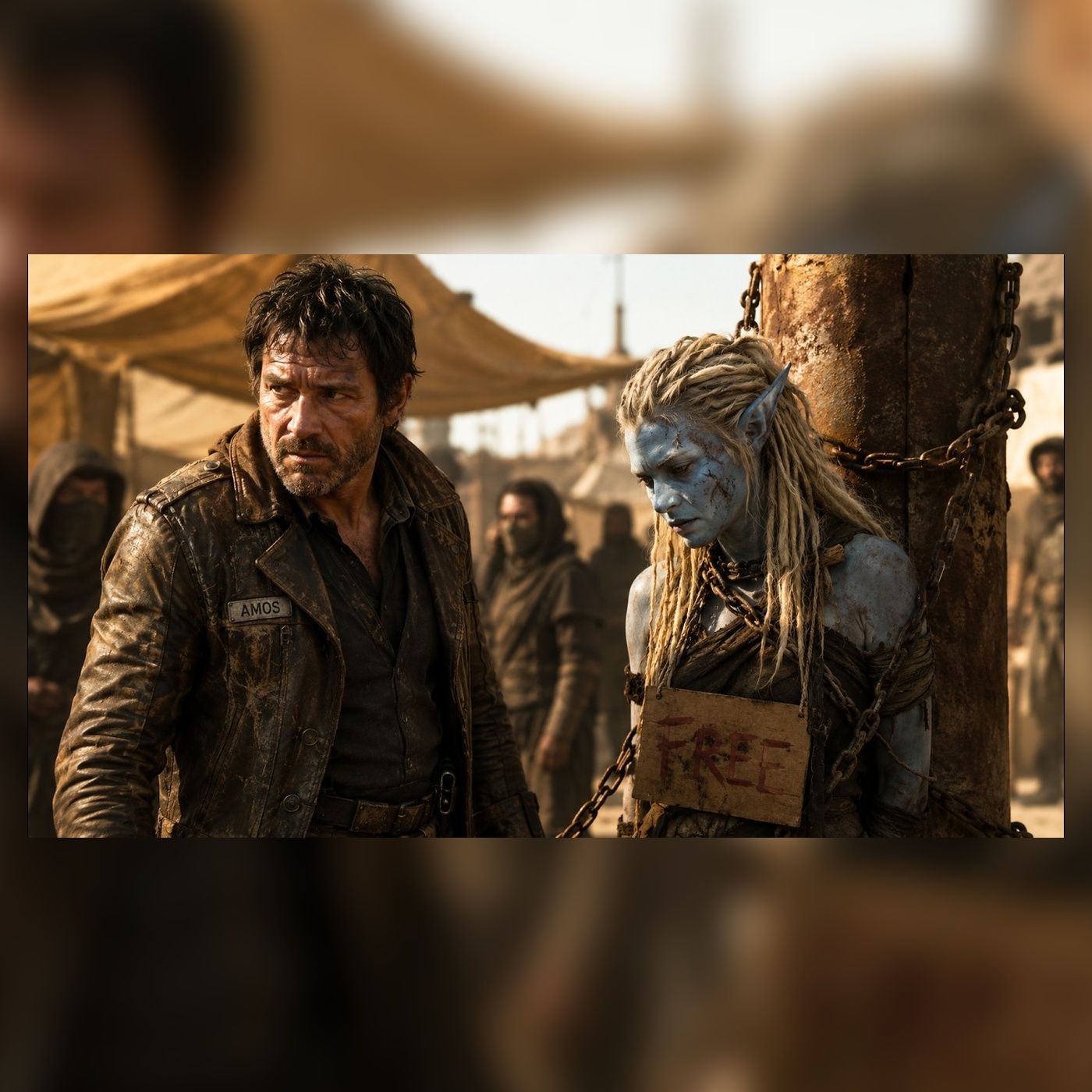
He Saw a Chained Alien Marked 'Free' in Market | Sci-Fi HFY Stories
Montag, 12. Oktober 2026 · 48 min
Kapitelklicken springt direkt hin
Shownotes
In this gripping sci-fi HFY story, a human traveler discovers an alien woman shackled to an iron post in a ruthless galactic market. Bearing a humiliating sign marked 'Free,' she is ignored by every other alien race until a solitary human steps forward. Unwilling to look away, his single act of defiance triggers a chain reaction that shocks the entire station. Listen to uncover the true power of human empathy and resolve in the deep cosmos. Subscribe for more thrilling HFY stories and galactic audiobooks. #HFY #SciFiStories #SpaceOpera #SciFiAudio #HumanityFuckYeah
This episode includes AI-generated content.
Transkriptvom Podcast bereitgestellt · Zeitmarken springen hin
The smell of burning metal hit me before I even stepped into the market square, and my hand was already on my blaster before my brain caught up with why. Something was wrong here. I could feel it in the way the crowd moved, the way voices dropped to whispers when they saw the color of my skin. I was the only human in a market built for a hundred other species, and every one of them was staring at me like I had wandered into a place I was never meant to be. I had come to this outpost for one reason. Fuel cells. My ship needed them, and this station was the only place within three jumps that sold the kind my engines could use. That was it.
That was supposed to be the whole story. Then I saw her. She was chained to a metal pole in the center of the square, wrists bound above her head, standing in the open air where anyone could look at her, touch her, spit on her if they wanted to. Her skin was a pale gray, almost silver in the harsh light, and her eyes were the color of storm clouds. She was thin, in a way that made my stomach turn, ribs visible beneath torn cloth, and there was a wooden sign hanging from a cord around her neck. Free. Nobody wants her. I stood there for a long moment, unable to move, while the market carried on around me like this was nothing. A merchant a few stalls down was haggling over the price of spiced meat. Two children ran
past her without even glancing up. A group of traders laughed at something near a stall selling scrap parts, close enough that their laughter reached her, and she flinched at the sound like it was a blow. Nobody looked at her. That was the part that broke something in my chest. Nobody looked at her at all. I walked closer, and the crowd near her thinned out, giving me space like I carried some kind of disease. An old vendor with too many eyes and leathery skin caught my arm before I got within ten feet of her. You do not want that one, he said, his voice rasping through a translator box strapped to his collar. Broken. Useless. Nobody has taken her in three cycles. Even the scrap buyers will not touch her. I pulled my arm free. What happened
to her? The vendor shrugged, an odd rolling motion of his shoulders. Her kind always end this way. Too soft. Too much feeling. No good for labor. No good for anything hard. Her last owner grew tired of her weeping, and left her here. Free is free. Take her if you want a burden, human, but do not say I did not warn you. I looked past him at her.
She had not moved, had not made a sound, but her eyes had found mine, and I saw something in them that I had not expected. Not hope. She was too far gone for hope. It was something quieter than that. It was the look of someone who had stopped waiting for anything good to happen, and yet some small part of her had not quite stopped watching the door.' What is her name?' I asked. The vendor blinked all four of his eyes at once, an expression I would later learn meant confusion.' Name? She is a Shari. They do not need names. They only need owners.' Something cold settled into my spine at that sentence, and I realized my hands had curled into fists at my sides.' I forced them open. Unshackle her, I said. I am taking her.
The vendor laughed. A wet, clicking sound. You misunderstand. She is not for sale. She is free. Nobody will pay for her, so nobody owns her. You may take her, but do not expect a receipt, and do not expect a refund when you realize your mistake. I do not need a receipt, I said. I need the chains off her wrists. Now. Something in my voice must have carried more weight than I intended, because the vendor's four eyes widened and he scrambled for a small tool at his belt, muttering under his breath about humans and their strange sentiment.
He fumbled with the lock at her wrists, and when the metal finally clicked open, she did not move. She stood there, arms still raised slightly, as if she had forgotten they were no longer bound. I stepped closer and reached out slowly, the way I would approach a wounded animal and gently lowered her arms to her sides. She stared at my hands the entire time, waiting, I realized, for the moment I would strike her. When it did not come, her eyes lifted to my face, confused, searching for the trick. There is no trick, I said quietly, though I doubted she understood a word of it. Come with me. She did not move at first. I glanced back at the vendor, who was already losing interest. already turning to shout at a passing customer about the price
of scrap metal. Nobody in that entire market was watching us anymore. We had already stopped being interesting to them. I held out my hand to her, palm up, an old human gesture that meant I offer, not I demand. Her eyes dropped to my palm, then back to my face, then to my palm again. Slowly, like she was moving through water, she reached out and placed her hand in mine.
Her fingers were freezing cold. I led her through the crowd, and I felt every eye that slid over us, every whisper that followed. A trader near a food stall said something to his companion in a language I did not know, but the tone was unmistakable. Pity, mixed with a kind of contempt, as if I had just picked up a piece of garbage that everyone else had already thrown away.
We were almost at the edge of the market when a voice called out behind us. sharp and demanding. Human. I turned. A tall figure in dark red robes was walking toward us, flanked by two others carrying weapons at their hips. His skin was a deep bronze, and his eyes had the flat, calculating look of someone used to being obeyed. That creature belonged to my tradehouse before she was discarded, he said. I have interest in knowing where she is going. She is not property, I said. She was left in the open with a sign that said free, I am free to take her. The bronze-skinned man's mouth curled into something that was not quite a smile. Interesting.
Humans are known for many things, but sentiment toward broken goods is a new one. Tell me, human, what will you do with her? She cannot fight. She cannot labor. She weeps at the smallest hardships. Her kind are bred for nothing but companionship, and even that, apparently, she failed to provide well enough to keep an owner. I felt her hand tighten around mine, and I realized she understood every word he was saying. That is none of your business, I said. He studied me for a long moment, then glanced at his companions, some silent communication passing between them that I could not read. Perhaps not, he said finally.
Take your charity case, humans. but do not come back to this market expecting a warm welcome. We do not forget faces here, and we especially do not forget humans who make a spectacle out of worthless things. He turned and walked away, his companions falling into step behind him, and I let out a breath I had not realized I was holding. I looked down at her, and for the first time, her stormy gray eyes were not fixed on the ground. They were fixed on me, wide and uncertain, like she was trying to work out what kind of creature I was and why I had not yet asked for something in return. Let us go, I said, and I would swear, though I could not be certain, that something in her shoulders loosened just slightly, as if a
fraction of the weight she carried had shifted. We walked the rest of the way to the docking bay in silence, her hands still cold in mine, her steps careful and small, like she expected the ground itself to betray her. My ship sat waiting where I had left it, scarred and unremarkable, next to the sleeker vessels around it. But it was mine, and it was safe, and I had never in my life wanted to get somewhere faster than I did in that moment. As the ramp lowered and the cool air of the cargo hold washed over us, she stopped at the base of it and looked up at me, her expression unreadable. Why, she said, and her voice was the first sound I had heard her make. It was rough. unused, like she had not spoken in a very long time.
Why did you take me? I did not have a clean answer for her. I thought about the sign around her neck, the way nobody in that entire crowded market had spared her a second glance, the way an entire species had decided that softness and feeling made a person worthless instead of precious. Because somebody should have wanted you a long time ago, I said, and I am not leaving this station without you. She did not answer, She simply stepped onto the ramp beside me, and behind us, the market noise faded into the hum of the ship's engines coming on line, and somewhere far above the station, the stars were waiting, indifferent to everything that had just happened, and everything that was still to come. The first thing
she did once the cargo bay doors sealed shut was sink to the floor and press herself into the corner, knees drawn up to her chest, as far from me as the small space would allow. I stood there for a moment, unsure what to do. I had rescued plenty of cargo in my years of running this ship along the frontier, broken machines, stolen goods, the occasional smuggled animal, but I had never rescued a person before, and I realized very quickly that I had no idea how to make her feel safe. I am Daniel, I said, crouching down slowly so I would not seem as tall, as looming.
This is my ship. You are safe here. She did not look up. Her arms wrapped tighter around her knees, and I noticed a tremor running through her thin frame, though the cargo bay was not cold. I am going to get you some food, I said, and water, and something warm to wear. I am not going to hurt you. Still nothing, I stood and walked to the small storage locker near the wall, pulled out a blanket that smelled faintly of engine oil, and set it down beside her without getting too close. Then I went to the galley and found the softest food I had on board, a warm broth I usually saved for when my own stomach was unsettled, and brought it back in a simple cup.
When I returned, she had not moved, but her eyes followed me the entire way across the room. This will not hurt you, I said, holding the cup out at arm's length. It is just food. She stared at the cup for a long time before her hand finally reached out, slow and hesitant, like she expected it to be snatched away the moment she committed to taking it. When her fingers closed around it and I did not pull it back, something shifted in her face, some tension easing at the corners of her eyes. She drank slowly, her hands shaking so badly that some of the broth spilled down her chin, and she flinched at her own clumsiness. glancing at me with something close to panic, waiting, I realized, for punishment.
It is fine, I said gently. Spill as much as you want. There is more where that came from. She blinked at me, and for a long moment, neither of us said anything. The engines hummed quietly beneath us, as the ship pulled away from the station, and somewhere in that silence, I saw her shoulders drop, just slightly, the first sign of the impossible weight she carried easing, even if only by a fraction. Over the following days, I learned things about her the way you learn about a wild animal that has been hurt too many times to trust easily. Small movements told me more than words ever could.
She flinched whenever I stood up too quickly. She would not sleep in the small cabin I offered her, choosing instead to curl up in the corner of the cargo bay where she could see the door. She ate only when I ate first, watching me carefully, as if my willingness to eat the same food proved it was not poisoned.
It took nearly a week before she spoke again. I was repairing a loose panel near the engine room when I heard her voice behind me, quiet, almost swallowed by the hum of machinery. Why do you not want anything from me? I turned, surprised. She stood a few feet away, arms crossed over her chest. her stormy eyes watching me with a caution that had not softened much since the market.
I do not need anything from you, I said, setting down my tools. I brought you here because nobody should have been left chained to a pole with a sign like that. That is all. That cannot be all, she said, and there was an edge of disbelief in her voice, sharp enough that I realized this was the most she had spoken since I met her. Every owner wants something. Labor. Company.
Someone to blame when things go wrong. You want nothing. That does not make sense. I am not your owner, I said. You are not property. You can stay here as long as you want, and leave whenever you want, and I will help you get wherever you need to go if that is what you decide. She studied me for a long moment, her expression unreadable, and then she said something that stayed with me long after she said it.
Nobody has ever asked me what I want. I did not know what to say to that, so I asked her the only question that felt right.' What is your name?' She hesitated, and I watched something flicker behind her eyes, an old memory surfacing.' Alyth,' she said finally, like she was testing whether the word still belonged to her after so long.' That is a good name,' I said.' It was my mother's name before me,' she said quietly, before she was sold to a different house.' I did not push further that day. I could see it cost her something to say even that much, and I did not want to spend whatever fragile trust we had built by asking too much too soon. Over the next several weeks, small things began to change. She started sleeping in the
cabin instead of the cargo bay, though she left the door open, and I understood without her saying it that she needed to know she could leave if she wanted to. She began eating without waiting for me to go first. She started asking questions, small at first, about the ship, about where we were going, about the stars we passed.
One evening, she found me in the galley repairing a broken relay, and she sat across from me without saying anything, simply watching my hands work. It was the closest she had come to me without flinching. Why do humans keep broken things? she asked eventually. I looked up. This relay is not broken. It is just old. Sometimes things just need someone to take the time to fix them, instead of throwing them away. She was quiet for a moment.
My kind are considered broken from birth, she said. We feel too much. We attach too easily. We grieve when we are sold away from those we have grown close to. And grief makes us slow. And slow makes us unprofitable. That is why nobody wanted me. Not because I did anything wrong. Just because of what I am. I set down my tools completely then, giving her my full attention.
Where I come from, I said carefully, feeling too much is not a flaw. It is one of the most valuable things a person can have. Loyalty that does not fade. Love that does not run out when things get difficult. That is not weakness, Aelith. That is something most people would give anything to have. She stared at me, and for the first time since I had met her, I saw the faintest shimmer of something that was not fear or sorrow in her stormy eyes. It looked almost like disbelief mixed with the smallest, most fragile thread of hope.
I do not understand you, she said softly. You do not have to understand me yet, I said. You just have to stay long enough to figure it out. She almost smiled then. It was small, barely a shift in the corner of her mouth, but it was real, and it was the first one I had seen from her. and something in my chest felt lighter than it had in a long time. That fragile piece lasted three more days.
It ended the moment the comm panel on my ship lit up with an incoming transmission, the frequency marked with a code I recognized instantly, one used by tradehouses across this sector to track missing property. My stomach dropped before I even opened the channel. The bronze-skinned man from the market appeared on the screen, his expression calm in a way that made my skin crawl. Human, he said, I believe you have something that belongs to my trade house.
I would like it returned before this becomes complicated for both of us. Behind me, I heard Aelith's sharp intake of breath, and when I turned, the color had drained from her face, her eyes wide with a fear I had not seen since the day I found her chained to that pole. He found us, she whispered. He always finds us. I muted the comm channel for a moment and turned to her. What do you mean he always finds us? Has this happened before? Aelith's hands were trembling again, that same tremor I had not seen since our first days together. Twice, she said. Twice I was given away, sold to someone who did not know, or did not care that I still belonged to the trade house in some way, some debt, some contract. Both times he found
the ship, both times I was taken back, and both times the person who tried to help me paid a price for it. What price? I asked, though some part of me already dreaded the answer. She would not meet my eyes. It does not matter now. What matters is that you should let me go back before he decides you are worth punishing. I felt something harden in my chest, a kind of resolve I had not fully realized I possessed until that exact moment. I am not letting you go anywhere, I said. Whatever happened before, it is not happening again. You do not understand what he is capable of, she said, her voice rising with something close to desperation.
His tradehouse owns half the shipping lanes in this sector. He can have your ship marked, your name flagged, your fuel contracts cancelled. He can make it so no station in three systems will let you dock. I have seen him do worse to people who own far more than you do. Let him try, I said, and I unmuted the channel. The bronze-skinned man's face reappeared. patient, almost amused, as if he had expected exactly this kind of delay.
I take it your silence means you intend to keep her, he said. She is not property, I said again, keeping my voice level even though my pulse was hammering. She never was. You left her chained in a public market with a sign declaring her free. You cannot claim ownership over something you yourself declared abandoned. His expression flickered, just slightly, and I realized I had found a thread worth pulling.
Legal semantics, he said, waving a hand dismissively. Ashari are bonded to trade houses through a lifetime contract signed by their line of birth. Freedom in the marketplace only applies to immediate possession. The contract itself remains active until formally dissolved, which requires a payment I doubt you can afford. Then name the payment, I said. Daniel, no. Aelith said quietly beside me, but I held up a hand, and she fell silent, watching me with something between fear and disbelief.
The bronze-skinned man considered me for a long moment, and then named a number so large it would have taken me a decade of runs along this frontier to earn it. I did not flinch, though my stomach dropped at the figure. I do not have that, I said honestly, but I am not handing her back either. Then you understand, he said, his tone shifting into something colder, that this ship will be flagged the moment I end this transmission. Every dock in this sector will refuse you. Every fuel depot will turn you away. You will become a ghost, drifting between stars with no home to return to, and eventually, human, You will grow tired, and you will bring her back to me yourself, because you will have no other choice.
He ended the transmission before I could respond, and the screen went dark. For a long moment, neither Aelith nor I said anything. Then she spoke, her voice barely above a whisper. This is what I meant. This is what always happens. I turned to her, and I could see the resignation settling back into her eyes. the same look she had worn chained to that pole, as if some part of her had already accepted that this was simply how her story would end, again and again, no matter who tried to change it. Listen to me, I said, crouching slightly so we were eye to eye. This is not the end of anything. I have been running cargo along these lanes for years. I know people who do not answer to trade houses. I know routes that do
not appear on any official map. He thinks he has already won because he has won this exact fight before, against people who gave up the moment things became difficult. I am not one of those people. She searched my face for a long moment, as if trying to determine whether my confidence was real, or simply a mask over the same fear she felt. You would risk everything, she said slowly, for someone who cannot even repay you. I am not doing this to be repaid, I said. I told you that already. Then why, she asked again, the same question she had asked me back in the cargo bay weeks ago, except this time, her voice cracked slightly on the word, and I understood that she was not simply asking out of confusion anymore. She was asking because
some part of her desperately needed the answer to be real. Because you matter, I said simply. Not because of what you can do for me. Just because you exist, and you deserve better than a sign around your neck telling the whole world nobody wants you. her eyes filled with something bright and wet, and she looked away quickly, as if embarrassed by the emotion, and I let her have that moment without pushing further. We did not have long to sit with it, though. Within the hour, alarms began sounding through the ship, as a proximity alert flagged two vessels closing in on our position, moving with the kind of coordinated precision that told me they were not simply passing traffic. He was not bluffing, I muttered, sliding into
the pilot's seat and pulling up the navigation charts. Aleth moved to stand behind me, gripping the back of my chair, her earlier resignation replaced now by something sharper, more alert. What do we do? I know a route, I said, my fingers already flying across the console. It is not on any registered star chart. It cuts through an asteroid field that most ships avoid because the navigation is difficult and the margin for error is small. If we can reach it before those two ships close the gap, we can lose them in the debris. And if we cannot reach it in time, she asked. I did not answer that question, because I did not have a good answer to give her. The ship shuddered as I pushed the engines harder than they were rated for, and behind us,
the two pursuing vessels grew steadily larger on the scanner, gaining ground with every passing second. I could hear my own heartbeat in my ears. could feel the tension radiating off Aelith, where she stood gripping the chair, and for the first time since I had taken her from that market, I felt real fear, not for myself, but for her, for what would happen if those ships caught us.' Hold on to something,' I said, and I angled the ship into a steep dive toward the looming gray shapes of the asteroid field ahead. The first few minutes inside the field were the most dangerous flying I had done in years.
rocks the size of small moons drifted past on either side and smaller debris pinged off the hull with sounds that made my teeth clench every time i weaved the ship through gaps that looked barely wide enough to fit through relying on instinct and years of experience more than any instrument on the console behind us The pursuing ships slowed their approach, clearly less willing to risk their expensive vessels in the debris field, but they did not turn away entirely. They hung back at the edge of the field, waiting, like predators content to let their prey exhaust itself before making the final approach. They are waiting for us to run out of fuel or nerve, I said through gritted teeth, still weaving between rocks, whichever comes first. How long can
we stay in here? Aleth asked. her voice remarkably steady now, and I realized that somewhere in the last several minutes, her fear had transformed into something more useful, a sharp-focused kind of courage that surprised me. Longer than they think, I said, and I meant it. I have run this field before. There is an old mining tunnel carved through one of the larger asteroids ahead, wide enough for a ship this size, and it comes out on the far side of the field in a completely different trajectory than the one we entered. If we can reach it, we disappear from their scanners entirely. And if the tunnel has collapsed since you last used it, she asked, then we will have a much shorter conversation about it, I said,
and despite everything, I saw the corner of her mouth twitch upward slightly, the barest flicker of dark humor breaking through her fear. We reached the mouth of the tunnel with the pursuing ship still hanging at the edge of the field, clearly reluctant to follow us deeper. I guided the ship into the narrow opening, the walls of rock scraping past close enough on either side that I could see individual veins of mineral deposit catching the dim light of our running lamps. The tunnel stretched longer than I remembered, twisting through the heart of the asteroid in ways that made my stomach lurch with every turn. But it held, unbroken, exactly as I had hoped. When we finally emerged on the far side, the scanner showed nothing behind us, no
pursuing ships, no signal locks, nothing but empty space and the distant glow of a star system I recognized as one far removed from the tradehouse's usual territory. We lost them, I said, and the words came out as something between disbelief and relief. Aelith let out a breath I had not realized she was holding, and her legs seemed to give slightly, forcing her to grip the back of my chair harder to keep standing. I set the ship on a stable course and finally turned to look at her fully.
Are you all right? I asked. She met my eyes, and something had changed in her expression, something that had not been there before, not fully. The fear was still present, it would likely always be present given everything she had survived, but underneath it now was something steadier, something that looked almost like belief. You actually meant it, she said quietly.
When you said you were not giving me back, you meant every word. I meant it before we even left the market, I said. I just needed you to see it for yourself. She was quiet for a long moment, staring at the console, at the stars beyond it, at anything but me, and then she said something that caught me completely off guard. If he finds us again, she said, I will go back to him before I let him hurt you because of me. I turned my chair fully to face her. Do not ever say that again, I said, my voice firmer than I intended. I did not fly through an asteroid field to lose you the moment things get difficult. We are in this together now, whatever comes next.
She looked at me then, really looked at me, and for the first time since the market, I saw something in her eyes that was not fear, was not resignation, was not even simple gratitude. It was the fragile beginning of trust. the kind that takes root slowly and grows only when it is given room to breathe, and I understood in that moment that whatever came next, whatever the tradehouse tried to throw at us, we were going to face it standing on the same side. The console chimed softly, a new signal registering on the long-range scanner, still distant, still faint, but unmistakably a message being broadcast across multiple frequencies at once. the kind used when someone wanted to make sure a specific message reached as many ships as possible.
I frowned and pulled up the transmission, and Aelith leaned closer, her earlier fear returning in a rush as the bronze-skinned man's voice crackled through the speakers, no longer patient, no longer calm, carrying instead the sharp edge of someone who had just realized his prey had slipped through his fingers and did not intend to let it happen twice. This message is intended for the human vessel that departed the Kastara market three cycles ago, the voice said, and the recording repeated itself steadily. clearly set to loop across every frequency the tradehouse could reach. You have taken property belonging to the Vantrell tradehouse. Return the Ashari female to any registered station within your reach. and this matter will end
without further consequence. Continue to evade, and every human vessel operating in this sector will find their trade licenses suspended, pending investigation into your actions. This is not a request. The message looped again, and Aelith's hands had curled into tight fists at her sides, her earlier steadiness cracking under the weight of what she was hearing. He is threatening every human ship now, she said. Not just you, If word spreads that helping me cause this much trouble, no one will ever take the risk again. I have seen this before. It is how they keep us from ever being helped twice. I sat back in my chair, thinking through the problem the way I would any difficult piece of navigation, breaking it into smaller pieces I could actually solve.
He wants this handled quietly, I said slowly. He would not be broadcasting an open threat across every frequency, If he actually had the authority to suspend every human trade license in the sector, that takes approval from a sector council, not a single trade house acting alone. Aleth blinked at me.
You think he is bluffing? I think he is trying to scare us into giving up before he has to spend real resources chasing us down, I said. But there is a way to test that theory, and if I am right, it might end this permanently instead of just buying us a little more time. What do you mean? she asked. I leaned forward and pulled up a contact list stored deep in my ship's archive, names and frequencies I had collected over years of running cargo along routes that most traders avoided. Among them was a name I had not used in a long time, a human trade representative who sat on the regional council that oversaw disputes exactly like this one. There is a woman named Grace Whitfield, I said. She represents human trade interests on the regional council.
If this Vantrell trade house genuinely believes it can suspend licenses across the sector, the council will want to know about it before it happens, not after. And if he does not have that authority, which I strongly suspect, then broadcasting this threat publicly was his first real mistake. Aleth watched me work. Her expression caught somewhere between disbelief and cautious hope. You are going to report him, she said slowly.
as if testing the idea to see if it could possibly be real. I am going to make sure every council member in this sector knows exactly what he did, I said, chained a person to a pole with a sign calling her worthless, then threatened an entire species with economic ruin because one of them refused to hand her back.
Let us see how well that story survives daylight. It took nearly six hours to reach Grace on a secure channel, and by the time her face appeared on my screen- I had already sent her every piece of evidence I could gather, the sign from the market that I had photographed before removing it, the recorded threat now looping across every frequency, and a full account of everything Aelith had told me about her treatment. Grace listened without interrupting, her expression growing harder with every passing minute, and when I finished, she leaned back in her seat and let out a slow breath. This is not the first complaint we have received about the Vantrell Tradehouse. she said finally. But it is the first, with this much documentation. Broadcasting an open
threat against human trade licenses without council authorization is not just overreach. It borders on a formal violation of the trade compact between our species. If what you are telling me is accurate, and I have no reason to doubt it, this could end very badly for him. What happens now, I asked. I will bring this before the council immediately, she said. and I want you to send me everything you have on the Ashari species as well. Their treatment across tradehouses in this sector has been quietly ignored for far too long, mostly because their species does not have representation of its own to advocate for them. If we can establish precedent here, it will not just help her, it could help all of them. Beside me, Aelith made
a small sound, and when I glanced over, her eyes were bright with something that looked almost too fragile to name. They would help others like me, she asked softly, directing the question more to herself than to either of us. Grace's expression softened slightly as she looked at Aelith through the screen, seeing her clearly for the first time. What is your name? she asked gently. Aelith, she answered, straightening slightly under the attention. Aelith, Grace said. I am going to need your testimony directly if you are willing to give it, not because anyone doubts your word. but because the council needs to hear it from you. What was done to you and to others like you needs to be part of the official record. I will give it,
Aelith said, and there was a new firmness in her voice that I had not heard before, something that had been buried under years of fear and finally found room to surface. The following day was tense in a way I had not anticipated. We remained in open space, well outside any trade house's immediate reach. while the Council reviewed the evidence Grace had submitted. I kept the ship's scanners active constantly, watching for any sign of pursuit, but none came.
It seemed the Vantrell Tradehouse had either lost our trail entirely or was waiting to see how the Council responded before committing further resources to the chase. Aelith spent much of that day pacing the small corridors of the ship, restless in a way I understood completely. Waiting for a decision that would shape the rest of her life was its own kind of exhausting, and I did what I could to keep her occupied, teaching her simple card games, showing her how to read the star charts, anything to keep her mind from circling the same fears over and over.
It was during one of these quiet moments, teaching her how the navigation console worked, that she asked me something that had clearly been sitting with her since the confrontation on the comm channel. Why did you not simply pay him, she asked. If you had the money, would that not have been simpler than all of this? I thought about the question carefully before answering. Because paying him would have meant agreeing that you were something that could be bought and sold in the first place, I said. And you are not. No amount of money changes that. The only way this ends properly is if he has to admit, in front of people who actually have authority over him, that what he did was wrong. Otherwise he simply finds
someone else to do it to next. She was quiet for a long moment, processing that. Where I come from, she said eventually, that kind of thinking would be considered foolish. Money solves problems. Principle does not put food on the table. Maybe not immediately, I said, but principle is the reason you are sitting here right now instead of back on that pole. It is worth more than people give it credit for. She looked at me for a long moment, something unreadable passing behind her stormy eyes, and then she said, very quietly, I am starting to understand why humans are spoken about so differently than other species in the markets.
Not always kindly, but differently. The council's decision came through late that evening, Grace's face appearing on the screen once more, this time with a formal document attached to the transmission. The council has ruled, she said, without preamble, that the Vantrell Trade House's threat against human trade licenses is constituted an unauthorized overreach beyond their jurisdiction, and more importantly, that the practice of binding Ashari individuals to lifetime contracts without consent violates the base terms of the trade compact itself.
Effective immediately, any Ashari individual currently held under such contracts is to be released, and the practice is banned across all trade houses operating under council jurisdiction. Aleth's breath caught audibly. and her hand found the edge of the console, gripping it tightly as if she needed something solid to hold on to while the words settled in. That means, she started, unable to finish the sentence. It means you are free, Grace said gently. Not free with an asterisk. Not free until someone decides otherwise. Free, permanently, under law that every tradehouse in this sector is now bound to respect. The Vantrell Tradehouse will not be pleased, I said. No, Grace agreed.
They will not. But they broadcast their threat publicly, and now the council's ruling will be broadcast just as publicly. Every ear that heard him threaten an entire species will hear exactly how badly that gamble failed him. After the transmission ended, the cabin fell into a silence unlike any we had shared before. Not tense, not fearful, simply full.
The kind of silence that comes after something long broken has finally been set right. Aelith turned to me slowly, and there were tears on her face now, though her expression held none of the sorrow I had grown used to seeing in her eyes. This was something else entirely. I do not know what to do with this feeling, she admitted, wiping at her face with the back of her hand. I do not think I have ever felt it before. What does it feel like? I asked. She thought about it for a long moment, like something that was always supposed to be there. finally arrived, she said.
Like relief, but bigger. Like hope, but real. I smiled at that, and for the first time since I had found her chained to that pole in the market, I let myself believe that the hardest part of her story was finally behind her. The months that followed were quieter than anything either of us had known before, and it took time for both of us to learn how to live inside that quiet without waiting for it to break.
Aelith changed slowly, the way ice thaws, not all at once but in small, persistent moments that added up to something real. She stopped flinching when I stood up too quickly. She began sleeping with her cabin door closed, a small thing, but one that told me she finally trusted the walls around her to keep her safe, rather than trap her, she started laughing, quietly at first, at things that surprised her, the strange way I sang off-key while repairing engine parts, the way I argued with the ship's navigation computer, as if it could actually hear my complaints. We picked up a few more crew members over that stretch of time, a young mechanic named Oliver, who had a talent for coaxing more life out of tired engines than they had
any right to give, and a quiet woman named Grace, not the council representative but a different Grace entirely, who had once been a station medic and now handled anything on the ship that required more delicate care than a wrench and a prayer. Both of them treated Aelith with an easy kindness that seemed to startle her every time, as if she still expected, somewhere beneath the surface, for the other shoe to drop. It never did. One evening, several months after the council's ruling, I found her standing at the small viewport near the cargo bay, staring out at the stars, and something in her posture made me stop rather than announce myself right away. You are thinking hard about something, I said eventually, coming to stand beside her.
She did not look away from the window. I have been thinking about the market, she said, about that sign. I have not been able to stop thinking about it since we left. I did not say anything, giving her room to continue. For a long time, she said, I believed the words on it, free, Nobody wants her. I thought that was simply the truth of what I was.
Something so without value that even freedom itself was a burden nobody wanted to carry. I do not think that anymore. What do you think now? I asked quietly. She finally turned to look at me, and there was a steadiness in her eyes that had not been there when I first pulled her from that pole. A steadiness that had been built slowly, day by day, through every small kindness and that had not asked for anything in return. I think that sign was never about me, she said. It was about everyone who looked at me and decided I was not worth the trouble of caring for. It said more about them than it ever said about me. I felt something tighten in my chest, pride mixed with something gentler that I did not have an easy word for.
That is exactly right, I said. She was quiet for a moment longer. and then she reached into the small pouch she kept at her side, one I had noticed her carrying since we left the market but had never asked about, and pulled out a familiar piece of wood, worn and splintered at the edges. It was the sign, the one that had hung around her neck. I kept it, she said, running her thumb over the rough lettering. I do not know why, exactly. At first I think I kept it because I was afraid to let go of anything, even something painful. in case letting go meant losing proof that any of it happened at all. But now I think I keep it for a different reason. What reason?
I asked. She held it up slightly, studying the words in the dim light of the cargo bay. Because it reminds me how far away that day feels now, she said. Because someone did want me. Because the words on this sign were wrong, and I get to carry proof of exactly how wrong they were. I smiled at that, and she smiled back. small but real, the kind of smile that had become more frequent with each passing week, no longer a rare and fragile thing but something that belonged to her fully now. Word of what happened to us traveled further than either of us expected. Grace had been right that the council's ruling would be broadcast widely, and in the months that followed, I began hearing stories, secondhand
at first, then more directly, of other Ashari individuals being released from trade houses across the sector. of human crews taking them in, of a slow but steady shift beginning to take hold in markets that had once treated them as disposable. It became something of a quiet reputation among the trade lanes, one I never set out to build but found myself proud of nonetheless. Humans, it was said in certain corners of certain stations, were the ones who wanted the things everyone else threw away, Not because humans were foolish, though plenty of other species still believe that to be the case, but because humans had a strange and stubborn habit of looking past what something could offer and asking instead what it deserved. One evening, nearly a
year after I had first walked through that market and seen her chained to a pole with a sign around her neck, Aleth found me in the cockpit, watching the stars scroll past as the ship cruised through open space between systems. Can I ask you something? she said, settling into the seat beside mine, a seat that had become hers over the months without either of us ever formally deciding it. Always, I said. Why did you really take me that day? she asked. I know what you told me back then, that nobody should have been left chained to a pole, but I have wondered since then if there was more to it. I have wondered if you saw something in me that you have never told me.
I considered the question honestly, the way I had learned to consider most things where she was concerned. The truth, I said slowly, is that I did not see anything special in you that day. Not at first. What I saw was a market full of people walking past someone who needed help, and not one of them stopping. I could not understand how an entire crowd of people could look at another person and see nothing worth saving. That is what made me stop. Not something extraordinary about you specifically.
just the simple, unbearable wrongness of everyone else walking by. She was quiet for a moment, absorbing that. And now, she asked softly, what do you see now? I turned to look at her fully, this woman who had grown from someone who flinched at kindness into someone who met the world with steady, clear eyes, who had testified before a sector council and helped change the fate of her entire species, who laughed at my terrible engine repair songs and and argued with me about star charts, and had somehow, somewhere in the last year, become one of the most important people in my life, without either of us quite noticing the exact moment it happened. Now, I said, I see someone I am glad I stopped for. Her eyes
shone in the dim light of the cockpit, and she reached over and took my hand, the same gesture I had offered her back in that market so long ago, except this time there was no hesitation in it. no fear waiting beneath the surface. Just two hands, held together, moving forward into whatever came next. Outside the viewport, the stars continued their slow scroll past, indifferent as ever to the small dramas of the beings who lived among them, but for the first time, in longer than she could remember, Aelith did not feel small beneath them. She felt like exactly what she was, a person who mattered, sitting beside someone who had never once needed a reason beyond that simple truth. The old wooden sign sat tucked safely in
a drawer in her cabin, its splintered edges worn smoother now from months of being held and studied, and finally, quietly, put away. Free, it still read, Nobody Wants Her, but the words no longer carried the weight they once had. They had become, instead, a marker of distance, a reminder of just how far a single choice, made by a stranger in a crowded market, could carry a person who had once believed she was worth nothing at all. And somewhere out among the trade lanes of that sector, other signs like it were slowly disappearing from other markets, one quiet rescue at a time, as word continued to spread of a species that could not quite explain, even to itself, why it insisted on wanting the things everyone else had
already given up on.
