

Apex Humans | Sci-Fi HFY Stories· Folge 7
Aliens Put 4 Humans Through Lethal Drills | Sci-Fi HFY Stories
Donnerstag, 8. Oktober 2026 · 1 h 08
Kapitelklicken springt direkt hin
Shownotes
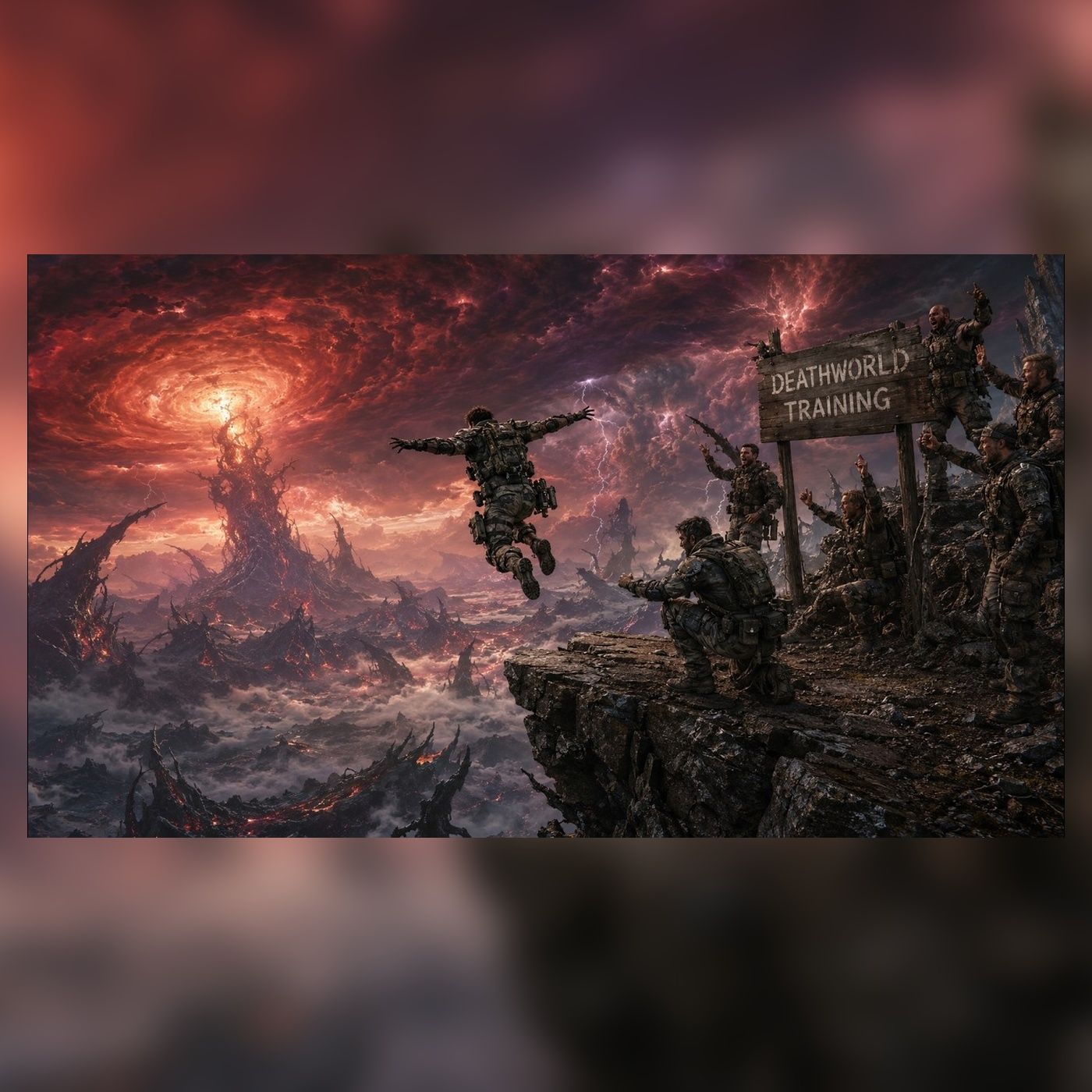
When an alien military command enrolled human recruits into extreme deathworld survival drills, they expected immediate surrender. Instead of breaking down under the lethal planetary conditions, the human soldiers treated the brutal obstacle courses like an exhilarating playground. Watch how the alien instructors realized too late what kind of predator species they had actually invited to train. Follow for more captivating sci-fi audio stories and human supremacy tales. #scifi #hfy #audiodrama #spaceopera #humanityfuckyeah
This episode includes AI-generated content.
Transkriptvom Podcast bereitgestellt · Zeitmarken springen hin
The dome cracked open above the human squad, and I braced myself for the screaming to start. My name is Vexthal Corrin, and I have run the Deathworld Adaptation Trial for 11 cycles. In that time, I have watched 340 species step into that dome. I have watched them fall to their knees. I have watched them beg for the simulation to end. I have watched proud warriors from the Kryzon Dominion weep like hatchlings when the gravity spiked to four times their homeworld's pull. The trial is not meant to be survived comfortably. It is meant to break something in you, so we can see what is left when the breaking is done. Today, the trial was for the newest members of the Grand Alliance. Humans. I did not
expect much. Their physical file sat on my display, and it was almost embarrassing to read. No claws. No venom. No exoskeleton. Skin so soft that a light scrape could draw blood. eyesight that failed in low light, hearing that missed half the frequencies most predators use to signal an ambush. By every metric my instruments could measure, humans were among the most fragile, sapient lifeforms the Alliance had ever accepted.
And yet, three cycles ago, a human diplomatic vessel had talked down an entire Skarn raiding fleet without firing a shot, and two cycles before that, a single human engineer had rerouted a collapsing reactor core on a research station while everyone else was ordered to evacuate. The Alliance Council did not know what to make of this species. Fragile bodies.
Unpredictable behavior. That combination made Command nervous, and nervous commanders send fragile, unpredictable species to me. So here I stood. in the observation tower above the dome, watching five humans step onto the churned red soil of the simulated death world for the first time. The atmosphere inside the dome was thin and bitter, laced with sulfur compounds that would sting any unprotected set of lungs. The gravity was set at one and a half times standard, enough to make every step feel like wading through mud. Storm clouds the color of a bruise rolled overhead, and somewhere past the ridgeline, The low horn call of a Grendrasi pack animal echoed across the rock. The first human out of the transport
pod was a woman named Priya Malhotra. She stumbled slightly as the gravity hit her, caught herself, and looked around with wide eyes. I activated my recorder. Here it comes, I thought. The fear, the regret, the pleading for extraction that always followed within the first ten minutes. Priya took a breath of the thin, acrid air. She coughed once, then she grinned. Oh, this is fantastic, she said, her voice carrying clearly through the dome's audio pickups. Feels like altitude training back home, except somebody added rotten eggs to the air. Behind her, a tall man named Callum Ashworth stepped down from the pod, immediately crouching to examine the cracked, mineral-streaked ground beneath his boots. Careful, Priya warned. ground soft
near the ridge. I see that, Callum said, poking at the dirt with a gloved finger. This is basalt, weathered fast, means there's volcanic activity nearby. Or there was. A third human, a woman with close-cropped hair named Freya Lindquist, tilted her head back and stared at the storm clouds with an expression that, on any other species, I would have called wonder.
Listen to that thunder, she said. It's got a rhythm to it, almost like a drumbeat. I frowned at my display. This was not fear. This was not even the calm, controlled discipline that some hardened species showed before the trial turned truly dangerous. This looked, disturbingly, like enthusiasm. The fourth human, a broad-shouldered man named Marcus Whitfield, hefted a simulated survival pack onto his shoulders and cracked his knuckles. All right, he said. Let's see what this planet's got. The fifth and final human, a smaller woman named Aisling Doyle, was already crouched by a jagged outcrop of rock, running her fingers along a vein of pale crystal embedded in the stone.
This mineral could be useful for filtering the water, she said, mostly to herself. If there's water here at all. I switched my display to their vital signs. expecting to see the telltale spikes of a fear response building beneath their composed exteriors. Elevated heart rate, yes. Elevated adrenaline, yes. But when I checked the secondary markers, the ones that measured dread and distress, I found something that made me recheck my instruments twice. The markers for enjoyment were climbing right alongside the markers for danger. I told myself this was a glitch in the sensor array. Species did not enjoy the Death World trial. It was not designed to be enjoyed.
It was designed to strip away comfort, safety, and certainty until only the rawest instincts remained, so we could measure what a species truly was underneath the layers of civilization. The first real test came within the hour, when a Grendrasi pack finally crested the ridge. I had seen the readings on Grendrasi before. Six legs, armored hide, a temperament best described as constantly hungry. In the wild, they hunted in packs of six to ten, using coordinated ambush tactics that had ended entire scouting expeditions from species far better equipped than humans. Three of them came over the ridge at a dead run, their claws tearing furrows into the rock.
I expected the humans to scatter, or freeze, or make some doomed attempt to flee toward the extraction beacon. Instead, Marcus Whitfield's voice rang out across the open ground, calm and sharp. Contact. Three o'clock. Freya, high ground. Callum, with me. Priya, Aisling, fall back to the outcrop and watch our flank. The humans moved. Not in panic, not in disarray, but in a pattern, each of them sliding into position as though they had rehearsed this exact scenario a hundred times before.
Freya scrambled up onto a rock formation and giving her a clear line of sight. Marcus and Callum planted themselves shoulder to shoulder, weapons raised, forming a barrier between the charging Grendrassi and the two women retreating to the outcrop. The lead Grendrassi lunged. Marcus sidestepped at the last possible moment, driving the butt of his weapon into the creature's flank hard enough to send it sprawling. Callum's shot caught the second one square in its exposed underside. the one place in its armor plating that had no protection. I had reviewed a hundred combat logs of a hundred different species facing this exact pack formation. Most of them died in the first exchange, or fled and were run down from behind.
The humans were fighting like they had studied the Grendrasi's weaknesses before ever stepping into the dome, which was impossible, because the Grendrasi were a simulation construct unique to this trial. The third Grendrasi, cornered and wounded, let out a screeching roar that should have sent any rational creature running. Freya, perched on her rock, let out a short, sharp laugh. Oh, I like this one, she called down. It's got spirit.
She put it down with a single, well-placed shot a moment later, and as the creature collapsed, she actually looked disappointed, as though the fight had ended too soon. I stared at my display in silence. The trial's algorithm registered the pack as neutralized within four minutes. My own combat evaluators back on my homeworld took an average of eleven minutes to clear a similar pack, and they were trained soldiers who had spent their entire lives preparing for exactly this kind of confrontation. Priya walked over to the fallen Grendrasi, crouching beside it with something that looked disturbingly like fondness.
Poor thing, she said, big scary teeth, and it still couldn't land a hit. Should we eat it? Callum asked, not entirely joking. Absolutely we should eat it, Marcus said. Waste not, want not. I want to be clear about something. In eleven cycles of running this trial, I have never once heard a recruit joke about consuming a creature that had just tried to kill them. Fear does not produce jokes.
Fear produces silence, or screaming, or the frantic scramble toward extraction protocols. What I was witnessing did not fit any pattern I understood. By the end of the first day inside the dome, the humans had built a shelter from salvaged debris and the bones of the Grendrasi pack, established a rough map of the surrounding terrain, and were sitting around a small fire, sharing rations and laughing about the encounter as though recounting a pleasant afternoon activity rather than a near-fatal predator engagement. I sat alone in the observation tower long after my shift should have ended, running the sensor logs over and over, searching for the malfunction that would explain what I had seen. There was no malfunction.
The instruments were functioning perfectly. The humans genuinely were enjoying themselves. Aisling's voice crackled through the dome's audio pickup as she leaned back against the shelter wall, staring up at the alien stars. You know, she said, for a planet that wants to kill us, it's actually kind of beautiful out here.
Freya laughed. Wait until tomorrow. I heard the trial gets harder the longer we survive. Good, Marcus said, tossing another piece of fuel onto the fire. I was getting bored. I switched off my display and sat back in my chair, feeling something I had not felt in eleven cycles of running this trial. It was not quite fear, and it was not quite confusion. It was the uncomfortable sensation of watching a system I understood completely begin to behave in a way I could not predict at all. Somewhere above the dome, in the true sky beyond the simulation, a council session was already being scheduled. Word of the day's readings had reached higher offices faster than I expected, and I had a feeling that tomorrow was going to bring
far more than an increase in gravity and predator density. I had no idea, in that moment, just how right I was. The morning brought a summons I had been dreading since the moment I filed my first day's report. Ambassador Shreet of the Kryzon Dominion requested my presence in the observation chamber before the second trial day began, and when a member of the Council's Oversight Committee requests your presence, you do not make them wait. I arrived to find Shreet already seated at the Central Console, reviewing the previous day's data with an expression I had learned over many cycles of working alongside the Dominion, to associate with barely contained alarm. Evaluator Corin, Sritt said without looking up, explained
these readings to me. I did not need to ask which readings. I had spent half the night trying to explain them to myself. The humans showed elevated positive affect markers throughout yesterday's engagement, I said. Enjoyment indicators, alongside the expected stress and adrenaline responses. I am aware of what the data says, evaluator. I am asking you to explain how this is possible. I hesitated, because the honest answer was that I did not know. It's possible the trial parameters were miscalibrated for this species. Human physiology is unusual.
Perhaps their threat response is simply wired differently than we accounted for. Sirith's crest flared, a chrysan expression I recognized as deep displeasure. The purpose of this trial, evaluator? is to determine whether a species can be trusted with the responsibilities of frontline alliance service without becoming a liability under extreme stress. If a species enjoys extreme stress, what exactly are we measuring? It was a fair question, and I did not have a good answer for it. Increase the difficulty, Sritt said. Today's environmental parameters will be escalated to Tier 3.
I want to see how these humans respond when the trial stops being pleasant. Tier 3 was not a setting I used lightly. It was reserved for situations where a species needed to be definitively and permanently disqualified from Alliance combat consideration, a setting so severe that most recruits from most species did not survive contact with it, let alone pass it. I had used Tier 3 exactly four times in eleven cycles, and each time the trial had ended within the hour. with extraction teams pulling broken, traumatized recruits from the dome. Ambassador, I said carefully, Tier 3 carries a significant risk of serious harm to the recruits. The humans have already demonstrated they can handle themselves in dangerous conditions,
Srit said. If they are as capable as yesterday's footage suggests, Tier 3 should present no undue risk. If they are not, then we will have learned something valuable about the limits of their capabilities. which is, after all, the entire point of this exercise. I did not agree with the logic, but I did not have the authority to override a council directive, so at 0600 hours I increased the gravity inside the dome to 2.2 times standard, thickened the toxic content of the atmosphere to a level that would require the human's rebreather units to work at maximum capacity, and released a second wave of predator constructs. this time including a full-breeding pair of Threxian sand hunters, ambush predators capable
of burrowing beneath solid rock and striking from below without warning. I watched the humans wake inside their makeshift shelter, and I watched their expressions shift as they registered the changes. Whoa, Callum said, stumbling slightly as he stepped outside and felt the increased gravity settle onto his shoulders. Someone turned up the difficulty overnight. Rebreathers, Reading toxin levels almost double what we had yesterday, Aisling said, checking a small display strapped to her wrist. This place really doesn't want us here.
I braced myself for the fear to finally arrive. Surely this was the moment the enthusiasm cracked. Marcus rolled his shoulders, testing the new weight pressing down on his frame, and then a slow grin spread across his face. Well, he said, guess the planet heard us complaining about being bored. Priya laughed, actually laughed, at that comment, and I stared at my instruments in disbelief as her vital signs registered genuine amusement rather than the fear I had expected. The Threxian sand hunters struck two hours later, exactly as designed, erupting from beneath the rocky ground in a spray of dust and debris, jaws already open, moving with a speed that had ended engagements with far more heavily armed and armored species in
a matter of seconds. I have reviewed the footage of that encounter more times than I can count, and I still find it remarkable. Freya was the one closest to the first hunter's emergence point, and instead of freezing or fleeing, she threw herself sideways with a speed that surprised even me, rolling clear of the creature's initial strike and coming up into a crouch with her weapon already tracking its second lunge.
Second one's coming up behind Callum, she shouted, and Callum spun without hesitation, driving his weapon into the ground creature's exposed flank as it broke the surface, the impact sending a spray of dark ichor across the red dirt. The fight that followed lasted nearly six minutes, longer than the previous day's Grendrasi encounter, and considerably more dangerous. Aisling took a glancing strike across her upper arm that tore through her protective suit and drew blood, real blood, the kind that would have ended most simulations immediately, as recruits were pulled for emergency medical extraction. She looked down at the wound, hissed through her teeth, and then, astonishingly, laughed. Okay, that
one's going to leave a mark, she said, pressing a field dressing against the cut with practiced efficiency. You all right? Marcus called, not slowing his own engagement with the second hunter. I'm great, Aisling shouted back. Ten out of ten would get bitten again, I sat frozen at my console, watching her vital signs. Elevated pain response, yes, exactly as expected from a wound of that severity. But layered beneath the pain, that same stubborn thread of enjoyment persisted, as though some part of her found the entire ordeal thrilling rather than traumatic.
By the time both sand hunters were neutralized, the humans had suffered two significant injuries, exhausted a considerable portion of their medical supplies, and used nearly all of their ranged ammunition. By any reasonable measure, this had been a costly, dangerous encounter. They sat together afterward, tending to Aisling's wound and Callum's bruised ribs, and the conversation that followed was not the shaken, traumatized processing I had witnessed from other species after brutal encounters.
It was closer to the kind of excited recounting I had heard from athletes after a hard-fought contest. Did you see the way that first one moved? Freya said, still catching her breath. Absolutely no warning. Straight up out of solid rock. I saw it, because you screamed a warning at exactly the right moment, Callum said. Good instincts. I heard the vibration in the ground half a second before it broke the surface, Freya said. Felt like a subway train coming. We should name them, Priya said suddenly. The scary rock monsters. Feels wrong to fight something and not know its name. Steve, Marcus offered immediately. The first one's Steve.
You can't name a monster that just bit Aisling Steve, Callum protested. Steve's a great name for a monster, Aisling said, still pressing the dressing against her arm. Very unassuming. Lulls you into a false sense of security. I stopped the playback there and simply sat in silence for a long moment. staring at the frozen image of five wounded, exhausted humans laughing together beside a fire on a planet actively trying to kill them. I began compiling my report to the Council with a growing sense of unease, because I understood, even then, that I was documenting something that had never happened in the entire recorded history of the Death World trial.
Every previous species that encountered Tier 3 difficulty had one of two responses. They either broke, curling into themselves in despair, or they hardened into grim, silent, joyless survival, the kind of stone-faced endurance that Alliance Command found reassuringly familiar because it matched their own species' response to extreme danger. The humans were doing neither. They were adapting, yes, and adapting quickly, faster than almost any species I had evaluated, but they were doing it while smiling, joking, naming the creatures trying to to kill them, and expressing something that could only honestly be described as delight. I submitted my report that evening, carefully noting every anomalous reading, every unexpected behavior. Every moment
where the human's response diverged from every predictive model the Alliance's evaluation system had ever produced. I did not editorialize. I simply presented the data and let it speak for itself. The response came faster than I expected, in the form of a message from Ambassador Shritt that contained exactly four words.
Escalate to Tier 4 immediately. Tier 4 was not a setting the Deathworld trial had ever officially used. It existed only in theoretical specification, a difficulty level designed by the Alliance's engineering corps as an absolute upper bound, a level intended to be so overwhelming that no species, regardless of physical capability, could reasonably be expected to survive contact with it for more than a few minutes. I stared at the message for a long time before responding. Ambassador, I wrote back, Tier IV has never been tested on a living recruit. The risk of fatality is extremely high. The response came within seconds. That is precisely the point, evaluator.
We need to know what breaks them. Every species has a breaking point. Find theirs. I looked out through the observation tower's viewport at the dome below, where five exhausted, injured, and inexplicably cheerful humans slept beside a dying fire, unaware that in a few hours I would be initiating a difficulty level that no living being had ever survived, and unaware that their response to it would change how the entire Alliance understood their species, forever. I did not sleep that night. I sat in the observation tower, running simulations, trying to predict what Tier 4 would do to these five people, and every model I ran— returned the same grim probability. Statistically, someone was not going to walk out
of that dome when the sun rose. I had never doubted the wisdom of the Death World trial before. That night, for the first time in 11 cycles, I found myself hoping, quietly and against every rule I was sworn to follow, that the humans would prove every one of my models wrong. Tier 4 began at exactly 0500 hours, and within the first 30 seconds, I understood why it had never been tested on a living recruit. The gravity generators strained audibly as they pushed the internal field to three times standard, a pressure that would crush the skeletal structure of most Alliance species within minutes of sustained exposure. The atmosphere thickened with a toxin blend so dense that the dome's ambient air turned a faint, sickly green, visible even through the
reinforced viewing ports of the observation tower. Storm systems that had rumbled ominously on the previous two days now tore across the simulated sky in genuine violence, lightning strikes touching down with enough force to turn patches of ground into glass. And then there were the Vorak. I want to explain what a Vorak is, because until that morning, I had only ever released Vorak constructs into empty simulation environments during calibration testing, never into a live trial with actual recruits present.
A Vorak is an apex predator construct, modeled after the single most dangerous creature ever cataloged by Alliance survey teams, a nine-legged horror the size of a transport vehicle, capable of moving in complete silence across any terrain, possessing a neurotoxin bite that could drop a creature four times its own body mass within seconds, and hunting not alone, but in coordinated groups that communicated through a combination of subsonic vibration and and chemical signaling that made ambush nearly impossible to detect. I released two of them into the dome that morning, and I did so with a churning, sick feeling in my chest that I had never experienced before in eleven cycles of this work. The humans woke to
gravity that immediately dropped two of them to their knees.' That' s not right,' Callum gasped, struggling to push himself upright against the crushing new weight.' That' s not right. That's too much. Too fast.' Priya was on the ground, one hand pressed against her chest, breathing in short, controlled bursts. Everyone, slow breathing, she managed. Slow breathing. Don't fight the weight. Work with it.
I watched, and for the first time since the trial began, I saw genuine strain in their vital signs. A spike in cortisol and adrenaline that finally, finally matched the fear response I had expected from the very beginning. But I did not see panic. Marcus forced himself upright, one hand braced against the wall of their shelter, his face pale, but his voice steady. Report. Everyone sound off. Here, just about, Aisling grunted. Here, Freya said, her voice tight with strain but controlled. Here, Callum managed. Here, Priya said, pushing herself up despite the crushing gravity. Okay. Marcus said. This is bad.
This is genuinely bad. But we've handled bad before. We adapt, we move slow, we conserve energy, and we figure out what's changed. I sat forward in my chair, watching the readings with an intensity I had never felt during a trial before. Something was different this time, and I needed to understand what. The atmosphere sensors on their suits began flashing warnings, the toxin density finally exceeding what their rebreather units were rated to filter indefinitely. Rebreathers are struggling, Aisling reported, her voice tighter now. We've got maybe six hours before the filters saturate completely. Then we find shelter with cleaner air pockets, or we find a way to extend filter life, Marcus said. Aisling, can you rig something? Give me twenty
minutes and access to that mineral vein I found yesterday, Aisling said. The crystal structure might work as a rudimentary filter medium. This is the part of the report that I have rewritten more times than any other section, because I struggled, and continue to struggle, to adequately convey what I witnessed over the following hours. Under conditions that should have produced total physiological collapse, under gravity that should have made even standing an exhausting struggle, breathing air that was slowly poisoning them, the humans did not stop functioning. They slowed down, yes. They moved with obvious difficulty. Every action clearly cost them more effort than it should have. But they kept moving, kept problem-solving, kept supporting one another with
a coordination that showed no signs of the fear-driven breakdown I had expected. The Vorak found them four hours in. I had reviewed the sensor data leading up to that moment perhaps a hundred times since, and I still cannot identify the exact instant the creatures made their presence known, because Vorak do not announce themselves. Freya simply went very still, mid-sentence, and held up a closed fist, the universal signal for silence that I had somehow not expected humans to share with several other Alliance species. Something's here, she whispered. I don't see it. I feel it. Ground's wrong. Wrong how?
Marcus whispered back. Vibration patterns off. Too smooth. Something's moving without touching the surface directly. I stared at my display in disbelief. The Vorak's silent movement had been specifically engineered to be undetectable by conventional means. And yet this human, using nothing but instinct and whatever subtle changes she had noticed in the ambient environment, had somehow sensed its approach before it struck. The first Vorak emerged from beneath a rock formation eight meters to their left, and even with Freya's warning, the sheer speed of its charge nearly caught them completely off guard. Its nine legs propelled it across the broken ground in a blur, jaws already parting to reveal the twin neurotoxin fangs that had ended so many
theoretical simulations in the engineering division's calibration tests. What happened next? I have watched more times than any other footage in my career, because I genuinely could not believe it the first time I saw it. Marcus did not run. He threw himself directly into the creature's charging path, driving his weapon into its foreleg joint with every ounce of strength his crushed, gravity-strained body could produce, and the impact was enough to throw the Vorak's charge off just enough that its fangs closed on empty air a hand's width from his shoulder and instead of finding their mark. Now, he bellowed, and Callum, positioned exactly where their earlier coordination had placed him, fired directly into the exposed underside of the creature's thorax,
the one vulnerability that the Alliance's own combat database listed for this creature type, information the humans should not have had access to, and yet somehow had anticipated through nothing but careful observation of the creature's anatomy in the split second they had to assess it. The vorax shrieked, a sound that should have paralyzed any sapient creature with primal terror, and staggered backward. The second vorax struck from the opposite direction, precisely as its species-coordinated hunting pattern dictated, aiming for the moment when the human's attention was divided. Priya, still struggling against the crushed gravity, threw herself into its path anyway, using a length of debris as an improvised barrier, buying
Aisling the half-second she needed to complete whatever modification she had been making to her filter system and pivot with a small device that released a burst of concentrated chemical irritant directly into the creature's sensory organs. The Vorak recoiled, disoriented, and Freya's shot, fired with a precision that should not have been possible for someone whose body was being crushed under three times standard gravity, found the gap in its armor plating that the creature's momentary blindness had exposed. Both Vorak retreated, wounded and disoriented, back into the storm-lashed darkness beyond the human's small camp, and the five of them stood together and gasping, shaking, bleeding in several places, surrounded
by evidence of the most dangerous encounter any recruit had ever survived at this difficulty level. For a long moment, nobody spoke. I held my breath, waiting for the delayed reaction, the moment where the accumulated horror of everything they had just endured finally overwhelmed them. Aisling started laughing first, a slightly hysterical, breathless sound, but a genuine laugh nonetheless. We just fought off two of those things, she said. Two of them, under this gravity. I think I broke a rib, Callum said, still catching his breath. Worth it, Marcus said, sinking down onto a rock, his whole body trembling with exhaustion.
That was, without question, the single most intense thing that has ever happened to me, and I once got caught in a building collapse during an earthquake. You never told me about a building collapse, Priya said. Wasn't relevant until now, Marcus said. Point is, this was worse. And somehow, also more fun. More fun, Freya repeated. Disbelief and something like giddy exhilaration mixing in her voice. Marcus, I think that thing's teeth missed you by centimeters. I'm aware, Marcus said.
Adrenaline's still going. Ask me again in an hour. I might have a different answer. Right now, though, I feel incredible. I stopped the footage there, my hand hovering over the console, and sat in silence for a very long time. I had run this exact scenario in theoretical modeling dozens of times before authorizing its live release. Every model predicted a minimum 60% fatality rate for any recruit exposed to dual VOJ-ARAC contact under Tier 4 gravity conditions. The humans had not only survived, they had driven both creatures into retreat, sustained no fatalities, and were now sitting together in the storm-lashed dark, trading jokes about the encounter as though recounting a particularly exciting sporting event, I compiled my report with
hands that were, I noticed distantly, not entirely steady. The Council's response came almost immediately, and this time it was not Ambassador Schritt alone who requested my presence, but the full Oversight Committee. six representatives from six different Alliance member species, all of whom had apparently been monitoring the live feed in real time. Evaluator Corrin, the presiding representative said, a Threxian elder named Vorkal, whose species had, ironically, provided the genetic template for one of the very creatures that had just failed to kill the human squad. Explain what we just witnessed. I don't fully understand it myself, I admitted.
Their tactical coordination exceeds what we would expect from untrained civilians facing an unfamiliar threat. Their physiological resilience under extreme gravitational and toxic stress exceeds our models. And their psychological response to mortal danger appears to be, for lack of a better description, positive. Positive. Vorkal repeated slowly. Evaluator, are you telling this committee that this species enjoys facing death?
I am telling this committee- I said carefully, that their data suggests exactly that, and I do not yet understand why, and I believe we need to understand why before we make any further decisions about how to proceed with this trial. The chamber fell silent, and I could see, in the expressions of several committee members, the same unsettled confusion I had been carrying since the very first day of this trial.
We had built an entire evaluation system on the assumption that danger produces fear, and fear produces predictable, measurable responses that tell us everything we need to know about a species' fitness for alliance service. The humans had just proven that assumption catastrophically, fundamentally wrong, and none of us yet understood what that meant. Continue the trial, Vorkal said finally, after a long silence. But Evaluator Corrin, I want a full psychological and physiological analysis of these five recruits by the end of the next trial day. If this species genuinely does not fear death the way every other Alliance member does, that is either the most valuable asset we have ever discovered or the most dangerous liability we have
ever allowed into our military structure. We need to know which, before this goes any further. I left that chamber with a growing certainty that we were no longer conducting a simple evaluation trial. We were witnessing the early stages of a discovery, that would reshape how the entire Alliance understood the species it had so recently, and so cautiously, welcomed into its ranks. I returned to the observation tower and watched the humans sleep, huddled together for warmth against the storm still raging outside their shelter, and I found myself wondering, for the first time in my long career, whether the trial I had spent eleven cycles perfecting had ever actually been testing the right thing at all. News of what
was happening inside the dome did not stay contained to the oversight committee for long. Within two days, recordings of the Tier 4 Vorok encounter had somehow found their way beyond the restricted council archives, and I began receiving communications from sources I had never previously interacted with in my professional life. Alliance military officers requesting technical clarification on the readings.
academic researchers from three different species asking for access to the physiological data, and, most surprising of all, requests from human squads stationed elsewhere in Alliance territory, asking whether they could volunteer for future Death World trial sessions. I want to make clear how unusual this was. In 11 cycles of running this trial, I had never once received a volunteer request. Every previous species treated assignment to the Death World trial as a grim, unavoidable obligation, something to be endured because Alliance regulations required it, never something to seek out.
The request that finally made me understand how differently humans processed this entire situation came from a human military liaison named Declan Farrow. who submitted a formal petition on behalf of an entire infantry division requesting priority placement in the next available trial cycle. I read his petition twice before I fully absorbed what it said. Members of the 4th Terrestrial Division have expressed strong interest in participating in the Death World Adaptation Trial, the petition read. Following review of the available footage from the current trial cycle, Morale within the division regarding this assignment is, notably, extremely high. Soldiers have specifically requested this posting be treated as a reward
for exceptional service rather than a standard obligation. A reward. I sat with that word for a long time, trying to understand how an experience designed to break the spirit of even the most resilient Alliance species could possibly be perceived, by an entire human military division, as a prize worth earning. Meanwhile, inside the dome, the current squad's trial continued, and their behavior over the following days only deepened the mystery. By the fifth day of trial exposure, Aisling's improvised filtration system, built from the crystalline minerals she had identified on the first day, had successfully extended their rebreather capacity well beyond its rated specifications, a piece of field engineering that our
own technical division later reviewed with genuine admiration. The squad had established a semi-permanent camp near a rock formation that provided natural shelter from the worst of the storm activity, and had begun what could only be described as a systematic exploration and cataloging of the dome's environment. We should map the predator territories, Callum suggested during one of their planning sessions, which I observed with growing fascination. If we know where the Vorok are denning, we avoid those zones unless we choose to engage. Agreed. Marcus said, and we should track the storm patterns. Freya, you notice the lightning tends to concentrate around the higher ridgelines. Every time, Freya confirmed,
we stay low during storm peaks. We're basically fine. This was not the behavior of creatures being tormented by a hostile environment. This was the behavior of explorers systematically learning to master a challenging new territory. treating every danger as a puzzle to be solved, rather than a threat to be endured. The Vorak returned on the seventh day. this time in a larger pack of five, likely drawn by the scent of the earlier wounded pair, seeking to reclaim territory the humans had effectively claimed as their own. By this point, the humans had developed countermeasures. Ashling had rigged a simple alarm system using debris and taut cord that would alert them to ground vibration before the creatures could
achieve a surprise strike. Callum and Marcus had reinforced their shelter's perimeter with sharpened stakes fashioned from broken equipment, forcing any charging predator to slow before reaching striking distance. Freya had spent hours studying the creatures' hunting vocalizations and had begun to recognize patterns that allowed her to predict, with unsettling accuracy, when and from which direction an attack was likely to come. The resulting engagement lasted eleven minutes, the longest sustained combat encounter I had ever recorded in this trial's history, and ended with all five Vorak either killed or driven into permanent retreat, and all five humans not only alive, but functionally uninjured, thanks to the defensive preparations
they had spent the previous two days constructing. I watched the aftermath with something approaching genuine awe. Eleven minutes, Priya said, checking a small timekeeping device on her wrist. Not bad. We're getting faster. We should be, Marcus said. We've fought this exact species four times now, getting a feel for their patterns. I still say we should try capturing one instead of just fighting it off, Aisling said. Imagine studying one of these things up close, in a controlled setting.
The neurotoxin alone could be worth researching. You want to capture something that's tried to kill us four times, Callum said, though his tone suggested more amusement than disbelief. I want to understand something that's tried to kill us four times, Aisling corrected. There's a difference. Knowledge is the whole point of being here, isn't it? I paused the recording at that moment, struck by something in her framing that I had entirely failed to appreciate until then. the humans were not simply enduring the death world trial. They were treating it as an opportunity, a chance to learn, to test themselves, to gather understanding about an unfamiliar and hostile environment, in exactly the same spirit that a curious child might approach
a challenging new game. I began to understand, slowly and with growing unease, that our entire evaluation framework had been built on a fundamental misunderstanding of how danger and fear related to one another. We had assumed that all sapient species process mortal threat the same way, that fear is a universal constant, that the only variable across species is how well they manage to suppress or control that fear in the moment. Humans, it seemed, processed threat through an entirely different framework, one where danger and reward were not opposites, but were somehow intertwined, where the very act of facing something dangerous and prevailing against it produced a kind of satisfaction that other species associated only with safety and comfort.
The oversight committee's psychological analysis, completed at the end of the seventh trial day, confirmed what I had begun to suspect through direct observation. The report, compiled by a team of Alliance psychologists working alongside a human specialist named Dr. Neve Sullivan, who had been brought in specifically to help interpret the data, contained a passage that I have returned to many times since because it fundamentally reshaped how I understood the species I had spent a week evaluating. Human psychology, the report stated, appears to have evolved under conditions of persistent, unavoidable environmental and social threat throughout the majority of their species' developmental history. rather than developing an aversion response to danger,
a significant portion of human neurological reward circuitry appears to be directly linked to the successful navigation of risk. This is not a malfunction or an anomaly. This is, according to Dr. Sullivan, a core evolutionary adaptation that allowed the species to persist and expand despite originating on a world that, by any objective measure, ranks among the most consistently hostile environments ever surveyed by Alliance exploration teams. I read that passage and thought immediately of something Priya had said, almost as a passing joke, during their first night in the dome.
She had compared the simulation's harsh conditions to something called altitude training, a practice, I later learned, that humans voluntarily undertook, subjecting themselves to reduced oxygen environments purely to improve their physical performance. entirely of their own free will, with no external requirement forcing them to do so. Dr. Sullivan's report continued with an observation that struck me even harder than the first. It should be noted, she wrote, that human history contains extensive documentation of voluntary engagement with extreme danger for reasons ranging from scientific curiosity to simple recreation. Activities such as mountain climbing without safety equipment, deep exploration of
unmapped cave systems, and various forms of extreme athletic competition have been pursued by human civilians, not soldiers, not specialists, but ordinary members of the general population, purely for the psychological satisfaction such activities provide. This trial, by human standards, may in fact represent a relatively moderate example of the kind of voluntary risk humans have historically sought out. I set the report down, and sat in silence for a long time, trying to reconcile this new understanding with everything I had believed, throughout my entire career, about the fundamental purpose of danger. The Council reconvened on the eighth day, and this time, the discussion was considerably more heated than
any previous session. This changes the entire calculus of our evaluation system, Ambassador Sritt argued, his crest flaring with obvious agitation. If a species processes mortal danger as a rewarding experience rather than an aversive one, how can we possibly trust their judgment in genuine combat situations? A soldier who enjoys danger may seek it out unnecessarily, may take reckless risks that endanger their entire unit, may prioritize the thrill of combat over the actual strategic objective, or countered a Valisian representative named Korai. whose species had historically been among the most cautious voices on the Council. A soldier who does not fear danger, who does not freeze or panic, or
hesitate in the moment of greatest crisis, is precisely the kind of soldier who saves their entire unit when a more cautious species would have already broken and fled. We have seen five examples of exactly this behavior over the past eight days. Are we going to disregard direct observational evidence because it contradicts assumptions we have never actually tested before now. The debate continued for hours, and I found myself, uncomfortably, drawn into it directly, as committee members turned to me for clarification on specific behavioral incidents, tactical decisions, and physiological readings from the trial data. Evaluator Corrin, Vorkal finally said, addressing me directly, in your professional assessment, Based on everything
you have observed over these eight days, do you believe these humans represent a liability, or an asset, to Alliance military operations? I hesitated before answering, aware that whatever I said next would carry significant weight in a decision that would affect not just five individual recruits, but potentially the standing of an entire species within the Alliance. I believe, I said slowly, that we built this trial to identify species who could function despite fear. We never considered the possibility of a species that could function because fear itself operates differently within their psychology. I do not yet know whether that makes them more reliable or less reliable in the field. But I know that everything I have witnessed
over these eight days suggests capabilities that exceed our expectations, not despite their unusual relationship with danger, but specifically because of it. Vorkal considered this for a long moment. Then we require further data. Evaluator, prepare the final escalation. I want to see what happens when even this species finally reaches its limit. I felt a familiar unease settle over me as I received that directive, because I understood exactly what final escalation meant. The Death World trial's theoretical maximum setting, a level of environmental and predator threat, had never been authorized for use on any living recruit in the entire history of the Alliance's evaluation program, a setting that existed
purely as an engineering specification, never intended to actually be deployed. I returned to the observation tower that evening and looked down at the five humans, still cheerfully cataloging the dome's flora between combat engagements, completely unaware that tomorrow I would be releasing something upon them that no Alliance evaluator had ever dared to test on a living being before. I found myself, against every professional instinct I had cultivated over eleven cycles of this work, hoping desperately that they would prove capable of surviving what was coming. not because the council demanded it, but because some part of me had come to genuinely respect the strange, fearless curiosity these five
people had brought to a trial designed to destroy exactly that quality. The final escalation protocol required an authorization code I had never used before, and my hand hesitated over the console for a long moment before I entered it. I had spent the entire night reviewing the specifications for what the Engineering Corps called Terminal Configuration, a setting theorized during the original design phase of the Death World trial as an absolute upper limit, a scenario so severe that its purpose was never to be survived, only to definitively prove that some threshold of danger existed beyond which no sapient species could reasonably be expected to function. The gravity would rise to four times standard, a level that would
place catastrophic strain on skeletal and cardiovascular systems even for the most physically robust Alliance species. The atmosphere would become directly poisonous rather than merely toxic, requiring perfect rebreather function with zero margin for equipment failure. And the Environmental Collapse Protocol, a feature I had never once activated in 11 cycles, would begin a systematic breakdown of the dome's structural simulation itself, causing genuine ground destabilization, structural collapse of terrain features, and a final release of every remaining predator construct simultaneously, rather than in the carefully managed waves I had used throughout the previous week. This was not a test of endurance anymore.
This was, by design, an unsurvivable scenario, created specifically to establish an absolute limit that no species could be expected to exceed. I entered the authorization code at 0400 hours, and I watched the readings shift on my display with a growing sense of dread that I could not entirely suppress, despite my professional training. The humans woke to conditions that, within seconds, made every previous day of the trial look gentle by comparison.' Ground' s shaking!' Callum shouted over what had become a constant, grinding rumble beneath their shelter. This isn't storm activity. This is structural. Everyone up, now. Marcus's voice cut through the chaos, and I watched five figures scramble
out of their shelter just as the rock formation that had sheltered them for the past several days began to crack apart, massive fissures spreading across its surface with a speed that suggested the entire terrain feature was actively collapsing. The gravity hit them like a physical wall, and I watched all five humans stagger, several dropping immediately to their knees under a weight that their bodies, even after a week of gradual adaptation, were simply not built to withstand.
This is bad, Priya gasped, struggling to draw breath against both the crushing gravity and the genuinely poisonous atmosphere now seeping past the absolute limits of their rebreather capacity. This is really, genuinely bad. Everyone stay calm, stay together. I watched their vital signs with an intensity that made my own hearts race, and for the first time in the entire trial, I saw something that looked, finally, unmistakably, like fear.
Not panic, not the breakdown I had originally expected on the very first day, but a clear, sharp spike of genuine dread as their bodies registered, correctly, that this level of environmental hostility exceeded anything they had previously encountered. And then the predators arrived, all of them. Simultaneously, the full remaining roster of every dangerous construct the dome had ever contained released in a single overwhelming wave that no evaluation trial had ever unleashed on a living recruit before. Grendrasi packs, faster and more numerous than the first encounter. Threxian sand hunters, erupting from destabilizing ground that no longer offered any safe footing.
And Vorak, an entire pack of them this time, Circling the humans through air thick with poison and dust, their silent approach made almost irrelevant by the sheer chaos of the collapsing terrain around them. I nearly reached for the emergency termination protocol in that moment. Every instinct I had cultivated over eleven cycles screamed that this scenario had crossed from evaluation into something closer to execution. that no combination of skill or resilience could reasonably be expected to overcome conditions this severe. My hand hovered over the termination control, and I hesitated, because some part of me, the part that had spent eight days watching these five people refuse to break under conditions that should have destroyed them, wanted
to see what happened next. We're not going to survive this by fighting everything at once, Marcus shouted. His voice strained against the crushing gravity, but somehow still steady. We need to get to defensible ground, now. There, Freya pointed toward a rock formation that, unlike most of the surrounding terrain, appeared to be holding together despite the structural collapse spreading across the dome. High ground. Natural choke point. Only one real approach. Move. Marcus bellowed, and the five humans, injured, terrified, gasping for breath in poisoned air, under gravity that should have made running impossible, somehow forced their bodies forward, dragging each other along when individual strength failed, moving as a
single desperate unit toward the only defensible position visible in the collapsing landscape. They reached it with seconds to spare before the first Grendrasi pack closed the distance, and what followed was, by every measure I had ever used to evaluate combat performance— the single most desperate and remarkable fighting withdrawal I had witnessed in my entire career. Callum took a Grendrasi's claw across his thigh, a wound serious enough that I flagged it immediately for emergency extraction consideration, and yet he continued fighting, using the rock formation's narrow approach to funnel the attacking creatures into a bottleneck where only one or two could reach the humans at a time, buying his companions the seconds they desperately needed. Sand hunters,
incoming from below, Aisling screamed, and Priya, without hesitation, threw herself directly over the small crack in the ground where a Threxian hunter's approach had been detected, using her own body weight and a length of debris to jam the creature's emergence just long enough for Freya to put a shot through the gap that ended the threat. The Vorak pack circled at the edges of the chaos, waiting, I understood with cold clarity, For the moment when exhaustion and injury finally broke the humans' coordination, the moment their formation inevitably collapsed under the combined weight of gravity, poison, injury, and sheer overwhelming numbers, that moment, by every model my instruments had ever produced, should have arrived within minutes. It
did not come. I watched, transfixed, as five badly injured, thoroughly exhausted humans continued fighting, continued protecting one another, continued making split-second tactical decisions with a clarity that should have been impossible under conditions this extreme, for nearly 40 minutes, an engagement duration that exceeded every previous encounter combined by a significant margin. Marcus, we can't keep this up much longer, Aisling shouted, her voice raw with exhaustion, blood soaking through a dressing on her shoulder that had clearly failed to fully stop the bleeding. We're running out of ammunition, running out of strength. I know, Marcus said, and for the first time in the entire trial, I heard something in
his voice that sounded genuinely uncertain, genuinely afraid. I know. But we're still here. We're still fighting. That has to count for something. It counts for everything, Priya said, forcing herself upright despite obvious severe strain. We're not done yet. The Vorak pack chose that moment to commit to their final assault, all five creatures converging on the human's position simultaneously, clearly calculating, with whatever cold predatory intelligence the construct's design had granted them, that this was the moment of maximum vulnerability, the moment the prey finally broke. What happened next has become, within the Alliance's evaluation community, something of a legendary account, discussed and analysed far beyond the scope of my original report.
Rather than breaking, rather than scattering in the desperate panic that any reasonable model would have predicted, the five humans, without any verbal coordination that I could detect in the audio logs, moved into a tight defensive formation, backs pressed against the rock formation's narrow choke point, weapons raised, and simply refused to yield ground. Together, Marcus said, his voice carrying a strange, fierce calm despite everything, we hold together or we don't hold at all. The Vorak Pak's charge met a wall of coordinated resistance that should not have been possible from five people in their physical condition, and in the chaos of poison, collapsing terrain, and overwhelming predator assault,
something happened that no evaluation model had ever anticipated. They held. Not without cost. every single member of the squad sustained additional injuries during those final desperate minutes. Freya took a vorax fang across her forearm, the neurotoxin dose thankfully insufficient to fully incapacitate her given the creature's weakened state from previous encounters. Marcus was struck hard enough to crack ribs on his uninjured side. But when the dust finally began to settle, when the last Vorok retreated, wounded and disoriented, back into the collapsing terrain, five humans remained standing, together, alive, having faced the single most severe scenario the Death World trial had ever been designed to produce, and having survived it.
I sat in complete silence in the observation tower, watching five exhausted, badly injured people slowly lower their weapons. and I felt something I had never experienced before in eleven cycles of this work. It was not simply professional astonishment. It was something closer to genuine, profound respect. We're alive, Callum said, his voice disbelieving, as he slowly sank down against the rock formation, cradling his injured leg. I genuinely was not sure we would be. Neither was I, Marcus admitted.
and for the first time I heard the true weight of what they had endured in his voice, the fear he had kept carefully controlled throughout the entire ordeal finally surfacing now that the immediate danger had passed. That was, without exaggeration, the hardest thing I have ever done. Was it worth it? Aisling asked quietly, pressing a fresh dressing against her shoulder wound. There was a long pause before Marcus answered, and when he did, His voice carried a quiet certainty that I have thought about often in the time since. Yes, he said simply, it was terrifying. I have never been more afraid in my life. And yes, it was absolutely worth it, because we did it together, and we're still here. The Dome's environmental systems began their
scheduled shutdown sequence moments later, the trial's termination protocols activating automatically now that the terminal configuration scenario had run its designated duration. The gravity began to ease, the poisonous atmosphere began to clear, and the collapsing terrain, no longer actively destabilizing, began to settle into stillness. I submitted my final report to the council that evening, and for the first time in the entire trial, I found myself writing not as a detached evaluator cataloging anomalous data, but as someone who had witnessed something genuinely extraordinary and wanted, more than anything, to convey its full significance to the people who would decide what came next. The Death World Adaptation Trial, I wrote,
was designed on the fundamental assumption that fear is a universal constant among sapient species, and that the purpose of extreme danger is is to identify the threshold at which that fear finally overwhelms function. Over the course of eight days, five human recruits have demonstrated conclusively that this assumption does not hold true for their species. They experienced fear, genuine and severe fear, particularly during the final escalation. But that fear did not paralyze them. It did not fracture their coordination or their judgment. If anything, it seemed to sharpen their focus, deepen their commitment to one another, and produce a level of tactical performance that exceeded every theoretical model
this evaluation system has ever produced. I recommend, in the strongest possible terms, that the Alliance reconsider the fundamental design of this trial for human recruits specifically. This species does not need to be broken to reveal their true capability. Their true capability was on display from the very first hour of the very first day. and every subsequent escalation only confirmed what should have been obvious from the beginning.
Humans do not require extreme danger to prove they can function under pressure. They require extreme danger, apparently, because facing it alongside people they trust appears to be, for reasons our current understanding of psychology cannot fully explain, one of the most meaningful experiences their species is capable of having.
The Council's response... delivered three days later after extensive deliberation, formally revised the Death World Trial Protocol for all future human recruits, reducing the maximum escalation tier and introducing new evaluation criteria, specifically designed to account for humanity's unusual relationship with danger and reward. I visited the five recruits one final time before they departed for their next assignment. technically a violation of standard evaluator protocol, but one I felt, after everything I had witnessed, was entirely justified. I found them gathered in a recovery ward, injuries healing under Alliance medical care, already laughing together about some detail of their ordeal that I had apparently missed in my review of
the footage. Evaluator Corrin, Marcus said, noticing my approach and offering a respectful nod, despite his still healing ribs. Come to deliver our final scores. I came, I said, because I wanted to understand something, and I believe you are the only people who can explain it to me. Why? Why does danger feel, to your species, like something worth seeking out, rather than something worth avoiding at all costs?
Marcus considered the question for a long moment before answering. I think, he said slowly, it's because we've always known the world could kill us. long before your alliance ever built a trial to prove it. Our history is full of ice ages, disasters, conflicts, diseases that nearly wiped us out more than once. We didn't get a choice about facing danger. What we got to choose was how we felt about it. Somewhere along the way, our species decided that fear alone wasn't going to be the only thing we felt when the world tried to kill us. We decided we could feel alive too, determined too, even sometimes joyful, when we came through it together. I did not have an immediate response to that, because it fundamentally reshaped how
I understood every piece of data I had gathered over the previous eight days. There's something else, Aisling added, catching my attention. This trial, all of it, the gravity, the poison, the monsters, the collapsing ground. It was hard. It was genuinely, deeply hard. But it was also, somehow... one of the best experiences of my life, because I got to test myself against something real, alongside people I now trust completely, and we made it through. That combination, testing yourself and trusting your people, that's not something we're afraid of. That's something we chase. I left the recovery ward that evening with more questions than I had arrived with, but also with a profound new respect for a species that Alliance
Command had originally viewed as fragile, unpredictable, and potentially unreliable under pressure. The Death World trial had been designed, across every species that had ever encountered it, to find the point where danger finally broke someone. Humans had shown us something else entirely. They had shown us a species for whom danger, faced honestly and faced together, did not break anything at all. It built something instead, something the rest of the Alliance was only beginning to understand, and something I suspected, as I watched five exhausted, laughing, deeply satisfied humans prepare for their next assignment, the galaxy had not yet seen the full measure of. Steve, the very first Vorak they had ever named, became something of a legend
among human recruits in the trials that followed. Every subsequent squad requested to meet him, and every subsequent squad, upon learning that Steve had, in fact, survived multiple encounters, and continued to patrol a specific region of the dome's simulated territory, expressed something dangerously close to genuine affection for the creature that had, on paper, been designed to end their lives.
I no longer run the Death World trial the way I once did. The protocols have been revised, the escalation tiers adjusted, the entire philosophy behind the evaluation reconsidered from the ground up. But I still think, often, about that final report I submitted. and about the quiet certainty in Marcus Whitfield's voice when he told me that facing the world's worst, together, was something his species had learned not to fear, but to embrace. We built a trial to find a species' breaking point. Humanity simply never had one to find.
