

Avant on croyait que ...· Folge 10
Ernest Rutherford et l'atome presque vide
Mittwoch, 28. Oktober 2026 · 9 min
Kapitelklicken springt direkt hin
Shownotes
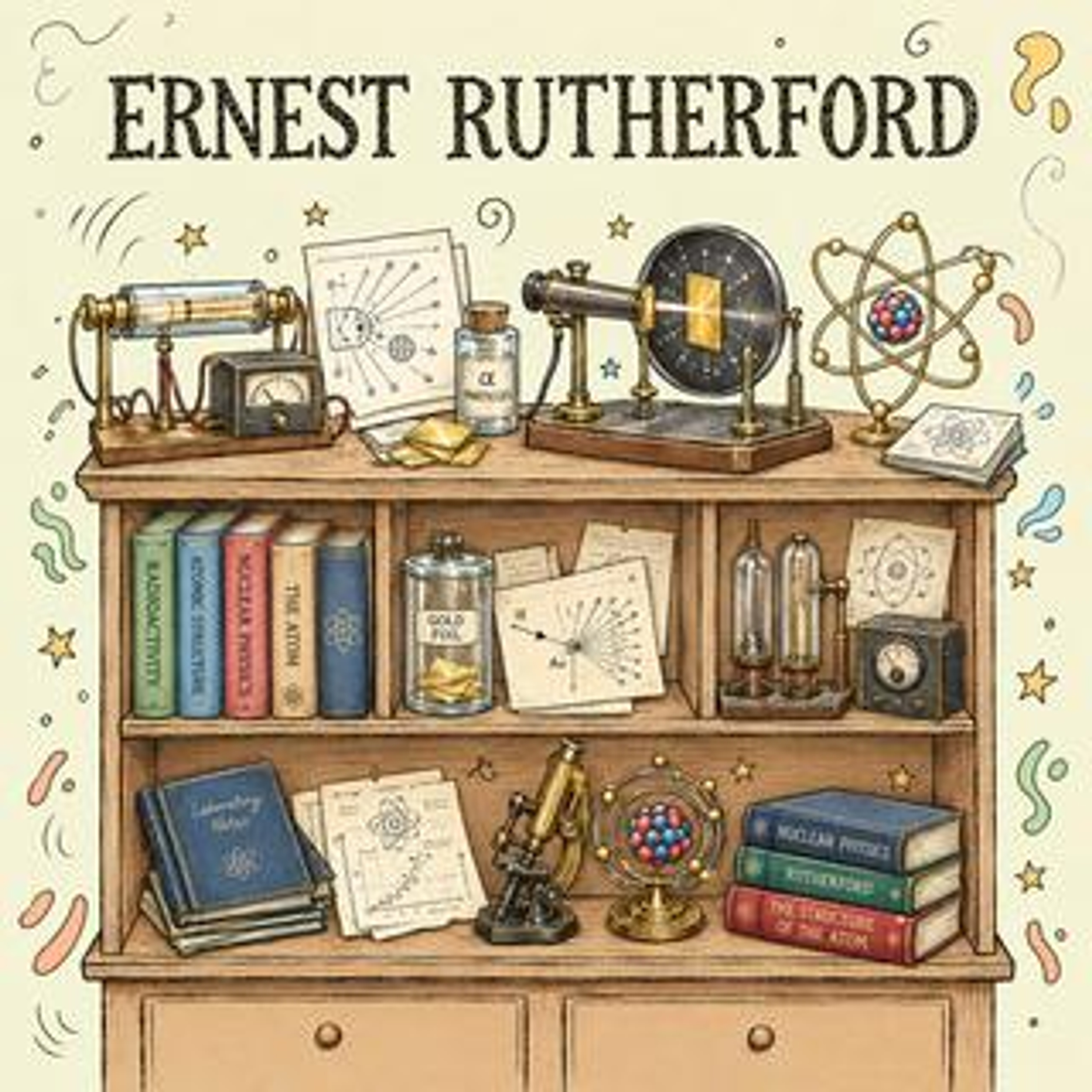
<html><p>Si on coupe un carré de chocolat en deux, puis encore en deux, puis encore... est-ce qu'on peut continuer pour toujours ? Il y a très longtemps, un philosophe grec a répondu non. À la fin, on tombe sur un grain si petit qu'on ne peut plus le couper. Il l'a appelé atome : « qu'on ne peut pas couper ». Et pendant longtemps, on a imaginé l'atome comme une petite bille pleine.</p><p>Ernest Rutherford est né en Nouvelle-Zélande, tout au bout du monde. En Angleterre, avec Hans Geiger et un étudiant, Ernest Marsden, il envoie de minuscules projectiles sur une feuille d'or. Presque tous passent tout droit. Mais quelques-uns rebondissent ! Pour Rutherford, c'est la chose la plus incroyable de toute sa vie.</p><h3>Dans cet épisode</h3><ul><li><p>Deuxième à la bourse, mais il part quand même</p></li><li><p>Le prix Nobel de chimie, pour un physicien</p></li><li><p>L'atome en cake aux raisins</p></li><li><p>Compter des éclairs dans le noir, pendant des heures</p></li><li><p>Un boulet de canon qui rebondit sur un mouchoir en papier</p></li><li><p>Un atome presque vide, avec un noyau minuscule au milieu</p></li><li><p>Le dessin de l'atome : un outil, pas une photo</p></li></ul><h3>Pour aller plus loin</h3><p>Fais l'expérience de Rutherford, sans radium ! Pose une planche, ou un grand carton épais, sur quatre piles de livres. Un adulte cache dessous un objet : une boîte, une tasse, un livre. Toi, tu ne regardes pas.</p><p>Fais rouler des billes sous la planche, de tous les côtés. Regarde où elles ressortent. Tout droit ? De travers ? Renvoyées vers toi ? Avec tes observations, dessine la forme de l'objet caché. Puis soulève la planche pour vérifier. Rutherford n'a jamais vu le noyau : il l'a deviné, avec des rebonds. Attention, les billes ne sont pas pour les tout-petits.</p><p>Le savais-tu ? Il existe un élément chimique qui porte son nom : le rutherfordium. Et son visage est sur le billet de cent dollars de Nouvelle-Zélande.</p><h3>Sources</h3><p><strong>Le personnage</strong></p><ul><li><p><a href="en.wikipedia.org/wiki/Ernest_Rutherford"; target="_blank">Ernest Rutherford, Wikipedia (en anglais)</a></p></li><li><p><a href="encyclopedia.com/people/history/british-and-ir…; target="_blank">Ernest Rutherford, Encyclopedia.com (en anglais)</a></p></li><li><p><a href="physicstoday.aip.org/features/ernest-rutherfor…; target="_blank">« Ernest Rutherford's ambitions », Physics Today (en anglais)</a></p></li><li><p><a href="physicsworld.com/a/breaking-boundaries-how-the…; target="_blank">« Breaking boundaries: how the physicist Ernest Rutherford won the Nobel Prize for Chemistry », Physics World (en anglais)</a></p></li><li><p><a href="cerncourier.com/a/rutherfords-nobel-prize-and-…; target="_blank">« Rutherford's Nobel prize and the one he didn't get », CERN Courier (en anglais)</a></p></li></ul><p><strong>Le cake aux raisins et la feuille d'or</strong></p><ul><li><p><a href="en.wikipedia.org/wiki/Rutherford_scattering_ex…; target="_blank">Rutherford scattering experiments, Wikipedia (en anglais)</a></p></li><li><p><a href="chemteam.info/Chem-History/GM-1909.html"; target="_blank">H. Geiger et E. Marsden, « On a Diffuse Reflection of the α-Particles », </a><em><a href="chemteam.info/Chem-History/GM-1909.html"; target="_blank">Proceedings of the Royal Society A</a></em><a href="chemteam.info/Chem-History/GM-1909.html"; target="_blank"> 82 (1909), ChemTeam (en anglais)</a></p></li><li><p><a href="web.chemteam.info/AtomicStructure/Rutherford-E…; target="_blank">Rutherford's Experiment, histoire de 1906 à 1911, ChemTeam (en anglais)</a></p></li><li><p><a href="hyperphysics.gsu.edu/hbase/Nuclear/rutsca2.htm…; target="_blank">History of Rutherford Experiment, HyperPhysics (en anglais)</a></p></li><li><p><a href="galileo.phys.virginia.edu/classes/252/Rutherfo…; target="_blank">Rutherford Scattering, Université de Virginie (en anglais)</a></p></li><li><p><a href="cerncourier.com/a/rutherford-the-road-to-the-n…; target="_blank">« Rutherford: the road to the nuclear atom », CERN Courier (en anglais)</a></p></li><li><p><a href="encyclopedia.com/people/science-and-technology…; target="_blank">Hans Geiger, Encyclopedia.com (en anglais)</a></p></li></ul><p><strong>Le noyau, le vide, et le problème</strong></p><ul><li><p><a href="en.wikipedia.org/wiki/Rutherford_model"; target="_blank">Rutherford model, Wikipedia (en anglais)</a></p></li><li><p><a href="en.wikipedia.org/wiki/Bohr_model"; target="_blank">Bohr model, Wikipedia (en anglais)</a></p></li><li><p><a href="pbs.org/newshour/science/just-ask-what-would-a…; target="_blank">« What would a baseball-sized atom look like? », PBS NewsHour (en anglais)</a></p></li></ul><p><strong>Aujourd'hui</strong></p><ul><li><p><a href="home.cern/fr/science/physics/"; target="_blank">La physique, CERN</a></p></li><li><p><a href="kids.britannica.com/kids/article/subatomic-par…; target="_blank">Subatomic particle, Britannica Kids (en anglais)</a></p></li><li><p><a href="openstax.org/books/college-physics-2e/pages/33…; target="_blank">Introduction à la physique des particules, OpenStax, </a><em><a href="openstax.org/books/college-physics-2e/pages/33…; target="_blank">College Physics 2e</a></em><a href="openstax.org/books/college-physics-2e/pages/33…; target="_blank"> (en anglais)</a></p></li><li><p><a href="fr.wikipedia.org/wiki/Rutherfordium"; target="_blank">Rutherfordium, Wikipedia</a></p></li></ul></html>
