

Kapitelklicken springt direkt hin
Shownotes
<p>I bet you’ve noticed it too. Everything we buy just seems cheaper, flimsier, and worse than it used to be. Some call it the "enshittification" of everything. </p>
<p>And almost everyone blames the exact same thing: corporate greed and the failures of capitalism. </p>
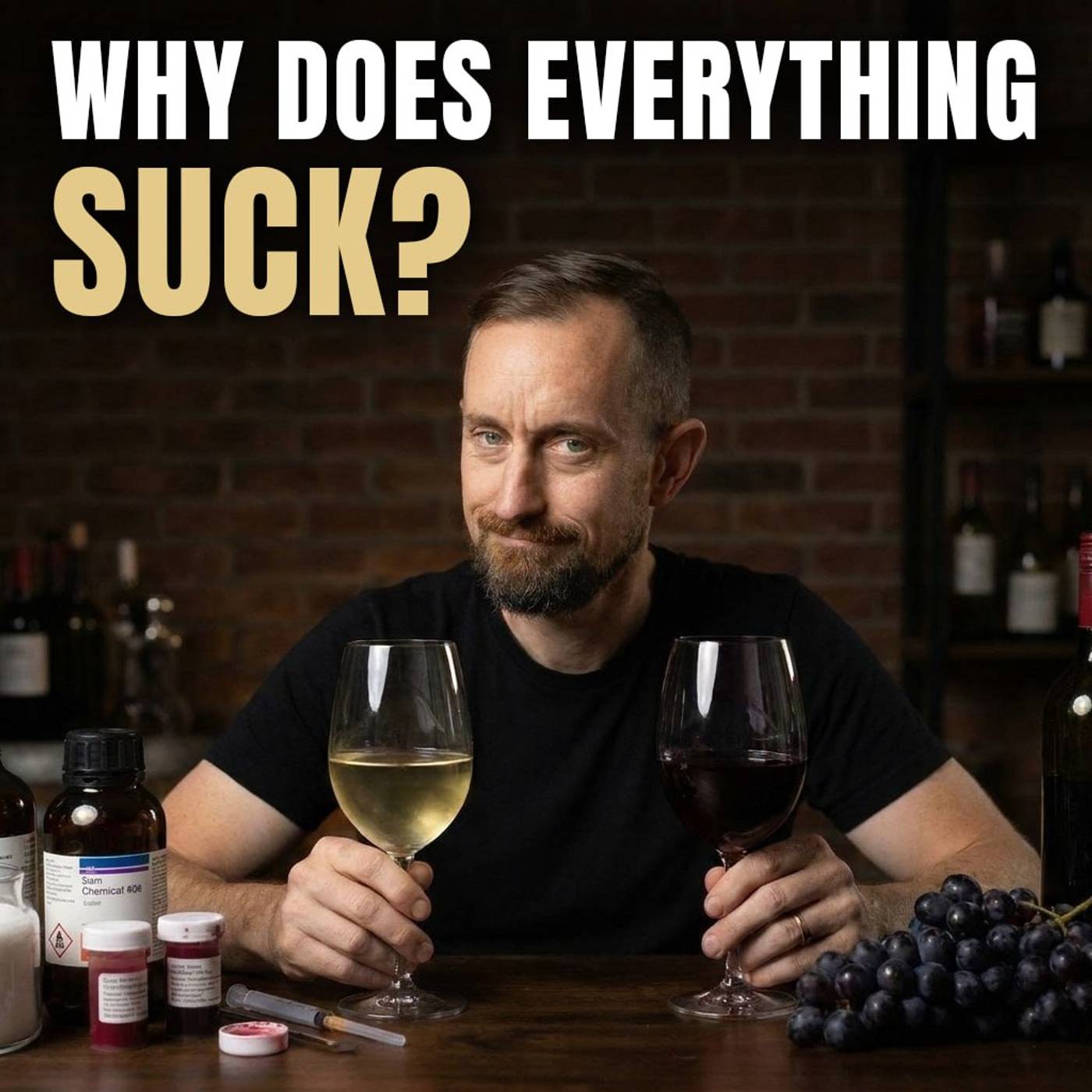
<p>In this episode, I’m sharing my take on the real reason our world feels like it's falling apart. I use a simple story about two winemakers to show how this broken fiat system actually punishes honest businesses and heavily rewards the ones cutting corners. </p>
<p>We aren't in a race to the bottom because companies are inherently evil, but because our money forces them to cut corners just to survive. Yet this is actually a solvable problem. We just have to fix the money first. </p>
<p><strong>Chapters</strong> </p>
<p>() - The enshittification of everything </p>
<p>() - “Greed” is not an answer </p>
<p>() - Monetary inflation </p>
<p>() - The winemaker story </p>
<p>() - Honest producer squeezed </p>
<p>() - Savings and investment </p>
<p>() - Sound money incentives </p>
<p>() - Monetary inflation rewards crap </p>
<p>() - Beyond wine </p>
<p>() - Capitalism vs central banks </p>
<p><strong>Affiliate Links</strong>\ </p>
<ul>
<li>Become sovereign, hold your keys, be censorship resistant with the Bitbox hardware wallet. Get 5% off everything in the store with code GUY (Link: <a href="bitbox.swiss/guy/">https://bitbox.swis…;)\</li>
<li>Get 10% off the best Bitcoin board game in the world, HODLUP! Or any of the other great games from The Free Market Kids! Use code GUY10 at checkout for 10% off your cart! (Link: <a href="freemarketkids.com/collections/games-1"&g…;)
<strong>Host Links</strong>
Guy on Nostr (Link: <a href="tinyurl.com/2xc96ney">http://tinyurl.c…;)
Guy on X (Link: <a href="twitter.com/theguyswann">https://twitt…;)
Guy on Instagram (Link: <a href="instagram.com/theguyswann">https://www…;)
Guy on TikTok (Link: <a href="tiktok.com/@theguyswann">https://www.t…;)
Guy's Takes on YouTube (Link: <a href="youtube.com/@GuysTake">https://www.you…;)
Guy Swann on YouTube (Link: <a href="youtube.com/@theguyswann">https://www.…;)
Bitcoin Audible on X (Link: <a href="twitter.com/BitcoinAudible">https://tw…;)
The Guy Swann Network Broadcast Room on Keet (Link: <a href="tinyurl.com/3na6v839">https://tinyurl.…;)</li>
</ul>
Transkriptvom Podcast bereitgestellt · Zeitmarken springen hin
I bet you've heard the term in shittification and understand the notion that everything we have seems to be falling in quality and in substance. But why, if our technology is becoming wildly more advanced, why would the quality of the products on the market be decreasing? Why would we be taking real ingredients out of foods and then replacing them with artificial sweeteners and flavors made out of chemical plant and dyes that are just used to make it look like what it used to be.
And I'm irregularly told that capitalism has done this. Down with capitalism! I'm going to walk you through the exact incentives step by step and look directly at the source of why this phenomenon is happening and share something that you might think sounds crazy, that this is actually a solvable problem, just probably not in the way that you think.
First up, almost any conversation you run into about this, people are invariably saying, well, this is capitalism for you, or the government should regulate this behavior, or some other thematically similar conclusion. If you're one of those people, or one of the ones that's likely to just think, ah, greed did this, I want you to stay and watch this video, and follow a real explanation of how the incentives can be turned upside down.
And understand that greed is not an explanation for anything. Especially for something that was good once and bad now. Well, why was it good before? Greed wasn't any different then. Like, what was the actual process? Greed is no more a process or an incentive structure or an understanding of what happened in an economy any more than gravity as an explanation as to why a plane crashed.
That was 90% gravity. Then after I'm done with that explanation, I am going to challenge you to explain to me why the conditions are exactly as I laid out and what I said did not happen. Or more importantly, why the opposite would actually happen despite the incentives that I've laid out. So what is my claim?
It's that this is a consequence of consistent, compounding monetary inflation. This is simply the result of when you print enormous amounts of money and issue enormous amounts of debt arbitrarily. And importantly, you cannot regulate your way out of it. To explain why, I want to use a story about two winemakers.
So first, we have a winemaker who is honest. He wants to make a really good quality product, and he wants to out-compete with better wine than his competitors. Our second winemaker is perfectly willing to compromise quality or mislead in the advertising, and generally compromise on anything except for their profit margins.
Now since 1970, the average rate of monetary inflation, that is new money and new debt being issued into the economy, is 7% compounding every single year. Notice this is monetary inflation, not price inflation. And I hope that you'll understand why that is such a significant distinction at the end of this.
We're not talking about the price of wine going up and how much it goes up. We're talking about how much money there is chasing the same quality of wine. So 7% inflation means that if they don't cut costs, if they don't drastically improve their production process, if they don't cut workers, if they don't decrease either the quality or the cost of the inputs for their product, and they keep their product exactly the same, it will cost 7% more the following year to produce and sell the same thing for the same price. Entire profit margins for companies are very often not that high. In fact, that's very close to the average, meaning that a consistent company with a consistent product that doesn't cut corners and a consistent price can one year make the median
return and net margin on their product. And the very next year, they're taking a loss on the exact same thing. Our honest winemaker wants to keep his product true. So he tries to cut costs in any way that he can. He cuts 20% of his customer service reps because he doesn't want to change the ingredients. He looks for any efficiencies. He looks for any fat in the company to try to lean it down and sell the same product at the same price to the same customers.
He is able to quickly cut about 3% of his costs, but still has to raise the price of his wine 4%. The dishonest winemaker, however, has way more tools available to him. He can literally just water down his wine and add in some sugars and some dyes and some artificial flavorings and emulsifiers to make his product 10 cheaper and sell it for the exact same price and actually bump his margin by 3%. Meaningful improvements and smart cuts take time. Cheapening the quality of the product or buying worse ingredients is something that can be done very, very quickly. What do the customers see. They see the winemaker that they trusted raise prices on them when everything is getting less affordable. And they honestly and rightfully feel cheated. Why did you take a product that I
could afford in my budget and make it no longer fit what I need? And so the narrative of the evil greedy corporation milking them for another three to four percent travels around very quickly and naturally. And the dishonest winemaker is more than happy to spend a little bit of his new profit to support that narrative. The dishonest winemaker ramps up their dishonest marketing and the bending of the truth and they stop focusing so much on the quality of their product and just kind of call it really great wine, and they really focus on the price. Let's make sure that we advertise that our price is lower, that our price is the same, and it's those other guys that are taking your wealth.
The honest winemaker tries to explain that they just have a really high quality product, and they look pompous and arrogant, instead of like an honest winemaker trying to keep his product true. The natural, shallow conclusion for the customer is that the honest winemaker is trying to cheat them, and the dishonest one is their friend. And frankly, nobody has the time to dig into every single reason and every single product and every single thing they interact with or maybe buy to find out the truth. Seriously, everything's more expensive than it was last year. Who has the time for that? So instead, they take the option that remains in the budget they've allocated for frivolous things like a glass of wine at the end of the day. The honest winemaker loses 5%
of their customer base, and the dishonest one gains it. And this happens again the next year, and the next year, right up until our honest winemaker decides most likely to sell to a higher clientele. Their quality product, which is just wine, now becomes something that you only sell to rich people, or they have to finally compromise on what they really don't want to compromise, their values and their reason for doing what they love, for making a good bottle of wine.
And they have to focus entirely on the profit margin and how quickly they can get it. There's actually another layer to this, and it's when you look at their savings. Monetary savings is just the record of the value that you've produced that you are now owed back from society. It's a promise that you'll get back what you put in.
That's it. So the winemaker, the honest one, decides that if he has a really good, meaningful improvement to his capital stock, then he could actually produce the same quality of wine at a lower price and do so sustainably. It's a significant technological process and structural change to the company, and it's going to take five to ten years.
It's a heavy, long-term investment to genuinely increase the quality and output of the company. The dishonest winemaker, however, is happy to continue on his rampage of short-term, quick quality and ingredient cuts to get a higher profit margin right now. Understand, in an inflationary environment, the longer you wait to make money, the more it costs you.
in an environment with sound money, where production and improvements in technology is manifested in the economy as things getting more affordable, the longer you wait and the longer your investment horizon, the more it benefits you. Now, the cost of the investment, all of the inputs is actually increasing by 7% every single year he's engaged in this project.
while not only is he taking his profit margin and investing it into this bigger enterprise and structural change to make his company better, he's also losing his profit margin by the same inflationary amount. Pretty quickly, the honest winemaker is wishing he had a one-year plan for a much faster and cheaper return.
The dishonest winemaker, on the other hand, is actually gaining customers through all of this because they're naturally leaving the honest one, While at the exact same time, they're happily cutting the quality, cutting their customer service, cutting the time that they care about any one version or brand of their wine, and just expanding as fast as they possibly can and taking on debt and further increasing the costs of all the inputs that the honest winemaker is having to compete for.
The honest winemaker is raising their price yet again by another 5%. And again. And again. The inconsistent and dishonest product is getting the benefit of looking like it has an honest, consistent price. While the honest and consistent product appears to have an inconsistent and profit price Eventually the honest winemaker either submits to embracing the snob and only selling to high-end customers because they have a product that is actually real wine, or they have to cut the same corners and make the same short-term, quick-profit trade-offs to grow their business again and compete to lower the quality of the product and try their damnedest to make it look like it's still the same thing.
Or one that is far too often taken. They become disenfranchised with the whole thing. They fall out of love with the thing they love to do, make good wine. And they sell out to the dishonest winemaker, who now buys and owns both brands because they just took on a big bunch of cheap debt and offered him a really good price for what was high-quality wine.
And they do a lot of the same corner cutting and now they have an even larger profit margin with the fancy wine and they also own the cheap wine. And everybody who went the dishonest route, who went for the cheap debt, who went for the short term expansion and corner cutting is benefited in the same way in every single industry.
And they have no intention or no need and they would likewise be punished by the prices if they took and made real serious structural investments and changes. When really all they have to do is take on debt and buy their squeezed competitors that have real products. It is actually cheaper and more profitable for them to take on debt to simply buy legitimate competitors that are being squeezed for their high quality inputs, then lower the quality of the inputs and keep taking advantage of the high quality brand and move on to the next company and consolidate, consolidate, consolidate as fast as they can.
Now let's turn this around and apply this to a sound money economy where technology, the capital investment, improves on average by 3% every single year, and the money supply stays the same. In that economy, everything will naturally and on average get 3% more affordable every single year. The honest winemaker has their costs decrease by 3% every year for the same quality of product.
Their customers never have any reason to hate them or think that they're being cheated. And they can either simply lower the cost of their product and pass those savings on and keep a consistent profit margin, or they can take that extra 3% and use it to grow the company by making those long-term capital investments to make a better product at lower cost.
Well, what about the dishonest winemaker? They still have a lower-cost product, right? They have a cheaper wine that they can sell cheaper. Well, they have a customer base that's not really worried about the price because the price hasn't changed or it already went down. So their cheap product just looks like what it is.
Cheap. Nobody wants cheap, low-quality crap. It's what they buy if they can't afford good-quality stuff. And so the honest winemaker has every incentive and is rewarded in every way for making long-term genuine investments, for increasing their production with all of their high-quality inputs, and for lowering and passing those savings on to the customers.
They can make it consistently better and more affordable, all while their ingredient list still just says grapes. the higher prices only happen because of money printing. If the money supply remains consistent and the economy becomes more technologically advanced and continues to grow, everything would always get more affordable.
And it indirectly encourages higher quality, more focus and time spent on the customer. It rewards consistency, and it rewards simplicity and meaningful technological advances, not frivolous hype that's easy to sell to VCs. While ever higher prices and constant money printing reward short-term gain, reward quick, cheap cost-cutting, it rewards planned obsolescence and arbitrary next versions.
It rewards the pushing and replenishing of your inventory as fast as possible. It rewards profit margin today over genuine capital investment tomorrow or next year. It rewards lowering the quality of the product to keep the price stable. And it rewards taking on debt that is offered at impossible prices to just buy up market presence rather than making meaningful capital improvements to the company.
All the while, there is a race to the bottom to create the crappiest legitimate quality product to appear to be the highest quality product that still fits into the lower standard of living and the budget available for the people who are stuck on the same wages. In other words, your stuff didn't get cheap and crappy because of evil companies.
And the solution isn't simply putting good ingredients back in food. The problem is that people cannot afford high quality ingredients because inflation made us all poorer And we were all getting 5 pay wages on a 7 monetary inflation all while the government measured inflation by pointing at the most popular wine on the market.
And look how stable its price is. While a careful observer will note that we started buying a different wine. The most popular wine five years ago had grapes on its ingredients list. While the popular wine everyone is buying today is full of sulfites and emulsifiers and potassium bicarbonate and some extra acid and a little bit of water and some sugar and maybe a couple of colored eyes to make it seem really vibrant.
Keep in mind that this isn't about wine. It's about everything. It's about the quality of houses as plywood becomes OSB, and OSB turns into fiberboard, and stone becomes vinyl, and hardwood becomes plastic. It comes in kind of rushing over the finishing touches and really caring for the customer in order to just turn over and get to the next project as fast as possible.
It comes in the form of built-in obsolescence for a product, forcing a shorter life cycle to hardware that works perfectly fine. It comes in the cutting of customer service and direct care and attention to the user. It's talking to more robots on the phone. It comes in the shrinking of candy bars and tin ingredients that you can't even pronounce.
It comes in the form of a giant corporation blasting through the economy at breakneck speed that doesn't make a profit for 10 years. and all it does is expand and grow and get investment and expand and grow and consume as much of its competition as it possibly can in a race to be the biggest thing that exists.
What else would you do if you're getting money lent to you at 1% to 3% when the price of everything is going up 5% to 7%? All you have to do is own it. All you have to do is own it and you've got a margin. You don't have to build anything. You don't actually have to improve things. That's a very difficult thing to do.
getting a loan and buying something, much easier problem. While everybody else is paying 28% on their credit card and 18% on their car loan, it comes in the puffening of everything. Less and less food designed to take up more and more space. And it shows up in depleted and never replenished savings accounts. In retirements that don't even have anything of meaning in them and dependency on whatever the government social safety net is going to be.
Which ironically is the very institution responsible for the problem. It turns having to dip into savings during an emergency or an unexpected storm into taking on more debt and spending four months paying off three months worth of money. It comes in the buy now, worry about it later culture. It comes in a sense of entitlement and distrust between consumer and producer.
And it comes in the breakdown of the love of even creating things. And it makes economic activity seem frivolous and just chasing numbers because it's better and easier and faster to just get that extra percent than it is to actually make stuff that means something. Arbitraging the price of money today versus the price of money next year is the easiest way to make a profit.
It comes in the breakdown of the social fabric because everybody can feel that something is wrong. They just know that somebody else is screwing them. And they don't even have the time to figure it out because they had to take on a second job to pay for the chronic illness that their son developed at 17 years old.
And of course that has nothing to do with the chemical cocktail and every single thing that they eat and the polyunsaturated and rancid fats and oils and every meal and snack bag and order out at a restaurant. economic life shifts from being about getting a return on the things that we built and the things that we do for other people and shifts into getting as much debt as possible to own as much as possible and expand as fast as possible on the cheapest corner cutting and biggest hype that they possibly can otherwise you're stuck in the race to the bottom and keep in mind nobody had to be evil nobody had to deliberately manipulate the culture It will happen naturally no matter what you do if you just keep inflating and counterfeiting the money.
Now, you say capitalism did this. I would ask, what does a central bank issuing endless amounts of money, counterfeiting trillions of dollars every year, and issuing impossible debts at impossible prices to giant corporations and financial institutions, has anything to do with the free market? What is the fifth pillar of the communist manifesto doing, sitting at the center of every single economic decision we make around the globe?
You'd be surprised what makes sense when you understand how money works. And there actually is one way out of this. But it doesn't happen unless we fix the money. Thank you.
