

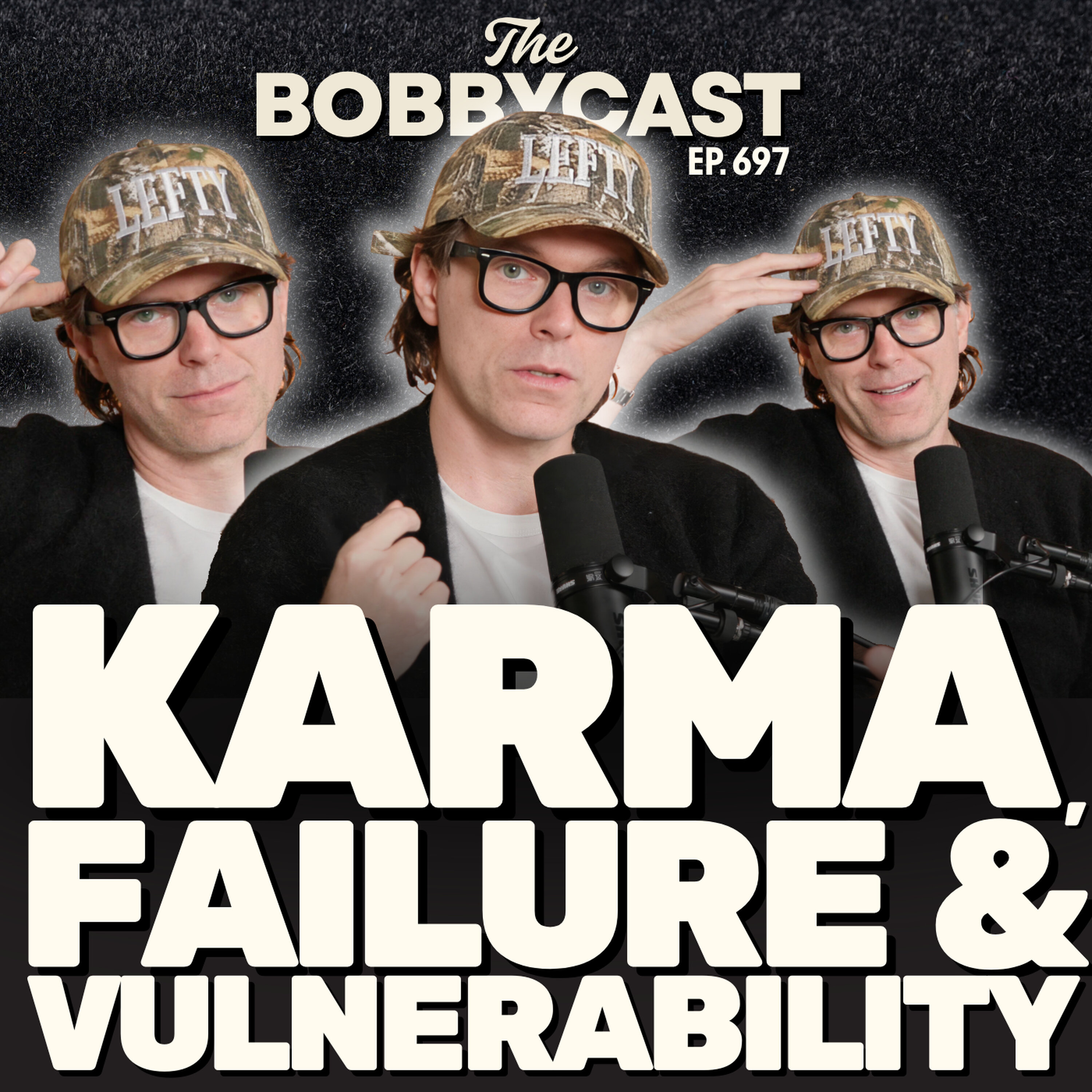
Bobby Bones Presents: The BobbyCast
#697 - Karma, Failure & Vulnerability
Samstag, 31. Oktober 2026 · 48 min
Kapitelklicken springt direkt hin
Shownotes
Bobby opens up about karma, the people he keeps close, and why he refuses to engage with people looking for a fight. He shares some of the biggest ideas he’s pitched over the years, including a National Geographic series, a Dancing With the Stars project, a late-night talk show, and his newest concept that he thinks could turn an ordinary person into a Mirrorball champion. Bobby gets honest about the projects that never made it past the pitch stage, the executives who made him think a deal was happening, and how those failures shaped his approach to business.
Watch The BobbyCast on Netflix.com/bobbycast!
Follow on Instagram: @TheBobbyCast (instagram.com/thebobbycast)
Follow on TikTok: @TheBobbyCast (tiktok.com/@thebobbycast)
See omnystudio.com/listener for privacy information.
Transkriptvom Podcast bereitgestellt · Zeitmarken springen hin
Hey, everybody. I've never really been someone to believe in karma. I don't think there's some invisible scorekeeper that is watching everything and then handing out rewards when we're good and punishments when we're bad, mostly because I know really good people that have had terrible circumstances and tragedies. And I know some awful people that have had really great things happen to them and they would continue to land on their feet. I don't feel like life generally is fair enough to explain that karma is sitting around rewarding people equally.
So not a karma guy. However, I do believe that the people you keep yourself close to and the situations that you put yourself in shape your odds. It's a bit of math, linear, logically. You spend time around kind, honest people who want to do something with their lives. You generally and genuinely start to have that rub off on you. And it starts to affect you even when you don't even realize that. They encourage you. They tell you the truth, even when it's not comfortable. They introduce you to somebody they can help you. Or they mention an opportunity that you take, or they remind you that you're probably more capable than you think. And maybe it doesn't change your life overnight, but those little moments can
add up. And maybe it doesn't feel like lightning bolt karma, but all those micro decisions that you're making do end up making, for the most part, a macro happy life. It works the other way too. If you're always around people who are angry or reckless or pulling you into one bad decision after another, pretty soon that starts to feel normal. Think about chaotic people. If you surround yourself with chaotic people, you're always going to live in chaos.
And what happens in chaos? Well, chaotic things. And it's weird to go, karma must be getting me because everything's chaotic. For the most part, you've put yourself, just a the bad choices are going to catch up with you. You might miss good opportunities. Sometimes because you're dealing with the fallout from the last opportunity. Again, this doesn't mean everybody around you has to be perfect. It just means the people and the places that you spend the most time have an absolute influence on you, on what you think, on what you think is normal, on what you think is possible. All those are affected. I think about this a little bit now because I've I have a baby.
She's seven months old, about to be eight. And I don't really want to teach her that if you just do good, maybe the karma blows in like a gust of wind and helps you out. I want to teach her that if you just generally point in a direction, things from that direction are going to come into your purview.
And so let me be clear about this because I'll get to a point here in a second. I don't think it means if something bad happens to you, you brought it on yourself. even mathematically speaking. I don't think that at all. Good people get sick. Good people lose people they love. Bad things happen to people that absolutely do not deserve it. I don't believe the world works as a very neat, simple equation as much as I'm talking about math here. I do believe though, mostly in probabilities, like probably this is going to happen if you do it most of the time. So I do think we have influence on our surroundings and sometimes more than we like to admit. Who do you call when you need advice?
Who are you around when you're making decisions? I think about this to teenagers. When I was a teenager, like who did I surround myself with that put me in a place to actually be a functioning, a hopefully giving back to society, young adult, and then main adult. And I think a lot of parents probably have to deal with this with their kids. Like how do you get them in the right environment? They're not going to make every decision right. They're kids, but can they make a lot right that put them in the best place? Who are they eating lunch with? Who are they hanging out with on Friday night? Maybe luck's a part of it.
I'm also not a big luck guy. It's a whole different topic. Maybe timing is a part of it, but more often than not, when you put yourself around good people and good situations and Good things are more likely to find you. And when you keep choosing the opposite, the opposite is more likely to find you too. That isn't karma. That's the effect of what and who you keep close. Now, hopefully you can remember that. On my computer that I have right here, I keep a list of people that I really don't like. My therapist says, he doesn't love that I do this. But I keep a list in my notes app. People I'm feuding with.
It never goes more than 10. And I don't root for bad things to happen to them. If they do, I don't care as much. I don't really think about them. But I want to be reminded, oh, I don't want to be around those people. I don't want to have anything to do with those people. Now, I have had people... on my list that we have made amends and they were pulled from my list one of them Kentucky Sports Radio's Matt Jones we were good friends he came to my wedding we had a bit of a falling out I put him on my list of people I'm feuding with we had a good talk after he's no longer someone I'm feuding with but I have this list and again I don't think about the people on this list I don't root for bad things to happen to them
And remember all the stuff about karma, right? Don't believe in karma, but I believe if you keep doing bad, it's a numbers game. Eventually bad is going to happen to you. In my professional world, I have people that will come after me because they know if I fight back, they will be platformed. Something I've spoken about many times.
So it's hard for me as someone who is highly competitive, unhealthily, wholly insecure, unhealthily. And I'm an eight, so I'm a challenger. Every part of me just wants to punch them in the face. And there's this one, we'll just say this unit that constantly begs for me to fight. And they say some really nasty things about me. And for me, I know it's better for them If I engage and interact.
So I don't. I'd love to. Because they're the worst. Literally the worst. I don't believe in karma. What's been happening with this unit? I wouldn't root for bad. But we're starting to see the numbers catch up. one after the other, after the other. And I'm going to be a bit vague here, but I think maybe we can put the pieces together and see that things aren't shaping up so good over and over again. And it's not karma because you're a bad person. It's you're a bad person so often that bad things eventually happen back. Congratulations.
You suck and now sucky things are happening to you. That's my TED talk on karma with a slight vague dig added in without platforming someone on my list of people I'm feuding with. Congratulations on your last few months. That's number one. Number two, and I'm going to talk to you guys here and I'm not going to clip this. Now, a lot of what we do It has to be consumed in different parts for us to actually make a good living off of it. If you're any sort of creator, you basically have three ways that you can create. You have the audio part, which this podcast goes on to audio feed. And my audio feed does really well, which is great because I've been podcasting since 2006. And luckily, I have folks that keep coming back. And I appreciate
that so much. I've never lost people. sight of who I am I've definitely changed which we all do as we get older I'm not the same person that I was at age 25 but I would like to think that I am still compellingly authentic that doesn't mean you have to agree with everything I say doesn't mean you have to like everything I say it doesn't mean you have to like me all the time because you don't do that with your friends you don't like your friends all the time you don't like everything about them but what I appreciate is with you guys that listen to me regularly or that watch me regularly is that you don't put an unfair expectation on me to be perfect because I don't present myself as that. I present myself
as someone who will read you a list of people I'm feuding with because I'm so insecure. And then my therapist says, you shouldn't do that. But I do anyway. I know a lot of my faults and flaws. I have really good awareness of that. And I'm at the age now where that okay. Good. Like I know what my ceiling is, but I have a great appreciation for everybody that has been riding with me for decades that has allowed me to have a really happy and successful career and have a great appreciation for people that just started riding with me. And so I try to be honest, from me. I don't know that I'm always telling the truth, but I don't think I lie on purpose. I don't think I mislead on purpose. I've just been wrong at times.
And so I come on and I share things and I appreciate the support. And I appreciate at times when you don't support, but then you still come back, right? I've been able to build this, this business into something pretty good. And the three ways you make money is audio. The first one, the second one is video. And luckily video-wise, I have a really wonderful, substantial deal with Netflix and it's a fantastic contract and we're still in the middle of it and we're doing a lot of episodes and it has been a really great working relationship. And so thank you for everybody watching on Netflix. The third way, because you have audio and you have video, and that's the long form video, is there's a clipping, right? And
so We clip all kinds of stuff. If something is impactful, if it's a moment or if it's a minute and a half, we clip it. And sometimes even in interviews, like I have Billy Corgan from Smashing Pumpkins coming up. I'm like, hey, we're going to do this part of the interview. And he knows. He's like, oh, you're going to clip this.
Yeah.
So we've got those three ways. And clipping really for me does not make me any money because all that's doing is like helping my social media. I don't make any money off social media. I don't do brand deals. So Instagram, I don't get paid anything. Twitter. That's just basically a terrorist attack over there. I don't even know what Twitter is anymore. TikTok, I don't make any money.
When I got on TikTok, I got into the, whatever the program is for creators, it's the creator fund. And I feel like even if it's unfair, I could be wrong, that as soon as I got into that creator fund, my videos were starting to get suppressed because who wants to pay out? I get it. But those are the three ways. And what I'm going to say now, we're not going to clip. All that to say, we're not going to clip this Because I'm going to keep it only in this space because if anybody sees this, I would hope they don't use this for their own ammunition or use it against me. Because I'm going to be vulnerable here and I'm going to share with you some ideas that over the past few years I have created, gotten to different stages with, and haven't crossed the finish
line as far as production deals for television shows, etc. And it's going to get to the idea that I sent out last night. And normally I would never share these ideas when they're still in the works. Because, well, you could be like, well, I don't want to jinx it, but I don't want anybody to steal it before somebody says no to it. But I'm going to leave it here.
No one's going to clip it. Just me and you talking. All good. I'll tell you an idea that I really thought was going to get far. A couple of years ago, I sent a voicemail to the head of Nat Geo. She's the president of Nat Geo. I'd done a couple of shows with her. She's awesome. Her name's Courtney Monroe.
And she's Nat Geo, Disney Plus. And I told her about this idea that I had. And I said, I want to do this show called Take Me to Your Leader. Now, if you watch any sort of alien television shows in the 80s or 90s, they'd be like, take me to your leader. They want to be taken to whoever the leader was in America. They take us to the president.
My idea was to show up to a foreign country. And the show was going to be called Take Me to Your Leader. And I would just go spend the day with whomever the president or chancellor or or prime minister was with almost no knowledge of them, go to where they're from. I'm not intimidated by them. I guess I would have respect for the office, but since I don't live there, the office does not hold like the same power. The office doesn't hold, you know, there's nothing about it that like the president, I'm like, I'll never meet a president. That's crazy. The president's a whole different thing.
If you're the prime minister of Zubakistan, I don't give a crap. That's cool. So I wanted to go do this show and look at these people that I didn't know that were these leaders and do a profile piece on them from my perspective. And then at the end, give my feedback on what I thought about them, not knowing where they stood on anything. And so I called her and I said, hey, I want to go to these countries. How do I get in touch with different presidents around the world? Bold idea, because I was just going to do it online. And she said, you're nuts.
I said, why? She goes, do you think you can just email presidents And they would just answer and say, yeah, come on over and spend the day here. And I said, oh, so you're saying no. She goes, no, I think you're so nuts. I've never heard anyone talk about it like that. People have done travel shows. But to say, take me to your leader and just want to go hang out with the president of every country and get to know them.
She goes, that's interesting. So this is the fun part about it. She says, I think that's a very interesting idea. I'm going to introduce you to someone that I think you guys would really have a lot in common. And maybe an idea can come from this. I said, great. I said, who's that person? She goes, I'm going to put you on text now. So the president of Nat Geo, Courtney Monroe, puts me on a group text with Mariana Van Zeller, who has now been on this show multiple times.
She had the show trafficked. She just had the romance scammer show, the documentary that was out. Again, she's been on the Bobbycast twice. She is my favorite guest. She basically lived with cartels for a while to report on them. She risks her life constantly. That's really how we got to know each other. We had a show on Nat Geo at the same time, and her show followed mine, but I didn't know her. I just knew of her, and I would watch her show and go, holy cow, she's with people that are stealing cars and selling them on the black market, and she's reporting on that. How is she not getting murdered all the time? Little did I know we would become friends later because of Courtney Monroe, the president over there, linking us together. And so before
Mariana Benzela did anything with me over on my shows— She said, I think that idea is very interesting. She has a production company. It's called Muck Media. She said, why don't you come to LA? Let's sit with our whole team and go through all of your ideas and see where we can come. So we go and we had multiple meetings and it then started getting pitched to networks.
And we were getting medium feedback. Occasionally someone would come back and they'd have more questions. And at one point we thought for a second it was going to get picked up. And the idea had slowly disappeared. changed a little bit over time because depending on what a network wants to buy and it's been very tough to get networks to buy anything recently and that show did not in the end get picked up and I thought Take Me to Your Leader was a pretty good show and a pretty good idea also I just wanted the free trips to all these countries and to get pictures of me and all these presidents so that's one idea that didn't get picked up it's still kind of out there I then also thought about doing that same idea, take
me to your leader as a podcast, but I wouldn't do presidents. I would go talk to different CEOs and different, I don't want to just go to all sports, but different leaders in general here domestically in the States or in North America. And it was a very much a leadership type podcast. I did a book. My second book was called fail until you don't and how to succeed, except I wasn't giving away any sort of miraculous cure or snake oil, or it was just, These are the pragmatic steps to actually win. And I think a lot of times we don't focus on the real practical stuff.
We focus on how do we get there the fastest and the highest. And a lot of times that's the worst idea because you have to really grab one ladder rung at a time for the most part. And I think Nick Saban's the one that said it. Never let a failure go to waste. I think a lot of times we do let failures go to waste. And what I mean by that is When it doesn't work out, because eventually, inevitably, it's not going to work out, if anything that you're doing is worth it, sometimes it's not going to work. Don't fail and not learn something from it, especially if you want to keep doing it. Like my, well, heights.
Other than heights. My greatest fear is for me to fail at something and learn nothing from it. It's not me trying something and it not working. I do that all the time. My career is that. It's me trying something, it not working, and me not being any smarter at all because of it. That's the worst. That's the fear.
I probably 99 to 1 on ideas that I have, that I spend time on, that I work through, that actually don't to do get picked up or used in some form. 99 no's. Hopefully one yes. It's not even a full yes. So that idea went from the beginning and it still lives in me a little bit because I think it could be turned into something else. I think Take Me to Your Leader could be any kind of leader. It could be any series here. Still pretty good.
I think we could do that even here on Netflix. And I go sit with leaders and it's a Take Me to Your Leader type show. Like I have a parenting show that sometimes I jump into. We haven't done it in a bit, but the parenting show is called, it's not called My Two Dads. What was that one called? Father knows less. Father knows less. Okay. It's like a parody of Father Knows Best, which also was like a black and white TV show. So that was number one that didn't work out. A lot of times I'll get people that come to me. and say, hey, you should really try to do something based around Dancing with the Stars since you won the show. And I'm not really involved officially, but I do talk about it a good amount.
It gets brought up to me more than I talk about it. And for the most part, I really only stay and talk about it during shows. the season, because I know that's going to get a lot of clicks, but I get TV producers sometimes hit me up going, Hey, what do you have? Do you think we'll be interesting about dancing with the stars? And at one point I wrote a script. It wasn't a full pilot, but I wrote a miniature pilot, a pilot is what we call in the industry. It's really not a term, but I wrote it and it was a parody of dancing with the stars and And it included a lot of what I learned about behind the scenes and the TV production part of it. But we were using, it was scripted and it was a comedy, but we were using actual
real celebrities playing themselves in it. So let's say James Franco was going to be one of the people on Dancing with the Stars. James Franco would play himself. And I think that inspiration, because I'm trying to think back as to why I had the idea to put people playing themselves in it. Jury Duty was the show. And in that show, Jury Duty, the real good looking guy, is his name James too? The actor, he was in Sonic the Hedgehog. That dude, he played himself and he was a celebrity. Yeah, this dude's like 55 or something and still looks like he's 25. James Marsden, Sonic the freaking Hedgehog dude. And I thought that was so interesting.
He was playing himself in that show where it was a comedy, but the person didn't know that it was all set up. I thought, what if we did a Dancing with the Stars comedy? We couldn't call it that. And then we had four or five real celebrities playing themselves, right? That show, I thought it was getting picked up. And I had written me a very small role in it because I created it and I was just going to be the host of the show, which fun fact, they had talked to me forever about being the host of the show. And they're like, you're the guy, you're the guy.
And I thought I was the guy until one day they said, I mean, my, my, Twitter just said, Tyra Banks hired as a new host. I was like, no, they're hiring me. They must have tweeted this out wrong. I've been in meetings. They said they're hiring me. So there was definitely talk to me. We were having not active negotiations, but we were having logistics conversations about me hosting that show. That being said, I wrote me a very small role as the host because the show wasn't about me. It was about what was happening behind the scenes.
And I thought that would be funny to get actors to play themselves. And The next year, you just have a new cast. You have five new actors coming in to play themselves on a dance show. I met with some really big producers, one specifically. And it felt as real to me as far as it was getting picked up as any show that I have ever fully pitched that didn't get picked up. And we had talked to a couple of networks. And this is how my experience, I should say that my experience, this is my experience with Los Angeles and Hollywood because I've never lived there full time, but I've been there enough and I've had enough jobs and I've professionally had moderate time in Los Angeles. Man, they gas you up every single meeting. I would go
in if they were like looking for a host for something or looking for someone to be a part of it. I would go in And you leave every single room going, oh, they think I'm a massive star. They wanted to give me a million dollars for just sitting in the room. And then you leave the room and you never hear from them again. At one point, I went to a meeting.
Let me back it up. At one point, I left Nashville on a private jet with Scooter Braun, flew to LA, had a great conversation about a project. went in, scooter-less, but it was a project that he was doing. They said, you are the man. Let's go meet the network president. We went from the office where I was with executives to the network president, the head of the entire network.
And he said, I won't tell you who, but he said, you're so-and-so. He said, and I found him. And obviously everybody knows who he is now. He said, you're him. Matter of fact, I think you can do things better than he can. How does that sound? Sounds great to me. Write the check. Never heard from him again after that day.
There's a microcosm of how that place works. And it started to happen so much that I don't believe anything at all that gets said in any room in LA ever. And if it works out great, otherwise I expect to go in and then to be like, you're the greatest. And then nothing to happen.
The Bobbycast. We'll be right back. Welcome back to the Bobby cast.
But that being said, this show where I'd created these, these, these characters and I created these scenes, just like the backstage of dancing with the stars and things behind the scenes. That big producer I was talking with, we had a call and they were like, Hey, on Monday, we're going to line this up. I got a feeling that the deal is going to get accepted. Monday came and I got an email. Hey, let's move it to Wednesday. Got another email. Hey, we're going to move it to the next week. Didn't get an email. I never heard from them again. Just never heard from them again. It went from that to nothing. I was a hundred miles an hour.
And then somewhere along the way, they thought this isn't going to work. So they just, they just cut it. And I've been the shiny toy for a minute. Like whenever I had my four years on idol, I was dancing with the stars at a couple of TV shows that kind of hit at the same time. I did breaking Bobby bones. That was really cool. I had a show called snake in the grass. That was, Sadly, never got renewed because of that deal. And that's a whole different conversation. But Breaking By Bones was an idea that did get picked up because it was, and that one I didn't think was going to, and that was my idea.
That one was, I don't know. Could work. Got a call. We're in. Let's start planning filming. So every idea that I've had that I thought was really great and that people have told me is really great hasn't worked out. The ideas that I've been, that they've been like, ah, lukewarm about That's the only one that's ever really turned into anything good. And so those are two ideas so far that I've had that I felt pretty good about that did not make it. Now, this isn't all, but I'm going to give you the one that I sent last night. Because I get hit up a lot going, hey, what do you have in the reality space? And the reason they ask that for the most part is because it's pretty cheap to produce. Nothing's cheap to produce, but
it's pretty cheap to produce some sort of reality concept. And so I'm going to read you this and this may be a terrible idea. And actually I sent it to my agent and I've not even got a response to this, but because a lot of the things that I'm being asked about are, Hey, what do you have that's in the reality space or the competition space? Or what do you, what do you think would be cool about Dancing with the Stars? I did have some meetings about basically like a Manning cast for Dancing with the Stars and Like we set up a studio here and then it's a secondary Dancing with the Stars show that we're watching and commenting on it. It's Peyton and Eli Manning.
I was like, that would be interesting. I don't have to really go anywhere. I definitely did not want to fly out every week and sit in a studio in Los Angeles for what that was. I thought that was a pretty easy slam dunk. Never got to the final stage. But we had some meetings with BBC, with ABC. This is what I sent last night. It's called The Mirrorball Experiment.
It's a documentary event series. I have, this is not what I wrote, but I've said many times, if you give me somebody that's halfway decent on that show, I don't need a ringer. Like on this season, the ringers are Jenna Dewan, Harry Shum Jr. Like they have professional dance experience. There are also ringers that maybe haven't been professional dancers that just have a bunch of dance experience because they learned to dance or they were in some sort of production where they danced a lot. A lot of the Disney kids have a lot of dance experience before they go on that show. I said, if you give me somebody decent, middle of the pack, I can win the show with them. As long as they focus and they learn from their dancer, I can do all
the things personality wise, build the campaigns. I can make anybody win that show. I have said that boldly. That's how I won the show. So I called it the mirror ball experiment. And in quotes, I said, give me a capable dancer. Not necessarily the best, and I believe I can coach them to win Dancing with the Stars.
End of quote. Then here's the pitch I wrote. Bobby Bones, the show's most controversial champion, is putting that claim to the test. Filmed confidentially throughout the season and revealed only after the finale, the series follows Bobby as he secretly mentors one contestant in everything beyond the choreography. Social media, live interviews, handling criticism, building the audience connection that turns viewers into voters. The professional partner teaches the dancing, as always, but Bobby coaches the campaign. With production approved access, cameras follow the contestant, their pro, and Bobby at times through rehearsals, backstage decisions, weekly performances, and elimination nights. Every week tests
his strategy. Every result raises the stakes. An early exit could end the experiment. A victory could validate his most disputed achievement. As a former American Idol mentor and Mirrorball winner, Bobby knows what it takes to compete and what it feels like when the audience sees something that the judges don't.
But can he recreate the connection for someone else? The project remains unannounced until the competition ends, preserving the central reveal Now they discover the story unfolding behind it. Was Bobby's victory a once in a lifetime phenomenon or does he know how to build another champion? Does he have the secret sauce? That's the pitch I sent last night.
I think it's pretty legit. I did then think, and I don't add this, but I did think, what if you get cast on that show and they tell you you're part of a documentary where I'm coming to coach you? Like that might be a little annoying. Unless they come to me and say, hey, what if we go find somebody together? Like, what if we get somebody in country music that you know or somebody in music that you know or somebody in sports that you know and bring them on? And that's the idea because there is added value in them being a part of a documentary even after the show ends because there's more exposure there. So that was what I pitched. I like it, but obviously I like it or I wouldn't pitch it. We're not
clipping it. It'll only live here. And I only share it because odds are it ain't gonna get picked up. And if it does, and then this ends up coming out, and oh my God, that would be the worst. But I just want to be vulnerable here and share with you guys what I'm doing a lot of times, because I will just keep creating and getting no's and getting no's and getting no's, and eventually I get a maybe, and then I get ghosted, and eventually I get a maybe, and then I get ghosted, and no, no, no. But it's one yes. All you need is one yes. And I've had a couple of those one yeses. I have one other idea that I really wasn't going to share here, but I'm feeling pretty vulnerable. It's another docu-series that I
thought about shooting myself. Now in Nashville, there are hundreds, if not a thousand songwriting sessions happening every weekday and songwriting in Nashville, very much factory. It's still creative, but it's done in a way of you get two and three people together and A lot of times their publishers put them together. Hey, you'll meet these other two people at 9 a.m. You guys will write till 3. Maybe you cut a demo. Maybe, who knows, right? And then you write a song that maybe nobody ever hears. You write a song that maybe gets put on hold by an artist, but they don't ever cut it. Maybe you get a song and an artist hears it, likes it, puts it on hold, cuts it, but it doesn't make the record. Maybe it makes the record and isn't a single.
Maybe it makes the record and is a single, but doesn't go number one. Maybe it goes number one. There are all these options. My idea was, and it is, and I haven't written this one up yet because it's kind of just up here and I kind of thought maybe just I would do it. I find three different songwriting rooms of three different levels. I go in, I have a fake name. My name would be Herb Tarlick.
It's not going to be now, but Herb Tarlick. And at one point I did create a group called Neon People and with two really accomplished songwriter producers in town. And we had written a bunch of songs under fake names. We never were going to be front facing. And then one of the songwriters in the group, and I've talked about this before, ended up running a record label. So she couldn't do it anymore. So we had to cut the group, but it is up on, on any sort of digital service provider, like whatever you get your music, but it's in, let me see. Cause it's spelled weird.
How did we spell Neon People? Because that was a bit of a different... It was like N, maybe 3-O-N? Regardless, Brandon's going to tell me in a second.
Neon P-P-L.
Oh, so it is Neon spelled the same. Neon P-P-L. Yeah, confusing. I should have never done that. We do have one song with 403,000 streams. Which is pretty cool because we never officially did anything. We never really announced it. We just put it up there and parked it. So that was that idea. That is a failure that I learned from.
So when I talk about never have a failure that you don't learn anything from, we did that. And I wouldn't say it failed because it didn't work. It failed because there are a hundred different things that have to happen right for it to succeed. And not everything happened right for it to succeed. But I've written a lot of music, almost all comedy music. Maybe you've heard my greatest hit, Hobby Lobby Bobby. What a jam. Me, Brandon Ray wrote that one. That one didn't just fall out of us either. And I know you think Hobby Lobby Bobby, that probably fell out in a minute. It didn't. It was very hard. We couldn't find a word that rhymed with hobby and lobby because it was just going to be a song about Hobby Lobby. And then Brandon said,
your name's Bobby. I was like, wow. So I'd done that experiment and we had tried to launch that unsuccessfully. I learned that I can sit in a room with accomplished songwriters and actually hold my own to the point where I'm not detrimental to the process. So I've also been in radio enough to see how the music process works and how record labels work. And my idea was this.
Of the three rooms, one room would be two new songwriters. One could be an artist. It doesn't matter to me. that really don't have success, much success at all. Maybe there's a cut they got on, you know, an Aldine record back in 2001. I don't know. But it's an easy room to get into. We write a song and we're in the room that day and we have the cameras on and we cut the demo and we track it.
We see if anybody puts it on hold. We see what publishers like it. They never know it's me. Nobody can know it's me because the name that I write under, remember, is Herb Tarlick. Now I got a second room that I go and write with. Not the same day. It could be two weeks later. It could be a month later.
We record the session. Now these people, maybe they've got a couple number ones. Maybe they're younger and they're like the next ones up. And they got a little heat behind them. And we write a song. They don't know what I've done with anyone else. They think we're just shooting a documentary on the songwriting process and what happens with that one song that we write. So we write that song. And then we track where that goes. Does the publisher think it's good? Does an artist want to option and hold it? Then the third one, I get with real power bangers here in town. And I know them.
I'm good friends with a lot of them. And I go in. I'm Herb Tarlick. We write a song that's going to get a look because of who I'm writing with. They write nothing without getting looks. They don't wake up, they don't roll out of bed without getting a look. And then we track that song, where it goes in its story. Who holds it? Who cuts it? Who doesn't?
Does it die? And we follow all three stories and see what happens with all three of those songs in the entire process. And in the end, maybe nothing. All three get killed and there is no storybook fairytale ending. But also how crazy would it be if like one of the songs you actually got to, I go to my phone, I put on speakerphone and I'm talking to one of my friends and he's like, yeah, can you believe Chesney just put it on hold? And like, we're documenting all this. And then at the end, all three of the stories are kind of merged with the, how difficult it is to be a songwriter in this town and the process of a song from creation to recording a demo, to getting it to the publishers, to the publishers sending it out, to who likes it, to it
being put on hold, to it being cut, to it being number one, to me winning a Grammy. Can you imagine? I'm on stage winning a freaking Grammy because the song I wrote resonated with the world. Hobby Lobby Bobby wins a Grammy. I just, I merged two storylines there. But that's the other idea that I've been working through in my head that I really wasn't going to pitch to anyone because I don't know if they would understand it like I do. And the thing with content now is it doesn't have to be living on one of the premier or I say traditional platforms. It's not going to air on network television. Maybe a streamer like a Netflix would possibly take a run at that even if they don't.
Who cares? Put it out yourself. Spend some time. Spend some money on it. I think that would be cool.
Hang tight. The Bobbycast will be right back. And we're back on the Bobbycast.
All that to say, I do that all the time. Constantly. And it's no, no, no, no, no. And it's all for different reasons. I had a pilot that got picked up. Two. I've got two pilot stories. My first pilot story was a talk show that I was doing from Nashville. And CMT came to me and said, do you want to do a late night talk show? I said, that would be fantastic. Of course, my hero has always been David Letterman.
I would love to do a late night talk show. And they said, we think it'd be fantastic. You come and do it from our studio. You have a studio audience. And I had started doing standup just for that reason. So when I needed to go up and do a two minute monologue, more or less, I can get up and feel comfortable doing it because I've spent time on the road just doing comedy. That's literally the only reason I started doing standup and writing it was because I thought one day I'd be able to use that in a show. And so we get in the soundstage, they fund us. A full pilot. And I got a band.
I got an audience there. I had a couple guests. I think John Party was one of my guests. This has been a few years. And the show goes. And I felt really good about it. We had recorded some. Comedy sketches. But not to the level. That you would see like in an SNL. They were a little bit improv-y. And not as long. Because the whole show was a half hour. I had two guests. It was. I felt like it was really put together well. And it was going to get picked up. We were already talking about my salary, which wasn't a lot because it was the first year of a show. It was going to be a three-year deal, but it was the first year. And years two and three were options. And they changed, I don't know if it was the president, but they changed
leadership in the company. And when a new boss comes in, it's like a new head coach on a team. You don't keep all the old coordinators. So we were a victim of that. They cut the show. Maybe cut, it's not the word because it never got picked up, but they, the person who was coming in, it wasn't their project.
So it did not continue. And when that happens, that sucks. That's okay. Another one was I went to just an open audition in Los Angeles on day one where they brought pretty much anybody in. They had any sort of background in acting or comedy or or television at all. And there were just like 200 of us. It was like me and somebody from Real Housewives of Poughkeepsie, my favorite Real Housewives series and season. And so I spent like four hours there sitting at a table for like a morning, The View type show, And I said it and I just kept lasting and kept lasting. And I didn't know what it was. I didn't know I was trying to last per se. I just know I didn't want to get cut and sent home. And so I
kept lasting and finished day one. And there was like 13 of us. I remember Julianna Rancic was one of them. I remember Sonny Hostin, who's now on The View, was one of them. And they said, hey, can you guys come back tomorrow for day two? Well, I didn't know there was going to be a day two, but I was like, yeah, sure. I'll stay for day two. Go to day two. And it was funny because the people were just a little more famous on day two. And I was like, oh, I'm like, I'm in double A ball now. I was in rookie ball. I didn't know that.
I thought I was just competing against the people from TLC, my 700-pound cousin. So we do day two, and now I realize that, oh, I'm just trying to get them to like me and keep me in the mix here. I go all the way through day two. There's a few of us that last day two. They're like, hey, will you go to day three? Absolutely. That's where I met Deion Sanders. And so at this point, there's like 20 total because these were pretty heavy hitters. Like every one of them was known. And so I go and at this point I'm going, I'm 17, 18, 19, 20 on the list. I know that just by looking around the room. But I just kept moving forward. They kept me all day, all day, all day. In the end, it was me, Deion Sanders, and one other person. And
they said, will you three come back tomorrow? I've been here three days. I plan to stay one day. But of course, I'll come back tomorrow. So we go in the next day and it was just us three for a couple hours. They were just testing us all together. They said, it's you guys. We're going to spend, I think it was about six weeks creating this pilot, which meant talking with us about what we're good at, what we want to do. And then we're going to shoot it as a pilot. It's going to be financed. It's going to be great. So we did the show. Dion and I were the main two people. We had another kind of co-host that was doing news and some audience stuff.
And I felt like it went pretty well. And we went all the way to pilot. Dion and I got to know each other really well. And in the end, it did not get picked up. So I've had a couple pilots that didn't make it. What's funny about that story is one day I get a FaceTime randomly not a call, a FaceTime from somebody that I had met while shooting that show a few years prior, the actual pilot.
It was one of the producers that I'd gotten to know. And she was like a mid-level producer. She wasn't the head producer, but she was mid, she was young. And so she called and she said, hey, I got this show I need a host for. And I was like, you remember who I am? She goes, of course. It didn't get picked up. It doesn't mean I don't think you're good. And I was like, dang. She goes, can you talk tomorrow to like me and another person about this show? I said, sure. So we get on zoom the next day and there's like nine people on there and it's people in ties and you can definitely tell their executives there. And her name's Tommy. And she said, Hey, we want you to host a show called snake in the grass. And I said, wow, wait, where's no audition.
Cause you auditioned for me for eight weeks. And I said, wow. Okay. I said, when is it? They said, it's in like nine days. And I said, that sounds great. We're going to shoot it here. No, it's in South America. So I moved to South America for a month and a half or so. I was living in Costa Rica in the jungle shooting that show while also doing my radio show.
But I knew her from that other failure that didn't work out. But I learned stuff and I met people. And I'm nice to people. I feel like I'm nice to people. And that turned into something. So I never want there to be a failure that I don't get something from. I don't gain something from. If it's a relationship, if it's knowledge. But that show worked out. And I'm going to keep creating these show ideas. I'm going to keep doing the podcast. I'm going to keep doing my radio show. I'm going to keep getting all the no's.
And I'm okay with that. I don't think anything is going to be a yes. But when it is, inevitably, that's going to be amazing. I have no expectation for a yes. Except for my expectation is if I keep pushing, it will happen. And that's pretty much been my expectation my whole career. Because it never happens. Until it does.
And that's what's up. We talked about karma. I slammed Mr. Rogers. You know we talked about. I know you do. We talked about karma. I shared vulnerable ideas with you that you're not allowed to steal. And also we talked about failing and how Even in the middle of it, it's not over until you quit. It could feel like the end of it. You're actually just in the middle as long as you don't quit. Like those pilots I got, they never, they didn't work out. They all led to something else. And who knows what they're going to lead to in the future. When I did Hell's Kitchen recently, like I started to think about these relationships that I've had that have turned into like random one-offs that I met.
Like that was from a relationship that I had. So thank you guys for being here. If any producer loves my ideas, you know how to get in touch with me. Just touch the screen. Rub the screen. This screen's like a genie. Whatever you're watching me on, a phone, if you're watching me on the television, rub the screen. I'll come out. I'll work for food. That's going to do it for today. Don't be afraid to fail because it ain't actual failure unless you quit. I don't believe in karma, but I do believe the more you do things right, good things will happen to you. It's math. It's logic.
And don't steal my ideas. All right, we'll see you guys soon. Bye, everybody.
Thanks for listening to The Bobbycast. Share this episode with a friend because they don't pay to advertise us.
