

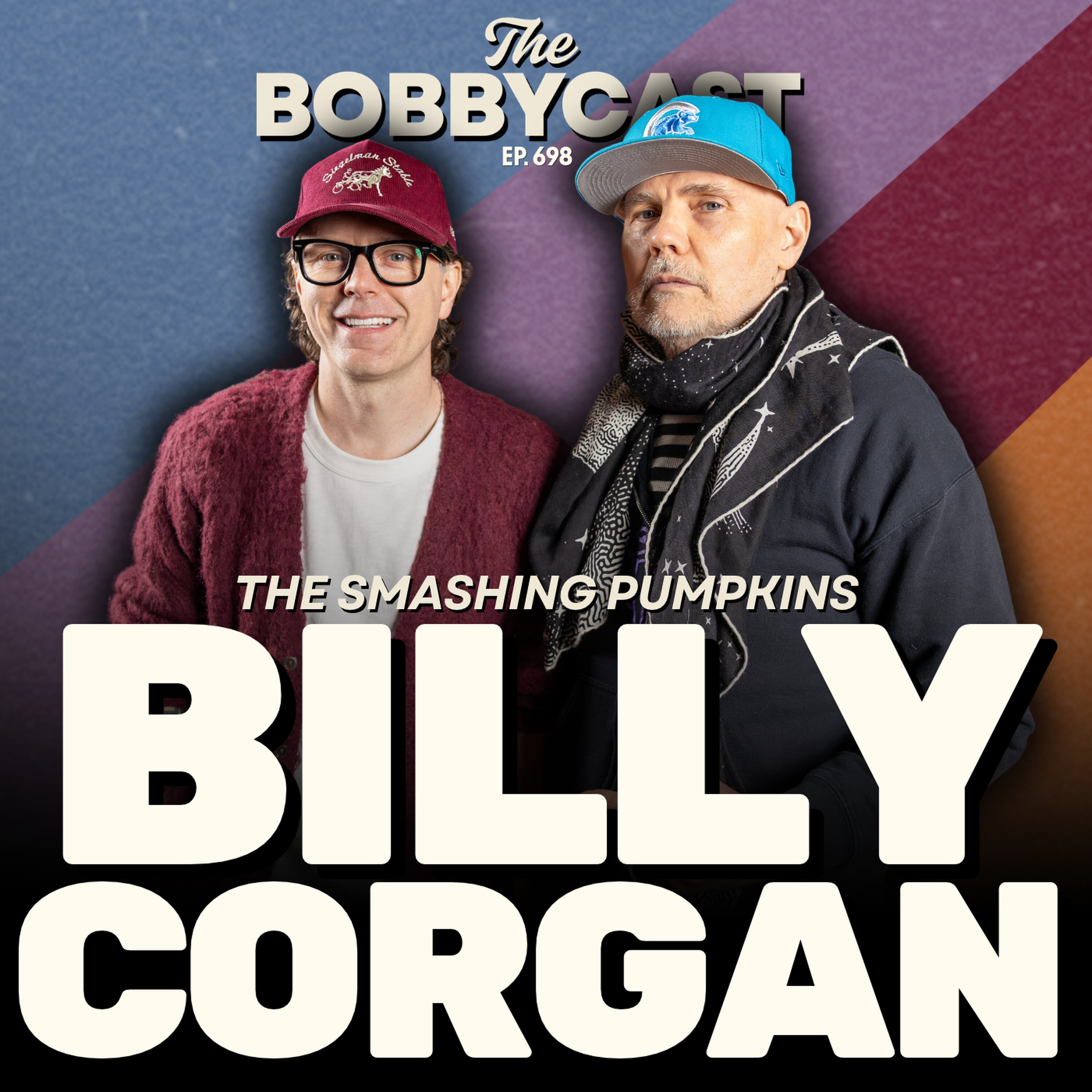
Bobby Bones Presents: The BobbyCast
#698 - Billy Corgan on The Smashing Pumpkins' Massive Comeback, Why Everyone Hated Their Band Name & The Emotional Moment He Shared with Johnny Cash
Dienstag, 3. November 2026 · 1 h 07
Kapitelklicken springt direkt hin
Shownotes
The (instagram.com/smashingpumpkins)Smashing Pumpkins (instagram.com/smashingpumpkins) frontman Billy Corgan joins Bobby to talk about the band's massive comeback and why a whole new generation is discovering their music. He shares why everyone hated the band's name when they first started, the hit song that came to him in a dream, and the criticism he faced throughout his career. Billy also gives his unfiltered thoughts about the music industry, how the business has changed, and why record labels are getting it wrong. Plus, he recalls the emotional experience of being in a room with Johnny Cash, reveals the surprising way he wrote some of the band's biggest hits, and explains why he's still determined to prove people wrong.
Watch The BobbyCast on Netflix.com/bobbycast!
Follow on Instagram: @TheBobbyCast (instagram.com/thebobbycast)
Follow on TikTok: @TheBobbyCast (tiktok.com/@thebobbycast)
See omnystudio.com/listener for privacy information.
Transkriptvom Podcast bereitgestellt · Zeitmarken springen hin
Everybody hated the name. In fact, two years into the band, people were still asking me to change the name. You know, in the 90s, I used to get interviewed all the time and say, you're awfully serious. And I was like, I'm in a band called the Smashing Pumpkins. Like, how serious can I be?
This one's really cool for me. Our guest today is Billy Corgan, the lead singer, the front man of the Smashing Pumpkins. I don't know what song you want to mention, but 1979, Today, Bullet with Butterfly Wings, The World is a Vampire. This band helped define alternative rock in the 90s, and they are still going very strong. Billy's keeping busy with a Rats in a Cage tour, which they're doing in town now. They're selling out like crazy. He's also hosting his own podcast where he sits down with some really fascinating people. We will talk about that as well.
He's also in professional wrestling. He bought a wrestling organization. So, I hope you enjoy this as much as I did. Here he is, lead singer of the Smashing Pumpkins, Billy Corgan. Billy, massive fan. Thank you for being here.
Thank you.
I was talking to my wife before I came over. She's 12 years younger than I am. And I said, I'm going to go talk to Billy Corgan from Smashing Pumpkins.
And.
Her response was, I know that song from Rock Band. Yeah. Cherub Rock.
Yeah.
That's her experience with Smashing Pumpkins. I thought that was kind of cool.
It's cool. Yeah. There were these weird years where we kind of fallen off or I'd fallen off whatever cultural cliff was considered sort of dead. But there was enough of a brand thing there that there were opportunities. Rock Band was one of them. And it was also those weird times where the record business was still figuring it back out before streaming kicked in. So it was kind of a fallow period. So I look fondly on those things, um, because they were little life preservers that kind of got thrown out. And here you come to find out years later that that's how people found you or connected with you when there wasn't like the obvious thing that, cause some guy writes a review and says this so amazing
or something, you.
Know, did you guys feel like you fell off or like, like you said, like at least in pop.
Culture, Well, that's a long thing. I think first you need to delineate the difference between alternative culture and popular culture. In alternative culture, I was always going to be one of those OGs. You don't lose your street cred because you stop selling records or something. To the New York world that stare down from a tower.
Down on American culture. Yeah, you're dead. You were this. They look at statistics. You were this and you're this. You don't mean anything anymore. And I watched it happen in the 80s with bands like the Beach Boys. I mean, when I was a kid in the 80s, I watched people talk so much crap about Brian Wilson and the Beach Boys, one of the greatest songwriters in American culture history.
And So I knew that there was going to be a time where my songs would come back around and things would kind of work themselves out. But yeah, there was a lot of weird years in there.
I think Johnny Cash suffered that a bit too.
Oh, absolutely.
I think it's a revisionist history now by people in this town because I was definitely an alternative kid and definitely a country kid because I came where I lived. Country music talked about it, but how I felt like the music that you guys made and a lot of alternative music like spoke to what I felt.
Whoa.
Well, look at this town, you know, Nashville, obviously. Look at the way George Jones was treated. Look at the way Waylon was treated. Look at the way Willie somehow survived a lot of that.
He left. That's why he survived.
Well, maybe that's part of it. But I'm saying is like, so there's lots of. It's hard for the business side and the cultural critic side to understand that there are certain artists that their value is not in... all the traditional metrics. The Grateful Dead are the greatest example of all time. It's one of the biggest brands in the history of recorded music.
But for 30 years, all I ever heard was they don't sell records. And now nobody gives a shit that they didn't sell records. Go on the Grateful Dead Spotify account. I mean, there's so many releases from the Grateful Dead. They have a cottage industry. They recorded themselves. They invested in their own infrastructure. They built their own brand. So That business that used to run 70s, 80s, 90s, the Grateful Dead ended up being way, way smarter than that business.
But all those people were getting, you know, $ 10 million payouts and golden parachutes and stuff like that. What Jerry and them figured out was way smarter than the music business. So I like to think I'm in that class that sort of is smarter than the record business I've had to exist in. As I once said on CNBC, the record business is oftentimes run by feckless idiots. And I meant it. You know what I mean? And unfortunately for the record business slash music business, once tech kicked in, you had a massive brain drain as they all ran out of LA and ran up to Silicon Valley. So what's left of the music business is very complicated. But unfortunately, the critical class still views success in the music business
on those metrics, which really are out of date. Because if you operate in social media at all, you can have 50,000 followers that give a shit about you, and you can have 50,000 followers that don't give a shit about you. And now social media is starting to catch up and realize you have to have actually an animated community of people that support you. So what I built was actually valuable, even if at times I didn't have the numbers to throw around.
What you're talking about, too, reminds me of what micro-influencers do now a bit on social media. And it doesn't really matter what they're influencing. But if you have 6,000 people that will follow you and have an allegiance to you and do what you say, that's way more valuable than a million that don't.
Yeah. So right now, a lot of people are having a hard time understanding why the pumpkins are having a massive comeback. Because in their mind, there was the band in the 90s, MTV falls off some cliff. They literally think you don't exist anymore. In fact, they wonder if you're dead. And then you show back up one day and you're playing Madison Square Garden. They're like, how did this happen? And as I told these writers recently on another podcast, I said, Just because I went off your radar doesn't mean I stopped working. I went back to the ground, which I call going back to ground, and I rebuilt who I was in the musical community.
Why are the pumpkins working again?
There's lots of theories. I mean, if you want me to speculate, I will. I don't have a good answer.
I'd like to speculate, too. And mine's going to be wrong.
Okay, sure.
So I'll go first because I won't take your good, real answer.
Can I criticize you if you're wrong?
Please criticize me if I'm right.
Okay, good.
I deserve it.
All right, good.
Part of the reason, I think, is people my age that have money, we can now afford to go to shows.
Okay, good.
And nostalgia is. There's a lot of value in nostalgia.
Okay, so stop there. Explain then why most of my audience is young.
I can't. Like I said, I'm going to be wrong. You're going to challenge me on a wrong statement. That wasn't the agreement. You can make fun of me, but don't challenge me because I'm wrong. But my answer to that would be because their parents made them listen to great music.
Still wrong.
Fair enough. My baby, we have a seven-month-old.
God bless.
We listen to a lot of Smashing Pumpkins. We listen to a lot of Beastie Boys. We listen to it. There's four or five. And Elmo. Got the Elmo in there. But that's what we listen to. And I can imagine if you're a kid and you grow up. Like my stepdad, I listen to a lot of the Hollies.
Yeah.
I listen to a lot of Creatives Clearwater Revival. And having John Fogerty sit in that same seat to me was one of the coolest things ever.
John's amazing.
So that would be my answer. You guys were revolutionary when you created it. It still sounds current. And... There's nostalgia with people that have money and their kids. That would be my wrong answer. Yeah.
Yeah.
That's what I'm saying. No one can quite figure out why suddenly most of our audience is young.
What is your right answer?
I don't have one. That's what I'm saying. I think what I see people reaching for is that we represent something to young people that's no longer in the culture. Let's call it in a parent culture.
Yeah.
They've been propagated for 15 years with pop pablum to the point where they just want to puke. And they actually want people who are imperfect, not perfect looking, and they actually represent something that's consistent with their actual life experience.
What do you think you guys represent?
Freedom. Just freedom. And I know that sounds kind of trite, but I'm telling you, this is real freedom. This is real freedom. Most people in the music business are compromised at some point. It's just natural. You learn what not to say, what to do. I did everything wrong, and I was mocked for it, and somehow that became a superpower.
What did you do wrong that you were mocked for?
I mean, literally, so imagine you start this band 87, 88. Guys in Chicago, mostly guys, are playing three-chord songs about drinking beer and getting late on the weekend. I mean, literally, literally. Like not sophisticated music, but you had like true artists like Paul Westerberg from The Replacements. Guys who were able to capture that experience and give it like a, let's call it a greater glow than what I just described.
Like true artists. And I bow to them because they're great songwriters. Bob Mould comes to mind as well. But we were on to something else that was more West Coast, LA meets, you know, UK or something. We weren't supposed to play guitar solos. Our songs were too long. My voice was too weird. Our influences did match. We were made fun of by hipster writers because we didn't dress right.
We wore thrift store clothes because we were poor. We didn't have the stink of the university. We had the stink of a back alley or something. We didn't fit in the class system that was in operation at the time. So start there and chart that all the way through. I mean, I could go on and on. It's too self-aggrandizing, and that's not what I'm trying to do. I'm just trying to say, like, all I ever heard was, you're wrong, you're wrong, you're wrong, you're wrong, you're wrong. The most common analogy of my look in the 90s, by the way, I'm talking about when I'm 28 years old, 31 years old.
I'm a lot skinnier. I was a lot skinnier than I am now. You know what I mean? I look the part, right, as you're supposed to, young. I looked younger than I was. So when I was 28, I looked like I was 24 or something, right? The number one analogy of me in the 90s was Uncle Fester.
Was that hurtful to you?
Well, because it wasn't hurtful like a dagger through the heart. It was like what the constant thing was, not only are we mocking you with something that everybody understands, you're ugly. You know what I mean? You're ugly.
You're ugly.
It's like, but now a lot of people tell me that I'm beautiful. Like as standards of, you know, we all see like, this is what a woman in 1900 was considered beautiful. And they'll show a more, you know, different body type. And now, you know, this. So I'm saying is I went through this thing where the way I looked was considered ugly and now it's considered beautiful.
Like I've had all these weird experiences where the things I do were called ugly and not worthwhile. And then even when they succeeded, elitist people mocked what I was doing as being too from the trailer park or too something. Do you understand? And the reason I'm trying to say this is an artist is sensitive to the code that's being put out by the intelligentsia. Like the words you, you know, it's the classic thing is, who are your influences?
If you say Velvet Underground, you're safe. But if you, like when I said Black Sabbath in 88, I was laughed at. How can you like Black Sabbath? Who listens? Literally, the response would be, who listens to them? These were my influences in 88, and I would say them in interviews and get mocked. Queen, Black Sabbath, Led Zeppelin. I mean, I didn't think I was... Electric Light Orchestra. I didn't think I was being revolutionary. I wasn't even trying to be contrarian. Those are bands you're not supposed to like.
So even learn what not to say. So once I saw that, and once I saw I didn't belong in their club, then I just went the other way. I said, fuck all you people. I'm just going to say what I want.
Were those bands you weren't supposed to like because they got so big that it wasn't cool to like them anymore? So that's why you weren't supposed.
To like them? No, there was a big thing in the 80s going into the 90s in alternative culture. And you have to remember, this is pre-Nirvana's breakthrough. So alternative culture was a very small group of people. And everything You know, San Francisco had their little group of people. Portland had their little group of people. And there wasn't a ton of communication. So every scene was a little bit different. So you were supposed to like bands you never heard of. You were supposed to think the guitar was passe. And if you played it, you played it ironically.
And I'll give you the most salient example that most people would understand. Kurt Cobain was a great guitar player. But when he soloed, he soloed ironically because he was signaling, hey. I'm not Yngwie Malmsteen. I didn't give a shit. I wanted to play like Yngwie Malmsteen. I wanted to play as fast and as clean as possible. So that's what I'm saying. If you're an alternative code, you're not supposed to play guitar solos. You're not supposed to like Black Sabbath.
When you guys' music got to me, it was the same time as, because listen, I'm going to trailer park in Arkansas.
Right.
It wasn't like I was, how old are you?
46.
So it wasn't like on a leading edge of, of getting music. I got what was on the radio or we went to Walmart and got, yeah. Um, so all of that came to me at once. And what I remember thinking about you guys was the tone that even like sonically, There was a lot of similar tone, but you guys weren't similar in anything visual. So it made me listen to it differently because visually you were so different.
And there was a lot of plaid and a lot of.
But you guys didn't... You noticed we weren't wearing plaid.
You didn't have that. And you had a female. And there were all these things that were different. And so because I was able to see on the CD case, it made me listen to it different.
Yeah.
Was that the goal?
No.
No.
We were representing something akin to who we were. And then that morphed based on our experiences and our positive and negative.
Did you feel like because people didn't like you, you just wanted to keep doing things for the purpose of if you don't like this, you're going to hate this? No.
No, no.
It's hard to... Listen, our first album at the time was the largest selling independent album of all time. So it's not like we were being rejected. We weren't being rejected by people. We were being rejected by the critical class. And once you kind of do this thing, it's like, well, who do you want? Do you want the critics in New York or London or Tokyo? Or do you want the kid in front of you from Arkansas that's like, you're my band? See, this is why I still have fans.
You know what I mean? If people want to write it off lazily as like, well, it's a 90s thing, MTV thing, you don't understand. Because those fallow years that I told you about, those are the people that were still there, that I was still playing to, that appreciated I was still on an artistic journey. And that has something to do with what's going on with the band now.
Yeah, the music that I related to the most, I still enjoy because I felt like it's the music that understood me the most.
Sure.
Like I felt like there was something about it that I felt then that I still feel now. And that's why I'm still a fan of the music or the artists if they're alive.
Yes. And, you know, the difficulty is anytime you start to observe something with too much focus and light, it, you know, the object changes. It's the quantum thing. You know, if you look at a quark, it goes, you know, whatever. So that's the same thing. We were all like– I mean, look at the way Kurt Cobain grew up. Look at the way I grew up. Look at the way Courtney Love grew up. A lot of our generation, they grew up similar circumstances. I mean, I actually lived in a trailer park at one point in my life. It's not a flex. It's not something I'm proud of. But I know what that feels like. I know what it's like to have your dad go to jail and all this shit.
You know what I mean? So– When we represented those values to people, we're like, yeah, that's music I can relate to. That's the world I'm growing. I call it latchkey generation or whatever. And then suddenly it's run through the pipeline of mass media, billions of dollars, Viacom. You know what I mean? Invariably, it changes. And then people start to put their finger there and say, well, gee, if I tone this down or I act more something like this or I wear more plaid, I'm going to sell more records. And then it's hard to keep that voice of authenticity.
When you're selling all these records independently, how are you selling them?
Oh, we were on a large independent at the time called Careline, which was a subsidiary of Virgin. And we actually had signed a Virgin, but Virgin didn't have confidence on us of being on a major label. So they put us on a subsidiary to see how it would go.
So they would just distribute them to regional areas?
They were a big distributor, but they were also a label. So we were in, you know, college record stores and all that type of stuff. And it sold, I think in the first couple of years, we sold 450,000 copies on an independent. And just to give you a sense of what the record company thought it was going to sell, the budget for our first album, Gish, I think was $ 20, 000.
And we went over budget by $ 10, 000 with Butch Vig. We spent $ 30, 000. So you can imagine if the budget was $ 20, 000, I mean, they didn't think we were going to sell 450,000 copies. And we were poor. Even at the end of the album, we had no money, you know, because all we did is tour and try to build the band up.
Do you ever hear from that album, Gish, which if you're a Pumpkins fan, you definitely know the record. That's why it didn't feel so independent to me because I knew it. A lot of times people will talk about their independent records and like it had three songs and they recorded it in their basement.
Yeah, yeah.
But I know that record. But did you ever hear other music that you felt like was derivative of what you guys were doing? Oh, yeah.
Yeah.
Of course.
And you felt like we're in our own little silo and we're creating this and it's obvious that it's derivative of what we're doing.
Yeah, but that's okay. I mean, everybody rips everybody off. It's how artful you are about it. I mean, the Beatles and the Stones were the biggest thieves of all time, but they were great artful about it. You know, I don't have a huge problem. My issue wasn't that people have taken liberally from us over time. My problem is when they pretend that they didn't take from us. I'm a person who feels it's honorable to cite your influences. Hence, when I was asked by some hipster in 88 who sneered at me when I dared mention Black Sabbath, it was like, Tony's my guy. And I don't give a fuck what you say. I'm a ride or die with Tony Iommi. You know what I mean? No one's influenced me more. No one's inspired me more than Tony Iommi.
And then, oh, by the way, it's one of the greatest bands of all time with Ozzy singing. I mean, come on. But, you know, I got to deal with these fucking hipsters who like... But I'm supposed to like Jerry and the Cowtones because they're in that year. You know what I mean?
Let's take a quick pause for a message from our sponsor.
And we're back on the Bobbycast.
When you guys first started playing, did you guys have a drummer or were you playing with a drum machine?
Drum machine, yeah.
In the 80s?
Yes, the first gig ever with Pumpkins. was me on bass, James on guitar, and a drum machine. So you programmed a drum machine?
Oh, yeah, yeah, yeah. That was so far ahead of what anybody was doing. A computer?
No, it was just a little drum machine.
Was somebody playing it or was it programmed?
No, you programmed it.
That's what I'm saying.
Honestly, it wasn't that hard. I appreciate the compliment. It wasn't that hard. It was really just because I couldn't find a drummer.
But you had to program the machine.
Sure.
At a time when you didn't program any, I had Oregon Trail. I thought Oregon Trail rocked.
You know, you just– plus the drums were pretty simple anyway. Yeah, so then Darcy joined the band. So that was just the three of us and a drum machine. And then one day a guy I knew came in, a recording engineer. He said, are you looking for a drummer? I said, yeah, I'd love to find one, but find me a good drummer.
And he happened to know Jimmy Chamberlain, and the rest is history on that.
When you guys started playing together, was it always Smashing Pumpkins? Yeah, it was Smashing Pumpkins from the very beginning. First gig was Smashing Pumpkins, and everybody hated the name. And they kept asking me to change it. In fact, two years into the band, people were still asking me to change the name. But you were dedicated. No.
Actually, I thought it was kind of a weird name. I mean, it was supposed to be a play on like a 60s band, like the Flaming Teapots.
You know what I mean?
I always loved 60s psychedelic stuff. So it was like the Smashing Pumpkins, kind of a psychedelic name. Smashing in the English sense, like fantastical. No one ever seems to get the joke. You know, in the 90s, I used to get interviewed all the time and say, you're awfully serious. And I was like, I'm in a band called the Smashing Pumpkins. Like, how fucking serious can I be? Yeah, but everyone always hated the name. But the thing I, the reason I always defended the name was, you know, this is pre-internet. You're in a bar, you know, somebody's like, hey, what's the name of your band? We're playing Wednesday night at the Avalon. What's the name of your band? The Smashing Pumpkins. Smashing, okay. You run into that same guy
six months later. How's your band Smashing Pumpkins? It was a one-stop remember on the name. Don't ask me why.
How'd you guys feel about Napster?
I defended Napster. I defended Napster. It's a really long story. I could tell it to you.
I'd love to hear it.
Um, so believe it or not, uh, Sean Fanning and Sean Parker of Napster, uh, uh, I met them at a smashing pumpkin show circa 99. I think they came to when we were playing the bridge school with Neil Young, his benefit. And, uh, I literally knew them before Napster blew up. I just knew them as these kids with this idea or something. So I defended them and I knew them a bit personally, and I still have some contact with them through the years. And I was one of the only artists that defended them because the whole music business came out and started, you know, railing against them.
And I was like, I guess I would do, and I don't want to be Nostradamus here, but I was kind of like, look, they figured out this is where it's going. So rather than demonize them, figure out what they're doing that's right, And, and, and, and, but you know, the, the record companies, rather than, you know, getting business with people who figured out a new business model, they attack them only to eventually end up in the same business model, right?
Which is streaming. But where I, where they lost me was there was a call, Napster, when they started kind of become, became corporatized, they were looking for a way to commoditize the whole thing. You know, does that translate the way I mean it? Like, Eventually, they're like, well, we're going to have to turn this into a business or we're just going to get subsumed here against the machine.
They started going around and handing out shares of the company to artists. And I knew this. So I got on the phone with them one day and I was like, look, I'm willing to go all the way to the ground with you on defending you. But I'm out here as a soldier alone. And they weren't willing to give me any part of the company. And so I was like, well, fuck that. You know what I mean? It's like, because it wasn't that I was being greedy. I knew that they were secretly handing out chairs to other people. Right.
And that's the way the music business works. It's like when you're on the up, they would have given me the whole shop for free. When you're on the down, well, we don't really need you. So again, I maintain a very friendly relationship with those guys. And I do like those guys, but I was there for kind of a piece of their little history. And invariably, I think they made the wrong calls, which is why Napster ended up blowing up. But then they ended up in things like Facebook.
So they ended up all right.
The wrong call was what?
They kind of got into the rebel spirit of like, we're the resistance. Free music for everybody. And I was like, well, that's not going to work. You figured out that people want access to music. And as I think the streaming services ultimately figured out, it wasn't that people necessarily wanted it for free. They wanted convenience and they wanted to use this new media called the Internet to have music whenever they wanted it. And, you know, Apple had identified with the iPod that people wanted to be able to take their music places and they wouldn't have to sit in front of a record player. So they had identified where the tide was going, but then they became like everyone else. They started thinking corporate, like we're going to
get paid here. And can you blame them? I mean, they were part of a worldwide sensation, early viral marketing, da, da, da, da, da, da, da. So I don't blame them for trying to flip it into a billionaire class. But I think they just made the right call with how they, they made the wrong call with how they played it. And I think I could help them play it correctly.
Back in 2000 or so, if we put ourselves back in that year when Napster was killing it, I was in a dorm, just I'd hit the letter L and download every song. It started with L. It didn't matter. I'd just check it out the next day. As an artist, did you see the benefit in the promotion in areas where you would never be promoted?
No, no, no. I mean, setting aside everything I just told you, whatever went on, and I don't blame Napster. I blame the record business for being flat-footed with where things were going. And that period from the end of the 90s into whatever, mid-2010s when things started to kind of finally... There's about a 15-year period. I mean, that period costs someone like me a lot of money. And I'll give you an anecdotal example that would demonstrate for you what I'm talking about. Remember around 2007, 2010, suddenly all these bands were going and playing their albums? So-and-so plays their 20th anniversary of so-and-so album. I don't want to say any names because people get mad at me. Well, the reason for that was all those bands didn't make
that second round money because of illegal file sharing. Pink Floyd and all them, they made first round record money. Then they made greatest hits money. Oh, no, by the way, then they made CD money. Well, if you were a big 90s band, well, you didn't make that second round money. So we all got nothing in that period. And the record business stood there with their palms up trying to figure out what to do. And then let's not forget, when they finally started figuring out with the Spotify's of the world, what did they do? They gave them a sweetheart deal on the per song rates in exchange for equity positions. So they used the IP of the artist's work.
to take a leverage position in the future of streaming, and artists ended up with this deal, which I've been okay, I'm not gonna complain. But for the middle class, the artists that are really, really reliant on that revenue, I mean, it's completely hollowed out the musical middle class.
So you were able to have success before that hit?
We had a huge period in the 90s, but then again, like if you call it like the 10 years later money, the 15 years later money, there was no money. You know, it wasn't coming in because there was nobody buying anything.
Was that the last cycle of real money, though, with CDs and you guys in that 90s phase?
I don't know. Artists are making a lot of money right about now. Now, yeah, from different buckets, though, for sure. Well, but, you know, look, things change, right? You know, maybe it was just meant to be. But there was that weird period where the– I mean, people pretty much accept that record revenue and streaming revenue is not part of their business model. You know, their primary function is to figure out how to go on tour or get people to pay them for perfumes.
What would you tell somebody if they asked you now, how do I make it?
Ooh, that's a tough one. I would go back to the Grateful Dead, which is like, you almost have to start from the beginning and you're going to like, I'm going to build my own world. I'm going to build my own world.
It's like that with content too, like build a fiefdom.
Okay, great. So you understand.
Yeah.
I mean, I literally, it's like, look, if you think you're the next Bob Marley, Kurt Cobain, Janis Joplin, you know, Jimi Hendrix, like start from the beginning. build a dedicated core group of people who have your back, and you create a special relationship that'll ride or die with you through the changes that are coming. Because what's the biggest buzzword now? AI. Nobody really knows what's going to happen.
And all indications are, in fact, I read a Goldman Sachs report yesterday that basically said that the indications are that they're going to wait– In essence, rather than go try to fight all the AI companies and get into a bunch of lawsuits, they're basically going to wait it out, figure out what the business model is, and then make a deal. Which has happened— So historically, and I'm only going historically, more than likely artists are going to get the lower end of that totem pole because people with the IP, which is the record labels or the rights holders, are going to make sure they're taken care of first.
Yeah. Any success I've had has been super serving the people that dance with me, that dance with me the whole time, and then grow outside of that. But always it's like with the core, right? And everything is built around my unit of folks. Yeah.
Yeah, there's a book. I wish I read it and I probably should read it. There's a book about the business model of the Grateful Dead, like where somebody examined it strictly from like a Wall Street perspective, like what do they build? How do they commoditize it? And why does it have sustain or something like that? I would say look at their model. To me, that's probably the greatest artistic business model in the 20th and 21st century.
How did you write songs? Alone with people?
Well, in the beginning, I liked writing around people until they started saying they were they were writing songs that they weren't writing, which I believe this happens a lot in this town.
A word for a third a lot of times.
Yeah, yeah.
You go on and you have a song you're going to cut. This happens here a lot. And you add a word when you had nothing to do with it.
Yeah, I dated a pop star for a while who's a good friend of mine still. And I was in a session and there was a guy in the room. So imagine, you know, the artist, the producer, writer they're working with. And there's this other guy. And as they're writing, this guy keeps going, Yo, blue, red and two. And finally I turned and said, what the fuck's this guy?
He's trying to fucking get us, get anything in to get a piece of the publishing. I mean, it was so like, and the birds flew. And you'd be like, huh? Like what? So, yeah. So once I saw that, I was like, I'm going to work on my own. I think I'll be, I'm good on my own.
The Bobbycast. We'll be right back. This is the Bobbycast.
In this town, they schedule out rights.
Sure.
And you have, you know, nine to three, and you're with people and new people every day. You know them, but you're just kind of bouncing around each day, sometimes in an office, sometimes in a room like this. When you were writing songs, are you just in an apartment bedroom?
Yeah.
I usually get up very early, 6, 7 a.m. When the house is quiet, go down to a piano, grab a guitar. I literally roll. I mean, I'm not joking. I wake up like this, like, oh, my God. Grab a guitar. That's been my most successful modality. Grab a guitar, go right to a piano, and just write whatever comes out.
Ever had a dream about a song and wake up and write it?
Yep. In fact, I had a dream in this town. We were working on a song, and that morning I had a dream. And I heard this incredible chorus, heard the lyric of the word, got up, sang it to my phone. It happened to be in the key of F, the dream. It's part of the story. And that day we were recording a song, which we had arranged out and we were doing the drums. And the song's in D minor. And we're working on the arrangement. I go, it's kind of boring right here. I wish I had something else to put in here. And I go, ah, I wonder if that dream will work. I put on my phone and if you know music, the relative major to D minor is F, which creates the, hey, the chorus is going up. And we literally pop the dream
song in and it not only ended up in the song and it became a successful single.
What was the song?
I can't remember the title of it at the moment because it's like, I'm so on the tour that I'm on. It's like, I have to think about it for a second, but it's there.
What song, if you just hit the first few notes, does the crowd go absolutely bonkers for?
Today, the doorbell. Yeah, that one.
Do you change the set list at all?
It was actually Pete Townsend who told me, because up until the time that I talked to Pete about it one time, and it was kind of in private, so it's not a private conversation, but he was telling me this in private, and I thought about it, because up to that point, I changed the set list every night.
I love the idea of like roll the dice and see what happens. And he was like, no, The Who, we always had the same set list and we would perfect every moment of the night. And I thought, well, I've never tried that. And so ever since then, we've done that. It's been very effective.
What's the first song you guys play?
On this show that we're out, we're doing a set of melancholy songs, about 15 melancholy songs. So we open with 1979. We opened the show with 1979 Bullet.
Are you surprised that that's your biggest streaming song?
Kind of, yeah. Kind of.
That was a pop radio song to me in my head as a kid.
Sure, sure.
Because again, it was radio.
But it wasn't, it was a big single at the time, but it wasn't massive.
In my head it was. So it was a massive song that I heard all over pop radio. I was already a fan and I started to not like people who liked that song because I was trying to be cool.
Yeah.
You know what I mean? Yeah, I get it.
I get it. In fact, the record company wanted that song to be second. Because the first song off the record was Bullet With Butterfly Wings. So in my mind, rock band, we need more rock songs. And there were plenty of rock songs. I think we were going to... I can't remember. Maybe Zero was supposed to be second.
Something like that. And they came and said, no, we got to go 1979. We're telling you it's a big hit. And I was like, oh, it's the wrong song. Because of the feeling of going from Bullet to 1979 felt too jarring to me. And they begged and begged and begged. And I said, okay. And they were obviously right. It was a huge song.
The success of that song, did it put you in places that being a massive alternative band didn't allow you to get?
No, Tonight Tonight was the crossover song. And I think it had a lot to do, it was a great song, but it was also the video. That was probably our biggest mainstream moment where you're like, okay, this is like, you're getting recognized everywhere. And that song seemed to crack the sky open for us, Tonight Tonight.
What posters did you have in your room?
Kiss. Kiss put a poster out in 1976 saying, Where they're doing like the revolutionary, like Peter Criss is wearing like a bloody headband and he's playing like a drum like that. I had the poster before I'd even heard Kiss.
I want to ask you a really uneducated question. I don't get Kiss.
Aren't they all uneducated?
No, because some of them I think I know what the.
Answer is going to be. I'm waiting for the educated questions. I was told this was high fluting over here.
You were told wrong. What do I not get about Kiss?
Well, you have to– how about this? Start here. What's your impression of KISS?
I enjoy wrestling. I can appreciate a gimmick. I am myself part gimmick. I have bad vision, but I'm wearing these big dark-rimmed glasses so people know who I am. There are things about me that are for show even though they're needed, and I think they make the product a little more understandable.
You're moving in the right direction. I got it.
I feel like that's what KISS was. And then I only know like two songs.
Yeah.
That would be my answer to that.
Okay. If KISS was just a good-looking, swarthy band from New York and never had the makeup, they're still a great rock and roll band. Great songs. Great songs. In fact, if you stacked up all the great KISS songs against most rock bands, there are a lot of great songs there. A lot. More than you might think on first blush.
Do you feel like the makeup then has people like me thinking, oh, it's a gimmick first, music second?
I think they would laugh and say, who gives a shit?
Yeah, and I understand.
We're one of the biggest bands ever. Yeah. We beat the critics, right? Because the critics were always all over them. They got treated like shit by the critics. And they were sensitive to that because they were from New York.
Yeah.
So they were aware of the critical class. I mean, they probably knew who they were, you know, by sight. They beat the critics. They end up in the Rock and Roll Hall of Fame, although the Rock and Roll Hall of Fame ignored them for 20 years, which is a joke. One of the biggest selling rock bands of all time. They were huge in multiple decades. They went out on their own terms. They were crassly commercial and it worked. So I think Gene would tell you, probably more so than Paul, it worked. What's not to like?
And oh, by the way, the most brilliant thing, which I don't think they would have anticipated when they were in their 20s, was they got to age without aging as characters. Because you're wearing all that grease paint, you still look kind of like you're in your 30s, even if you're in your 60s. It was less visible than it would be like someone on me without that. So I think that was the brilliant sort of ancillary result of their foresightedness to do something that really had never been done.
I'd like to say again to everybody watching on F, I'm not a hater. I'm asked because I don't have an understanding.
No, no, but I'm telling you straight up as a musician, and I'm friends with a lot of musicians, KISS is a great fucking rock and roll band. It's a great fucking band.
It really is. And I think to casuals like me, then we go, okay, they're wearing makeup, so that's an added element that they felt like they needed.
Yeah, but sorry, God bless, but that's like Pablo Picasso was an asshole. Is Pablo Picasso a great painter or not? Yeah, both can be true. Pablo Picasso to this day is still the number one traded artist in the world.
Do you have any Pablo Picasso art? Is that why you bring that up? No.
No, I wish I– in fact, I tried to buy at one point and the guy I was trying to buy from basically dissuaded me from doing it, which was a mistake. Because if I would have spent $ 6 million in 1990 whatever on one of his paintings, it'd probably be worth $ 80 million now. So I probably should have followed my instincts there. But the point is I'm just tetchy when it comes to people overlaying against music other things that to me don't have anything to do with music.
Does that make sense?
It does.
You're a comedian, yes.
Yeah, but I can appreciate you saying this.
That's like saying, I saw him at the grocery store and I didn't like what he was buying. I saw what was in his bag. He's not funny. It's like, no, you're either fucking funny or you're not. You're either a great rock and roll band or you're not. All the other stuff is just showbiz, right? There's a lot of people who have an issue with the way I walk, talk, the fact that I own a wrestling company. I mean, I've heard it all. I'm in a great rock and roll band. We wrote a lot of great fucking songs.
It's like take it or leave it. You know what I mean?
Have you always been confident?
It's not confidence.
You don't think what you just said was confident?
No, not at all.
Okay. What was it?
Listen, if I was sitting next to somebody who won a gold medal, okay, I would be like, holy shit, you won a gold medal, right? That means you're the best fucking luge guy in the fucking world, okay?
Yeah.
I don't sit there and say, yeah, but you're the 72nd best luge guy in the world ever. That's the rock and roll game. I'm sorry, but if you make it to the top of the mountain at any point, you got something, okay? You don't see me running around saying I'm something. I'm not. You know what I'm saying?
I'm good at what I'm good at, and trust me, I have very limited skills outside of my skill sets, right? So I identified at an early age, I'm a very good songwriter. I'm a really good guitar player. I'm a visionary as far as it comes to production. And I'm a bit of visionary about where culture is going, which I think you see more so in the podcast. Outside of that, I'm just a normal dweeby nerd from the suburbs.
I'm just saying is what I'm saying is, and maybe it comes from having to battle the critics from a very early age. I'm just not going to play the parlor game where I'm going to sit here and do the, gee, I'm so lucky. And no, I'm really fucking good at my job. And if it's not for you, like meaning whoever's out there, that's totally cool. But I think the evidence demonstrates that I'm really good at my job. I don't have to play this weird game. If you won the World Series, you don't have to be like, gee, I'm so lucky I won the World Series. You just won the fucking World Series, okay? I've been to the top of Rock Candy Mountain twice in my life, okay?
There are very few artists that make it to the top of Rock Candy Mountain twice. There's a reason for that. And I don't have to play this weird hipster game like, gee, you know, I'm so lucky. I rolled out of bed and I just happened to write, you know, this great song. It's bullshit.
What were the two times?
What do you mean?
You got to the top of the mountain twice.
Now and in the 90s.
Got it. I thought maybe you're talking about like a single project. Yeah. Hey, by the way, I'm the ally here, Billy.
Oh, I'm just projecting.
Okay, good, good, good. I just want you to know I'm the one who believes.
Oh, God bless. Thank you for having me. No, I'm just saying this. I just don't... I just... I just think it's, there just comes a point in your life where it's just like, look, you know, like I'll give you an example. When I was a, you know, a budding rock star, I had a friend at MTV and they called me one day and said, we're doing Johnny Cash Unplugged. Do you want to come? And I was like, yeah, I like Johnny Cash. I'd love to go. I didn't have a positive opinion of Johnny Cash at that particular moment in my life. And I certainly didn't have a negative opinion. It's Johnny Cash. Now I'm in a room with Johnny Cash, and there's fucking Johnny Cash, okay? Everything I thought I knew about Johnny Cash, every, you know,
whatever I, cultural, you know, because we all play this game in our head, like, he used to be this, or he's this, or that, or, and it was all before the Rick Rubin stuff, the beautiful music that he did with Rick. So here's Johnny Cash. He's playing with the 10 EC2. There's Luther on the guitar, right? It's just, There's the original combo, the son version of the band, okay?
I wept openly watching this man, and I couldn't tell you why other than his humility was like, it was like, I'm like, this is the closest thing to Abraham Lincoln. Whatever he carried, I was like, holy shit, that's Johnny Cash. It's like, he took me out of the moment. I was in timeless space. I was like, now I get, you're Johnny Cash. Like, yeah, there's Johnny Cash in the 50s on methamphetamines. And there's Johnny Cash doing live TV from the Ryman on national television. And there's Johnny in some weird country movie that they would do for TV.
And right, there's all of that. And now there's the Johnny Cash Museum. But I saw the Johnny Cash, like, Like the, ah, okay? And what I said recently in an interview, and I'm only bringing it in here because I think it's part of the conversation is, there's only so many of those people. If you want to count me in that, great. If you don't, I don't care.
You know what I'm saying? I think the jury's still out on it. But if you don't believe you're that guy, what are you doing? What are you doing? I'm 59 years old. I got three little kids. I'm on this insane rock tour. It's like, you've got to believe that you're contributing something of substance that's beyond the metric or the click or the meme or the clickbait. So that's what I'm fighting for, which is like, I believe I'm in that class of great artists. I may be wrong, but my delusion might be right. So far, my delusion has worked out to my benefit.
Does your perception not think that others think you are? Cause I think you're in that class easily. Do you feel that people don't feel like you're in that class?
No, somebody, somebody asked me the other day, we do these VIP things before shows where we do like a little Q and a with fans. And, and what I said to, and these have got to be, these are people are paying extra to hang out with us before the show. And we play some music and stuff. And I said, with all due respect, I can't remember the exact setup of the question, but I said, with all due respect, you don't really know, um, what I've actually accomplished.
And so my argument would be, and it's a bit quasi-spiritual, what my actual contribution to this culture and my actual contribution as a musician is, is different than what most people think it is. So when I'm talking about that, I'm actually talking about a line that maybe I'm only on, like an arc line that I'm only on. So it might be too esoteric for this conversation, but.
I don't feel like it is.
So if you said to me, like, you know, I think you're an OG alt guy and, you know, you're one of the strongest artists of the 90s, I'd think, yeah, sure. But that's not really where my brain's at. In fact, I didn't really care about that then and I don't really care about it now.
Then what do you care about?
To me, there are certain people in this world that walk with the light. If you want to put that in godly terms, spiritual terms, that's totally fine. If you want to be new agey about it, that's totally fine. There are certain people that walk with the light. They're gifted with something, and their job is to share that gift.
And how they apply that gift is not always linear. So using Johnny Cash as an example, okay? When I was in a room with Johnny Cash, I saw it. And now I understand why he's venerated, okay? Yes, there's a museum and yes, there's records and yes, there's tributes. But at the end of the day, whatever he was, that man in there, the spirit of God coming through him, okay?
If you believe you're of that class, well, then that's a different mission, right? I saw a quote the other day where it said, at the end of the day, this is from Johnny Cash, and it's the internet, so I hope he said it. But it was something like, at the end of the day, you're going to find it all comes down to Jesus.
Let's take a quick pause for a message from our sponsor. And we're back on the Bobbycast.
Do you believe you're of that class?
Well, there's different tribes. So I wouldn't necessarily put myself in the, because when I think of the Johnny tribe, I think of Waylon and I think of Willie and I think of Christofferson. There's a certain tribe of guys, especially that were in this town that changed a lot of things, changed, you know, even Johnny's, why did he wear black, right? It's like he represented a lot of things that are Americana. America is such an incredible country for creating this kind of mythical narrative. I think we're were the greatest progenitor in world history of creating narratives that somehow go out into the world and seem to inspire people in other cultures for other reasons. Like you don't have to be American to be inspired by what
America's gotten right. And so what those guys did in that time, a particular American ethos, and it extended into, you know, Dennis Hopper making, you know, with Peter Fonda, what's the famous movie? They ride motorcycles. I can't think of it. You got a whole team of researchers over.
Easy rider?
Thank you.
Easy rider.
I'm saying guys who changed film, guys who changed. Sure, sure, sure. Like Waylon fought the recording industry in this town because he wanted to record records the way he wanted to do. And he wouldn't have to do these three-hour sessions at RCA or whatever. And Waylon was like, if I want to stay up all night and record, that's what I'm going to fucking do. So he started recording outside of town, I think with Jack Clement. Started making more radical records.
And that's what brought in the whole rebel country and all that stuff. Outlaw country.
So who would be in your tribe then?
That's a great question. I don't know if I would answer that question publicly.
Can you give me one person that you think would be in your tribe?
Snoopy? The dog?
I'm being funny.
It's being funny. You had a Snoopy album in your green room.
Christmas, yeah.
Snoopy Christmas.
Great album.
So I just reach for Snoopy. I think I'm part of a different class. So it's hard to say. At the end of the day, it may be ultimately more cultural and less musical. And I think, again, you see some of that in my podcast. I think you see there's a different shifting going on in this culture about different voices saying different things for different reasons that aren't always predicated on clicks.
Who have you spent time with? Because this is a very intimate thing for people to do. And you know that like we rely on each other, right? We're doing an hour together and I depend on you. You depend on me for this to go well. We have to have each other's back.
Okay.
Who have you found in these moments that you really enjoyed that you didn't have an opinion on before they came in?
Oh, you mean in terms of podcast? Yeah. I don't know. I've been blessed. I've had so many great guests. I don't know if I would single anybody out.
Who comes to mind first when I say that? Like you didn't have an expectation out of the way and you left going, man, I really enjoyed whatever that was.
Well, let's go back to Kiss for a second because the very first interview I did was with Gene Simmons. And I argued, I don't know if you've seen them. I doubt you've seen it. But I argued with Gene that Kiss is better than he thinks it is. And he argued with me because Gene has this kind of saucy take where he's like, we weren't that great a band, but we were great marketers or something like that. And I argued and I was like, you're a better, you were a better rock, you were a better, I think you're a better rock band than you think you are.
And he argued with me and we argued on camera about how good Kiss was. The vulnerability to even have that conversation, I think it's because it's between artists, you know what I mean? And that's what I've tried to create is like a space where it's like, Because when I first started putting my podcasts out, people were like, he talks too much. He won't shut the fuck up.
He keeps interrupting his guests. And I heard that criticism. I was like, are they right? Maybe I'm doing something wrong. And then I realized, no, no. I'm actually having the conversation that you and I would have if we were just hanging out backstage at one of your shows or you came to one of my shows. I want to let people into those conversations between artists where it's more like a riff. It's more like a jam session, right?
It's not just like, let me listen to you give a bunch of bullshit that I know is bullshit. I'm just going to sit here and nod my head while you give me your propaganda because you want to sell more records. It's like, I'm not doing that. You don't need me for that. I actually want to show people why you're a great artist or a great mind, and you'll actually gain more fans than you think because once you open up and show people that there's a greater mind at work and not just this narrow pop thing that we're all forced into, you know, I need to sell records. I.
Consume your podcast in the way i think a lot of people do through clips a lot of times okay yeah and i for me as someone who's done long form media for a long time i was a bit resistant to thinking that was real even with my stuff people would say i and now i'm lucky enough this podcast is on netflix it's obviously a big audio podcast but when they would say no i watch it in clips i'm like well that doesn't count but it so counts because i'm able to get to watch a lot of.
Clips yeah I was resistant, too, and I'm cool with the clip thing now. It's all good. It's like whatever works, whatever works. And, you know, look, you're constantly battling the algorithm any day. Like YouTube wakes up one day and is like, now we're into short clips. And like, no, now we're into long clips. So, you know, you're constantly chasing like this. And they don't tell you. You know, you're supposed to figure it out. So it's all good.
If people want clips, that's all good. You know, if they want to live in a, look, my wife is addicted to TikTok. I have a young wife and, you know, I come to bed at night and I always joke, I lost my wife to TikTok because I see the glow of the phone and I know she's on fucking TikTok.
All right. Last few things here. By the way, we talked about it before you came in, The Magnificent Others. So that's the podcast.
Thank you. The Magnificent Others.
It's fantastic. I was going to ask about a few songs.
Sure.
Whatever story comes to mind about either, it could be how you wrote it, why you wrote it. Are you about to clip me? Are we looking for clips? See, now you know because you've done this.
I don't do clip. I'm sorry. I don't do clip setups.
No, but there's a difference.
I'm here to have your back. I want you to get some clips.
There's a difference in knowing. I'm not trying to farm you for clips, but I know some of the stuff.
Listen, I've been in the music business since 1990. I'm used to being exploited. Exploit me. Go ahead.
As am I. Tonight, tonight.
Yes.
What comes to mind?
Tomorrow, yeah. That was a joke.
You give me nothing now. The whole interview has been amazing and now you give me nothing. You just shut it down.
In the beginning, I only had the da, da, da, da, da. That's all I had. And it was like that for like six months, it seemed like. And I got frustrated because I felt like there was a good song there. And then somehow I worked it out on acoustic guitar and ran it through a bunch of reverb so it sounded like an orchestra was playing. And then I brought that to the band and I said, okay, I want to do this song. I want it to sound like The Who about 1965 as far as the band component.
And then we're going to put a bunch of strings on top of it. And we recorded it not knowing what the string arrangement was going to be over the top. It was complete like a lark.
And you loved it?
Loved which part?
The string arrangement over the top of it.
Well, that was a different, because once we recorded the band version, then I had to figure out how to put the strings over it. And then I spent four days arguing with somebody who does it for a living, who kept saying, that doesn't work. You can't do that. They can't play that note on the violin. Like, it would be like, you can't. And she was English, so it was an English accent. You can't do that. And I was like, but is the note on the violin? Yes. Okay, then we're going to put the note in. She would get mad at me. And yeah, it was four days of that. And then- cross your fingers, you know, three hour session with 30 session players. And, and, um, I think the first half of the song is take one
and the second half of the song is take two and that's it.
The year 1979. Why is it important?
It wasn't, it wasn't, it just, I wrote, I wrote it as a poem. Um, I don't know why I wrote as a poem. I don't remember writing it as a poem. I just had this memory of being at a stoplight, um, there was a long road that I would take into the city when I lived in the suburbs when I was about 17, going to visit my father.
And I remember being at the stoplight, rainy, you know, 40 Chicago, 40 degree Chicago day, wipers going like this. And it's like, whatever that feeling was, I just wrote it like in a poem. And then I had the riff. I wrote the riff for a 1979 watching Regis and Kathie Lee in the morning. So I just, the riff kind of came out and I was just playing the riff watching Regis and Kathie Lee. And then I was like, I need to figure out what to sing over this song.
And I had the, the piece of paper. And I was like, and I literally just sang and it was like, it was like a perfect, I didn't change a word. It was weird. It was like, it was, I wrote the lyrics for a song not yet written. And then when I sang it, it just was there. Everything, the melodies, everything was like, okay. It was, it was weird.
With Bullet With Butterfly Wings, was it always intended?
Are we doing only 90s now clip, clip climbing or? Yeah, yeah. 90s are hot. So I get you there. Yeah.
You want to do 80s or 2000s next?
Well, you know, you won't get the clicks. I can tell you that. So I got your back. We're going 90s. Here we go.
Last one.
Bullet with Butterfly Wings. When you write that song, were you intending it to be dry at the beginning and as intense as it was?
Define dry. You mean?
No music. The world is a vampire.
No, we tried starting it like... It sounds stupid to me. And then we tried it, you know, like just drums and bass, just the guitar. And every time we did it, I was like, that's lame. It felt like it had no momentum. So I was just like, let's try it with the vocal. The world is a vampire. It's not something we ever did. And it was like, okay, that works.
That was it. We made decisions really fast back then. We did not spend a lot of time thinking on this stuff.
Are you having fun right now? Not right now on this couch, just in general, like playing the massive shows. People loving you, kids showing up, new generation.
I would use the word rewarding because there were a lot of years in the digital desert with people questioning my sanity, people trying to get me to be an oldies artist, people trying to get me to do all sorts of things. And I just trusted whatever that was. I think I made a decision somewhere along the way, which was, I'm going to stick with what I am and who I am and what I got. And if it works, great. And if it doesn't, then I can sleep well at night because I went down swinging. And I think that was the right decision for me. I'm not good with compromise. I'm just not. A quick thing, which has nothing to do with music. I've been in a successful relationship for 14 years and If you're in a successful relationship, invariably people ask you for advice because
everybody deals with love problems, and I certainly dealt with my share. You know, what's the secret? And Americans love to throw around the word, you know, if you're going to be in a relationship, you have to learn to compromise. I think that is the stupidest word in the English language. I think love, music, art, there should be no compromise.
Because if you find the point of no compromise, then you win it all. You are who you are. You're not... cowed by anything external. You believe in who you are. You believe in what you're offering. You believe in what they're offering. You meet in the middle and that's where the magic happens. So I think when the band's not compromised, we're at our best. And at this moment, we're not compromised.
There've only been a few people where I really was excited to do this because I'm a bit jaded and I've been lucky enough to have.
Your flat monotone delivery doesn't give you away at all. At all.
It's all the same. Ringo Starr.
Is that the source of the comedy or the... A bit.
A bit, yeah.
Is that a post... Like, is that like an irony on irony type of thing? Like, I'm so disaffected.
No, mostly it's I just don't have the energy.
Now that's funny. Now that is funny. I'm just too tired to make you laugh.
Fogarty, Ringo, you.
Oh, God bless you.
Yeah, like I really like appreciate the art that you've made for so long because I've connected with it for so long. And for me, again, I'm jaded. This is not one of those times where I'm jaded. I was genuinely excited about this. So thanks for being so generous. Yeah.
Well, if you let me talk for five more minutes, I will definitely make you jaded. I guarantee.
What do you say pisses people off so much?
When I was a little kid, and I'm talking like five years old, people started throwing words at me, like arrogant and conceited, full of yourself. And when I was a little kid, I didn't know what that meant. There's something about my natural state of being that just seems to rub people the wrong way. And I've learned to mitigate it in life. And I certainly know how to be more agreeable. But my natural state, I think, is just, it just, I don't know. I don't know what that is because, you know, it's like saying to a rose, you know, or a pile of garbage, you know, it's like, when is a rose not a rose?
You know what I mean?
It's like, if you are who you are and I think people kind of like that I'm my weird self. You know what I mean? I don't think there's anything particularly wrong with me. You know, I've never been arrested. I've never been to jail. You know, I'm not a particularly violent person. You know what I mean? I'm just a peaceful warrior just riffing away over here.
Smashingpumpkins.com, the Rats in a Cage tour.
Well, by the time this podcast airs, it'll be too late. So you're not really helping me.
No, it won't. You're going all the way through November.
That's true. Are you putting this right out?
In the next two weeks. Okay.
Yeah. Are you desperate for content?
No, we will move the good ones up. Don't tell anybody because some of the ones we don't move up, then they'll know what's up.
God bless. Yeah.
All the way to November 14th. Yeah, yeah. And then The Magnificent Others, that podcast will still be going, even if this was put up.
We didn't even talk about the opera tour. The what? My opera. You don't know my opera?
No.
Tell me about that.
You got this whole... No, go ahead. Go ahead.
It could be... I don't go to notes. I don't go to notes. So we do our whole thing.
We did an operatic version last year of Melancholy at the Lyric Opera.
So where are you doing this tour?
What do you mean?
The operatic tour.
Next year, we're going to do Dates in America. We did seven shows at the Lyric Opera in Chicago last year, all sold out. I just did 12 shows in Europe, all sold out. And then next year, we're going to do more shows in America.
You sing opera?
Well, I sing... I sing with an orchestra. I sing only part of the show. The rest of the show is done by opera singers.
Opera singers sing Smashing Pumpkin songs? That's legit.
Only Melancholy for the evening. It's not the whole album. It's a lot of the album. All orchestrally arranged. It's huge. It's a huge deal.
What's one of the songs they sang the first time you heard it? You were like, holy crap, that is just so much bigger and grander than I thought it could be.
Galapagos, if you know that song from Melancholy. Jimmy and I, the drummer from Pumpkins, always thought it was one of my better songs, but it's not a fan favorite per se. But when you hear it with the opera, especially with opera singers, it's unbelievable. It's so beautiful.
Well, there you go. I didn't know that. That's not on my notes.
I'm going to get you on the opera tip.
Yeah.
I don't know if we're coming here, though. I can't remember. I assume you don't leave Nashville. Rarely.
Unless it's for work.
Can't be bothered.
I don't leave my house. I grew up and still am a massive wrestling fan. I would watch the WCW religiously when they were part of the NWA.
Yeah.
So whenever I saw that you had bought the NWA, I was very curious as to what you were going to do with it. And you're also quite the passionate wrestling fan from when you were a kid, right?
Yeah, but I fell out in my goth teens. I just wasn't that interested. So like at peak. Late 80s, early 90s, I really wasn't paying much attention, which is kind of weird. So if you'd have told me in that period of my life that I would end up being involved in professional wrestling and or owning a wrestling company, much less the NWA, I would have told you you were insane.
Were you a fan, though, as a child before that?
Oh, yeah. Yeah, I grew up in Chicago, early 70s, watching the AWA. It was mostly AWA talent, although it wasn't called AWA in Chicago. It was convoluted because In order to own a promotion in Illinois, you had to be a resident. So they used this gentleman named Bob Luce as a sort of front man. And Vern Gagne and Dick the Bruiser owned the promotion, in quotations, from the side. So we grew up thinking it was Bob Luce's company. And I can't remember what it was called.
But it was mostly AWA guys.
Did you have a favorite as a kid? It was your A1?
Well... You know, I've been asked this question a hundred times. And the first time I remember thinking like, what is this? It was Dick the Bruiser. And the second time I remember thinking that was Ric Flair. And what I like about that is that as a kid, I didn't know what I was watching. And the greatest spoke to me as you would imagine the greatest would. There was something about what they did that penetrated whatever childhood fog I was in to be like, well, that's different, you know?
So why get into the business later? Total insanity, boredom, megalomania. I mean, there's a whole list of descriptors there. I can go into it longer, but it's actually not that interesting.
I got bored once and bought a pickleball team.
Okay.
Part of one, professional pickleball team. You ever played pickleball?
Oh, you bought a professional pickleball team.
Yeah.
Sorry, it took me a second to track that. Yeah, this is a little bit different because, you know. In wrestling, you're guaranteed to deal with sociopaths, people with body dysmorphia, and people who are really good at lying for a living. So try that on as a business model. I can't imagine pickleball players are big liars. You know what I mean? I mean, I'm going out on a limb there, you know?
How much are you involved day to day?
Every day I'm on the phone talking about it, running the business. I do all the booking. I finance it all by myself. So I brought it back. I mean, people said I could not do it and I have brought it back.
Is this a business that you plan to run day to day forever or is it to get to a point and then just kind of free it and have other people run it for you?
No, the optimal point would be I can go strictly onto the creative top down side and let other people run the day to day business. Because I already run a day to day business called the Smashing Pumpkins and that's a full time job. So Ideally, that's the dream. I don't have to deal with all the minutiae stuff.
But at this time, considering it's my money exclusively, I have to deal with it.
Billy, you're the man. Thank you so much. There he is, the great Billy Corgan.
Thank you.
Thanks for listening to a BobbyCast production.
