

But Why: A Podcast for Curious Kids· Folge 303
Where do pumpkins come from?
Freitag, 30. Oktober 2026 · 28 min
Kapitelklicken springt direkt hin
Shownotes
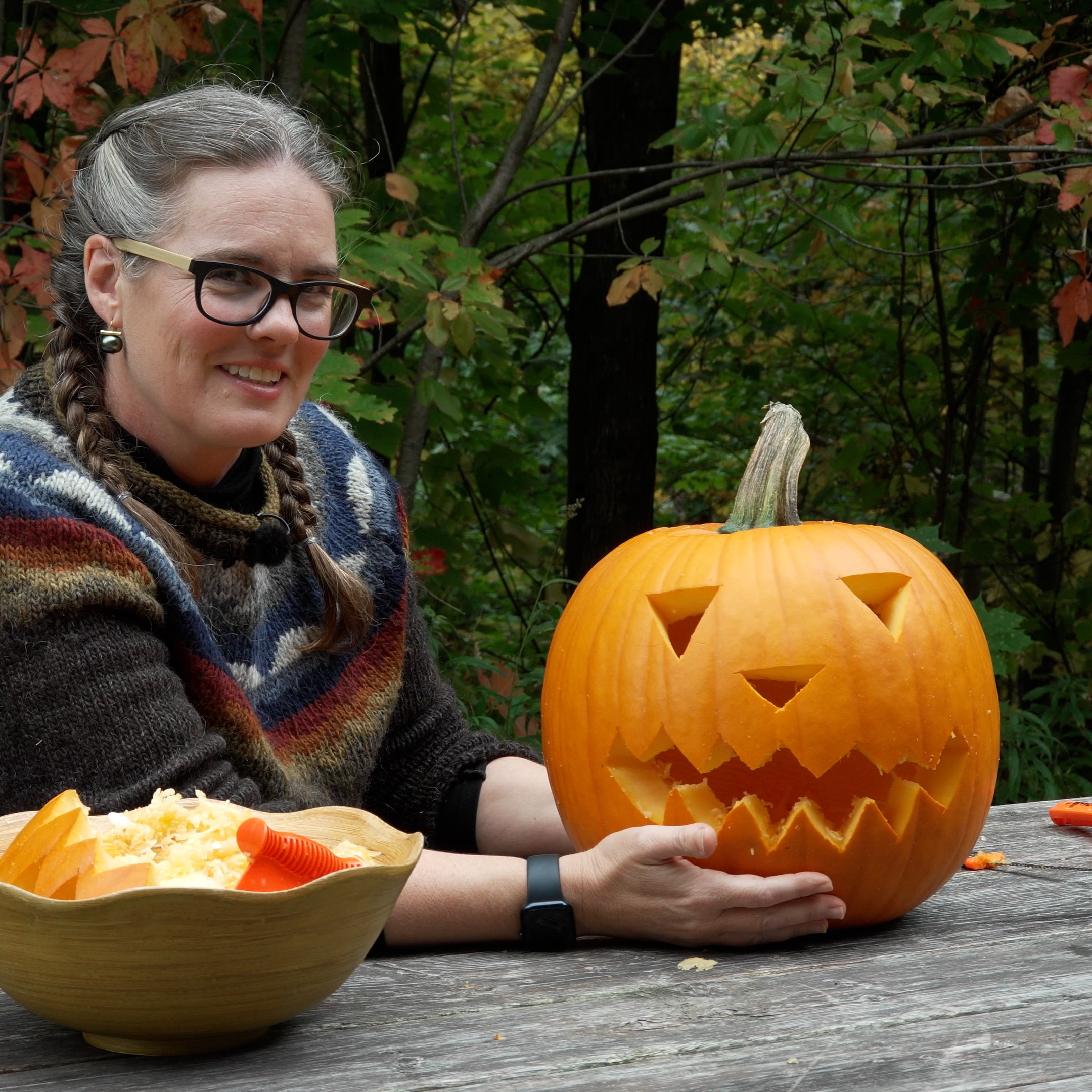
It’s autumn where But Why is based, in the northeastern United States, and we’re all thinking about pumpkins! We eat them in soups, pies, curry and even coffee! And they’re all over the place as part of whimsical seasonal decor, or carved into jack-o’-lanterns on people’s porches and front steps. But what do you actually know about these North American gourds? Where do pumpkins come from? Why do pumpkins come in different shapes and sizes? Why are pumpkins orange? How do pumpkins get really big? Why do pumpkins have that icky mess inside? Why do pumpkins float? We get the download from Chris Hernandez from the University of New Hampshire. Plus, the history of carving pumpkins with historian and author Regina Hansen.
Download our learning guides:PDF (npr.brightspotcdn.com/3f/70/ebefca9b416ca4ce9f…) | Google Slide (docs.google.com/presentation/d/1IajI7iHdfjWRs0…) | Transcript (npr.brightspotcdn.com/c7/7b/ea44b0af448c835d49…)
Transkriptvom Podcast bereitgestellt · Zeitmarken springen hin
Jane This is But Why: A Podcast for Curious Kids from Vermont
Public. I'm Jane Lindholm. Every two weeks on this show, we take questions from curious kids just like you, and we go out in search of answers. What season are you in where you live? Here in Vermont, it's autumn. The leaves have mostly fallen from the trees, and they make these really satisfying swishing and crunching sounds when you walk on them. Temperatures are starting to drop. We like to call it sweater weather, but now it's almost jacket weather. Around here, as soon as we hit October 1, people start thinking about pumpkins. For one thing, lots of folks like to carve silly faces into pumpkins and light them up for Halloween. But this is also the time of year people do other things with pumpkins, namely eat them:
pumpkin pie, pumpkin soup, pumpkin curry, pumpkin spiced latte. You name it, we probably love it. But there is more to these bright orange fruits than Jack o' lanterns and spiced coffees. Yes, I said fruits. Today we're answering all your questions about pumpkins, these distinctly North American gourds, and we're joined by someone who studies them, grows them, and eats them. His name is Chris Hernandez.
Chris Hernandez I'm an assistant professor at the
University of New Hampshire, and I study plant breeding. And plant breeding is basically being a plant inventor. So it's my job to invent new types of plants that we can enjoy and eat.
Jane Whoa! Like what? What have you invented?
Chris Hernandez What I work with is pumpkins. So I'm working
on inventing new types of pumpkins. So these are pumpkins that might look a little bit different. They grow a little easier for farmers, and so that's kind of what I do.
Jane So when you say they might look a little different, if I
think of a pumpkin as usually orange or maybe sometimes white, I'm picturing one now that's purple. Is that the kind of thing that you're doing?
Chris Hernandez Not quite. So I kind of have like the nature's
color palette. So there are some kind of limitations, like what's just possible out there in the world of pumpkins, so kind of have what I have to work with. So naturally, you can get anywhere from like dark green, all the way to like a really dark red in between. So yellow, green, and then you also kind of have you might see like a bluish in certain types of pumpkins, or almost a gray. That's kind of this like wax coating on the surface of that fruit that kind of makes it appear a certain color. Not it's not true blue. That's not in the color palette.
Jane But mostly, you're not working on making fantastical
colors. You're you're doing things like working on making a pumpkin that is easier to grow in certain kinds of conditions, or maybe one that withstands certain types of pests or or soil problems. Is it that kind of thing, more like how to grow good pumpkins than how to make them really cool looking?
Chris Hernandez Yeah, well a little bit of both because
pumpkins and ornamental crop. I mean looks really do matter so it needs to look interesting but we also do a ton of work on, you know I do a lot of work on like disease resistance and so you know that so farmers can grow the plants without having to spray a lot of pesticides on them. It just makes it easier to manage them, and so it's still important that it looks cool, and also that you can pick it up by its handle. That's an important thing for a pumpkin.
Jane Yeah, right. So you have to make sure that the those
handles... that the that vine is strong enough.
Chris Hernandez Yep, I pick every pumpkin up and give it a
little shake. And if the handle comes off, it's it's not going to make it in my in my program. Just because, again, you're going to pick it up from the handle. If it doesn't have its handle, it's not really a pumpkin.
Jane So, how does one come to specialize in pumpkins? Were you
a kid who was like, I just really love pumpkins?
Chris Hernandez Actually, sort of yes. So I got interested in
growing giant pumpkins when I was a kid because they were just so cool. They grow so big, and so I started growing those. And then high school, you know, I had biology classes and realized that you could have a career like inventing new types of plants. Like I wasn't interested in like engineering things, like mechanical things, but the idea of making like new types of plants was really interesting, and so that's kind of why I decided to be a plant breeder. And I just happened to end up in a position later in life that was back with pumpkins, so that kind of worked out well.
Jane What's the biggest pumpkin you've ever grown?
Chris Hernandez Around 840 pounds. Which is... it might
sound big, but that's really, really small. So the the current world record is 3,156 pounds.
Jane Oh my gosh!
Chris Hernandez So a ton and a half.
Jane So so at 800, that's like not the major leagues of giant
pumpkin growing.
Chris Hernandez Definitely not. So I I think I'm a better
pumpkin breeder than a giant pumpkin grower, but still very fun to grow.
Jane At the University of New Hampshire, where he works, Chris
runs the Cucurbit program. That's Cucurbit, C-U-C-U-R-B-I-T. And what is a Cucurbit?
Chris Hernandez Basically, it refers to the cucurbitaceae
family, which is a much harder to say word, too. But the cucurbitaceae family is home to all of our kind of vining crops like cucumbers, melons, pumpkins. Are all from this cucurbitaceae family, and we kind of shorten it to cucurbits.
Jane Let's get to your questions.
Sydney My name is Sydney, and I live in in Skokie. And my
question is, where do pumpkins come from?
Chris Hernandez That's a good question, Sydney. So pumpkins
are actually from the Americas. Nobody from Europe or Asia or Africa even knew that a pumpkin was a thing until they came here about 500 years ago. But they were here much earlier than that. Here in the Americas, our ancestors working with pumpkins about 10,000 years ago, we think so. In what we call Mexico today, there were farmers who were saving seeds from kind of the ancestors of pumpkins, and it was mostly seeds that they were working with too, because the fruit of these wild or ancestors of the modern pumpkin were super bitter, and so farmers initially were growing them, eating their seeds. Then over time, they noticed that there was something they could actually eat the flesh of, and then they started to notice
other colors, and so they started to over time kind of develop different types of pumpkins and squash. So, but yes, they're all from the Americas, and it's actually we think one of the oldest crops in the Americas that we started domesticating, and then they kind of expanded across from there. And then when people from Europe came over, they got interested, took them back to Europe and made zucchini, and so we got all kinds of different types. But they're originally from the Americas and probably Mexico, we think.
Jane What do you know about what those original pumpkin
ancestors looked like?
Chris Hernandez You know, we can't... we don't know. We can't
go back in time and see exactly what they grew. But we have a lot of like still wild species that are out there, kind of out there in nature, and so we think they probably resembled those. So they were really small, really tough rind. And again, we think initially they were using them for the seeds because the the other parts were so tough and bitter, and we wouldn't like to eat them. And actually, even before humans were really using them, we think that it was actually giant mammoths and sloths back from the ice age that were able to eat the fruits and sort of move them around. And then after those animals sort of went extinct, then we started to interact more with squash, and we were the primary way that they were sort of moved
around. But but yeah, we think they're probably you know pretty pretty hard, bitter fruits, which is what we see in some of the wild, you know, species that we see out there today.
Jane I didn't realize that the pumpkin soup I love to eat in
the fall was originally giant mammoth and sloth food. But wait, you think they were orange back then?
Chris Hernandez Probably more like green, dark green. But they
probably again, it's hard to know exactly because you do see some some different color forms too.
Alice My name is Alice. I live in B.C., Canada. I'm five, and
why do pumpkins come in different shapes and sizes?
Chris Hernandez Another good question. So, basically, the
short answer is genes and people. Every pumpkin seed gets instructions from both of its parents that control how that seed develops and the type of pumpkin it will make. Just like you get different, you know, parts from each of your parents, right? And so, if you look at your brothers and sisters, you're all a little bit different because you inherited different instructions from your your parents. And so, for the same reason, you know, pumpkins are all a little bit different for one another, and over time, farmers grew those pumpkins, and they saw some of those differences. And different farmers liked different traits or characteristics in the fruit, and so they selected or you know picked the ones that they liked
best. And so over time, different farmers were choosing for different colors, different sizes. And so today we have all this these different colors and sizes because of that, so it's again part of this different instructions that we see, and again those instructions can change too over time. You can get little changes of those instructions. We call them mutations that occur, and that can lead to a different color, a slightly different size. And again, farmers would see that and say, "I like that one," and continue that. And so over time, that leads to a bunch of diversity in what we see today.
Jane There are some kids who have specific color questions.
Addie & Christian: Hi, my name is Addie, and I'm 11 years old. My name is Christian, and I am seven and a half years old. We live in Longview, Texas. Our question to you is: Why are pumpkins orange? Bye. We love your show.
George My name is George. I live in Alaska, and I am six.
Why are pumpkins orange?
Ben My name is Ben. I'm from East Hampton, New York. I'm five
years old. And my question is, why are some pumpkins white?
Chris Hernandez Like a lot of fruit, they go through this
process where initially, you know, so the purpose of a fruit is ultimately to be consumed by an animal because the fruit has seeds, and you want the seeds to be spread. And one of the ways that a fruit lets us know, or other animals know, that it's ready to be consumed, is it changes color, it ripens, right?
And so it's very common for different fruits to change, like an orange or red color. Think about an apple. It's similar with pumpkins. They have this process where they ripen. So they start green, and that that green is caused by what we call chlorophyll. And so these are what you see that they have the same kind of molecules or compounds that make leaves green. They make the pumpkin rind green. Then over time they start to break down, and you start producing these other types of compounds known as carotenoids, which tend to be can run from yellow. If you have a lot of them densely packed in there, they you can get a red color. And again, those kind of symbolize or signal to us that they're ripe and sort of
nutritional content, and so so pumpkin fruits are producing these compounds. And again, farmers were noticing this and saying, "Okay, I just like the way that looks, right?" And so over time, and so you have this sort of evolutionary thing where they're trying to let animals know to eat them, and then on top of that, you have people saying, "I just like the way that looks," and continuing that pumpkin on, so you get all this diversity in color. But it's really due to these sort of naturally occurring compounds that give all fruit their color as they as they start to ripen.
Genevieve My name is Genevieve, and I live in San Francisco. How
do pumpkins get really big?
Jane As someone who, you know, spent some time when you were a
young person growing really big pumpkins, this is a good question for you.
Chris Hernandez It is. I thought I had the same question
as Genevieve when I was a kid. And so basically, if you think you know, if you go to the store and get like a little package of water balloons, right? There's like maybe 200 little water balloons that fit in that package, but then if you were to fill each of those balloons up with water, they would take up a whole lot more space, right? And so basically, you can think of a little baby pumpkin as having these what we call cells. Each of these cells is like a little water balloon, and as it grows, they start to fill up with water, and so you get a really big fruit just from the how these cells filling up with water, and so it's basically how pumpkins are getting really big.
So they have a lot of cells, and as they grow and develop, these cells start to fill with water. You can think of again like little water balloons filling up, and you get this large fruit as a result of that. So these really big pumpkins just have a lot of cells with a lot of water in them. So they're really big cells, and that's what gives you a really big fruit.
Jane Do you have to do something special though? I
mean, sometimes you see people talking about growing their big pumpkins, and it's almost like they have a pet. They're taking such good care of it, and they're making sure it's on a special you know piece of cardboard, or they're rotating it, or they're making sure it it its vine isn't ever twisted. I mean, it's it takes a lot of work.
Chris Hernandez Yeah, I mean, giant pumpkins, I should say,
are in a league of their own, right? So, part of it is that the type of pumpkin that that the giant pumpkin is, it's it's actually different from a traditional pumpkin. So, when you think of a traditional jack lantern, that's one species, actually called Cucurbita pepo, but there's a whole other species called Cucurbita maxima that the giant pumpkin belongs to, along with Hubbard's and buttercup squash, and they just have more potential to get large. So part of the thing is, you know, these this particular strain that growers are growing for giant pumpkins, it's just built a little bit different, right? So you can imagine it has just really, really tall parents, right? So it's going to be, it's going to just have more
potential to produce a bigger pumpkin than a Hubbard, which has two small parents, right? So part of it's got the genetics to get large, and then exactly as you said, you just kind of have to pamper them. So people often think it's about giving them an excess of stuff, but it's really about making sure they have absolutely no stress. And so you know, like the the world's biggest pumpkin was grown in a in kind of a high tunnel or greenhouse-like structure, so it could have everything it needs, be warm. It was watered, you know, consistently. Whenever it was a little bit dry, just got the perfect amount of water, and so you kind of need this perfect management, and then to have that the genetics or the ability to get large, which that
particular strain called the Atlantic Giant has.
Jane We just did an episode about how humans grow and how we
get bigger as kids, and now I'm wondering if maybe if my parents had just found a way to make sure I never had a moment of stress in my life, I could have been six foot 10. But no.
Chris Hernandez Yeah, still you still have you know how tall
your parents are and the genetic component.
Elliot Hi, my name is Elliot. I'm eight years old and I live
in Seattle, Washington. Why do pumpkins have that icky mess inside?
Chris Hernandez Yeah, Elliot, I'd say that's also my least
favorite part about the pumpkin. You know, when you carve it, it's all that icky, icky stringy material. So that's actually... We call that sort of placental material, and so it's a part of the pumpkin fruit. So you can think of the pumpkin fruit as kind of a mother, and each of the seeds in there is babies.
And so the the seeds are attached to the mother, kind of like through this this placental tissue. You can think of it kind of like an umbilical cord that attaches the baby seed to the mother fruit, and so the seed is going to get all of its all its nutrients, everything it needs to grow and form a nice seed from the mother fruit through that umbilical cord or stringy stringy bit. So over time, when the seeds are fully developed, the fruit is ripe. That tissue starts to break down. It gets less strong. It gets more slimy. There's you know it's it's done, right. The the seed's ready to be harvested, and so when you go to to carve that pumpkin and take the seeds out, it's all slimy at that point. That tissue is important for for letting the
seeds develop. It's like again, kind of like the umbilical cord.
Jane So does each seed have its own sort of filament or cord?
Each one is attached to its own little stringy bit, and every little stringy bit has a seed?
Chris Hernandez Yep. So each seed is attached to its own
stringy bit. Each seed was ultimately came from a separate grain of pollen on a bee. So it all traces to one seed as one grain of pollen, one string, etc.
Jane Wow, that is so cool.
Eve My name is Eve. I live in Canada, Nova Scotia, and my
question is: Why do pumpkins have seeds?
Moritz My name is Moritz. I live in Olympia, Washington. I
am six years old. How do pumpkins get seeds? Do the seeds grow with the pumpkins?
Lorelei I'm Lorelei. I'm six years old. I come from Downey,
California. Why do pumpkins have so many seeds in them?
Chris Hernandez Yeah, so I think you know why. Let's start
with why do pumpkins have a lot of seeds? Well, basically, pumpkin plants are just like every other plant, and their whole purpose is to make more plants, right? And so each of those seeds in the pumpkin fruit can make another plant, and part of the reason they have so many of them, though, is because you could think, you know, let's say it has 500 seeds. Well, not all of those, you know, some of them might not develop fully. Some of those seeds might go bad or spoil. Some of those seeds might start to grow into a plant, and then the plant, you know, gets eaten by an animal or crushed by a person, and so they're producing so many seeds to basically ensure that at least one of those seeds is going to make a new plant, and so that's
kind of again that's why that's why the plant is producing so many seeds because each seed is an opportunity to make a new plant, and that's that's basically what it wants to do, if a plant could actually want, you know, that's that's what it's trying to do.
Jane Do you remember just a minute ago when Chris said that
each pumpkin seed can be traced back to one grain of pollen on a bee? Here's how it works.
Chris Hernandez You'll see that if you look at a pumpkin plant
early on, you'll see it kind of has these flowers, and one of the flowers looks like it has a little fruit on it. Okay, and so that's that's kind of the mother flower, and a bee will come and put some pollen on that flower. So the pollen comes from a father flower on the plant or another plant. That pollen will go on the on the female flower, the mother flower will go down and then create a fertilize and create a seed, and then the fruit that flower will come off, and that little fruit will start developing into what we call the pumpkin or the main fruit. And within that, the seeds will be developing along the way, and then eventually, you know, it will be fully ripe, and those seeds will be fully mature. And then you can harvest them, you
can eat them, or you can plant them.
Jane Well, speaking of eating it...
LIam Hi, my name is Liam. I'm eight years old. I live in
Arizona. My question is, why do people eat pumpkin seeds?
Chris Hernandez Well, they taste good, Liam. I think is the
short answer. But and as I said early on, we think that that was originally why farmers were interested in the seeds or in the fruit in the first place. Is that the fruit was not able to be eaten because it was bitter and stuff. But they had seeds that they knew that tasted good, and were actually end up being very nutritious. So the seed, it has the baby pumpkin plant in it, and also comes with a little bit of food package for the baby to develop. So the seed has in it a little bit of food. So when you plant that seed, the baby pumpkin will use up that food and grow into a new little plant. And so it has a little food in it, and so that's kind of what gives it a lot of nutritional value, along with other protein and vitamins in
it. So it it tastes good. It's it's nutritious.
Jane Do you have a favorite way of eating pumpkin seeds, or
because you study pumpkins, are you like, oh, I couldn't possibly eat them?
Chris Hernandez Oh no, I have no qualms with eating the seeds.
I just like you know, toss them in some a little bit of butter, oil, and then a little salt, and toast them. There's also some seeds, some pumpkins that have seeds that don't have a shell on them, so they're kind of you maybe seen these hullless seeds that are kind of green in color.
Jane Oh yeah, yeah, yeah, yeah.
Chris Hernandez They kind of there's there's mutation for
that, and in places like Austria, for example, they'll actually squeeze them for oil. So it's kind of an oilseed crop, and so those you can kind of because they don't have a shell, you can kind of brine them in a little bit of salt water and just put them in the microwave, and they'll pop almost a little bit like popcorn. And so I like those.
Jane That does sound good. I like to try to put a little bit
of maple syrup, but not enough that it's going to burn. But some maple syrup and then a little bit of sea salt and roast them, and then they're like savory and sweet. So we've been talking about how big pumpkins can get, and if you've ever picked up a pumpkin from maybe a pumpkin patch or a farm stand, especially, you know, for my family, we like to have pumpkins in the fall to eat and to carve for Halloween, but they can be really heavy, and we've talked about how big they can get. And Nico is wondering
Nico Why do pumpkins float?
Chris Hernandez Yeah, so Nico, it's true that the pumpkins are
really big, and they can be really heavy. But if you've ever, you know, when you carve them, you cut them open, you can see they're mostly air on the inside, so they're kind of a hollow ball, right? And so the thing is that for its size, pumpkins are lighter than the amount of water that they take. That they the equivalent amount of water, right? So that's the key: is that for the size that they are, because they're hollow and have air in them, they're lighter than the the same amount of water that they take up. And so because of that, they float.
So even if you have a really giant pumpkin, it's really big, but it takes up a lot of water for its size, or covers a lot of water area for its size, and it's mostly hollow, so it's still able to float. And that's the same reason that like big ships can float, too. And so some people use the giant pumpkins like ships, right? They have little call them regattas or boat races in the giant pumpkins, and that's because they're mostly hollow on the inside.
Jane And we have a whole episode about this. If if you're
wondering more about, wait a minute, I don't quite understand the density and displacement of you know of the water. We have a whole episode. I think it's titled "How Do Boats Float," and you can learn a lot more about the physics of how things that are really heavy can still float in the water. Chris, is there anything really cool about pumpkins and the family of plants the pumpkins are in that you think kids should know about? Something maybe we don't know about pumpkins?
Chris Hernandez They produce this bitter compound called
cucurbitacin. So if you were to cut open a gourd and lick it, which I wouldn't suggest. It would be super bitter, probably because it hasn't been selected for eating, whereas a lot of other pumpkins we've selected against it. But it has this cucurbitacin compound in it, and again, we think that basically because of that, it was mammoths and you know large sloths back in the ice age that were eating these fruit. So it was food from mammoths. I think that's interesting. Like you know, so we took a food from mammoths and made it a food for us.
Jane So the next time you have pumpkin soup or pumpkin pie, you
can think, hey, I'm eating mammoth food, except with a lot more sugar. Thanks to Chris Hernandez, who runs the Cucurbit Breeding and Genetics Program at the University of New Hampshire, for educating us about the amazing pumpkin. Coming up, where did the tradition of carving faces into pumpkins for Halloween come from?
This is But Why. I'm Jane Lindholm. Today we're talking pumpkins. I wonder why we've been getting pumpkin questions lately. Hmm. There must be some reason. Oh yeah, of course, Halloween. In the United States and some other countries, lots of people have fun carving faces into pumpkins and calling them Jack-o'-lanterns. It's part of the Halloween tradition. But have you ever wondered why we do that? We've got you covered.
Nora Hi, my name's Nora. I'm from Minneapolis and I am six
years old. My question is, why do people carve pumpkins on Halloween?
Elliot My name is Elliot. I'm eight years old from Lakeville,
Minnesota, and my question is, why do we carve pumpkins?
Francesca Hi, my name is Francesca and I am six years
old. I'm from Massachusetts, and my question is, why do they carve pumpkins for Halloween?
Grant My name is Grant. I'm from East Hampton, New York, and
I'm three. And I want to know why you carve pumpkins.
Jude My name is Jude. I am nine years old. I live in Cincinnati,
Ohio, and my question is, why do we carve pumpkins?
Jane All the way back in 2018, we did an episode about how
Halloween celebrations came to be. The whole thing is fun. You should listen to the episode. But since we're talking pumpkins today, we thought we'd just play you the part about those strange fruit. Our guest was Regina Hansen, an author and historian who teaches at Boston University.
Regina Hansen This is one of my favorite stories because it's
got a mystery to it. And although it's interesting because light is very important in all of the traditions around the harvest and around honoring the dead, the Jack-o'-lanterns specifically started with the Celts. They would carve creepy faces into turnips, and they put a coal inside. They walk around with these lanterns, and it was supposed to scare away the spirits of the dead. But also, this continued when Halloween and All Saints' Day became a religious holiday. People kept doing that. It's one of the traditions that's been kept all the way along the line from the beginning of the when it used to be called Samhain. But when the immigrants came to America, two things: there weren't as many turnips because people just
didn't eat turnips. But there were lots of pumpkins, and pumpkins are much much easier to carve.
Jane Because they're bigger, they're rounder, and they're
hollow.
Regina Hansen Exactly, and they make such a nice light too, and
they smell so good. So it was like a you know it was a good trade,
Jane Right? And you can roast the seeds and eat them. I mean,
so many good things.
Regina Hansen Oh it's awesome, right? And then you can make a
pie afterwards. That's what I do. There's a mystery about why they call it a Jack-o'-lantern. Some people say that it's because of an Irish story where there was a guy who couldn't get into heaven or hell, so he has to walk the the earth and he carries a lantern with a face on it. So that's one of the reasons why people say. But there are other reasons too. But yeah, pumpkins are a lot easier to work with, and I think that's that's that's the main reason why we have pumpkin Jack-o'-lanterns now instead of turnip Jack-o'-lanterns.
Jane That's it for today. Thanks to Halloween historian
Regina Hansen and our cucurbit expert Dr. Chris Hernandez for answering all of our pumpkin-related questions. As always, if you have a question about anything? Have an adult record you asking it on a smartphone using an app like Voice Memos. Then have your adult email the file to questions@buykids.org. Tell us your first name, where you live, how old you are, and what you want us to investigate. But Why is produced by Sarah Baik, Melody Bodette, and me, Jane Lindholm at Vermont Public and distributed by PRX. Our video producer is Joey Palumbo, and our theme music is by Luke Reynolds. Oh, and by the way, do you know we have a newsletter?
Tell your adults because we send it to them. We send the newsletter out every time we have a new episode, and we tell your adults all about what's in the new episode, plus other cool things we're working on that we think you might like to know about, like our video episodes, which we do every other week as well, and when we have questions we want you to help us answer, we always share that first in our newsletter. You can find the sign-up form on our website, butwhykids.org. We'll be back in two weeks with an all-new episode. Until then, stay curious.
