

Kapitelklicken springt direkt hin
Shownotes
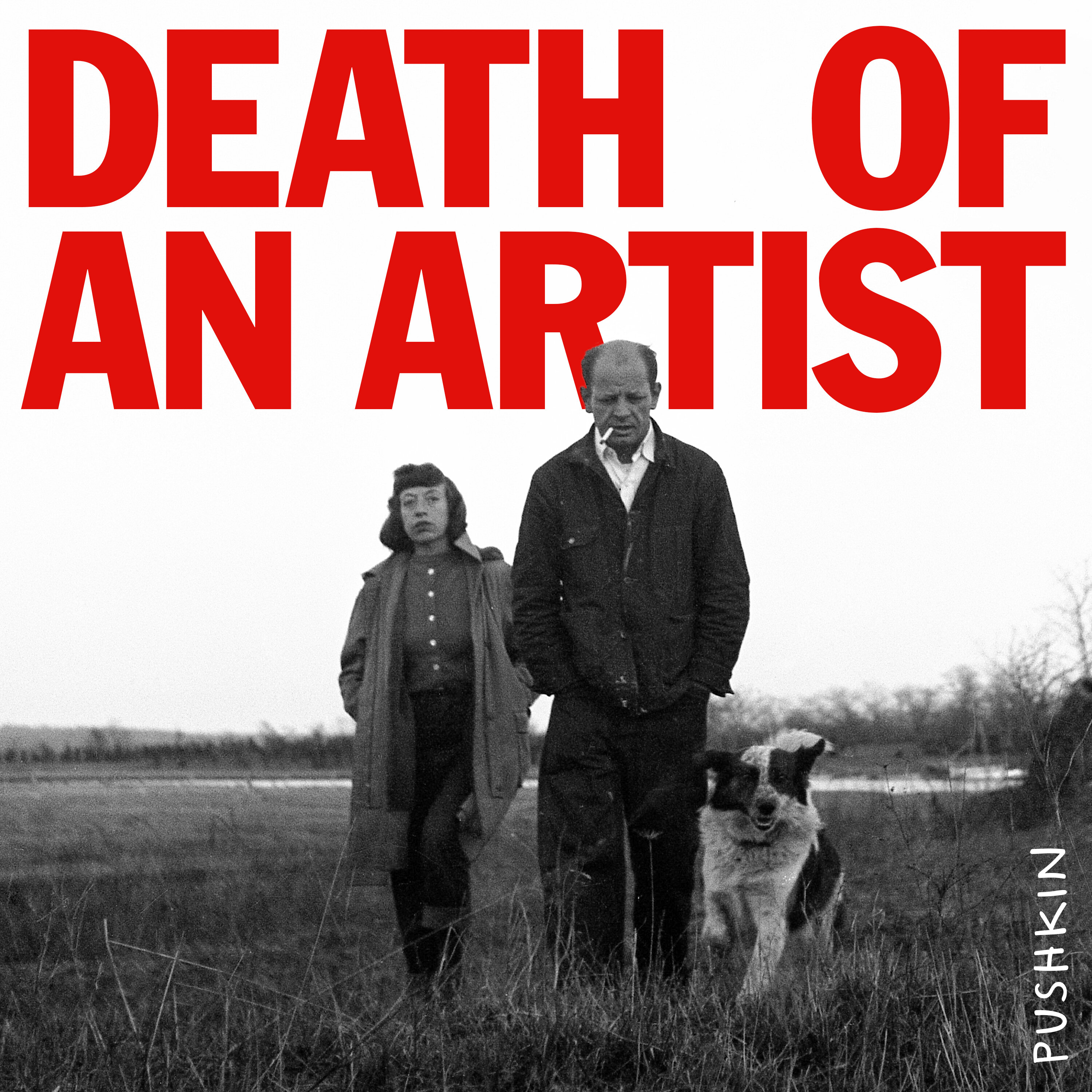
1936. Brooklyn. A young Lee Krasner leaves home and starts to create a kind of art America has never seen before.
See omnystudio.com/listener for privacy information.
Transkriptvom Podcast bereitgestellt · Zeitmarken springen hin
Pushkin. It's winter nineteen thirty six in New York. A party is in full swing and everyone is having a good.
Time drinking and dancing.
The cigarette smoke was so dense they could barely see each other.
The place is full of artists wearing patched up woolen suits and cheap sequin dresses, driving as fast as they can just to keep warm. This is Mary Gabriel, who wrote Ninth Street Women.
Life outside and the streets was difficult because it was still the Depression. Life inside their studios was difficult, but inside their dance hall they could let it all go. They would buy bottles of booze, get together and have just a raucous good time.
In the middle of the crowd is a woman in her late twenties, short bob net stockings, heels. She's effortlessly dancing rings around everyone else. Lee Krasner has got rhythm.
Dancing was one of the passions of her life, and she took it very seriously.
Lee knows she's turning heads, and not just because of her quick feet. Lee's painting had got people's attention. Even in art classes, other students would keep their eye on what Lee was.
Doing while she was on the dance floor. A young man stumbled into her mumbled something about wanting to dance.
She looks up skeptically.
A handsome young man, muscular, someone Lee might have actually been attracted to.
She's never seen him before, must be new on the scene, but he's kind of hot type.
Until he stepped on her feet, burped in her face, and ended his dance floor seduction with the question do you like to fuck?
Lee pushed him away and that was the end of that.
But that's not the last she'll see of him, not quite. In five years time, she'll meet him again, and this time, to everyone's surprise, they fool in love.
Her friends didn't really know what to make of them. Some of them thought he wasn't worthy of Lee, that he didn't have the personality, that his art wasn't good enough. She was the center of the scene. She was almost seen as doing him a favor by producing him.
Jackson Pollock my husband, who was ghastly and stepped all over these.
This is Lee Krasner talking about her first meeting with her husband.
Any time my name comes up as an artist, it's how it's in relation with Jackson Pobin, who the hell else has ever related to Jackson Pollock. Lee Krasner is always compared to Pollock, and the cliche it's Lee is beshadowed back her husband, and that's it's easy and we don't have to think about that.
But it wasn't always like that. In this episode, we're going to go back to a time when Jackson Pollock was overshadowed by Lee Krasner, when Jackson was a nobody and Lee was the one to watch. It's the story of how, at the beginning of the twentieth century, a young Jewish girl from Brooklyn created a new kind of art America had never seen before. I'm Katie Hessel, and this is Death of an Artist Krasner and Pollock Episode two, Inner Rhythm. Here is Lee Krasner talking about her early life in an interview from the nineteen seventies.
My whole background is one way.
I don't have encouragement right from the beginning, So this is another tough nut to crack. Okay, itself imposed, and I'm aware of that.
She was born Lena Krasner in nineteen oh eight, the daughter of Orthodox Jewish immigrants. Her family had fled the pogroms in Eastern Europe. With four young children, they moved to Brownsville, Brooklyn, and less than a year later Lena was born. The Krasners made a living selling fish, fruit and vegetables at a local At home, they spoke Yiddish, Hebrew, and Russian, with a smattering of English, and regularly attended synagogue.
Lena hated synagogue. She couldn't understand why the women and men couldn't sit together, why there were so many rules. Instead, Lenna spent her free time copying fashion ads from newspapers and reading Edgar Allan Poe. She already had a sense that Brownsville was not the life of her She wanted something else.
I'm graduating from elementary school and one had to indicate what you wanted to major in. And for some reason which to date has not been explained, including a couple of years of analysis, I chose the word art. Don't ask me why. There was nothing in my environment that I can think of now that would have produced this.
She watched as her older sisters married nice Jewish boys, stayed in the neighborhood and helped with the family business. And then, in nineteen twenty eight, when Lee was nineteen something, happened that rocked the family. Her older sister Rose died and according to the tradition of their community, Lenna was required to marry Rose's widower, but she refused. The duty fell to her younger sister, and before too long, Lena would leave home and change her name to Lee, becoming Lee Krasner, shorter, more chic, and crucially more American, ready to make a new life for herself.
I want my independence. Deal with them.
I want to make my own statement.
Damn well, deal with it now.
I haven't the patience for a time to deal with now, go aheads who I don't know how many years behind me. And that's true as of today.
Picture the scene. It's nineteen twenty eight and she is in an airy, chalky room in Manhattan, wearing a smock, sketching a nude. She has made it to New York's most prestigious art college, the National Academy of Design.
Was very tradition bound.
This is Mary Gabriel.
She and her fellow students worked from a nude model Anna Stand in a classical pose, with very rigid rules about what could and could not be drawn and how it should and should be drawn. It was actually the opposite of what creative freedom was about.
So this place was not like the art schools of today. It did not encourage you to discover your inner voice or to express yourself. You went to the National Academy to train for a future of painting commissions, landscapes, portraits, that kind of stuff in museums.
Against in fact, were largely palaces of artifacts. They were historical places. They weren't places where there was living art.
So Lee had finally got out of Brooklyn and made it to the big city. But she now found herself sketching plaster casts of Greek statues and carefully arranged fruit and flowers. It was all well, quite traditional, certainly not what she left her old world behind for. Lee became restless. A note on her record card from the school states, this student is always a bother insists upon having her own way despite school rules. Lee wanted to make a different kind of art, something that could make her feel alive.
She was just not quite sure what that looked like yet. But about a year later, Lee got her answer. One afternoon in November nineteen twenty nine, Lee and her classmates were walking down Fifth Avenue. They were on their way to the opening of a new gallery called the Modern now known as the Museum of Modern Art or MoMA, on the corner of fifty seventh Street. Lee walked into a skyscraper and into a fancy lobby. She took an elevator up past the interior designers and magazine offices, all the way up to the twelfth floor. She saw walls covered in dazzling kaleidoscopic colours, shapes and lines dancing from edge to edge, rich thick textures like nothing she'd ever seen before.
It took her breath away. It literally moved the earth underneath her. And what she saw on the walls of that museum was pure freedom.
A summer's day on a riverbank, made up of thousands of colorful dots, A still life with apples, composed of jagged shapes, landscapes of sun flowers with swirling paint strokes. These were paintings by Suzanne van Goff Gogan Sura, showing in the first ever museum devoted to modern art in New York City. Today, these paintings are uber famous. They're on mugs, t shirts, posters, But imagine being Lee Krasner seeing them here for the first time.
A group of us went down and saw this, and that really hit like an explosion with like a barnaby, and that disclouded.
These works defied everything that had come before.
Suddenly a painting no longer had to be something. They had depicted something, or at.
Least not realistically. That was not the aim here.
It could be about how the brushstrokes were made, how colors played off each other. It was about the act of painting, much less than what was on the canvas itself. It was absolutely a revolutionist.
Even I remember learning about these artists for the first time and being stunned by the blazes of color I'd see on a gallery wall. How they distorted all sense of realism made at the stroke of the twentieth century, they marked the start of tearing the image apart. These works are part of a style called post Impressionism. Impressionism had occurred a few decades before, in the eighteen seventies in Paris, and was a style that was all about creating an impression of something as opposed to the real thing.
At the dawn of a new century, artists began to move further away from the real image and use color to express their inner emotions. Then Cubism came along with its sharp edges and lines, breaking down any inkling of perspective. And now suddenly all of this had arrived in New York City.
It was like a meteorite had hit the United States and left behind thousands of pieces of art that changed profoundly the way people considered what a painting was.
What Lee saw that day and in future visits changed the way she looked at the world and the way she painted forever. Lee and her whole art class rushed back to their.
School, stormed into the classroom, tore apart the model's stand that had been set up for them to draw from, and basically declared a revolution. They took the model, and rather than draw a nude model, they put clothing on the model, which injected a sense of modernism to this tradition.
Not a big deal, you'd think, but their teacher was not impressed his Lee.
On the first day of criticism, our instructor walked in and did about three criticisms, then hurled the brushes of floor and walked out of the room, saying I can't take this class anything.
For Lee, there was no going back. She wanted to create the kind of things she'd seen at the moment, but make it her own more American. There was just one big problem.
The notion of an American artist just hadn't really taken hold. An artist was an elite, An artist was in most cases European. Anyone who was an artist had other jobs. They worked for companies that had art departments.
Like advertising, or they taught art.
But no one was actually a full time painter, a full time sculptor.
It just wasn't done.
It wasn't done because you just couldn't expect to make a living selling your own original art.
Those were the men.
For the women, it was absolutely not even a possibility because such a thing as a woman artist in the history of art doesn't really exist.
There wasn't a single woman in that groundbreaking exhibition Lee went to at the moment, and it would take that same gallery nearly twenty years to dedicate a major show to the life of a female artist, Georgie O'Keeffe in nineteen forty six. Lee had no role models to look up to, let alone anyone willing to push the boundaries like her.
For an American woman artist, especially a working class Jewish woman like Lee, Krasner. There was just absolutely no pathway for her to make that happen, and for her to even declare herself an artist or someone who wanted to be an artist was.
A laughable dream.
The idea of being an artist was really beyond the pale.
But something else happened in that momentous year eighteen twenty nine.
The tremendous crowds which you see gathered outside the Stock Exchange are due to the greatest crash in the history of the New York Stock Exchange and.
Market prices after the break. The story of how the Wall Street crash and the government's response helped create the New American Artist.
It was a cataclysm throughout the United States. The suffering was massive. Twenty five percent of banks in the United States folded. Quarter of the population within weeks was out of work. Everything stabbed, the world changed.
By spring nineteen thirty two, Lee had dropped out of the academy. She could no longer afford it. Everything she'd been working towards was suddenly up in the air. To make ends meet, she started waiting tables at a dive bar in Greenwich Village, making barely enough to buy art supplies. The whole country was in a pretty state for years, and in nineteen thirty two, presidential candidate Franklin Roosevelt announced his plan to restore America's economy. He called it the New Deal.
I say to you now that from this date on, they paint them men mother's doom. I fled myself go a new deal for the American paper, and.
The idea was that the federal government would provide a basic salary and existence to get people to work on massive infrastructure projects, anything that could improve the quality of life in the United States, and at the same time get people working.
Much to Lee's surprise, Roosevelt said he was going to include artists and put them to work on public projects like painting murals. When Lee heard this news, she quit the dive bar and immediately applied. By January nineteen thirty four, she was drawing fossils for a government funded book on rocks, not to dream exactly, but it paid the bills. Within a few months, the president announced something even bigger, an organization that promised to employ about four thousand artists and give them a weekly stipend. It was called the Federal Art Project, and it was a total game changer.
The Federal Art Project is a practical relief project to take care of people who otherwise would start.
Artists went from being unpaid undervalued to being recognized as having a contribution to make to society worth investing federal dollars in. And so this immediately elevated artists in the United States took place they had never been before.
Lee was about to get a steady paycheck and for the first time, she would be paid the same as her male friends.
So Lee Krasner could hold herself high because the federal government told her and her fellow women, you know, we value you, we appreciate your work, and we're going to give you a paycheck to do it. So for the first time, definitely in the history of the United States and possibly in the history of the world, women artists were recognized as having worse equal to their male counterparts, and this was a revolution in every way.
Lee worked on murals for schools, government buildings, the local radio station WNYC, and through her work she was meeting more artists than ever before.
In their own studios. Under the influence of one another, they started developing a style that was more radical, and they started experimenting.
More radical meant less realistic. At this time, the early nineteen thirties, Lee painted a lot of cities, gapes, images of docks or buildings that captured the eerie mood of the Depression, all stark lines and geometric shapes. She was clearly trying to imitate elements of what she saw at the moment, and for the first time, Lee had enough money to really dedicate herself to her own work. She wanted to improve, to be at the cutting edge of it all, and she kept hearing about a new school that had just opened, run by an eccentric European called Hans Hoffmann.
A German artist who had been working with Matisse and Picasso before World War One. His school was a temple for all of these artists who wanted to learn how to do the works that they saw in the Museum of Modern Art.
And so in nineteen thirty seven, Lee walked into the school on West ninth Street carrying some sketches, sketches that no one beyond her fellow aspiring artists had seen before. Lee knew this school was very selective, and she really wanted to get in. She put on her best game face and strode up to the reception desk.
From that ververy second I saw her walk across the studio, I was really.
Hotd that's Lillian Kisler, the school's registrar. In an old archive interview.
She was dressed in a black blouse, black kite skirt, black net stockings, high heel shoes. Even walking in she had a animal magnetism and energy are kind of arrogance, the commands that makes the waves happen.
Lee opened her portfolio and arranged it on Lillian's desk. They were sketches of a nude model, and as.
I remember those drawings, they were powerfully black and white. The contrast between the blacks and the whites and the grays were unusually dynamic. It struck me that here was a very original talent. I keep thinking today how extraordinary her work was, even in those days. It was so above all the work that was being done at the school, everyone's work. I found her just a phenomenon that first day, and I still think of her that way.
Lee was immediately admitted, and soon she was attending classes. Here's Mary again.
When she marched into a studio, Lee pushed her way through, took the best position.
In the class.
Without any regard for her fellow students. She just simply didn't care. She was there to do her art.
Lee would take out how chocolate crayon and confidently strike the page.
There was a group of Lee watchers.
They literally watched what she created on canvas and how she behaved. That left some grumbling, but others watched with admiration that this young woman in a man's world of painting would take for herself the primary spat in the classroom of the most advanced artist teaching in the United States at that moment.
During her time at this school, Lee departed even further away from realism. She was beginning to come up with a new visual language, one that went even further than what she saw at the moment, one that would come to be called abstract art. And before long she would meet an artist who nobody knew, but someone who spoke her secret language, a partner in crime, and together they would change art forever. That's after the break In nineteen forty one, Lee was done with school and was becoming well known as an artist about town. In early November, she bumped into a friend, the curator John Graham, and invited him over to her studio. Just days later, she received a postcard from him. It said that he was
preparing for an exhibition of American and French painting and he'd love to show her work. Lee read the note again and again. As the news sank in, Lee looked at the list of other artists slated to be in the same show, Picasso, Matisse, brack Her Idols, artists who had blown her away at MoMA a decade ago, and now she was going to be in a group show with these guys. Gail Levin, an art historian who befriendedly in her twenties, remembers Lee telling her about this huge moment.
She looks at the list of other Americans, and there's a guy she's had never heard of, Jackson Powack.
His was the only name Lee didn't recognize, so naturally she was curious.
So she asked who he is and was told he lives on Ninth Street, not far away. She's a competent woman, she's a well respected artist, and she wants to know who's this person showing with her that she's never heard of.
Lee walked over a few blocks to his studio and climbed up some Rickety steps to the top floor of the tenement building and knocked on the door.
He answers the door, and she says, Hi, I'm Mie Krasner. We're in the same show.
Jackson invited her into the cramped department, which he shared with his brother. Kitchen furniture was pushed aside to create space to paint.
She actually recognized him from an artist union party in nineteen thirty six, where he'd asked her to dance, but he was drunk. She was a great dancer, and he was stepping all over her feet.
This was the party where Lee first met Jackson. It wasn't a very successful encounter.
So she didn't have much use for him then. I don't know who he was. But now the situation is different. They're in the same show. So she looks at his art and she was really stunned by his work. She thought it was really something special.
Lee looked around Jackson's studio and saw paintings covered in slabs of fiery colors and thick raw textures, shapes neither human nor animal, mystical scenes with hints of Mayan and Aztec symbolism. They reminded Lee of what she'd seen at the moment. That first time, she'd described that experience as a bomb going off, and now she had that exact same feeling stepping into Jackson's studio. Here's Lee again.
The bomb exploded when I saw that first French show. The next bomb that had flooded was this incident. When I walked into his studio. There were five or six canvases around, and it had the same impact on me.
Something blue.
At the time, Jackson was twenty nine years old, a guy who was born on a farm in Wyoming who'd made it to New York. But apart from that drunken dance, Lee hadn't seen him around before.
Nobody knew Palack, no one had really seen his work.
Lee went home, wanting to see Jackson again.
Soon.
Just a couple of months later, in January nineteen forty two, when Lee went to the opening of that big group show that they were both in, she took Jackson as her date.
And so this shy, good looking young man appeared at this art opening on the arm of a supernova. She was the tap of the art heap in Manhattan, the center of the scene. She was almost seen as doing him a favor by introducing him.
Jackson was a certain kind of handsome, but he could hardly afford clothes and usually wore ovals. Many of Lee's friends mistook him for a janitor.
No one had any idea that they were looking at Jackson Powlock, who would be the seminole figure in American art history.
That's next time on Death of an Artist. Death of an Artist Krasner and Pollock is produced by Pushkin Industries and Samasdat Audio. Clem Hitchcock is our producer. Story editing by Dasherlitz at Sina, Sophie Crane and Karen Schakerji from Pushkin. The executive producer is Jacob Smith from Samasdat Audio. The executive producers are Dasherlitz at Sina and Joe Sykes. Sound design by Peregrin Andrews. Original scoring and our theme were composed by Martin Austwick. Fact checking by Arthur Gompertz, with special thanks to Jacob Weisberg. I'm Katie Hessel. The cap from the theat
