

Kapitelklicken springt direkt hin
Shownotes
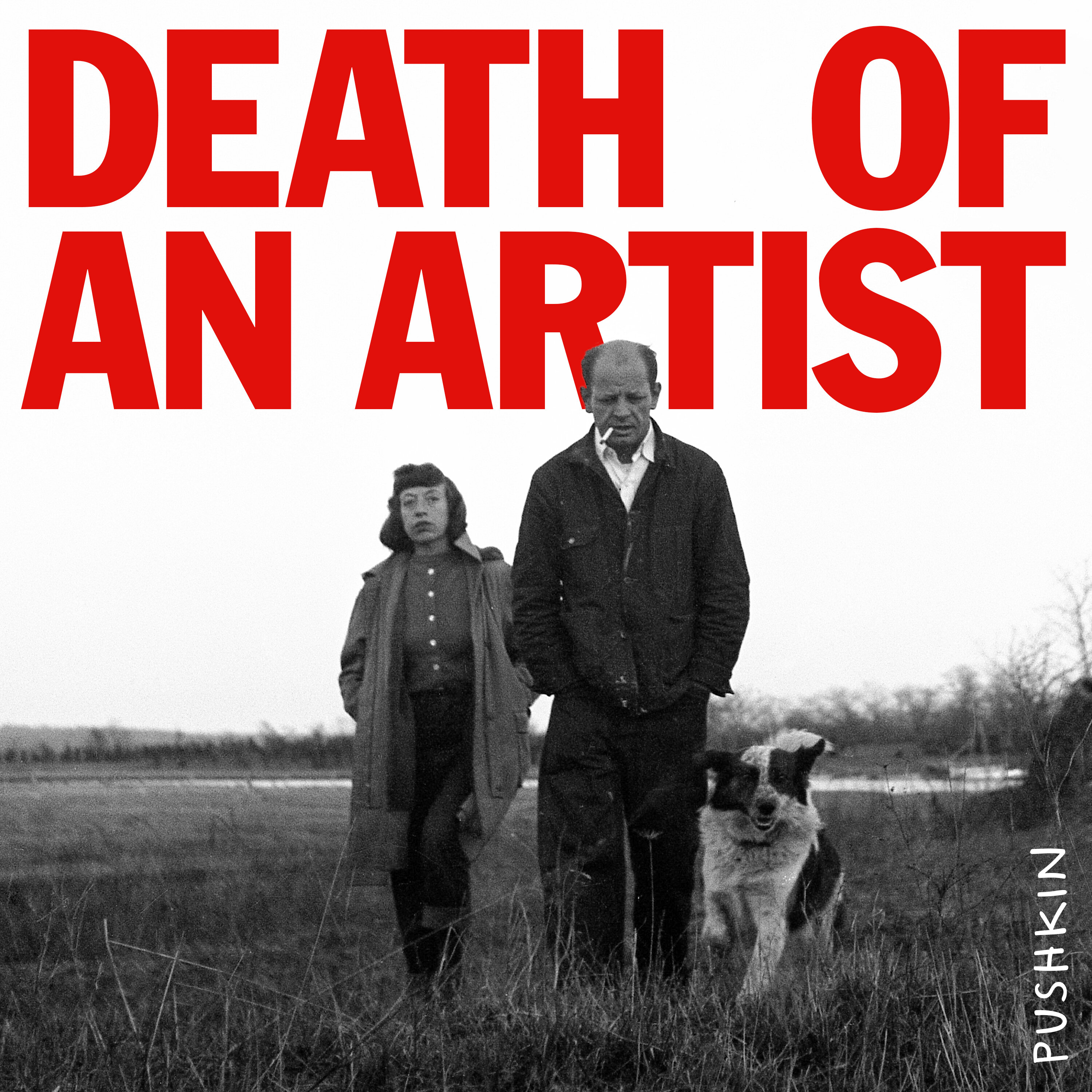
1945. East Hampton. Lee Krasner and Jackson Pollock start a new life in a farmhouse 100 miles east of New York City.
See omnystudio.com/listener for privacy information.
Transkriptvom Podcast bereitgestellt · Zeitmarken springen hin
Pushkin. In the winter of nineteen forty five, Lee and Jackson found themselves about one hundred miles east of New York City.
It was freezing cold. It came in a rainstorm. They had a borrowed delivery wagon with all their stuff in it. What were they thinking.
Standing outside an old, dilapidated farmhouse. They pulled on the door, it didn't budge. This was meant to be their new home.
They had forgotten to pick up the key from the realtor, so they had to break in.
This is art historian Helen Harrison I sat down with her at this very farmhouse Lee and Jackson moved into almost eighty years ago. Helen looked after it for over three decades. The house is in the hamlet of Springs in the Hampton's. Yeah, that Hampton's, the one that today is dotted with millionaire mansions. Madonna has one, so did Jay Z and Beyonce. But when Lee and Jackson arrived in nineteen forty five, it looked very.
Different, definitely not the quote unquote Hampton's. It was a very quiet backwater, very rural community. Farmers and fisherfolk, mainly dairy farms, corn fields and fishing shacks.
When Lee and Jackson first broke down the door, they were in for a shock.
The house was a bit of a fixer upper.
Lee looked at the mess around her, wallpaper peeling off, junk everywhere.
Was built for a fisherman's family, and even the fisherman's mackin ore was hanging on a hook and the back of the door. And they also had no plumbing or central heating.
So why on earth were Lee and Jackson moving here from the bohemian Greenwich village.
To get Jackson on track to give him the kind of space that he needed to really function properly. They didn't know anybody in the neighborhood. They had no other distractions.
Two years earlier, Peggy Guggenheim, the biggest dealer in New York, had agreed to represent Jackson. Lead managed to convince her, and what it meant in practice was that Jackson and Lee now had a for them generous stipend of one hundred and fifty dollars a month in return for Jackson's paintings. He came up with an idea to get out of New York City to this farmhouse in Springs to give Jackson mental and physical space to create, and it's here that he would end up making some of the most famous American artworks of all time. I'm Katie Hessel and this is Death of an Artist Krasner and Pollock, Episode four, Jackson Pollock, Inc. It's nineteen forty five and Lee was in a ramshackle farmhouse, surrounded by junk, clambering over fishing equipment, rain,
slashing the window panes. Thinking about where to even begin, We.
Did nothing but peer war paper. Every single room in the house tavered with war paper.
Lee and Jackson spent those first few weeks and springs clearing the place out. They learned how to use a manual pump to get the water going unclogged the chimney, worked out how to heat a house with coal, and crucially where to hang all their paintings.
Jackson closed off windows, broke down walls to create space to hang paintings.
When Lee and Jackson arrived, they were perceived as being, you know, some of those not us, and a little bit strange.
This is Pruden's Carabine, with family roots here going back as far as sixteen forty eight.
My name is Prudence Talmadge Hamilton Carabine. All of those names make me a long term eastchamp to Night.
An old school hamp Tonight with a big extended family.
I had probably three hundred cousins living in Springs. You know. One was a plumber, one was a carpenter, One did landscaping and mowing and that kind of thing.
Prudence was born a couple of years after Lee and Jackson turned up, but her family got to know them pretty quickly.
Well. Jackson's toilet would need work or the plumbing would back up. Jackson and Lee moved into a house of some age which constantly needed fixing of some way or another. They needed plumbing, and they needed electrical, and they needed a carpentry, and they needed help in the house. And their form of payment from the early days until maybe fifty two was a painting, which was a joke.
Yeah, Jackson and Lee gave out paintings in return for plumbing gigs. Their stipend was good, but it wasn't enough to cover a house refurbishment.
And what was he painting? Well, nothing that we would understand for those of us who lived here was you know, you're getting all these Jackson parlor paintings. What are you going to do with them paper your living room. There simply was no understanding of what he was trying to say with paint.
Once Lee and Jackson got the basic house functions in order, running water heating, they started to think about the most important question, where to paint. There was one building on the property that they hadn't really tackled yet, a rickety storage space used for fishing equipment. It was the biggest space they had, twenty one feet by twenty one feet.
Walking in, Lee could immediately see its potential. It would make an incredible painting studio. Together, Lee and Jackson cleared it out, gave it a new wooden floor, and cut a big window high up in the north wall for maximum natural light. As they stood marveling at its transformation, Lee made a crucial decision. This barn it should be Jackson's, not hers. She would take the small upstairs spare bedroom as her studio, a cramped room with thin windows on two sides. Lee felt that Jackson needed the big space more.
After all, that's why they were here in the country to get Jackson painting again. Over the past couple of years, Jackson's drinking had got even worse, so bad. He wasn't even painting much anymore. But soon Lee and Jackson settled into their new countryside routine. Here's Helen Harrison, the art historian and keeper of the house.
Jackson was not a morning person.
I think I could have guessed that, but the mornings were Lee's time.
She had to do some of her own work before she had distractions from him.
In the tiny bedroom, Lee was making kaleidoscopic paintings at her tabletop using shods of luminous color. They'd become known as her little Images.
And then she would make breakfast for him around what we would think of as lunchtime. He would nurse a cup of coffee and smoke a cigarette. Then he would go out to the barn and do his work as long as the daylight held.
At the end of the day, Lee would get dinner ready, will Jackson might wander down the road to decompress.
He would go over to what was then called Jungle Pete, a local watering hole.
Jackson was still drinking, but a lot less more to socialize.
He would hang out with the local guys, you know, the plumber and the roofer.
He also made other kinds of friends.
When Jackson was first here. He somehow tamed a crow that came to the house and he called it corcor And we have the bird house that he actually built for Corcaw and missus Corkaw, and I guess all the little cor.
Cocks painting all day talking to birds. For the first time in years, it felt like Lee and Jackson were at peace. They could breathe a little, just have space and time to create. One day in late summer nineteen forty seven, Lee was painting in her upstairs room when Jackson called up to her from the backyard. Mary Gabriel, our guide in this series, told me what happened.
Next.
He came out to say, you know, come on out, I want to show you something.
Lee dropped her Russia's and went downstairs.
What he wanted to know from her was just simply, does it work? Does this painting that he's just created that he doesn't even understand resonate with her.
She hadn't seen any of his new work for a while now.
He'd been locked away in the barn working all summer, and finally decided to invite her in.
Walking across towards the barn, Lee felt a tingle of excitement.
Anticipating what she's going to see, knowing that whatever it is is something that's never existed before. There's no way to prepare yourself for that. It's like meeting a new person.
Lee opened the door. Jackson stood there, surrounded by half filled paint cans and canvasses taped to the floor.
She walked into a room filled basically with constellations of paint, fields of moving color, massive works that Jackson had danced around, dripped around, poured paint an What.
Lee had just walked in on were the earliest versions of Jackson's drip paintings. These are what you probably envisage when you think of Jackson Pollock, all consuming universes of drip paint that dance from edge to edge. These are the works that will become some of the most famous and valuable paintings in the history of the twentieth century.
Lee's eyes darted between explode visions of color, fluid black swells overlaid with shiny silver paint, thin red lines breaking through thick yellow strokes. It looked like Jackson had poured paint directly from cans onto the canvases, or dripped it from sticks. The only time he'd used a brush was to flick little droplets. Lee even spotted cigarette butts and coins they'd fallen onto the canvases as Jackson walked all over them.
Lee looked at all of that, surrounded by this cacophony, works that were so chaotic and yet controlled in a really magnificent way, Works that told the story of the chaos that was his mind, but also the universe.
At this moment in time in nineteen forty sive, no one outside a small group was paying much attention to Jackson's work, or to modern art at all. Most people in America dismissed it as a fad, strange stuff. They didn't see the point or beauty in. Lee knew that these latest works by Jackson, these drip paintings, deserved widespread attention.
But how was she going to get that attention? How could she change public opinion in America. Lee realized she needed help. She needed somebody who could explain to America why these paintings were important, someone to help her promote Jackson's art, and soon she knew just who to ask. One day, a while later, Lee and Jackson were sitting around their table in Springs deep in conversation with Lee's old friend Clement Greenberg late thirties. He was bulled, a chainsmoker, and a heavy drinker, and he would come to play a huge role in the rise and fall of Jackson Pollock.
Clement Greenberg had become one of the most powerful critics in the United States. His voice was respected.
Lee had first met Clem almost a decade before at a party in nineteen thirty seven. Back then, he was a customs officer for the Port of New York trying to learn how to write about art, and Lee introduced him to everyone she knew. Clem wanted to be an art critic, but back then that wasn't really a job that existed in America.
Newspapers really didn't even employ art critics. They had theater critics or literary critics, music critics. Art was so little part of the American way of life that it just simply wasn't necessary.
Most people didn't look at contemporary art in the thirties, but by the fifties there were more exhibitions of this new art and people needed someone to explain it.
Newspapers and magazines started scrambling to find people to write about them. Art critics suddenly became necessary.
When Jackson had his first solo show in nineteen forty three, Lee had invited Clem along.
Clem was one of the very few who wrote about it in a way that showed a real sense of understanding and also intrigue that this person was on a path and maybe this is the most interesting new American artist he had seen. So there's no way Lee wouldn't have appreciated that comment and recognized Clem as someone she should cultivate.
When Clem first started out, he wrote for niche publications read mainly by other artists, but now he was art critic for The Nation, a popular monthly magazine read all over America. Lee figured if there was someone who could influence wider public opinion, it'd probably be him.
His voice was aired's most powerful in Jackson's work, was at the point where it was going to become the most original that he had done.
Lee realized that timing was just right. They finished their coffee, and I like to imagine that's when Lee led Clem out to the barn to show him Jackson's latest work, what would come to be known as the Drip Paintings. He saw in them what Lee had seen, something that could change the whole story of art. And so Lee made Clem a proposition, a kind of business arrangement. What if he would promote Jackson's work to the wider public.
Making sure that the world knew about this man, Jackson.
Pollack, and she would be Jackson's agent.
Lee and Clam were the models of what today we take for granted, which is an artist's agent, which is a Lee, and an artist's promoter, which was Clem.
Clem immediately understood what Lee was suggesting that together they could make Jackson Pollock the most famous American painter of all time.
Clem and Lee naturally fell into this kind of role that today it would almost be known as Jackson Pollock Inc.
Today, it takes a number of different people to put an artist's work out into the world. You need the gallery, writers, curators, critics, advisors, a whole team, and Lee, she was way ahead of the curve on this. Over the next few months, Lee and Clem worked full steam ahead. Lee tried to keep Jackson off the booze while fielding calls from collectors and dealers and Jackson's new galerist Betty Parsons. Peggy had since closed shop in New York and returned to Europe. As for Clem, he was constantly thinking about opportunities to write about Jackson. In January nineteen forty eight, Jackson had his first ever exhibition of the now famous strip paintings. In the reaction, it was not good. One member of the
public called the work quote wallpaper. Another scrawled shit next to one painting. But Clem still went out to bat for Jackson.
He had been so bold as to call Jackson the greatest in print.
In his article for the Nation, he wrote, quote, it is indeed a mark of Pollock's powerful originality that he should present problems in judgment that must await the digestion of each new phase of his development before they can be solved. Lee also knew nobody was ever going to get it straight away, but she trusted the power of the Jackson Pollock Inc. Machine, trusted Clem's words to trickle down.
He his work as a propagandist was significant, and his voice was important enough that even mainstream news publications started picking up on this.
A year and a half later, one summer's day, Lee got a call. It was Life Magazine. They wanted to do an article on Jackson.
Life magazine was the most widely read magazine in the United States at the time. It had a circulation of five million. Everybody got this magazine in the most rural corners of the country. This was the American publication. To have an article on Jackson Pollock in that would be revolutionary. It would be introducing this artist who people barely knew of, to the entire country.
On the day of the shoot, Lee was marching around the barn trying to get Jackson to pose for the photos, brushing the cigarette ash off his denim jacket. He looked tired, nervous, and disheveled.
Lee's role in the Life photo session and later in the interview was very much that of Jackson Pollock's manager agent.
Lee persuaded Jackson to shuffle himself in front of the latest painting he'd been working on.
A painting called Summertime, which was a very long, narrow painting that almost looked like a musical score. Jackson leaned against the painting in his denim jacket, paint splattered clothes, with a cigarette hanging out of his mouth, the ultimate macho American.
The photo shoot was awkward, but the interview was even worse.
It was actually Lee doing much of the talking, because Jackson was so tongue tied, he was so terrified that he wasn't actually able to speak. And so Lee did the role that she had whenever gallery owners would come, whenever collectors would come to look at his work, She could do it in her sleep.
A few weeks later, a bundle of magazines arrived at the h Lee tore it open, took out Life magazine, and nervously flicked to the centerfold. Lee read the headline, is he the greatest living painter in the United States? Above it was a photo of Jackson.
He was Marilyn Brando. He was a working guy. He had calloused hands, and no regard whatsoever for the elitism usually associated with artists. You know, in American minds, an artist was somebody who wore berets and spoke French. Jackson Pollock showed that an American artist could be a man who looked like he worked at a gas station.
This was it exactly what Lee had been working towards. It was why she'd wanted to move out here, why she'd fought so hard to keep him sober, why she'd sacrificed her own work. Jackson was no longer a nobody connected with a niche art movement.
The country was talking about Jackson. He had actually become the most talked about artist in America. He was American.
Eric Lee's project Jackson Pollock, Inc. Was a triumph for now Ever since Jackson had become the Life magazine painter, there had been an explosion of press interest, interviews, articles, photos. It had all done wonders for Lee and Jackson's bottom line. They'd sold around two thirds of the paintings from their last show, with buyers including everyone from Wall Street sliquors to Hollywood actors. Jackson's star had risen, and now he was set to appear in his very own film, a film showing him making his trip paintings in action. In the fall of nineteen fifty, Lee watched Jackson in the yard, posing in front of yet another camera as a director called cut. Hardly any other artist had been filmed like this,
and Lee felt a film was the perfect vehicle to maximize Jackson's visibility to a broader public.
Jackson was supposed to pay on cue, but Jackson wasn't a performance artist.
This is art historian Professor Gail Levin, Lee's biographer.
He wasn't used to performing in front of an audience, much less a camera. Is painting usually solitary in his studio. Maybe he posed for a still, but to be filmed this is really invasive.
They'd been filming for a number of days, and Lee could see Jackson become increasingly moody and withdrawn, like he wanted to get away from it all, away from all this press. Lee left the chute and headed back into the warmth of the house. She needed to cook for a party they were hosting that night, a party to celebrate Jackson's upcoming show.
They were having a big dinner party with good friends of his.
At some point Jackson arrived. Lee felt the room go quiet as he pushed everyone aside and headed straight for the drink's cabinet.
He pulls a bottle of liquor out. Lord knows why it was in the house, but I guess they offered it to others.
Lee knew Jackson had been strained lately, but she hadn't predicted this.
He hasn't been drinking for two years, and he starts bolting it down for Jackson to really decide he's going to drink. This is big trouble.
Lee ushered everyone through to the dinner table. Maybe food would help.
And he's drinking and drinking and they're all around the table. Pollock just upsets everything by turning the table onto the floor.
Nobody said a word. Jackson laughed and he.
Quips, shit, I wasn't upset. The table was as the remains of the specially prepared dinner were left on the floor.
After that night, things would never be the same for Lee and Jackson.
Pollock was dragging her down a very black, deep hole where he would have these sessions where he would drink himself into oblivion. There was no support system. It was all on.
Lee coming up. In a desperate attempt to bring Jackson back from the brink, Lee turns to Clement Greenberg for help, and he recommends his own therapist from a mysterious group of psychotherapists who lived together in New York's Upper West Side.
They literally had people living in communes. They were controlling who they could sleep with, all kinds of things. It became known as the Selavanian cult.
Pollen was told don't worry about your drinking, having affairs, and finding a new sex partner was a good idea.
Sending Jackson to a Salavanian therapist was the kiss of death. As far as I'm concerned.
That's next time on Death of an Artist. Death of an Artist Krasner and Pollock is produced by Pushkin Industries and samasdat Audio. Clem Hitchcock is our producer. Story editing by Dasherlitz at Sina, Sophie Crane and Karen Schakerji from Pushkin. The executive producer is Jacob Smith from samasdaut Audio. The executive producers are Dasherlitz at Sena and Joe Sykes. Sound design by Peregrin Andrews. Original scoring and our theme were composed by Martin Orstwick. Fact checking by Arthur Gompertz. Special thanks to Jacob Weissberg. I'm Katie Hessel.
