

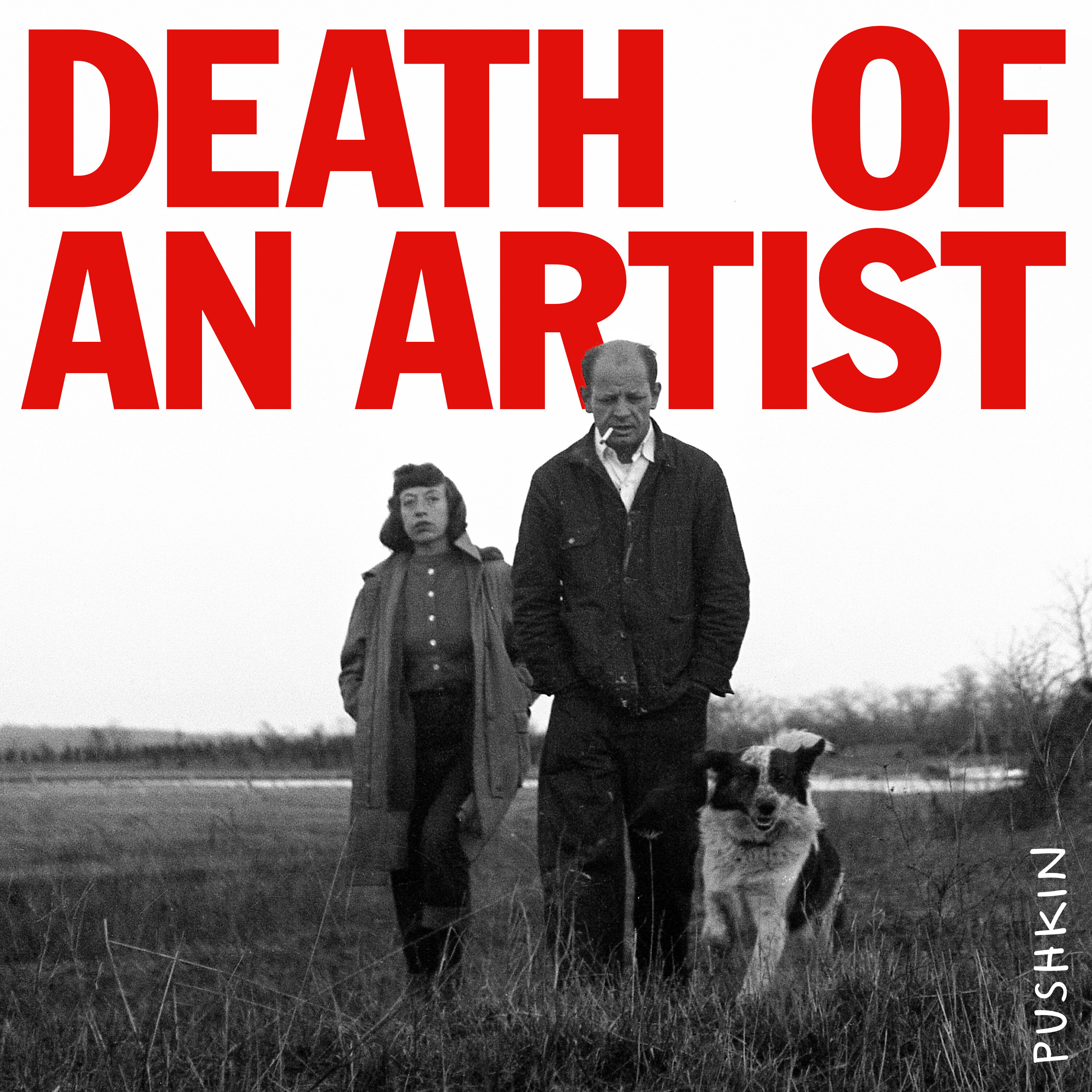
Death of an Artist· Staffel 2· Folge 6
Episode 6: A Phoenix From the Ashes
Freitag, 21. Juni 2024 · 25 min
Kapitelklicken springt direkt hin
Shownotes
1956. New York City. After Pollock’s death, Krasner balances her new role as executor of his estate and her ambitions to continue making art.
See omnystudio.com/listener for privacy information.
Transkriptvom Podcast bereitgestellt · Zeitmarken springen hin
Pushkin. After Jackson died, Lee was in the hot seat. She became Jackson's sole heir and the executor of his estate. This meant she was now responsible for Jackson's entire legacy and the value of his work. And so around the autumn of nineteen fifty six, Lee went to meet a guy called Sydney Janis, Jackson's art dealer. Janis was sixty years old and usually wore a sharp suit. He had that air about him of experience and authority. He had made his money in the garment industry, designing a new kind of shirt with two pockets on it, and from there he turned to art. He was now one of New York's most successful dealers of modern art, with a gallery on East fifty seventh Street. He was well connected
and had a reputation for being a tough negotiator. Lee knew Janis was the person who could get the best price for Jackson's work, and that's exactly what Lee wanted. But it wasn't going to be easy. Lee listened carefully as Janis told her he had good news. He'd managed to line up the sale of one of Jackson's drip paintings called Autumn Rhythm to the Museum of Modern Art MoMA.
The price eight thousand dollars. At the time, this would have been the most a Jackson Pollock painting had ever sold for, and I might add a hefty price tag for an abstract work at least won by an American contemporary painter. While European were commanding healthier sums, anything more than ten thousand dollars on an American abstract painting was unheard of, So eight thousand dollars for one painting was a big chunk of money, and Lee knew this was a fantastic deal. When Jackson died, she only had two hundred dollars in the bank. She'd even had to borrow money for the funeral, so surely this was in the bag.
But then something remarkable happened. Lee told him the price was no longer eight thousand dollars. It was thirty thousand, more than triple, an outrageous price hike. Thirty thousand dollars was more than Jackson had made from all his other sales when he was alive. So there was Lee, the great advocate for Jackson's work, and Janis, the rude businessman who would blink first if momabiz, it would be the highest ever sale for an American abstract painting. It would secure Jackson's artistic reputation and Lee's financial future. It would allow her to carry on painting. If there's no sale, she risks never being taken seriously again and puts the future of the whole of Jackson's estate in jeopardy. In
this final episode, the deal that revolutionized the American modern art market.
Here it is then at fifty million dollars sold at fifty two million, and Lee's own rise to the top, the most accomplished work of her career. Extraordinary, lyrical, vibrant, luscious paintings.
I'm Katie Hessel and this is Death of an Artist. Krasner and Pollock, Episode six, A Phoenix from the Ashes. After Lee more than tripled the asking price of Jackson's painting, she saw Sidney Janis, his art dealer, staring back at her in disbelief. This was becoming a real game of chess. Lee was the executor of Jackson's estate, meaning she could make the final call on what to sell for how much and to who. But Sidney was the dealer, the guy with the right connections to the big museums. He was the person who could get her over the line.
So on the one hand, you can imagine why Janis questioned Lee. He thought he was the expert. They were, after all, in his gallery, and he thought they had a deal that would make a everyone happy. On the other hand, we can imagine why Lee might have decided that this was the opportune moment for a big move.
Lee understood that if she sold one of Jackson's paintings for a much higher price, it would make all of his work more valuable, and with Jackson now being dead, he would never produce another painting. But it was also symbolic. Here was a chance to have Pollock's genius acknowledged by the market, and she knew the value of everything she'd worked for over the past fifteen years. How she'd managed to convince Peggy Guggenheim to represent Jackson. How together with Clement Greenberg, she'd publicized his work, helped him get into Life magazine, where they'd asked if he was America's greatest living painter, and that value was not eight thousand for a painting, it was thirty thousand. So she held out,
and to her complete surprise, Janis agreed he would do as she asked. He would write to the director of MoMA that if they wanted to buy Autumn Rhythm, it would actually be thirty thousand dollars. But MoMA's director was so appalled by the price change that he didn't even reply, which put Lee and Janis in a tricky position. But the game wasn't over. There was one other place they could potentially sell the painting, to the Metropolitan Museum of Art, MoMA's then rival. Now, I gotta say, business wise, this move to approach the MET after MoMA had dropped off was pretty risky, because if they talked to each other, they could have easily both refused to pay the higher thirty thousand dollars price. Worse still, if the Mets simply
said no deal, Lee would have surely damaged any chance of selling Jackson's work for decent prices ever again. But if Lee pulled it off, it would be the biggest deal for an American abstract painting so far. We don't know exactly how long Lee and Janis waited for a response from the MET, but at some point they finally got one. The Met had agreed to the terms Lee had played her cards right. She'd outdealered the two main entities in the New York art market. News of the sale traveled fast among New York artists, nearly all of them, like Jackson, had struggled to make a decent living from selling their art. Suddenly, prices for their work doubled overnight and would continue to climb year on year till we
get to the kind of stratospheric prices today.
At eighty million dollars is the bin in the se Jeff Coon's rabbit. You have it, so eighty million dollars.
As for Autumn Rhythm, it's now a star attraction hanging in the met purchased for thirty thousand in nineteen fifty seven, now essentially priceless. With that one deal, Lee had set the train in motion that would secure her fortune, Jackson's legacy and below the modern art market wide open. And now, as she would say in one interview, I can once again concentrate on being Lee cra the painter. After the break, leif finally gets some recognition. It's a late summer's evening.
In nineteen fifty nine, three years after that watershed sale of Jackson's work, Lee was lying awake in her bedroom in Springs. These nights she couldn't sleep since Jackson died. She'd tried to rebuild her life. She invited friends out to stay and she carried on painting in the barn. Lee felt like she was getting herself back on track, but then she received more bad news.
Her mother dies. Nineteen fifty nine becomes this really difficult moment because her grief redoubles.
This is my friend Ellen. She's an art curator and a few years ago she put on a landmark show of Lee's work at the Barbican Art Gallery in London.
You know, she was still so much in the wake of Pollock's loss, and now she has the loss of her mother. She says this really poignant line. She says, I wasn't allowed to grieve at my own tempo.
The days became almost impossible to bear. By the time it was the evening. All he wanted to do was sleep, but she couldn't. Her mind wouldn't stop racing.
She's grieving heavily, and grief is complex.
Lee tried everything, surrounding her bedroom with plants and her collections of shells from nearby beaches. None of it worked.
We might imagine Krasner on one of these evenings, finding herself again awake in the night, that sense that we've all had at moments of insomn air of what to do.
Lee would get up, eyes barely open, and slowly walk down the wooden staircase. She would turn the handle of the front door and carry on out into the night.
And she'd pad through this very familiar landscape out to the barn, which is sort of maybe ten paces away, no great distance.
And Lee would open the door, turn on the electric lamps, flooding the space in a dim artificial light, and slowly she would take out her painting.
Materials, tacking a canvas the entire length of one wall. It was just her paint trolley and her canvas.
Paints that were dark brown, creams, and whites.
She also kind of made some extended brushes on the ends of sticks to help herself be able to be painting at this height to create these very sum assaulting, arcing marks across the canvas. She's working on a huge scale.
We can imagine how as she moved the brush in that dimly lit barn, she felt the tension begin to lift. As long as she was there, she didn't have to think about anything else other than painting.
I think anyone who's ever been a night owl and found themselves working late into the night can sympathize with that particular kind of experience of making something when it feels like the whole world is asleep, a feeling of being kind of cloaked in your subjectivity, in yourself, and there being an extra andary heightened sense of intimacy to that moment.
And in those moments Lee felt like she could do what was impossible during the day.
She's processing, she's really wrestling with herself. She wants to go down deep into whatever this murky space is, and she says I was going down deep into something that wasn't easy or pleasant.
These paintings would later come to be called her Night Journeys.
These are enormous paintings, and they're incredibly invigorating on the one hand, feeling very feathery and light, but they also have a kind of violence and roughness.
I first saw these paintings in Eleanor's lee Quasm exhibition. They had a powerful effect on me, Hanging on the wall under low light, just like they would have been in lies Bonn. They felt to me, like a visual exorcism.
I was thinking about it just the other day. An artist's friend of mine was talking about the idea of what it is to experience rock bottom, and how in those moments of emotional or psychic collapse or unraveling, we could be feeling a sense of exhilaration because they're so often followed by some kind of reawakening or reconfiguring. Often there needs to be some degree of collapse before phoenix can rise from the ashes.
And out of this period of so much grief, depression, and insomnia came something extraordinary.
The most accomplished work of her career, extraordinary lyrical, vibrant, luscious paintings.
And this time they're bursting with color, crimson and white, electric pink and orange blues, still on that big scale, but looser, freer, bright and joyful, And these paintings they're getting recognized. During the sixties and seventies, Lee would show in a steady stream of exhibitions in London and New York, but there was one thing she wanted more than anything.
By the early nineteen eighties, Krasner definitely came to think about what her career had amounted to and how and when she might receive the kind of level of institutional recognition that would ensure her place in history.
For so many years now, Lee had been frustrated that she had never had a full solo show in her home city. In the late seventies, she had vented her frustration in an interview, saying, do you realize that to date, no goddamn museum in New York City, where I have been born and bred, where I fought the battle, no museum has given me a retrospective that's coming up after the break. It's the summer of nineteen eighty three, and Lee Krasner is seventy four years old. She's been unwell for a while arthritis, and mainly uses a wheelchair to get around. Lately, There's something she's been dwelling on. Lee was sitting in her house and Springs, listening closely to a friend as he read from the catalog of a
fourthcoming big solo show. It contained details of a whole life in art. As she listened to one line in particular, she allowed herself a smile. A life lived richly, organically, authentically, and bravely expressed in an art one could describe in the same manner this show. It was hers.
It's not small, you know. There are one hundred and fifty works across paintings and works on paper in this exhibition. There's a publication to accompany it. There's a press release that goes out. It's an event.
It was set to open on the twenty seventh of October, her seventy fifth birthday. It would begin in Houston, Texas, before traveling to other museums across the country, including in California, Virginia, and Arizona. And this exhibition would tell her story going right back to those early days when she was experimenting with modern art before she met Jackson.
It meant so much to her to know that this body of work would be traveling between these American museums and audiences would be able to appreciate that she was one of the pioneers of abstract expressionism. She was one of the first women to be really thinking about how to express herself abstractly in this period of modern art in America.
There was one bit of news that topped it all though, in December of nineteen eighty four, it was going to be shown at the Museum of Modern Art in New York City. For Lee, this was the jewel in the crown.
Is momentous. She had been at the Modern when it opened in the nineteen twenties, when she was twenty one years old. She had seen those first exhibitions.
Think all the way back to episode two of our series, when Lee was just making her way as a young artist, when those visits to MoMA transformed everything. Here's Lee.
A group of us went down and saw this, and that really hit like an explosion.
It was like a bonab and that disploaded. Finally, Lee was getting her wish and at the museum that meant the most for her.
This was the most important institution to her, and it was her home turf.
Incredibly, she was still trying to work when she wasn't in completely unbearable pain. But by the early months of nineteen eighty four, Lee's health had further deteriorated and she was being treated in hospital, mainly staying in her apartment in Manhattan waiting for her big New York show.
I mean, it was incredibly significant. It was a chance for visitors and for critics to be able to really come and appreciate this full arc of her career. And because she was somebody who cycled through these very different painterly styles. It's especially important with her to see a larger body of work.
In nineteen eighty four. It was also a huge deal for a female artist to be given a show like this. Lee's big MoMA exhibition opened on the nineteenth of December nineteen eighty four. It was called Lee Krasner a Prospective, and the New York Art world braved the winter chill to gather on opening night to honor Lee.
I cannot emphasize enough how seismic an achievement it was for Lee Krasner to have a retrospective at the Museum of Whatnot in nineteen eighty four. Krasner would have been maybe the fourth or fifth woman ever in the history of that institution.
But Lee herself was not there.
She passed away six months before.
Lee had died on the nineteenth of June, so she died knowing that it would come, but unable to be there in body. In twenty nineteen Eleanor organized an exhibition of Lee's work at the Barbican Art Gallery. I remember arriving a day before opening night at the press preview, walking into the vast airy gallery through a frenzy of journalists and TV crews. I was stunned by an array of colorful, abstract paintings. I hardly knew anything about this artist, and I'd never seen an exhibition of hers in person before.
But one of the first paintings to really draw my eye was at the very start of the show. And it wasn't an abstract. It was a self portrait, one that she started painting when she was just nineteen, a few years younger than I was at the time. It's Lee standing in front of a forest, wearing a paint stained pinafore over a sky blue shirt, brushes in hand.
The canvas she's painting on is off to one side but facing away from us, so we can't see what's on it. So the main event becomes Lee herself, staring right out at us with a folk determined gaze that stops you in your tracks. To me, it feels like a one image mission statement. It says, look at me, I am an artist, and I am going to succeed.
Deal with it. I want my independence, deal with it. I want to make my own statement. Damn well, deal with it. Death of an Artist. Krasner and Pollock is produced by Pushkin Industries and Samasdat Audio. Clem Hitchcock is our producer. Story editing by Dasha Lissitzina, Sophie Crane and Karen Shakerji from Pushkin. The executive producer is Jacob Smith from Samasdad Audio. The executive producers are Dasha Lissitsina and Joe Sykes. Sound design by Peregrine Andrews. Original scoring and our theme were composed by Martin Austvik. Fact checking by Arthur Gompertz. Special thanks to Mary Gabriel, Jacqueline Bogard World, Audrey Flack, Alexander Stiller, Helen Harrison and Elena Nen at Pushkin.
Special thanks to Eric Sandler, Kira Posey, Jordan McMillan, Anna Scrabatz, Greta Cone, Sarah Nix, Jake Flanagan, Carrie Brodie and Jacob Weisberg. I'm Katie Hessel.
