

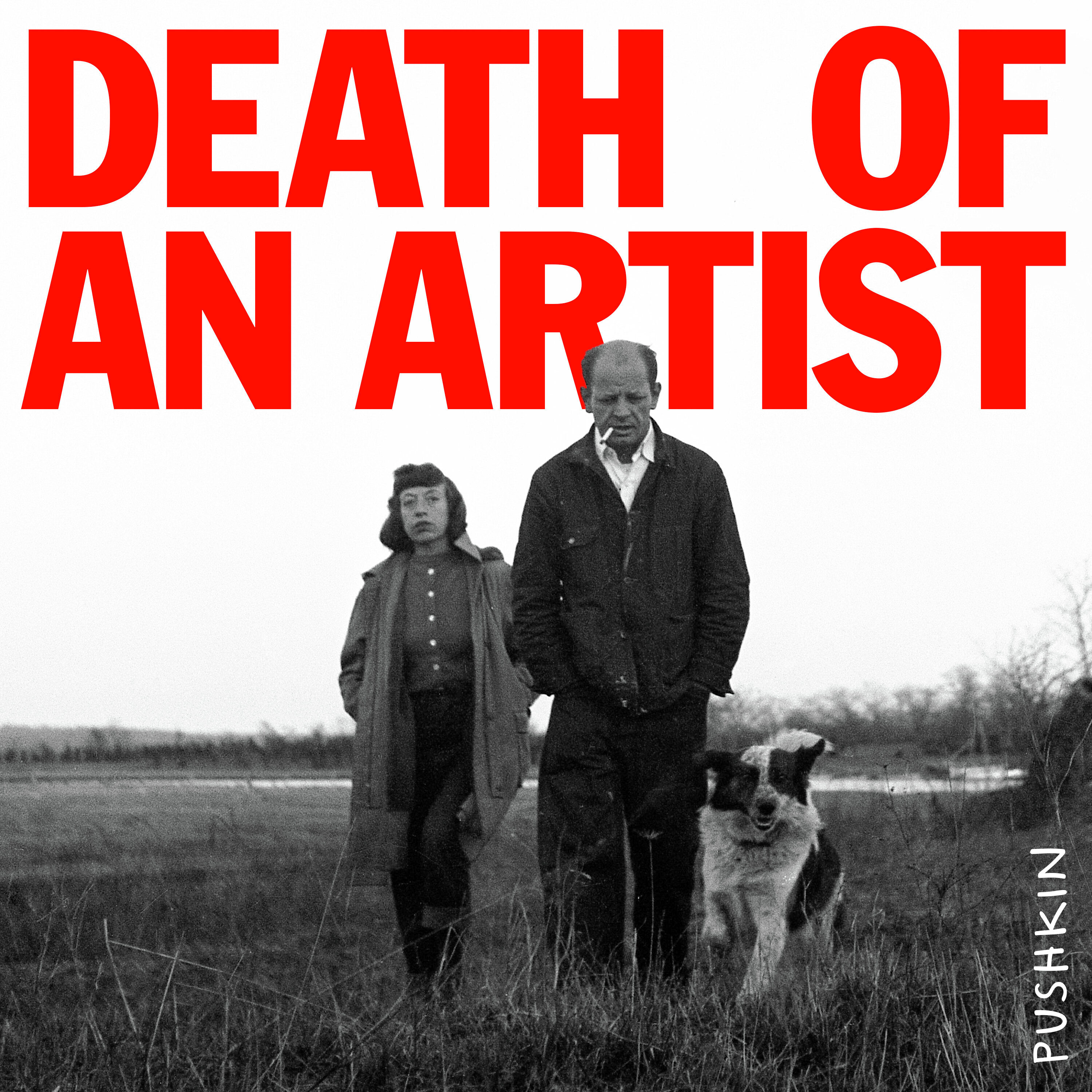
Death of an Artist· Staffel 2
Bonus: The Women on the Scene with Audrey Flack
Freitag, 23. August 2024 · 16 min
Kapitelklicken springt direkt hin
Shownotes
Artist, musician and writer Audrey Flack shares her firsthand accounts of the downtown New York City art scene in the mid-twentieth-century and a song she and her band, The History of Art, wrote about Jackson Pollock.
Flack passed away in June. For more about her life, see “Audrey Flack, Creator of Vibrant Photorealist Art, Dies at 93 (nytimes.com/2024/07/03/arts/audrey-flack-dead.…).”
See omnystudio.com/listener for privacy information.
Transkriptvom Podcast bereitgestellt · Zeitmarken springen hin
Pushkin. Hi, everyone, it's Katie here. You're about to hear a bonus episode interview with the artist Audrey Flack, who we spoke to at the very beginning of this series in episode one. We had such fun recording with her. Audrey is a life force. But sadly, a few months after we launched Death of an Artist, Audrey's studio manager contacted me to tell me that she had passed away at the age of ninety three in Southampton, New York.
Audrey lived an incredible life and I feel so lucky to have spent time with her and honored that I can share some of her memories from the art scene with you today. Okay, so Audrey, please, can you introduce yourself? You are and what do you do?
Well? I don't want to do that. You should do that.
Okay, let's leave that.
You know you should say, here's Audrey flat and she's blah blah blah, and she's an ancient person.
This is Audrey Flack, and this bonus episode is a conversation we had when my producer, Clem Hitchcock, and I went to visit her in New York. Her Upper West Side home slash studio was filled with her photorealist paintings and sculptures of ancient women, from Madea to Meducer. You've been hearing snippets of our conversation throughout the show. It was one of my favorite interviews that we did. In fact, after we finished, I just wanted to keep hanging out with her, and there's so much of her story we couldn't fit in. So that's what we're going to do.
Now.
Spend a bit more time in the extraordinary world of Audrey Flack and the downtown art scene from the mid twentieth century.
What was it like the scene? It was so exciting, it was throwing. You knew you were part of something, and it was very pure.
Flack has been an artist for seven decades encounting. She's a writer too, and just released her brilliant new memoir with Darkness Came Stars. And she's a musician. She plays banjo and lead vocals in a band called Audrey Flack and the History of Art Band. More on that later, but let's start at the beginning. Audrey Flack was born in May nineteen thirty one.
It came from a very bourgeois family, very middle class, and we were Jewish.
In nineteen forty eight, she enrolled in an art school called Cooper Union.
Cooper Union was in the heart of abstract expressionist territory Eighth Street and Astro Place, so I was right there, heart of this hurricane.
Abstract Expressionism, or ABBEX for short, is a term loosely applied to a group of artists working in New York in the nineteen forties and fifties. Lee Krasner, Jackson Pollock, Helen Frankenhaler, William Da Kooning, Grace Hartigan, and Audrey was one of the young artists on the scene.
It's interesting realism was frowned upon, it was looked down as something lesser. From the moment I hit Cooper, that was abex. The whole world was abex, The whole downtown was abex. And people were coming over from Europe to be around Eighth Street, tenth Street, ninth Street, right where Cooper was.
These artists were part of a community. They put on shows together, talked about the future of art, and last but not least, they drank together.
You know, I would have wine, but they were drinking scotch, little little shots of scotch with a beer chaser. So the Scotch would go down in one gulp, and then the beer and then they put a lemon or something in it. Sometimes I put on a good show, but it wasn't my style.
Audrey told us that there were two places that the abstract expressionists all went to hang out. First, the Waldorf Cafeteria.
It was the most gloomy, awful decrepit. You know, you look like you were embombed if you went in there. But we would go there and you could have a cup of water and put ketchup in it and that was your tomato soup. You could save money. And that was a few blocks from the Cedar.
The Cedar was the hard drinking tavern where the artists would have raucous debates about art and where as we learned in episode one, Audrey first met Jackson.
The Seedo was, you know, the place that everybody went smoky, crowded. In the front there were cubicles, little seats with where people could sit and it was always jammed, and then there was a bar with stools along the edge of Jackson liked to sit towards the back.
Everyone was there. Artists tailed for their action like brushstrokes. Joan Mitchell William Da Kooning, Franz Klein to name a few, plus writers Jack Carrouac and Alan Ginsburg stopped by.
When Jackson and billdy Cooney and Franz kleinb showed up all you know, one at a time, but three of them were there. There was like a hush. I mean, everybody knew that you were in the presence of greatness. It was like a jack It was like, wow, they're here, you know, and then arguments would break out. Sometimes people would shove and push. It was scary for a girl, you know, mind her, I'm like eighteen. It was male dominated, there was no doubt about it. It was an old boys club.
I've heard descriptions like this before. Lee Krasner once said it was where the women were treated like cattle. Most women artists avoided it. But it wasn't just the cedar that was like this. The whole art scene was very male in its vibe. But of course there were women at the heart of it. Audrey knew them all and told me some great stories.
On the scene was John Mitchell, who I thought it was some absolutely marvelous artist.
Born in Chicago a few years before Audrey. Joan Mitchell was known for her lossal canvases full of energy, action and dynamism. She arrived in New York at the end of the nineteen forties, where she remained for a decade before settling in France. Unlike many other Abbe's artists, Mitchell looked back to the nineteenth century French painters, and her spectacular canvases often reflect the palette of the likes of Claude Monnet. To me, her greatest strength was transforming oil paint into gusts of light and movement.
I loved her work. I think she's one of the best artists, and I thought so.
Then then there was Grace Hartigan.
Grace and I became good friends.
It was her work The Persian Jacket that looked back to the Spanish Old Masters. She used cheap industrial brushes for her bold, sensuous strokes.
Elaine dy Kooning, who was absolutely brilliant, smoked like a chimney and drank or so.
Elaine was also one of the first people to write about these artists in the publication Arn't News. Although working in an abstract vein, she was famed for her portraits, notably of sports stars and politicians, including John f Kennedy.
Oh Helen frank Nzaler, who did not go to the bar.
Frankenhaler pioneered what is known as color field painting. Instead of using action like gestures like the other Abex painters, she developed a technique called soak stain. She put the canvas on the floor, thin down the paint and let it glide over. The results were multi layered pools of spontaneous organic forms.
These women felt that they had to be as tough as the men, and tougher than the men to survive, and they adopted male behavior. They suffered. Who else whom I leaning out? Oh?
Lee?
Of course Lee didn't go to the bar.
So tell us about Lee Krasner. I mean, what do people think of her? What was her reputation? What was her involvement?
Well, she was like the Diane. Lee was in love with Jackson. One of the things that I was always almost shocked by is when they got the house, there was a barn on the property and you went into it because that was Jackson's studio. Right, did you see where Lee painted at first? Weren't you shocked? Yes, you're answering.
Yes, I visited last year and it was worlds away from Jackson's vast studio in the barn.
I wouldn't have done that. You wouldn't have done that. You have to have enough self respect us an artist, and she was already an established artist, more so than he, And so she paints in this tiny little bedroom upstairs. My god, you know it was a place to sleep, even with a single bed, not even a king sized bed would fit in it.
Can you talk to us about Jackson's reputation and also your encounters with him and what he was like.
I think about him all the time and I try to reevaluate those times why his work was great? Was his work great? No, Jackson, when he starts dripping, is no longer a painter. He's not painting a painting. He's not dealing with space spacial relations in that way. You know, he's not dealing with color relationship. He's not painting. He becomes somebody who takes on an entire scope of the world and makes galaxies. And when you enter a Pollock painting, you're entering out of space. You're going through ropes and nuts and tangles of galaxies. Something magical.
Do you talk to us a bit about Ruth Kligman and who she was and how she got together with Jackson.
I'm working for a gallery and I'm curating a show. Ruth claps up five floors in her high heeled shoes, climply clop, you could hear her, and comes into my apartment. And Ruth was unbelievably sexy. It just reeked, it reaked. And she was wearing a ray on dress, polka dot dress, I think. And she had thick black hair and sunglasses, white rimmed sunglasses and red lipstiff. I mean, she was fent.
She looked like Elizabeth Taylor. She was really knockout. And she came in and said she has an opportunity to curate a show for this gallery, the Collector's Gallery, and wanted to look on my work. And she began talking about my work. It was amazing. She really had a good eye and an ability to talk that mesmerized you, which she must have done to Jackson. She really got him and she was good. I would have bought my work if I heard her talking. You know, how did she meet Jackson? Okay, so then she didn't know much about the art world. She was from New Jersey. Thinks took one or two art classes. She didn't know very much teach me, so I would teach her what's going on.
I said, well, there's a movement called abstract Expressionist. Who are the artists? I told her? She said, in what order? Who is the most important? I said, I think, I mean, I love Dacooning, but I think I'd have to say Jackson first, then Decooning, and then Franz Climb. So then she said where do they meet? I said, Licita Bar, where is it? Well, it's on Eleventh Street and University.
So I drew a map. I walked down the stairs with her and I watched her, you know, I waved goodbye. She wiggled her little cute body and waved goodbye with the paper in her hand, and I told her where Jackson sat. That was it.
I found it so incredible how Audrey has such vivid memories of all those characters she knew more than half a century ago. It really felt like being transported back to that nineteen fifties scene in all its creative and unhinged glory. She still thinks about their stories today and has even written songs about some of them, including one about Jackson.
I have a song you know my band. I wrote a song about it. I had a band, History of Art band, which was a feminist band, by the way.
Now to finish it off, here's Audrey Flack and the History of Art Band playing their song Action Jackson Jackson power.
That's my name. Abstract painting brought me fame. I sell my paintings one by one, and I get drunk when I am done. Oh Jackson, Action Jackson, Well, I'm ripped by sneer Denis malnerin lands everywhere. It just doesn't matter. I'm Action Jackson, jack Dripper. I get drunk when I take Zipper.
Death of an Artist Krasner and Pollock is produced by Pushkin Industries and samasdat Audio. Clem Hitchcock is our producer. Story editing by Dasherlitz at Sina, Sophie Crane and Karen Schakerji from Pushkin. The executive producer is Jacob Smith from samasdaut Audio. The executive producers are Dasherlitz at Sina and Joe Sykes. Sound design by Peregrine Andrews. Original scoring and our theme were composed by Martin Ustwick. Fact checking by Arthur Gompertz. Special thanks to Jacob Weisberg. I'm Katie Hessel,
