

Disclosure· Staffel 2· Folge 3
He Brings Sunlight to College Football
Donnerstag, 29. Oktober 2026 · 32 min
Kapitelklicken springt direkt hin
Shownotes
Is your alma mater inviting the government to monitor its football fans on game day? How much do Big Ten schools earn renting out their mascots? You can FOIA that – or visit FOIAball.com, where journalist David Covucci adds transparency to the big business of collegiate sports. Covucci tells Jason and Matt what he learned from FOIAing Osama Bin Laden’s porn collection and how he applies it to a multibillion-dollar industry run by public institutions. Matt and Jason let David in on their FOIA Soundtrack (open.spotify.com/playlist/73YJz4dwYpvAXFGxJHtt…) playlist.
Subscribe to the FOIA Files newsletter at bloomberg.com/account/newsletters/foia-files.
See omnystudio.com/listener for privacy information.
Transkriptvom Podcast bereitgestellt · Zeitmarken springen hin
What do Osama bin Laden, college football, and the Freedom of Information Act have in common? This guy.
Bro asked CIA for porn, and my parents were just appalled.
David Cavucci is the editor-in-chief of college sports newsletter FOIABALL. But 11 years ago, one request started it all. It was May 2015. David was sitting at his desk in Soho, Manhattan, scrolling headlines. He was working for BroBible, a men's humor site. The day was winding down.
I think I was drinking a beer. I think it was like a Lagunitas IPA.
You have to drink a beer if you're working at Men's Humor Publication Bro Bible.
He sipped and scrolled. Headline, headline, politics, disaster.
Then.
Bin Laden's files have been declassified by the U.S.
The CIA recently announced that it will not release something very shocking that the Navy SEALs reportedly see.
That's Bin Laden's massive stash of pornography.
None of the documents released today.
Include the pornography, right?
Correct.
Smut-loving horned dog of the desert.
That Osama bin Laden had a porn collection on his laptop that Navy SEALs had seized four years earlier was old news. That the public would never see it, well, that was news David wasn't going to let by him.
If you want to ascribe logic to it, I think I might have just wanted to troll the CIA on a, you know, Wednesday afternoon.
Quickly, he wrote up a Freedom of Information Act request to the CIA. It was a pretty raunchy request.
We here at ProBible.com would like to know what pornographic materials Osama bin Laden had in his possession at the time of his death.
We're adults.
We can handle it. We would like to know what kind of porn the world's most wanted man to. Does being under the constant threat of capture require extra stimulation? I imagine it would be hard for him to focus on this. So I figure he had to watch some really nasty.
I got to admit, it's not a great request. The FOIA requires that you reasonably describe the records you're looking for. And I'm not sure he actually accomplished that. Shockingly, he did get a response from the CIA.
A quick one.
Nine days later, on official CIA letterhead.
The CIA had to write bro bible there.
They said the records quote. should they exist, would be located in operational files which are exempt under the CIA Information Act.
And so I wrote it up, obviously thinking it was going to flop.
Instead, His story went viral.
Bro Bible, of all people, did a freedom of information request.
And the answer, sorry bro, the CIA says the information is classified.
The Washington Post wrote three different stories about it.
I even wrote about it when I was working in Vice News. I quoted David as saying, it's Kafkaesque obfuscation bull they are hiding behind.
David got a taste of the FOIA.
And he was hooked.
I'd never sent a FOIA request in my entire life. I had no idea what would happen. And now this is my career.
Crank it. I'm investigative journalist Jason Leopold. I spend most of my days getting documents from the government.
I'm attorney Matt Topic, and I fight them in court to open their files when they don't want to.
From Bloomberg and No Smiling, this is Disclosure, a podcast about prying loose government secrets, the Freedom of Information Act, and the unexpected places that takes us.
David, we meet again.
And this time it's under less salacious circumstances. Last year, David Cavucci turned his love for college sports into a full-time job. And no, it isn't through DraftKings. David founded Foyaball, a newsletter dedicated to uncovering secrets in college sports, mainly through, you guessed it, public records. It's an amazing newsletter. David's a longtime reporter and editor based in New York. He's racked up a number of impressive FOIA ball scoops, including how Aaron Rodgers is funding floxile cameras in his town and how DHS is watching you at football games. And he gets into the serious stuff, like how much colleges are spending on fireworks. Hint, it's a lot. David, welcome to the show. Do you remember when I quoted you
back in 2015?
Not to brag, I got quoted in a lot of places that week.
Look at this guy.
Nice.
All right, Matt, you heard David read his request. Great. What do you think of that request?
I mean, as a reader and a fan, it's brilliant.
I love it.
If you came to me and said, hey, can we sue on this request?
I don't know.
I mean, I would love to. I think I'm not sure what a judge's reaction would be to the commentary in that. But I love it. And I'm sure you got some chuckles at the CIA.
I can see the growth. the growth in your FOIA education, just in the way that you've been describing this since 2015. But did you ever think the, you know, FOIA request on Osama bin Laden's porn collection would ultimately lead you to this career FOIAing records around college sports?
Absolutely not.
And much like that, I sort of stumbled into this a little bit. I was at a small tech and politics site. I went there in January 2017, so a little after I sent this. And the politics editor at the time had just launched a FOIA internship to teach college students how to use FOIA. And right before it started, he got a job elsewhere. And he came to me because of that. He was like, you've done FOIA, you know this. And I was like, yeah, sure, definitely.
Totally. I get it.
And so with no knowledge whatsoever, I started teaching college students. We'd do sort of one project a semester. We'd send out 50 requests. They'd get a couple back. We'd try to turn it into one big story. The first semester, I had no idea what I was doing. I had to learn on the fly, but I learned to really like it. I wound up running that internship for about eight years. And so as I started doing it and getting better at it myself, I started formulating the idea for this website. It was always just kind of a glimmer in the back of my head. I never really thought I would go out on my own. But after getting laid off in April 2025, I figured now is the time to give it a try.
David, here's the thing. Jason doesn't really know a whole lot about sports. He lives in LA.
You know, they're not really. Hello, LA Kings hockey.
Yeah.
That's a sport, Matt. I'm not saying I can talk hockey. I just wear the hat.
Jason doesn't really follow college football. So I'm going to play the job of reporter a little bit here. Do you notice the sweatshirt I'm wearing here? And do you ever slum it down in Division three football when you're playing and covering college sports?
I have not sent a single one to North Central College. I don't even know where that.
Is, I'll be honest.
Well, David, North Central College is a 2024 Division three college football champion and the runner up last year.
I hope none of my readers hear this.
So you're focused mostly on college football at Foyaball, which, by the way, I love the name. I also I love the logo, too. It's on your hat there. It is a seal like the animal in a nice, cool banana yellow kind of color. And it's got a old school football helmet in like a pinky purple kind of color.
I love it. What's the story with the logo?
My wife designed it. The idea was a seal, sort of like an FBI badge that said Foyerball. And when she said seal, I was like, that's it. That's perfect.
Oh, I love it.
It was a bit of a miscommunication, but it worked out in the end. And it's really great. It's very fun that people have been responding to the logo.
I love it. The aesthetic of the site is great. Thank you.
Why Foyer College Sports? I mean, of all the things to Foyer, why did you get into college sports and college football specifically?
I followed college football for a long time. I went to Virginia Tech when I was there. They were a fantastic team. They'd since fallen on hard times, but are hopefully going to be back this year. I'd always been a fan and I'd be watching games with friends and something would happen. I don't know, they'd be talking about a player who was arrested. And I kept saying to them, like, you know, that'd be something good for you. And there are lots of reporters doing public records reporting around college sports.
A lot of them are at local sites. But I sort of felt that there was no one treating the sport with the sort of appropriate absurdity that it deserves. It's a very ridiculous sport with lots of high profile coaches and rich donors and weird laws and regulations. So I just kind of thought I could sort of dive in and have fun with it, do some very serious reporting, do some very silly reporting, write very serious things in very silly tones. And when I originally launched, I thought it was about college football. And within like two months, I was getting documents about like DHS having access to cameras on college campuses. They were like surveilling CCTV footage at pro-Gaza protests at Ohio State. Like the school was
handing over that footage, like straight live stream, straight to DHS. I was like, that's a huge story.
That is a huge story.
At the time, I didn't think that like, oh, this is gonna be a microcosm of society at large, but it really kind of is.
Colleges and universities touch on a lot of stuff.
They're sort of, in a way, training grounds for a lot of technology, whether it's AI tools to detect plagiarism, whether it's surveillance stuff. And then sports teams are always experimenting with new stuff. Every huckster out there is trying to sell some sort of AI product to a sports team. There's a lot of bio surveillance that's going on. You don't need to like football to like it. I don't talk about games or players. Hopefully, Jason, I mean, he claims he's reading it, but I think he understands it's not too sports focused.
I'm reading it.
Are you kidding? I mean, the recent ones on Flock cameras.
I want to talk a little bit about some of the headlines you've covered because they're just great. So I'm going to read a couple and then I'm going to ask you about them. How much money does your school's mascot make? I love that.
That's great.
Nick Saban flew on Alabama's private jet to complain about money in college football.
Brilliant.
And you won't believe how much college football teams spend on balloons. So I got to start there. How much do college football teams spend on balloons?
Some of the bigger programs just for their football programs spend about $ 50, 000 to $ 60, 000 a year on balloons.
Oh my God.
$ 50, 000 to $ 60, 000 a year. I mean, that's like the balloons are paying college tuition.
This got picked up in some other outlets, right? A lot of my stuff has been getting picked up. It's been really nice.
It's been very useful.
It helps that a lot of news outlets struggle to do new original reporting these days. So they'll take anything that's original. Yeah. So yeah, the New York Post picked up the balloons one.
The Washington Post, maybe.
I don't know if the Post has ever picked me up.
They used all their powder on the Bin Laden thing 10 years ago and now they can't. I've been in the New York Times and stuff.
Maybe it was in the Times.
Who's the highest paid college mascot and how much did they make?
That was funny because it was a tad misinterpreted. The mascots don't get paid themselves. The people who are in it make, you know, $ 10, $ 20 an hour, depending. It was how much the schools were making for appearances. So if you wanted to have... I don't know who North Central College's mascot is, but if you wanted to have Chucky the Cardinal come to your wedding, you know, they would charge like $ 500. It's Chippy the Cardinal, not Chucky.
Pretty close for just guessing. I think the number one was, it was Brutus Buckeye at Ohio State.
Oh yeah, that probably goes for a lot.
I believe next up was Bucky Badger of Wisconsin and Goldie Gopher of Minnesota. So it was really a big 10 sweep.
Interesting.
You have so many directions you can go with.
I mean, you've now seen seriously.
Yeah.
I mean, there's all these really interesting issues. It's it involves money and taxpayer dollars. They're a little snarky. We try to do that on this show, too, is like you find something that people can relate to and find a little bit humorous.
But there's a much bigger point.
Behind all that. And I see that in a lot of your reporting and I love it. But I really some of this like really is. I mean, it's even beyond sports. So you have a story. DHS is watching you at college football games.
Tell us about that.
I was looking at into local police departments and their communications with football teams. I was trying to see if there were some back channels that were going on, like, you know, the director of player personnel or whatever, emailing the chief of police. And I did find that at the University of Georgia. When I did it at Ole Miss, it's a big university in Oxford, Mississippi. So I made a request with the Oxford Police Department. I think their police department never had gotten a FOIA request before because they just sent me.
Wow.
They sent me something like 500 emails for a one-month span.
Wow.
They charged me $ 7 for it.
It was perfect. None of it was what I asked for. My mouth was watering.
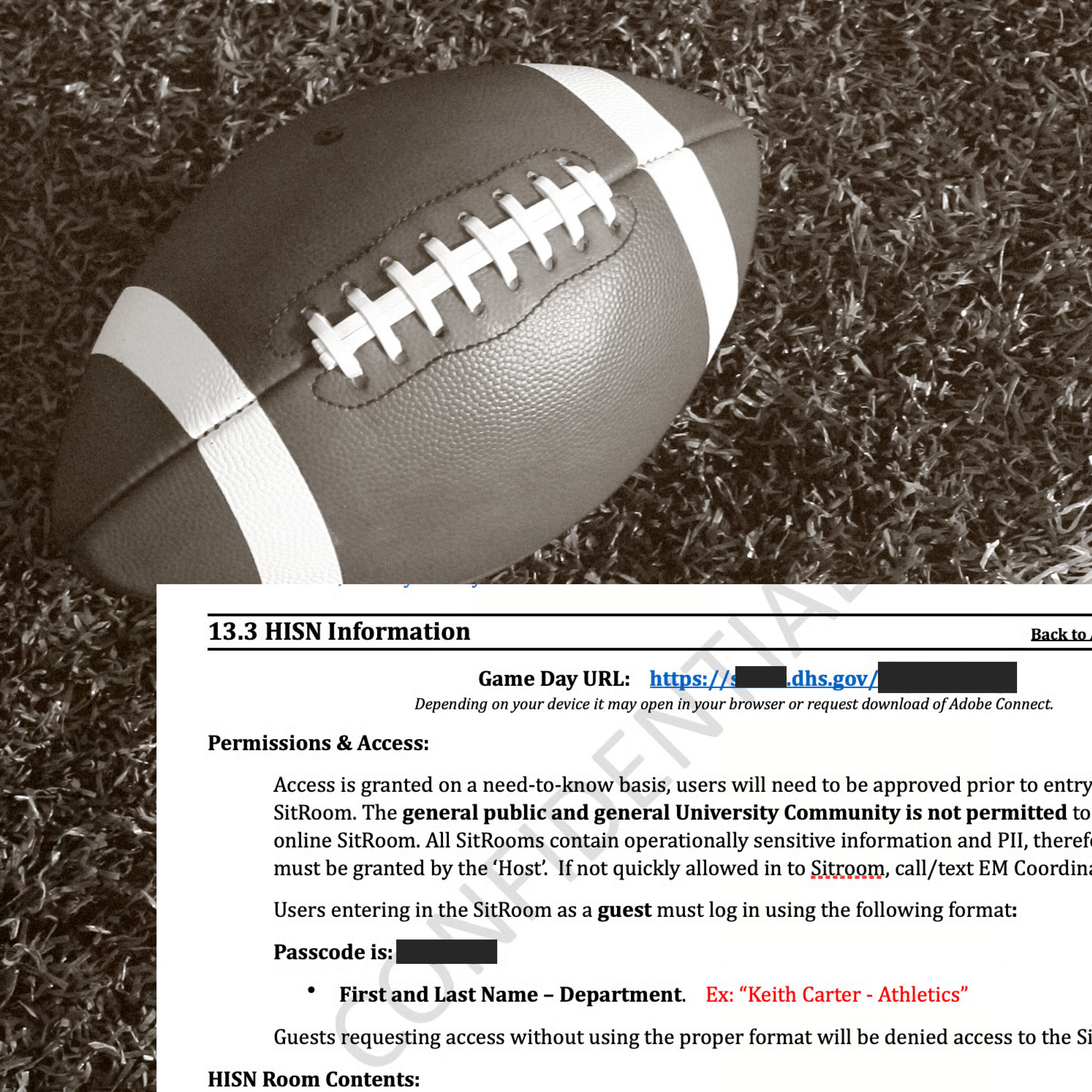
They included prep documents from a DA to work with witnesses, like cops who were on trial. There was all sorts of stuff in there. Inside that was their operations manual for game days at Ole Miss. And it noted that they were using this DHS surveillance network called Hizen Homeland Security Information Network. I believe it started after 9-11 as a way for agencies to better cooperate with each other.
And it morphed into sort of threat level assessment sharing, sort of data sharing. And now they run, at big events, these sort of mobile operations centers where they're tapped into live CCTV footage. And the funny thing about that one was I only had the knowledge that they were doing this. I didn't have any other information on it. So I just kind of started Googling. And you'd be amazed what you can find just by amending file type PDF to a Google search. The actual network within DHS that runs these, the Hizen Network, published an internal newsletter That was just for employees, but it was hosted online.
It was easily accessible.
And it listed out all the colleges they were at. It listed out that like, hey, Ohio State gave us access to their CCTV footage during Gaza protests. You know, and that sort of got me on a surveillance kick because it turns out that we're just being surveilled everywhere. So I started looking into schools that are using Flock.
And there's, I think... At least 75 that I found.
Wow.
I'm really afraid of what the world is becoming, where we are living. You know, the word like the digital panopticon phrase is overused. But I think when you it's very apt, like there is not a way there's no way to avoid surveillance in the world these days. And I like to cover it. I'm working on a story about a school that has just crazy high definition cameras with facial recognition in their in their stadium. A command center can absolutely zoom in on you if you're causing a ruckus. sit in the stadium, immediately see who you are and like, not only get you out of there, but like have the information to, you know, when they question you.
Wow. Can you describe the ruckus, sir?
I've only been kicked out of one college football game.
So, um, I don't know.
Voting a line from, uh, the Breakfast Club and dating myself in the process.
Well, you can't say that and not tell the story.
Oh, it was just for sticking in booze and getting caught drinking. So it was a very minor thing. I didn't even get in trouble.
They just shuffled me off.
By the way, you wrote that Ohio State told FOIABALL that it no longer uses the Homeland Security Information Network for events or incidents, but it declined to answer questions about surveilling protesters or football games. And that Ole Miss record departments didn't provide documents on what campus cameras DHS may have had access to.
It's hard to get comment on stories about police surveillance and security.
They usually just clam up.
DHS can't comment either.
But that's great how you, you know, are discovering big headlines, you know, across the country in terms of AI surveillance, surveillance technology, and the role government plays. has played in that. I mean, that's, that's great. And that's ultimately what, you know, the FOIA or public records, what, what we request is what they hope for is that, you know, what will lead to something else, something bigger. Absolutely.
When I, when I started this, I was like, I'm going to get a funny text to coach sent and people are going to laugh. And then I'm like, Oh, Aaron Rogers is secretly funding a surveillance network and is in his town. So it's been really, I really liked how it's, it's grown and people have been very into it.
And yeah, it's, I really do think sports and especially college sports right now, obviously, there's a whole political angle with bills in Congress and stuff are just such a great lens with which to talk about the world.
I didn't even realize Aaron Rodgers was still playing football. I don't care that you beat the Bears like 90 percent of the time.
Go Bears.
I reached out to Aaron Rodgers when I did the story.
I didn't hear back.
Well, if we're talking about transparency and college sports, we would be remiss if we didn't talk about NIL deals, right? Explain to Jason what an NIL deal is in the context of college sports.
For the longest time, college athletes were considered amateurs. They were not paid. They got free tuition, free board, and that was about it. They were on scholarship. Everyone and their mothers assumed that they were getting paid under the table by boosters. There's definitely been some proven cases of that, but money was being funneled to them.
And in 2021, I believe, the Supreme.
Court allowed college athletes to make money off basically their advertising rights.
The NCAA changed its NIL rules after a Supreme Court decision addressing a different type of athlete compensation. So now, college athletes have the rights to benefit from their name, image, and likeness, commonly known as NIL. I'm just going to read a little piece of this Supreme Court decision because it's just so good. From the start, American colleges and universities have had a complicated relationship with sports and money.
In 1852, students from Harvard and Yale participated in what many regard as the nation's first intercollegiate competition, a boat race at Lake Winnipesaukee, New Hampshire. But this was no pickup match. A railroad executive sponsored the event to promote train travel to the picturesque lake. He offered the competitors an all-expenses-paid vacation with lavish prizes, along with unlimited alcohol.
I had no idea Supreme Court rulings had such flourish and lengthy backstories.
And then it goes on. And there's one more little example that I think is just really good. Colleges offered all manner of compensation to talented athletes. Yale reportedly lured a tackle named James Hogan with free meals and tuition, a trip to Cuba, the exclusive right to sell scorecards from his games, and a job as a cigarette agent for the American tobacco company. The absence of academic residency requirements gave rise to tramp athletes who roamed the country making cameo athletic appearances, moving on whenever and wherever the money was better.
It's 1850 all over again. A quarterback of the University of Texas could advertise for a clothing brand. I think Arch Manning has a deal with Fiore now. And every school started up a collective that they just funneled money to and claimed that the athletes were doing social media for the collective. So basically I found like in UCLA, they would pay, you know, a quarterback a quarter million dollars for one social post. And that's like what, you know, someone like Kylie Jenner gets for an Instagram story.
Wow.
And there was no policing of it. The collectives were their own sort of entities. And as this sort of blew up into a crazy situation, pretty much every state has passed a law that exempts any NIA deal from a student athlete. So if you want to request any information about what a school is paying a player or any information they have about what that player is getting from outside advertising, that is completely restricted.
I get it a little bit like.
You know, it would be kind of weird for someone to be like, this kid is making that and this kid is making that.
But like these.
Schools have just carved out a transparency exception for it.
What are they saying in terms of the why they're not releasing it? I mean, it's it's because there's a stat. But part of the statute says that they built it's built into state public records law that exempts that information. Is it a trade secret?
There's a little bit of trade secret going on. But pretty much these bills have just been introduced by a state legislature who's a fan and no state legislature is going to want to vote against the local college football team. You don't want to be on record as going up against Clemson or the Gamecocks in South Carolina. The governor of South Carolina, Henry McMaster, actually vetoed the first version of the bill because he thought it was too broad.
But pretty much every state was just like, yep, these are kids. These are trade secrets. They're protected, even though they're all over 18. And we're not going to give it to you. The Louisiana Illuminator, a local publication down in that state, was suing LSU over this, over not releasing records. And during the lawsuit, the legislature passed a new law that said records retroactive to a certain date were exempt and basically just like killed the lawsuit.
Wow.
They said like tough and even the paper was like, yeah, you know, we could fight this to be an uphill battle, but like no judges in Louisiana is just going to overturn that law.
You know, as a lawyer, I've seen these across my desk. I think an interesting theory that I would love to argue at the appropriate time is the way that some of these statutes are written. It is for exemptions for NIL deals. I would love to argue that these aren't NIL deals. Like they're just paying players to play. They're not actually NIL deals. They're bogus NIL deals. And so If it's not a legitimate NIL deal, then it doesn't qualify under an exemption for an NIL deal, which sort of lets you put the legitimacy of these deals sort of on trial at the same time. But, you know, you mentioned legislators changing the laws. This isn't the only time this has happened, right? I mean, there have been
lots of other instances of legislators changing public records laws, you know, sort of at the behest of colleges or college coaches who were super, super powerful.
Tell us about what you've seen with that.
I assume you want to talk about Georgia.
Yeah, let's talk about Georgia.
They are, for a long time, they were a college football powerhouse. They kind of fell on hard times. And hard times for them is still, you know, eight and four and a good bowl game. But it's not national titles. And in, I believe it was 2016, they hired a coach that they'd been eyeing for a long time. He was a Georgia alum. He coached under Nick Saban for a couple of years, won a couple of national titles as their defensive coordinator. And basically it was, you know, the chosen son to return Georgia to glory days. And one of the first things he did was meet with a couple of state legislatures, you know, at the Capitol building.
And then a couple of days later, a couple of weeks later, they introduced a bill that allowed athletics departments within the state of Georgia to have a 90-day carve-out of response time, 90 business days, which is a very random, specific time. Georgia did originally have a pretty quick response time.
It was three days. A lot of states are five, a lot of it are 10.
But it is very funny.
I'll email Georgia something. If I email them today, I'll be like, catch you in 2027 when you reply to this. So it's a They claim it's on competitive grounds that people could FOIA, you know, where his recruiting plan went and follow him around and get recruits. At the same time, it's just made that university opaque. And if you follow college football, Georgia has come under a lot of fire as they've become a powerhouse.
Yeah, players have racked up hundreds of traffic violations over the years, including dozens of cases of extreme speeding and reckless driving and even a street race between a UGA staffer and a player. that resulted in two deaths and serious injuries, according to lawsuits.
That's alarming.
So, David, that's not the only time legislatures have made special carve-outs. Tell us about North Carolina.
I don't know if you remember, but last October, Pablo Torre revealed that Michael Lombardi, who had been hired by Bill Belichick to be North Carolina's general manager, had flown to Saudi Arabia to meet with a donor about potentially funding the football team. And it was a It's a big story. Like it's definitely a public university should probably not be courting funds from Saudi Arabia just because.
They need more money for football.
And, you know, North Carolina sort of issued this weird denial where they were like, it's not from the PIF, the private investment fund. It's just a guy who loves football and wanted to meet with Mike. So I and a lot of other reporters requested details from that trip, you know, flight logs, expenses, risk management forms filed with the Office of Travel and stuff like that. And they, to their credit, North Carolina handed those over. But the name of his host and sponsor for the trip was redacted.
And Jason, this will drive you up a wall, but North Carolina redacts stuff in white instead of black. So you can never know if it's just the end of an email.
Or a redaction.
What?
Oh, man.
It's the only place I've ever seen that.
I mean, I would have to turn on, you know, Rain and Blood by Slayer in order to deal with that.
And so I asked them if that was redacted and they said yes. And they cited a law that had passed that protected the names of donors to nonprofits from being released to the government. And it's sort of weird on several levels. One, The law was passed that summer and it wasn't slated to go into effect until December.
So after all this stuff happened and the law specifically says that it only applies to offenses after the data goes into effect December. So theoretically, they would have been within their right to release it.
And when you say offenses, what do you mean?
It's a little confusing. The law is not actually related to FOIA. It was a change to the state's rules around nonprofits designed to prevent like an attorney general from leaking, from obtaining, like going to Planned Parenthood or the NRA and obtaining their list of donors. It was to protect that information. But the way it was written is the state like athletics department was able to sort of say like, well, this applies to us too. And I talked to a few different lawyers in North Carolina and none of them really wanted to bring the case because they were like, well, yes, this is sketchy, but like it's existing law now and no judge is going to want to overturn something, especially when it comes to individual privacy.
Well, I look forward to reading that story.
I'm working on it.
That sounds like a good one.
Are fees often an obstacle in different states?
I have been relatively lucky with fees. I recently did a story on how much teams were spending to stay at fancy hotels during training camp. I guess players don't stay in dorms anymore during training camp. They go to nice hotels. And it's sort of an added expense at a time when college sports claim they have no money.
So if I send that to 120 schools.
It just depends.
Every school will handle things differently in every way, every time. So some people are just like, this is really easy to give. Some people will be like, this is going to cost you $ 250. So when I do those sort of broad swath stories, I kind of just cancel the requests that have fees. So I don't necessarily need to pay to know about one school doing this one thing.
I've had to pay some, you know, I think I paid... a couple hundred dollars at a time for a couple of different requests. And honestly, probably not worth it. Being on good terms with the FOIA officers, you know, being willing to negotiate, like understanding how they work. Like a lot of times I will say in my request, whatever is easiest and cheapest for you. Like I want to be cooperative. I want the stuff, obviously, but like, I don't know how your system works. Sometimes... Records officers really appreciate that. Sometimes they don't. So it's sort of a mixed bag there as well. I've tried to stay away from emails because that's where a lot of fees come in.
But there's been some schools where like this is going to cost you $ 5, 000. I'm like, but another school gave it to me for free. And again, that has to deal with how they handle their systems, how they can search things, how they interpret my requests.
So if they don't understand exactly what you want, they just say it's going to cost you a ton of money.
I mean, I've seen quotes that are like, this is going to cost you hundreds of thousands of dollars.
I have gotten that from like police departments and stuff.
Yeah. Yeah, it's crazy.
We had to write specialized software to extract all this stuff out of our system. And our vendor charges $ 200 an hour.
I got to say, I'm a little jealous that you're getting records very quickly.
States are a little bit better. They're not under as many pressures, I think, though. A lot of universities are pretty backed up.
What states have been good and what states have been more challenging?
I have this running bit that Southern states are a lot better than Northern states. And while a lot of Northern liberal states claim to love public records and the sort of tool it provides to look into the government. They also love the government and they don't want to reveal all its flaws and wrongdoings. Whereas the southern states are just like, here, take our government files. We hate this thing. Just have at it. A state like Louisiana is really, really good. And Texas is really great. New York is not very good. Pennsylvania has a ton of exceptions for universities. But the thing that's really interesting is that every university has its own kind of fiefdom. Michigan State is fantastic. They send me everything. They don't charge
me a thing. They're very prompt. They do minimal redactions. They pass along like names of donors and stuff. Whereas everything at the University of Michigan is like kicking and screaming, pulling teeth. It's kind of fascinating that two places bound by the exact same law can be very, very different.
That's really interesting. And I agree with you about the politics of FOIA. It's the sort of liberal pro-government mindset leads to like, leave these agencies alone.
Don't bother them.
Just trust them to do the right thing.
And the more skeptical of government kind of states and views, it does make sense.
There's all sorts of exceptions. And universities are all organized different ways.
I'm in Chicago.
I've done, I've probably done a thousand public records cases in the state of Illinois. The Illinois statute is very, very good. in part because of reforms in 2010 after a fourth Illinois governor went to prison.
It happens.
That then led to a bunch of reforms, and the statute itself is very strong. And I think that's one thing from state to state, is like, just what does the statute say, right? But then you have the culture of it. Generally, public bodies in Illinois are... pretty much thumb their nose at the statute, which is how I stay employed. That and that plus Jason. So I think that your theory is probably largely right.
The Kentucky statute, I love.
It has a clause that says, even if the, like in the actual constitution or general statutes, it says, even if the material is embarrassing to an individual or the government, it must be released. And I was like, I'm so glad you like specifically cite embarrassing stuff because that's the things I want.
Yeah.
Well, this has been super fun, David. I got to ask you one last question. What's on your music playlist right now?
I have terrible taste in music. We'll be the judge of that, David.
Just tell us. Yeah.
So I listen to a lot of like YouTube DJ sets when I'm working. And just because I don't love lyrics, but I think I just listened to yesterday Ibiza Clubbangers 1995 to 2007, which was perfect.
Oh, I like it. Damn.
And I'm not like a.
Clubbanger person, but I just love sort of uninterrupted music while I'm working.
Matt and I are going to send you a playlist. Yeah, please do. And we want you to listen to that while you're going through records and writing your newsletter.
Especially if you like writing from a place of rage, which I think Jason and I share.
For my one-year anniversary, me and my wife watched Enemy of the State. We thought that was sort of an appropriate sort of mindset.
Well, good movie.
David.
This has been great. Keep up the good work. Yeah, congrats on the newsletter. It's fantastic. And you're keeping the public informed, which is critical. The thing is, I may need to get one of those FOIA ball hats.
Yeah, we need hats.
From your first FOIA request, David, and look at you now.
I know.
100% success record for the CIA.
I think no one else can claim that.
Great work, man.
Yeah.
All right, buddy.
Thank you. FOIA like a champion today.
From Bloomberg and No Smiling, this is Disclosure. The show is hosted by Matt Topic and me, Jason Leopold. This episode is produced by Callum Foote, Heather Schroering, and Sean Cannon. Our editor for Bloomberg is Jeff Grocott. Our executive producers for Bloomberg are Nicole Beamster-Bohr, Cheryl Brumley, and me, Jason Leopold.
And our executive producers for No Smiling are Sean Cannon, Heather Schroering, and Matt Topic. The Disclosure theme song is by Nick, with additional music by Nick and Epidemic Sound. Sound design and mixing is by Sean Cannon. Video production is by Drew Brown. Fact-checking is by Mick Swosko. For more transparency news and important document dumps, you can subscribe to my weekly FOIA Files newsletter at Bloomberg.com slash FOIA Files.
That's F-O-I-A Files.
And in the show notes, you'll find our FOIA soundtrack for David.
It's no redactions, all riffs.
We'll see you next week.
And then I said I'd be willing to pay up to $ 100 for that information.
Up to $ 100. That's great.
