

Disclosure· Staffel 2· Folge 1
The Secret History of the Mar-a-Lago Document Seizure
Donnerstag, 15. Oktober 2026 · 42 min
Kapitelklicken springt direkt hin
Shownotes
Investigative reporter Jason Leopold and attorney Matt Topic take viewers inside a yearslong effort to head off document destruction at the White House during President Trump’s first term. Drawing from government documents (and The Big Lebowski), they reveal how the US National Archives and Records Administration tried to alert the feds to potentially illegal record disposal. And they learn why FBI and Justice Department personnel clashed before searching Trump's Florida home, Mar-a-Lago. Voice acting by Mandy Hull.
Subscribe to the FOIA Files newsletter at bloomberg.com/account/newsletters/foia-files.
See omnystudio.com/listener for privacy information.
Transkriptvom Podcast bereitgestellt · Zeitmarken springen hin
Is anyone going to abide at any point here? Sorry, that's the extent of my Big Lebowski references.
Well, I'll tell you who's not. The Federal Bureau of Investigation. Tear it up. I'm investigative journalist Jason Leopold. I spend most of my days getting documents from the government.
I'm attorney Matt Topic, and I fight them in court to open their files when they don't want to.
From Bloomberg and No Smiling, this is Disclosure, a podcast about prying loose government secrets... the Freedom of Information Act, and the unexpected places that takes us. Matt, we are so back for season two.
Are you excited?
I'm super excited.
I mean.
Are you super pumped?
I'm pumped!
Nice.
Since we ended last season, I want you to guess what I've been doing.
Have you been making FOIA requests?
Matt, I have been filing multiple FOIA requests per day. Just listen to some Slayer and I'm ready to go.
All right.
Last night, I watched The Big Lebowski. Have you ever seen that movie?
Well, interesting you ask that. The answer is once. The answer is I can never watch it again. And the reason is I find milk to be utterly disgusting. The mere thought of drinking it makes me sick. Watching other people drink it, forget it. So when he drinks those god-awful white Russians... And the cream gets all stuck in his beard and mustache. I throw up in my mouth a little bit. So I can't watch Big Lebowski anymore.
I'm sorry.
Well, speaking of throwing up in your mouth, that's why Big Lebowski actually reminds me of what we're going to be talking about. Let's get into it.
Let's do it.
Matt, do you remember Donald Trump's old pal, Jack Smith?
Yeah.
You mean deranged Jack Smith, as Trump calls him? You mean deranged Jack?
He's a deranged individual. That is the Jack Smith I am referring to.
So for anyone who's not been listening to the news or paying attention, Jack Smith is the special counsel appointed in November of 2022 to take over the two ongoing criminal investigations into Donald Trump. One of those investigations was, of course, Trump's alleged mishandling of classified presidential documents that resulted in the FBI raid on Mar-a-Lago.
And you know I have been filing FOIA requests endlessly for a wide range of documents that relate to that investigation, I think several of which we've sued over and we've been waging this This FOIA battle over the past four years since the news first surfaced about Trump taking these documents to Mar-a-Lago. By any chance, did you catch the Senate Judiciary Committee hearing where Jack Smith testified at recently?
I didn't watch it. I've seen some of the reporting.
It really was a spectacle. I mean, a four hour spectacle. One senator called Jack Smith a dirtbag. Another said, you make me want to throw up in my mouth. It was kind of unhinged.
Yeah.
Republicans brought in Jack Smith for a real specific purpose, right? They wanted to essentially catch Jack Smith in a lie so they could then make a referral to the Justice Department that Jack Smith perjured himself.
Can you tell me more about that?
Senator Eric Schmidt tried to catch Jack Smith in a lie. And The lie hinged on a basketball game.
On a basketball game?
On a basketball game, seriously. But his plan totally backfired.
Oh, do tell.
What would you say if I had a series of text messages from your team that said you were in Atlanta at a Warrior Hawks game on February 3rd, 2024, the day after Willis and Wade announced their affair? Schmidt was trying to accuse Smith of secretly being in Atlanta the day after a Georgia district attorney, the one who brought the Georgia election interference case against Trump, announced that she was having an affair with the special prosecutor she hired to lead the case. Schmidt claimed he had a text exchanged from his team that placed Smith at an Atlanta Hawks game.
It sounds like he blew the whole thing open.
It certainly seemed that way, right? Jack Smith, we caught you.
I definitely did not go to a Hawks game. I'm sure of that.
I think you've already perjured yourself. But it turns out that the texts that Schmidt had were about a completely different game.
I recall going to a University of Maryland basketball game.
In a completely different state. Where Caitlin Clark was playing right around that time.
Caitlin Clark, of course, being now a big WNBA star. have been playing for the Iowa Hawkeyes, sometimes referred to as the Hawks at that time. So did Jack Smith reveal anything about the classified documents at Mar-a-Lago?
No.
Or just about basketball? No.
No, nothing was revealed about the classified documents that were retrieved from Mar-a-Lago. And Smith was limited in what he could say because in February, a Trump-appointed judge in Florida- permanently block the Justice Department from releasing Jack Smith's final report on the classified documents case because she had ruled that his appointment had been unlawful. It pretty much ended there.
But it didn't end for me, Matt. It didn't end for us.
Of course it did. It just began.
Luckily, Matt, through my FOIA. Requests and the litigation that we've been engaged in over the past four years, I've been getting some documents that kind of tell the story about how this whole thing unfolded. Matt, you remember our epic investigation we did last season, the White House toilet episode. Toilets.
Toilets. Toilets. We won't talk about toilets. Toilets.
Toilets.
And what goes with a sink and a shower? I could not possibly forget, Jason, I don't think anyone has ever before brought together FOIA sinkholes, fatbergs, and presidential papers that were allegedly flushed down the toilet? And if so, what, if anything, could be done to retrieve them from the DC sewer system?
I feel like we broke major news in that one. I mean, that was an amazing forensic investigation, in my humble opinion. And it also relates to exactly what we're talking about right now. The episode's incredible, and I hope people will go back to listen to it, because... this is kind of a continuation of that. So Matt, you'll remember that I filed a series of FOIA requests after the alleged document destruction and the FBI raid on Mar-a-Lago took place. I was like, light bulb, gotta FOIA that.
So I blanketed all these agencies, Department of Homeland Security, Secret Service, FBI, CIA, NSA, FBI, DOJ, for records about Trump either flushing certain documents down the toilet or just records that were brought to Mar-a-Lago.
And even though the FBI initially Glomar-ed you.
Meaning they can neither confirm nor deny that the records exist.
We ended that episode with a major victory for us in the lawsuit we brought against the FBI. A federal judge ruled the Bureau could no longer keep its Mar-a-Lago investigative file off limits and that it could not withhold those files from processing.
First, let me just say, Matt, that was an epic win. And in the last year, these records that the FBI has been processing and records from other agencies have been rolling in. or I should say actually kind of trickling in. And each document is like a puzzle piece. The more documents I get, the more I get to see inside of how this whole case unfolded. And the more I learn about the whole ordeal, the alleged document destruction, presidential records, classified documents, the more it reminds me of The Big Lebowski.
So let me put it like this. The Big Lebowski, the movie, it begins with a simple problem, right? Two goons break into the dude's house and, you know, thinking he's someone else, they pee on his rug. And when the dude tries to get the rug replaced, the story spirals into a ridiculous web involving kidnapping, ransom money, and a conspiracy way more complicated than the rug. Now, Matt, hear me out on this. The presidential records are the rug.
That's our MacGuffin. And on one level, these are just pieces of paper. These documents, these presidential records, they're just pieces of paper. But they somehow draw in archivists, DOJ prosecutors, FBI agents, a U.S. president, Jack Smith, Congress, and eventually the entire constitutional theory of presidential records.
So in that case, who's the dude in this scenario?
That would be NARA, the National Archives and Records Administration. And NARA, all they want, they just want their rung, you know, the presidential records. But everyone else keeps turning that basic problem into something vastly more complicated. And remember, the investigations into the Trump administration's mishandling of presidential records, that didn't start with Jack Smith. He just kind of inherited this case when he was appointed special counsel. It all began with NARA, with the National Archives.
I like it. So let's take a look at some records.
So recently, I received this batch of documents from the National Archives that gives us a peek behind the curtain about what was going on there months before the 2022 search at Mar-a-Lago. You know, it's 16 pages of emails between the National Archives Inspector General and the DOJ, and the focus is on one thing, document destruction during the Trump administration. After Trump left office in 2021, the National Archives had spent the better part of the year chasing down presidential records and that it believed hadn't been handed off to them. So Matt, can you explain to our listeners why this is such a big deal?
This is a big deal because there are laws that govern the handling of presidential records after a president leaves office and during while they're in office. So you can't just willy-nilly take things and destroy things. There's laws that apply to that. So this is where the National Archives is saying, that's my rug. Give me the rug.
Exactly. They just want the documents, just like I do, Matt. I just want documents. And in mid-January 2022, the National Archives retrieves 15 boxes of of presidential records from Trump. Then on January 31st, NARA issued a statement that confirmed some of the concerns they had while Trump was in office.
Some of the documents they got back had been, quote, torn up by President Trump. Trump, by the way, didn't address at the time whether he did, in fact, tear up documents.
So someone damaged the rug?
Yes. Someone peed on the rug, Matt.
Someone peed on the rug.
I mean, it's all started to make sense.
So what do the documents show? So this is great.
These emails from the National Archives began on February 1st, 2022, the day after their statement. And this email thread carries the subject line, issue regarding potential destruction of presidential records. So I'm looking at this.
That's quite a subject line.
My immediate reaction is, wow, you know, after fighting for four years, we just got something. This email is from a special agent in charge at the National Archives' Office of Inspector General. And, you know, most big federal agencies have an inspector general's office. It's an independent watchdog who investigates misconduct, waste, fraud, and abuse, whistleblower retaliation, and, you know, any kind of wrongdoing within its programs. So getting to the bottom of the rumors that had long been swirling around President Trump and presidential records and the destruction of presidential records, that's exactly the kind of thing the National Archives Inspector General would be looking into. So now this
investigator is trying to get the attention of a federal prosecutor. She starts with this guy, Thomas Windham, who's at the Justice Department in Washington, D.C. Matt, why don't you read this email?
Hi, Thomas. Might we have a moment to discuss the below matter concerning the destruction of presidential records with you tomorrow as well? Thanks. Redacted.
I'm like picturing, you know, there's a discussion that's been going on maybe for a few days, however long it's been. And it's like, oh, by the way, hey, Thomas, can we also talk about the destruction of presidential records? And that's like just such a reveal.
Yeah.
Yeah.
Who's Wyndham?
So Wyndham is a little known prosecutor at the time. You know, he'd been looking into investigating Trump and his inner circle for their alleged role in trying to overturn the 2020 election. And on February 7th, the inspector general investigator followed up with Wyndham saying that their office had received more information from the National Archives alleging possible violations of the Presidential Records Act.
Would you like me to read?
Please, Matt.
I know you mentioned doing some more research, but in light of additional information, torn records, missing records, an official email sent from a personal account and not properly preserved, I thought it made more sense to consult PIN, the public integrity section, on the various issues.
The only thing that's missing in my analysis here is.
Exactly.
There is no flush down the toilet. But still... It's so disappointing. It may arrive. It may arrive.
So what's this public integrity? What is it?
So the public integrity section is a division within DOJ that investigates federal corruption, bribery, election crimes, stuff like that.
They're called PIN, P-I-N, but they're the public integrity section. They didn't want to call themselves PIS?
PIN. Public in, public integrity section.
Oh, I get it.
Wyndham put the agent in touch with John Keller. And Keller is the principal deputy chief at the Department of Justice's public integrity section. So a pretty high up guy, not just some random prosecutor. And in a four page long email, the National Archives' watchdog sought, quote, prosecutorial guidance on three separate matters. The second one was about, quote, the destruction of presidential records. It said after reporting in 2018 alleged that Trump would, quote, tear up records and throw them in the trash, the National Archives warned the White House to stop. And at that time, just to refresh your memory, Matt, there were a number of news stories that popped up saying how Trump would routinely tear
up records and his aides would have to piece them back together or tape them back together.
That must be a coveted job in the Trump administration. I'm official taper.
Yeah.
Like, like I would imagine at some point he's like, what are you doing?
So the National Archives, NARA, thought that this warning that they passed on to the White House had taken care of the issue.
Oh, come on. They really thought that? They thought that that was going to fix it?
I mean, look, they did send, Matt, a strongly worded letter.
Strongly worded letter.
A strongly worded letter.
I wonder if that got ripped up in pieces.
But they learned when they got the records back that it kept happening and obviously, you know, was going on throughout the entirety of Trump's tenure in office during his first term. So some of the records from these 15 boxes showed up at the archives still in pieces. I mean, it's kind of crazy. Like the tapers, you know, they were done. You know, their job was done. So it was just let's throw the torn pieces in. you know, in these boxes. And here's something fascinating, Matt. Can you give this a read, please? I mean, it's just incredible.
In response to the Presidential Records Act special access request from the January 6th Select Committee, NARA staff restored approximately four pages of torn up records, which NARA provided to the committee on January 19th, 2022. So it seems from that, like, some of what was ripped up might have involved the January 6th riots.
To actually now have that in an email, I feel like that's pretty significant. And then the special agent pointed directly to a federal statute that might be relevant here. So, Matt, the statute is 18 U.S.C. Section 13. 2071.
I know this statute, Jason. It applies to concealment, removal, or mutilation of government records.
This is kind of significant. The agent said they hope to discuss this, quote, unique situation further with Keller. Unique situation. So to me, it looks like what's going on here is that the special agent is essentially saying they never had to deal with a scenario quite like this.
Mm-hmm.
It's clear they were wading into new territory as far as enforcing violations to the Presidential Records Act and literally having to deal with a former president and the investigation of a former president. So the documents really show a sense of urgency and maybe a bit confusion, maybe a little bit of fear because they're like, whoa, I don't want to touch that. That's at least impression I get from some of the back and forth emails. And maybe to sort of back up what I'm saying a bit, Keller didn't appear to be interested. On February 10th, he wrote back.
Based on the allegations, matters 1, 2, and 3 are not matters for which PIN would open a criminal investigation at this time. If you develop additional evidence related to these allegations, especially as to the contents of the underlying documents or any evidence of obstruction of justice... Please revisit these matters with the public integrity section.
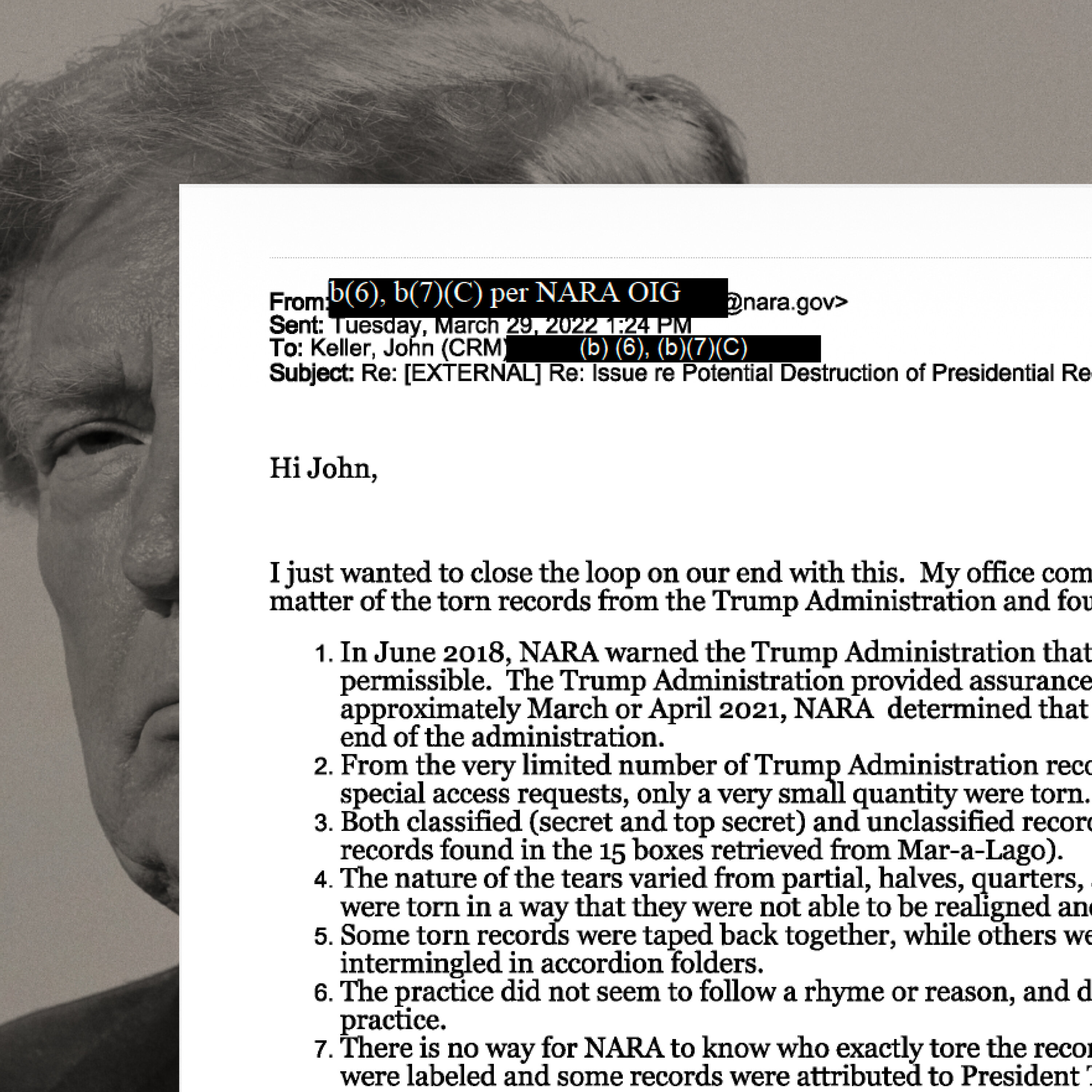
So PIN, the public integrity section, they say that there's nothing they can do. And they tell NARA, let us know if you get more evidence. And NARA certainly did. Several weeks later, on March 29th, The special agent followed up with Keller with a list of findings. To me, Matt, this is the most important email in the batch because it gives us the clearest view yet of the scale of the alleged document destruction during Trump's first term. Let's take turns reading this, Matt.
Both classified, secret and top secret, and unclassified records were torn. including two partially torn records found in the 15 boxes retrieved from Mar-a-Lago.
And number four on this list, I love this. It's so visual. Like, just close your eyes, Matt. Try to visualize this. The nature of the tears varied from partial, halves, quarters, and smaller pieces. However, no records were torn in a way that they were not able to be realigned and put back together. These tears were not just, you know, boom.
It was halves, you know, quarters. So, Tearing once and then tearing again.
If I went to the National Archive and looked at these, would I see literally the original pieces of paper with like scotch tape or would there be like a reproduction of it or what would I see?
Guess what, Matt? Presidential records from Trump's first term are subject to the Freedom of Information Act.
So we're going to get an answer to this question.
Foya.
To the rescue. I love it. So next is, some torn records were taped back together while others were placed in their multiple pieces and intermingled in accordion folders. I mean- I just love the minutiae level of descriptions here.
Yeah.
Again, we were talking about the National Archives. They just want their documents back. Bullet point number six, again, in this email, the practice did not seem to follow a rhyme or reason and did not appear to be a discriminant practice.
Just sort of willy-nilly.
What do you make of that?
You can't read anything into the reasons. There's no ripping policy that's being followed.
It's not like Kim Jong-un sent a letter to Trump and said, I hate him. I'm going to rip this up. It was just like, oh, thanks. Good letter.
The energy that's going into this is remarkable. Government records professionals are having to resort to scotch tape to do their job.
All right.
So next, they say, there is no way for NARA to know exactly who tore the records, but it is implied by how the records were labeled. And some records were attributed to President Trump. And recently, one box containing torn records was attributed to Matthew Sheehan, former deputy counsel to Vice President Mike Pence. Why mention Sheehan? This seems to be implying that Sheehan and Trump are the ones ripping documents. It's interesting.
They just sort of you know, throw his name in there. So I don't know.
Did you reach out to Matthew Sheehan, Jason?
Yes. Matt, can you read from that?
I was not involved in collecting records outside the office of the vice president, nor did I ever damage or tear records. The boxes of documents that I collected from office of the vice president staff and the documents that I transferred to boxes were sent by me to White House records personnel in the condition I received or found them.
So he's saying, look, if something's ripped, that's how I got it. It was like that when I got it.
So going back to these emails, the next day, okay, on March 30th, and again, this is 2022, Keller wrote back to the OIG special agent inside NARA's watchdog. Can you read that?
The results of your preliminary inquiry solidify our initial view, at least with respect to the public integrity section's equities. As such, we do not seek to pursue the matter further based on information currently known to us and with the understanding that DOJ National Security Division is examining the classified records issue.
What's your opinion? Give me the legal opinion on what could be happening here.
It sounds like some aspects of this would be within the wheelhouse or the jurisdiction of the public integrity section, but they're not planning to pursue it based on the information that was provided to them, but that there's other aspects involving classified records. It's not their domain that is something that has to be handled by the DOJ National Security Division.
Back again to the emails. This wasn't the first time that Keller had mentioned another division at DOJ that was looking into this. Keller copied someone else at DOJ, the head of the National Security's counterintelligence section. He also wrote in an earlier exchange that the FBI's counterintelligence section was also assessing these allegations. In fact, Matt, the same day this email was sent, the FBI opened its investigation into Trump's handling of classified documents.
So just as one inquiry into the document destruction reached a dead end, another is moving forward.
Exactly. You see, there were two other issues the NARA watchdog raised in an email to Keller. One that would elevate this to a potential national security matter. The National Archives investigators alleged they had found classified records in the boxes that were retrieved from Mar-a-Lago.
Okay, so now the National Archive is saying there's allegedly something sensitive inside the rug.
What we eventually learned is that NARA had found more than 100 documents with classification markings totaling more than 700 pages. And another set of documents I obtained shows that this is where the story splits open. Because prosecutors at the DOJ and agents at the FBI were not on the same page about what to do next. All right, Matt, this is the drama.
I love me some good government drama in the emails, man. I just love it.
This is not going to disappoint.
Tell me.
So the emails show that agents from the Washington field office, that's the FBI's Washington field office, who were assigned to this case, They clashed with leadership at the DOJ over the direction of the investigation, and they didn't believe there was even probable cause to execute a search warrant. So I just want to stop for a second there and say that there were agents inside the FBI who were really disturbed about what was taking place and the fact that this investigation was launched. In an email dated April 27th, 2022, a day after the federal grand jury opened the investigation into the classified documents case, an FBI agent expressed sharp disagreement about the probe.
Let me read here. This was unilateral action by DOJ. The Washington field office does not have anything in this case currently that would indicate there are additional presidential records at Mar-a-Lago or any other location.
So first, let's just note that whenever there's a federal investigation, the FBI and DOJ usually work together. The FBI investigates and the DOJ looks at the evidence to see if charges could be filed. So to me, it sounds like the agent is saying that some people at the FBI were completely out of the loop.
Yeah, that's a sure way to get government officials angry is keep them out of the loop on something they think they're supposed to be part of the loop on.
Right.
Especially something like, we are opening an investigation into the former president.
Especially that. Just his little old investigation into this guy. His name's Donald Trump. He used to be like the president or something. And we're going to go see if he's keeping records he's not supposed to.
So another agent responded and described their own frustrations with the DOJ. This is getting heated. Each time I've picked a fight on this case, and I've picked more than a couple, that's in parentheses. I've gotten the, yes, understood, but do it anyway type of reply.
Ouch.
Yeah. It's almost as if the records keep forcing everybody else into conflicts that they presumably would rather not have.
Right. And there's even another layer to the conflict.
I like layers. Tell me.
What's not in the records I received, but it's documented in a letter that a National Archives archivist sent a Trump attorney- is that the FBI had not seen what was inside the 15 boxes yet. So Trump's lawyers had repeatedly sought delays, quote, in order to ascertain whether any specific document is subject to executive privilege. They wanted Trump to have the opportunity to, quote, assert a claim of constitutionally based privilege. The National Archives, by the way, said there is no claim.
Kind of hard for the FBI to assess what's in there if they haven't seen the boxes.
So here's something else that's been simmering. NARA's watchdog long had concerns that there were additional records at Mar-a-Lago. And if there was classified records there, there was an urgency to retrieve them. That's a no-brainer. In May, the grand jury issued a subpoena seeking additional documents.
So now the question is, is there more rug?
Yeah.
Not everyone was on the same page about whether or not they should go get the rug. My documents show that some at the FBI had hoped it could avoid searching Mar-a-Lago altogether. Like, think about that. There were some people at the FBI that were trying to avoid a search of Mar-a-Lago. And agents believed that they could resolve this case and retrieve the documents Trump took by just dealing directly with Trump's attorney at the time, That's according to a July 13th, 2022 email that contained a bullet-pointed list titled, Other Options for Resolution. And an FBI agent noted in the email that the proposal was also conveyed to the Justice Department. Elsewhere in the documents, the FBI prepared a call script for bureau officials to use when
they contacted Evan Corcoran asking for their future cooperation with And a consent search of Mar-a-Lago.
Wait, I'm sorry. Consent search?
Yeah, a consent search.
They're going to consent to a search.
Yeah.
Yes. That's... That seems unlikely. Did you get the call script?
Yeah, the call script is redacted, but there's some stuff left in, so give it a read.
So this is a script for... The FBI is going to call Corcoran and they're like, all right, this is how you're going to do it. Right. This is what you're going to say. Okay. But I actually think it would be even more fun if it was like a automated call, like telling me that there is a great credit card offer for me.
Your assistance would facilitate the proper retrieval and handling of these classified documents and governmental records. We would therefore request the former president's cooperation and the opportunity to thoroughly search and retrieve any additional classified documents or governmental records in order to properly secure these records. Your cooperation in conjunction with a consensual search would help provide a level of comfort that the FBI has retrieved and safeguarded all the appropriate documents.
Try to imagine... Evan Corcoran bringing that to Donald Trump. Just try to imagine it.
He's still laughing. He's gotten the call. He's still laughing.
Oh yeah, definitely.
So what happens here? Does this, does anything happen with this proposal?
So the FBI's proposal never panned out. What came out is that, you know, they did try to deal with Trump's camp, Trump's attorneys, to retrieve these records. And they did get some additional records back. But there were still more that the National Archives believes that Trump was holding on to. and that he refused to return these records.
So we learned later when Trump was indicted that Trump allegedly suggested that his attorney falsely represent to the FBI and the grand jury that he did not have the documents the grand jury subpoena asked for.
Trump, by the way, has repeatedly denied any wrongdoing.
Correct. But when it became clear that the search warrant on Mar-a-Lago would be served, the assistant special agent in charge- at the counterintelligence division and the assistant director in charge of the FBI's Washington field office exchanged emails. The agent wanted the FBI rather than the DOJ to serve the warrant because of what he characterized as top DOJ officials' hostility towards the Trump defense team. So I think this is really illuminating here. So Matt, can you read this August 4th email? which was four days before the search took place.
This first contact will set the tone for the day. The FBI intends for the execution of the search warrant to be handled in a professional, low-key manner and to be mindful of the optics of the search.
The agent specifically called out Deputy Assistant Attorney General George Toskos saying.
That, quote, he frankly doesn't give a damn about the optics. I mean, wow.
And then the agent also name-checked Jay Brat, the head of DOJ's counterintelligence section, who he said had.
Built an antagonistic relationship with Trump's attorney.
Evan Corcoran.
This is a pretty blunt quote here. I think it is more than fair to say that the DOJ contact with Mr. Corcoran just prior to the execution of the warrant will not go well. Oh, man.
Oh, man.
I mean....
Obviously, it didn't go well because here we are four years later, Matt, and there's a new investigation, this time being handled by Trump's DOJ, into all of these folks. So when I wrote about this in my newsletter, neither Corcoran, Toskis, nor Bratt would return my request for comment. The agent believed that Trump's camp would cooperate if the search went smoothly and there wasn't any drama. But Documents also show that the FBI tried to secure the cooperation of some Mar-a-Lago employees. So they're trying to get employees to cooperate at Mar-a-Lago. And this agent's reaching out to this one employee.
And obviously, the discussions aren't going well because the employee is like, hey, why do you keep calling me? Matt, can you read from that?
I'm sorry, but you are not giving me any subject to talk about. What kind of conversation or questions are you expecting from me? I would like to know exactly what is happening before I respond to anything. And as a lawyer, I got to say like, that's what I would advise a client. Like you're getting a email or a call from law enforcement. Like I want to know exactly what we're going to be talking about before we start talking about anything.
Totally.
Totally.
Despite the resistance from the FBI, we know that, you know, this search took place on August 8th, 2022. We know that FBI agents descended on Mar-a-Lago. And during the search, agencies, thousands of government documents, including classified material that were commingled with Trump's personal items in storage rooms, in his offices, a ballroom, and boxes that were stacked in Trump's bathroom.
So indeed, there was more rug.
Yes, more rug. Lots more rug, Matt. FBI employees were, frankly, they were pissed, particularly when it became national news. Not everyone in the FBI knew that this was happening. They kept this pretty compartmentalized. Another batch of documents, Matt, reveal how upset they were. And in one email that was sent to the FBI's acting ombudsman, this FBI employee reaches out to the ombudsman and just kind of goes off.
You got to read this.
Did this really just happen? Am I dreaming? The FBI served a search warrant on a former president? I've lost just about all faith in our leaders. If he took documents, give him a call and ask for them back. Like seriously, my own agency, a bunch of Democrat political hacks up top. Well, that's an angry, that's an angry FBI person right there.
Why didn't they just call and ask for the documents back?
I mean, I, I, as I understand it, I think they kind of did try to do that, but this just seems, I got to say, this seems to me like everyone wants this fight. Like the DOJ wants the fight. Probably the Trump people want the fight. Like, they're happy to have the fight. And it sort of feels like the FBI is a little in the middle. But if they think that there's any way that this wasn't going to be a fight, I think that doesn't seem right.
There was going to be a fight regardless.
You really get a sense from these documents of the raw hostility. That's just been erupting inside the Bureau. And this is where the divide begins to look like it's ideological, not procedural. Listen to the next email. This FBI agent writes, a sizable percentage of the employee population sympathize with the January 6th riots.
Wow. I mean, that's just, that's startling to me in the substance, but also that that's coming up in these discussions. This is just crazy. So let's get back to the rug. Yes, the rug.
There's one more thing, Matt, that happened earlier this year that may ensure this never happens again.
What's that?
Back in April, Trump's Justice Department concluded that the Presidential Records Act itself is unconstitutional, arguing that Congress never had the authority to dictate how presidents preserve and surrender the records.
So now the question is, does the rug really belong to the government? And in the DOJ's opinion, maybe not. The opinion says the president need not further comply with the Presidential Records Act. Just to read that again, the opinion says that the president of the United States is not required to comply with a statute. You know, to be fair, this administration has... sometimes successfully challenged the constitutionality of things that would limit the power of the president.
But this would really upend the ability of lawmakers to protect public access to government records.
It seems like Trump now could tear up records, flush them down the toilet, take them to Mar-a-Lago and just keep them there.
But the Supreme Court has not ruled on this yet. It is still the law. And obviously- The National Archives very much disputes the DOJ's opinion. We will have to stay tuned and see what happens.
So Matt, some late-breaking news.
Ooh, exciting.
Tell me.
I finally got a response from the White House to my request for comment related to the torn records. So the response I get, the president and his team are focused on winning for the American people. Not whether Bloomberg discovered a ripped piece of paper from 2022. Joe Biden weaponized his administration to target political opponents. most famously President Trump.
The Biden DOJ's raid on President Trump's home was highly illegal. The president is committed to preserving records from his historic time in office. And that's a statement from Lauren Biz, a spokeswoman from the White House.
That's quite a statement, Jason. What's your reaction to that?
First of all, the last sentence that you read, that's a bonus. I didn't ask anything about preserving presidential. records, but they made it very clear, Matt, that they are committed to preserving records from his historic time in office.
And so don't pay any attention to the OLC memo that says the president is not required to preserve records because the Presidential Records Act is unconstitutional.
Just never mind that piece of it.
You can set that aside for now.
I'm confused by the timing. So they're saying they're not focused on whether Bloomberg discovered a ripped piece of paper from 2022, but the paper is not from 2022. Trump wasn't president in 2022.
My question to them is.
You know, essentially, Did he tear the records or did he not tear the records?
Which, of course, they did not answer in this statement.
They did not answer that question. They're focused on winning that.
I just see evidence of winning all over the place.
Well, Matt, do you want to know what I think is winning?
What's winning, Jason?
Getting records from NARA showing that records were torn.
That's right.
Well, there you have it, Matt.
So, Jason... Could we say that the presidential records really tied the whole investigation together?
Just like the rug, Matt. From Bloomberg and No Smiling, this is Disclosure. The show is hosted by Matt Topic and me, Jason Leopold. It's produced by Heather Schroering and Sean Cannon for No Smiling, with additional support from Callum Foote. Our editor for Bloomberg is Jeff Grotak. Our executive producers for Bloomberg are Nicole Beamster-Boer, Cheryl Brumley... and me, Jason Leopold.
And our executive producers for No Smiling are Sean Cannon, Heather Schroering, and Matt Topping. The Disclosure theme song is by Nick, with additional music by Nick and Epidemic Sound. Sound design and mixing is by Sean Cannon. Video production is by Drew Brown. Voice acting in this episode is by Mandy Hall. For more transparency news and important document dumps, you can subscribe to my weekly FOIA Files newsletter at Bloomberg.com slash FOIA Files. That's F-O-I-A Files. We'll see you next week.
