

Fit For Science· Staffel 1· Folge 18
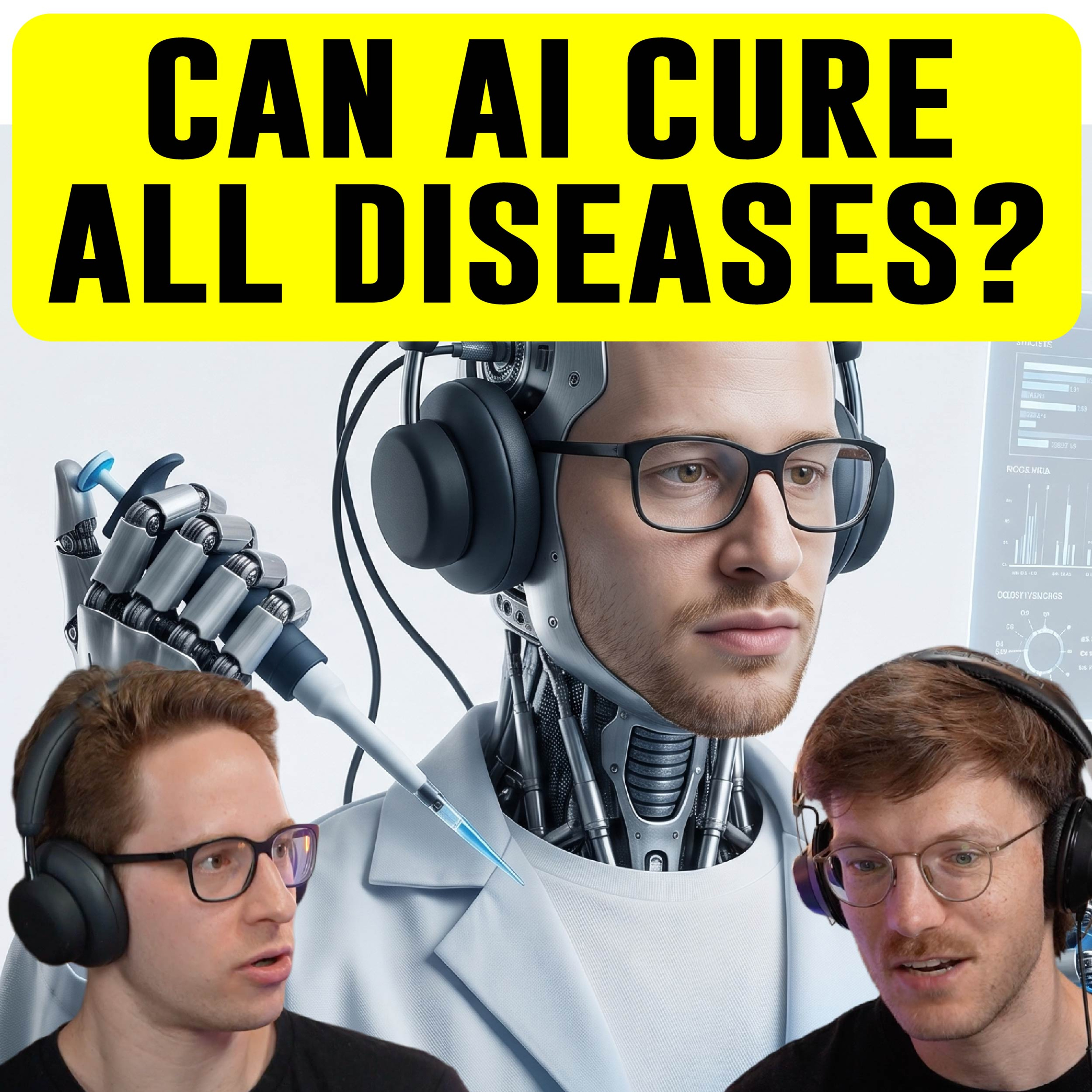
#18 Will AI Actually Cure All Diseases? The Promise, Limits & Our Contributions to “AI for Science”
Mittwoch, 3. Juni 2026 · 1 h 00
Kapitelklicken springt direkt hin
Shownotes
Stephan and Rob explore the ambitious claims made by AI industry leaders about rapid scientific advancement due to AI. They provide an introduction to the "AI for Science" field and analyze the fundamental physical limitations that govern the acceleration of biomedical discovery through AI.
📝Summary
Biological data scientists Stephan and Rob evaluate the grand claims made by major tech executives regarding artificial (general) intelligence compressing a century of scientific breakthroughs into a single decade. By analyzing a recent paper co-authored by Stephan, the hosts break down the theoretical limits of general-purpose AI systems when faced with physical world restrictions. They emphasize that while cognitive tasks like literature synthesis, data analysis, and manuscript preparation can be massively accelerated, the time constants of the physical world remain irreducible bottlenecks. The conversation balances the promise of AI for science, including the hosts contributions to and beliefs in the field, with realistic infrastructure and policy demands, and the psychological and technical risks of relying on systems we do not fully comprehend.
⏳Chapters
Machines of Loving Grace: Dario Amodei and compressing a century of progress into a decade
Theoretical Scaffolding: Defining general purpose AI versus narrow machine learning systems
Cognitive vs Physical Domains: Splitting the lifecycle of a scientific research project & irreducible bottlenecks
Human Creativity and Technical Debt: The risk of losing comprehension via vibe engineering
Strategic Proxies: Using predictive biomarkers to capture outcomes early and bypass constraints
Emergence of “AI Co-Scientists”: Discovery of digital biomarkers from wearable datasets
Discovery Deficits: Why modern molecular biology is data-rich but discovery-poor
AI for Science: FutureHouse, Marinka Zitnik's ToolUniverse and James Zou's virtual lab
Simulating biomedicine with AI: What we did with early access to GPT-4 in 2023
Matthias Samwald, the EU General-Purpose AI Code of Practice and Accelerate Europe: Balancing trustworthiness and acceleration
MrBiomics: Automating biomedical data analysis using workflows and AI
Summary: Accelerating scientific discovery is possible, but not easy
📚Resources
Stephan's recent paper: What are the limits to biomedical research acceleration through general-purpose AI? (nature.com/articles/s41598-025-32583-w)
Social meda: LinkedIn (linkedin.com/posts/stephan-reichl_ai4science-b…), X (x.com/matthiassamwald/status/2014649978157727921), Press release: Potential and limitations of AI in biomedical research (meduniwien.ac.at/web/en/about-us/news/2026/new…)
A multimodal sleep foundation model for disease prediction (nature.com/articles/s41591-025-04133-4) -> we discussed this paper before in episode 8: AI is Changing Wearables in 2026(?) and Predicts 130 Diseases from Sleep! (Episode 8) (youtu.be/pO2-fBqMdDk)
Rob's and Stephan's 2023 AI paper: GPT-4 as a biomedical simulator (sciencedirect.com/science/article/pii/S0010482…)
Press release: "ChatGPT" for biomedical simulations (meduniwien.ac.at/web/en/about-us/news/2024/new…)
Correction: GPT-4 predates o1-preview by 1 year and 6 months, not 6 months
Matthias Samwald (samwald.info)
Previously: Co-chair of the Safety & Security chapter of the EU's General-Purpose AI Code of Practice (digital-strategy.ec.europa.eu/en/policies/cont…)
Now: Accelerate Europe (accelerate-europe.org) coordinator
Stephan's passion project: MrBiomics: Composable modules and recipes automate bioinformatics for multi-omics analyses (github.com/epigen/MrBiomics)
…There is MUCH more: complete show notes here (docs.google.com/document/d/1LCIm780Aue5573FWVp…)
🎙️About
Fit For Science is a deep-dive podcast hosted by two biological data scientists, Rob and Stephan, exploring the intersection of research, health tech, and data-driven lifestyle design. The hosts provide evidence-based systems, layered with practical "N=2" personal experimentation, to cut through the noise and enable everyone to become their best N-of-1.
Learn more (creators.spotify.com/pod/profile/fitforscience) and subscribe on your favorite platforms:
YouTube (youtube.com/@FitForScience)
Spotify (open.spotify.com/show/56TjUxuMsPETb0kGEJ7nwf)
Apple Podcasts (podcasts.apple.com/us/podcast/fit-for-science/…)
Amazon Music (music.amazon.de/podcasts/c3e54ee7-4a2c-442e-a5…)
Collection of all show notes (docs.google.com/document/d/1LCIm780Aue5573FWVp…)
⚠️Disclaimer: This podcast represents our own opinions and is for informational purposes only. It does not constitute medical or financial advice or a professional relationship.
