

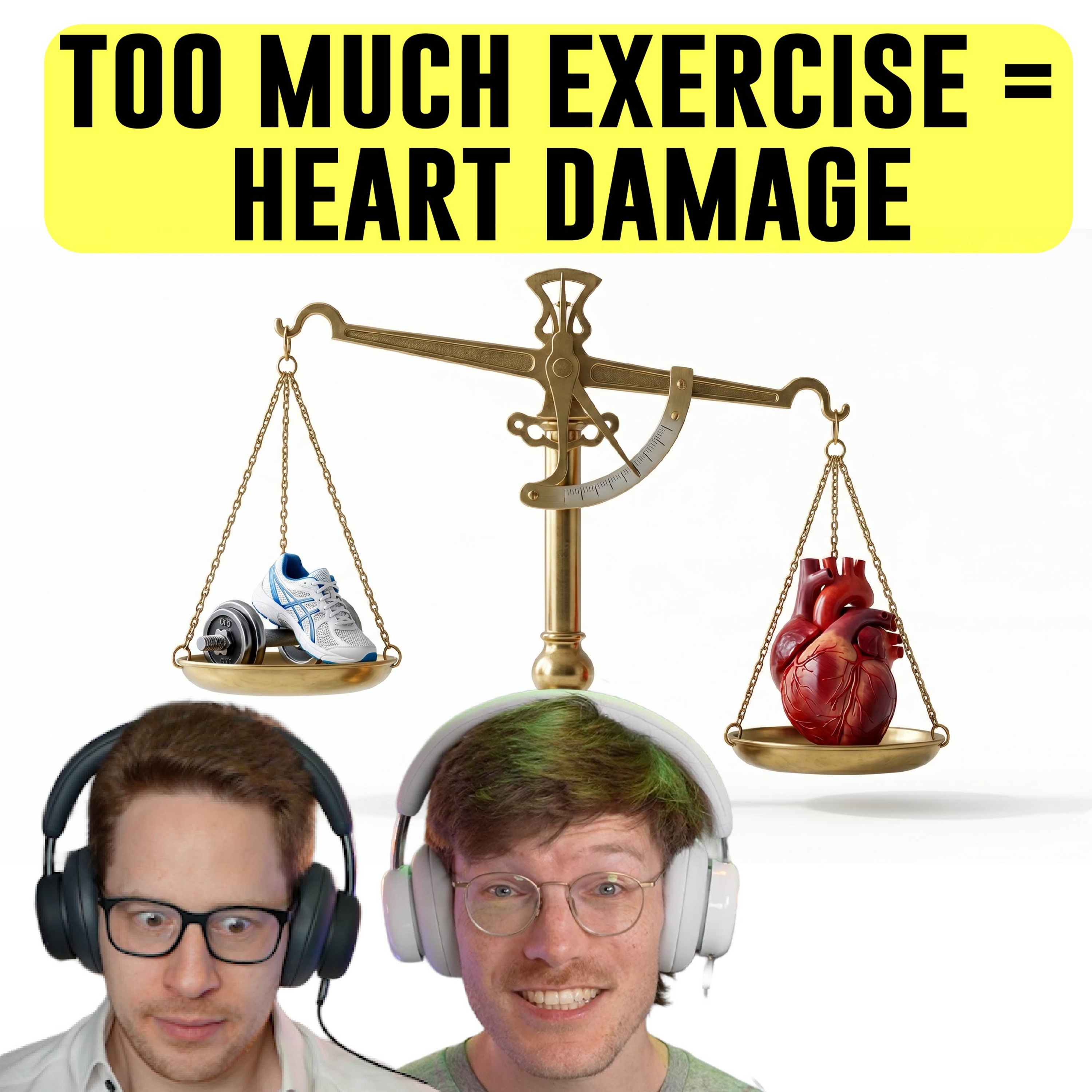
Fit For Science· Staffel 1· Folge 16
The 1-Minute Exercise Myth, Exercise & Mortality, Athletes' Health Risks & Rob's 8-Watch Marathon (Fit For Science #16)
Samstag, 9. Mai 2026 · 58 min
Kapitelklicken springt direkt hin
Shownotes
In this episode of Fit For Science, Rob and Stephan explore the complex relationship between various exercise types, intensity levels, and mortality, while also recounting Rob's intense DIY smartwatch-testing marathon.
📝Summary
In this episode, Rob and Stephan dive into the nuanced impacts of physical activity on mortality and disease risk, emphasizing that while exercise is universally beneficial, its effects vary by type, intensity, and duration. The hosts unpack a 30-year cohort study involving over 111,000 participants, highlighting that 20 MET hours per week and a variety of activities optimally reduce mortality risk, with walking being highly effective. They critically examine recent wearable-based studies claiming that a few minutes of vigorous intermittent lifestyle physical activity (VILPA) can drastically substitute for longer low-intensity sessions, pointing out the limitations of substitution modeling. Furthermore, the discussion touches on "masters athletes," exploring how extreme, long-term exercise volumes can lead to unique cardiovascular adaptations and potential risks like atrial fibrillation or bradyarrhythmias, underscoring the need for specialized cardiological care. Finally, Rob shares his experience running a solo marathon fueled by a stationary bike feed station to test the GPS accuracy of eight different smartwatches simultaneously.
⏳Chapters
The DIY Marathon: Rob recounts his solo marathon to test eight smartwatches
Exercise and Mortality: A 30-year study on MET hours, activity types, and death risk
Walking vs. Swimming: Different mortality correlations between specific sports
The Power of Variety: How mixing exercise types significantly lowers mortality risk
VILPA and Vigorous Exercise: Analyzing studies on high intensity exercise
Critiquing claims that one minute of vigorous activity equals 54 minutes of low intensity activity
Masters Athletes: Defining high-performing athletes over 35 and their cardiovascular health
The Athlete's Heart: Exploring cardiovascular specific risks in endurance athletes
Final takeaways on balancing exercise intensity and seeking appropriate medical advice
📚Resources
Physical activity types, variety, and mortality: results from two prospective cohort studies (bmjmedicine.bmj.com/content/5/1/e001513)
Mix of different types of physical activity may be best for longer life (medicalxpress.com/news/2026-01-physical-longer…)
Metabolic equivalent of task (MET) (en.wikipedia.org/wiki/Metabolic_equivalent_of_…)
Association of wearable device-measured vigorous intermittent lifestyle physical activity (VILPA) with mortality (nature.com/articles/s41591-022-02100-x)
Wearable device-based health equivalence of different physical activity intensities against mortality, cardiometabolic disease, and cancer (nature.com/articles/s41467-025-63475-2)
Why Vigorous Exercise Is 4–10x More Effective Than Moderate (New Evidence) (youtube.com/watch?v=QnloZ45PVxQ)
The Best Type of Exercise for Longevity (foundmyfitness.com/episodes/exercise-intensity)
1 Minute of Vigorous Activity Same as 53 Minutes of Light Intensity? (youtube.com/watch?v=qBqMHSoTM8M)
Masters Athletes With Abnormal Cardiovascular Findings (sciencedirect.com/science/article/pii/S0735109…)
The Recreational Athlete's Heart (pubmed.ncbi.nlm.nih.gov/41330412)
en.wikipedia.org/wiki/Bradycardia
…There is more: complete show notes here (docs.google.com/document/d/1LCIm780Aue5573FWVp…)
🎙️About
Fit For Science is a deep-dive podcast hosted by two biological data scientists, Rob and Stephan, exploring the intersection of research, health tech, and data-driven lifestyle design. The hosts provide evidence-based systems, layered with practical "N=2" personal experimentation, to cut through the noise and enable everyone to become their best N-of-1.
Learn more (creators.spotify.com/pod/profile/fitforscience) and subscribe on your favorite platforms:
YouTube (youtube.com/@FitForScience)
Spotify (open.spotify.com/show/56TjUxuMsPETb0kGEJ7nwf)
Apple Podcasts (podcasts.apple.com/us/podcast/fit-for-science/…)
Amazon Music (music.amazon.de/podcasts/c3e54ee7-4a2c-442e-a5…)
Collection of all show notes (docs.google.com/document/d/1LCIm780Aue5573FWVp…)
⚠️Disclaimer: This podcast represents our own opinions and is for informational purposes only. It does not constitute medical or financial advice or a professional relationship.
