

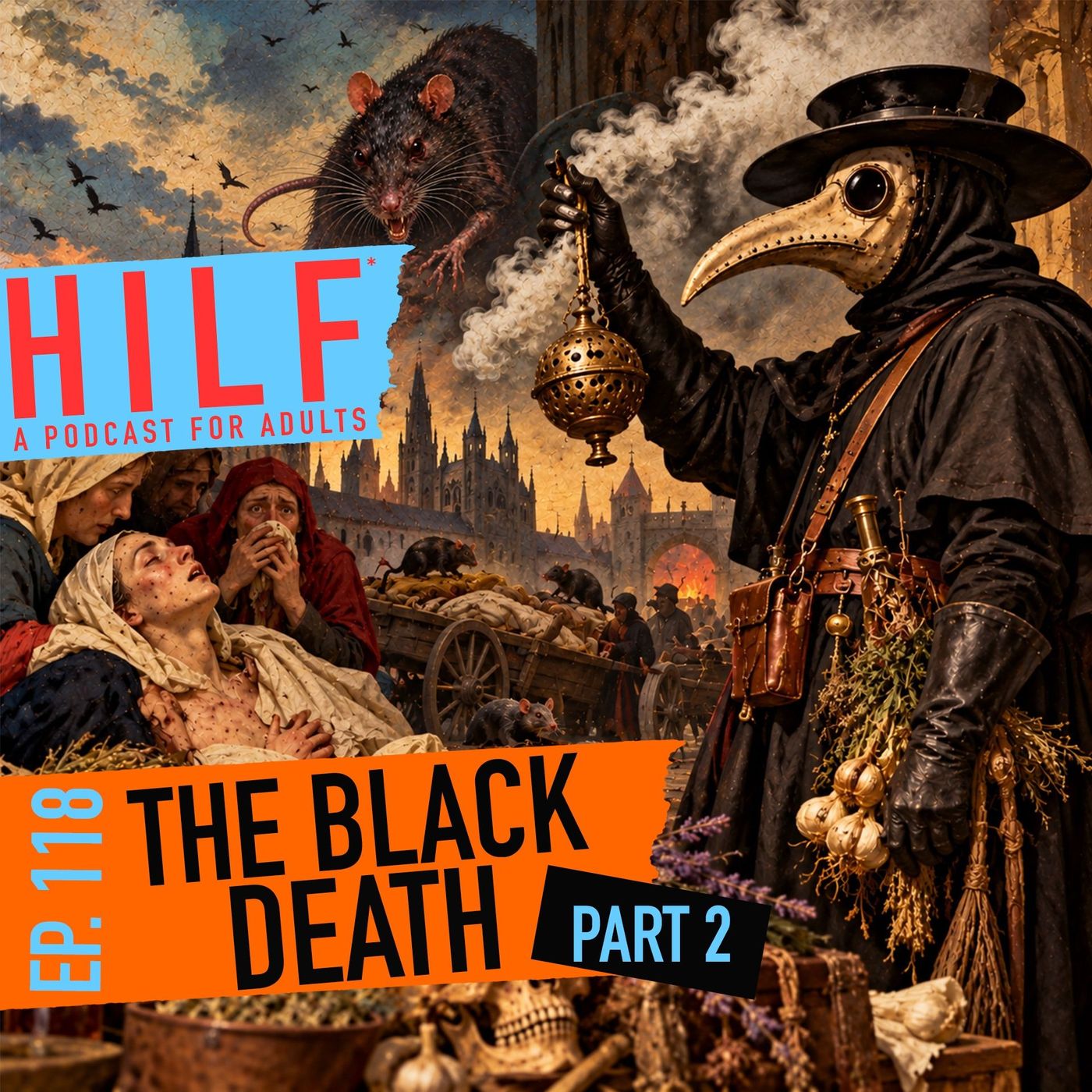
HILF: History I'd Like to F**k· Folge 118
HILF 118 - The Black Death with Mary Ramos Part 2 [RE-RELEASE]
Samstag, 24. Oktober 2026 · 1 h 08
Kapitelklicken springt direkt hin
Shownotes
Hear about the places that managed to avoid the plague, at least for a little while, and what a medieval haz-mat suit looked like. Also, continue to roll the 'Death Dice' along with celebrated music supervisor, Mary Ramos (maryramosmusic.com), to see if any of the characters we meet along the way manage to avoid the sickness and death that overcame half of the global population. ---✅ Follow HILF on TikTok (tiktok.com/@hilfpod)! 🎟️ HILF Public School (dawnbrodey.com/events)- the live, interactive version of HILF: First Thursdays at Flappers Comedy Club (flapperscomedy.com) - Burbank, CA🤑 HILF is now on Patreon! (patreon.com/hilfpodcast)---SILF's (Sources I'd Like to F*ck)• The Great Courses - With Dorsey Armstrong, PhD (thegreatcourses.com/courses/the-black-death-th…). Got a library card? Find it via Hoopla (hoopladigital.com) or Libby (libbyapp.com/interview/welcome#doYouHaveACard)!
• Check out this great visual guide (washingtonpost.com/graphics/2020/local/retropo…) to understanding how The Black Death compares to other pandemics.
• Read an article about plague bodies being found outside London (bbc.com/news/science-environment-26770334) this decade!
• Read Mary Ramos's article in Variety (variety.com/2019/music/news/quentin-tarantino-…) breaking down the soundtrack to Once Upon a Time in Hollywood.
---LILF's (Link's I'd Like to F*ck) • See Dawn on THE HISTORY CHANNEL!
• Crazy Rich Ancients (history.com/shows/historys-crazy-rich-ancients)
• Histories Greatest Mysteries (play.history.com/shows/historys-greatest-myste…)(multiple seasons)
• Check out HILF MERCH now available on Redbubble (redbubble.com/people/hilfpodcast/shop?anchor=p…)! Stickers, t-shirts, bags and more!
• HILF is now on Patreon! (patreon.com/hilfpodcast)
• Buy Me a Coffee (buymeacoffee.com/hilfpodcast)
---Theme song: Composed and performed by Kat Perkins (katperkinsmusic.com).
Become a supporter of this podcast: spreaker.com/podcast/hilf-history-i-d-like-to-….
Transkriptvom Podcast bereitgestellt · Zeitmarken springen hin
If the lights go out and we're all just stumbling through with the knowledge we have, and this piece of knowledge I've just given you has stuck, and you find someone with a bulbo in their groin or their neck or their armpit, just leave it alone. Don't poke it.
Don't poke it.
History, I'd like to Follow me down the rabbit hole History, I'd like to Flank a leaf.
I want to know. Hello and welcome to Hilf. History I'd like to fuck with Don Brody. I'm Don Brody, your host who believes history is a party and everybody's coming. And this is episode 119, The Black Death Part 2 episode. with Mary Ramos, where we return with more plague stories. All right, now this one was originally recorded in 2024, and just, I really truly wish that it wasn't so damn timely, right? So supposing that the recent news of the plague possibly being released in a lab in Siberia is no big deal, right? And then the lessons that we learn here will prove only useful in conversation and not in survival. If you've already listened to part one, and I'm sure you did, then you've already met the
self-harm cult, the flagellants. And coming up, we've got even more jaw-dropping tales, including the story of a village where everyone died except for one. We'll also discuss the best and worst medieval methods of medical treatment and prevention, which are all nasty. And then we'll cover some origin theories for Yersinia pestis, the bacterium behind the plague. All right.
Not just the fleas and the rats, but like, how the hell did they get it? Right? Outer space? Nature, God, where'd he come from? Trust, it's fabulous. Mary and I will also, of course, continue to roll the death dice along the way. These dice, of course, approximate the odds for a medieval person to first get the plague and then second die of it. So thanks for joining us for this dance macabre. May it remain unchallenged as the greatest horror show in human history. Let's get started. I mean, it's.
Probably got to be this sound, right?
Yeah.
I mean, because it feels like a marching thing.
Uh-huh. Uh-huh. Screamo Now this guy's got the mnemonic I can just tell See there's so much.
This is disturbed There's a whole There's just a whole And surprisingly enough There's a lot of music from Scandinavia That is that vibe Oh, really?
Oh, really? Like, screamy, darky, ragey, die?
Oh, most definitely. I mean, these beautiful, like, pristine, like, Iceland hat, you know, just lots of them have this kind of style of music.
I love that.
It's a faction of style of music, but you just think, wait a minute.
It should all be feathers.
You should be.
I want to feel the down of a polar bear when I listen.
To this music.
Oh, right. Before we get back into our boobos, speaking of The Walking Dead, you have raised children in L.A. I am raising a child in L.A. Any advice?
Oh. Wow.
Is that exactly the same as like The Walking Dead? I know that living in L.A. is beautiful and wonderful and I love it and there's all this great, but it does kind of feel like a horror show sometimes. And I feel like you have survived. You got out of the farmhouse. You guys are in the clearing. Your children are grown. They're doing great.
Man, I wish I had good advice.
I don't.
Oh, come on.
It's so hard. Give me the key.
It's so hard.
Give me the answer. I mean, you know what?
Here's the advice. As much as I try to, like, encase them in, you know, hermetically seal them and keep them from, you know, harm. You can't do that. You just can't because they find it anyways. And the kid, you kind of steer your kid towards to be a buddy because you think, I like his parents. His parents are cool. Oh, he's the one who says, you want to see my dad's gun? When they're in kindergarten, it's like, oh, my God.
No, and hermetically sealed isn't good, man. I mean, nothing thrives.
I know. I saw Finding Nemo. I learned that lesson. Pixar, that's how.
You raise them.
Let's go to school and get some knowledge. Oh, yeah, sure, sure, sure. You raise them with Pixar movies. Pixar's good. History helps. I told Beatrice the story of the plague on the way to school this morning.
You did not.
Yes, I did.
You did not.
I said, the dead bodies, I said, guess what they threw over the wall? And she was like. I said, dead bodies. She was like, what? And I was like, have a nice day at school, sweetheart.
I love you.
See you at martial arts.
She does.
She occasionally, this is not kidding. She occasionally does tell her teachers things that like she learned. We went to the Titanic exhibit in Las Vegas and you get a boarding pass. When you go on, that tells you you're a real passenger, and you go through the whole exhibit, and at the end of the exhibit, you learn if your passenger survived or not. And Beatrice and I survived, but our father sadly died.
Oh, yeah, he's a man.
These details were lost when Beatrice went to school and told everybody that her father died.
Did you get a call?
Yeah.
Yeah, I got a call. And I was like, I'm sorry, what? And I had to go through it with her. I was like, why would you say that? And she's like, I don't know. And I was like, are you making up lies? Are you a psychopath? What? This isn't even funny. And it took me a minute to be like, oh, wait, on that.
Details, details. She was four.
She was four.
Little kids in details.
I shouldn't do this. But don't you just love it?
I swear.
I swear to you, kindergarten and first grade teachers just must get. Just must get all the stories.
I know, right? And there's no context. And they're just like, okay. Well, speaking of context, we, Mary, my friend Mary and I, have been tits deep in death for an hour now. And we're about to go through, we're about to wade through it now. So we saw the pool of death. We saw how deep it was and how wide it is.
And now we're just going to dive into the death pool and we're going to swim around. And we're going to navigate death. Freely from this place.
You put a wetsuit on. I'm like, so.
Get it all up in you.
Ready.
You don't want a skinny dip in death. You need something nice then. You will recall from part one that that first wave hits us in that mid-14th century, kills half the population on Earth. Then the subsequent waves come back. It was six to ten years.
Six to ten years.
Different virility. And some are more tragic because they just get the kids. It's just terrible. Then, in 1666, don't think that number didn't slip people's attention, poof, the plague kind of goes away. Certainly, we get well past that six to ten years, right? And what this episode is going to do is we're going to talk about that, that icky gooey part where it just kept coming and going back and what we did.
Yeah.
And then I'm going to talk about when it did come back. In the 1880s. And what we learned about it at that point that really has informed everything we know about the fleas of the black rat, that bacteria, the Yersinia pestis, and the origin on a molecular level and a scientific modern level on actually what the fuck was this thing? Because we know a lot, obviously, now, but we know less than I think. You're prepared to accept.
So let's just for context, you and I now, as we exist, this is, we're recording this in the fall of 2024. We are give or take five years from COVID.
Yes.
Right.
Although I still carry my mask.
Yes.
And that's one of the things. I'm going to go visit old.
People coming up. So I wear my mask everywhere.
And that's one of the things I want to point out is that that, as we talked about, the death rate is minuscule in comparison to even AIDS and even to the Spanish flu in terms of how many people it killed. And it's fair to say we don't know the future. But where we sit now, we feel like we're through it, and we can look on it with some reflection, and you can point to a lot of things that have changed.
Yes.
That COVID changed. The way we work, the way we go to school, how we have a doctor's visit.
Day nights.
I'm an actor, self-tapes. We're never going to go back into those casting rooms again, I don't think. Even traffic flow is different on Mondays and Fridays in L.A., and it might never be back to the way it was.
Ooh.
Think about religion and politics. I mean, we were like, boy, COVID was a big ripple. That rock left big ripples in the pond, right? So it changed everything. But lots of things. happened in human history on the scale of COVID, on the scale of world wars, on the scale of natural disasters that change everything. I can point to a million places where everything was this way and then that happened and everything was different after that. What makes the plague different is it didn't just change everything, it shattered everything.
Everything was broken. And was rebuilt. That is a big difference between everything changing. It was just obliterated. And my feeling is the only thing that I can imagine that could come close to what the plague did to humanity is a nuclear bomb.
Holy moly.
Because we are organic species that live and mold and flex and move with various things. Something like that.
Yeah.
So here we go, back into the plague, and I'm going to take you by the hand to Lapland, Finland. Lapland? Have you been to Lapland?
I haven't, but it's on my list of things to do.
Oh, well, I hope that your experience there will be more pleasant than the one I'm about to describe. Oh, no.
Oh, don't.
Don't. It's 1481. And one of the things you should know about your village outside of Lapland, Florida.
It's pretty.
Florida. Finland. It's pretty. It's gorgeous.
All those pretty little houses. You mountain people.
And your mountain people in the cold. Mountain people in the cold, of course, live significantly different than agrarian people down there in Europe. These are farmers, right? The farmers in Europe, you work a ton of land. And then if you have a lot of land around you, you go, well, I'm going to grow wheat and you're going to grow corn.
And then we're going to trade. We're going to go back and forth. And that's how their society is built. For the folks up in the mountains in Lapland, Finland, they have some stuff. And they rely on one or two people from their village going down the mountain into the city down there and getting a few things they need on occasion. But those things they need on occasion are absolutely desperately necessary for their survival. But this is a very, very, very different way of doing stuff. And we up here in Lapland, Finland in 1481, we have heard of the plague, even up here. We have not gotten it, though. Nobody here has gotten it or died.
Some of the dudes that go down the mountain for us don't come back. That has happened always, but that seems like maybe they're going down there and dying, especially when you and I know how quick you die, right? And it's starting to get like people don't want to accept trade anymore. And one of the things that is becoming abundantly clear to us up here is that if we don't trade, then we're all going to starve to death.
Which means if the plague don't get us, starvation will. And we've got to figure something out here. So the people of Lapland, Finland basically make an arrangement with their trading partners down below that is essentially a medieval contactless grub hub. They're like, how about this? We will bring our stuff down to that rock next to the tree, and then we're going to leave. That's smart. That's smart.
And the people down below were like, fucking deal. Fucking deal, man. And here's what happened to the people of Lapland, Finland. The plague still came. No. And half of everybody died.
But.
They did not starve to death. They continued to have enough people that went down to their fucking Grubhub spot and get their shit that the people of that mountain village survived, ultimately. Even though they got the plague and half of them died. How did they get it? Because even if they had never gotten the plague and that trade route had stopped, they all would have died.
Really? Yeah. I don't understand. Okay.
Right? Because they would have been blocked off and isolated. It would have been the same thing that would have happened to them if there had been a landslide or something that severed that line of trade. They know what happens to the people who live there. They either all die or they have to move and leave because they can't actually, they don't have the resources to survive.
Right, right. Okay, right, right, right.
So they were like, half of us die of plague still means half of us are here. But how did they.
Get it, though, if they didn't have contact?
Oh, God.
Okay, okay. No, no, no, no.
Mary, you've saved me.
Okay.
You have made what we call in the podcast business a natural segue through your organic curiosity.
How?
Right? Yes. How did they get it?
Turns out that the fleas of the black rat can live in textiles for 30 to 50 days. Oh, my God.
Yeah.
That solved a lot of mysteries. When we fucking figured out, first it was the fleas of the black rats, and then we figured out that fleas of black rats can travel in a spool of wool for over a month. We were like, well. What? Well. And everyone goes, that changes things a lot.
Oh, my God.
So we're going to give you your first death roll here.
Okay.
You, resident of the beautiful scenic.
Lapland.
Lapland. Pick a number, please. One through four.
Oh, God.
Four.
Four.
One.
Son of a.
You got it, girl. Pick a number one through eight.
I don't... Two? It's eight!
Damn it! You know, one of you Falco is still going strong, though. You're a first character.
Damn it.
I'm going to tell you now what we know in 2024. We were just in Lapland in 1491. We're going to hop quickly over here to the 20th, 21st century. I'm going to tell you what we know about the plague because it's fucking nuts. And part of the reason why we know this is because, again, it resurged. In the mid-1800s in China and India, killing millions of people. But we had microscopes and we were tipping a toe over the modern era. And we figured out a lot of stuff and went, oh, my God, that was what was happening to these fucking guys. Was it bats? Exactly. But it is black rats. And it's really specifically black rats.
The fleas of the black rat who carry... And the black rats have to be infected with this Yersinia pestis. Where the Yersinia pestis came from.
Or at least fans of that band.
They at least have to have a t-shirt. I've heard one single. We're going to talk about where the Yersinia pestis came from. Okay, so we'll back up there. But for now, let's just say you got infected rats and the fleas and the infected rats. Something, and we'll get into this later, why the rat population moves into the human population, they've been there for a while, but they're infected, okay?
Then what we know is that the black rat population has to die for the fleas to jump to people. Fleas of black rats don't like anything but black rats. Black rats are their absolute favorite. They have evolved together for tens of thousands of years, and it's their absolute favorite food.
Okay.
And these fleas on the black rats are incredibly sophisticated, also evolved amazingly. So when a black rat gets sick, the flea has this like natural enzyme that basically shuts off its straw. So if you picture like a mosquito sucking device and it's got like chompers at the end of a long straw. So it digs in the rat, chomp chomp, sucks the blood. Once its body is like, this blood is bad, the flea's body creates this enzyme that clogs that tube so that the blood can't get into the flea. But it fills that tube. But it starts to get hungry. So it sucks harder.
Chomp chomp chomp chomp.
And it fills that thing. And then eventually it starts. And then the rat dies. Now, the other critical thing that has to happen is all the rats have to die, which actually takes a lot longer than you think because they cannibalize each other and they've got babies for days. So, like, it takes a long time for actually all the rats to die. And the fleas are so dedicated to the rats, they really don't want to jump on anything else. So once the last rat's done, this flea with... Yersinia pestis in its little sucking tube as a last resort jumps onto a person.
Oh.
It's starving, so it's sucking and digging. But its hose is still clogged because its body said, shut it down. This is poison blood, right? So it regurgitates everything that's in its tube out so that it can now suck your blood.
Oh.
So really, the main primary number one way you and Falco and all the people you've played and everyone we're about to meet gets plague is an infected flea. Period.
Wow.
The second most likely way is you encounter someone with pneumonic plague who coughs on you.
The cough kind.
Or you're lancing your buboes with open wounds, but that's almost kind of hard to do. Which would be stupid.
You wouldn't do that, oh, would you?
Oh, hang on. Yeah, don't underestimate the Middle Ages, girl. Yeah, so that's crazy, right? And then through the course of studying, you know, in the various years, we know that these similar fleas also are on gerbils, and gerbils are in various places, and that the Mongols were eating... some of the Faraday type creatures that may also have had some of these fleas. We also know the fleas lived in grains.
So grain shipping could have held infected fleas for 20 to 30 days for 30 to 20, you know, all these ingesting periods. They can live that long in these fibers of clothes.
Yeah.
And they won't jump onto a person until all the rats have been dead for a couple of days. It's so fucking interesting.
Or it's, Or there's just no rat around, right?
Right.
Okay.
Which is why the crazy thing is, like, it totally sounds ridiculous now, but you're like, you'd be safer if you had a couple of rats in your house than if there were no rats. In certain instances, having one family of black rats in your house was kind of great for you.
Yeah, yeah.
Wild. Wild.
Um so that's.
A great idea for a right story.
Or even like you're the you're the human version of that to like an outer space species like we need you to be the black rats in our basement okay oh yeah.
It got dark. I mean, it gets super dark.
It gets really dark. No, you and I, all the things we know.
Why can't we talk about cumin or cinnamon?
Next time Dawn says, what's your hill if you say unicorns? What's your hill? How did we develop the cute hairstyle known as the bob? I bet that has less to do. No chance. We're getting in. But this question of like, what the fuck, man, is not something that we started asking in 2024. It certainly wasn't even something we started asking in 1380 when it came back. When the plague came around with the Pope walking between his two fires and various universities in Paris and stuff, we're like, what the fuck is this? And they're like, I have all the answers. Anyone who's been selling... For the last millennium, the eye of all the answers has to at least take a swing. Right, right, right. So the theories at
the time, I'm going to tell you now what the medieval theories were about what this was and where it came from and what ought to be done.
Okay.
For treatment and prevention. Here's some of the smart stuff. They're all swinging. They have no fucking clue. We don't know about germs. We don't know nothing. But here's some of the stuff that happened to be fairly wise. Quarantine.
Oh, da-da.
Quarantine comes from quarter, 40 days is the idea. 40 days, your ship comes in. We don't know where you're fucking from. We're going to be hanging out there 40 days. By then, someone's going to get sick and show it or you're all going to be dead or whatever. That's not the dumbest thing. That makes sense. The other was the Birdman suit.
You saw that little hazmat suit. I'm going to show you a picture to my friend Mary. And Mary, I'd like you to describe... To the listeners.
That sexy, sexy Tom Cruise, Nicole Kidman movie. Remember that?
Eyes Wide Shut.
Eyes Wide Shut. It looks like that, you guys.
Totally like that. Totally like that. His dick's out. No, wait. That's his hand. Never mind. What are you showing me, Dawn? But you guys might know it's like kind of a Tim Burton-y kind of mask. The beak. That long beak. You had a black cloak, usually carrying a stick. And this is the plague doctor, okay? And that was kind of a hazmat suit. Like gloves, mask. Now, they weren't trying to protect themselves from germs because they didn't know what that was. But the idea is at the end of that beak is full of like dried flowers and perfume and stuff because even if this isn't going to keep me safe from like germs, it stinks. Y'all stink.
I'm not going to smell it.
Dying.
I didn't realize that's what that nose was for. I thought it was scientific. Stupid me. Because I thought, oh, they're at least staying this far away. Because the nose goes out for how many inches or whatever.
Yeah.
A broken clock. Twice a day. They just rolled the dice and happened to help themselves out. Yeah. Here's some of the dumb stuff. They lanced and drained them boobos. Don't do that. And here's just like if the lights go out and we're all just stumbling through with the knowledge we have and this piece of knowledge I've just given you has stuck and you find someone with a bulbo in their groin or their neck or their armpit, just leave it alone. Don't poke it.
Don't poke it. Okay. Don't Lance it. Just that word.
Lansing it. Don't Lance it. No, uh, pilgrimage. You don't need to go anywhere. They were like, well, Clearly, what God wants us to do is hit the road and see our friends.
You know.
And we're like, no, God doesn't want that.
Oh, and then the other thing was, because, you know, everything's hard to get in the Middle Ages, clothes and bedding of those who died inherited and donated immediately to the closest members of the family. That's right. Full of them, please.
Hello, goodwill. Hello.
Here's how the church's initial reaction, of course, as we talked about, was like, I got to go. Also, fuck you guys. Bye. Bye.
Sancta Dominus Dominus. Bye.
Yeah, and they got real flexible suddenly. The church found ways to be negotiable.
You can confess to a woman.
They were simply non-negotiable before. These elements of flexibility certainly preserved the church to whatever extent. The church obviously didn't go away. We still have a pope and everything kind of maintains. So it saved the church. It's also why in the middle of this, if you're doing the math on dates, 1517 is when Martin Luther stabs that treatise into the door. And we have the Protestant revolution, which is like, I think you're all full of shit. And among the things I think you're bullshitting about is how much money you need, how nice your house has to be. Right.
So there was definitely like the idea and historians have debated about this, but the theory is that the schism and the doubt, the ability to challenge the church, was probably impossible prior to the plague. And the plague itself, in addition to distribution of population, just actually took them down.
You're wrong. You can't prove it. But a lot of people who lost faith in the church never lost their personal faith. It was sort of astounding to some that it wasn't just an institutional belief that was bolstering them and how their faith sort of transpired. We talked in part one about About the flagellants.
Yes, yes.
And there is a shortage of clergy and some saints. Are you Catholic?
I was raised Catholic. Now I'm Protestant.
Fascist. So you know all about this stuff. Well, you have a hand in either side. Some of these saints, if they're familiar to you, tell me. I was raised Lutheran. So we would sort of be like, what is a saint exactly? And they'd be like, well, it's like a... like a little angel god. They help you out. Yeah.
And the idea was in this particular instance that the saints function as intercessors, that they basically talk to God on your behalf and they're in with the big guy. And they have a certain perspective and a certain experience that will make them uniquely qualified to make your prayers and your petition. And help you find that thing you lost, right? Correct.
Yeah, exactly.
Help your dog, help that thing. What is their thing? And one of the fascinating things that happens... Um, during this waves and stuff that happens is like, there's like grassroots saints. Oh, there's like figures that the Pope, the, up until this point, the Pope is like, you know, you tell me about a miracle. And then my guys come down there and they check in if it's a miracle.
And then I, all of a sudden there's this like. Who are they talking to? The saint? And they're like, well, the people have decided this. And there were some that like 200 years later, they're canonized, but they had been interceding on behalf of the faithful for like centuries. Oh. And one of my personal favorite is Saint Roche.
Roche?
R-O-U-C-H-E, Roche. He's a saint, bottom-up, grassroots guy that he was like, he was a 1590, and it was when the people started talking about him, they loved his family, he was very pious. When his family died, He traveled. He was like a nomad, and he got sick, but then he miraculously got healed. He lived in the dog.
He had a dog in the woods. They like math about him. They lived in the woods.
Yeah.
Okay, that's my kind of saint.
It was good. Saint Roche had a great time. He went from nobody to a saint.
Did he talk to the animals like the other saint? I don't know. Like Saint Francis of Assisi.
They were close.
Okay.
But there were like 14 holy helpers, they're called, that the people nominate to bring around. One of my favorites, St. Agatha gets a big boom. She had sort of been lost and forgotten. Yeah. She was a chest plate, if you can visualize her, if you're picturing the stained glass window in your church.
I thought that was Joan of Arc.
She also had a face plate. But Agatha was less of a warrior than she protected for illnesses of the breast and the breathing and the chest. And they thought, hey, people are coughing. They're coughing up blood. We'll ask for Agatha. Um, there was one, she in particular, her relics, you know, her bones, the pieces of her body were in the city of Messina. Good God. And there was a group of people that were like, we need some of them gooey bones up in our town. Could somebody please go get Agatha's bones? Cause we need them right now. And the people of Messina were like, uh-uh. We got them bones and them bones are keeping us safe. So no way.
So a priest is like, I know exactly what to do. I'm going to go with this water. To Messina, I'm going to get them bones wet. I'm going to collect the water from the bones. I'm going to bring that over, and it'll contain some of the hormones.
I'm going to do it all behind this screen so you don't see what I'm doing.
Just trust me.
Trust me on this.
No, he actually did it.
He did?
And he died of the plague.
Oh, shoot. Oh, shoot. Well, I could have just come to that conclusion, of course, of the bone juice, the relic juice.
It didn't work.
Nope.
Nope.
Before I break, I'm going to roll the dice one more time. Okay, you've been praying to all these saints.
Yes.
You've been doing everything right. You've been dripping your water on the bones. It doesn't matter. You're going to roll the dice like everybody else. Oh. Pick a number one through four.
Four.
One again. No.
See, I got all my dice there.
That's crazy. So you got it. So now you're going to do one through eight. One.
One yay so i got the kind you're so.
Fine you got the bubonic nobody lanced your boobos nobody lanced me do they eventually go away doing this the boobos do even if you it's because the idea is the 18 i think your window in there 18 is that yeah they go away but it seems that the likelihood is that it spreads to the semi-septic or to the or to the mnemonic and once it gets in there then.
Yeah yeah yeah you're you're you're effed your your ass is pretty much effed That's exactly right.
And when we come back, we're going to get into a time machine.
Oh.
Okay.
And I'm going to help you out. If time travel is ever possible, we're going to get you some dates. I believe it is. Yes. Dates and places you can write down in your little book to not fucking go.
Oh.
Okay. Or the window where you're like, oh, but I hear Lapland's gorgeous. I'll give you some times and regions that might be safe for you to go for a minute. Before we climb back into the tombs with Mary, a moment to thank those who propagate my bacterium, my patrons. The latest to jump in bed with the pod include Tori S. and Megan P. Their support not only fills my sales, but it helps me pay for everything from tech subscriptions to big, hard cover books.
Oh.
Also, listen, I got to thank everyone who's coming out to the live show.
Okay.
Hill Public School, first Thursdays at Flappers in Burbank. It's just so nuts. It's so fun. And like, not only are we filling the house on a Thursday night, but the clips from the show are going viral. Okay. And then that brings even more folks to the pod. It's all very exciting. So if you find yourself in LA and your calendar lines up, come Hill with us live. Oh, tickets are in the show notes. Can't wait to meet you.
In the meantime, the best way to show the pod some love is to spread the word. Rate and review. Share an episode with your funny, nerdy friends. And then go to at Hilfpod on all social media and.
Follow me, follow me, follow me, follow. Follow me, follow me, follow me, follow. Follow me, follow me, follow me, follow. This is so fascinating.
I should tell you, I tried to have Mel B listen to this. I was, cause I was like, you know, it's been a couple of weeks. I had the research front of mind and then I'm going to have it sit for a while. And then I'm going to try to come back. And I, I, I said, could you, um, would you do me a favor and just like, let me tell you the story so that it's fresh in my mind. And he was like, sure, of course, darling.
I love you. And I went, you're going to drown in your own blood. He's like, you know what? I'm so sorry. It is late, actually, and I hate this.
This is gross.
And I was like, what if Mary hates this?
No, it's fascinating.
It's beautiful gross.
It's beautiful gross, especially since you're going to bring it around. You're going to turn it around. But also, yeah, it's just so flippant. I'm surprised we're getting this much done with just two because there's a lot.
There's a lot. I mean– You can imagine, I did, the total was about 18 hours of lecture. Like, there's stuff that, of course, I was like, oh, I love that. But then I saved that for the book. Yes. Saved that for the live show.
Okay.
But I picked out the stuff that, and there was a lot of it, clearly, that had me say something out loud. Like, as the research went, I was like, oh, my God. You know, and I was like, I have to share that. Or that I just was gobsmacked. Like, I didn't even... I don't know.
Anything about that.
I mean, did they implement quarantine? Yeah, the port cities for sure. The port cities were like quarantine 40. Then they changed it. Then they made it longer. It was like 40. But, you know, we now know that the goods, if the grain and the textiles were coming off those ships and moving around, the people actually weren't the problem.
Yeah.
Because only a mnemonic... form was contagious on contact.
Right.
Because keep in mind that Yersinia pestis is a bacteria. COVID is a virus.
Yeah.
Oh, generally speaking, right. For the way the human average person experiences, it doesn't really matter, but of course it matters enormously because bacteria can live for a while outside of a host.
Right.
But a virus has to be in a host. to multiply. So that's Matt.
Okay.
Oh my God. So, um, I told you I'd give you some, there are slivers of good news. If you have a time machine and you're like, I just do really want to see the Middle Ages, Dawn, and you can't scare me away from it.
I do, because I bought you my book.
You did. It's right here. I can't say. It's called, yeah, it's so beautiful, and it's so wet. Your pages are curled from poolside lounging. Mary has a book, The Time Traveler's Guide to Medieval England, a handbook for the visitors to the 14th century. Do they help you out with, like, these books?
Yeah, it's got a few things. I didn't finish it, so I'm, yeah.
All right.
Let's see. I'm flipping to a random page.
Oh, yeah.
They got acrobats and dancers often accompany minstrels around the country.
See? I love that.
They would have been the choreomaniacs. I love that.
I would have loved these guys. Choreomaniacs. That's another.
That's another.
That's another great band. I would have belonged to them.
Sure. Sure.
I'd love to dance.
I'd love to dance. And if the flagellants are going to do it to rhythm. Thin line?
Not ever.
No chance.
Ever, ever, ever joining them. Forget it.
Forget it.
Either version. Either the farting or the beating.
I don't care which comes first.
Yes. But we digress.
We digress. Now, if you look at, as Doc, my... My absolute heartthrob crush, Dr. Dorsey Armstrong, has a lot of graphs in her lectures. That's one of the best parts.
Really?
You can listen to the audiobook version, which is also great. But if you watch her lectures, they give you lots of visuals. And if you watch a map of the slow burn of the plague, it really does look like a forest fire. Like it just starts in Italy and just sweeps. It goes west, up. And then into the Northern Europe, the Finland, Iceland, and then into Russia. And it just ends where it started, kind of right in that golden horde, like Mongol area. In Iceland.
Iceland.
Manages to avoid the first wave completely.
Okay.
And one of the piecing together was when people were like, yeah, I think it was traveling mostly by grain, because if you just went with people, it like got to Scotland after it got to, and they were like, oh, it's because of the ships. It's not because of the people, but we figured this out here, but Iceland was like safe.
And they did kind of miraculously miss the first wave by one hour. Oh, a ship. that had a plague victim on it, was about to port in Iceland during the first wave and was delayed by weather. Just happenstance. And during the weather delay, the symptoms started to show. And they said no. And so they even went to the first wave. Now, it does come when Iceland gets sick later.
All right?
When it gets there in 1402, it comes through and kills half everybody.
But.
The historians agree that there, like in Finland, which had a similar deal, if they had been hit by the first wave, their civilization may have been wiped out forever.
Oh, wow.
Because there weren't enough people. Not a lot of people.
Mm-hmm.
But by the time it got there, they could still maintain some of their society, some of their architecture, some of their culture with the people that were left. Right? Right. Poland is an interesting one. We start getting our data, right? Keep in mind, we start collecting, you know, a plague data in the 1900s and the 1950s and doctors and stuff are getting to that. And we're like, God, Poland, Poland, how was your plague experience? And Poland was like, great, we didn't really get it. And I was like, wow, fuck, really?
They're like, yeah, no, it was pretty good here, actually. And I was like, that's nuts. So people start pondering, why, why, why, why, why, why did Poland not get it? And so the theory is, well, maybe they had more cats, right?
Oh.
Because they did. They got a lot of cats in Poland. And they were like, is that it? Is that something? You could just add cats and you could have avoided the plague? Like, I didn't know that. I'm like, no, no. It's probably because it's so rural. It's so spread out. They didn't have a lot of big cities. So it was all wooded. And they were like, yeah, there's a lot of places. Real wooded, real rural. They got the plague.
It's fucking weird. And then somebody was like, well, we are asking communists. Oh, right.
That was the first thing that came to mind. I was like, they're never going to tell you.
No, we never had it. What are you talking about?
I don't know.
We don't have any gays. We don't have any of that. We never had any plague. We don't have any revolutions. Everyone's doing great here. Thanks for asking. Bye. So we think maybe that was not so much of a discrepancy.
Of the situation. Don't include that in the answers.
Now there's two other cities I find very, very fascinating. Milan and Nuremberg both had significantly lower death rates than anywhere else. Both are cities, big cities with lots of people. Milan isn't a port city, but again, we can compare it to a lot of other places and be like, they got it. Why didn't they? The mortality rate in Milan was only 15%. Not 50, 60, even. I mean, 30 you thought you were doing great if only 30% of your population died. And only 15% in Milan, generally.
And so we scrutinize. We go in there. What was the deal with Milan? Why was their death rate so low? And it turns out it's because it was governed by a despot. This Visconti who basically brutally shut down fucking Milan, man.
Mm.
No visitors. No one moves around. If someone is sick and their family is sick, we board up their house and burn it down with them inside.
Oh, wow.
And you get 15% mortality rate. And so a part of you as a historian is like, fuck. I don't want to learn any lessons from that. I don't like that lesson, right? But then you go over to Nuremberg, which had only a 10% mortality rate, even lower than Milan. And you go, well, why was that place so much better? Well, because they had very high standards of public health. They had paved streets, which were fairly unusual. And those paved streets were regularly cleaned and swept of garbage. They had a law that you had to bag and dispose of your own garbage, which is like, we don't got bags.
How are you going to find a bag? I mean, in the Middle Ages, it was up to you. You got to find a bag and get rid of all your own garbage. They had bathhouses, big public bathhouses, and they encouraged everyone to use them. They had those. Right? And they were not, a lot of other places had them, but it was like code for get fucked in here.
And they were like, no, no, I mean, you can get fucked in here if you really want to, but this is for bathing. We're actually into that. Right? Yeah. And dead people's bedding and clothes were burned and not inherited.
Oh. Smart.
So if we are looking for lessons, it turns out that there is an alternative to just locking people in their homes and burning them alive and you actually get better results.
Makes me think of Singapore. Remember, we're during SARS and Singapore didn't have.
Right. Right.
And it just makes me think of it. I've never been to Singapore, but didn't they like. Cane some kid for spitting gum on it.
Yeah.
Yeah.
That was, yeah, I remember that. This can be edited, by the way.
No, no. Because this is really me just talking right out of my butt.
No, it's cool.
Because I don't have facts. No, this is important.
Because these are the lessons we're trying to learn, man. And the question that we still ask is, if you want something out of your population, There's several ways to do it. And one of them is brutal lockdown, stop, don't allow it. And another is mitigation and sanitation. And they're not both necessarily the right way either way. You know what I mean? But some work better than others.
And the problem is when you see results, what do you do? Is it worth it? Double down.
You double down.
Exactly.
There was actually a place, I remember I was in Scotland several years ago, and there were these new buildings going up in like big, you know, Edinburgh, outside Edinburgh, and they are digging up a foundation and they found a city, like a roofs of houses and a place they didn't even know was there. And the government was like, well, yes, on occasion, on occasion, we would just, there'd be a town that had the plague. And so they would board everybody up and bury the town.
Oh, bury them alive?
Mm-hmm.
Oh, wow. That's one way to do it. Um, and there's also like these, we, they start to build these like home. Cause you know, it's hundreds of years now we're doing this for centuries and it comes and it goes. And so we're like, how about this?
Uh, okay.
We're going to Lance your boobo. You're welcome. We're going to give you some leeches. That's on us. We don't mind.
Um, Yeah.
And there's these places called Lazar Houses. The idea is Lazarus, who is the person in the Bible who comes back to life. And it was for nice. If you have some money, you stick a person out of there. It wasn't like they're going to have a long convalescence, right? You're either going to die in the next couple of days or you're not. But we kind of take care of you here. We keep you comfortable. We at least do whatever the loosey-goosey stuff we think we can do here.
versus the pest house i mean you can just hear it in the language the lazarus house the idea is you're coming back to life the pest house is get these vermin out of our city.
Not dead yet yeah yeah yeah.
Yeah gross nobody wants to and a lot of people would hide their sick relatives because it was better than having them go to these horrible oh god right how awful terrible.
Oh Around what time was this?
It would have happened sort of as the various waves would come, but it probably took them, you know, if the first wave ended in 1353 and the last wave ended in 1666, we're talking around the 15 to 1600s, come and go, here and there. It worked, it didn't work. The people who worked there, they didn't get it. A lot of turnover.
Right.
I'm sure. I'm sure. Here's one of my favorite places.
Hey, ding, ding, ding, ding.
We just ring a bell outside and you can line up for the job. Um, this is one of my favorite plague stories. Uh, so this one, um, It starts off with this family in, let's see, in the Beardgen Mountains, okay? And the idea is, you know, similar. People are getting sick, and then we get rid of their clothes, and they're starting to realize that, like, the contagion seems to be in a spot. And so instead of being like, I got to get out of here, they're like, come on, everybody, we're all getting out of here. Ugh, which we know. Everybody, get your textiles, get your grain, and come with me.
Maybe bring some of those.
Rats and cats. Don't forget grandma's hair that you have rolled up in a pillowcase for old times' sake. Ranger, you bring that up with us. Because you know that was a thing, right? You know it was. You know it was. And they go up to the mountain and then they die along the way and they die along the way and they get up there. And then who knows, right?
Flash forward. A group of people, similar, were trying to escape the plague, get up to this area and they find a lone girl. She's feral. She has been living with the animals, with no other people, for a time indeterminate. Okay? Her name is Reepa the wild bird, is what they name her. She is eventually re-domesticated.
I'm sorry. I'm just getting that picture. Reepa.
Okay.
Yeah. Just this long girl. She's probably around seven years old.
Okay.
I love it.
We don't know how long. She doesn't have language. She's wild.
Okay.
They re-domesticate her.
I saw that movie, Jodie Foster played her.
Tay and the Wind.
Yes.
Sorry, Jodie. But you know. Jodie, you know us. So she's re-domesticated and she still today, if you go into the Beardgen Mountains, you will find the Ripa family estate. Because one of the things that happened to Ripa, the feral girl, is what happened to a lot of people during the plague. They inherited everything.
Oh.
Every member of every family for her entire village, she got everything. And she became a bit of a catch. Also, she's crazy. She bites your dick off. She's crazy.
She was wild. She was feral. Like wild in a feral way.
Wild in a feral way. And this was nuts, man. Right? I mean, this, and this is one of those foundational things that the plague really started to shake. Dr. Dorsey Armstrong says several times in the lecture series, the plague is obviously awful. Awful. Nobody would ever, you've heard me. But for the people who survived, they were all of them to a person much better off, much better off, infinitely better off than they were before. Oh, and some of it became like burdens of inheritance. I mean, it was like, so much has come to you. I don't even know how to take care of it all. Like you've given me more land than I have animals than more animals than I have land. I mean, people were starting to, it was, it was nuts.
Right.
And so it created this whole new thing for another group of people. However, it exasperated. situation that had already been terribly tragic for them. And that is the Jewish population. So remember, if you remember way back in part one, I talked about how the plague arrives in Europe and we have these three tiered system, right? And how it's all been going really well. This is what has sort of happened since there was this, like, big population boom that started in, like, 1,000. It was, like, good global warming.
Where all of a sudden, all the crops were doing great, and everyone was surviving as long as possible. And everyone's eating. And we were like, population, population, population.
Boom, boom, boom, boom, boom.
Good global warming.
Good global warming.
And it starts to create, like, competition for the land, which isn't great. But it starts to kind of shift all this stuff. And once there became a land crunch, more people than there was stuff.
Mm-hmm.
Tribalism really takes root fast. Jews and Muslims and Christians were really getting along. This is before the Crusades. They often, the three of them, occupied the same holy lands, the same Old Testament.
They literally would walk into a bar together.
They literally would. Often did. Arm in arm. Everybody's getting along, right? But when there was a land crunch after this population boom is the first time, really, in this area of the world, in this history, that people started to look askance at Christianity. Who the fuck are you? Why do you have so much? If you get some, I won't have enough scarcity. Right. And it is then really in like that early time that the Jews become a target.
Why should they get anything? So land is confiscated and they are restricted by the church who runs everything. We already talked about those who pray, right? They say the Jews are clearly not Christians. This is a line we now can draw very clearly. They had to live in ghettos. They had to live in separate areas and they were not allowed to do certain jobs and their land was confiscated.
And it wasn't just that they weren't allowed to do certain jobs in Italy and in France and in England and in various other places, the Jewish population was actually forced to do one job, which was money lending because, and this is a wild concept, it's a sin in the Bible. to charge interest on a loan.
Okay.
Okay. But you got to borrow money.
Am I right?
Yeah. So when you were a Christian King, right? So if you're a Christian part of the nobility, those who fight, or you are in the clergy, those who pray and you need a loan. and you need it to be kind of mutually beneficial to the person who has the money that you need so badly, and you don't know how to convince them to loan it to you. It's called interest, man. We got to make an arrangement, but that's a sin. I need to get someone who can do it for us. So they would force the Jews to be the moneylenders in those scenarios. It also was a problem because the Jews then had to, sort of like prostitution, they were then forced to collect, I mean, all the worst things that came with moneylending, which further
ostracized them and further demonized them. From the population. And it was even in England at one point, dude, King exiles all the Jews and then literally forces them to come back to bank for him.
Oh.
Okay. This is the setting as the plague arrives.
Okay.
And so one of the first thing that happens is it's perceived, historians actually can't confirm if it was true or not, but it's perceived that the Jews are getting the plague in lower numbers.
Okay.
In the early days, which they may have been because they were walled off because they were living in isolated segments of the population and also various traditions, including Sabbath require cleaning every crumb and removing all food. So there actually may have been some instances in which they weren't getting it. They still got it the same way as everybody else, but there was like already, uh, ostracizing, already blaming, already looking for a scapegoat. Certainly the church was like, somebody has gotta be fucking up. How about them? Right.
And the reaction is nuts. You've heard of the progrums, which is the first like organized, systematic persecution of Jews starts during the plague as a reaction to the plague. In particular, this pinpoint is they kidnap this guy and they torture him into confessing. And it's super specific because some of this stuff is what's on 8chan today. This guy, through torture, confesses that not only did the Jews bring the plague, they did it on purpose. It was an orchestrated thing. All the Jews agreed to do it. Okay, so that took however many weeks of burning and torturing.
Then how? Well, we did it through the wells. We poisoned the wells. Poisoned the wells. Poisoned the wells. How did you poison the well? With poison from a basilisk. Oh. So you've seen Harry Potter. Totally.
I am getting the image in my head right now.
So that news travels fast. It was a confession. He confessed the Jews did it. So you, I already told you in part one and part of this, everyone's looking for a fucking answer. That sounds great. We still are very easy to be like, great. Oh, good. We know who did it.
Let's get them.
Okay?
Yeah.
And it's sick and it's widespread. They're burned alive. Fucking awful. Worse than anything you've heard from the plague. Now, these fucks are also getting the plague at the same numbers the rest of us are, and they're being ushered by the dozens into mass graves. Okay? The worst example, the city of Salzburg. Get this, Mary.
Ugh.
Salzburg hears about this confession from this Jewish individual.
Mm-hmm.
They cap their own wells... and execute over 900 Jews before anyone in the city of Salzburg even has a symptom of plague.
Oh, wow.
Yeah. Now, subsequent waves of the plague, the Jews never are treated great, but that level of persecution pretty much... was reserved for the first wave for the same reason every other inexplicable thing was, and it was because the Jews died in the same number as everybody. I mean, it didn't take long. And the Pope, to his credit, fucked up a lot of shit, but the Pope, to his credit, was like, stop that. And he made a missive.
It was like, Jesus was a Jew, Jesus is mom, Mary's faith was Jewish, just stop this. Didn't do great. Still isn't doing great, but that was one of the first times in the world that.
Yeah. Holy crap.
I have two more swoops of a roller coaster for you. First, we're going to go up.
Okay. Okay. Good.
With art.
Yeah, please. Yay.
Okay. Yeah. I have a tattoo on my arm.
Yes.
Of a skeletal mermaid who looks like she's having a great day.
She's living her best life. Well, she's a skeleton.
Her best life was a few years ago, but she's still doing great. And you may have seen the dance macabre of the skeletons that dance with each other, right? This came from the plague. 10% of the population is literate. 50% of the population is dead, which means we got a lot of feelings, and we don't know how to, like, come out. And simultaneously, spontaneously, around Europe, visual, poetry, literature, and music is featuring the joyful dead.
Oh!
The joyful, dancing, macabre, the dance macabre. They come about in stories of.
Did I say it? The grateful dead? You may.
That's the one, Mary! You know the cover of Black Sabbath's greatest hits, girl.
What?
Right?
It is this feeling that through it all is like death got the last laugh. We will dance together in the afterlife. Life, we are already dying. Let's make the most of it. I mean, cool, right? Absolutely love that stuff. We get stuff like Canterbury Tales. which is a collection of short stories that not only the stories themselves are plague stories. It is the Canterbury Tales is a bunch of noble people who are trying to get out of town because of the plagues. And while they're traveling to get away from the plague, they stop and have a storytelling contest. And so you just get all of these great, like four rooms, right? It's just so fucking cool. Okay, we talked about Where the Yersinia pastis came from. These
are my two favorite theories.
Oh, okay.
Because this bacteria is like all bacteria and viruses. They like evolve and they change and they like grow over time. So like maybe it wasn't so bad once. Maybe it got worse. My favorite theory is from 1979. Oh. This guy was like, I'll tell you where it came from, girl. It's intergalactic germination. Dr. Chris Patal, who, by the way, is going to Mars in 2026. This guy is still around.
He's still around.
Yeah. Okay.
He was like, we know a lot of organic biological life on Earth came from meteors and asteroids. We actually know that. And he's like, I'm telling you, it came. And then we're like, wait a fucking minute. We go back to the books of like those guys in Paris that were trying to crack the code. We're like, a lot of comets right now. Maybe that's it. And he's like, when a virus or something or a bacteria or something like that comes from outer space, we call that vertical transmission when it comes down and then lateral transmission when it just sweeps across the globe. Some people say it is actually associated with earthquakes. At the time, there were a bunch of huge earthquakes that were felt and documented
throughout Europe. And the idea was like, well, maybe something shook loose and vapor came from the ground. And they're like, that's fucking dumb. And then In like 2016, they were like, well. And we're like, wait, no, what? Well, what? You mean it could have been that?
Really?
Yeah, we really don't know. We still don't know.
That sounds like bunk.
I know. I can't say. I think association is close.
I believe in the meteor thing, though. That actually sounds.
The meteor thing.
That sounds about right.
That doesn't sound like it has nuts.
No, that sounds about right.
Mm-mm.
Right now, you and I have survived COVID so far.
Knockity knock.
As of 2024, the year we're in right now, guess how many plague deaths there are in the United States today? Every year.
What? Plague?
Yeah.
Plague?
Bubonic, pneumonic, septicent, like, yep. Guess how many plague deaths- In the United States? There are in the U.S. of A. Every year.
Every year?
Yeah.
I'm sorry.
I know.
This is not cute.
It's not comfy. It's not comfy. It's not comfy.
I don't know. I mean, I don't think any. There can't be. Didn't we eradicate it?
Two to 20.
Of the plague?
The bubonic plague. The Yarsinia pestis.
Here in America?
In America.
That ain't right.
Two to 20 a year. How the, how? Where?
Right.
Where? We don't know why she goes to sleep and we don't know why she wakes up. We do know, the scientists went back because they were like, God, you know, this is fucking weird. Because there was one other plague. You know, because we don't have, we haven't had written language so long. We haven't had groups of people that could die and travel that far. You know, it's not so long we can do this. But it turns out that in 500 AD in Rome... There was this Justinian plague.
And they said tens, and the records that we have are like tens of thousands of people died. Sometimes thousands a day. They woke up fine. They went to bed dead. What the fuck? Okay. And then, as we know, 1348 is when the one you and I have been talking about had its first wave. And then I told you in China in 1880, they were like, whoa, we don't know why. It went to sleep from 500 to 1348.
We don't know why it woke up again in 1880. We don't even really know why these two to 20. Now we do know an infected flea We don't know enough. And if that doesn't hurt your night's sleep tonight, I got one more.
Oh, God. And this is a Halloween story.
99 kids.
In 1995.
Mm-hmm.
That was recently.
1995.
There was a bacterium. The plague is a bacterium, right? COVID's a virus. So this is a... It's not Yersinia pestis, but a new bacterium that never existed before was found in Madagascar. And no antibiotic on planet Earth can kill it. None of them, Mary.
It is.
A naturally occurring mutant-free bacteria that appears to have evolved the scariest parts of both Salmonella and E.
Coli.
So, buckle up.
Oh, God.
Sleep tight.
Oh, my God.
I'm going to give one more roll of the dice before we say goodbye.
What?
That was it? Wait, I'm on the edge of my seat.
There's still more.
I'm eager to hear. What do you want to know? Because if I know it, I'll tell you.
God, no.
Wow.
No, I just, no. But I want to know what, I want to know the ones in the 220.
See, what I'd like to say is like, so 1666 is crazier. Poor London. London was in the midst of a fucking plague. And they had the fire. The London fire of 1666. These fucks, right? Wow. And after the fire, the plague never came back. Kind of wiped out the plague. Kind of killed the fleas or like did a thing.
Maybe it was just a coincidence. But largely speaking, in the scale that we're talking about, after 1666, she went to sleep. Now, if you listen to Dr. Dorsey Armstrong's follow-up lecture, which you have to, and she talks about what we've learned since COVID. And one of them is that my great story from Kapha with Yanni Begg is more interesting. situational than causation. Like they don't think that actually is what spread at first. It just coincided with the spread because of what we know about the grain and how long these fucking fleas can live inside of textiles and all this kind of stuff. Right. But geneticists and our ability now to like, look at the DNA of the Yersinia pestis is basically like the virulence, how much,
how fast it kills us and how is just a little mutation. And the way I love it, the way that she explained it and how many generations because rats, you know, these things germinate. So it takes after several generations, maybe that aspect of it goes away. And then 16 generations later, that mutation comes. You know, that's one of the explanations. But she was like, as a historian, she's like, I'm not a biologist. But as a historian, here's what I kind of get from it. Is it's like when I read a text where there was a mistranslation because all of these scribes got the same thing and they all wrote their copy. But one wrote meal instead of mail, which one means hand and the other means God. So the phrase now says it was the hand of the church.
The other said it was the God of the church. These are very different meanings.
Yeah.
And not only who reads that one, but which one gets passed on, which one burns, which one goes into the archive, which one, and then what are the odds that intentionally or otherwise the next person who transcribes it does it the right way. So now we have one version of the story with the myths and how do you figure out which was the correct and which was the intended? She goes, my understanding as a historian is that that's what happened biologically. In all of these little pieces of the virus, there's that one tiny, seemingly insignificant little twist that changes it actually fundamentally.
Wow.
And the only good news is that it's as easy for it to switch back. So, happy Halloween. No, I mean... I am so grateful. I am utterly starstruck by you. Oh, stop. You have to know that the work that you've done deeply influenced the way I think. I'm a cog in the wheel. We can't.
I'm a cog in the wheel, but I'm a grateful cog. The wheel rolls. Yeah. Thank you.
Anything, questions, anything before we? No, man.
This was incredible. This was a great way to spend the morning. And I now am going to dive even further into it. Holy moly, there's so much.
And I will have, of course, in this episode's show notes and descriptions, I got links, man, to Dr. Dorsey Armstrong. You should take her lecture. It's free. If you don't have a library, you're like, oh, I wish I could, but I don't have a library card. Yeah, you do. Go to the library. You can go to the library online and you get your library card. You know what I did? I'm such a nerd. I ran out. The library was like too much. I didn't know there was a limit. Because each lecture is 30 minutes long. There's 24 of these things. You know what I mean? And I'm just like, yeah, man, more. I'm tapping my bay.
And I'm like, Dr.
Armstrong.
Okay. And the library was like, that's enough.
Yeah.
You only get 13 a month. And I was like, no, no, no, I'm not done. I haven't finished my lecture series.
How am I going to finish it?
So then I get another library card under a different last name.
Like, totally.
So you talk to your nerd friends and you say, okay, you're a nerd. Are you what? Oh, you took a great course at the library. Did you take the great course at the library so hard that the library told you to stop learning?
You found a cheat. That's awesome. Ha, ha, ha. Man, the library would turn you down. That's interesting. But, yeah, no, I'm going to totally drill down on this further. You have, you know, sated a lot of my questions, but also have spurred more curiosity.
Oh, I'm so grateful, man.
But it was incredible.
Yeah, yeah. Well, thank you, thank you.
Thank you, thank you.
Dang.
Thanks again to Mary Ramos, who sat through two hardcore hours of plague talk before noon. I know, that's a friend. So the next time you're watching your favorite Tarantino movie, listen, you raise your glass and you tell your friends how cool you are just to have joined her on this dark journey. Oh, as for us, you and me, listen, we're still rolling in grad school, baby. All right. And as I record this, I'm about midway through my second semester getting my master's in history from CSUN. Go Matadors.
And among the things that this means for you is that the usual release schedule is like a bit TBD. You know, like I never like to leave a lover hanging. But for now, I am commanded to be up the annals at my professor's whim. and episode release times may vary. Know, however, that the Hilf Fuck It Bucket is being absolutely jam-packed right now with hot, hot history, and that it's all going to be coming your way in due time. Until then, our theme song was composed and performed by Kat Perkins.
A reminder that you can find my sources, links to the books, documentaries, and articles I reference in the summary of this episode, or by emailing us, hilfpodcast at gmail dot com, or messaging us on social media at Hilf Podcast. If you would like to leave a little cash on the nightstand, so nice of you, you can find me on Patreon or buy me a coffee. Links to these and more are all in the show notes. This has been Hilf. History, I'd like to fuck with Dawn Brody.
I'm Dawn Brody, reminding you that history is a party and everybody's coming.
Oh, my God.
