

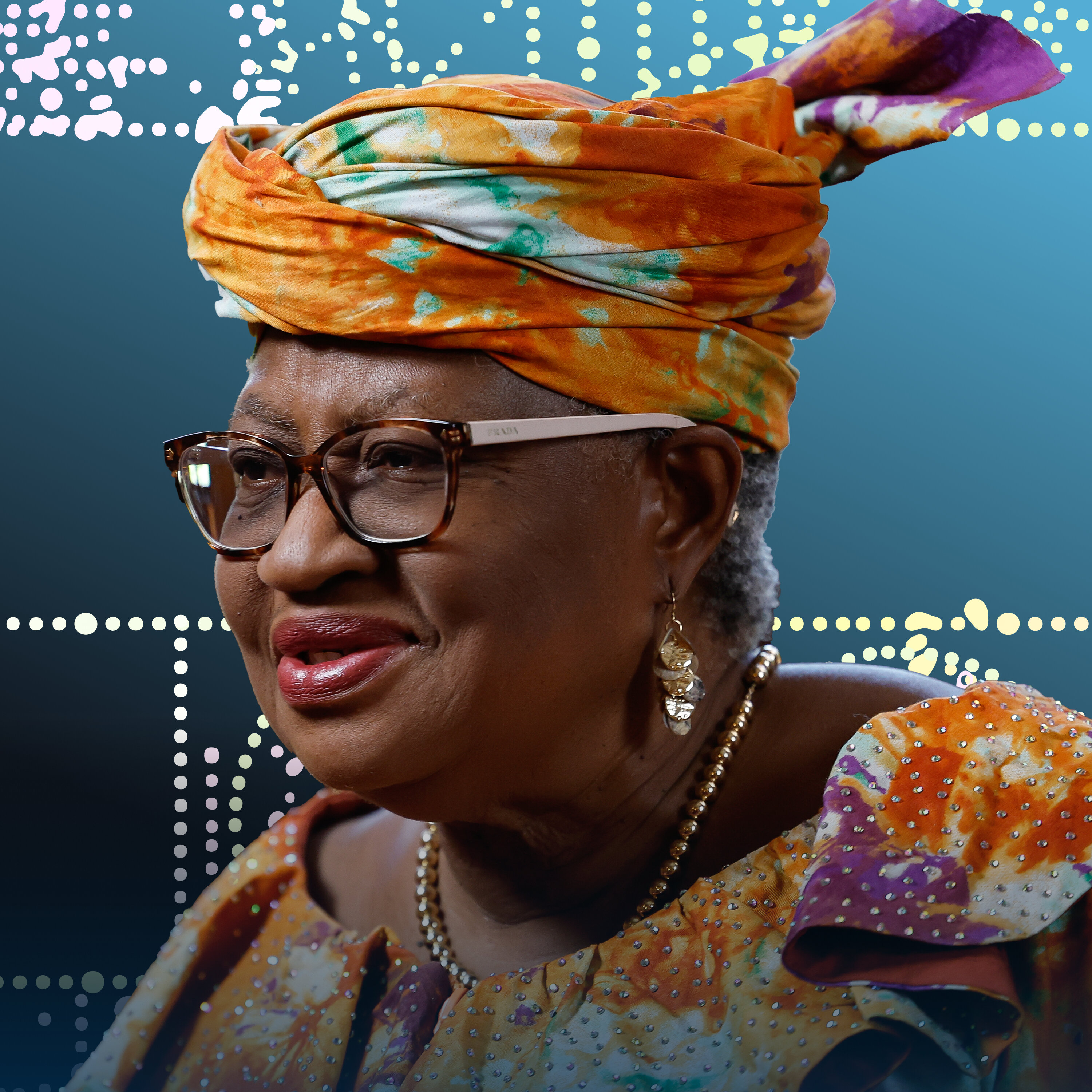
Ngozi Okonjo-Iweala on Leading the WTO Through a New Era of Tariffs
Montag, 12. Oktober 2026 · 21 min
Kapitelklicken springt direkt hin
Shownotes
Ngozi Okonjo-Iweala spent her early career fighting corruption, at great personal cost. Today, she leads the World Trade Organization at a time of unprecedented disruption. On this episode of Leaders, she speaks with Francine Lacqua about her work in Nigeria and how it led to her mother's abduction, how the US trade war and geopolitics are putting tremendous strain on global trade and why it’s time to re-imagine globalization.
Watch the interview
Bloomberg: bloomberg.com/btv/series/leaders-with-lacqua
Youtube: youtube.com/watch?v=bPSeumz6sgI
See omnystudio.com/listener for privacy information.
Transkriptvom Podcast bereitgestellt · Zeitmarken springen hin
Bloomberg Audio Studios, podcasts, radio, news.
The 1st of April, 2025, Liberation Day is etched in a lot of people's minds. I mean, as head of the WTO, what was your first reaction?
I felt we had to not get overexcited, wait for the announcements to roll out, wait to see how the implementation would work. Because if you react too quickly, then you might make mistakes.
Hi, everyone. I'm Francine Lacroix, and this is Leaders, a podcast that explores what drives the world's most influential people. And listeners, let me tell you, it's good to be back. We're hard at work on season two of the podcast with a really great lineup of guests joining us to talk about what it takes to lead in today's changing world.
But before we get to the new season, we'll also be bringing you podcast editions of Leaders with Francine Lacroix from the Bloomberg Originals TV series. So we're starting with my guest this week, Ngozi Okonjo-Awella, Director General of the World Trade Organization. The WTO was created back in 1995 to really provide a common set of rules for global trade so that it isn't simply the biggest economies calling the shots. It's 166 members that negotiate those rules together and have a system for settling disputes. And the stakes, let's face it, are enormous. because trade shapes jobs, growth, and living standards around the world, especially in developing economies.
Few people understand those stakes better than Okonjo-Wala, because before taking over the WTO, she spent decades at the World Bank and served twice as Nigeria's finance minister. She's built a career navigating institutions where the interests are enormous, the politics are difficult, and consensus is rarely easy. In this conversation, we talked about the responsibility of leading the global trade system, but also the challenge of preventing Trump's tariffs from triggering a wider trade war, and the personal values that carried Ngozi through confronting corruption in Nigeria, even when the consequences reached her own family. Ngozi Okonjo-Iweala, welcome to Leaders. Let's start with what may seem like a simple question. How
would you explain trade?
Ngozi Okonjo-Iweala Everyone trades without really realizing they're doing that. But when people go to the store and they find things on the shelves, they never think about how did it get there? How can I trust that what I see, this t-shirt, this good that I'm buying, whatever it is, meets the right standards and quality. When a business person from one country sends goods to another, they know that they face fair competition. Because another business selling the same goods will meet the same rules. This type of trade takes place because there are rules that govern the trade.
And most people don't know that those rules exist. That's why I call it the plumbing in your house. You know, it's there. You never think about it until the pipe breaks.
It feels like one of the pipes is broken. I don't know if everybody's gotten a fair deal. How many countries come to you and say, look, this needs to change?
Right now, Francine, this is an unprecedented time for global trade because we are seeing disruptions to trade. And as you say, emerging fragmentation in a way we've not seen since really 80 years, since the 1930s. And we have to admit that global trade is under tremendous stress. And that is because many members of the WTO are beginning to feel that the rules no longer work for them.
the same way that they used to work in the past. So the dissatisfaction is leading to unilateral behavior on the part of some, meaning that they're deciding, okay, this doesn't work for us. We're going to try bilateral arrangements. By others, it's leading to a lot of complaints.
Do countries like the U.S. forget how much they've benefited in the past with free trade?
Well, you know, the human nature and the nature of countries is that When members or countries feel the pain, many don't remember the benefits. But I just want to tell you this. Both rich countries and poorer countries have benefited, maybe not to the same extent. You take the African continent, whose share of global trade remains at around 3%, has stagnated around that number for a couple of decades now.
They've not benefited as much. But that doesn't mean they can't. What we need to do is say, what doesn't work? How can we change it so that those who are not benefiting can benefit more?
Is it each to their own? And is this really a breakdown of all rules?
No, it's not a breakdown. Almost three quarters of world trade, believe it or not, is still going on on our terms, which means that the core of the rules is seen as solid and beneficial. So you need to ask, what do we do with, say, the 25% that is not going on according to WTO rules? So you need to say, what works? And make sure you safeguard that. You know, when we have problems in the world, we tend to forget what works and go after what doesn't. So let's safeguard what works, which is three quarters. Then we say, what doesn't work? Well, let me talk about some of these things. One is the developing countries, for instance, feel that they need the rules to allow them more space to develop countries. to manufacture, to add value to their
products so they can sell more. And that will integrate them better into world trade. And there's some truth to that. So we need to look at our rules and say, what can we do better to allow developing countries to benefit? The second, many developed and developing countries feel that there's some unfairness in the system, that members are not being as transparent in their policies as they used to be.
They're supposed to notify to us at the WTO the core of the principles of the system is non-discrimination, most favored nation is non-discriminatory treatment of each other. It is fairness and transparency. And when members don't declare what they're doing transparently so that others will know, it undermines trust.
So many members feel this is no longer working as well.
Are the biggest problems with the system really about the U.S.
And China?
And actually, if you could get those two more aligned, would that solve much of the rest?
It's not just U.S. and China. I think making it a U.S. and China problem, I think, is not recognizing that many emerging markets and poorer developing countries also have problems with the system. No, so it's beyond that.
Is there a danger that reform just takes too long, that members are frustrated because it just takes a long timeline to put them in place?
Well, you know, it's up to members. The WTA is a very interesting organization. Members pride themselves on saying it is member-driven. They are the ones who push things, who make the rules, who decide what to do, who agree on what to change. So if they are frustrated, they need to act faster. All that I, as DG and the secretary, can do is support them, you know, and help them to say, look, you really need to focus on this and that. But they themselves have to move.
President Trump's Liberation Day tariffs represented a direct challenge to many of the assumptions that have underpinned global trade for decades.
April 2nd, 2025 will forever be remembered as the day American industry was reborn. Starting tomorrow, the United States will implement reciprocal tariffs on other nations.
For the WTO, the immediate danger wasn't simply the tariffs themselves. It was really what could follow if countries responded in kind. For the Director General... That meant trying to keep dialogue going at precisely the moment when governments had every incentive to dig in. So I asked her what those days were like from inside the WTO and how close the world came to a much more damaging tit-for-tat battle. Liberation Day is etched in a lot of people's minds. I mean, as head of the WTO, what was your first reaction?
Who did you call first?
I actually didn't call anyone. I was anticipating. We knew it was coming. So my first reaction was exactly what I had said, I think, on a CNN broadcast to Richard Quest. Well, this is what I say. I say, Richard, we should all chill. Can we chill? Let's wait and see what actually is done. I felt we had to not get overexcited, wait for the announcements to roll out, wait to see how the implementation would work. Because if you react too quickly, then you might make mistakes. These are very consequential announcements. So you really need to absorb them to see what they mean, to see their impact.
And before you come out with, okay. So, but many of our members, of course, were looking at how does this impact me? And I was saying, let's take it calmly. Let's slow down a bit.
You were right, actually. It served you well, right? Just taking a step back and seeing what happens.
And seeing what happens. And in some cases, some of those tariffs were, you know, later on, the reciprocal tariffs were revised down. And certain of them didn't have quite as an impact on others.
What I thought was extraordinary is that a lot of countries didn't retaliate.
Did not.
Did not retaliate.
That's what I mean, Francine. because the initial reaction when you see that is retaliate. Like in the 1930s, where we had... Fight back. Fight back, yeah. And the Smoot-Hawley Act of the U.S. came in. There was a tit-for-tat where countries felt immediately, oh, they did this, we have to retaliate. But at that time, that was why I said, chill, tit for tat will not be good for the world.
What did you learn in 2025?
What I learned in 2025 were two things. Gratitude to WTO members because they didn't do the tit for tat that would have taken the world down in the way that would not have been good. I was very appreciative of them for that. I think the second thing I learned is the resilience of world trade. You know, supply chains reconfigured. They found ways to deal with the tariff issues.
Trade continued to follow global rules for the most part. And I think that resilience at every turn. Remember, each time we've had crisis as well, trade has been very resilient. We had the COVID-19 crisis where supply chains had a lot of problems. You remember?
Yes.
They were very vulnerable. But what happened? They reconfigured. And we were able to get goods. including vaccines and other medical goods from countries where they were made to those that didn't have them. Eventually, trade played its role. We had the Ukraine crisis with the Black Sea and the shortage in grains and fertilizer. What happened? We had reconfiguration of supply chains and trade played its role also. Countries that couldn't get wheat from the Black Sea, like Ethiopia, for instance, they were able to get more from the U.S.
from other places. Trade played its role. And then now we have the home use crisis, which is hitting the world very hard. You're beginning to see supply chains also try to find ways to reconfigure. So the lesson I've learned is the resilience of trade.
Still to come, the values that shaped the Director General's leadership and what kept her going when the consequences of taking a stand became deeply personal. As Nigeria's finance minister, the director general pursued reforms aimed at tackling corruption and increasing transparency. And in 2012, that fight became intensely personal when her mother was kidnapped. I wanted to understand what carried her through that tragedy and what that experience taught her.
Would you say that your life's biggest fight was against corruption?
Probably, yes. Yes, I would say so.
Why?
If you look at what corruption does in diverting resources that should be benefiting education, health, agriculture, all the things that make life better in a developing country for poor people, helping to create jobs. If you see these monies that the state should be spending being diverted by corruption, then you feel that this is a real fight that has to be waged. If you are a country that is not that rich, Every single penny counts. Every naira, as they would say in Nigeria, would count. Every dollar counts.
That you have to stop from being taken by unscrupulous people so that it can be put into the development of the country. So that is what really the fight is about.
You've continued this fight at great personal risk.
It was great personal risk when I was working in my country as finance minister. When I was finance minister of my country, we noticed that large sums of money seemed to be being spent on a program that we had subsidizing gas at the pump to make it cheaper for people. Nigeria is an oil producing country, but we cannot refine everything that we consume. So we do bring in refined oil from outside. So importers would bring in and they would be paid the subsidies and they would sell it cheaper at the pump. And they put in claims for these subsidies. And we suddenly found that the amounts were just skyrocketing. It just didn't seem normal. So I went to the president and said, look, something is going on here. Could we audit the accounts? And he said, yes,
go ahead, which was very good. We had the president's backing. And we found about $ 2. 4 billion worth of fraud, fraudulent claims. Those who were saying we brought the oil in at this, but they didn't really. And so we refused to pay that amount of money. Can you imagine? 2.4 billion.
But he was brave. Yeah.
The president fully backed us to say we would not pay for that fraudulently invoiced amount. But that then led to threats to me. And then something that really astonished me is that my mother got kidnapped. It was a terrible, terrible five-day ordeal. I think the worst thing.
In my life.
You know, when you feel that what you're doing might lead to the death of your own parent, that is not a situation that anyone ever wants to be in. But yeah, so it's even painful every time I think about it and what happened. I feel very emotional. She was held in the middle of a forest. And one night she found that her kidnappers had left her alone and As dawn was coming, she escaped. She's still alive.
She's 96 now. You can't talk about, if you mention it, she just starts shaking immediately. But it was terrible, a terrible ordeal.
I mean, I can't believe what you went through. Did you ever think of quitting?
Yeah. I mean, between my mother, having my mother alive and staying in a job, I will pick my mother any day. But it was my father who said, no, you're not going to give in. You're going to carry on doing your work. You're going to go to cabinet meeting. You know, meetings used to be first part televised in those days. And he said, you've got to go. I said, I can't do it. I was so paralyzed by fear.
And what I was going to do is give in and get out to get my mother back. I don't think anybody would think differently. But my father had a highly different opinion. And he said, we don't give in to blackmail. We don't. And he said, you've got to carry on. You've got to go to work. I never dreamt my parents could ever be touched in this way, that people would be that evil. So the enormous guilt, even till today, I still feel a bit of it.
I think I take things more in stride these days. Age also helps. By the time you get older, I love being older, you've had so many experiences in life that really help you be, in my case, become a much stronger, wiser, more patient person. My mind always goes to what is the solution and where the next opportunity?
I think it just comes out of so many difficult experiences.
You're also very principled. In your book, you talk about a time where you go to an airport and you show an African passport instead of a Nigerian one. And you had both with you, but you slept at the airport all night to make sure that actually the African one was recognized.
You know, the African Union was beginning to issue these Africa passports where you're supposed to be able to enter another African country without a visa. And this is supposed to make movement easier so we can be better integrated as a continent and trade better with each other. You know, so I arrived at an African country with this passport and they said they would not, they didn't recognize the African passport. And they said they wouldn't let me in.
And I said, but this is something agreed by the African Union and you have to. And they said, well, the officials there said they are not used to this passport. So I said, OK, I'm not, I'm going to stay here. We can't have a situation in which the continent says we can use this. without a visa. And then I arrive and you say you don't even recognize it. So on principle, I stayed at the airport all night until morning.
We sat in the place. They couldn't believe it. I refused to leave. I had my Nigerian passport with a visa, which would have gotten me in. But I preferred to wait. And in the morning when they came in, they eventually gave the green light. If we don't stand up for the things we are doing, then who will?
But DG, the world is changing. What do you say to people that say you're idealist?
I don't mind being idealist. The world is changing, but should it change around the basic principles of what makes people human? That's the question. And my answer is no. If you abandon principles, if you have no moral anchor, then when you have change in AI and so on, you won't even know ethically How should I deploy these new tools so that it can serve humanity better? You wouldn't know because you have no anchor yourself. So no, we should never abandon what makes us decent human beings.
Don't spend so much time dwelling on what doesn't work. That really irritates and frustrates me. If it is within my power, I will work at it. If it is not within my power, then I admit it's not within my power. Go for something else that is within my power to try and change. And that's the way you can make the world work. In this uncertain time, that's what I urge. Dr.
Ngozi, thank you so much.
Thank you.
Thanks for listening to the podcast edition of Leaders with Francine Lacroix, the TV series. Check out the full episode, which features explainers and extra footage at Bloomberg.com slash Leaders with Francine Lacroix or on YouTube. Links are in the show notes. The episode was hosted by me, Francine Lacroix.
The podcast version was produced by Samer Saadi and Moses Andam. Amy Keene is the executive producer of Talk Podcasts. Sound design by Blake Maples. And special thanks to Ngozi Okonjo-Iweala.
