

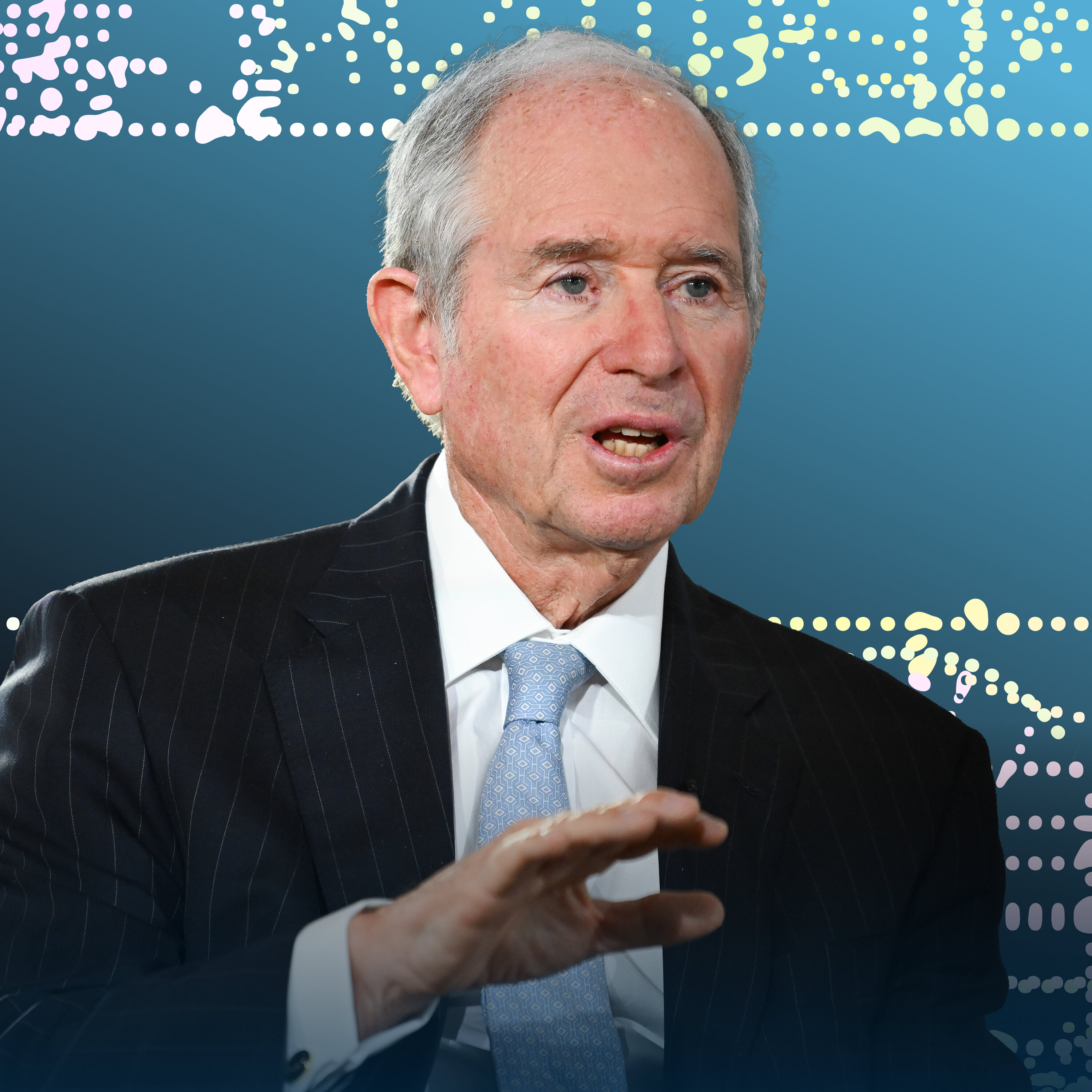
The Man Who Built Blackstone Into a $1.3 Trillion Empire
Dienstag, 27. Oktober 2026 · 22 min
Kapitelklicken springt direkt hin
Shownotes
As chief executive of Blackstone, Stephen Schwarzman helped transform modern finance by moving private equity into the mainstream. The company is now the world’s largest alternative asset manager with a portfolio worth $1.3 trillion. On this episode of Leaders, he speaks with Francine Lacqua about spotting economic shifts before they show up in public data, investing early in artificial intelligence and where the world is heading next.
Watch the interview
Bloomberg: bloomberg.com/btv/series/leaders-with-lacqua
Youtube: youtube.com/watch?v=zaeHzTS6Pck&t=500s
See omnystudio.com/listener for privacy information.
Transkriptvom Podcast bereitgestellt · Zeitmarken springen hin
Bloomberg Audio Studios.
Podcasts. Radio.
News. I mean, the biggest risk I took retrospectively was starting Blackstone because I didn't understand at the time that what we conceptualized had never been done.
I'm Francie Lacroix, and this is Leaders, the podcast that explores what drives the world's most influential people. This week, another piece from my Bloomberg Originals TV series, Leaders with Francine Lacroix. My guest is Stephen Schwartzman, co-founder of Blackstone, the world's largest alternative asset manager. Today, Blackstone manages around $ 1. 3 trillion across businesses, including private equity, real estate and credit, giving Schwartzman a view across markets few others can claim.
We had this chat back in June, and what interested me most in this conversation is really how he makes decisions when he knows he doesn't have all of the answers.
They think it's a one-person game. They think that leaders don't need other people's inputs. That's completely wrong. What I do throughout my life is pick pieces. of other people's style and intellectual approach.
We talk about how he spots opportunities others miss, why he believes leadership has to be learned, how he approaches succession, and why making a bold bet is very different from taking a reckless risk. And if you haven't heard it yet, check out my conversation with Blackstone Chief Operating Officer John Gray from our first season of The Leaders Podcast. Steve, thank you so much for joining us.
It's great to be here.
Steve, Blackstone sits on hundreds of thousands of data points. How does that inform your decision on what to invest in next? How does it inform your thinking about the world economy and how that will change in five, ten years?
Well, part of the reason why I love working at Blackstone is that you get all of this unique information on a continual basis. So when we started the business, I was always interested in having contemporary feedback knowledge. If you give me enough information, I can see something in that pattern that doesn't make sense. Most people, when they're presented with something that doesn't make sense, they try to pay no attention to it because it interrupts their understanding of the world. I just focus on that piece of information.
It's a keystone to tell you where the world's going to shift. You can usually figure it out with one piece of information a third of the time. If you get another discordant piece of information, you can do it two thirds of the time. And by the time you get three of them, you can just nail it. And that is a way of detecting paradigm shifts that give you amazing advantage over the rest of the world.
So what are you seeing now? that others are not seeing.
We did see the whole AI revolution.
And that's just because of an accident when I was in China in 2015, sitting on a bus with Jack Ma, who is the founder of Alibaba.
And he started talking about that.
And I literally had no idea what.
He was talking about.
And he explained that this would be the most consequential technological change which would change the world. So I have a bunch of academic relationships, one of whom was the head of MIT. And he said, Jack's underselling this. So I said, how do you know? He said, because we invented AI at MIT. And we positioned the firm at Blackstone in this unique way where we bought a very large data center, a company, in 2021 for $ 10 billion.
It's now 15 times larger. We're the largest owner of data centers in the world. That puts us in touch with the six hyperscalers, because we work for all of them, so we know what's happening sort of almost everywhere in this ecosystem. One piece of information that I didn't know in 2015 has opened up the most exciting thing that's going on economically and also in terms of its impact on society.
Stephen, do you think that's luck that you found out? Or is it that, you know, was it a skill to then be able to use it and dig deeper?
I think part is sort of the network you have in Blackstone. We have a system where we learn information every week from every one of our businesses. Part of it is having the curiosity. Because those pieces that don't fit tell you the future. And the future is always key to having a successful present.
So what doesn't fit now?
Well, you don't get these things every day.
And we're playing out. things we've seen.
So for example, during this AI data center thing, we learned that certainly the developed world is going to be short electricity. And once we learned that, we then realized we were already positioned with some electricity things, but we need to dramatically expand this. And now we've become huge investors in that area before other people didn't. So I'm very patient in terms of learning what the next thing will be. You can't force these things. They just, they're out there and you see them. Now, one of those is, are we really going to have space developed the way people think?
Do you think we will?
I don't know. I just don't know enough yet. But I know I have to be thinking about it. And that leads me to areas... that I wasn't thinking about before.
Are you sure that these valuations in AI will come to fruition, actually? Or is there a danger that we're spending too much money and actually real-time application will come much later and it will have to be at a much cheaper price?
We're in the early innings of this. There's so much capital infrastructure that needs to be built and then The new products, they'll all come and they'll create a lot of prosperity. In the interim, you'll have different stages of economic return. If you just looked at the return in the first few years, it wouldn't make any sense. But in the longer term, we know that it did, although the people who invest the money at the beginning, some will make it to the end and some won't.
After the break, why Schwarzman believes leadership isn't innate and why choosing a successor is only the beginning of the job. I've heard from a lot of business leaders that Blackstone got succession unusually right, laying out its succession plan without the ego clashes and instability that so often come with it.
John Gray was elevated to president and chief operating officer of the private equity firm in 2018 and has long been seen as Schwarzman's eventual successor. So I wanted to know what Schwarzman thinks made it work and why he believes succession is really about developing a leader, not just choosing one. Steve, I hear this over and over, actually, in your world, that Blackstone, and you specifically, have gotten a right on succession.
Why?
Have you started thinking about it earlier than everyone else in your industry?
I always knew that I'm just a person and anything could happen to me.
I also needed help. building the business. I got to the point around 2000.
Where I just couldn't work any harder to do anymore. And I needed, you know, a partner to help build the business. And I found Tony James, who's a terrific guy. And he was there until 2018. And then Tony wanted to retire. John Gray was on our management committee. And John is absolutely amazing.
I mean, he is.
Just astonishing as a talent. And so Tony and I said, well, John's the obvious guy. And then we spent two years training him before we announced that to anyone. Because part of the art of learning how to run a company is it's an acquired skill.
This is not innate.
What do you mean?
It's just how you deal with people, how you understand the right time frame to resolve internal problems. At the same time, there are all kinds of external threats that you have to a business. There are regulatory issues. There's dealing with the public. There's dealing with the media. These are not native skills for most people. They may be good at one or two of those skills, but this is a whole range. So you really need to train people.
So this idea that other companies use of bake-offs between individuals really gets mixed outcomes.
But when you think about succession, is it about leaving your ego actually to one side, that someone could replace you eventually?
Well, John Gray will replace me. I'm very open about that. He's basically running most of the business now. I've been doing this for almost 41 years, and I want the company. To have at least a good run, as it had for the last 41 years. There is only one way that that happens, is you have to have somebody who can succeed you, who's got the gift, who's an A-plus person.
And that's your obligation to the organization.
Schwarzman has built a career on taking some very big bets. But he's adamant that doesn't mean being reckless. One of the clearest examples came in 2007 when Blackstone did a $ 39 billion real estate deal, then quickly sold off large parts of what it had bought to limit how much it had at risk before the market collapsed. I wanted to know how he works out which risks are worth taking and which ones aren't. Steve, you've been in this for such a long time. Is there a deal that you enjoyed putting together or thinking about more than others?
We've had. so many things in my life, my goodness.
First was surviving and creating a business. That was sort of a kick. In 2007, when prices were high, we knew they were high. We bought the largest real estate office complex in the world. It was a $ 39 billion deal. The largest deal that had been done before was like $ 10 billion.
So it was four times the size.
And I was so scared of this deal because prices were high. We concluded that we wanted to sell half of what we bought the day we bought the $ 39 billion. We sold it at big game and made the existing deal safer. We came back a week later and we said, I want to sell half of what we got left.
So we sold.
Another $ 10 billion at even higher prices. And so we got left with only $ 10 billion in the interim. Everybody who bought real estate, except one company, went busted.
Real estate collapsed.
People managing real estate funds basically were devastated.
And we made 2.2 times our money.
Do you like a challenge?
I love challenges and I don't like doing anything that's dangerous. I'm a very conservative person and I have a saying that there are no brave old people in finance. Because if you're brave, you might win once or twice, but you can't win forever.
Private equity has changed so much, really enormously. Is there something that makes you uneasy about some of the risk out there?
Risk is really created by high prices and over leverage. When I started at this, there were probably about 10 firms maybe doing private equity. It was very easy to be successful. Now there are thousands of companies, private equity. It's also much more developed. You have people who have in-depth knowledge of individual areas before everybody was just a generalist, which happens when things are small. We've learned now how to not just invest better, but run companies better. I mean, a firm like Blackstone, for example, we have 275 companies that with 750,000 employees and revenues somewhere around $ 275 billion.
I mean, this is not some boutique business. This is one of the largest companies, if you will.
In the world.
And we have specialists in all kinds of areas to run these businesses along with their management to be really terrific. I mean, we have average growth. This last year, around 10% on revenues. And this is a different scale. And we're doing things that are very significant size-wise. We have the intersection of different areas of the firm doing one way we differentiate ourselves. That's just the Blackstone piece is by using that scale, to do activities coordinating around the firm.
So it gives us, you know, unique things that we can do. For the industry itself, I think, you know, there's been a lot of money. When interest rates went up with COVID and inflation, it stopped companies often from growing as much. It really interfered with exiting. And so the returns increased. in that interim period from those funds will go down. On the other hand, the things that have been done afterwards, after that interest rate decline and after COVID, some of these deals are fantastic. And if you're in the right areas, for example, investing in some of these technology things or the energy themes, returns.
Are in the 30s.
Schwarzman grew up in the middle-class Philadelphia neighborhood of Huntington Valley, and from the age of 10, he worked in his father's shop. As a teenager, he tried to persuade his father to expand the business, only to discover that his father had a very different idea of what success looked like.
What did your dad's curtains and linen store actually teach you about running a business?
Well, it taught me I don't like waiting on customers, and I'm not much good at wrapping. But I did have a chance to watch people wander and how they made buying decisions. And, you know, the frustrating thing for me, it was a very successful store and I wanted my father to expand it. So when I was 14, I said, why don't we go national with the store? And my dad said, Steve, I don't want to do that.
And I said, why?
He said, well, they'll steal from the cash register if I'm not watching it. Then I said, okay, if you won't do that, let's just expand through the state. And he said, I don't want to do that. I said, well, we live in Philadelphia. Let's open units around Philadelphia. And he said, I don't want to do it.
I said, why not?
He said, because I'm happy just as I am. And I said, Dad. We can be really successful. And he said, Steve, I am really successful. I have a nice house in the suburbs. I have two cars. And I have enough money to send you to college with your brothers.
That's really all I aspire for.
And I learned I was different than my dad. But I also learned to respect his sense of a successful life.
But did you see that as a lack of ambition? Were you annoyed by your dad's lack of ambition?
Of course.
But he was a very smart person. One of the things I learned is you can't change people. And I realized something else would.
Make me happy.
What makes you happy? What did you think at the time made you happy?
Well, I love doing new things. I love building things. I love creating things. And.
I do that in all kinds of different areas, not just business.
Okay, rapid fire. Are you ready?
I'm always ready.
You're always ready. These are quick answers. What is the non-negotiable skill in the executives you hire?
They have to be nice. They have to be smart.
They have to believe that Blackstone is the mission to be the best in the world at whatever we try to do.
What is the one thing that a leader should never do?
Get angry at any person.
Why? Because the only reason you get angry at someone is they made a mistake. And the objective is to learn from that mistake. Not punish the person. They feel badly enough.
Your ride or die motto. Do you have like a favorite saying?
Don't lose money.
Who's the leader you've learned the most from?
There is no leader that I've learned the most from. What I do throughout my life is pick pieces of other people's style and intellectual approach. No one person has made that difference.
What is one thing that people misunderstand about leadership?
They think it's a one-man game, a one-person game. They think that leaders don't need other people's inputs. That's completely wrong.
The smartest risk you've ever taken, was it on a company or on a person?
I've taken a lot of risks on people. I didn't think they were risks. I mean, the biggest risk I took retrospectively was starting Blackstone. Because I didn't understand at the time that what we conceptualized had never been done.
Steve, you've always been a lifelong Republican, right? Is it different being a Republican today under President Trump than it has been in the past?
I think it's difficult being in any of these political parties today because there used to be some large center of the country.
And I'm part of that. I've never changed.
We should measure outcomes and do what's the best. We've gotten into a place now where people don't listen to each other. I think this is exceptionally unfortunate and challenges the country. And we need to get back to a balanced center. And that's what I believe in.
Steve Schwartzman, thank you so much for joining us. Thanks for listening to the podcast edition of Leaders with Francine Lacroix, the TV series. Check out the full episode, which features explainers and extra footage at Bloomberg.com slash Leaders with Francine Lacroix or on YouTube. Links are in the show notes. Now, the episode was hosted by me, Francine Lacroix. The podcast version was produced by Summer Saadi and Moses Andam. Amy Keene is the executive producer of Talk Podcasts. Sound design by Blake Maples and Kelly Geary. Special thanks to Steve Schwartzman.
