

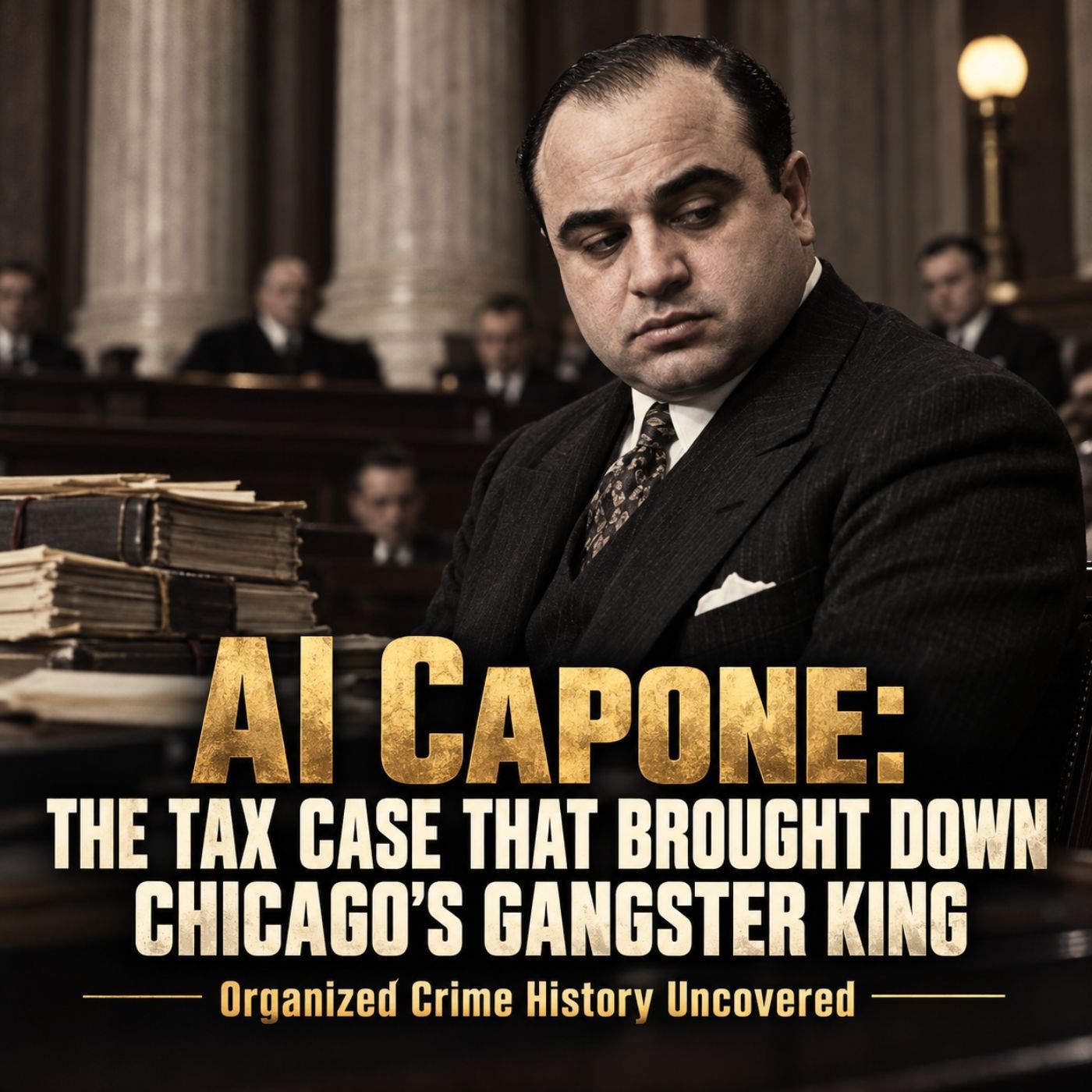
Organized Crime History Uncovered
Al Capone: The Tax Case That Brought Down Chicago’s Gangster King
Montag, 2. November 2026 · 24 min
Kapitelklicken springt direkt hin
Shownotes
On October 17, 1931, a federal jury in Chicago returned guilty verdicts against Alphonse Capone on five income-tax counts. The surviving verdict, preserved by the National Archives, records a legal result built from financial inquiries, witness testimony, tax calculations, and a prosecution effort to connect income to Capone personally.
This episode follows the Bureau of Internal Revenue investigation from its 1930 financial leads through the 1931 indictments, trial, mixed verdict, sentencing, appeal, and imprisonment. It examines what witnesses Charles Arndt and Chester Bragg contributed, why the 1924 acquittal mattered, and how the government used a legal principle established in federal tax law: unlawful income could still be taxable.
The federal case did not decide every allegation attached to Capone in Prohibition-era Chicago. Its historical importance lies in what the jury did decide, count by count, and in the institutional effort required to turn scattered financial evidence into a conviction.
This podcast uses artificial intelligence in its research, writing, production, and narration. Episodes are editorially reviewed before publication.
#OrganizedCrimeHistoryUncovered #OrganizedCrime #CriminalOrganization #Investigation #CourtRecords
YES OR NO: Did the 1931 verdict prove the government met its burden against Capone??????
Thanks for listening to Organized Crime History Uncovered. Follow the show on Spotify or your podcast app, leave a rating or review, and share this episode. Find more from FKN Pods at FKNPODS.COM.
Transkriptvom Podcast bereitgestellt · Zeitmarken springen hin
On Saturday, October 17, 1931, clerks in the United States District Court in Chicago recorded a jury's decisions in the consolidated criminal cases against Alphonse Capone. The document survives in the National Archives at Chicago in Record Group 21, the records of United States District Courts. It is not a newspaper reconstruction or a later memoir. It is the verdict form in United States of America versus Alphonse Capone, also known in the file under several aliases. On five counts, the jury marked guilty. On another charge involving the year 1924, it marked not guilty. That piece of paper is the opening object for this story because it captures both the force and the limits of the prosecution. The federal government
had secured convictions, but not on every allegation placed before the court. The jury had made distinctions year by year and count by count. Capone had become one of the most conspicuous figures in Prohibition-era Chicago. Newspapers, police officials, civic reformers, federal investigators, rivals, and residents associated his name with illicit liquor, gambling, prostitution, intimidation, political influence, and violence. Those subjects belonged to the larger history of Chicago's illicit markets. They were not all adjudicated in the income tax trial. The question in the federal courtroom was more exact. Had the government proved, on the particular counts submitted, that Capone willfully failed to pay federal
income taxes due on income the prosecution attributed to him? The legal theory was not improvised for Capone. Federal income tax law applied to income without granting an exemption because a source was unlawful. In United States v. Sullivan, decided by the Supreme Court in 1927, the court held that gains from illegal activity were subject to federal income tax.
That rule did not permit the government simply to label someone a criminal and calculate a tax bill. Prosecutors still had to prove receipt of income, its attribution to the defendant, tax liability, and willfulness beyond a reasonable doubt. That burden made the Capone investigation a sustained institutional project rather than a simple search for a dramatic document. The organization commonly associated with Capone is often called the Chicago Outfit. The term is useful as a broad later label for networks and associates connected to Chicago's illicit markets, but it should not suggest a formally documented corporation with one permanent chart of offices and reporting lines. The surviving record shows shifting associations, businesses, intermediaries, rivalries,
and law enforcement descriptions. It does establish that federal agents focused on Capone as a central figure in a network they believe generated substantial unreported income. The Bureau of Internal Revenue, the predecessor institution to today's Internal Revenue Service, supplied the investigative machinery. Federal prosecutors brought the case in the United States District Court for the Northern District of Illinois. Judge James H. Wilkerson presided. George E.Q. Johnson, the United States Attorney, led the prosecution. Their challenge was practical as well as legal.
Capone's apparent wealth had been publicly discussed for years, but public visibility did not identify taxable receipts or prove that he had personally received them. The National Archives account of the case says that, despite apparent wealth, Capone had not filed tax returns or purchased assets in his own name.
That made ordinary personal financial records less available. It did not relieve investigators of the need to show where the money came from and why Capone was legally responsible for the unpaid taxes. The documentary trail begins well before the verdict. Frank J. Wilson, a special agent in the Bureau of Internal Revenue's Intelligence Unit, later prepared a report dated December 21, 1933, describing the investigation. Wilson said the inquiry ran from May 23, 1930 through October 30, 1931, and involved work in Chicago, Kansas, Missouri, Florida, New York, Washington, and other locations. That report is valuable evidence of the government's investigation, but it is not a substitute for the underlying court files. Wilson was describing his
agency's work after the fact and from an investigator's perspective. His account must be separated from a jury finding, a guilty plea, or a conviction in another case. The early work followed financial and tax leads. Government records examined whether Capone had filed returns and whether money from businesses linked by investigators to his circle could be tied to him.
In a September 20, 1930 letter cited in Wilson's later report, an official named Mattingly discussed evidence relating to the 1929 tax year. Wilson's report later characterized that letter, together with another document, as especially important to the government's assessment of income. On March 27, 1931, Wilson wrote the intelligence unit chief in Washington with an update on what the files called the Capone investigation. Another update followed on April 8th. These letters show an inquiry in motion. Agents were still gathering material, seeking witnesses, evaluating tax years, and reporting upward within the Bureau of Internal Revenue. The records also show why an investigation of unreported cash income could become difficult. Witnesses might
be beyond the district, records could be fragmentary, and individuals connected to suspected enterprises had reasons to resist subpoenas or limit what they said. A difficult search for a witness is evidence of investigative effort. It is not proof that every person sought had committed an offense. Wilson's report listed several people whom he described as associated with Capone's organization, including Jack Guzik, Sam Guzik, Frank Nitti, Terrence Druggan, Frank A. Lake, and Louis Lipschultz. The report says that evidence secured in the inquiry resulted in convictions or guilty pleas involving some of those men and an indictment of Lipschultz. The report does not provide a reliable count-by-count account of every charge, plea, verdict,
or sentence for each named person. Without the underlying indictments, docket entries, plea records, and judgments for their separate cases, the specific legal outcomes should not be repeated as a collective claim. What can safely be said is that Wilson portrayed those matters as connected investigative developments. They did not establish Capone's guilt by association, and they were not a replacement for proof in his own case. By the spring of 1931, the federal inquiry had reached the charging stage.
A separate charge concerned tax liability for 1924. Then, in June 1931, a federal grand jury returned a 22-count indictment covering later tax years. An indictment is an accusation, not proof. It signaled that prosecutors believed they had evidence sufficient to bring the accusations before a court. The 22-count indictment focused on the years 1925 through 1929. The structure mattered. Prosecutors were not asking jurors for a general verdict on Capone's public reputation. They were presenting specified tax allegations tied to particular years. One path into that evidence ran through gambling records.
The National Archives account of the case says that the Internal Revenue Service's Special Intelligence Unit uncovered cash receipts from a gambling operation linked to Capone and that the receipts became a foundation for the federal case. That wording should remain attributed. The archival summary describes the prosecution's evidence and theory.
It does not independently establish complete ownership of every gambling operation or the total income of every associated business. The prosecution's position was that gambling receipts, related financial evidence, and testimony supported an inference that taxable income reached Capone. The defense could challenge every part of that chain, whether the operation was connected to him, whether the receipts represented profit rather than gross intake, whether income reached him personally, and whether the government's tax calculations were reliable. A second evidentiary path came from tax records themselves. At trial, Charles Arndt, a Bureau of Internal Revenue official in Illinois, testified from
government records that Capone had filed no income tax returns for the years 1924 through 1929. The account of his testimony appears in contemporary trial reporting and later historical reconstruction, including the Mob Museum's review of the proceedings. Arndt's testimony was concrete, but its limits were equally concrete. It could establish non-filing through the government's records. It did not alone prove the amount of income for any year. A taxpayer who filed nothing might have had taxable income, no taxable income, or income that the government could not adequately attribute. The prosecution needed more. That is why the Cicero testimony became relevant.
Cicero lay immediately west of Chicago and had become a focal point for public concern about gambling, illicit liquor, municipal politics, and enforcement failures during the 1920s. Historical scholarship and contemporary reporting document recurrent public allegations that local government and policing were vulnerable to criminal influence. Those allegations should not be transformed into a blanket finding that every official was corrupt or that Capone controlled every institution in the suburb. One documented civic confrontation took place at the Hawthorne Smoke Shop, a gambling establishment in Cicero. Chester Bragg testified about it in Capone's trial. Bragg was not introduced as an expert
on the entire structure of Chicago organized crime. He was a Cicero resident and civic participant who described what he had personally seen during a 1925 effort by local residents to close gambling establishments. According to reporting on the testimony, Bragg said that he and other citizens had acted to make the western suburbs fit places in which to live and raise children. Bragg testified that he stood at the door of the Hawthorne Smoke Shop to discourage customers. He described Capone arriving and attempting to enter. In Bragg's account, Capone confronted him with the question, What the hell do you think this is? A party? Bragg said he allowed him inside and then heard him confront a local pastor
involved in the action. The moment gave prosecutors something more particular than a general report of Capone's notoriety. Bragg placed Capone at a specific site during a documented civic conflict. His testimony helped the government's effort to connect Capone to a location that prosecutors associated with gambling income. But Bragg could not establish by that testimony alone how much money the establishment earned, whether all receipts belonged to Capone or the complete structure of every business connected to people around him.
His evidence was a link in the prosecution's chain, not the entire chain. This is where the human stakes enter the record without requiring myth-making. Bragg's testimony shows residents acting publicly against a gambling establishment in their community. It reflects concern about the conditions in which families, workers, churches, and local civic institutions had to operate. The trial did not calculate the full social damage caused by illegal markets. It did preserve an example of residents attempting to challenge them. A.D.
Brake The trial opened in Chicago on October 6, 1931. The proceedings drew heavy attention. Crowds gathered around the federal building, reporters followed Capone's movements, and the case had become national news. Judge Wilkerson had reason to guard courtroom order. Public interest could not decide the counts. The government had to proceed through witnesses, documents, and tax calculations. Capone's attorneys, Michael J.
Ahern and Thomas D. Nash, had the opportunity to test the prosecution's evidence and argue that its conclusions went beyond what the records established. The prosecution's case did not rest on a claim that every dollar associated with a suspected enterprise had been traced. Its task was narrower and more demanding in a legal sense. To persuade the jury that the government had proved the charged failures to pay taxes for the specific years before it. The government asserted that Capone owed more than $ 200, 000 in unpaid taxes connected to gambling profits. That figure was part of the prosecution's tax position.
It should not be treated as a complete measure of Capone's personal wealth, the revenues of every business associated with him, or the economic harm imposed on Chicago. The concrete courtroom record includes at least two important moments. First, Arndt's testimony supplied official Bureau of Internal Revenue records showing non-filing from 1924 through 1929. Its provenance was the government's own tax administration files. It advanced the prosecution by establishing that Capone had not reported income during the period covered by the charges. Second, Bragg's account of the Hawthorne Smoke Shop supplied eyewitness testimony from a Cicero civic action in 1925. Its provenance was sworn trial testimony, later summarized in historical accounts of the trial.
It advanced the prosecution by placing Capone at an establishment the government connected to gambling activity and by supporting its broader effort to show a relationship between Capone and potential income-producing operations. Neither witness supplied a complete accounting. That gap explains why the prosecution relied on a cumulative case. Agency records, witnesses, financial material, tax computations, and arguments about personal receipt and control.
The defense centered on the weakness within that cumulative case. The government had evidence of cash enterprises and evidence that Capone had not filed returns. The defense could argue that neither proposition, separately or together, proved that Capone personally received taxable income in the amounts alleged. It could question whether the government had confused association with ownership, whether calculations rested on assumptions, and whether the evidence demonstrated willful evasion rather than an unproven financial theory. The mixed verdict demonstrates that those objections mattered. On October 17th, the jury acquitted Capone on the charge concerning tax liability for 1924. It also returned guilty verdicts on five counts involving the years 1925, 1926, 1927, 1928,
and 1929. The National Archives identifies the case file as Consolidated Criminal Cases 22852 and 23232. Its holdings include indictments, appearances, bench warrants, citations, dockets, motions, subpoenas, orders, a notice of appeal, a statement of proceedings, and the verdict. The verdict is the strongest available evidence for the result. Guilty on five tax counts, not guilty on the 1924 charge. The acquittal is not a minor footnote. It shows that the jury did not simply accept a broad story about Capone and return a universal judgment. It found that the evidence did not warrant conviction on the earlier charge while accepting the government's proof on five later counts. That result also requires
precise language about what was established. The jury found Capone guilty on five tax counts for 1925 through 1929. It did not make a finding that every dollar of income in each of those years had been proven, nor did it endorse a complete account of every alleged enterprise connected to Capone or his associates. The verdict was a legal finding on the submitted charges. It was not a census of Chicago's illicit economy. A week later, on October 24, 1931, Judge Wilkerson imposed sentences totaling 11 years on the five tax convictions. The sentence also included $ 50, 000 in fines and $ 30, 000 in court costs. The sentencing result is recorded in court file summaries and has been consistently reported in accounts drawing
on the federal case record. The sequence after sentencing is often compressed into a single sentence about prison. The record is more specific. After sentencing, Capone was held in Cook County custody while appellate proceedings continued. He then entered federal imprisonment, beginning service of the sentence in May 1932 at the United States Penitentiary in Atlanta. In August 1934, federal prison authorities transferred him from Atlanta to Alcatraz Federal Penitentiary in California.
The transfer to Alcatraz later became a central image in popular retellings. Yet the legal sequence began in Chicago. Conviction, sentencing, custody, federal imprisonment, and then transfer. Capone appealed his conviction to the United States Court of Appeals for the Seventh Circuit. In Capone v. United States, reported at 56 Federal Reporter, 2nd Series, 927, the Seventh Circuit affirmed the convictions on June 13, 1932. Capone then sought Supreme Court review. The Supreme Court denied certiorari on October 10, 1932, reported at 286 U.S. 565. Those actions matter because they replace the vague statement that an appeal somehow left the case unchanged.
The Seventh Circuit affirmed the judgment, and the Supreme Court declined to review it. The convictions and sentence therefore remained in force. The appellate record did not turn the underlying prosecution into proof of every public accusation attached to Capone. It upheld the legal judgment in the tax case. The evidentiary and legal question remained whether the government had properly established the offenses charged. The appellate disposition answered that question in the government's favor. A.D. Brake The Capone prosecution is often remembered as a tidy moral lesson. Federal investigators could not reach a notorious figure through the crimes most discussed in public, so they used taxes instead. The surviving record
tells a less tidy and more instructive story. Tax law gave the government a route into income that might otherwise remain hidden behind cash businesses, intermediaries, and incomplete public records. But that route demanded its own proof. Agents had to locate materials, identify taxable years, develop witnesses, calculate liability, prepare indictments, withstand defense challenges, and persuade a jury. Frank Wilson's later report conveys the breadth of that work. It references investigative activity in multiple states, information gathered from revenue agents, witnesses whom officials attempted to locate, and other cases involving people Wilson associated with Capone. The report is strongest when used
to show the scope and direction of the federal inquiry. It is weaker when treated as final proof of every assertion within it. For the same reason, broad claims about corruption need careful boundaries. Chicago and Cicero were places where contemporary observers, reformers, journalists and later historians documented substantial concern about political influence, gambling, illicit liquor, and failures of local enforcement.
In individual instances, records can show charges, testimony, public allegations, or official inquiries. Those sources do not justify claiming that every local officer was bought, that every election outcome was controlled, or that Capone's personal authority extended without limit. The case itself did not adjudicate those wider questions. Its importance is not reduced by that fact. It is sharpened. The jury found that the government had proved five tax offenses. The case provided a model of how a financial investigation could be used against someone whose public standing and cash-based associations made more conventional prosecutions difficult. It also exposed a limit of criminal law. One conviction, even a consequential one, could
punish a defendant without fully repairing the civic damage associated with years of illegal markets and weak institutions. For residents such as Chester Bragg, the Hawthorne Smoke Shop was not a backdrop for a gangster legend. It was a place they believed was harming their community. Bragg's testimony did not settle every question about Cicero, but it placed a local civic struggle inside a federal courtroom. For Bureau of Internal Revenue personnel, the case tested whether official records and reconstructed financial evidence could overcome the absence of conventional books in a cash-driven setting. Arndt's testimony established non-filing. Bragg's testimony supplied a personal connection to a gambling location. The prosecutor's calculations
attempted to turn those and other materials into tax liability. The defense attacked the link between operations, receipts, and Capone himself. The jury's divided result remains the clearest indicator that the process was not merely ceremonial. The 1924 charge failed. Five later counts succeeded. That distinction should govern the final historical judgment.
Capone's conviction did not adjudicate every murder, act of violence, bootlegging allegation, corruption claim, or business relationship connected in public memory to his name. Those subjects require their own records and, in some instances, remain incomplete or contested. The tax verdict established something more specific. The jury found him guilty on five income tax counts for the years 1925 through 1929.
The 11-year sentence removed Capone from ordinary freedom and placed him first in Cook County custody, then the federal prison system, and eventually Alcatraz. The appellate process confirmed that result. The Seventh Circuit affirmed on June 13, 1932, and the Supreme Court denied certiorari on October 10. The October 17 verdict form remains the best closing image because it has none of the theatrical qualities that later surrounded Capone's name. It is a court document marked with decisions reached under federal criminal procedure. Five guilty findings. One acquittal on the 1924 charge.
A sentence imposed one week later. An appeal affirmed. A petition for Supreme Court review denied. Those entries do not explain every part of Prohibition-era Chicago. They do show how federal investigators and prosecutors converted a long financial inquiry into a judgment that survived review. This has been Organized Crime History Uncovered.
