

Organized Crime History Uncovered
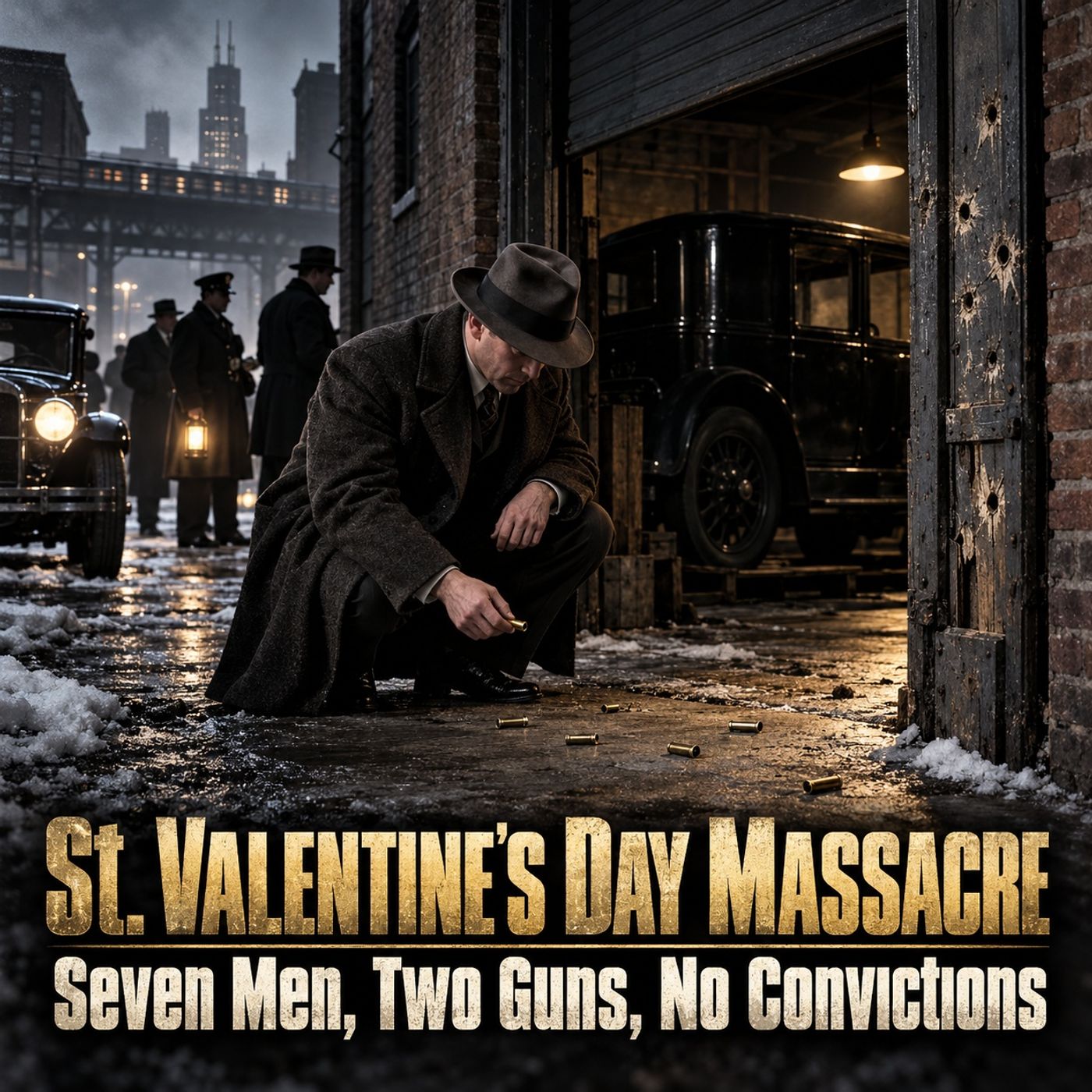
St. Valentine’s Day Massacre Seven Men, Two Guns, No Convictions
Freitag, 30. Oktober 2026 · 20 min
Kapitelklicken springt direkt hin
Shownotes
On February 14, 1929, seven men were shot and killed inside a garage on Chicago’s North Clark Street. The St. Valentine’s Day Massacre became one of the most infamous crimes of Prohibition-era America—and a case that never produced a conviction.This episode reconstructs the killings, the investigation, and the evidence that followed. We examine the victims’ connections to Bugs Moran’s North Side organization, the widespread suspicion surrounding Al Capone’s gang, and the ballistic comparisons that linked crime-scene evidence to two Thompson submachine guns later found in Michigan.But a weapon link could not identify who fired the guns—or who ordered the attack. Capone was never convicted of the massacre, and the full chain of responsibility remains unproven. Explore how contemporary reporting, the coroner’s inquest, physical evidence, and later theories shaped the story of Chicago’s most notorious unsolved gangland murder.
Thanks for listening to Organized Crime History Uncovered. Follow the show on Spotify or your podcast app, leave a rating or review, and share this episode. Find more from FKN Pods at FKNPODS.COM.
Transkriptvom Podcast bereitgestellt · Zeitmarken springen hin
Later in 1929, forensic specialist Dr. Calvin Goddard examined bullets and cartridge cases recovered after a mass shooting in Chicago. He compared their markings with two Thompson submachine guns recovered in Michigan. According to the surviving forensic and museum accounts, the comparison supported a link between those guns and evidence collected at 2122 North Clark Street. That was important. It was also incomplete. The comparison did not establish an unbroken chain of custody for the weapons before their recovery. It did not identify who fired them on February 14th. It did not identify who entered the garage, who selected the victims, or who may have authorized the attack. Before the guns became evidence, seven men had been shot in a Chicago
garage on Valentine's Day morning. Six died at the scene. Frank Gusenberg was taken for medical treatment and died later from his wounds. The dead were Peter Gusenberg, Frank Gusenberg, John May, Adam Heyer, Albert Weinshank, Albert Kachalek, also known as James Clark, and Reinhard Schwimmer. They were associated in different ways with George Bugs Moran's North Side organization. They were not all interchangeable figures in a gangland legend. John May was a mechanic. Reinhard Schwimmer was an optician who associated with the group. Other men were more directly identified in contemporary and later accounts with Moran's criminal organization. Their roles differed, but all seven became victims of a deliberate
attack in a commercial garage on Chicago's north side. The killing was soon called the St. Valentine's Day Massacre. It became a national symbol of Prohibition-era violence. The name endured because the crime was spectacular, because the number of dead was extraordinary, and because the case quickly attached itself to the most famous organized crime figure in Chicago, Al Capone.
But the historical record requires a slower account. The address was 2122 North Clark Street. The garage operated under the name SMC Cartage Company. It was connected to Moran's organization and used by men associated with that group. On the morning of February 14, 1929, at approximately 10.30, the building became the site of one of the most investigated killings of the Prohibition era. National Prohibition had begun in January 1920 under the 18th Amendment and the Volstead Act. The law prohibited the manufacture and sale of alcohol on a national scale, but it did not eliminate demand. Instead, it created opportunities for illegal suppliers, transporters, distributors, corrupt officials, and criminal organizations. Chicago contained competing groups rather than one unified underworld.
Bootlegging profits overlapped with gambling, labor rackets, theft, protection schemes, political influence, and legitimate businesses pulled into illegal markets. Corruption and uneven enforcement gave powerful criminal figures room to operate, but the city was not controlled by a single gang or a single ethnic organization. Moran led a major North Side group. Capone headed the rival organization most often associated with Chicago's South Side. Their conflict had already produced intimidation, shootings, and retaliatory violence. That rivalry supplied a possible motive for an attack against Moran's men. It did not, on its own, establish who planned the events on Clark Street. Moran was not among the dead. His absence became central to the
public understanding of the case. Many later histories concluded that he was the intended target and that the attack failed to reach him. That interpretation fits the broader rivalry and the selection of victims associated with his organization. The available records do not establish exactly why he was absent, whether the attackers expected him to arrive, or whether they had mistaken another man for him. The earliest reports also differed on important details. They varied on the number of attackers, the weapons used, and the precise sequence inside the garage.
Those differences do not erase the event. They show why later cinematic versions should not be treated as complete reconstructions. Contemporary reporting and the investigative records strongly support one central feature. The attackers appeared to use police authority as part of the operation. Witnesses and newspaper accounts described men posing as officers or dressed in a manner suggesting police uniforms. In the commonly reported reconstruction, the victims were lined up near a wall before the shooting. That staging appears in contemporary accounts and is consistent with the coroner investigation, but early reports did not agree on every detail of the lineup, the number of assailants, or the exact sequence of gunfire.
The broad outcome was clear. Seven men were fatally wounded in a concentrated attack. Six were found dead at the scene. Frank Gussenberg survived long enough to receive medical attention, then died later that day. Cook County police and coroner personnel confronted a crime scene that was both public and difficult to penetrate. The garage was at a known address. The violence had taken place in daylight. Yet the surviving record did not yield cooperative eyewitness testimony capable of identifying and prosecuting the attackers. Cook County Coroner Herman N. Bundeson presided over the official inquiry. A typed transcript of the coroner's inquest survives in the St. Valentine's Day Massacre Manuscript Collection
held by the Chicago History Museum. That surviving transcript provides a concrete procedural record. A formal Cook County inquiry was convened under Bundesen after the killings to establish the deaths and collect testimony connected to the crime. The inquest was not a criminal trial. It did not decide the guilt of a defendant. Its function was to determine the circumstances of death and preserve information that could guide further investigation.
The inquest's very structure reveals the limits investigators faced. It could document seven deaths, receive testimony, and preserve physical evidence. It could not compel a reliable identification where witnesses lacked knowledge, feared retaliation, withheld information, or gave accounts shaped by the confusion of a rapid attack. That was not an abstract problem in late 1920s Chicago. Men connected to criminal organizations could have reason to fear both rival gangs and official scrutiny.
Residents could distrust authorities in a city where political corruption had repeatedly weakened confidence in public institutions. None of that proves that every witness was threatened or that silence resulted from a coordinated conspiracy. It does help explain why a public mass killing produced so little courtroom-ready testimony. The coroner and police inquiry also preserved the fact that the victims were not simply anonymous casualties. The legal process recorded deaths that had immediate consequences for families, employers, associates, and neighborhoods.
The famous name later attached to the case can obscure that human reality. Contemporary newspapers rapidly turned the killings into a national story. A United Press report dated February 15, 1929, described fear spreading through Chicago's illegal alcohol trade after the attack. That report is useful evidence of immediate public reaction. It is not a final forensic reconstruction. Early reporting after a major crime often combines police statements, hurried witness information, rumor, and claims from people with their own interests. Names can be misspelled. Numbers can change. Motives can be assigned before investigators have established them. The press documented what Chicago and the country were being told in the first hours. It
did not settle the case. Still, one public attribution hardened quickly. Capone's organization became the presumed source of the attack. The explanation was understandable. Capone's group was Moran's principal rival. The victims were tied to Moran's side of Chicago's bootlegging conflict. The attack appeared coordinated and targeted. Capone was already widely known to newspapers and the public as a powerful criminal leader.
In that atmosphere, suspicion moved faster than evidence. The FBI's later historical summary describes the massacre as generally ascribed to Capone's organization. That wording matters. It records a strong historical attribution, not a court finding. Capone was in Florida on February 14th, according to that later FBI account. His location rules out placing him inside the Clark Street garage during the shooting.
It does not, by itself, prove or disprove whether he authorized anything from elsewhere. The legal status of the case is straightforward. Capone was never charged with these murders, and no person was prosecuted for them. Capone's later federal conviction must remain separate from the massacre. In 1931, he was convicted of federal tax evasion. That prosecution concerned tax offenses, not the seven deaths at the Chicago garage. It rested on different evidence, different conduct, and federal authority unrelated to a completed homicide case. The distinction is especially important because later retellings often turn the tax conviction into a symbolic answer for the massacre. It was not. The tax case
punished Capone for federal crimes. It did not identify the men who fired at North Clark Street or establish who organized the attack. The Federal Bureau of Investigation also occupies a complicated place in the story. The FBI vault contains files related to the massacre, and the Bureau later investigated Capone in connection with federal matters. The existence of those files does not mean the Bureau ran an authoritative homicide investigation in 1929 or solved the killings. At the time, federal jurisdiction did not cover ordinary gang murders in the way many modern audiences might assume. Local police and Cook County authorities bore primary responsibility for the homicide inquiry. Federal attention to Capone developed through matters such as contempt and
tax violations. A federal file can preserve leads, correspondence, and investigative interest without transforming a local unsolved murder into a solved federal case. The physical evidence offered investigators their strongest route beyond rumor. Bullets and cartridge cases were recovered after the shooting. Firearms examiners could compare microscopic marks left on bullets in cartridge cases with marks produced by test firing a suspected weapon. In the late 1920s, this work was an important development in forensic science. It offered a way to connect an object at a crime scene to a particular firearm. Soon after the killings, two Thompson guns recovered in Michigan became part of that inquiry. Goddard compared evidence
from the Chicago crime scene with those weapons. According to the Mob Museum's artifact record and later technical accounts of the examination, the results were reported to link bullets and cartridge cases from the massacre to the two Michigan guns. That finding narrowed the history of the weapons. It supported a connection between those guns and the shooting. It did not supply the missing human evidence. The surviving accounts do not independently establish a complete chain of custody for the guns before they were recovered. They do not identify every person who possessed them. They do not identify which individual fired each weapon during the attack. They do not establish who transported the weapons, who recruited the assailants, or who
gave an order. Those limitations are not minor technicalities. They define the remaining gap in the case. A gun can be moved, transferred, stolen, stored, or used by more than one person. A firearms comparison can tie the gun to a scene while leaving the identity of its user unresolved. The same evidence cannot, without additional testimony or documentation, establish command responsibility. The ballistic result was therefore meaningful but bounded.
It gave the investigation a weapons connection. It did not produce a prosecutable account of the people behind the trigger pulls or the decision-making behind the attack. Frank Gusenberg's final hours became part of the case's later mythology. Later accounts report that he was questioned before he died. The primary record of that exchange has not been established here, and the reported wording varies sharply among retellings. No quotation should be treated as fixed evidence. The cautious historical conclusion is narrower.
No surviving, reliable identification from Gusenberg led investigators to named attackers who could be brought to trial. As the original inquiry stalled, the case accumulated theories. Some accounts named individual gunmen connected to Chicago organizations. Others focused on criminal figures from outside the city. Still others relied on retrospective claims, letters, or statements offered long after the event. A later allegation has been cited in secondary discussions involving William Three-Fingered Jack White.
Such material can preserve a lead. It can identify a person investigators or later writers considered relevant. It cannot resolve the case without independent corroboration. A late claim requires scrutiny. The source must be identified. The timing matters. The person's access to first-hand knowledge matters. So do possible motives for self-promotion, revenge, fear, financial gain, or redirecting blame. The claim must also be measured against contemporary records, travel evidence, physical evidence, and testimony that can be independently checked. The theories surrounding the massacre do not carry equal evidentiary weight. The best supported interpretation remains that the attack targeted men associated with Moran's organization
and was connected to the conflict between Moran's group and Capone's organization. That interpretation rests on the established rivalry, the selected victims, the apparent use of police disguise, contemporary public suspicion, and the later weapons evidence. It remains an interpretation because the surviving evidence does not resolve the identities of every attacker, the full chain of command, or the exact intended target.
The motive also remains unsettled. Control of illegal alcohol markets is often cited. Retaliation is often cited. An effort to reach Moran is often cited. Each possibility fits the violent commercial conflict of the period. The available records do not allow one motive to be declared the final answer. The case had consequences beyond the garage. Contemporary coverage shows that the killings intensified public alarm about organized violence and the illicit alcohol economy. The February 15th United Press account described an exodus or fear among beer operators after the attack.
Later historical interpretations have treated the massacre as a moment that exposed the scale of criminal power and violence to a national audience. It is reasonable to infer that such an attack damaged faith in local order and law enforcement. The contemporary reaction supports that inference, but the effect should not be stated as a universally measured fact. Chicago residents did not all react alike, and public confidence cannot be reduced to one headline or one event. What can be said with certainty is that seven men were killed during a morning attack at a known Chicago address, and that the investigation did not produce a prosecution. That outcome became part of the city's wider reputation for corruption, criminal violence,
and institutional weakness during Prohibition. The garage itself later became part of the story's afterlife. The building stood for decades after the killings. In 1967, it was demolished. Bricks from the wall associated with the massacre were recovered, circulated through commercial ventures, and eventually became museum objects. 300 bricks are displayed at the Mob Museum in Las Vegas. Those bricks are real remnants of a real location. They also require careful interpretation. The Mob Museum notes that previous owners added paint to enhance some visible bullet holes. As a result, the displayed wall should not be treated as an untouched crime scene surface preserved exactly as investigators saw it in 1929.
It is both physical material from the former building and an artifact shaped by decades of collection, display, commerce, and public memory. That distinction mirrors the larger history of the massacre. The event has been retold in films, crime books, newspaper anniversary stories, museum exhibits, and popular culture. Repetition can make uncertain details sound settled. A reported police disguise becomes a fully scripted scene. A suspected target becomes a documented plan.
A weapon link becomes proof of an organizer. A famous public accusation becomes an established verdict. The records support a more precise account. Seven men associated to varying degrees with Moran's organization were shot on February 14, 1929. Six died at the garage, and Frank Gusenberg died later from his wounds.
Contemporary accounts strongly support that attackers used an appearance of police authority, although early reports differed on the number of men involved, the weapons, and the detailed staging. Cook County conducted an inquest under Coroner Herman N. Bundesen. The surviving transcript documents the official effort to establish the deaths and gather evidence. Police and coroner investigators recovered bullets and cartridge cases.
Later in 1929, Goddard's comparison was reported to connect that evidence with two Thompson guns recovered in Michigan. The public and press widely attached responsibility to Capone's organization. The FBI's later historical account describes that attribution while noting Capone's Florida presence on the day of the killings. The record did not yield a murder prosecution against Capone or anyone else.
That unresolved status is not a failure of historical attention. The case has received enormous attention. Its limitation lies in the evidence that survives and the evidence that never emerged. A bullet can retain marks from the firearm that discharged it. A cartridge case can preserve impressions from a weapon's mechanical parts.
Those marks can help establish a weapon's link. They cannot identify the hand that held the gun without further evidence. They cannot reveal the contents of a meeting, prove an instruction, or establish who stood at the top of a criminal chain of command. The St. Valentine's Day massacre matters because it shows both the power and the limits of investigation in the prohibition era. The crime itself is clear. The human loss is clear. The weapons evidence is significant. The public attribution to Capone's organization is historically powerful. The identities of all the gunmen, the precise plan inside the garage, and the person who may have authorized the attack remain unknown.
Capone's later tax conviction did not answer those questions. This has been organized crime history uncovered.
