

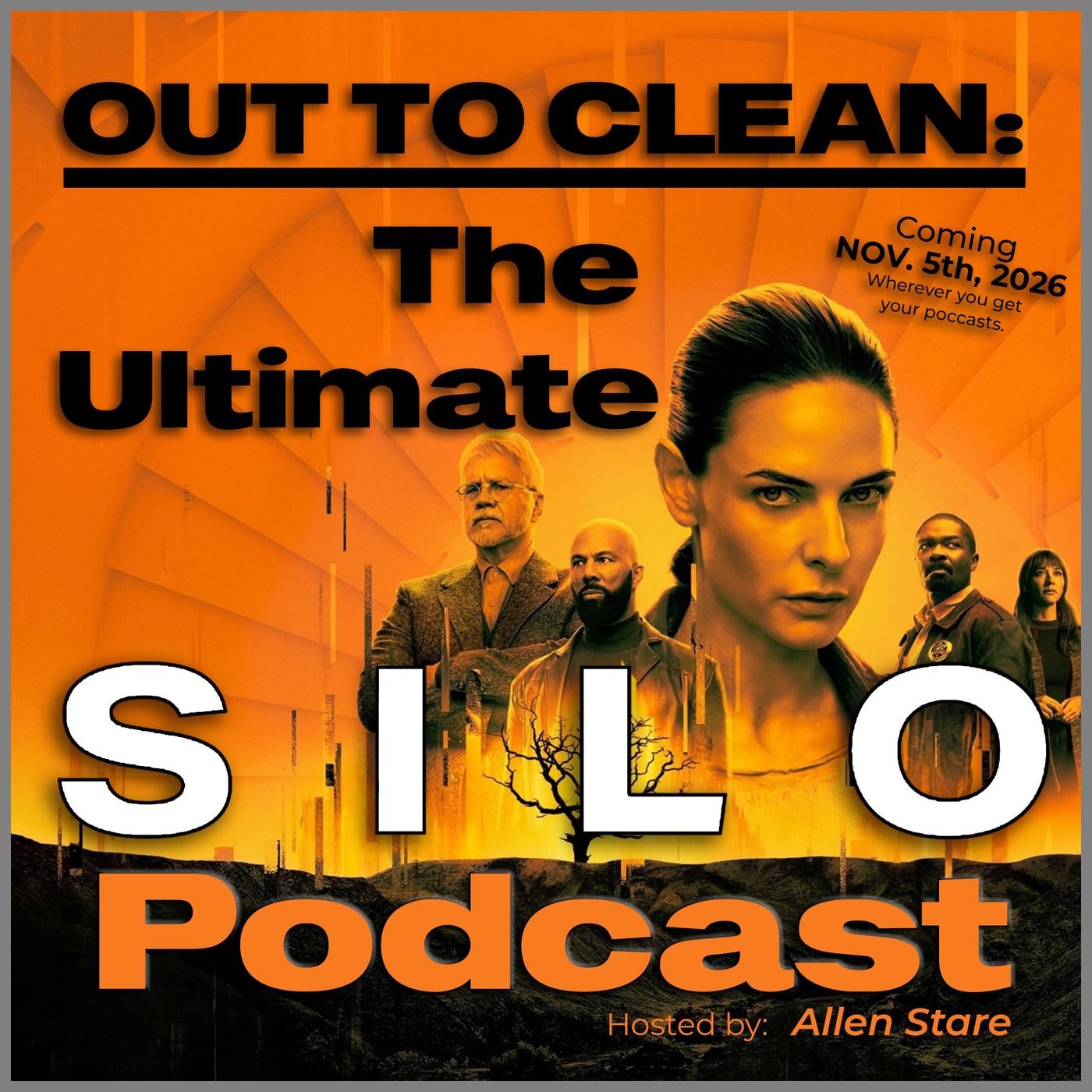
Out to Clean: The Ultimate SILO Podcast· Staffel 1· Folge 1
OTC-01-FreedomDay-PT01
Donnerstag, 5. November 2026 · 1 h 20
Kapitelklicken springt direkt hin
Shownotes
WELCOME TO "OUT TO CLEAN: THE ULTIMATE SILO PODCAST"
This is the very first episode of "Out to Clean.' So glad you found it! This is the newest podcast in the 'ultimate' style. That means scene-by-scene and shot by shot. It also means SPOILERS!! You MUST have seen the first three seasons of "SILO" before starting this podcast.
In this episode we meet the Sheriff of the Silo. We also meet the Silo...and the stairs...and the Sheriff's wife. It's a pretty full episode. We've got Will Patton as a deputy. There's Oscar winner Daniel Oyelowo as the Sheriff. Rashida Jones is his wife! A word of warning: don't get too attached.
There's a lot of world building to be done! Hit 'play' to start the ULTIMATE Re-watch of "SILO"!!
****
SUPPORT THE ULTIMATE FAMILY OF PODCASTS ON PATREON!! You can now support ALL of the "Ultimate" family of podcasts on a SINGLE PAGE on Patreon. All you have to do is go to: patreon.com/UltimateRewatchPodcasts and sign up to pledge $5/mo. or $10/mo. (let your budget be your guide). Thanks for the support!! It's either that, or I might have to go out and find a real job to supplement my retirement income!! -Allen Stare
Transkriptvom Podcast bereitgestellt · Zeitmarken springen hin
Hey, it's Alan. Before we start this debut episode about Declan, the ultimate silo podcast, I wanted to say a quick hi to Spexmom. I have no information about this person other than his username. Spexmom left a review on the Severed podcast right about the time the third season of Silo was finishing up. About half of the severed review was a request that I do a silo podcast. At the time, I was thinking about doing one. I loved the third season, and it was really tempting. Listeners send me DMs and email all the time requesting other shows they want me to give the ultimate treatment to. Silo is far and away the number one requested show, and it has been since it debuted. I was on the fence considering a silo podcast. Then I saw Specs Mom's
review slash request. I appreciate everyone who sent a note requesting silo, but it really was Specs Mom's Apple podcast review that pushed me to say, okay, I'm in. I'm doing this. It was the right message at the right time. Thank you, Specs Mom. And take note, gang. you really should go rate and review this podcast and all of the Ultimate Rewatch podcasts on Apple Podcasts. Give them all five stars and write a review. I read them all and who knows where it might lead. Okay, so if you guys are ready, let's get on with episode one of Out to Clean, the Ultimate Silo Podcast.
Welcome to the Down Deep. You're listening to Out to Clean, the Ultimate Silo Podcast.
Welcome to the very first episode of Out to Clean, the ultimate silo podcast. I'm your host from the down deep, Alan Stare. Out to Clean is a new ultimate deep dive rewatch podcast. We'll be going episode by episode, but as with all of the ultimate podcasts, prepare for soul-crushing spoilers. This podcast will draw on information and events that have taken place in the first three seasons of the TV series Silo. You must have watched all three seasons before starting this podcast. You have been warned. You should be here for part one of season one, episode number one, Freedom Day. We have new cast to meet. We need to discuss the author and creator of this world. We need to inspect and discuss the unique living situation we've
been thrust into at the start of this series. This is going to be a huge and fun episode, but we won't get to nearly all of it today. This is part one of three, which means we'd better jump in. Whether you're from up top, down deep, or somewhere in the mids, You're invited to join me on a journey through silos starting with episode one, Freedom Day. Before we get into the episode, we need to talk about where this whole silo idea came from. It was the brainchild of one author, Mr. Hugh Howey. In 2011, he wrote a short story called Wool about a dystopian future where a group of 10,000 people had been exiled to live post-Armageddon in an underground silo. In sci-fi in general, when the world is threatened, we usually go one of two places.
Space or underground.
Mr.
Howey decided to go way underground with mole people who exist in a mile-deep silo. These silo dwellers are forced to live under strict rules that sometimes don't make any sense. They don't know why they are there or who created the underground habitat where they live. They do realize this is not how people are supposed to live. which leads to a lot of unrest. The short story was so well received how he expanded the original idea into what eventually became the novel Wool. Wool was the first title in a trilogy that includes Shift and Dust, along with a number of additional short stories. There had been a film adaptation planned back in 2012. 20th Century Fox acquired the rights Ridley Scott was on board to produce. The
script was in turnaround hell for several years before it was ultimately shelved. The shelving wasn't a quality issue. It was due to the acquisition of 20th Century Fox by Disney. Silo was an expensive project that didn't have a lot of Disney hallmarks. This shelving would trigger a move from one production house to the next. The wool movie project became the wool TV series project in 2018. The whole thing was moved to AMC Studios, with writing and development being led by LaToya Morgan. AMC Studios had the cred to get this thing done. The debut series to come out of AMC Studios was a little thing called The Walking Dead. It was a graphic novel adaptation that became the highest rated series of any kind ever in cable history.
Since those heady TWD days, AMC has developed a number of strongly creative shows with high production values. These days, AMC is producing about 1,000 hours of original content a year in addition to Silo. Development of Silo continued at AMC Studios, but there was very little progress being made. Scripts wouldn't materialize, or costs were too high to proceed.
Apple TV, known as Apple TV Plus at the time, got involved in the project financially as of May of 2021. AMC continues to act as the production house for the series, and they do benefit by collecting licensing fees. According to SEC filings, AMC collected $ 56 million in licensing fees in 2023 alone. Canadian writer and executive producer Graham Yost had an overall development deal with Apple TV at the time.
He'd been behind bringing the excellent and very popular Slow Horses to air. Yost has several high-profile television titles in his resume. Going back to 1989, he wrote 44 episodes of the series Hey Dude. Yost was showrunner, executive producer, and writer on the Timothy Oliphant vehicle, justified for 78 episodes.
Yost was also exec prod on 67 episodes of The Americans and 20 episodes of Sneaky Pete. When it comes to the big screen, one Yost credit really stands out. He wrote 1994's big-budget bus movie, Speed. Weirdly, although Yost has a reputation for delivering high-quality hits, he was also the guy who wrote Speed 2 Cruise Control. Proof that even with the quality talent like Yost, they can't all be winners. Yost replaced Morgan as creator and writer on The Wool TV Project. He was already a fan of the Hugh Howey trilogy. When Apple TV came to him, they said they were going to do a deal with AMC Studios to serve as the production company. They wanted to know, would Yost be interested in taking on showrunner
duties for the series? He said he certainly was. Yost knew the trilogy had legs with a ton of story and a great central mystery. It would be up to Yost to overcome the challenges that had caused the project to stall while at AMC. Yost would be the one to bring the trilogy to life for Apple TV. There was a lot of writing to be done in order to translate the pages of the books to the screen.
Some changes were made, but the central story was solid. Book author Hugh Howey worked closely with Yost on the changes and revisions made to the original tale told in the trilogy. Every change was directed towards making the original story more visual and and watchable. Yost told Collider he truly loved the property. He said, quote, it's been proven time and time again, don't take something on unless you love it, unquote. Howie has said in multiple interviews he also appreciated the chance to basically do a rewrite on his original property. Principal photography began in late August of 2021.
It had taken 10 years and multiple studios before someone was able to figure out how to put this story on a screen. This episode, Freedom Day, premiered on May 5th of 2023 on Apple TV. So far at the time of this recording, the first three seasons have been produced and aired. This means we're into the second book, Shift.
The fourth and final season is set to premiere on June 9th of 2027. It draws primarily from the third book, Dust. Yost is listed as one of the writers for this pilot episode. along with author Hugh Howey and staff writer Jeffrey Wang. Wang only has four credits on his IMDb profile, and the three before this season were shorts. I do think I see how Jeffrey got in with this group.
He was a production assistant and writer's assistant on 13 episodes of Justified. This must have given him an in with Graham Yost. Not sure what else Jeffrey does outside of show business... I noticed there was a 10-year break between his last writing gig and this position on Silo. The plan for this podcast is to be book-aware. This means we will be comparing and contrasting some of those things that differ from the books to the TV series.
This is not going to be exhaustive or comments I'll be making about every detail. But some of the more interesting changes will be noted. For example, the Walker character is male in the books. If you're a TV-only fan, can you imagine Walk as a guy? Graham Yost suggested this gender switch. Hugh Howey loved the change. It's one example of his rewrite of the original. I'll have more about this character difference when we meet Walker. I will usually only get into book comparisons when I find something interesting that... illustrates how the books either influence or differ from the series. As mentioned, the first two seasons of the TV series are based on the first book, Wool.
The third season draws from the content of the second book, Shift, and content for the fourth and final season will come from the third book in the trilogy, Dust. This pilot episode is being directed by Morten Tildum. Morten is a Norwegian director who started his career in Norway in the mid-1990s. Morten's earliest directing gigs were for Norwegian TV series. His 2011 film Headhunters was a breakthrough. It was sold to over 50 countries. According to IMDb, that was a record at the time for any Norwegian film. Tilden's first film for English-language audiences would be the 2014 World War II epic, The Imitation Game. It starred Benedict Cumberbatch as real-life codebreaker Alan Turing. Since then, Tildum helmed one other movie, a
2016 feature called Passengers. Other than that, Mr. Tildum's been all about TV. He did a single episode of both the series Jack Ryan and Cape Fear. Morton led all eight episodes of the miniseries Defending Jacob, plus these three episodes of Silo. Freedom Day is the first Silo episode to be directed by Tildum. He doesn't do the whole season, but Mr. T does get us off to a good start.
He's behind the camera for the first three episodes of the series. We'll meet our performers as we go along, so if you're ready... The silo is waiting. Freedom Day opens on a close-up. It's a sheriff's badge. This sheriff's name is Becker. A hand reaches for the badge, and we tilt up to reveal our sheriff. He's a serious-looking man in his 40s. He's wearing a uniform shirt and has a beard. If you notice, most of our male characters in the silo do have a beard. Modern shaving options include one-time-use consumables, especially the blades. I'm guessing shaving is not a common practice among silo dwellers because of the waste involved. If they do shave, I would bet a reusable straight razor is involved. The sheriff is looking
in a mirror as he pins the badge on his uniform shirt. This is highly regarded actor David Oyelowo playing Sheriff Becker. He was born in Oxford, Oxfordshire in the UK to Nigerian parents. You might recognize David as Dr. Martin Luther King Jr. It was one of his most high-profile roles. He played the civil rights leader in the movie Selma in 2014. He was also the title character in the 2013 movie The Butler. David is quite the prolific actor. He's notched a total of 102 performer credits as of this recording. Since appearing here as the sheriff in 2023, Oyelowo has logged another 14 jobs, including 10 episodes of a comedy series called Government Cheese. He has five projects, either in production or waiting for release at
the time of this recording. Be watching for David as the pirate Long John Silver in the TV series Treasure Island. He's also going to direct and star as the title character in a new adaptation of William Shakespeare's Othello. Interesting to note, since David is Nigerian, there does not seem to be any racism or sexism in the silo. Our primary characters are a wide variety of races and spread fairly evenly between genders. In the books, the races of our characters aren't always specifically defined. Here in the TV world of the silo, we can see that race and sex don't seem to matter. If you can do the job to the benefit of the silo, you are valued.
If you're a bad seed who refuses to contribute to the welfare of the silo, you get sent out to the mines. Your skin color does not enter into the decision. This is an intentional aspect of this society, according to the creators. The biases that led to racism and bigotry have been forgotten thanks to the drugging that happened 140 years ago. Wiping out the memory of an entire population may not be the most pleasant way to uproot racism, but it sure did work. The sheriff looks proudly defiant as he pins his badge on his uniform. We cut to a long shot of the sheriff's apartment. It looks old, dingy, and kind of dark. Most places around the silo feature this dilapidated design aesthetic. The living room is sunken with
steps up into a visible bedroom and kitchen. We watch as the sheriff very intentionally places a huge vase of flowers on a table in front of the mirror he was using. The design of the siloed living areas looked like they could be berths on a cruise ship or a spaceship or a submarine. The sunken rooms are a recognized design approach for handling a lot of hidden hardware like ducks and hoses. Ever wonder where we got the office of sheriff? We'll find out after the break. Out to clean, we'll be right back. And we're back. The Office of Sheriff was created in early Anglo-Saxon England. Originally called a reeve who maintained order in a shire, the term shire reeve got shortened to sheriff. In the earliest
incarnations of the job, the sheriff was appointed by the king or his nobles. Sheriffs were considered royal agents of the king who had wide-sweeping judicial powers in the old days. In the United States, modern sheriffs aren't nearly so royal. They are typically elected county officials. Modern sheriffs are more directed toward law enforcement, peacekeeping, and custodial duties. These days, sheriffs tend to leave judicial matters to the courts. On the other side of the bedroom, opening from the mirror, is a round vent. In another wide shot, we can see the sheriff as he's opening this vent with a screwdriver.
Check the wall next to where he's working. You can see the faint round and rectangular outlines of items that had been hanging on these walls. It looks like they've been recently removed. I wonder if the sheriff has already sent some things to recycling in anticipation of what he's about to do. Everything about this space indicates it is old.
The light switch and thermostat are also visible on the wall just left of the doorjamb leading to the bedroom. It looks like a standard round mercury-controlled thermostat like the kind I grew up with in the 1960s and 70s. The lights are also standard switches like what you'd find in any mid-to-late 20th century American home. We cut to close-up as Sheriff Becker removes the screws from the frame of the round vent. We cut away to another scene outside of the apartment before he opens the vent, so we have no idea what he's up to. Do make sure to tuck this bit of vent information away for later retrieval. The good sheriff is creatively hiding things in vents all around the silo, but we won't know that
until later. We cut to a follow shot behind the sheriff. He is now out in the hallway around his apartment. We're about to get our first glimpse of this strange apartment building where he lives. The sheriff is trudging along with a serious expression on his face as he trudges a voiceover begins.
We do not know why we are here.
This launches us into an incredible visual introduction to the silo. Rebecca Ferguson and several of the cast and crew have referred to the silo as another character in this story. It is truly the hulking performer lurking in the background of every shot. The camera cranes down past several lighted levels.
This is no ordinary apartment building. Across the way are cows standing in feeding pens. There is animal husbandry happening in the silo. I would also bet every part of the animal is used. We're going to meet a character in the next episode, Robert Sims, who wears a pretty cool leather coat. A number of reviewers have taken shots at this wardrobe item in online comments since it was first introduced. The naysayers ask, isn't the silo supposed to be 350 years old? Wouldn't this leather jacket be ratty and worn? Well, if you question the jacket, I would like to point to this animal husbandry floor featuring numerous cattle.
I'm sure they don't make a lot of leather jackets each year, but there have to be a few. Someone as highly regarded and well-connected as Sims would be able to nab one, I'm sure. We're also probably looking at the raw material for new shoes. Later, we're going to meet a rabbit. They are also being raised as a part of the silos agricultural program. The smell of rabbit stew wafting through the cafeteria is mentioned in the books.
Juliet even has a bowl. Rabbit fur makes great clothing, like maybe a nice collar for a leather jacket. The camera continues to swoop down through this enormous space. Sprinklers are just kicking on over two entire levels devoted to crops. It looks like this field is full of corn. This is just one of several farms that exist within the silo.
Farming is of utmost importance in a self-sustaining environment. Farming has been explored at length in long-term space travel scenarios. 2001 A Space Odyssey included farming levels. In The Martian, one of the primary functions of the newly arrived Martians is to start planting things. The Sheriff's voiceover continues as we're watching this impressive montage.
We do not know who built the silo.
Most of what we're looking at here is CGI. We'll talk more about the CGI being used in the silo in a bit. The camera rolls and sweeps by level after lighted level, extending down past our field of view. This is an enormous structure. We're going to be told the hole dug to accommodate it was more than a mile deep.
We do not know why everything outside this silo is as it is.
These lines he's saying have the feel of ancient words passed down for generations. Outside, as we'll see, is a barren wasteland. Something has destroyed all visible vegetation and rendered the air toxic. At least this is what the silo dwellers have been led to believe. The sheriff crosses over from the central staircase to a cafeteria. The central staircase is the DNA of the silo. It curves and twists down through the center of the structure from level one all the way up top down to level 144, located in the area referred to as the down deep. We're going to talk more about this staircase when we get out on it in a bit. We spend a lot of time on the stairs during the series. The sheriff has crossed one of the many bridge landings that connect
the outer ring of the silo to the central staircase. These bridges extend out from every level, offset by 120 degrees. The sheriff has entered the cafeteria for this area of the silo.
Morning, Sheriff.
The silo operates like an all-inclusive resort or a cruise. You've got your assigned cafeteria where you can go eat whenever you're ready. The steam trays are fired up. The sheriff knows the kitchen staff. I'm sure he sees them every morning.
Hey, Sam.
You awake yet?
I'm about halfway there.
The far wall of the cafeteria opposite the serving line is an enormous video screen. The entire wall displays a blasted out landscape that extends as far as we can see. It's a wasteland with a single leafless tree jutting up from the scrub out on the horizon. There appear to be rocks strewn about on the ground, but it's hard to tell. Our view is blocked by dirt and debris on the camera lens. I've seen some reviewers and commentators calling this video screen a literal window looking at the outside.
I would like to clarify, just in case anyone's confused by this terminology, this is not a window. There are no windows to the outside in the silo. The silo is wholly and completely buried underground. The airlock that opens for a cleaner to exit is the absolute uppermost portion of the silo, and it's at ground level. We will watch cleaners walk up a ramp that lifts them about another 30 feet before they're able to exit the airlock.
What this cafeteria wall is showing is the output of a camera that sits in a concrete bunker just behind the airlock. The effect might mimic a window, but on the other side of that wall is nothing but dirt, or more likely, hallways and back alleys. As mentioned, the display is dirty. Dust and dirt are clinging to the lens.
It blocks out most of the details, especially in the foreground. While we're here, don't miss the enormous round lighted ceiling decoration in the center of the cafeteria. The wall with the video screen is also curved. It's subtle, but the entire silo is round, which means all of the walls include a curve. They're aren't many, if any, straight walls anywhere in the silo. This presented a challenge to set builders, designers, and even CGI creators. I've seen video of prop wall sections laying on the floor, only they can't lay flat on the floor. Each panel has a curve to it that makes them difficult to stack or store. The sheriff heads back to his office. It's located just off the cafeteria.
Reinforcing the circular motif, we have a look at the ceiling of the sheriff's office. The rectangles of fluorescent lighting are placed around a circle, each one in a pie wedge of the ceiling.
We do not know when it will be safe to go outside. We only know that day is not this day.
Six desks are arranged in a ring, with each desk facing into the center of the room. Along the far wall, sitting on top of a file cabinet, is one of those over-under-bonomatic coffee makers. It's designed so a carafe can be catching a fresh pot on the lower warmer, while the previous pot stays hot on the upper warmer. This means coffee beans are being grown and roasted somewhere in the silo. Also, they must be incredibly careful with those carafts.
I don't think I've ever used one of those coffee machines that had the original caraft. They get broken all the time. Keeping two of them intact for 350 years and at least one rebellion is a major feat. Ancient computers with heavy, bulky CRT displays and 16-bit graphics are on each desk throughout the Sheriff's Office. From what we discover about the development of the silo program in Season 3, it was modern day or even 2049 when the silos were built. Computers were far more advanced than what we're seeing here in the world of the 21st century. So why not load the silo up with some flat-screen LEDs and powerful desktops running Windows 11? I'm guessing they went with these older-style computers for use in the silo because
the tech was more tested and known to be stable. Windows 11 does everything, sure, but it can still crash out pretty easily. Also, the newest version is always being updated. No one in the silo needs to interface their computer with their garage door opener or control the temperature. of their cappuccino machine remotely. Why bog the silo servers down with unnecessary lines of code that's never going to be used?
DOS has been providing a stable, practically crash-proof PC platform since the late 1970s. It's not fancy and doesn't have a lot of whistles and bells, but it delivers the basic functions of a computer without error. And bonus, the CPUs it runs on don't consume nearly as much power as the newer, bigger processors. 16-bit graphic cards don't require a lot of special drivers or any additional cooling. Also, they just work. Even under adverse conditions, older tech has proven to keep running and running, which is what you want in a computer that's ideally going to be in service for 500 years. The sheriff passes through the main room of this silo police station. He goes into his private office. It says sheriff right there on the door.
We cut to a close-up of Hans writing. This is the sheriff making a note on a scratch pad. He's written, double the flowers in front of the mirror. It's not addressed to anyone in particular. What does it mean? Well, we're going to discover that denizens of the silo are being spied on by IT. And probably they're doing it for judicial. There is a lot of crossover. Unbeknownst to most, there's a camera hidden in each apartment behind the built-in mirror.
This camera and accompanying microphone is how the powers that be in the silo keep tabs on the populace. The sheriff has somehow discovered the existence of these cameras. Rather than raise a stink about it, his fix is to block them with a big vase of flowers. IT can't say, hey, move those stupid flowers or they'd be giving away the fact there's a camera. Putting a big vase full of flowers in front of the mirror is a beautifully passive-aggressive way for a denizen to solve the problem. He places the note inside the pocket of a folder. There's a clip at the top holding several sheets in place. The top sheet is a flowchart showing the administrative hierarchy of the sheriff's department. This note is Sheriff Becker's message to
the next sheriff. One of the things Hugh Howey has said he regrets about the TV version of his story is the way paper is treated. In the books, paper is far more scarce and special. You don't just grab a sheet off a pad and scratch out a note. You think long and hard before you commit something to paper.
In a bit, we're going to see the sheriff's wife mention that printing something out must have cost a huge number of credits. This is a nod to the scarcity of paper. It's just not as scarce on TV as Hugh would like. The sheriff writes a word that starts with M on another sheet. This is where he places his sheriff badge, the one we opened on back in his apartment. The way he situates the badge obscures the word.
They don't show us until next episode, but the word is Marnes. It's the name of his deputy. We're going to meet Marnes in seconds. Cut to a close-up on a coffee mug. You can see those 350-year-old glass carafts I was talking about in the background of this shot. We're back out in the squad room. A hand is pouring some creamer into a mug of coffee. The creamer is just another valuable product to come from those cows we saw earlier. The camera tilts up to reveal another man in a police uniform. Hey. This is Deputy Sam Barnes.
He nods to the sheriff who's coming out of his office. You in early? Barnes says he couldn't sleep.
Got the damn leg cramps.
This is a subtle nod to the living conditions forced on these people by the silo. There is no sunlight, so there is no chance for people to naturally make vitamin D through their skin. We will see later they do add vitamin D to the water supply, much the same way we add it to cow's milk. The amount the deputy is getting might not be enough. Low vitamin D is known to contribute to leg cramps because calcium absorption is reduced. The sheriff is about to make an unusual decision. We'll find out what he's up to after the break. Out to Clean, we'll be right back. The sheriff continues to make his way across the main room of the police department.
When you get your coffee, meet me in holding three.
Barnes turns. There's concern in his voice.
Three.
We don't know it yet, but holding cell three has a special purpose in the silo. The camera cuts to a straight-on look at the door to holding three. We need to pause a moment here to meet the man playing Deputy Marnes. This is the legendary Will Patton. Will has notched 126 acting credits on his IMDb profile, but those represent hundreds of episodes of television. In 1984 and 85, he did 203 episodes of Daytime Sub Search for Tomorrow.
He's appeared in dozens of movies, both theatrical and for TV. Will was a regular on 45 episodes of The Agency at the start of the century. He was Dan Weaver on the series Falling Skies for 52 episodes. While he was doing these four episodes of Silo, Will was also on Outer Range for 13 episodes. Even though he stays busy on TV, he's not limited by it. Patton, from South Carolina, has also been the recipient of two Best Actor Obie Awards for his work in off-Broadway plays. In addition to the acting skills, there's also that incredible voice of his– I know a couple of years ago I listened to an audible recording of a Stephen King book, and it was narrated by Mr. Patton. He is quite the dynamo when it comes to creating quality content. in
all media. The beautiful wooden door that allows entry to holding cell three gives us a great look at the seal of the silo. It's that circular image in the middle of the lower panel of the door. We can really check it out as the sheriff gets the keys out of a box mounted beside the door. The icon includes the image of a dozen stick people standing in a circle. Their arms are raised in celebration. At least, I hope it's celebration. Their legs form an enclosed 12-pointed star.
The people are surrounded by a multi-part circle that indicates the various sides of the silo. It's been noted that this image, at least the stick people part of it, is almost an exact copy of the symbol used by the Montreal World's Fair held in 1967. In Montreal's version, the people don't have legs, or at least their legs are together. They form a single line below each stick person.
The theme of the World's Fair icon was man and his world. This icon on holding cell three would have to be man and his silo. This basic icon gets amended throughout the silo to act as icons for the various departments. We've already seen one, the icon above the cafeteria, included the circle, only the center of the icon was a line-drawn tree. This must be indicating the visible tree on the video screen. When we go down the hallway towards the airlock, I'll point out another variation on this icon theme. When the sheriff opens the door to holding three, you can see the main icon repeated as a relief in the far concrete wall. The sheriff doesn't hesitate. He steps into the cell at the end of the hallway,
closes the door, and locks it with the key he retrieved from just outside the wooden door. As the sheriff is locking the cell, make sure to notice his sleeve. You can see the same icon for the silo repeated here on his shoulder. They really get a lot of use out of that icon. After the cell is locked, the sheriff casually tosses the ring of keys out onto the floor in front of the cell. They are far enough away he can't reach them. The sheriff has effectively locked himself in, holding cell three. As soon as he's locked in, the sheriff turns his attention to the far wall of the cell. A much smaller video screen is located there. It's showing a smaller version of the same scene we could see spread across the far wall of
the cafeteria. Reverse cut to a close-up. We can see the sheriff's hand reaching for a figure visible on the screen. A tiny human form is lying on the hill in the distance. They're lying just below and to the left of the scrub tree still standing there. The sheriff lovingly runs his fingers over the image of this cleaner who didn't make it. We can't know it here, but we're going to discover this is the body of the sheriff's wife.
The sheriff's reverie is broken by Deputy Marns from the other room.
Want some coffee?
Marns has wandered into holding cell three carrying his own coffee mug. He stops short when he sees the sheriff.
What are you doing?
I want to see her.
He continues to stare silently at the video screen on the far wall of the cell.
No.
There's concern in Marn's voice because holding cell three is reserved exclusively for those who have either chosen or are being forced to go outside to clean. Holston speaks, but he's talking to himself as much as to Marn's.
Should have done it three years ago, but I couldn't listen.
At this point, we don't know the importance of three years ago. We will soon enough. Marn's approaches the cell closely. He tells the sheriff to stop it.
Come on out of there.
Let's talk about this.
The sheriff has not yet said the words. Anything he's done to this point can be undone, just so the sheriff doesn't say the forbidden phrase. The sheriff slowly turns back to Marnes.
I made up my mind or I wouldn't be interested.
We cut to a reverse angle from behind Holston, looking out through the bars at Marns. At the other end of this hallway is access to the airlock. This is the first door that cleaners pass through on their way to the outside. Marns looks a little like he's talking down a jumper who wants to end it all.
I'm sorry, Sam.
No, now don't apologize. There's nothing to apologize for as long as you don't say those words.
Are you going to say this to me?
After all we've been through. This is a horrible thing to do to a friend, but the sheriff has decided this is what he absolutely must do. In the book, Mr. Howey uses a great phrase to illustrate the immense relief the sheriff is feeling about his decision. He said it was like letting out a breath he'd been holding for three years. The sheriff asks if Marnes would rather he wait until Sandy gets in before he says what he's going to say. It's not about who he says it to.
I don't want you. to say it. Barnes is almost talking in a whisper, trying to soothe the sheriff. Please, sheriff, don't say it. There's no stopping him. This is not a decision that was made on a whim. There was a lot of thought and reflection put in before deciding on this course of action.
Deputy Barnes. Please, sheriff, I want to go out.
Barnes winces. A music cue and a minor chord underscores the seriousness of this situation. In a later flashback scene, the sheriff is going to tell us that if the pact were boiled down to one rule, it would be this. If you say you want to go out, you're going out. Both Marns and the sheriff are shaky after he says these words. This is very emotional stuff. The sheriff is, in effect, committing suicide, and he's asking one of his best friends to help him do it. The sheriff knows the procedure. He's been on the other side of the bars for more than one cleaning. This time, he won't be involved with the preparations. Instead, he'll be waiting and holding three.
While you get things rolling, I think I'm going to lie down.
Barnes remains outside the cell as the sheriff lies down in the cot. He is on his back looking up with a troubled expression. Camera's doing a slow zoom in on his face when we cut away to another face. It's someone he's seeing in his mind's eye. It's the face of a woman with brown hair. Hey, it's Rashida Jones.
We can see the track of a tear running down her right cheek. She's wearing a suit that has an airlock ring for attaching a helmet. We don't get any explanation, but I was very happy to see Rashida Jones. We cut back to Holston, who closes his eyes. There's a cut to a sun coming through the clouds. That was our cold open. We're now into the opening animation sequence, kicking off for the very first time. I'm not going to do a breakdown of this opening here. It's fairly illustrative and pretty long. It runs over 90 seconds. I might do a breakdown at some point later in the series, like maybe an off-week extra. I don't think there are any real clues or secrets hidden in this opening animation.
It's interesting and very well done. Do give it a look at least once. After you've experienced it, I think you're fine hitting skip from then on. There is one interesting point about this particular episode's opening. It lists the performer Common as appearing in the episode. Common portrays the character Robert Sims. Sims is going to become a major player later in the series, but he does not appear in this episode. In the IMDb cast list, they put credit only in parentheses by his name. When this episode first dropped, I was there on night one. All I knew about it was the premise. I've got to tell you, when I saw David Oyelowo, Will Patton, and then Rashida Jones in the cast, I was psyched. This is some
incredible star power, and I enjoy watching all of these folks work. You can imagine how bummed I was when Rashida was dead by the end of this episode. Marns, the mayor, and the sheriff get a bit more play, but by the fourth or fifth episode of the season, there are nothing more than flashbacks. The silo can be brutal.
Don't get too attached to anyone. You never know when they'll wind up going out to clean or getting thrown over the side of the stairs. Coming out of the opening sequence, we're looking at a wall, a circular vent. I think the same one the sheriff was messing with in the cold open is visible on this wall. We can also see all of the items that left those frame marks. They don't specifically tell us, but we've jumped back in time for this next scene. We've gone back to a time before the three years the sheriff mentioned in the cold open. Take a look at the pictures on the wall with the vent. It illustrates one of those little things that is different about life in the silo.
Everyone who is important to the family is represented on the wall as either a painting or a sketch. There is no photography in the silo. Old-school silver halide-based photography requires a ton of chemicals and equipment. Plus, film stock is unstable. Over the course of just a few decades, it can degrade to the point of being unusable. Film would never last for centuries. Digital photography also requires equipment.
It's not as unstable as old school film stock, but to get a digital image to the point where you can hang it on the wall requires photographic paper, a printer, ink, and a computer that can handle the image. Since the tech of the silo is pretty limited, it kind of kills the possibility of digital photography. So to preserve those images of loved ones, the silo dwellers have gone to a pre-photography solution, painted portraits. I would bet a good portrait painter in the silo is rolling in credits. Taking the family to the portrait painting guy would be synonymous with taking them to the photographer at the Sears Portrait Studio back in the 1970s. There are cuts looking at more detail in this apartment. On the dresser is a
painting of both the sheriff and his lovely bride together. There's some kind of bone displayed on a stand. More sketches and paintings. knickknacks on shelves. The whole place has the feel of cozy, bordering on cluttered. It looks like a happy, lived-in sort of space. We hear a voice from off-camera. It's Rashida Jones.
Are you getting coffee?
I am, I am. There's a cut to close up on two coffee mugs. They are his and her joke mugs. One of them says mine on it. The other one says also mine. The sheriff is pouring the coffee as his very nervous wife is manically flitting around the apartment. Rashida is playing Alison Becker, the wife of our sheriff.
She says she wants some milk in her coffee, then immediately changes her mind.
Actually, no milk. I don't, I don't. I don't need any milk.
No.
She is so nervous. She runs over to sit at the computer terminal in their apartment. Come on, it's almost eight. The sheriff, already in his uniform, scoops up the mugs. Please.
You're coming.
Thanks.
He has a seat by Allison at the computer. After the break, we're going to meet the woman playing. Allison, out to clean. We'll be right back. The character of Alison Becker is being played by Rashida Jones. I realize I've been talking about Rashida Jones like she's an old friend. If you're an office addict or a Parks and Rec lover, she kinda is. Rashida Jones is the daughter of legendary music producer Quincy Jones. So, sure, she may have had a bit of an in when it comes to show business.
But Rashida is no slacker. She is a gorgeous and talented powerhouse of a performer with both comedic and dramatic chops. Rashida's performing career got underway in 1997. She appeared in an episode of the miniseries The Last Don. Her first real breakthrough part came on Boston Public in 2000. She would appear in 38 episodes as the character Louisa Fenn.
Rashida made an indelible mark on pop culture as the character Karen Filippelli on 26 episodes of The American Office. She's the only paper salesperson who even had a chance of stealing Jim away from Pam. Her office connections, namely Mike Shore, carried her to 100 episodes of Parks and Rec as the grounded and hilarious Ann Perkins. Rashida would have her own starring vehicle as the title character, in 40 episodes of the 2016 comedy series Angie Tribeca. Rashida has logged 86 performer credits on IMDb, with two still to come in 2026. Fun little bit of trivia involving Rashida and one of her past characters. Here, she is playing a character named Alison Becker, with two L's in the first name. When Rashida was playing Anne Perkins on
Parks and Rec, a recurring nemesis to both Anne and Leslie was the reporter character Shauna Mulway-Tweep. The character of Shauna was being played by the actress Alison Becker. Same name, only with one L. I have no idea if this naming is intentional or some bizarre coincidence. Although I wish it was, this is not my observation. Somebody posted this info as a trivia item on IMDb, and I thought it was very cool. I did double check to make sure everything's accurate. Allison is talking down whatever has her so excited. She's trying to not get her hopes up.
I don't know why we're doing this. We're not going to get it.
We had two tries.
The sheriff puts a comforting hand on her back as the computer chimes. Something has arrived via silo mail. Our view cuts to a close-up of the screen. Allison clicks on the new message. It's from the silo health department. The main headline says REPRODUCTIVE CLEARANCE GRANTED in all caps. Below that, in a subhead, it says CONGRATULATIONS! You have been approved for childbearing status for one year. Please see your doctor. No surprise, the silo has a pregnancy lottery.
Couples of childbearing age can apply, but not everyone gets a shot at having a baby. The administration has to maintain the population at just under 10,000. Without strict controls over how many babies are born each year, the fragile resources of the silo could be overrun with too much population growth. The sheriff and Allison are both shocked to be getting the thumbs up. I can't believe it. The sheriff says third time's a charm.
You're just excited to have sex every day.
Well, yeah, there's that, too.
Hey, you could be pregnant a month from now. Please let it be more than that.
This kicks off our one-year fertility storyline. A countdown is about to pop on the screen, ticking off 364 days left for the couple to get knocked up. It counts days, hours, and minutes. The founders certainly can't be accused of being romantics. This fertility storyline was created for the TV series. It's not in the book. I'm sure they are controlling population in the books, we just aren't told how. This lie about the birth control is a more emotional and visual story than what's in Wool. In the book, Allison starts to question the truth about silo history after recovering files on the main server that predate The Last Rebellion. Her discoveries make her wonder about everything they're being told regarding
their existence in the silo. She does find information indicating the video feed coming from outside is a lie, so her motivations for going out are the same. In the book, she doesn't do any self-surgery to remove her birth control chip. That's a gross and disturbing visual reserved for the TV audience.
I do like how they have a little fun with this trying-to-get-pregnant storyline over the next several scenes. The happy couple pauses for a tender kiss. The sheriff says he loves her no matter what.
Shut up.
We're doing this.
Let's go.
They need to get to the doctor, but his office doesn't open for an hour.
Yeah, well, we can get some breakfast. We can.
about baby names, which would be me just humoring you because obviously if I'm giving birth to this little critter, I'm naming it whatever.
The hell I want. Wow.
Allison is wound up. The sheriff can barely keep up as they climb the stairs to their front door. Our view cuts back to the message on the monitor. The screen clicks over to the pregnancy opportunity time countdown timer. It is showing 364 days, 23 hours and 59 minutes left to get pregnant. We'll be checking in on this timer throughout the year. The cafeteria is bustling with activity.
In the food line, the servers are wishing the happy couple good luck. The fertility list must be published like it's the cast of the spring musical.
Good luck. Oh, thanks.
Congratulations.
Thank you.
As they walk through the cafeteria, tables full of well-wishers are smiling in their direction. The sheriff and Allison have a seat at a central table.
I really hate this part.
People are just happy for us.
Oh, I just wish everyone didn't know.
It does seem like a very public announcement for such a personal matter. Breakfast looks like a slice of tomato, scrambled eggs, and a green juice. Guava, maybe? It's farm-to-table dining wherever you go in the silo, I'm sure. There are salt and pepper shakers on the table. Pepper can be grown. Salt might be one of those critical supply items.
It looks like the preferred silo sweetener is honey. There must be an apiarist on some of the levels. Bees would be necessary to cross-pollinate crops, so I imagine they're near the farm levels. Honey makes more sense than trying to grow sugar cane in the silo environment. Plus, it's more of a byproduct than anything. They do need those bees for pollinating. As they're getting settled in at the cafeteria table, the sheriff looks off to frame right.
Oh, shit.
He quickly looks back down at his eggs, trying to ignore whatever it was he saw. We cut to a view looking across the table. The sheriff is seated frame left, Allison frame right. A new character makes her entrance, walking right up to the side of the table. She positions herself between the couple from our viewpoint. They didn't wave this woman over or anything. She just arrived, and as we heard, the sheriff is not too happy about it.
Sheriff, Mrs. Becker, I.
I don't mean to intrude.
So don't.
Okay, so no false civility here. The sheriff is making his feelings about this woman abundantly clear. She appears to be a dedicated crackpot. Her wild hair and multiple layers of patterned clothing are all loudly saying crackpot. After years of experience, crackpots know how to deflect barbs and criticism.
She smiles down at Becker knowingly.
There's your famous tell it like it is manner.
Why everyone likes you. If everyone likes me, I'm not doing my job.
This woman is the character Gloria Hildebrandt. She's being played by British actress Sophie Thompson. You'd never recognize Sophie out of her Gloria costume. She has brown hair. Sophie is a six-time Olivier Award nominee for her stage work. She has 97 IMDb credits as a film and television actress. Those include multiple episodes on TV. Like most British actresses I've ever profiled, Sophie did her time on Coronation Street for 14 total episodes, which is a drop in the proverbial bucket. The long-running British soap is about to hit a total of 12,000 produced episodes at the time of this recording. Gloria fancies herself some kind of silo midwife or doula, but according to the sheriff, she's just a Mrs. Becker,
your husband might not be interested in what.
I have to say. I'd really be interested in as you leave us alone, Gloria.
Allison is a bit shocked at the sheriff's rude behavior. She scolds him under her breath. Undeterred, Gloria prattles on.
Whatever our sheriff may have told you, I provide fertility counseling.
Oh yeah?
Like what?
The sheriff continues to eat, but his tone is very combative.
Your husband's waiting for me to say something I'm not legally allowed to say.
Such as?
There's some tricky wordplay happening here. Gloria claims she has no desire to be sent out.
Thank you, Sheriff.
She tells Allison if she has an open mind to come see her.
I wish you both the very best.
And with that, Gloria turns and scurries away from the table and out of the cafeteria. Allison and the Sheriff watch as she retreats.
What does she do exactly?
She goes right to the edge of promising people a baby if they do what she says, which is fraud. And it's cruel.
This is great exposition for us, but I have a problem with continuity here. We were just told this is the couple's third attempt at getting pregnant. How could Alison have been in baby-making mode for a total of two full years prior to this without knowing about Gloria and what she offers? It's a little thing, but I'd have preferred a storyline where the Beckers were turned down twice before, and this is their first approved attempt. Because of their ages, it will also be their only attempt. If this were a first-time experience, it would explain a lot of these interactions, including this initial meetup with Gloria. We cut away from the cafeteria to a doctor's office. Allison is in the exam chair with a curtain placed over her midsection. In
order to start the pregnancy process, it is necessary for the woman to have her implanted birth control removed. I'm guessing the implant is mandatory for all female siloed dwellers who've passed through puberty.
Dr.
Leonard is handling the procedure. British actor Paul Bigley is portraying the good doctor. He's got 60 performer credits on his IMDb profile, but strangely, no headshot in his main account icon. Paul has been a regular on British television dating back to a 1980s series called Juliet Bravo. He appeared in 14 episodes as an uncredited youth in a club.
Paul appears mostly in TV series and TV movies, but he does have a couple of big screen credits in his profile. Most recently, Paul appeared in nine episodes of the series Call the Midwife as the character Mr. Perry. Doc Leonard is numbing the area where he is going to surgically remove Allison's birth control capsule. We aren't given any details about this technology. The item itself looks like a tiny metal barbell with fins. It's maybe three quarters of an inch long. It looks more like it belongs inside a piece of machinery than inside a person. After I remove the birth control, it'll take two to three weeks for your hormones to reset. This doesn't seem fair.
The clock is already running, but they can't get pregnant until her hormones reset? They should remove the birth control, let the hormones reset, then start the one-year countdown clock. Although the doc does say some couples manage to get pregnant within days of getting clearance. Somehow, I don't think this couple is going to be one of those.
Is this your second time?
The sheriff tells him no, it's their third. Allison chimes in with, and last.
I'm almost 38.
Which might be the best special effect of the entire episode. The lovely Ms. Jones is actually 47 here, although I can't imagine anyone challenging her about that 38 claim. I guess above ground 47 translates to underground 38, and, you know, 50 is the new 30. Allison has her birth control removed, or at least we think she does, right after the break.
Out to clean. We'll be right back. Allison is all prepped for contraception removal. The doc is about ready to cut.
Can you feel this? Just pressure.
Even though she's numb, the doc warns her it's still going to feel weird. Yeah, doc, this is her third time doing this. I think she knows what to expect. Again, I would have liked this storyline better if this was their first lottery selection, not their third. The doc continues talking as he's working. He mentions how the capsule is inserted quite deep. He appears to be digging down into Allison's incision. Thankfully, the curtain is blocking our view. We can hear somewhat disturbing squishy sounds, and then he's got something.
The doc lifts the bloody capsule in forceps and shows it to them. You're no longer under birth control. We get a close-up of the bloody capsule as it is dropped onto a metal tray.
You are now free to make a baby.
Well, at least you are in three weeks or so when your hormones reset. Allison and the sheriff share a relieved smile. We cut to activity out in the halls of the silo. Kids are playing a curved version of hopscotch. that uses circles around the numbers instead of the usual boxes. When your entire environment is round, it's going to affect everything you do. It looks like some adults are getting home from work. We can see a balcony jutting out of one of the units. Laundry is hung over railings to dry. The dirty and dilapidated motif continues. Most of the structures we see were built out of concrete by the founders. In some places, the concrete is aging and crumbling.
All of the visible surfaces in the public areas of the silo look like they could use a good power washing. These walls and surfaces are actually fiberglass formed over wood frames in most cases. The aging and distress is part of the creation of these items. The giant swinging steel-looking vault doors are the same material. They still have some heft.
but it's a lot lighter and easier to work with than tons of concrete or steel. We cut to back inside the sheriff's apartment. The couple is just getting home from the doc's office. He's thanking someone named Mrs. Flores as they enter.
I swear, if one more person congratulates us.
Allison enters the apartment at the bottom of the stairs. She turns back to her husband.
Impregnate me.
Now.
There is only one acceptable response to that command.
Yes, ma'am. Oh, my God.
He scoops her up in his arms and heads for the bedroom. Hormone reset be damned. Allison tells him to wait a minute. He puts her down.
Remember last time? At some point, this is going to start feeling like work.
Really, not so much. For the guy, at least.
Best work ever.
Exactly. They kiss. Discussion over. Since this isn't HBO, our view cuts away from the amorous duo to the countdown timer on the computer screen. It goes into fast motion. Days are counting down rapidly. We cut away from the scene at day number 342. This means it's been about three weeks since Allison's chip was removed. Those hormones should be all reset and ready to go. We cut to inside another round office. This is not the sheriff's office, but it does have the same circular ceiling. Desks are placed around the edge of the circle, but they are also out in the middle of the floor, too. These fluorescents are inset, and this room looks like it's bigger and nicer than the sheriff's office. As we cut into
this new room, we can hear small talk happening in voiceover.
We tried like four times before we finally got clearance, so.
Now's your time.
Yeah, so.
Is there a fertility problem in the silo? I don't think so, but since some couples are targeted as not fit to have kids, it looks like there's a lot of infertility happening here. This is IT. I'm guessing it stands for information technology, but they never specify. This is where Allison works. Allison is a hacker who's very good with computers. She's taking a bit of time to gossip with co-workers about her new status. Of course, everybody's got a getting pregnant story.
My cousin Charlene, she convinced her husband he had to dye his unit blue.
Did it work?
They got pregnant. But I'm pretty sure his blue dick had nothing to do with it.
Allison laughs at this. She's drinking her coffee from another homemade novelty coffee mug. This one says stolen from Sheriff Becker on the side of it. As this pair is having a laugh about the blue unit, a tall man with white hair and a beard approaches.
Hello, Bernard.
Morning, Bernard. You're not seeing things. The character of Bernard Holland is being played by Academy Award-winning actor, director, writer, and producer Tim Robbins. Tim lists 83 actor credits on IMDb, but those include a lot of episodes of TV. He got his start on three episodes of St. Elsewhere back in 1982. Physically, Tim varies rather significantly from the short, plump, and dumpy Bernard described in the book. When we first meet Bernard in wool, he's described as the small man whose job it was to keep IT running smoothly. He was also called short and portly, with a pair of glasses perched on his small nose. Tim Robbins retains the cool menace of Bernard from the book, while adding in some truly imposing physicality. He does keep the small pair
of round glasses. Tim has a reputation for doing quality work on film. He's the star of Frank Darabont's 1994 epic, The Shawshank Redemption. In it, he plays innocent murderer Andy Bufrain. It's considered one of the most popular movies ever made. To this day, Shawshank maintains an incredible 98% popcorn meter score on Rotten Tomatoes. Robbins says the breakthrough in his career came with the part Nucleloosh in the 1988 baseball comedy Bull Durham. He was Bob Roberts in the movie Bob Roberts. He was in the Hudsucker Proxy, IQ, Arlington Road, High Fidelity, War of the Worlds, and he was the player in The Player, just to name a few of Tim Robbins' very recognizable titles. For you How Did This
Get Made fans, Tim was Jacob in the movie Jacob's Ladder.
Mr.
Robbins is an Academy Award winner. He was named Best Actor in a Supporting Role for his work in the 2004 movie Mystic River. Not only is he an Oscar winner, but according to IMDb, he is the tallest person to ever win an Oscar. Tim is my height, standing 6'8. feet 5 inches tall. Tim appears in 29 of the first 30 episodes of the series. I'm sorry to say we won't be seeing him in the fourth season unless it's a flashback. Tim's character bravely offers himself up as a diversion when he goes out to clean in the third season finale. We do get to enjoy his work as the authoritarian and scheming head of IT up until then.
Bernard greets the ladies.
Karen, Allison.
But he's not here for pleasantries. He has an issue he needs to discuss with Allison. I see you posted an article on our BBS about recovering deleted files. I did. If you were born in a year that starts with a 2, let me explain the term BBS. It stands for bulletin board system or bulletin board server. Back before the World Wide Web and the mosaic web browsers seamlessly delivered web pages to our desktops, There were random servers sitting out in the world that were referred to as bulletin boards. These were individual servers put up by groups, businesses, and just interested individual hobbyists. They weren't connected to each other the way web servers are. There were no hyperlinks.
There wasn't even HTML, for that matter. you had to dial into a specific BBS in order to access whatever was on it. Some BBSes also had rudimentary social tools, like the ability to chat with other users who were on the BBS the same time you were. Some BBSes required pre-approval or membership before you could access files on the server. Others were wide open. If you had the phone number, you could access the BBS. I knew a radio engineer who put up a BBS server at his house in 1981. It was purely for fun and a see if he could do it kind of thing. Once it was up and running, he was proud to be getting call-ins at all hours from as far away as Norway and Italy. Bulletin boards went the way of floppy
disk drives and CRT monitors in the real world. Since the silo server is dedicated and limited to use by a max of 10,000 people, I can see where a bulletin board would come in handy. Allison posted her article as a public service. Bernard reminds her anything IT-related must be approved before it goes wide.
Well, I figured we could cut down on service calls if people could handle some things on their own.
Hmm. Karen of the Blue Unit story silently sips from her coffee mug. No way is she getting in the middle of this. Karen is being played by actress and writer Georgia Goodman. Georgia's mother was Vietnamese, and her father is mixed-race French-African. This gives Georgia an ethnic ambiguity that she claims has served her well in her career. Georgia has 49 performer credits on IMDb, dating back to an uncredited appearance on a 1988 episode of MacGyver. Since this 2023 silo appearance, Georgia has notched nine more performance credits on her IMDb profile. Bernard smiles knowingly. He's giving off the air of an understanding father who is disappointed with one of his wayward children. They may not understand why
what they're doing is wrong, but they have to stop it anyway.
I took it down.
He's sure Allison's intentions were good. Allison doesn't push back. She smiles as she picks up her coffee cup. She turns to Karen and quietly mouths the words. As Bernard stalks away from Allison's desk. There was certainly some menace emanating from Bernard. Is he a bad guy? Sometimes. Other times, he's a huge help. Hugh Howey has said one of the most annoying things he runs into with both the books and the series... is people don't correctly identify the bad guy. I would say that's because there is no true bad guy. Even though the baddies can be pretty ugly at times, they all eventually show up with some redeeming qualities. In the long shots, do make sure to check out the desks. You can see more framed sketches
and paintings of loved ones sitting in Allison's workspace. Each desk in this room also seems to be equipped with a personal fan. In the sheriff's office, we could see oscillating fans mounted on the walls of the squad room. Moving air around the silo must be a constant challenge. I'm curious what happens to all the paper on these desks when someone turns on their fan. We cut away from IT back to the Becker's apartment. The sheriff is wondering if Allison knew that posting her article was wrong.
No. Maybe. Kind of.
Her excuse? There are too many rules in that place. You wanted to work Allison quickly tells him it's not just I.T., it's everywhere throughout the silo. She then launches into a very dangerous discussion about the last rebellion.
We blame the rebels for erasing our history, right?
The sheriff solemnly says yes.
So why can't we ask questions about that stuff?
Allison is alluding to some big and scary questions. These are the kinds of questions that can get a person sent out to clean. Why can't the silo dwellers know the history of their existence? This is one of the central questions posed by the entire series. The reason is in the minds of the founders. I'm hoping we get a clear explanation in the fourth season. I've got theories, even if we don't. You know that old adage, those who don't know history are doomed to repeat it? I think the founders have taken a different approach when it comes to historical knowledge. They seem to subscribe to the theory, if you know about something that happened in the past, you might be tempted to repeat it. We're going to
hear how rebellions were happening about every generation prior to the big rebellion of 140 years ago. After that one, the servers were wiped, and big reveal in season three, the siloed dwellers' brains were also wiped. The water supply was infused with a compound invented by one of the founders that erases memory. Hugh Howey said in his Reddit AMA that one of his underlying themes in the books involved these generational rebellions. He attributes the uprisings to young men full of testosterone and restless about being stuck in an underground tube. They think their ideas are new and original, but nobody will listen to them. Their aggression and frustration boils over about every 20 years or so as a rebellion.
Or at least it did. Once the memories of this history were wiped, the rebellions stopped. The last one, and the only rebellion anyone can remember, was about seven generations ago. No one since has had the urge to defy the law and break out of the silo. It's questions like what Allison is posing that lead to restlessness and rebellion.
And if losing our history is so bad, why can some goons from Judicial.
send you down to the mines if you happen to have a relic from the before times. Allison, she'd better watch herself. The flowers may be in front of the mirror, but the microphone can still hear every word. This focus on relics from the before times is also a TV series creation. In the books, there are relics, but they aren't forbidden. We're told in Wool that children's books survived and were even being read. I like this ban on relics.
It adds a layer of tension and mystery to the TV series. The Pez dispenser also makes a great visual icon of the before times. This discussion between the sheriff and his wife is getting a bit emotional. The tone of her husband's voice doesn't sit well with Allison. Really?
You're going to use your sheriff voice with me?
The sheriff then mentions the pact. We haven't had any exposure to the pact as of yet. It's an involved set of written rules for silo living laid out by the founders. The pact goes beyond being a guideline or a framework. It gets into very specific detail. We will see indications the pact has been published in book form multiple times. Everything about the pact is directed towards managing 10,000 people in an underground silo. The sheriff says it is the only history the silo dwellers have. Following the pact has kept the silo safe until now, even if some residents don't agree with everything it says. The sheriff gives an illustration as to why following the pact is so important to the life of the silo.
What if a bunch of rule breakers decide they want to see for themselves what it's like above ground? They somehow manage to open that door? We are done.
That door he's referencing is the airlock up top. It is the general belief of silo administration that the world outside the silo is not only dangerous, it's deadly. They claim there is no breathable air. What's out there is poison. The entire population of the silo has witnessed multiple times what happens to cleaners who run out of air. They keel over and die before they can climb the far berm.
The message is clear and repeated often. The air out there is toxic. If you go out in it, even with a specially made cleaning suit, you will die. We know from the end of Season 3, the big world-ending event that left the outside looking the way it does was probably some kind of nuclear warhead over Atlanta. don't know the scope of this attack or who launched it.
It may have only been the area around Atlanta, the entire United States, or it could have been worldwide. The residual danger from a nuclear warhead is radiation. Radiation at high levels will definitely kill you, but it's not something that makes you keel over in your cleaning suit in minutes. The idea that the air is poison seemed dubious to a lot of reviewers. There are also a number of silo dwellers who aren't buying this story. We know from Hiroshima, Nagasaki, and Chernobyl, it only takes 10 years or so for grass and trees to start coming back naturally after a nuclear incident. Nature breaks through to reclaim the landscape. The radiation levels at a blast site might still be elevated years later, but they aren't going to knock you down
in a few minutes. What we're seeing outside the silo is still a barren wasteland. It's a desert with one twisted tree in the distance. They really want us to believe nothing has grown back in 350 years? If every bit of vegetation across the planet was completely wiped out, maybe. But that's a pretty big maybe. Nuclear winter would kill all vegetation. But has nuclear winter persisted for three and a half centuries? We've never had one, but best estimates after a full-scale global war put nuclear winter at about 10 years, not 350. These inconsistencies raise a nagging question.
Is this image we're seeing on the video screen really the outside, or is somebody lying to the denizens of the silo? Is it possible that's not really how it is out there? Allison may be one who is already questioning the truth of their underground existence. She is sitting quietly through the sheriff's monologue about rule breakers and the dangers of going outside.
Part of my job is making sure that doesn't happen.
Allison doesn't answer. She is looking at him intently, weighing his words against her own questions about their existence. We cut to an up-angle view from in the middle of the silo main shaft. Light is coming on in the middle of the large dome. Mirrors in the central dome are opening, directing artificial sunlight down through the central silo.
Take note, this is not real sunlight. Again, the silo is completely underground. There is a huge light with the surrounding mirror systems. The mirrors direct light down into the silo during daylight hours. At night, the light is turned off and the mirrors close. The mirror schedule does follow the sun since the cycles of the sun can be seen through the camera mounted outside. We're also looking up past three levels of the incredible spiral staircase that connects the entire silo top to bottom. It's a huge spiral tube of concrete. It serves all 144 levels of the silo.
On each level, there is a landing bridge that extends to the outer ring of the silo. This is where the living and working areas of the silo are located. Each of these landing bridges is offset by 120 degrees from the bridge directly above or below it. This means there is a third bridge extending off the back of the uppermost level from our current viewpoint. You might be asking, so where exactly did they put this silo and how are they shooting these scenes? I had the same questions.
I found a great news story from the summer of 2021 with a lot of answers. The silo, the sets, the stairs, the apartments and back alleys are all housed in a former warehouse in Hoddeson, Hertfordshire in the UK. It sits on the Charlton Meade Lane Industrial Estate. At the time, in 2021, the working title for the series was Wool. This story also identifies the production company as, quote, AMC Studios for Apple TV +. This was during that final transition between production companies. The production at this point had already named Rebecca Ferguson and Tim Robbins as cast members.
The warehouse space they used for the silo studios was only temporary. Studio space is in set short supply in the UK. It has become a common practice to repurpose old industrial sites like this one for productions to use on a temporary basis. The wool production was granted use of the warehouse space as a studio by the Broxbourne Borough Council for five years. This was a hard out.
They had to give it up. and vacate the premises by August of 2026. Since they shot seasons 3 and 4 back-to-back, they were all done shooting the entire series when the lease was up. I just hope they don't need any on-the-stairs pickup shots once they get into editing. The production obviously could not build a mile-high staircase. It's a big warehouse, but not that big. Instead, they built three complete levels of this impressively wide concrete staircase in the middle of their temporary warehouse. This means the middle coil has complete visible flights of steps going both up and down. The section of stairway you are seeing in the up-angle shot looking at the light is about as much real as there is. Anytime you see more levels
extending up or down, those are being added to the three real levels via CGI. These three levels stand in for whatever level is needed for a scene. This means a lot of redressing takes place on the stairs from one shot to the next. A huge amount of continuity work is devoted to making sure the set deck of the level being shown is accurate and consistent from scene to scene. This dramatic sweeping concrete staircase has become iconic in the TV series, but it was not in the books.
There are certainly stairs in the books, and they are a spiral, but they're described as being all metal with chipped paint and a railing rubbed down to shiny bare steel. The stairs in the books also feel more narrow and crowded than these much larger, sweeping concrete stairs. It's the difference in the way the two media present details. In the books, we aren't constantly looking at the stairs. They're always there in the background, but they're only briefly described or mentioned. Knowing that so much of the action in the TV series was going to happen with the stairs as an always-visible backdrop, the production decided they needed to create some impressive stairs, which they certainly did. Oh, and
pretty much anywhere you're seeing old and distressed concrete, that's actually fiberglass that's been painted and then distressed. We get a montage of life in the silo shots. A baker's out on the street selling pretzels and coffee to the crush of commuters on their way to work. The person running through the crowd with a large basket on their back is a porter. The porters are constantly running up and down the steps, delivering everything from notes and mail to food and supplies. Porters are necessary because there are no elevators anywhere in the silo. They don't even allow the concept of an elevator. If you should ever conceive of a conveyance to go from floor to floor without using the steps, better just forget about it. Such things
are expressly forbidden by the pact. Just talking about a rig like an elevator could get you sent out to clean. This no elevator directive has a huge impact on the social structure of the silo. The rule is there to make sure silo dwellers get enough exercise, but it also affects economic status. Since you're taking the stairs to work, you're probably going to live close to where you work.
You might go up or down a level or two, but a person living on 40 wouldn't have a job on 4. Clusters of floors become communities. Stores, healthcare, and consumer services are distributed every few floors, so each of these loose communities doesn't have to go far for the things they need to live. Where you live, up top, in the mids, or down deep, becomes a shorthand identifier for your social status. Administrators and government employees live and work in the top 30 floors or so. They are the more intelligent, better educated silo dwellers. They also tend to be wealthier and live in better apartments. You find the mayor, judges, and department heads living in the upper floors.
In the mids, from around the 30th floor down to about the 110th level, you've got the middle class. They do the lion's share of producing and consuming that goes on in the silo. Even within this middle class, you will hear some characters claim to be upper mid or lower mid as a further indicator of social status. If you live and work in the upper mids, It's a given that you're making more credits and living in a nicer apartment than somebody who might still be living in the mids, but they are 30 or 40 floors below you.
The down deep, anywhere below about the 110th floor all the way to the bottom, is the purview of mechanics and engineers. These are the people that keep the hardware of the silo running. They build and repair things, including the enormous generator that provides power to the entire silo. The down deep is also where all of your unused items are directed for repair and reconditioning. The down deep is dirty and noisy. The people who live and work there are rough and tough. They know they are literally looked down upon by the rest of the silo dwellers.
But they also know how incredibly valuable the work they do is when it comes to maintaining life underground. ground. Those who work in the down deep also live there. Apartments are smaller and dirtier than what you'd find even 20 or 30 floors above. Since most children learn their life's work from shadowing their parents, it's hard for a generation to move up in status. Okay, Mechanic, before we cut back to the Sheriff's apartment, this is going to have to be it for our work today. We've met several major players, including the Silo and the Stairs. We'll pick this up next time with Part 2 of Freedom Day.
We'll actually get to celebrate Freedom Day, plus the Sheriff and his wife continue their pregnancy odyssey. Thanks for listening to Out to Clean, the Ultimate Silo Podcast. Out to Clean is one of the family of Ultimate Rewatch Podcasts that include Severed, the Ultimate Severance Podcast, the WKRP Cast, and Hello Carol, the Ultimate Pluribus Podcast. You can now support all of the Ultimate Rewatch Podcasts on Patreon under a single page. Go to patreon.com slash ultimate rewatch podcast to join. Starting at only $ 5 a month, you'll have access to the entire family of Ultimate Rewatch Podcasts. Get new episodes before their release. I'll have news about upcoming seasons of the various shows. You can even help to
proof some episodes as they're being created. You'll have access to all past Ultimate Podcasts ad-free. That's Ultimate Rewatch Podcasts on Patreon.com. Sign up today so you can help to supplement my retirement income. For now, you need to head home and get some sleep. We'll get into another intense session next time. We know that someday we will complete this...
ultimate rewatch, but that day is not this day.
You've been listening to Out to Clean, the Ultimate Silo Podcast. Out to Clean is a television review podcast written, produced, and hosted by Alan Stare. Out to Clean is not endorsed by AMC Studios or Apple TV. This podcast is intended for entertainment and informational purposes only. Silo, the Silo logo, and all video and audio of Silo and Silo characters are registered trademarks of AMC Studios, Apple TV, or their respective copyright holders. Please make sure to leave a five-star rating and review for Out to Clean at Apple Podcasts.
