

Apple’s Big Smart Home Bet Is Finally Here
Donnerstag, 15. Oktober 2026 · 46 min
Kapitelklicken springt direkt hin
Shownotes
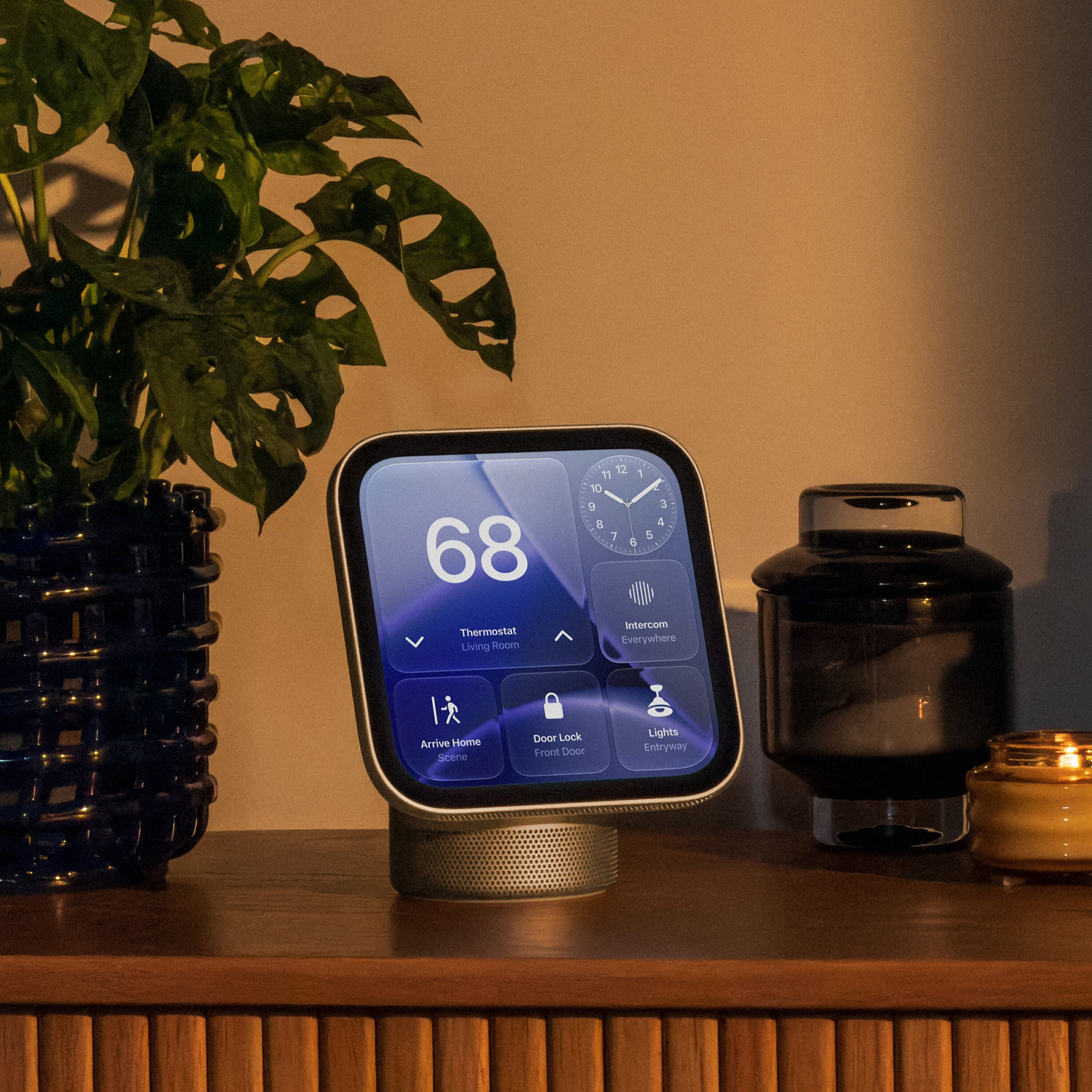
In this episode of Power On, Mark Gurman is joined by Bloomberg’s Chris Welch and Vlad Savov to break down Apple’s long-awaited smart home launch. They share hands-on impressions of the new $299 HomeView, debate whether Apple can finally challenge Amazon and Google in the home, and explain why the new Apple TV 4K and HomePod mini may not be worth upgrading to. Plus, Mark reveals new details about Apple’s upcoming touchscreen MacBook Pro launch, including plans for a late-October event in Los Angeles, a potential November release date and what to expect from the OLED iPad mini.
Have a question for Mark? Email us at poweron@bloomberg.net or join the Power On Discord (discord.gg/3WmCXveqv)
Subscribe to the Power On Newsletter at bloomberg.com/poweron
See omnystudio.com/listener for privacy information.
Transkriptvom Podcast bereitgestellt · Zeitmarken springen hin
Bloomberg Audio Studios, podcasts, radio, news.
I think for the most part, Apple presented for the first time a coherent, complete end-to-end solution for the home. Welcome to Power On. We talk about Apple and the world of consumer tech. I'm Mark Gurman from Bloomberg, and today I'm joined by two of my colleagues, Chris Welch and Vlad Savov. And of course, we will be breaking down Apple's big Welcome Home smart home launch events where the company introduced the Home View, new Apple TV and updated HomePod Mini. We will also break down Apple's late October event where the company is planning to introduce its long anticipated touchscreen MacBook. So stay tuned for that and much more. Chris, so a lot of people listening to this show are have watched Apple events online, have read
about Apple events, and have probably wanted to go to an Apple event. But you've been to many, including the Welcome Home launch event in New York City on Tuesday morning. Can you just tell us about your day? Just start from the wake up. maybe not from the wake up, but start from the early morning.
Start with breakfast.
Yeah, start from the early morning and talk us through the event. Make us feel like we were there. How did it go? Who did you see? Tell me everything.
Yeah, so it's kind of funny to call this an event because it really wasn't one in the usual sense of an Apple keynote or new product thing. It was more of a guided tour of the new HomeView. For folks who don't know HomeView, There's this large building downtown in New York that Apple owns. It's like five or six floors, and they often use it for product demos and these types of things. But there was no sign of John Ternus at this event. As far as I could tell, there were no high-profile Apple folks there. It was more of like a come-in. They played that three-minute video of the family using the Home View. And then we all just kind of did our thing and walked around and saw the Home View demos, saw the HomePod
Mini 2, the new Apple TV 4K. in various rooms and various setups and several demos and took a lot of videos, took a lot of photos, got a few demos, not really too much quality time with it yet. That comes for later. But this didn't feel like the usual Apple event by any means. It was more of like, hey, welcome.
Here's our new stuff. We'll see you later because it's been a busy month and there's more to come, as we know.
And so you were able to actually hear the device, hear the bass, hear the audio quality. You're a bit of an audiophile. How did it compare to a HomePod mini or a full-sized HomePod?
I heard a few songs pretty briefly, so I don't want to make any firm conclusions yet since I didn't really hear too much. But I think it kind of slots in between the full-size HomePod, which costs more than the HomeView, and the new HomePod Mini 2, which is now $ 150. So, yeah, there's some bass, decent bass. It's clear, it's loud, like it gets very, very loud for a speaker, for a screen especially. But on the whole, I think it's kind of that middle ground between full HomePod and the HomePod Mini.
Vlad, are you a HomePod user? Have you ever had one? I know you're from the Android world, but maybe you've used one in the past.
I really like the category. I got to tell you, this smart speaker, especially when connected to Spotify or some service like that, fine, you guys can use Apple Music. It has a lot of benefits. And I think the way that I would actually address the question that you just asked, because to my mind, the first question was in fact sound quality. Because I find myself when I get home from work, I do some of the same routines that Apple's trying to indicate with their breakfast routine in that video. And we've got to talk about that teaser video, right? They ground that lot into three minutes.
But I do find myself, when I come home, if I'm listening to a podcast, a really good example might be in Apple's proposition, Apple's ecosystem proposition. I'm listening to a podcast with my iPhone. I present it to my home view, and I need to get used to using this language, my home view device, and then it will pick it up and start playing it. That is a great proposition to me. I would also say something like a tablet or a laptop when I want to listen to YouTube videos in the kitchen or whatever else you're doing.
You know, the background noise situation. This is why the sound quality matters to me. I'm not going to sit around and listen to a beautiful, you know, orchestral music on it and try and get into the nitty gritty detail of the music. It's does this sound really good when I listen to a podcast, when I'm watching a video in the background. And how do you feel about that, Chris?
For all that stuff, I think it's going to be great. For all kind of spoken word podcasts, YouTube videos, it's going to be more than enough. I wouldn't sit there and play a whole album on the home view because that's not what it's for. But for a song here and there, it's fine. But it's more so for Siri interactions, spoken word podcasts, just very brief interactions. And for that, I think it's more than enough. Yeah, it sounds pretty good.
And a question for.
Both of you guys. Do you feel like there's enough of an advantage to the screen? Like it is called home view, but I didn't immediately see something that upgrades it from a smart speaker. So how do you both feel about that?
For me, it's super interesting how long this device has been in development. I first wrote about it in January of 2023. It's been delayed so many times. They initially wanted to release it as part of the new series at the end of 2024. Then it got delayed to spring, to summer, to fall of 2025. And then again, got delayed to spring, to summer, and to September of 2026.
They were planning to announce this device alongside the iPhone Duo and 18 Pro and 4 Max and the AirPods 5 and the new Apple Watches at the September 9th event, but they split it out because the software wasn't ready, right? This still is gated by software. So the HomeView is not going on sale until November 13th, the month after the introduction, because they want to put some finishing touches on that operating system, which I guess they're calling HomeView software instead of HomeOS. But I want to break down each of the products one by one. Let's go back to the HomeView. So there's four colors, right? There's the pink, there's the starlight, there's the silver, there's the space gray.
It has a seven-inch screen. It has a wall mount. Let's talk about colors. So Chris, what colors stood out to you? Which ones do you think are going to be most popular?
I tend to be a sucker for silver, just because it's so traditional and easy. But that and the space gray look great. I think pink is going to be pretty popular. It's fairly It's light, right?
It's not a dramatic. It's not a hot pink.
It's light.
It's not super in your face. It's not dramatic. It's not. Yeah. So that'll do well. Gold is nice. Starlight is nice. These are all very like tamed down colors.
I actually ordered a silver one for my kitchen and I ordered a space gray one for my desk in my home office.
Two of them already.
Two of them. Yeah.
And I also ordered the new Apple TV, but we'll get more into that. I think the smart home use cases are actually going to be quite slim, at least in the short term. I think the smart home element is a bit overplayed here. I think there's a lot of people who are already in the Amazon and the Google Nest ecosystems in the United States, and it's going to be a large, large challenge for Apple to get people to switch, right? Like, for example, some people have 15 cameras in their house. Some people have, you know, multiple echo shows, thermostats, all sorts of stuff, doorbells hooked up to the ecosystem already in. And getting people to switch away to this, you know, new set of stuff, it's going to be a hard sell. But I think
that the AI story right now is so strong that people are looking for these types of AI devices. They're looking for a dedicated Siri device. So I think if you look at the home view, less as a smart home system controller and more as something where you can get Siri, you can get cooking instructions. You can have a dedicated tablet for FaceTime. You can have something to play your music, right? Basically a HomePod with a screen.
I think, especially for $ 299, that is a compelling product. And I think part of the reason they were able to get down to $ 300 on the price is because these were produced in such mass quantities so many months ago. maybe even north of a year ago in some cases. It's going to be really interesting to see the year labeling on some of the packaging, if the serial numbers will indicate when these things actually went into production. Because these were built before the memory shortage, that's how they got the price down, I believe. So that's a pretty interesting element here.
When the three of us have talked about pricing, and Chris, if anybody wants to come to Bloomberg.com and look at your coverage, half your stories in recent times have been about $ 100 plus price hikes on products. Galaxy S26 devices. Again, more of these home entertainment devices. When it comes to consumer electronics, everything is pricier. And when we've talked about this, we've talked about this being priced at like $ 400 and up because it's Apple, because Apple can go ahead and put its own premium on things. $ 300 is perfectly reasonable. If this product came from Google at $ 300, we'd be like, hey, there goes Google competing on price.
So I said at the top, Sound quality is going to be really important to me because I have to think about this also as a replacement device for some other gadget in my home. Again, I keep coming back to this coming home to watch some YouTube thing. It's going to be a laptop or a tablet that's going to sit somewhere around your living room, right? And this is what this device is supposed to replace. I think it can. And especially because of that price point. Like I think that's going to be the most compelling thing.
And Mark made the point. Um, this is going to be more of an AI entry point rather than a smart home organizer. I fully agree. But Mark, you said something else. You said, um, the new series in 2024, you and I both know there's a new series every year. It's like the jerseys on soccer clubs every year. There's a new series brand new. You got to get the new one. So like, this is my area of skepticism, the area where I'm really attracted pricing. Again, the design, if anybody looks at this, it's evocative of the old Mac designs from back in the day. It's got this hemisphere for the stand and the base, and then this seven-inch square tablet. I mean, we have to give credit to Apple. Like Chris says, from the user's perspective, you
only really see the screen, which is great. But then you have this... large space to put a large speaker into where you can deliver on the quality so to my mind again i feel like apple has done the usual apple design thing um it isn't just hot air when apple talks about apple design there's meaningful something there um somebody like xiaomi who is who tends to be the do-everything device maker over here in Asia. Oh, I will tell you, Xiaomi made sure to give me a ping to tell me that they have more than one billion smart home devices. They really wanted that to be known today of all days. But the point is, Xiaomi will not do it with that level of polish, to my mind. I mean, the design is great. The pricing
is great.
MARK MANDELMANN Yeah, for sure. I think if there was one design thing I could change, I wish you could turn the display around the base. You can't do that. It'll tilt. But if you want to like change it so like someone else can see it, you have to like move the whole unit and turn it towards someone else for it to like recognize their face.
And we saw this a lot in the advertisement, right?
Right.
They had the mom looking at calendar appointments. They had the daughter looking at text messages from her boyfriend. They had the father looking up, you know, French toast recipes and what have you. I have no idea what the son was doing. And then there was another daughter who was still getting ready upstairs. But this device screams for a robotic arm that can turn it to the person talking to it by recognizing their voice. And that's the next product from Apple in this category, J595. That'll come in 2027 or 2028. And so you can see when they were developing this why they thought that the follow-up person should be able to spin on a robotic actuator.
So Definitely looking forward to diving deeper into that. But I want to go back to the presentation for a minute.
Yeah.
Kind of odd. Like you said, no Ternus. Was Jaws there, the head of marketing?
Not that I saw he might have been. There are like several groups. But as far as I knew, there were no like high level, like super senior VPs at Apple who were there today. So I think that made it feel like more like an experience than some big event. That was their point to make it feel more casual and more welcome home, if you will. But it didn't feel like an event.
Why John Ternus is not very welcoming?
I mean, he's the new CEO. You would think for like a brand new product category, he would be there like boasting.
You would think so. Here's my guess. They got to be back in about a little bit over a week, right?
Right.
A week and a half or so for the iPhone Duo launch. Fifth Avenue. And so they'll be there for sure. And I guess it would be too much, not too much money for Apple, but too much of a schlep, so to speak, to go to New York for this and then go back to New York a week later. for the iPhone Duo release at the Fifth Avenue store.
So I'm guessing that's what happened, and I happen to think that I'm right on this one. Okay, let's talk about the app situation on the HomeView. No app store, quite disappointing. But, you know, I do feel pretty compelled by this HomeView product, at least for now, and hopefully it gets better over time. I know it's kind of interesting going against the grain here. Lots of controversy going around this product, and I'm the one saying positive things.
I do want to ask you, because one of the fun comments that I've seen recurring about this device is that, hey, it's an Apple Watch. I mean, Chris, you brought it up earlier. It's an Apple Watch scaled up, which does remind me, when the iPad came out, one of the big, haha, I'm a smart guy critiques was, hey, it's a large iPhone.
Look at you.
Don't you want desktop apps? So, Mark, let me ask you, do you reckon, because I kind of do, that If this thing is really smooth in whatever it does, it doesn't need to do everything. It doesn't need to have every app. It's really smooth.
It's well-designed.
And you feel like you're getting good value for your $ 300, which nowadays in electronics, you can't buy anything for that much money. Do you feel like that can be enough just to get people in the door and using the device?
Yeah, for me, it's a price thing, right? I mean, if this was $ 400 or $ 500... this would be a lot less interesting. For 300 bucks, the same price as the new Apple TV 4K, which we're gonna get into, for me, it's a no-brainer. Obviously, I need this new operating system. I need to play with it for work.
But I definitely can see this thing fitting into my life as a dedicated FaceTime device, as a dedicated speaker, right? Like, I want a speaker on my desk. I want a speaker in my kitchen. It's gonna be great for cooking. It's going to be great for looking up recipes. It's going to be great for FaceTiming while cooking or doing other things in the kitchen. So I definitely see the use cases here. And I think that it is a compelling product. But the downside for Apple is that it's just so many years late. on bringing something into the smart home market. Amazon and Google have such deep penetration here that Apple's going to find it very difficult to get people to move out of those ecosystems. They're basically
going to be pitching themselves to new home buyers who are already deep in the Apple ecosystem, or people who have not gone into the smart home yet.
I think that's still a pretty big group, the latter, of people who still don't have too many smart home gadgets in their house. I think there's still quite a few people.
Right here.
There you go.
Yeah, but you don't have an iPhone, Vlad, so you're kind of SOL.
Yeah.
Yeah.
Well, listen, I've had a Nest Thermostat in my home in London for a very long time. The thing with the, quote unquote, smart home, it's a decades-old idea, and what tends to happen is we just tend to get one device. We never jump in in a full-fledged manner. Some of it has to do with just the facts of modern life, which is that you move around quite a lot. But Chris, trivial question for you without looking it up. Can you name all the partner devices, the LG and Schneider Electric devices that Apple showed off?
Because I can't.
Name, definitely not. But there are several cameras, indoor, outdoor, thermostats. There's an LG door lock.
Doorbell.
Doorbell. And those are all pretty pricey in their own right as well. For their categories, they're up there.
Some of them are more expensive than the home view. The floodlight camera, I think, is $ 350.
Yeah.
And the home view is $ 300. But anyways, let's move on to the second edition of the day. That would be the new Apple TV 4K.
Oh, my.
So the standout features here, A19 chip, which is an upgrade over the A15 Bionic in the prior version of the Apple TV. But perhaps the biggest development when it comes to this new Apple TV is the price. $ 299, the same as the Home View. This is a shocking price increase. They went from $ 129, I believe, or $ 149.
What was it, Chris?
$ 129, I believe.
So they went from somewhere in the $ 100s. to $ 200 with the memory hike, and then they added another $ 100 for this new version. And is it really worth another $ 100 for those features? What do you think, Chris?
I mean, I love the Apple TV, and I have for a long, long time. I think it's the best home theater device.
There is.
But even for me, $ 299. Well, there are no ads. I've got like a Roku TV. I've got a Google TV.
That's it, Chris.
That's our benchmark nowadays. It doesn't put ads in my face. Therefore, it is my money.
I mean, it's easy to use.
No, but genuinely, I ask because you're much more into the home theater scene than I am. I mean, my home theater is a 32-inch monitor in front of me. What differentiates a really good home theater device, such as this Apple TV, versus whatever else you can get on a budget?
Speed performance, app selection, stuff like AirPlay works great on the Apple TV, obviously. But also TVs have that now these days, like Samsung TVs have AirPlay and so things like that. So it has lost some of its luster. And I think $ 299 does not help that case at all. Because in terms of video and audio performance, this model is the exact same as the last one. There are no new audio or Yeah, there's no new benefits like the picture quality or the audio processing. No 8K. But you can now use four HomePods for surround sound if you want to spend God knows how much that'll cost you to buy four HomePods. Nobody's going to do that.
Nobody's going to do that.
That's an option only for this model. But there's just nothing super standout about it. And also, Siri AI is coming to the past model, they said, today. So some version of Siri AI is coming back to the prior version of the Apple TV 4K. So at that point, all you're buying is this There's this, like, hands-free, like, voice feature that some people use, I'm sure, and like.
And they're remote, which I lose a ton, so I will appreciate having, like, a beep or a Find My Sound just to find it in the couch cushions. But $ 299. If it were, like, $ 249 even, I could see. But, like, this is, like, game console pricing. This is, like, up there. It's, well, I guess old game console pricing because we're in 2026.
That's right.
Back in the day in Kosovo.
A few things. The one thing people had been asking for Apple to add to the Apple TV was a FaceTime camera, right? Instead of that, they just put some microphones in it. So I guess you're halfway there, Apple. The second thing is many people put their Apple TVs in two different places. Some people put it behind their TV, right?
If you have a TV mounted on a wall, you put it in a slot that you buy on Amazon or whatnot behind the TV. And there's many people who throw it in a cabinet under their TV. How well are these microphones really going to work if the device is in a cabinet or hidden behind a TV, right? So this might be a worthless addition anyways. So I don't get it. I'm not really sure why they added these microphones. I understand it from a Siri AI and ecosystem perspective. But the chances are if you're buying this Apple TV, you probably got a bunch of HomePods in the house anyways. and other Apple devices. And you can control your Apple TV with your voice on Siri through your iPhone, your iPad, or your HomePods already. So this
just seems like a worthless addition that just added cost instead of doing the thing that people actually were asking for, which was the built-in camera to use FaceTime on the Apple TV, which if you haven't tried it, is pretty darn good. What about the HomePod Mini 2? It's equally as disappointing, if not more, than the Apple TV 4K, right?
I mean, they raised the price.
No, you can't be that bad.
Dude.
The one new feature, there's no telling when it's actually coming.
It's not ready, just later.
AI out of the box. They've delayed Siri AI. So you get this new HomePod Mini, and the only new feature is the faster processor. There's a few other things, but for the most part, you have this S10 chip going up from the S5. And what can you do with it if Siri AI is not available?
Right?
And nobody knows when it's going to be available.
So.
That I thought was ridiculous. The colors are cool.
There are a couple of things. You can use it as a speaker for your Mac now. And so there's like no latency.
Who's going to do that? Who's going to do that?
These are the demos they showed because they didn't really have much else to demonstrate. So like there's not much really going on with it. But the thing on the top, the glow light. now synchronizes with your album artwork on your phone.
Who cares?
Who would even notice that? I don't know.
No, seriously, who cares? Like the only people that should be buying these new minis are people who have wanted a HomePod mini, people who are going into the Apple smart home ecosystem. If you're upgrading your current HomePod mini to a new HomePod mini, you have so much extra cash that you should probably rethink your investments. So that's what I'll say. For instance, I said I got two home views and I have an Apple TV coming. I have three TVs and I'm only getting one Apple TV because I got this current gen Apple TV in two of them. And I have a really old Apple TV in one of them and I need to replace that.
I have a bunch of HomePod minis in the house. I think I've got four or five. I'm not touching those. I'm not getting any additional ones. This is just a waste of a product in terms of an upgrade. In terms of if you're new into it, fine. But from an upgrade standpoint, which I assume a lot of people already have HomePod minis, Just don't even bother.
Yeah.
But even then, like 150 for this thing, like 99, you can make a case like the sound wasn't great, but for, you know, it's 99 bucks. 150, like even there, like your bar, you know, starts to go up a little bit. And I feel like the HomePod mini is fine, but it's no HomePod. It's no, you know, Echo Studio.
It's no Sonos Play. So I think, you know, it's fine for what it is. Well, it was fine for 99. 150, we'll see, you know. But I guess once Siri AI comes along, Then we'll be able to tell, like, okay, does this change the game for this tiny little speaker?
Well, there's no screen on it, right? And so it's like, what are you even doing here? What are you really gaining here?
Yeah. Mark, I do want to point out, when you started breaking down the home view, you got right into the really important stuff of colorways. And then when Chris brought up the colors and the lights on the HomePod Mini syncing with your music, you're like, who cares? Like, we gotta be consistent, all right? Colors even matter, but it don't matter.
I'm kind of questioning if I got the right colors for the home view. Chris was there. He saw them in person, wanted his take. Believe me, I've been bugging him the last month or so on if I should be getting the dark blue iPhone Duo or the white iPhone Duo.
White all the way, everybody. White all the way.
I ended up going with the dark blue, one terabyte, the night sky. I'm looking forward to it. I think it looks absolutely slick. But yes, when I'm asking Chris about colors, it's for selfish purposes. But also, many people listening may be curious, too.
To round all of this up, let's take me as the example of the person who's outside the Apple ecosystem. You guys did an amazing job of not selling me on the Apple TV 4K. I won't even think about that thing after we finish this podcast. I think you attacked the HomePod Mini 2 so hard that now I feel like I need to defend it. And I'm intrigued by the home view. Let's start with you, Mark. Do you feel like this is a compelling lineup right now?
And beyond that, Now that the HomeView is there, now that the new digital hub for the home is there for Apple, do you see a whole bunch of other partnerships with the likes of LG and Schneider Electric, more such providers for more home gadgets?
Let's take price out of the equation, right? Let's just talk about the products. Let's just talk about the ecosystem. Let's talk about the story. They made a very compelling case for why you should buy from the Apple Home ecosystem. I don't think there's really anything other than video and third-party apps from the home view that's missing here. I think this is going to be a cool device. It's going to be a great device. It's going to be extremely popular. People are going to want to put them in the kitchen. People are going to want to put them in their bedroom. People are going to want to put them in the entryway. People are going to want to put them on their wall next to their ADT panel or whatever their security system panel is. I think
that you're going to see a lot of different companies jumping up and down, trying to get deeper into the Apple Home ecosystem because then now they have something central to bring people in with. The problem with the original HomePod and then the HomePod Mini is that those were not flagship devices to bring people into the HomeKit universe.
There was no reason for the accessory makers to do everything they could to get into HomeKit because they had no Apple flagship devices attracting people into that world. But the Home View, the more compelling Apple TV 4K and the improved, I guess, marginally improved HomePod Mini, that changes the equation. So I think overall, Apple is going to see success here, even if that doesn't mean stealing share in terms of existing Amazon and Google users.
What do you reckon, Chris?
I mean, I'm most intrigued by the Home View, obviously. There are still so many questions about facial recognition and how soon does it recognize someone and how soon does it change modes when someone walks away from the screen.
I want to talk about the facial recognition. Can I jump here? Let's talk about the facial recognition. Let's be very, very clear here. This is not Face ID. This is software-based AI. And I wouldn't be surprised because there's no IR sensor here. There's no depth sensor here. If people are going to be able to fool this thing with super high resolution digital photos of people, right? Now, I understand Apple's argument here, which is, well, if you're living in a house with someone who does that, Maybe you shouldn't really want that person in your house. And fine, I get it. But from a security standpoint, there is a reason why Apple's not touting this as some highly secure device. There is a reason why there's a backup
authentication method about having your iPhone with you or recently unlocked on your same Wi-Fi network. there's a reason why they are not touting this as Face ID grade or Face ID quality. And there's a reason why the iPhone Duo, which doesn't currently have room for a depth sensor to do highly secure Face ID, is not using these same algorithms.
That's why they're using Touch ID there instead, because that's a phone you always have with you, something you can leave at a bar, leave at a restaurant, leave at work, or what have you. And so it'll be interesting to see if people are able to fool that thing. It'll be interesting to see how well it can hold up over time, and if the algorithm gets better as it's being used. Did they talk much about that at the event, Chris?
Not at all. Not at all. They said, yeah, so you can use up to six profiles, and each profile has to have their own iPhone or iPad, because I guess that's how you set it up. Because there is so much deep ties to the iPhone and iPad still. That's how it gets all your personal contacts. So if you ask about your calendar, it's pulling that from your iPhone.
That's not on the actual home view at all. It's always pulling from your device when it comes to your own personal details and data.
So what's the latency going to be? Like if anyone listening to this has used Siri AI, which I'm sure is a lot of you other than Vlad, you know how slow that thing is. You ask it a question, it could take, you know, 30 seconds, 60 seconds in some cases to get you a response, go deep into your phone to get something that you have to connect to the network to process it. So you're going to have to do all that. Then you have the potential latency between the device and the home view on your kitchen counter. Did they show any like live demos of this thing working or was it all sort of video loops?
Yeah, there were a few demos. There was one where someone asked, like, when is David getting to the airport? And it took like a few beats, like one, two, three. And then it was like, he'll be at the airport at X hour. And then the person asks, how long will it take him to get to my house once he's there? And again, like you wait like three or four seconds and you hear. So it was like pretty speedy.
Like it seemed pretty standard for Siri AI, as I've come to know.
But it's a device that is on a server that's not being tackled by millions of users already. They probably put together a dedicated infrastructure for that device. You're probably hardwired to the best internet connection you can get in the Tribeca area in New York. So there are factors there that make it very different and sort of like a prime sort of place to do this lab experiment, whatever you want to call it. The other question I have is, in what use cases, is it actually more convenient to use that device than to just pull out your phone or ask your Apple Watch, right? There are going to be many use cases. Like if I want to know where someone is, you know, I may pull out my phone and ask, find my, where is my wife, right?
Versus going, walking over to the home view and asking that question. So I don't know. I think that the better use cases are the alarm clock, the bedside table, FaceTime, cooking, music. I don't think the Siri stuff is as compelling as Apple thinks it's going to be, nor do I think the smart home stuff, at least for now.
I think it's worth bringing up the fact that this is going to be Apple trying to break into a new category successfully. For the first time in close to a decade, I look back and we have to go way back to the Apple Watch itself, to the AirPods 2016, for a real Apple product that was a breakthrough and genuinely took a leadership position in a new category. We've had a Vision Pro that went nowhere, but then the entire category has also gone nowhere.
I can't talk about the Vision Pro because I'm going to get attacked. I'm going to get attacked. You have to see what these guys.
Do to me online about the Vision Pro.
It's really crazy. Look, I know you spent four grand on this thing. I know you made a big mistake doing that. It's not my problem. It's not my problem. It sounds like it is your problem. People are harassing me while they're making it my problem. It's like, yeah, you're right. I came up with the thing. I designed it.
I developed it. I made it, you know, 10 pounds. The Welcome Home Smart Home event was the first of two major events happening this month in October. The next one, this one's going to take place in LA, in Los Angeles, and it is going to occur on or around Tuesday, October 27th. And what they're going to introduce here are the touchscreen MacBooks, the 14-inch and 16-inch versions. They're going to introduce the M6 iMac, the M6 entry-level low-end 14-inch MacBook Pro, and the OLED iPad Mini. And this is going to be a creator-focused event. Now, I think it was our first episode where I talked about influencers and how there's lots of influencers at these Apple events, and Apple is shifting their PR and marketing towards them. Well,
I said that it's very likely these people are either getting paid or getting their trips covered. I can tell you exclusively on the Power On podcast, that I have confirmation now that Apple does indeed offer influencers paid hotel, paid business class travel to go to these launch events. And they are planning a two-day spectacle for certain influencers in LA that includes meetings with John Ternus, the new CEO, and other Apple executives, includes a dinner on the evening of the 27th. So you can already tell how they're trying to position this. They want influencers, They want creative types.
They want video editors, music specialists, et cetera, to be playing up these new iPads and these new Macs, which, of course, is unsurprising because this is how they've tried to position the Mac now for several years.
I will say some of that is kind of standard fare when it comes to, you know, Samsung, Google. They, from what I've seen, pay for travel, hotels. They host dinners. Everybody, that's just kind of the state of the tech industry we're in now, for better or worse. You seem to think it's worse.
Which I seem to think it's worse. And I definitely don't think that Apple is the worst actor here. I don't necessarily think they're doing anything out of line or anything different than the competition. But there was a time where people didn't have to get paid or get their travel paid for to go to an Apple event.
Right.
People were begging to go. It's not the other way around, typically. So it's a bit of an interesting thing worth noting. Yeah.
So Los Angeles is It does speak also to this idea of speaking to the creator economy and creatives in general, since it's such a hub. I'm surprised, Mark, that you didn't just come out and say that they hosted it there just to be closer to you, because you're so stoked about this touchscreen MacBook.
I am.
Once a month, I hear you just exclaim with excitement about a touchscreen MacBook. Tell us why.
Oh, well, I think that Apple should have added a touchscreen to its laptops 15 years ago, right? They're only doing it now because everyone else is doing it. And again, they're 10 years late to this. I think being able to transfer the way you use your iPhone or your iPad to your Mac to have that unification, I think makes a lot of sense. I think the iPad and the Mac should be differentiated in terms of performance. They should be differentiated in terms of screen real estate. They should be differentiated in terms of ports and different hardware technologies and audio and maybe form factor to some extent.
But I think having unification when it comes to user interface paradigms and applications is extremely important. So I'm glad they're finally doing it, right? It's kind of jarring. You're using an iPad. You're pinching to zooming. You're doing touch manipulation and then moving over to a Mac, and you have a completely different paradigm. It makes sense for them to be completely linked. And the user interface Apple has come up with with this new MacBook Pro I think is fantastic. The best way I can explain it, is the user interface changes they made to iOS to fit the iPhone Duo hardware. You're going to see a lot of things bespoke for macOS GoldenGate on this touchscreen MacBook Pro.
So looking forward to taking it for a spin and using it. hopefully we'll be there at the launch event to get you that information early like we were.
Yes, Apple, please invite me. I know nothing about any of these products. I don't know anything about any of this. Please invite me to your event. Thank you.
And Chris will come for free, by the way.
You don't need to pay Chris. You can pay for his own travel.
Yes, and we will cover Chris's travel. That's hilarious.
I would say that right now, the entire Mac lineup, as far as the laptops go, is not necessarily sufficiently differentiated for me. I can see that the MacBook Neo has its niche. It's the most affordable one. It does most things really well for most people. You're buying one for your parents or your not particularly techie family member.
Here you go, MacBook Neo, you won't go wrong. Great. What's the difference between the MacBook Air and the MacBook Pro? There are so many applications where those two devices really overlap. $ 2, 000. Right, price, of course. I tend to neglect it when we have these conversations. But when you're talking about them as products, I look at the MacBook Pro and I'm like, great, this gives me a lot of performance. And then the MacBook Air seems to do the same, right? So maybe the touchscreen, together with a few other nice bells and whistles and additions, can be the thing that elevates the MacBook Pro to feel like a more differentiated product from the Air.
I agree with you. So I think this will be successful. I mean, the biggest headline here is this is a complete reversal. from everything Tim Cook has said and Steve Jobs before him. But the times have changed. They need to do more, and now they're doing more. Ternus has been a big driver of this product, and now it's finally coming to market about a year late. Okay, so something else I can share exclusively on this podcast is that Apple retail stores are going to have a big floor reset on the evening of Thursday, November 5th, into Friday, November 6th. And given that these devices are going to be introduced on the 27th or 28th in L.A., And Apple typically releases new products on Friday. It seems plausible
that November 5th to November 6th is when these new Macs go on sale. To be clear, November 6th would be the start sale date based on this timeline, if that holds. So it's going to be a very busy next few weeks for Apple. You've got the rollout on October 23rd for the iPhone Duo. You've got October 30th for the HomePod Mini. Man, Chris, you think there'll be long lines for the HomePod Mini?
People are going to be camping out for two days for the HomePod Mini.
Yeah.
You guys are brutal.
Yeah.
And then potentially on November 6th, you've got the new MacBooks or iPad Mini OLED. And then November 13th, you've got the Apple TV 4K, again, long lines and the HomeView. So it's going to be a busy four or five weeks.
The president is going to be tweeting about it, the Apple TV release date. He'll be like, Apple, I need it sooner.
Get it to me sooner. Yeah, that's funny. That's funny.
You know, I got to say, I do appreciate the fact that we're so deep into it and you're breaking news about November 5th and Apple retail operations.
This is it.
This is what people should be doing to the podcast.
Oh, yeah.
Vlad, they already know that. They're already listening. All right.
And just to clarify, will there be the classic Apple pre-recorded full-blown event for these Mac refreshes?
They'll do something, right? I mean, at the very least, they're going to have those those videos, they'll have some sort of explanation video. But it's interesting because Ternus, as Chris said, wasn't there for this New York home launch event, again, because he's coming in a week for the iPhone Duo.
But I fully expect Ternus to be involved this time around. Again, he was the Mac guy, right? He was the iPad guy. And let's not forget the OLED iPad mini, which is going to be there too, and is going to be pretty darn expensive. I guessed in my Power On newsletter, again, it was just a guess, that the iPad mini is going to be $ 799, which is, you know, Bit of a hefty price hike from the current iPad mini when you factor in the OLED and the other changes. And I was like, maybe $ 799 was too high of a guess.
You know, what I really know is going to be more expensive. But then you look at the $ 300 for the Apple TV and the $ 150 for the HomePod mini, I'm like, OK, maybe that sounds kind of reasonable.
Yeah, I'm pretty hyped for this iPad mini. So it's OLED. Do we know if it has ProMotion, 120 hertz? Could it still be 60 hertz?
We'll see. This has been a bit of a controversial topic in the rumor mill.
I have.
been told of iPad mini units with 120 hertz promotion. But I've also been told of iPad mini units that cap at 60 hertz. So as of now, I would say it's a coin flip. We'll figure it out closer too.
Feels like if you're going, you should just go all the way, you know, but we'll see.
Right.
Are you an iPad mini guy, Chris?
I'm an iPad Pro 12-inch guy. So, but it's, you know, there's a place for this probably. I mean, if it's a waterproof, I'm going to use it for like e-reading, you know, it could be like, It could be a nice high-tech Kindle competitor.
What about your iPhone Duo?
You know, I'm still trying to save pennies for the Duo. Yeah, the Duo is going to be a huge expense, even with a trade-in to my 17 Pro Max. It's going to.
No, no. I mean, you know, why would someone need an iPad mini and an iPhone Duo, right?
I mean, they're more sturdy. Like you were saying, this is going to be like water-resistant, waterproof.
I mean.
So is the Duo. I guess the Duo will, too, to some extent, but... That can break probably easier than an iPad mini.
Look, Apple doesn't need the money more, right? This is true. I would get the Duo and probably bypass the mini. That's what I'm doing. I'm not getting the mini.
Yeah, it feels like this might be the last gasp for the iPad mini, like one more very nice upgrade, and then we'll see how much more life this product gets.
It's another product category because on paper, it kind of looks like it has a reason to exist. And I would also say that about the smaller... pro-level smartphones. Like I've been using Google's latest Pixel, the non-Max edition, the smaller one. And it's like, on paper, if you ask me, I say, yes, give me the more compact smartphone so it's more comfortable for me to tuck it into a pocket, et cetera. When I'm actually using it and I compare it to those six, seven, six, eight inch BMOs that everybody sells, I'm like, no, I actually want those big things, right?
And likewise, with you saying use a 12-inch iPad versus the mini, well, that's the difference between a horse and a pony, You can do so much more with a 12-inch display, whereas that 7, 8-inch display is kind of the unhappy middle ground. We have this in our editorial meetings, the mushy middle, where you're not really being ambitious and you're not really doing something quick. It's just you're in the mediocre middle. I think you're right about the size, but let's not underestimate this OLED upgrade. I think once you get one of these things in hand, The Nintendo Switch is a really good example. A friend of mine, he's a long-time Nintendo Switch user. The moment Nintendo came out with an OLED Switch, he switched to the OLED Switch.
And now he's an OLED snob. He's like, if it doesn't have an OLED display, I'm not even touching it. I feel like this month with these two events, both the one that just happened and the one that's coming up, is giving us Apple following two tracks. Like on the one hand, there's a very familiar thing, which is Apple just iterating and improving on products like we've been saying.
Some of them are getting us really excited, some of them less so. And then with the home view is trying to break into new categories. How do you see the whole lineup now as it's shaping up? Is it shaping up, let's say, heading into 2027? Do you think it makes sense? Do you think it's promising? Do you think there's more growth to squeeze out of users? Because the Apple ecosystem has a lot of loyal users, but they're not growing in number quite the same way that they used to.
Can we just take a step back and recognize that Ternus has been CEO for a month and a half, and he'll have introduced in that month and a half three new product categories, the iPhone Duo foldable phone, the Home View, Smart Home Hub with a display, and MacBook Pro with a touchscreen. Tim Cook did like three product categories in the whole 15 years with the AirPods Watch and the Vision Pro. Obviously, this was all developed and driven under Cook. And Cook, for some reason, let Ternus take the spotlight for these products. So it is fairly interesting.
They're really trying to position this guy as some sort of Apple product savior and new type of visionary, even though this stuff has been in the oven for half a decade.
I guess like how much is too much, though? Because can the average person really like keep up with like five or six new Apple gadgets in the span of a month or two.
I mean, wait till I tell you about the November and December events. Just joking. Just joking.
Yeah, it sounds like we're done for the year almost, thankfully.
We're not taking Christmas off. We're going to be working Christmas because Apple can't stop.
All right, let's get into the listener Q & A. If you have questions for us, of course, shoot them over at poweron at bloomberg.net, and we'll get to it in a future episode. Vlad, what do you have for me this week?
Right, this question is from a user named Stretchmaster2. Love these names. Mark, you touched on this already in our conversation, but given Turner's push to streamline the company and his plan to increase hardware releases, as we've just been talking about, how does the Apple retail changing under his leadership? Do you foresee significant changes?
I think it's too early. I do not foresee significant changes in the short term. I do think in a few years, you will see a management shift for retail. Deirdre O'Brien has been at Apple for north of 35 years. She has the dual role of senior VP of retail and being the company's chief for human resources. About a year ago, she promoted her deputy, Vanessa Trigub, as someone who's a new vice president in charge of all retail stores.
That was a newly created role So they're clearly preparing for a succession there. So maybe Vanessa has some changes up her sleeves. But in terms of Ternus, I think he's letting that operation flow as it does. And he's mostly focused on the hardware engineering side. You know, Apple was going to lay off about 5,000 AppleCare workers in the summer. But, you know, I'm told Deirdre, she's pretty allergic to these types of layoffs. And, you know, she threw herself in front of a train to stop it, so to speak.
And John Turner is doing his best to fill the stores with as many gadgets as possible. So everybody keeps as busy as possible.
Yes, he is. And I strongly believe that he strongly believes in Apple retail and Apple retail having a strong place in the company and being part of that pipeline of the Apple product rollout. Apple creating the product, Apple helping manufacture the product. and then Apple completely dictating how the products get sold and distributed. And it is an essential part of the process. And you saw how happy and involved he was at the Apple retail launch for the iPhone 18 Pro. And I'm sure that'll be tenfold when the Duo comes out. So I don't see any major changes anytime soon to Apple retail.
Just make it a little bit easier to actually buy something. That's my request. Just point me to one specific spot in the store to go to and make a purchase and be on my way. Because even now, it's still, you know, you've got to walk in, Hope you find someone who's free and available. So I guess, I don't know.
I should just order stuff for pickup, but I'm an old school guy. I just walk in and try and buy something on the spot. And it's still too much of a challenge at most Apple stores, I feel like.
Isn't it crazy how hard it is to go into an Apple store and buy something?
Yeah.
I mean, just from a fundamental standpoint, maybe Ternus should just walk into an Apple store one day. No one's going to recognize him anyways. And just try to buy something and see how that goes. And maybe he should figure that out.
I need a camera. I need a camera with John Ternus walking into an Apple store and just see how long it takes for an Apple employee to recognize him. That'd be brilliant.
I would guess a couple will recognize him immediately, but I don't think he's got that Tim Cook-like recognition. I mean, I saw the videos of Tim Cook in China the other day. They were all over him. You would think the guy's still CEO, but Ternus will get there. It's still early. It's only been a month and a half.
For more from Mark, subscribe to the Power On newsletter at Bloomberg.com forward slash Power On and follow at Mark Gurman on all social platforms. Power On is a production of Bloomberg Podcasts. Our show is produced by Alexis Hott and Keshav Pandya. Our supervising producer is Magnus Henriksen. Audio engineering by Blake Maples. Original music is by Taka Yasuzawa and Alex Segura. Our video editor is Bobby Krause. Our executive producer is Amy Keene. And Cheryl Brumley is our head of podcasts. Special thanks to Nick Turner and Tom Giles.
Thank you for listening.
