

Smart Bear Live· Folge 11
E11 w/ Mariya Delano: How to Fix a SaaS Trial-to-Paid Conversion Problem
Samstag, 24. Oktober 2026 · 1 h 12
Kapitelklicken springt direkt hin
Shownotes
About half of Userlist’s paying customers never fully set up the email automation they paid for. Jane Portman and Benedikt Deicke built Userlist over nine years for sophisticated SaaS marketers, but its onboarding is free and optional.How do they get customers to do the setup that makes the product valuable and sticky? Making onboarding mandatory, and charging for it, could scare off the very customers they want most.
Cohost Mariya Delano and I dig in: A candid working session including:
- an onboarding fee that “needs to hurt”
- a one-person business that spent $20k on consulting
- when a low price looks “suspicious” to buyers
- a cofounder admits she can’t do enterprise sales
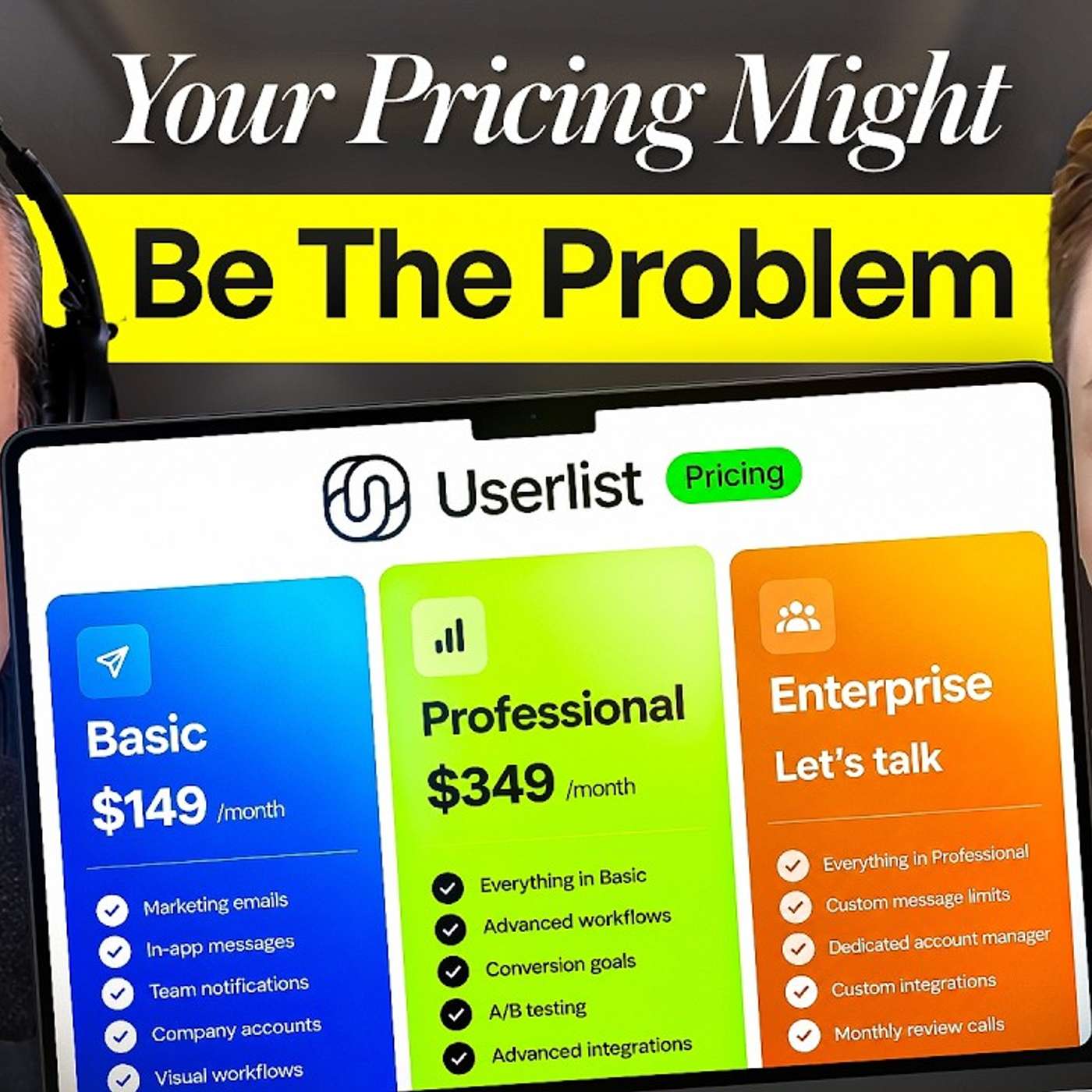
- the $149 tier Jane says should be eliminated
- they can’t name one podcast their buyers hear
ME ME ME!!!
Subscribe on YouTube (youtube.com/@asmartbear)
Subscribe via Podcast (smartbearlive.com)
📘 Get my book (hiddenmultipliers.com) 📘
My bio + 20 years of articles (longform.asmartbear.com)
Twitter (twitter.com/asmartbear) | LinkedIn (linkedin.com/in/jasoncohen)
STARRING JANE PORTMAN & BENEDIKT DEICKE
Userlist (userlist.com)
Jane’s UI Breakfast podcast (uibreakfast.com/podcast)
Twitter (twitter.com/uibreakfast) | LinkedIn (linkedin.com/in/uibreakfast)
Benedikt’s Slow & Steady podcast (slowandsteadypodcast.com)
Twitter (twitter.com/benediktdeicke) | LinkedIn (linkedin.com/in/benedikt-deicke)
WITH COHOST MARIYA DELANO
Kalyna Marketing (kalynamarketing.com)
The Marketing Speakeasy podcast (belkins.io/the-marketing-speakeasy-podcast)
ADMD newsletter (admdnewsletter.com)
LinkedIn (linkedin.com/in/ria-delano)
REFERENCED IN THIS EPISODE
TinySeed (tinyseed.com)
MicroConf (microconf.com)
Segment (twilio.com/en-us/segment)
“Marketing Technology Landscape”—chiefmartec (chiefmartec.com/2025/05/2025-marketing-technol…)
TIMESTAMPS
• () - Userlist's stalled growth: who is it for?
• () - Why growing customers cancel
• () - Email ROI is measurable: wrong customers?
• () - Lost champion: spread value beyond one user
• () - Fixing onboarding: HubSpot's forced training
• () - A $10K implementation fee for onboarding
• () - Selling to bigger budgets: the $20K client
• () - Priced below Mailchimp and ConvertKit
• () - Where are the customers for geeky features?
• () - Should Userlist go simple and down market?
• () - Do thousands of geeky marketers exist?
• () - Next steps: interviews and $20K onboarding
• () - Be proud of the path that got you here
• () - Imposter syndrome and perfectionism
Transkriptvom Podcast bereitgestellt · Zeitmarken springen hin
Jason Cohen (00:00) The stars of today's episode of Smart Bear Live are two co-founders who spent nine years building an email system for product marketers at SaaS companies. But growth has slowed recently and two things are going wrong. Trial conversions have fallen by half, and customers that had been sticky in the past are starting to cancel.
Benedikt Deicke (00:17) So far, we haven't been successful at like selling to companies with a bigger budget, basically, or like slightly larger teams. For a long while it was feature based because we didn't do this or we didn't do that and…
Jason Cohen (00:28) But I don't understand. Your whole the whole thing in your product is…
Jason Cohen (00:31) It's got every feature…
Jason Cohen (00:32) A sophisticated SaaS person needs, so what do you mean it doesn't have the features?
Jane Portman (00:35) If we step into the shoes of a SaaS founder who is in a crisis mode and is trying to cut costs between all the software tools they're…
Jason Cohen (00:42) So we're no longer talking about the sophisticated marketer. We're talking about somebody else.
Jane Portman (00:46) Sadly.
Benedikt Deicke (00:49) Be part of the problem because that positioning definitely evolved over the years.
Jason Cohen (00:53) You need to say exactly what the product is for, who it's for.
Jason Cohen (00:57) Charge $10k implementation fee to help them implement it.
Jason Cohen (01:01) The people who aren't serious won't buy…
Jane Portman (01:03) We had in mind was like $1k Guided on boarding fee.
Mariya Delano (01:07) No, no, it needs to hurt. You need a consequence that is obvious not just…
Jason Cohen (01:11) So today these star founders are gonna open up their business to us and we are gonna help them figure out what's going on and how to restart growth. And so who is this we you might ask? I'm Jason Cohen, known online as Smart Bear. I've built four startups over the last 25 years, two of which are now unicorns. I've bootstrapped, I've raised hundreds of millions of dollars, I've written hundreds of articles. I just published a book called Hidden Multipliers, which has all my best ideas about how to grow your business with your existing budget and team, which is relevant to today. But you can look at all that later because joining me to help our star founders is the great Mariya Delano.
Jason Cohen (01:45) She runs Kalyna Marketing, which helps technical B2B companies do content marketing, and she has a podcast called The Marketing Speakeasy, which I love. Because the idea of a speakeasy is it's not allowed, but we're gonna do it anyways. So I like that. Now her whole framework is about turning customers into super fans, which is exactly what our star founders need because the customers they thought were locked in are starting to leave. And so welcome, Mariya.
Mariya Delano (02:11) Thank you. Thank you for having me. Very excited to be…
Jason Cohen (02:14) Oh yeah. So together, Mariya and I are gonna help the stars of the show, Benedikt Deicke and Jane Portman, with their company Userlist. So Benedikt and Jane, thank you both for being open and vulnerable and sharing your business with us. It's a scary thing to do, which means it's brave. And it's generous to the listeners, and so we thank you for that.
Benedikt Deicke (02:35) Thanks for inviting us. Um we feel honored to be here.
Jason Cohen (02:39) This is gonna be fun. But not for you. No, I'm kidding. We'll see. So when I look at your home page, the big text at the top says email automation for sophisticated product marketers. So there's a lot in there. There's automation and only sophisticated marketers. So tell us what the product is and why it's only for sophisticated marketers.
Jane Portman (03:02) Um Userlist is an email automation platform, and the way we help SaaS companies uh send lifecycle marketing and transactional emails. But that every other platform can also do that. So the way we differentiate from others is by offering advanced features where SaaS companies need it and not offering advanced features where they don't. So tailoring our scope to SaaS companies while also offering all kinds of advanced, super nerdy, super geeky features and content that goes along with it…
Jason Cohen (03:32) G Geeky for who? Like the marketer?
Jane Portman (03:35) Um Yeah, all kinds of advanced things you can need down the road…
Jason Cohen (03:39) But…
Jason Cohen (03:39) For who?
Jason Cohen (03:39) So if you have a simple thing that you want to do, you're not the right tool, right?
Jane Portman (03:43) No, we aren't. Because there are ways to do that five times cheaper.
Jason Cohen (03:47) Nice. Okay. So it's expensive, but you get what you pay for. You get a lot of stuff only for SaaS. So… I would think that if I was implementing this and I was using this for onboarding as well as for marketing and it really was bringing people back on the happy path and increasing retention through onboarding. That is growth and money. I don't understand how I could cancel. So w when people cancel, what is going on? Are they going to a competitor?
Benedikt Deicke (04:13) I think there's multiple reasons why people cancel. Um a big chunk is because they never really start using our product properly. Because like setting everything up and uh building a tight integration with their own application is work, and who wants more work?
Jason Cohen (04:28) Is that ironic that a product that's supposed to help you with onboarding, among…
Benedikt Deicke (04:31) It…
Benedikt Deicke (04:32) It in a way it is, I guess, yeah. Um but um I guess that's the tough reality of… And then uh we noticed as companies grow, like which is usually a good thing because they get more users, make more money, eventually they churned out because we became too expensive for their use case, I guess, or they didn't want to pay that much anymore.
Jason Cohen (04:54) Wait, I don't understand. As the company gets more and more revenue, and therefore more and more value out of your product, they churn because it's too expensive now? Isn't that the opposite of what it should be?
Benedikt Deicke (05:06) I don't understand either.
Jane Portman (05:08) So the thing I still personally struggle as well is the ROI of email marketing for SaaS is there, but it's very hard to really prove. Uh and it's especially hard to prove if you're doing your work not the full way in investing a lot of hours into the email program… And since the ROI is hard to we sometimes get sacrificed.
Mariya Delano (05:29) Yeah. When people cancel, do you know what they go to do instead? Do you know like what kind of tool they end up switching to? Do they just stop doing email marketing altogether? Like, what's the story there?
Benedikt Deicke (05:41) So some switch to other tools, uh, but we also recently had a couple who just shut down the company because it isn't working anymore for them. Um and some at least on the smaller side of things, some uh stated that they are building stuff in-house now.
Jane Portman (05:57) Yep, probably an in-house solution or either they just replacing it with a cheaper basic newsletter tool.
Mariya Delano (06:04) So we're talking like the substacks, uh right, and things like that easy, or something more traditional like a Mailchimp.
Jane Portman (06:11) In the realm of MailChimps, ActiveCampaigns of the world uh probably SendGrids. So uh SendGrid's among the cheaper ones, so something that would allow them to do this, you know, send a newsletter one or two times a month, cost efficient…
Jason Cohen (06:23) I'm just I still don't understand. I'm just hearing contradictory things. First you tell me the bigger they get, the more they want to quit. But the more value they're getting out of you. And if it was valuable when they were sending 500 emails, it's more valuable if they're sending 5,000, not less valuable. So I understand the price, but then why don't you just charge, you know slightly differently and keep them.
Benedikt Deicke (06:45) I guess that's the problem of like if they don't fully adopt Userlist and only use the newsletter part of it, sure then they can use any other newsletter tool.
Jason Cohen (06:53) But if that's all they do, then that's not your target audience. If they signed up and they shouldn't have, because they're not SaaS or they're not sophisticated, then when they churn, nobody's surprised them, and that's okay. So I'm wondering why when they are sophisticated and they're not just using it for basic newsletters that you can replace with SendGrid, why are they churning?
Jane Portman (07:13) Those probably wouldn't be. But it's just a fraction of the users. The others, their ambition matches our value prop, but the reality doesn't.
Jason Cohen (07:22) Okay, so is that because they really can't ever do it and they are not right customers in the first place? Or do you think it's a failing of your product that they can't figure it out?
Jane Portman (07:32) Imagine Autodesk AutoCAD for drawing sophisticated blueprints. And there is no qualification for engineers who are using this software. Engineers, the industrial profession do have education and they're s there to sit down and do the blueprints in Autodesk AutoCAD. And then you can say that the AutoCAD is a good tool. Uh in marketing we observe this is not a super well mature industry. There isn't rarely a dedicated email marketing professional in the size of business that we target.
Jane Portman (08:06) And they either don't have skills or time or both to fully invest time into the sophistication of it.
Jason Cohen (08:15) I I don't understand. Your target is sophisticated marketers. It says so on your homepage. But you just said you target companies that don't have an email marketing person. So I just don't… See like I'm just still puzzled at like what's going on at all. Like that because I'm just hearing different things. And again, like if they're growing and they have more money than ever, I don't understand why they would then leave. Like if it wasn't giving them value, it's when they don't have money that they need to leave.
Jane Portman (08:39) I love it how you using our own word against us for uh 20 minutes. Maybe the replacing with the word advanced would help, but uh actually not. Uh it's just a catchword. Yeah, I guess we nailed that coffin.
Jason Cohen (08:51) It's your own homepage. I'm just saying that's what you say you are. And if that's not right, like maybe that's one thing we figure out is that that's not right. And there's some other thing that we should be targeting because either those people don't exist or there's not enough of them, or when they do exist, you're not the right tool for them. Like it could be that that's not the right way to cleave the market to find who this tool is right for.
Mariya Delano (09:10) My full-time job uh that I've been doing for the last couple of months in addition to the business is as an email marketing manager for um a big enterprise. And we have what I would call a sophisticated email marketing program. I'm one of what 12 twelve email marketers. Like I manage the whole program, but there are dedicated ones for the sub-brands and all of that. Um and where I was going with all of that is if we've actually found it very easy to measure the value of our emails. Like email seems to be one of the easiest channels to measure after ads because you have everybody's email address.
Mariya Delano (09:46) You can see are they clicking, are they opening, what did they click and open? And then you can see did somebody with that email address or in the case of B2B with that domain at that company, what did they buy? Did they upgrade? Did they get more seats? Did they go to, you know, use this new feature, this add-on plan, right? Did they churn? And how does that correspond with the email activity that they have? Because if you have a company where, you know, there are four different people that are reading your emails and all of them start looking at the emails you've been sending them about why you should have more seats or upgrade to a team plan, right, or do something like that.
Mariya Delano (10:19) You know, what was the conversion rate of it, right? Who might have been the main decision maker? You can get all of that from email data. So I am confused by the assertion that this is hard to measure because email gives you some of the most data and time for all of them.
Jane Portman (10:34) If we step into the shoes of a SaaS founder who is in a crisis mode and is trying to cut costs between all the software tools they're using…
Jason Cohen (10:41) So we're no longer talking about the sophisticated marketer. We're talking about somebody else.
Jane Portman (10:46) Sadly.
Jason Cohen (10:48) Okay. So…
Jason Cohen (10:50) Have you targeted the wrong person maybe? Is that the problem?
Benedikt Deicke (10:54) That might be part of the problem because that positioning definitely evolved over the years. Um like initially we were very much targeting super small companies like the indie hackers and…
Jason Cohen (11:06) Okay,
Benedikt Deicke (11:06) Stuff like that…
Jason Cohen (11:07) but who cares? So now here you are now. You have a sophisticated product that does lots of things, including measuring stuff, I assume. Yes?
Benedikt Deicke (11:15) Yeah.
Jason Cohen (11:16) Okay. So that means it's possible to measure it. So if you have a customer that says, despite a product that measures everything, I can't measure this, is that a sophisticated marketer at all, or is that not a sophisticated marketer?
Benedikt Deicke (11:28) Probably not a sophisticated marketer.
Jason Cohen (11:30) Is that an incompetent marketer?
Jane Portman (11:33) Let's presume they're not competent enough to make it happen.
Jason Cohen (11:36) Okay, then they're not your target customer. And so I'm not surprised that they leave because they don't know what they're doing. And as you say, since they don't know how to measure this thing, because they're not competent… So then when it's time to cut costs, they'd cut it. I get it. That's not a surprise. It's also not who you're targeting according to your homepage and current product. You just said the whole thing is geeking out with uh sophisticated marketers. That's your whole thing in content marketing and in the product and in the homepage. Even on a lot of these shows, people say like I'm targeting small business. And I'm like hundreds of millions of businesses.
Jason Cohen (12:08) And they say yes, right? So what I love is you're not doing that. You're like, no, no, no. These are people that know what they're doing and we make a product that geeks out with them. Awesome. I love that so much. And then this entire conversation has been about people who don't understand it, don't know how to measure it, don't see the value in it. This is why I'm confused. You're very clear on who you are. And then this whole time we're talking about the wrong people. So that's why I'm wondering if the problem is you know who your best customer is, you know who you're built for. You know who you want to geek out with.
Jason Cohen (12:39) You aren't selling to them enough. I'm making this up now, but 10% of your customer base is them, and 90% is not the right people. Is that the root problem here, really?
Jane Portman (12:48) That sounds like it could be the case.
Benedikt Deicke (12:51) I think I'm also not sure that we that misaligned. Like I mean yes we get some churn, but um the too expensive case looking at the last six months, there was two and uh we established that one of them at least was not too expensive but more like no one at a company cared anymore because they let the person who ran this go.
Jason Cohen (13:12) That makes sense.
Benedikt Deicke (13:12) Um so then of course it's expensive. Like when no one's looking at it, no one's using it and no one caring…
Jason Cohen (13:18) But see, even there, now of course, I don't know this, but just as an example of how you can decide to take a little bit more ownership over that. So I understand that the champion leaves and so they cancel. That's normal, and indeed maybe there's nothing you can do about it. That's fine. But before you just assume you're helpless, here's what I'm thinking. So only one person at that company knew that your tool was incredibly valuable. They were looking at the reports, so they knew. And nobody else ever looked at the reports.
Jason Cohen (13:49) And so no one else knew. They didn't know how to use the tool, and they didn't know the tool was doing something. So it's easy to cancel at that point. Well, how could that be changed? How could you make your tool different so that there wouldn't be just one champion who understands that the tool is valuable? That someone else would at least know that it's valuable. So for example, we have software like New Relic is a good example. New Relic measures the performance of your website. If now New Relic sends an email every week with performance data, and who cares? I don't even look at it.
Jason Cohen (14:19) It's weird numbers. It doesn't matter, right? But they don't just send it to one person. In that case, it's technical. So they want to send it to the CTO. They want to send it to the head of infrastructure, ba-bah ba-bah, right? They want people to be able to configure their own so that everyone gets different emails and whatever. So that lots of people know that New Relic's doing something. So if one champion of New Relic left, that wouldn't be enough to kill New Relic because the CTO knows about it. So similarly, you know, if this is so valuable, it more than one person should see the report in some form.
Jason Cohen (14:50) Maybe it should throw up in other people's inboxes. And that's features you can build. And also then if you have a person who's being successful, but you've noticed that there's only one email address uh having stuff sent to you could notice yourself and say, hey, we've noticed that our own customers get more support from their peers. You can say, what could we do about that? Because if we only have one champion, yeah, that's kind of our fault. That only one person even knows there's any value at all.
Benedikt Deicke (15:17) I think you raise a good point. think historically we have been not good at presenting the value of the product. Um and it's funny that you mentioned it, like report emails, like weekly reports and stuff like that. I think that's been a thing we've been thinking about for a while now, which is never actually implemented. In part probably because we also think it's a nice feature for the product itself. So you can do this for your own company. Um, but maybe we should start doing.
Benedikt Deicke (15:45) Yes, we realize that sending report emails to show the value is good thing to do. We should do it for ourselves.
Jason Cohen (15:52) You know, you are very likely you're very likely focused on geeking out with your customers and what would they we need, which is right for like 80% of the time. What do we need? We need to build what we need. Um, for trial companies, um often, for example, you think there are features that I put to make you want to do the trial. So they're free. There's features that I put across the payment line because I want you to be enticed and then believe there's value and buy it. And I need to segment those features. And one of the ways you segment them, one of many ways of course is you say, would this feature make it more likely for them to buy or make it more likely that more people would use it at their company?
Jason Cohen (16:34) In other words, does it help it spread or otherwise, right? Which is what we were just talking about. If yes, you always should make that free in the trial. Because you just said it makes it like more sticky and like that. Don't put that behind paywall. You know, like that's what you want them to do. Make that free for God's sakes. Now we're not talking about a trial per se. It's just it made me think of it because it's similar of like what features will make your product work better, be whether more sticky or you know, whatever. Okay, it's not quite the same, but like you should do those features, not just geek out with the geeks um where no one else is seeing it.
Jason Cohen (17:07) Most of the time you should, because that's your customer, I get you. But like maybe we're missing some of that. Uh, because if only one person at their company knows that you're valuable, like that's bad.
Jane Portman (17:18) What I find very amusing is specifically over the last year uh there's been so much legwork going into um follow-ups with um customers, high value customers, all kinds of customers, getting them on board. And I do this. It's always with the angle of training and doing more. It's never been about reviewing the results and I find this uh almost amazing how of a blind spot it's been uh now that we discussed this. Uh yeah.
Jason Cohen (17:45) Mariya, what are you th thinking?
Mariya Delano (17:47) I'm thinking, yeah, I like this direction as well because when you think about who would that person be reporting to, right, within their org, within that SaaS org, the person that's using your tool. Um, and you say not everybody is an email marketer, like fully, but they might be responsible for email and another channel, right? And how are they doing that reporting? Whether it's to the CMO, to the founder, right, to the chief brand officer, right? Sometimes it's combined with sales. Um what else do they have in there? Usually there's an SEO tool, right? You usually there's like an ads dashboard and how did those look?
Mariya Delano (18:18) Because I have talked to many a founder who knows nothing about marketing, but they will tell me what are their SEO tools, what are they called, what is their ads tool and what is that called, and how do they know that? They know that because they keep being sent reports that are either links to the URL of that domain that you can see already in the site without logging in. They know that because they're getting screenshots from the tool that are put in slide decks that again have the name of the tool on them. So they keep seeing that. So somebody that knows nothing about marketing will tell me whether they use Ahrefs or um, you know, SEMrush or Moz or whatever for a SEO.
Mariya Delano (18:51) They will always know what website analytics they have. And so I think you can learn a lot from those tools that are also geared towards marketing, but not necessarily email tools, and see, you know, where is this visible? How can we make it really easy for somebody internally to report to their boss, to their team, uh, to anybody else that they work with, and have the name of the tool there so that it's just in the conversation. It's obvious who this is coming from.
Benedikt Deicke (19:16) Totally makes sense, yeah.
Jason Cohen (19:18) Yeah, all of those things, like in your reporting tool is your logo in the corner of the chart? Or is it only at the top left of the website? I'll bet it's not in the chart, right?
Benedikt Deicke (19:32) Uh that like we don't export charts at the moment, we just…
Jason Cohen (19:34) No, no, no, no. I didn't say that. Mariya just said what people do is they screenshot it and put it in presentations. Yes, that is what they do. I do it. I don't export the chart. We have retina displays. The image is actually pretty good. It's fine. Right. So like that's not something I would ever think of, by the way. I would never think putting my logo in the chart. I would think that's annoying. But when Mariya said that, I thought, oh no, that's smart. I didn't think about that. That's so smart. Right?
Mariya Delano (20:03) And it doesn't have to be big, it can be small because if it's on a slide deck, it's gonna be blown up anyway.
Jason Cohen (20:08) Yeah, yeah, yeah.
Jason Cohen (20:09) What percentage of people are onboarding properly, like in the last 12 months? Like they really are using the product the way it's intended. They're geeking out as sophisticated marketers. What just roughly? Like 50%, 80%, 10%.
Jane Portman (20:23) 50% would be a good ballpark. Oh, you mean among the paying customers? 50%, yeah.
Jason Cohen (20:30) So they have multiple data sources connected. They're not just doing a newsletter. They've got some rules set up. You say 50% uh of people who sign up and uh do that?
Jane Portman (20:40) Not sign up who convert 50% of paying customers. Um of those who stay. And among signups, it's roughly, I don't know, 40% activation rate if we exclude um spam signups.
Jason Cohen (20:55) Right.
Jane Portman (20:55) So I guess.
Jason Cohen (20:56) Okay, so m the majority are not successful in onboarding. Because the majority don't convert. They never were successful. And of the ones who then convert, half of them are still unsuccessful in fact. Because they're not taking advantage of what the product is. We're losing more than half which is fine. I mean these are normal numbers. We're m losing more than half on activation, then we lose another half in terms of people who are actually using the product as intended, which means data sources are tied in all this kind of stuff. So that's kind of normal. So that's one really obvious place for improvement is the onboarding process. And just sending them nudges, we all know how that works.
Jason Cohen (21:28) Like it is better than nothing. It is. And at scale it's really interesting, which is sad that at scale people start leaving when that's when it's like the most useful. Um But uh there's probably a lot of opportunity there for people that could have been successful that weren't. I'll give you an example. Again, like I feel like a lot of resignation from you guys of like we send emails, so we're done. That's all we could do. HubSpot discovered that people who had to go through an hour of training one-on-one, they stayed something like four or five X more than people who didn't, like the retention was.
Jason Cohen (22:01) So they decided to force people to do it. So you sign up for HubSpot, you're a paying customer. Fine, you have to book this call and do this training before you can use…
Jason Cohen (22:09) But it's so annoying.
Jane Portman (22:09) Thought about this last year.
Jane Portman (22:10) Yes, we thought about this. W didn't dare.
Jason Cohen (22:14) So it worked. It worked.
Jane Portman (22:16) Mm-hmm.
Jason Cohen (22:16) So that's one example of something that does work. And in let's just say the marketing world, so the general kind of industry that you're in, that technique works. So there's lots of things you could do, but there's a simple one. Like so I think there's a lot of opportunity in onboarding. Mariya, what else in onboarding can they do? Because it's such an obvious place where of course someone has is so interested that they're trialing it. Like i it's great, you know, like this is moment. the…
Mariya Delano (22:43) What I'm thinking about is in terms of the UI of the product itself. So I don't know how feasible this would be or if you already have this, but usually things like you see the features that you would have access to once you connect the data source, but they're grayed out, right? And you can't click on them until you connect that data source, and there's a big button. Like you click on it, it's like connect your data source to see this, but you see like a mock report and you're like, I want to click on that graph, or I want to be able to do these selections to segment further, but I can't do that until I connect it. So it like reminds you at the moment when you'd want it and you can already visualize exactly what the benefit of connecting that data source would be, right?
Mariya Delano (23:19) So things like that, where could you build that in within the interface, especially in somebody's first months of using the tool? Or well weeks I'd rather.
Jason Cohen (23:29) Yeah, and another thing you can do is use that for your nudges. So in other words, so someone goes to the chart, they click filter or whatever, and it says, Oh, you gotta connect the Segment or whatever to do this. And also you now know they wanted to do that. You've now logged the event that they clicked that filter button. So now you send them an email saying, Hey, so we can help your engineering team connect it, or we can help you, you know, depending what tool you have, we can help you connect that. And now the nudge is like it's both time and space accurate for the person, which is of course the best kind, right?
Jason Cohen (24:01) Or even write in that dialogue that says you need to connect it, I would put there it and click here to book a time for it or put it your engineer's email address in here and we'll send them instructions. I mean, no kidding. Like it should just go in there.
Jason Cohen (24:14) Here's what you can do. Charge $10k implementation fee to help them implement it.
Mariya Delano (24:19) Yeah, honestly that would help. That would help a lot.
Jason Cohen (24:22) Cause what will happen is the people who aren't serious won't buy it. Good. They weren't serious and they weren't gonna do it anyways. They're gonna waste a lot of your time. And then cancel.
Mariya Delano (24:33) Yeah.
Jason Cohen (24:33) But the ones that are serious are paying. And now it's in the budget. It's now in their monthly or quarterly reports that they're doing this.
Jane Portman (24:42) Mm-hmm.
Jason Cohen (24:44) So now their boss is expecting it to happen. Coordination is happening on their side because they paid for it. In fact, 10 grand is probably too low. But whatever. I don't know what you should charge.
Jane Portman (24:55) What we had in mind was like $1k uh Guided on boarding fee. Uh…
Mariya Delano (25:00) No, no, it needs to hurt. That's why I was asking what are the consequences? You need a consequence that is obvious not just to the marketer, but to their boss.
Jason Cohen (25:08) Right.
Mariya Delano (25:08) Because otherwise they won't show up.
Jason Cohen (25:11) Also, it's costing you more than $1k to get them on boarded. Right now you are giving away free consulting services, it sounds like.
Jane Portman (25:20) A lot.
Benedikt Deicke (25:21) In part, yes, yeah.
Jason Cohen (25:22) Okay.
Mariya Delano (25:23) Yeah.
Jane Portman (25:24) Benedikt saying in part, but it's actually a lot.
Mariya Delano (25:28) And you're worried about shutting the people who are self serve, right? Like I feel like there are two ways to go about it. One way is if you've already just connected everything within like four eight hours or something, you don't even get the prompt to go to consulting, right? You've connected it, you're done, right? You you're fine, you can get it waived. But if you haven't, then you get forced into everything else. Or it's also like how much of your customer base really does have that scenario? How often does it happen? And I wonder how many of them would actually be very grateful for having more consulting and more development and letting you help them do more specific features, right?
Mariya Delano (26:03) Maybe you can do not a basic onboarding if they're more advanced, but you can help them set up some more custom flows, right? Some more complex integrations that help them track things with revenue and do custom pixels on their site that then tie two emails, right? Things like that. So you can have a second version of
Jane Portman (26:18) Okay.
Mariya Delano (26:18) it.
Jane Portman (26:20) It's scary. Uh…
Mariya Delano (26:22) It is.
Jason Cohen (26:23) Is it scary because your best customers will now not buy?
Benedikt Deicke (26:27) I think that's probably accurate, yeah.
Jason Cohen (26:30) Well then maybe this just isn't valuable. See, we've implemented things like Segment and all these things I'm talking about. We did it. We've spent millions of dollars. Let that sink in. We are the right customer. We see the problem, we understand the problem, we're investing teams into it, we spend millions of dollars. That's good. That's a sophisticated marketer with the resources and the means to do it.
Mariya Delano (26:54) Yeah, to give another example.
Jason Cohen (26:54) I'm just still wondering if you're targeting people who are not, in fact, people who can do this. You're certainly not charging them like it. Like isn't this worth shouldn't isn't this worth millions and millions of dollars to them in outcome? If no, then the product's not valuable. And they shouldn't do it. They shouldn't waste their time. But if it is worth millions and millions of dollars, which I think it is, I do think it is, then y you know, you said you have these sophisticated marketers. That means they know that. And then you have reports to show it which maybe you don't.
Jason Cohen (27:26) But that's what you would do.
Jane Portman (27:26) Not to the extent you may think.
Jason Cohen (27:28) You deliver huge amounts of value and you prove it. We do. We just doing it right now like this happens. Now you again you could change your mind and say, Well, I t I take it back, it's not a sophisticated marketer that we're going for, it's something else. And I would say, Oh, okay. But then other things have to change, like this whole thing where we geek out about stuff and integrate 800 things, that can't be the product anymore if it's not a sophisticated marketer. It has to be something else. And that's okay, we can go down that path. It's just that I'm sticking to what you're saying your target is in both your uh you know, not just your headline on your homepage, but everything, right?
Jason Cohen (28:02) Um I'm just assuming that is correct. But if I'm a sophisticated marketer, I know how to do all this stuff, I'm getting reports, I've access to an engineering team. Then my budget isn't $1k for implementation. That's crazy. Just the internal budget for the engineering team is at least tens of thousands, if not hundreds of thousands of dollars of time. Easy. If I don't already have my own team and therefore it's millions of dollars a year already. So again, like uh you says this is sophisticated, it's for this sophisticated marketer who is capable of getting all this stuff done within their company.
Jason Cohen (28:36) And they have no budget for it? That's confusing to me. Like I think maybe that's another contradiction to be unwound.
Benedikt Deicke (28:42) I know there might be something to it as and I think the problem is uh equating sophisticated with company size and budget size. Um…
Jason Cohen (28:52) Well, see I didn't quite say company size. Um I don't know what company size is right because I've seen e-commerce companies with four people that spend $1m a month on tech, right? And then you have other large companies who the tech budget is nothing and you're like, I don't understand. How are you guys scraping this together with stones and sticks? I don't get it. Why don't they give you a budget for software? So it could be company size, but that's not where I went. I backed out this way. The only way you're gonna be successful with this product is if you've integrated I'm just making up numbers, but you're integrated three different data sources in ranging from sales to the product itself to other marketing things so that there's inputs to the product so that the emails are awesome and there's rules and flows and all this stuff so that it's hyper effective.
Jason Cohen (29:34) And then that's the perfect customer. It has a lot of value, maybe before and after the sale. That would be an even more ideal customer as they're doing… Both sort of relational emails as well as um more transactional things like onboarding. Your perfect customer does all of the above, if we're talking perfect customer. And that person is sophisticated, meaning things like knowing about this stuff, understanding metrics, wanting to project manage it. That's the kind of thing I'm imagining you mean by sophisticated or but you could correct me if I'm wrong. Um and they have the ability to implement it.
Jason Cohen (30:07) Cause of course if they don't have the ability to implement it, they're not a perfect customer for you. They're a huge waste of time because they're gonna be a customer for six months and leave. So as we're listing what is the perfect customer, one of the things we put in is and they can get it implemented. That may mean they have their own team at probably means they have they can grab engineering time for a month, whatever, right? But one way or another, like they can get it done, whatever that means. That has to be a bullet point of your perfect customer. So first of all, I'm thinking, I don't think you're targeting that person. You're you are saying that on the home page, I th kind of cool.
Jason Cohen (30:41) I'm guessing you're not really targeting and selling to them. Your pricing structure is probably not aligned to them. I don't know if you're finding them and identifying them. It because it sounds like most of your customers aren't like that. So okay, so like maybe we're not getting to that perfect customer, and that's one thing. And even the conversation before about like, well, we can't prove any of it, to me is con contradicts what I just said. So as I'm trying to understand your perfect customer, I feel like there's this contradiction in maybe your own marketing and where you're selling, how you're selling, what you're charging, what you're expecting from them, how much value you think you're even delivering them or they think they can prove.
Jason Cohen (31:19) That's see, that's what I mean by contradiction. Like those things don't align with those bullet points of your perfect customer to me. I think that's where I'm fundamentally confused.
Benedikt Deicke (31:29) Maybe we are as well, I guess.
Jason Cohen (31:32) Mid-sized company.
Benedikt Deicke (31:34) If we were successfully targeting companies like that, sure then that 1,000 isn't too much, right? Um…
Benedikt Deicke (31:41) At least so far, we haven't been successful at like selling to um companies with a bigger budget, basically, or like slightly larger teams. Um mostly like for for a long while it was feature based because we didn't do this or we didn't do that and…
Jason Cohen (31:57) But I don't understand. Your whole th the whole thing in your product is…
Jason Cohen (31:59) It's got every feature…
Jason Cohen (32:00) A sophisticated SaaS person needs, so what do you mean it doesn't have the features?
Jane Portman (32:05) It used to be a different case in the past.
Jason Cohen (32:07) Well nothing has all the features, so what.
Benedikt Deicke (32:10) I mean there's definitely stuff we can't do or can't do well at this point. Um I think it's only been over the last year or so where we are at a stage where you feel like the product can do a reasonably good job at all the things at least um small SaaS companies.
Jason Cohen (32:28) But Small SaaS companies don't have sophisticated marketers. Again, like there's this fundamental contradiction between what you've built for and what you always start talking about. You're talking about people who can't measure the value of the thing. It's hard for them to get on board and put the data in. They're small companies because once they're large, it doesn't work anymore. You're describing something that is not a sophisticated marketer. And yet the product does require one.
Jane Portman (32:54) The diagnosis from my side, uh the confession maybe would be: we have built a technically beautiful geeky product that serves geeky marketers in a great way, which is functionally better than the competitors of the world. Uh but we are really losing in the way we market and especially losing in the way we sell it because I'm personally underqualified to do enterprise sales. Uh like I can't. I don't know how to do this well. And we have not been successfully.
Jason Cohen (33:23) But Benedikt just said you lose the sales because it doesn't have enough features.
Jane Portman (33:26) No, I don't think so. I think we have a bad uh sales approach. But… Uh he's not the one selling it. I'm the one selling the calls. I can tell you like the features are fine. But we're losing it in terms of uh like I…
Benedikt Deicke (33:39) I mean at this point they are finish, right? Like.
Jane Portman (33:43) Uh we feel like there's Customer.io, there's Intercom, and I can just sense how their aggressive sales teams are taking uh the prospects away from us. Uh at least that's what I very often…
Mariya Delano (33:56) When we're talking about sophisticated marketers, of course, like it's easy to talk about the enterprises that spend a lot, and I do think you should consider those. But to give another example of somebody that I do think would count as a sophisticated marketer but isn't a large business, I just had a client like two months ago. Um it's a one-person business. It's just one person with some freelancers. They've been around for a couple of years. They've just raised a tiny little bit of funding. And I was brought on to help them fix their email marketing and set up flows and automations. This one-person business with not that many customers, their email list is in the five figures.
Mariya Delano (34:32) Um, but they spent $20k on just consulting fees as well as spending $2k plus on their email marketing tools. This is a one-person business, right? So that's I would say like on the smallest side of somebody that could be using your tool. And even for them, if you say $1k to implement a tool, that's nothing. They were spending much more than that for consulting and getting people to help them with that. So I do think that this image that $1k is too much, it's just unrealistic.
Jason Cohen (35:01) They're the sophisticated market who…
Benedikt Deicke (35:02) I mean they sound like a perfect customer.
Jason Cohen (35:04) Yeah, yeah, they're the perfect customer, let's just say close enough. How do they find that person? Through other agencies and consultants who bring it in or like how do they find them? Through…
Mariya Delano (35:13) I think agencies and consultants can totally bring them in, but also thinking about it more large scale. A lot of what that person was attracted to was looking up technical terms for like how do I set up these kinds of automations? You know, the specific life cycle touch points, that's the kind of stuff they were looking for. That's the kind of stuff they were asking for in communities. I can probably find the job description that they sent to me for uh the project that ended up with me like working with them and the words that they were using, because I know that's the kind of stuff they were shopping for, and our like sales calls were very technical in nature, like we barely talked about marketing.
Mariya Delano (35:50) We talked mostly about like what features do you have? How big is your email list? What integrations do we need? What kind of reporting are we gonna set up? And I think focusing on that is what's gonna get you the sophisticated marketer because that's also the conversations we have in my full time job are almost all technical in nature as well. We're talking about um delivery rates and increasing that, right? We're talking about what do we need specifically in terms of um criteria for flows or criteria for this kind of automation. Like we're talking about integrations and technical load, right?
Mariya Delano (36:21) It's that kind of conversation. You sound half like an IT team even when you're marketers. And I think that might be what you need to target more.
Jane Portman (36:29) The lower tier, which is 149 at moment, the which is a like reasonable middle ground for SMB companies, whatever, starting out, uh, does not match our ideal customer profile and shall be eliminated.
Mariya Delano (36:44) It's also too cheap actually because you say your volume is 500,000 emails a month. I have been looking through a bunch of email tools to compare while we've been on this call. I have not seen a single one that is less than double that for that volume. That volume is usually $1k plus a month. So I think you need to lower the volume of emails on these lower plans a lot. And have the tiered pricing by a volume of emails because that's what marketers look for. That's what a serious, sophisticated email marketer would be paying attention to. And I do worry that you might be turning them off by having that flat, really large volume.
Mariya Delano (37:18) It might seem like you don't know what you're doing with your pricing, which is not the impression you want to give…
Jane Portman (37:23) Funny is just uh Benedikt's like uh lower baseline for any limit uh that we're just reflecting there. So it's literally uh…
Mariya Delano (37:23) Off.
Mariya Delano (37:23) To.
Mariya Delano (37:23) This.
Benedikt Deicke (37:33) How the limit actually works is like five times the number of users…
Jane Portman (37:36) A boost.
Benedikt Deicke (37:37) But a baseline of at least 500,000 with the idea that we don't want people to worry about that part at all. Because…
Mariya Delano (37:44) They're used to worrying about it. They're used to being upcharged. When you're this much cheaper than everyone else, it's suspicious.
Benedikt Deicke (37:51) Hmm. Interesting. Well that that's an easy value to change. What do you think would be a good value?
Mariya Delano (37:58) And I answered the question about how many emails should be on the lower paid plan, and I would say up to 5,000 on the lowest paid plan is standard.
Jason Cohen (38:05) Just 5,000.
Mariya Delano (38:07) Yeah.
Jane Portman (38:07) For 10,000 users, that's not even one broadcast.
Mariya Delano (38:09) I've been clicking through a bunch to make sure I'm correct.
Benedikt Deicke (38:12) But would that be then make emails the usage metric we charge by? Because right now we charge by contact, right? Like it's not by message sent.
Mariya Delano (38:22) Then you can make an equivalent of that then. Um, you know, figure out how many emails that is and just show that. But whatever that is, it's either subscribers or emails sent, but it should be low. It should be way under 10,000.
Benedikt Deicke (38:35) Even if the baseline is 10,000 users.
Mariya Delano (38:38) That's already more. Like, usually lowest paid plans on email tools are like you have up to a thousand users, up to 2,000 users, maybe up to 5,000, but less than 10.
Benedikt Deicke (38:48) I I'm good with lowering the limits.
Jason Cohen (38:50) Well, but I think the issue is not just changing the price. The issue is what we've been talking about. Who's the customer? What are they doing? What is the value? What's happening here? Because you should be much more expensive than MailChimp.
Mariya Delano (39:06) Yeah. Exactly.
Jason Cohen (39:07) Because MailChimp isn't for a sophisticated marketer and MailChimp can't do the sophisticated things you can do. You should be more expensive than MailChimp. And if you're not, the answer isn't just, well I'll just change the price. It's like no no no because you you're scared if you change price you won't get people. But that's means you're talking to the Mailchimp people then.
Mariya Delano (39:24) Yeah.
Jane Portman (39:25) Agree.
Mariya Delano (39:27) I think it's the fact that it's so large, it's not just the price and the limit itself, it's what it signifies. It signifies that you're not thinking in the same way as everybody else about email volume and and who you're trying to attract. Yeah, I will have to drop out now, but thank you all.
Jason Cohen (39:44) Thanks so much. I really appreciate it.
Benedikt Deicke (39:46) Thank you.
Jason Cohen (39:47) Yeah, yeah. What you need is you need to say exactly what the product is for, who it's for. You have said it, but you have all these other behaviors and actions that are not consistent with it. You need a consistent thing. So you can stick with what you have in terms of the sophisticated marketer, SaaS only, etc. That's fine. But then we have to ask, okay, well then where are they? We need to get those people on board. We don't care when other people quit or don't sign up.
Jason Cohen (40:20) What pricing do they need? What behaviors do they need to do to be successful, like onboarding? And you have to make them do it. If you don't make them do it, then you know, maybe they never meant it after all and they weren't the perfect customer after all, but anyway, you have to. And if you're saying, no, no, no, I'm telling you, if we did all that, all our customers would leave. Then I would say, then something's gotta give. Because that means they're not seeing the value, they're not getting the value, and these claims aren't true of them. So something's gotta give.
Jason Cohen (40:51) So we had a call recently where where we said um for the people that you're targeting that we pay 10 times as much. And he said, Yeah, um actually I did do that with uh my several biggest customers. I just multiplied the price by five and they were just like, Okay, what else you got? Like it wasn't even an argument, it wasn't even a discussion. Like which means he wasn't even close to the price point that they would pay. Now I'm not saying you are or are not like that. I'm not saying that. What I'm saying is it's either is or it isn't. And if you're far away from the value people see in it, then you need to charge accordingly, not just so that you can be paid correctly, although that too, but that way you can afford to go get more like that.
Jason Cohen (41:29) Right? That's why. Um and on the other hand if you if you're not in that position, if you said, oh yeah, man, if we charge even $1k for onboarding, we would never sign up another person again. I would say, okay, well then something has to change. Either you're wrong about the sophisticated marketer thing, that's not who you're targeting, that's not who's buying, and that's not who the product should be for, and you need some different reason why they're buying you and all this, which is fine, that could be. Maybe the sophisticated marketer is too rare. Too hard. It's possible. But if it's right, then…
Jason Cohen (42:03) What are you doing to find them? Not these people where you have to charge less than Mailchimp or they won't sign up. That's not the sophisticated marketer who's getting value out of this.
Jane Portman (42:12) The sophisticated…
Jason Cohen (42:12) If you matched Mailchimp's prices, what do you think would…
Jane Portman (42:16) Get less customers. Mm-hmm. Much I mean, reducing.
Jason Cohen (42:22) No, increasing Mailchimp is more expensive than you, which makes no sense. This is what I'm saying. It makes no sense that a simpler, more consumer product is more expensive than you doesn't make sense. So if you're to raise your prices there, would people just leave? And if so, why would they leave if you're so much better?
Benedikt Deicke (42:39) I mean, is it actually more expensive? I I'm not convinced about that, but… I don't think it's the case, but uh yeah I could be wrong.
Jason Cohen (42:47) Well, you know, I have 60,000 people in a newsletter in uh ConvertKit. It costs something like $800 a month. And that's just like really simplistic marketing.
Benedikt Deicke (42:57) Right.
Jason Cohen (42:58) So if I had 60,000 people in my mailing list with you guys, what do I pay?
Benedikt Deicke (43:01) Um that would be five ninety-nine or eight ninety.
Jason Cohen (43:05) Yeah, so you're cheaper than ConvertKit right now for my stupid newsletter that doesn't do anything. And you're cheaper. It doesn't make sense. So again, my question would be if you were to let's say double prices, it should be more than that, right? You should be more than a little bit more than ConvertKit. But okay, let's say double prices. Say people would leave, but why is that if you're delivering way more value than the alternative? More features and more value.
Jane Portman (43:31) They're not using them, that's why they would leave.
Jason Cohen (43:35) And they're not using them because they are or are not a sophisticated marketer.
Jane Portman (43:40) They're not. Oh, w we didn't cover that a big part of our loyal customers from the old times are actually very basic users, unfortunately, because they adopted Userlist when we had less features. Uh so that was kind of painful to learn… That they don't care for any of the new cool stuff, but they're just doing basic things.
Jason Cohen (43:59) That's fair. So where are the people that um do care?
Benedikt Deicke (44:05) I guess that's a big question.
Jason Cohen (44:08) Is this the first time you thought of that question?
Benedikt Deicke (44:10) No…
Jason Cohen (44:11) Okay. So what have you where have you found them?
Benedikt Deicke (44:15) I guess we haven't found them.
Jason Cohen (44:17) Where have you looked?
Jane Portman (44:19) Community work, top-level SEO with uh content marketing, and then putting them into our own email list, nurturing them. That's our current funnel.
Jason Cohen (44:30) Okay, SEO is maybe the le w weakest way to find them, right? What do you mean community work? What does that mean?
Jane Portman (44:38) Uh we uh not as much now, but we used to hang out in…
Jason Cohen (44:43) What are you doing now… Product?
Jason Cohen (44:44) This year? What are you doing to find the people that want the current product?
Jane Portman (44:48) Tiny…
Jane Portman (44:49) Tiny seed example, we're doing a mentor call next week with tiny seed to…
Jason Cohen (44:54) That's a one-on-one thing with one person. How are you…
Jane Portman (44:56) No no no that's uh a uh office hours mentor lecture thingy. Um…
Jason Cohen (44:56) Finding.
Jason Cohen (45:03) Oh, okay. So you go to the TinySeed community and do a lecture because maybe more TinySeed companies will sign up. Okay, I like that. What else? This year, what else have you done besides set up this one lecture with TinySeed, which I love? What else are you doing to find these people? Some SEO, okay, you and literally everyone else, so okay, fine. Also, SEO is going, you know, in the toilet for everybody, but okay. Of course you're gonna do it, so that's fine. What else are you doing to find the person that wants this product that you now have?
Jane Portman (45:30) Social media posts which go down the same toilet. Um
Jason Cohen (45:34) Ha ha.
Jane Portman (45:37) and uh screaming into the void with many other founders that we know. Uh yeah. We've revamped uh our own email marketing inside our own email list, but that's not top of the funnel, admittedly.
Jason Cohen (45:49) Okay, so give me an example of a geeky feature you have that other competitors don't have, and so someone who just happened to love that geeky feature would never leave.
Benedikt Deicke (46:01) I think the prime example for this is uh we at least try to model the B2B SaaS data model of users belonging to many companies and companies having many users, which in most of our competitors isn't either possible or very hard and workaroundy to do…
Jason Cohen (46:17) Give me an example of who needs that. Like why do I care about that?
Benedikt Deicke (46:22) Um if you're B2B SaaS, you're selling to companies, right? There might be 10 people at the company, and depending on who you're talking to, you might send them different content, uh, you might onboard them differently. Um some one might be the buyer, one might be the user, one might be interested in the reports…
Jason Cohen (46:39) And you're saying your competitors cannot do that? Your competitors cannot tag people by what their role is.
Benedikt Deicke (46:45) Well they can tag it, but once.
Jane Portman (46:45) A proxy.
Benedikt Deicke (46:48) But but uh once you get too many too many and uh like one user belonging to m multiple accounts, they might have different roles in different accounts, for example. Or if payment fails on a company account, um you need to send to everyone who's billing related, which is a nightmare if you only tag them on the user level.
Jane Portman (47:10) Um, I go into the customer data structure.
Jason Cohen (47:13) Cause we do this now, so I don't understand that you just tag who they are and then you send them to the finance people with a finance tag at the company, right? Are you saying that's impossible?
Benedikt Deicke (47:22) I'm not saying it's impossible, it's usually just a headache to set…
Jane Portman (47:26) Nerdy feature. Um we support arrays for customer data. So our customer is a marketplace of integrations. They have a list of 200 integrations and we can have an array of what integration their end user has with states and other parameters on it and they can query and build filters on it to for targeted messaging.
Jason Cohen (47:49) Gotcha. So the data model is really sophisticated…
Jane Portman (47:51) That's advanced. Our events in the timeline can have properties on them. So you can build queries who did what and what parameters that had.
Jason Cohen (47:59) Okay.
Jane Portman (48:00) And more.
Jason Cohen (48:01) Alright, that's cool. I like that. Um…
Jane Portman (48:03) That's geeky.
Jason Cohen (48:04) It's possible with other systems because we do it, but it's annoying. So like if it's really easy and that means I can make reports with your system and stuff like that sounds really good. Okay. So that's definitely sophisticated marketer stuff because most marketers have no idea what you just said and certainly can't do anything about it, right? So I hear you about the advanced… Yeah, so good, good. It's great.
Jane Portman (48:25) Can we spend two minutes on the hypothesis that we are wrong targeting geeks and that nobody cares for it? And therefore we should be on the more simplistic side for SaaS marketing, which we have been throughout the years. What we found is that it does contradict our beliefs on what good marketing is because that you know mediocre, medium-sized company does not have resources to do this well. And it's very painful to watch, very painful to support.
Jane Portman (48:56) So it's either to the simple route or to the complex route, which we have gone to. The simple route. We don't believe in, but maybe we're fools and we should simplify dumb everything down and have a $29 dollar plan and kill our business, but maybe that's the route.
Jason Cohen (49:14) Nothing you said sounded good. I don't know why you would do any of that. You didn't give me one good reason to do it. Nothing. You said we don't like them, we don't respect them, it wouldn't be enough money, and what you left out is, and there's like 10 huge good incumbent products already that already have all the attention. You left that part out. So it's all negatives. And so what
Jane Portman (49:35) Right.
Jason Cohen (49:36) would be the reason to do that again? I didn't hear one reason to do it.
Benedikt Deicke (49:40) I feel like that's where we came from. And what we evolved out of, I guess, yeah.
Jason Cohen (49:45) Well, even back then, how did you win anybody versus the big people? Or maybe you didn't really. You just got a few customers and you weren't really winning against uh other people.
Benedikt Deicke (49:55) I think we relied very much on friends and family.
Jason Cohen (49:58) Yeah, which is good. But then that's what it is, right? Because that means it's not working. In terms of not a big huge business, that's not the goal, right? Uh but just having what you want, which is maybe to get twice as big as now or whatever the current goal is, right? So I think you clearly have this culture and excitement around really geeky marketing email stuff. It is what you love and it is what you do, and the only things you do special are in that area.
Benedikt Deicke (50:25) True.
Jason Cohen (50:27) So that's it. That's what the business is. Even if you didn't want that business, it's the business you have. It's what you possess.
Benedikt Deicke (50:36) I'm fine with that, but that's just me.
Jane Portman (50:40) Uh in a more expensive way to better qualify teams.
Jason Cohen (50:43) Well, again, like maybe it's more expensive, but that that's not really the point. It's that you're not finding the right customers. You said who they are on the homepage and you built a product for them, and then you're not going where they are.
Jane Portman (50:55) Mm-hmm.
Jason Cohen (50:56) You're not going to those conferences. You're not going to those podcasts. You've got one call with one uh group that's the right group. So I love that, but that's one all year. Well, that's not it. That's not how you do it. You want, right?
Jane Portman (51:10) Mm-hmm.
Jason Cohen (51:10) So you're not going where they are.
Jason Cohen (51:12) When I ask like what are you what have you done this year? We're now in September. What have you done this year to get to those people? It's like well SEO along with everyone else you're not going where they're going and talking to them.
Jason Cohen (51:24) Right? With this new message. And again, of course not, because you sort of got here slowly. You evolved here slowly. And so some pieces got left behind. Marketing is still the old way and pricing has changed a little, but it's not like fully rethought. And that's just normal that you've evolved and some things like the product and the homepage has evolved along with it. Yes, great. And then some things haven't. The pricing hasn't caught up and the marketing definitely hasn't. And maybe sales hasn't. Okay. Maybe support has.
Jason Cohen (51:55) I'm just guessing, but it sounds like you guys give incredible support. So maybe let's just assume support is totally caught up. Awesome. Check plus. Great. We charging enough for that?
Benedikt Deicke (52:06) At least once. At least one thing, right?
Jason Cohen (52:09) Okay, so maybe you need to charge more for it, maybe not, but anyway, okay. Good. So maybe it's marketing is way in the wrong direction just simply because it's got left behind. Pricing is maybe halfway there, but needs a little adjustment or something like that. Who knows? So to me, this is what was uh tickling my head at the very beginning, where I'm seeing these contradictions. I just don't understand how you would go down market and compete with me. Like no dimension about you it matches that, which means it's the worst possible strategy. The best strategy takes your strengths and the assets that you have and the things that you love doing, that you're motivated to keep doing, and says, Well, whatever that is, that's what we should be selling because that's what we're gonna love and do really well selling.
Jason Cohen (52:50) Like we will be excited about it and we'll make content forever because we're good at it, you know?
Jason Cohen (52:56) So I think you need to declare, yes, just what your home page says. It's for the sophisticated product with sophisticated data for sophisticated marketers that does email, of course, based around email. And we need to actually go to visit our people. And…
Benedikt Deicke (53:13) We need to find them yes.
Jason Cohen (53:15) St and whenever someone's not our person, we need to stop listening to them. We don't care what features they want. We don't care if they leave. We have to stop that. Because if we don't stop that, then we're saying our perfect customer is a sophisticated marketer, and then we're acting different. Which means we don't have a strategy. We're just like flailing around. We said what our strategy was and then we're not doing it. That's what that means if you do that.
Jane Portman (53:42) I love how the school is 30% coaching us to be more positive about what we're already doing. Or maybe not doing, vice versa.
Jason Cohen (53:52) You believe that there are thousands of marketers out there array-based field data in their events? Do you think there are thousands of marketers who would be stoked for that?
Jason Cohen (53:55) Who would be super stoked to have…
Benedikt Deicke (54:04) Probably not, I guess.
Jason Cohen (54:06) You don't think so?
Benedikt Deicke (54:08) I don't know.
Jason Cohen (54:09) So you built a company for them and you don't know if they exist? Your homepage says it's for them. It the big H1 huge text says it's for them and you don't think they exist?
Jane Portman (54:19) Oh, they definitely exist. We could find a thousand.
Benedikt Deicke (54:22) I mean yeah. They probably exist if it's like array specifically, I'm not sure. But like…
Jason Cohen (54:28) And I just asked you if you think there's thousands of marketers or people like that, and you said no.
Jane Portman (54:34) There's…
Benedikt Deicke (54:35) About arrays specifically, I think people who had problems modeling their data in flat ESPs are probably excited to…
Jason Cohen (54:43) You are you're being too German. Forget about the actual data model and how many people have that data model. That's not what I'm asking, and you that. know I'm not asking that. I'm asking you how many people will see something like that and go, thank God I finally found my tribe. Finally, a product that gets me, a product that's as geeky as me. That is what I mean. Do you think there's thousands of marketers who would feel that way? Seeing the kinds of bullet points we said were unique about you.
Jane Portman (55:14) There is a new direction to this conversation today about uh reporting because our reporting is rather underwhelming for the type of geeky marketer we're declaring. So there is some product work to support the direction you're mentioning. Actually go find those geeky marketer.
Jason Cohen (55:31) Answer the question is there are thousands of people who would say that if they could see that.
Jane Portman (55:36) I believe so.
Jason Cohen (55:37) Tens of thousands?
Jane Portman (55:39) No. Hehehehe But at the good price point, we don't need tens of thousands to build like the scale of business we want.
Jason Cohen (55:48) By good price what you mean higher?
Jane Portman (55:50) Mm, Yep. Bigger businesses, bigger lists.
Benedikt Deicke (55:53) Probably but not necessarily, I guess, right.
Jason Cohen (55:56) Where are the thousands of marketers who care about stuff like that right now? What podcasts they listen to right now? Name one podcast that person listens to. It's not that the podcast is only about that. That's not what I'm saying. Just what podcast would they, among others, listen to?
Benedikt Deicke (56:12) I guess that's the part where we want to target, but we don't know where they are…
Jason Cohen (56:17) You can't name one podcast? You don't listen to any podcasts about this topic since you guys geek out about it?
Benedikt Deicke (56:23) I stopped listening to podcasts about this a while ago, having done this nine years.
Jason Cohen (56:29) Okay, that's fair.
Jane Portman (56:31) I've been podcasting for 10 years and I don't listen to any podcasts at the moment either.
Jason Cohen (56:37) Okay.
Benedikt Deicke (56:39) But I guess I'm hear what you're saying. Like
Jason Cohen (56:41) Yeah.
Benedikt Deicke (56:41) I think we evolved our target audience to a place where we no are an embedded part of them, which used to be the case. Like we targeted the MicroConf community, the TinySeed community, because we're part of that and that was easy. And I think what we're still struggling with is like adapting to sell beyond those ponds. And if anything, we need to invest more time into researching where they are, what they do, how we sell to them. I think that's the big takeaway.
Benedikt Deicke (57:13) Besides the couple of feature improvements and pricing changes. In hindsight it's obvious.
Jason Cohen (57:17) I don't see how you can hear this whole conversation and come away thinking that what you need to do is feature improvements.
Benedikt Deicke (57:24) No, I mean like the tiny stuff of like uh change the limits and maybe add a role when you invite a user. Like that's small stuff. Like but…
Jason Cohen (57:33) Okay, so stuff like the reporting that kind of stuff. Gotcha. Okay, okay. Yeah, yeah, yeah. That makes sense. Um yeah, so the way I'd put it is you have declared your perfect customer on your homepage well and correctly, and you've built a product for them. Well and correctly. You've done it all correctly. And there's other parts of the business that need to catch up. And you've accidentally ignored the other parts of the business, hoping that just doing the same thing as before will just work with this new target person with a new product.
Jason Cohen (58:09) And of course it won't, but it makes sense why you got here. That makes sense. Happens all the time. Totally makes sense. But then you take a step back and you go, oh wait. You know, we made these changes bit by bit, and then we sort of just ended up far away in certain places. Not ever again, the product, service, and homepage. Perfect. It's perfection. Nice.
Benedikt Deicke (58:32) Thank you.
Jason Cohen (58:33) But uh-oh, uh-oh, marketing, where do we get the demand in the first place? Oh shoot, yeah, yeah, yeah, yeah, yeah. Yeah. We needed completely rethink. Where are they? How do we go there? We needed to think that from scratch, because all that stuff is mired in the old way. And then our pricing, we do it indeed need to figure out what is the right structure. And that does not mean going in and just shifting one number or changing the number of views. That's not what that means.
Benedikt Deicke (59:02) Right.
Jason Cohen (59:02) That means we need to interview people who are our new target customer and understand how they think about value and how they think about how they pay for stuff. And out of there think of a comprehensive way to change pricing, which still might be minor, and it may not be minor. Nobody knows until we figure out how they think. So for example, they may think number of users is a great usage metric, but they may not. They may think number of emails is, they may not. They may think in a totally different way about around what they should be paying for.
Jason Cohen (59:34) I don't know. Um, but that's what you will find out before going and just doing random pricing changes. Although what you could do to test in the next couple of people is test a pilot program and say, hey, so we've discovered that people who don't onboard have an 80% failure rate. So what that means is you're gonna pay us for a few months, you're gonna spend a lot of your own time and then fail. And we don't want that because you'll cancel. And you don't want that because you won't be successful. So nobody wants that. So we've discovered is you've got to go through an onboarding program with us where we actually like, and so we help you.
Jason Cohen (01:00:10) We have our experts do that. We have calls once a week. We also have extra special tech support on the front end of that. Because you might have tech support questions in two years and we're always there for you. But at the beginning, you're gonna have a lot. And your developers will have a lot because they have crazy little, you know, they have uh crazy developer stuff and you need an engineer answering that stuff, not tech support, engineers. And we do that, but of course that costs money.
Benedikt Deicke (01:00:33) Yeah.
Jason Cohen (01:00:33) So in other words, I've just described why a pilot program is necessary. Or I should say not pilot onboarding. Pilot implies you're seeing if it'll work. We want to presume that it does work, right? So onboarding, you need to do it. You need special services from us in terms of weekly calls in general for the project and a special tech support. So that's why it's 20 grand, 10 grand, 30 grand. And each time you talk to a customer, you can quote them a different number based on just how you're feeling, what kind of company that is, et cetera, and you can gauge it that way. And the cool part about that is here's the worst case scenario.
Jason Cohen (01:01:07) The only way to land this customer is if you do that for free. But here's what you can now do. You've already established and anchored that this is 20,000. And they're like, oh, we got I don't have the budget. Or uh you're like, okay. Well, um, what we could do is if you bought an annual plan and paid up front, and we can use your logo and we get a testimonial. Um, you know, we don't usually do that, but you know what? Like I think this is really gonna work well for you, blah, blah, blah, blah. In other words, you end up backing down, but because it's so valuable, you get some something in return.
Jason Cohen (01:01:41) An annual plan paid up front is valuable. Okay a logo is valuable. Okay, not that valuable. Like I get it, but like you got something. And the other thing is the customer also feels reciprocity. They now feel like you're giving them something whereas today they don't. Today they're like it's hard to onboard and they just expect you to help or something because you told them that you would and there's not a lot of value there. Whereas here you've comped them 20,000 of value. That's a totally different relationship now going into the onboarding thing. So again, it's better if they pay you $20k, I know, but like hey, you've gotten a few things out of it when you backed off of it.
Jason Cohen (01:02:18) So it's still useful to start there. So you can start doing that right now. If you want. Because you can always go back to they're not paying anything. Or they can say I can't do 20,000, but I could do, you know, I got permission for five. You know, you're also learning. What will people do? You don't know what people will do. The first time someone says 20,000, oh yeah, sure. I thought you were going to say 100. That's when you guys are gonna kick each other under the table and say, Oh my god Right.
Benedikt Deicke (01:02:45) Looking forward to that day, yeah.
Jason Cohen (01:02:47) Yep. So that's what I mean about stuff like pricing. You know, you're gonna interview them, you're gonna find stuff out, you're gonna test things like that, and you'll figure it out. You're not gonna just go to the page and change something randomly, right? That's not what you're gonna do. Yeah.
Benedikt Deicke (01:03:00) Cool. I feel like we have sort of a plan. I I'm sure Jane and I will spend lots and lots of time uh recapping this and coming up with an actual strategy. But I feel like for the first time in a while we have at least a direction to go into.
Jason Cohen (01:03:16) It's almost like you said before, you aren't proud enough of what you have. You've got features that nobody else has in one of the busiest markets there is. I mean how many marketing tools are there? I think you're something like 8,000, right? Isn't that the latest chief Martech diagram is 8,000? Okay, not all 8,000 are email marketing. Fine. A thousand? Like you know, it's crazy.
Benedikt Deicke (01:03:41) I don't know all of our competitors because it's impossible.
Jason Cohen (01:03:44) Exactly. So you have unique things. I mean, that's incredible. So you gotta lean all the way into that and then say, Yeah, now everything else has to get aligned to…
Jason Cohen (01:03:56) And maybe before it also wasn't so clear. Maybe it was just look, we hear things, we do things. That's how we go. And I think early on, you know, it's better to have a crisp strategy and a unique perspective. That's better. But so what? I didn't always have that starting out. Of course, focus is better. But maybe, you know, you just have a product and like you said, you had some friends and family type, you know, quote unquote that uh use it and you kind of go from there. Yeah. So what you've done is you have now found, you've discovered, you were on a path, and you discovered, hey, we took a path that finally led us to something unique.
Jason Cohen (01:04:32) Nice.
Benedikt Deicke (01:04:34) Yeah.
Jason Cohen (01:04:34) Good. So does that mean we were wrong the whole time we took this path? No. We were taking the path. How's that wrong? If I took a path and made a discovery, could the path have been shorter? Uh you know.
Benedikt Deicke (01:04:46) Yeah.
Jason Cohen (01:04:46) You can't say that. There's a quote I love which is uh it's about math and the joke is like to try to come up with a new theorem, is like climbing a mountain and it's really hard and you can't see around anything and you get halfway up and realize this is wrong and you backtrack into and then after months of this you finally reach the summit just to see that there's a paved road going up the other side. Right? Because of course the proof you give when you're done is some really easy proof. That's not what it took to get there.
Benedikt Deicke (01:05:14) Yeah, but you have to learn it the hard way, right?
Jason Cohen (01:05:16) You have to get there the hard way. So sometimes people were lucky and they found a path sooner. Okay, fine. Sometimes the path is windy before and then you see the paved road. Fine. So you can't ask. Could it have been faster? You can't ask that. Of course, there's a paved road. I can see that now. Of course, we could have just said everything we said today nine years ago. We could have said that. Of course. That that's a ridiculous thing to say, right? That's silly. So you took a path. Good. You have a business.
Jason Cohen (01:05:43) And so now it's like oh but then there's some parts of the company that aren't aligned with that okay, no kidding. So it's gonna be a lot of work and puzzling out to get them aligned, but yeah, that makes total sense. By the way, another thing I know is that your employees love to be there because some of them even reached out. They said they're so excited that you're gonna go on this, like we can't wait to see it. This is so great.
Jason Cohen (01:06:06) We love Jane and Benedikt. Like, so let's not leave that out. You have a fantastic culture with employees that love to be there. I mean, that's freaking incredible. That already is far better than most companies in the world. I mean, so you've got all kinds of assets that you should be proud of that you made. That wasn't lucky. You didn't get lucky to have great employees, you know? And so…
Benedikt Deicke (01:06:06) Interesting, didn't know that.
Benedikt Deicke (01:06:30) Sure, yeah. I mean we are proud of where we are.
Jason Cohen (01:06:33) Yeah.
Benedikt Deicke (01:06:34) But that's always the next thing. Like you reach one goal and there's…
Jason Cohen (01:06:39) You've turned a corner in the path. And now and a few train cars have turned the corner, and now the rest of the train cars need to turn the corner so that the whole train's going in the right direction, right? So that's not that's nothing to be uh that's that that's just like, oh okay, so we figured that out.
Jason Cohen (01:06:53) Cool. All right. I feel like we figured out who you are, and we figured out you're half of the company is aligned there, and half of it is uh needs to be come that way, and that's really great.
Benedikt Deicke (01:07:06) Yeah, I think this is a good outcome of this conversation. It's uh…
Jason Cohen (01:07:11) How do you feel about that? Like are you how about this? Are you excited or not excited about focusing just the act of focusing on that type of customer? Like do you want to talk to that kind of customer all day long?
Benedikt Deicke (01:07:23) Jane, you're the one talking to them the most, so I guess that's your question to answer.
Jane Portman (01:07:28) I'm a bit intimidated and a bit imposter-ish because I'm not a marketer by trade and therefore I'm not of their tribe naturally. However, I guess by running a tool like this for nine years, I can qualify myself as part of the tribe by an extent. So yeah.
Jason Cohen (01:07:47) I would think you're more of an expert than they… Aren't you more of an expert than they are?
Jane Portman (01:07:52) Um…
Benedikt Deicke (01:07:54) Yes, she is.
Jane Portman (01:07:54) Probably um, but I'm shy.
Jason Cohen (01:07:57) And you're making content marketing about it.
Jane Portman (01:08:01) Okay, okay. Uh…
Jason Cohen (01:08:02) So but I hear you. No, no, no, but I hear you. I'm not saying you're wrong. No, I'm not invalidating the imposter syndrome. You already know that imposter syndrome is it the emotion is real and the truth is of course you deserve it. Right? Of course. And yet the emotion's there anyway. And to me that's what imposter syndrome is all about. Because if you didn't deserve the title, it wouldn't be imposter syndrome. You would just be an actual imposter. You just have no business talking about it for real. The fact that it's imposter syndrome because you're not an imposter and yet it feels that way. I do think it helps a bit to hear from someone that you trust that you do deserve to be in the room. It doesn't solve it completely, but I actually do think it helps a bit to just hear from someone else. Yes, you do. Um, there's also a lot of fun stories about all kinds of people that you respect who also feel imposter syndrome. And when you see, like, oh, um, these super funny comedians all have imposter syndrome and all believe they shouldn't have this and they shouldn't have that, and all these actors and actresses have imposter syndrome and think they suck and they won the Academy Award, and also they think they're horrible actors and musicians. And like when you see so many people, you start going. Okay, so this is just the human condition. Again, that doesn't make the emotion go away, but maybe it can be helpful anyway for just addressing it a bit, right? Um, another thing I find is the only people that have imposter syndrome are people who hold themselves up to an incredibly high bar. They're perfectionists for themselves. They have the highest bar for anything. But the gun is turned on you too. Like you're not exempt. Like the narcissist says, I'm better than you because I'm the best. But the imposter syndrome person like you is that's not good enough what you did. But also what I did is not good enough.
Jason Cohen (01:08:10) It's funny with imposter syndrome because…
Benedikt Deicke (01:09:56) Know what our podcast is called? Like I mean we're not running it anymore, but the name of the podcast is better done than perfect as a reminder to ourselves because we're both recovering perfectionists.
Jane Portman (01:10:07) I have uh the four letters on my wrist saying better done than perfect. Uh I…
Jason Cohen (01:10:15) See? And you're not listening to your own tattoo.
Jane Portman (01:10:18) I am trying to, yeah.
Jason Cohen (01:10:19) No, that you so exactly. Exactly. And so the good part about that is that's why you're so damn good. The reason you started a company at all is because you're like, no, it can be better. And then the reason you're good at content marketing in fact is because you're never satisfied with how good it is. That's why it's so good. Right? And the reason this product is so sophisticated is so good is because it's never sophisticated or good enough. There's always another features. How many times in this conversation do you say, oh, we need more features? Because it's never good enough.
Jason Cohen (01:10:50) Well, that's good in that it drives you to be great. And you are. So look, it worked. And then it's bad because it overflows just you being great. It overflows that into, and actually I'm still not good enough. And it's like, no, that part's not true. That overflow is false, right? So I you know some people are like meditate and make it all go away. I don't like that because I don't want it to go away. I want to be unhappy. Well, not unhappy. I want to be unsatisfied with the quality of every single thing I write because I'm trying so hard.
Jason Cohen (01:11:23) Every blog post I've ever written, I feel like this so is not as good as I want it to be, but at some point I gotta publish the damn thing. Same with the book. I probably would have sat there and and re-edited it for uh more years, you know? But you gotta get it out there. But that's why it's good too. So I know you're good because you do that. And anyway, I'm saying it out loud just because again, sometimes if someone else says it, it's like, all right, it doesn't make the emotions totally go away, but it's like maybe it can take an edge off or file an edge off or mute it a little or something.
Jane Portman (01:11:54) Thank you.
