

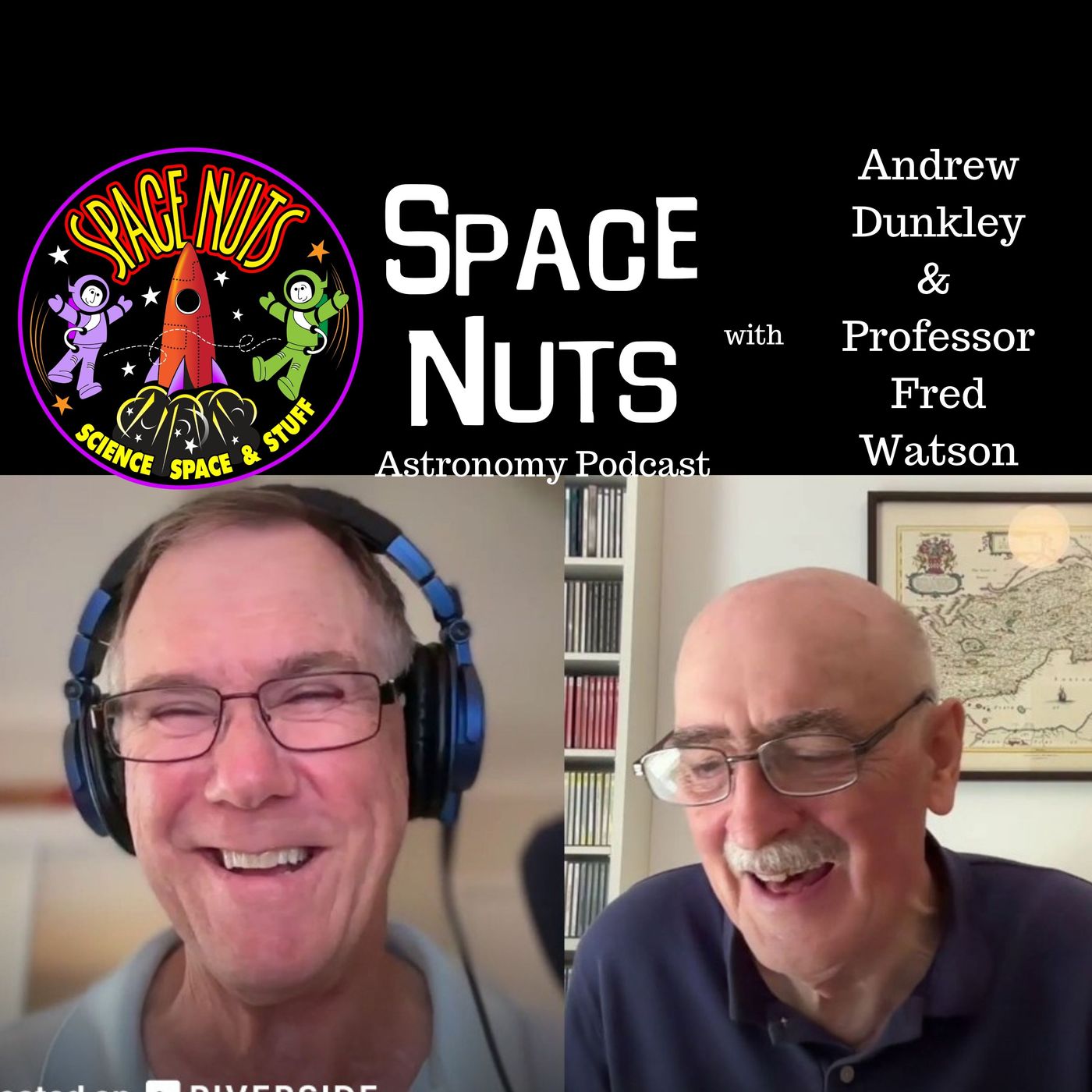
Space Nuts: Astronomy Insights & Cosmic Discoveries· Folge 675
Rubin’s New Dwarf Planet & Neptune’s Trojan Asteroid: Discoveries on the Solar System’s Edge
Donnerstag, 5. November 2026 · 30 min
Kapitelklicken springt direkt hin
Shownotes
Space Nuts: A New Dwarf Planet, 3I/ATLAS, and Neptune’s Hidden Trojans
In this episode of Space Nuts, Andrew Dunkley and Professor Fred Watson explore three discoveries from across the Solar System and beyond. They begin with the Vera C. Rubin Observatory’s discovery of a distant, potentially large dwarf planet, and discuss what its unusual orbit could tell us about the hunt for the elusive Planet Nine. Next, they examine new James Webb Space Telescope observations of interstellar comet 3I/ATLAS, whose unusual chemistry may preserve clues to its origins in a very cold environment billions of years ago. Finally, the hosts turn to Neptune’s long-sought Trojan asteroids, discovered in data from the Rubin Observatory by a team in Belfast. Join Andrew and Fred Watson for distant worlds, ancient cosmic ice and asteroids hiding in the dark.
Key topics
- The Vera C. Rubin Observatory’s discovery of dwarf planet candidate 2026 ED138.
- What makes an object a dwarf planet, and how its orbit could inform the Planet Nine debate.
- 3I/ATLAS’s unusual isotope ratios, methane and possible origins in an ancient, cold environment.
- The discovery of Neptune’s Trojan asteroids and why they have been so difficult to observe.
Timestamps
- Introduction and episode overview
- The Vera C. Rubin Observatory discovers a new distant dwarf planet
- What defines a dwarf planet and how it may eventually be named
- The object’s size, unusual orbit and possible relevance to Planet Nine
- 3I/ATLAS and its unusual chemistry revealed by the James Webb Space Telescope
- Isotope ratios, methane and clues to the comet’s age and origins
- Neptune’s Trojan asteroids are finally discovered
- How Trojan asteroids share a planet’s orbit and why Neptune’s were hard to find
- Closing remarks and where to follow Space Nuts
Become a supporter of this podcast: spreaker.com/podcast/space-nuts-astronomy-insi….
Transkriptvom Podcast bereitgestellt · Zeitmarken springen hin
Andrew Dunkley Hi there. Thanks for joining us on Space Nuts
where we talk astronomy and space science. My name is Andrew Dunkley. It's good to have your company coming up on this edition of the show. Uh, wow. Uh, we've talked about the Vera C. Rubin Observatory and what it will mean for, uh, the future of discovery. And it's already paying big dividends because it has found a new dwarf planet and it seems to be the biggest one they have yet discovered. Tell you about that.
3i Atlas is back in the news and it just got a little bit weirder. And Neptune's Trojan asteroids have been found. We always knew they were around, but we didn't know where they were. Well, it turns out the Irish had them. We'll tell you all about it on this episode of space nuts.
Professor Fred Watson 15 seconds. Guidance is internal.
10, 9. Ignition sequence start.
Generic Space nuts.
Professor Fred Watson 4, 3, 2. 1, 2, 3, 4, 5.
5, 4, 3, 2, 1. Space nuts. Astronauts report it feels good.
Andrew Dunkley And back to tell us all about it is
Professor Fred Watson Watson, astronomer at large. Hello Fred Watson.
Professor Fred Watson Hello Andrew. Very good to see you again.
Andrew Dunkley Good to see you too. Hope you're well. You
look well.
Professor Fred Watson I'm doing all right. Yeah. I think it's week
10 now since the knee replacement. So.
Andrew Dunkley Huh.
Professor Fred Watson Yeah. So,
Andrew Dunkley uh,
Professor Fred Watson down
Andrew Dunkley past its trade in period.
Professor Fred Watson Yeah. Down in Victoria the weekend and
cutting about like somebody with a new knee. It was um, very good.
Andrew Dunkley Good, nice. Okay,
uh, uh, shall we get straight into the business of the day?
Professor Fred Watson Uh, yes, adequacy, of course.
Andrew Dunkley Yes, yes, we'll do it, we'll do it all
adequately. I, I spotted this story on the weekend and I thought, wow, this new uh, observatory, Vera C. Rubin is um, this is just doing some great stuff already. It's hardly, it's hardly started doing what it's supposed to be doing, which I think is basically observing the entire known universe from the southern hemisphere. Uh, but it has found a new dwarf planet and it looks like it's a big one.
Professor Fred Watson It's relatively big. That's right. Uh,
it's not the biggest, um,
Andrew Dunkley and it's not planet nine.
Professor Fred Watson It's not planet nine. No. The biggest, uh,
still in terms of diameter is still Pluto, although Eris is about the same diameter but a bit more massive. Uh, which means it's made of something denser than Pluto is. And just recapping, what's a dwarf planet? A dwarf planet is an object that orbits the sun. That it is at, um, least within the solar system, it has sufficient size that its own gravity has pulled it into a spherical shape. But it has not become the dominant body in its part of the solar system. That's what distinguishes it from a planet.
Andrew Dunkley Right.
Professor Fred Watson So um, the uh, story
is exactly as you've said. It's the Vera C. Rubin Observatory's legacy survey of space and time, um, which is this decade long survey of the southern sky. And what they do is they survey the entire sky every, I think it's every three nights roughly, certainly every few nights. And of course what that lets them do is um, observe things that change.
So in a sense it's um, you know its main stock in trade is transportation. Transient events, whatever they are, whether they're stars that come and go. And so that includes exploding stars and things of that sort. Huh. Or objects which are moving, uh, which are ah, in the solar system. Uh, and indeed it has been uh, credited now with the discovery of a new dwarf planet.
So it was one of the scientists actually, um, uh, who's part of the staff of the Vera C. Rubin Observatory, uh, uh, person by the name of Matthew Holman. Uh, he's um, on the staff but he uh, is based at the Harvard Smithsonian Centre for Astrophysics, one of the great institutions in astronomy. And basically looking through the data that Rubin collects and you know that you get well over a million alerts of something changing every night and it might be even well over 10 million. The numbers are huge. Um, and this is where basically machine learning and AI and techniques like that come into play. Because um, of these alerts of things moving or coming and going or whatever, you can't just pick them out by hand. There's so
many of them that you need machines to do the job. But still at the end of the day somebody looks at the data and it was um, on the 13th of October, not very long ago that uh, Matthew Holman uh, was looking through the data and discovered an object now classified as 2026 ED138. And it's um, going to be, it will eventually have a name, uh, but at the moment perhaps its identification number. Uh.
Andrew Dunkley Rodney.
Professor Fred Watson Rodney. Could be, could be.
Uh, did he say Rodney?
Andrew Dunkley Rodney?
Professor Fred Watson Yeah, Rodney. Well there was a battleship
called Rodney.
Andrew Dunkley Yes, I'm aware of that,
Professor Fred Watson yes. Yeah,
Andrew Dunkley so you don't. I think we should give
um, planetary bodies more, you know, common names. Rodney, Trevor, Louise,
Professor Fred Watson Andrew.
Andrew Dunkley Yep, that's getting, that's getting, you
know, that's getting higher up the ladder.
Professor Fred Watson Um,
Andrew Dunkley there's an object. Fred Watson.
Professor Fred Watson There's certainly an asteroid called
Fred Watson Watson.
Andrew Dunkley Yeah, yep, there you
Professor Fred Watson are. But, but that leads me to um, an
interesting point. That you raised there, what is it going to be called? And it will almost certainly be called after one the creation gods, uh, in the m. Mythology of the Mapuche people, who are the first nations people down there in Chile, where this telescope is based. Uh, and that's basically the protocol for naming dwarf planets in the far distant solar system, which is where this is. We didn't mention that It's a Trans Neptunian object.
So it's well beyond the orbit of Neptune. In fact, it's well beyond the orbit of Pluto. Um, Pluto's on average about 6 billion kilometres away from the sun. This is more like 7 billion, not quite, but nearly 7 billion kilometres away.
Andrew Dunkley Yeah, it's a heck of a long way out.
It's, um, um, at least two more AU out. I think if I'm remembering that rightly, it might have been more,
Professor Fred Watson uh, it's probably more, yes. Uh,
um,
Andrew Dunkley 46 astronomical units from the sun.
Professor Fred Watson Yeah. Um, but it will, as
I said, end up with probably a Mapuche name which will be very nice. Um, and we are all familiar with Mapuche names because the four component telescopes of the Very Large Telescope are named after them. Um, can't remember the other two. It'll come to me in a minute. Uh, yeah, anyway, you'll find them, don't worry. And my apologies to the Mapuche people for forgetting those wonderful names which, uh, by the way, are, uh, Sun, Moon, Southern Cross and I think it's Evening Star is the other one. Might be serious. Um, I wish I hadn't drifted off in that direction because I've revealed what, uh, happens.
Yeppon. Uh, and is it Melipal? Yeah, yeah,
Andrew Dunkley I'll take your word for it.
Professor Fred Watson Thanks.
Um, anyway, um, there will be lovely names, a lovely name for this object. Why are we excited about it? Because it's big, um, up to possibly. And remember that you can't actually see a disc here. This is a point of light that tells us where it is by its movement because we can do the solutions of the orbital, um, equations and work out whereabouts it is from watching how fast it moves. Basically the slower something moves, the further away it is. Uh, and, um, its brightness is the only other clue that we've got. But combining those two things suggests that, um, its diameter is up to about 1500 kilometres. Um, might be smaller than that, but the upper limit seems to be about 1500. Uh, compare that with,
um, the size of Pluto, uh, about 2,000 kilometres. And I think Eris is just about the same size as well. Two similar sizes.
Andrew Dunkley Yeah. I said at the start, the biggest, I
think the furthest out is. What is
Professor Fred Watson it? Probably is. Um, um,
Andrew Dunkley so far,
Professor Fred Watson certainly the furthest out of its size. Uh,
um, we. It's interesting because it's going to play into the whole debate about Planet nine. Here you've got a new object. Uh, the more observations we can make, the more accurate we can determine its orbit. Uh, and um, if we find that it is a highly eccentric orbit, a highly elongated one that's aligned with all the other, um, transectunion object orbits that are aligned, then uh, it will almost certainly come into the Planet nine debate.
Um,
Andrew Dunkley well, I mean one of the theories is that
there may not be a Planet nine, but there may be just enough stuff out there, big stuff, to create the same effect.
Professor Fred Watson That's right. Uh,
that's true. Um, although it's hard to align all these orbits without it being a single large, uh, object or
Andrew Dunkley a
Professor Fred Watson single massive object. Because, um, if it's a
group of object, they're all in their own orbits. Anyway, um, there are some interesting things about this object, uh, ED138. Uh, one is it's tilted, uh, quite highly to the plane of the solar system. And that means it belongs to a category of trans neptunian objects called, and I love this, the hot classical Trans neptunian objects. Most people think of Beethoven as being the
Andrew Dunkley hot
Professor Fred Watson classical, but uh, it's actually
uh, one of these. And why is it hot? Um, that relates to the energy of its orbits and the fact that it is highly, ah, inclined. M. Maybe it has been disturbed into that highly inclined orbit by interactions with the planet Neptune itself. But Neptune's actually quite a lot further in, uh, into um, the solar system. Um,
Andrew Dunkley uh, they've got a great diagram on this story
on the BBC which shows the orbit. It really is a long way out.
Professor Fred Watson Yeah, yeah, it is. Um, it's
um, well out of the solar system.
Andrew Dunkley Yeah, but
Professor Fred Watson it's part of it.
Andrew Dunkley It's part of it. But it's sort of like the
second, uh, cousin twice removed.
Professor Fred Watson Yes, that's right. But we do know that
there's this, um, relatively large population of uh, the solar system that exists way beyond the orbit of Neptune. I um, do love the diagram that you've just mentioned as well because, um, I think they've drawn it with the stars in the right position. And there's Orion in the background, which is quite nicely done.
Andrew Dunkley It looks good,
Professor Fred Watson but uh,
it is a very distant object and it's tilt. It's well outside the plane of the orbit. So something has disturbed it in that regard. Um, but an exciting, you know, an exciting uh, discovery. It's
Andrew Dunkley absolutely. And a, um,
another feather in the cap of the Vera C. Rubin Observatory which has just sort of, the minute they switched it on, it, it started finding stuff. And you said it would, it would change the game, it would start finding things lickety split. And that's exactly what's happening.
Professor Fred Watson Yeah, it's exciting stuff.
And look, because it's looking at the transient universe and this is really an aspect of the universe that we haven't had the capability of doing before. Looking at things that come and go over short timescales. Um, that means we're almost certainly opening up a completely new discovery space here. And it's not just asteroids and dwarf planets. It's going to be all kinds of things that come um, and go in the night, whether they're moving or changing in their brightness. Um, just wait for a, an influx of um, extra, basically extra solar comets and things of that sort. Which might be a segue into one of our stories later on this month. This afternoon.
Andrew Dunkley Yeah, maybe so. Okay. If you'd like
to read all about it, it's on the website BBC sky and Night magazine. Is there a published paper, Fred Watson? There's probably one.
Professor Fred Watson Oh, um, yes, there is.
Uh, maybe the sky at Night hasn't given us a link to it though.
Andrew Dunkley Maybe not. But uh, yes, it
Professor Fred Watson won't be hard to find.
Andrew Dunkley Yeah,
Professor Fred Watson uh, Holman is the author.
Andrew Dunkley Indeed. All right, great, um,
story and more to come. And when they give it a name, uh, Frederica or something like that, we will let you know. This is Space Nuts with Andrew Dunkley and Professor Fred Watson Watson.
Professor Fred Watson I'm going to step off the land now.
That's one floral scale for man. 1tr
Generic space nuts.
Andrew Dunkley Our next story takes us to an
interstellar object that has been making the news continuously since it was discovered. Comet 3I Atlas. And it's in the news again, Fred Watson. And things uh, just got a little bit stranger from what I understand.
Professor Fred Watson Very unusual chemistry. Uh,
so, um, I think this is the result of observations with our favourite space telescope, the James Webb Space Telescope. Um, and basically, um, uh, these observations date from December last year. Uh, it was about two and a half times as far from the sun as we are and heading basically through the asteroid belt.
Uh, and um, this object, um, three I atlas clearly when it was uh, in the, you know, in that, that close up region of the solar system, we could see that it was a comet. It was releasing, um, basically dust and uh, and plasma, uh, because of the heating effect of the sun, the radiation effect of the sun, um and basically to use the technical term solar, uh, radiation sublimates its icy volatile chemicals. And what that does is we have the chance to analyse those chemicals spectroscopically. Uh, and basically uh, the scientists who've done this work have um, kind of gone to town almost on the amount of detail that they're able to put into now. The chemical um, constituents of the um, the, the object which we haven't
mentioned. We're talking about Three Eye Atlas, in case we didn't mention its name earlier on or uh. Maybe you didn't. Can't
Andrew Dunkley remember anyway. I did. You didn't, but
that's okay.
Professor Fred Watson Yeah. Okay. This
Andrew Dunkley uh, is, this is the third
extra solar comet uh, we've found, isn't it? The third one?
Professor Fred Watson Yes. So 3i is the third interstellar.
Andrew Dunkley Yeah, of course it is.
Professor Fred Watson Um, of uh, you know, it doesn't have to be a
comet. It's a, any object with that um, our uh, designation is interstellar and it could be an asteroid, it could be a comet. But this is definitely a comet,
Andrew Dunkley right?
Professor Fred Watson Not a spacecraft as some people have said.
So what it's telling us though is the, you know, the details that are coming out are all about, about isotopes which we've talked about before. The number of different differing number of neutrons that there are present in a, in the nucleus of an atom. Um, and they've got isotope ratios uh, that um. In this Science Alert report, uh, which I'm looking at at the moment, um, written by Ivan uh, Farkas, uh, that uh, is basically the uh, you know, the crux that they, the isotope ratios are uh, unusual and um, basically uh, hint that at some time in the past of this object it was exposed to very high levels of radiation.
Uh, and what they're speculating is that it was actually born in a gas cloud that is the sort of precursor of the core of a star. Um, um, it's a region that despite the fact that it sounds as though it should be very hot, it's actually pretty cold gas. Uh, and that is um. You know what that does is makes it very dense. It's cold, it's dense. And so it's uh, almost like ah, a refrigerator that's preserving uh, these signatures of these various isotopic ratios that we've been talking about. And the suggestion is that it was formed at a temperature of something like 260 degrees Celsius, 263 degrees Celsius which is about 10 degrees above absolute zero. Uh, it's got a very low carbon content as well. One
particular isotope of carbon, carbon 13, uh, which also suggests that it is very, very old. Um, in other words, it originated at a time when the universe was low in what we call heavier elements. Um, because heavier elements basically increase in their numbers, um, as the universe gets older. And that's because they're formed in the interiors of stars and subsequent generations of stars, uh, mean that the universe is gradually enriched with these heavier elements.
Andrew Dunkley Extraordinary. Extraordinary. And, uh,
it seems to also have, um, a much more significant, uh, methane, heavy methane content than anything else we've looked at.
Professor Fred Watson That's right. Um, that's
one of the features of this unusual chemistry that we mentioned at the beginning. Um, very, very interesting that it has got this very high, what's called a D to H ratio. That's deuterium to hydrogen. And deuterium is heavy hydrogen. It's hydrogen with an extra neutron. That ratio for methane, um, as they say in this article, that elevated D to H ratio for methane in 3i Atlas is consistent with the hypothesis that its ice is formed in a cold, low metallicity interstellar or protostellar environment under a high cosmic ray irradiation rate.
Uh, that's a quote from the researchers who've, uh, done this study. So the bottom line is that the age that is being Put now on Three Eye Atlas is something like 10 billion years. And that is, you know, what is it? 4/5 of the age of the universe. Yeah. Um, that's
Andrew Dunkley amazing.
Professor Fred Watson It may have lurked in its own solar system
for 3 billion years. They think it's been travelling perhaps for 7 billion years. Uh, and that's of course, 3 billion years before our solar system even existed. So really quite extraordinary.
Andrew Dunkley So I probably got kicked out by, you
know, for not paying the rent or something.
Professor Fred Watson Yeah, it could, it's more likely to be
gravitational interactions, but it could just be not paying the rent. You're right. Yeah.
Andrew Dunkley Yeah. Well, it's another,
um, amazing discovery and I just find it extraordinary that something so far away, so small and so fast you can get a few snapshots of it as it's passing by through the likes of the James Webb telescope. And then you can study it and just unravel everything about it that, um, it consists of. And, yeah, I'm stunned by this new, um, era of telescopic capability.
Professor Fred Watson It is, yeah, it is
remarkable, um, where we are at the moment, even compared with two years ago, maybe. When was it? 20, 21 when, uh, uh, the web was deployed. So, yeah, certainly compared with a decade ago. We're in an extraordinary situation.
Andrew Dunkley We certainly are, notwithstanding what
Hubble's achieved. But, yeah. And it's still going strong. Still going strong, yeah. If you'd like to read about it, uh, sciencealert.com or you can read the study in the journal Nature Astronomy. This is Space Nuts, Andrew Dunkley here with Professor Fred Watson Watson.
Generic Space Nuts.
Andrew Dunkley Now, Fred Watson, our final story takes us,
uh, back to the outer reaches of the solar system. Not as far as, uh, dwarf planet 2026. Ed. Ah, 138. But getting out there, uh, we're looking at, uh, asteroids in the, uh, Neptunian part, ah. Of the, um, uh, solar system. What's interesting about this is that, um, other planets have got these asteroids. But, uh, they've never been able to find Neptune's, uh, Trojan asteroids until now. Because, uh, a team in Belfast has made the discovery.
Professor Fred Watson Exactly. And guess what they've been using to
make the discovery.
Andrew Dunkley Vera C. Rubin Telescope.
Professor Fred Watson Yes, that's right.
Andrew Dunkley Yeah. Again,
Professor Fred Watson um, technically, it's the observatory that's
called Vera C. Rubin. The telescope has a different name, uh, from its benefactor. That'll come to me in a minute as well. But we usually refer it to it as the Vera C. Rubin Observatory. That's right. Um, so, uh, it is a discovery that exactly as you've said, sort of dots the I's and crosses the T's of our understanding of these, uh, objects. Which we call Trojan asteroids. And just to remind our listeners, uh, and viewers, um, Trojan asteroids are, uh, objects that are not in the main asteroid belt between the orbits of Mars and Jupiter. They lurk, uh, 60 degrees in front of and 60 degrees behind, um, planets. And the best known ones, and in fact, the only known ones.
When I was a young astronomer, my supervisor used to work on them. Actually, my, um, master's degree supervisor at St. Andrews, he worked on these objects. They were the ones before and after the planet Jupiter. Ah. Uh, but sitting in Jupiter's orbit, the Jupiter Trojans, um, at an angle, I should say, of 60 degrees. So 60 degrees ahead of Jupiter, there's one bunch of them. 60 degrees behind Jupiter, there is another. And they are called, uh. The two groups are named Trojan and Greek populations. And I can never remember which way around they are. I think the Trojan ones are the ones at the front. They're the ones that go first. Uh, anyway, um, so here's the conundrum. Um, we know about the Trojans of the planet
Saturn. We know about the Trojans of the planet Jupiter, uh, and Uranus, but they have never been found for Neptune. So um, that is why this is such a breakthrough because these uh, scientists, yes as you've said, led uh, from Queen's University in Belfast and I think there's a fairly high degree of student uh, members to uh, this team. They're at the Astrophysics Research Centre at Queen's University. Ah, Meg Schwamb, uh. Is uh, an astronomer and lecturer there and basically led the team of uh, scientists working on this including um.
Uh, some uh, other international colleagues, um, and of course using the Vera C. Rubin Observatory's telescope. So, um, how's the discovery been made just by what we were talking about a bit earlier this session, Andrew, that um. The telescope basically photographs the entire sky um, every three nights. And so if you're looking for things that move, that's the way to do it. The planet Neptune will have been in their field of view at one point and they probably subtracted that from the images. Uh, but that would have allowed them to see uh, this excess of numbers of asteroids which fit into the place that we're talking about 60 degrees before and after, uh, Neptune, but sitting in its orbit. So a big triumph actually
for the uh. Um. Ulster team, the Northern Ireland team.
Andrew Dunkley I wonder why it's been so hard to nail this
down. I mean they found nuggets floating around Uranus. But, uh. Why haven't. I, couldn't help it. Why haven't
Professor Fred Watson that
Andrew Dunkley one.
Why haven't they been able to until now find these objects around Neptune? What makes Neptune so difficult?
Professor Fred Watson Uh, it's much further away. It's quite
simple. Um. Um. We think of. Yes. Oh yes. Jupiter, Saturn, Uranus and Neptune. We think of them as being in a row and nicely spaced out, but they're not. The distance kind of doubles from each one. So, uh, from, um. Jupiter. Sorry, from uh. Let's get this right. From Uranus to Neptune is twice as much as it is from. Basically twice as much as it is from Saturn to Neptune.
Andrew Dunkley And
Professor Fred Watson of course, because the brightness of an
object varies with one over the square of its distance, that means, um, that it gets fainter very much quicker. So it's all about the brightness of these objects. Uh, they're below the threshold for visibility for most of the telescopes that have looked for them before. But yeah,
Andrew Dunkley you've got to remember it's really dark out
there. I mean the sunlight gets there. But I think, uh. I can't remember where I read it, but Pluto, um, for example, daytime is like, like Twilight on Earth. I think
Professor Fred Watson I would say that's correct. Yes. Yeah.
Andrew Dunkley Uh, it is a really dark place. And cold.
Professor Fred Watson Yep. All of that. No point in putting your
solar panels up there because you're not going to get much juice from them
Andrew Dunkley unless you get one the size of a planet.
Professor Fred Watson Yes. Which
Andrew Dunkley sort of defeats the purpose. I suppose
Professor Fred Watson it does.
Andrew Dunkley Although the way things are going on Earth,
we've just about got a solar panel the size of a planet.
Professor Fred Watson Yes, it might work that way. That's right.
Andrew Dunkley Saw a lot of them in Eastern Europe which
surprised me. But, um, yeah, they are everywhere. But, um, they're almost outnumbered by wind turbines.
Professor Fred Watson Yes. Yes.
Andrew Dunkley That's a whole other story. Uh, yeah, if you
would like to read about the um, uh, discovery of the Neptunian Trojan asteroids, you can do so on universetoday.com or you can check out the paper at the Astrophysical Journal Letters. That brings us to the end. Fred Watson. Thank you.
Professor Fred Watson That went quick. Um,
Andrew Dunkley nice
Professor Fred Watson to talk to you again, Andrew. Good to
Andrew Dunkley talk to you. We stayed
Professor Fred Watson in the solar system this time, but um, no
doubt we'll venture further afield in future episodes
Andrew Dunkley for sure. Possibly the next one. We'll see
what people are asking us in our Q and A episode. See you soon, Fred Watson. Thank you.
Professor Fred Watson Sounds great. Cheers, Andrew.
Andrew Dunkley Professor Fred Watson Watson, astronomer at
large. And don't forget to visit us between episodes on our website or on social media. We've got uh, a very strong presence on Facebook, the official Space Nuts page. Or you can go to the podcast group which uh, is like minded. People chatting to each other, sharing their um, their images and discussions and all that. Um, just space, uh, Nuts podcast group on Facebook. Uh, and yeah, I think we're on uh, YouTube. I know we are because we're on it right now. Ah, going out live and uh, um. What's the other one? Instagram.
So yeah, check it all out there. And thanks to Huw in the studio. Couldn't be with us. Every time Three Eye Atlas makes the news, he thinks he has to go out and buy the latest edition of his atlas. It's. I'm not telling him. Not going to tell him. And from me, Andrew Dunkley, thanks for your company. We'll catch you on the next episode of Space Nuts. Bye. Uh, bye.
Voice Over Guy You've been listening to the Space Nuts
podcast.
Professor Fred Watson Mythic Play Decent,
Voice Over Guy available at Apple Podcasts, Spotify,
iHeartRadio or your favourite podcast player. You can also stream on demand@bytes.com.
Voice Over Guy this has been another quality podcast
production from bytes.com. um,
