

The D-Con Chamber· Staffel 5
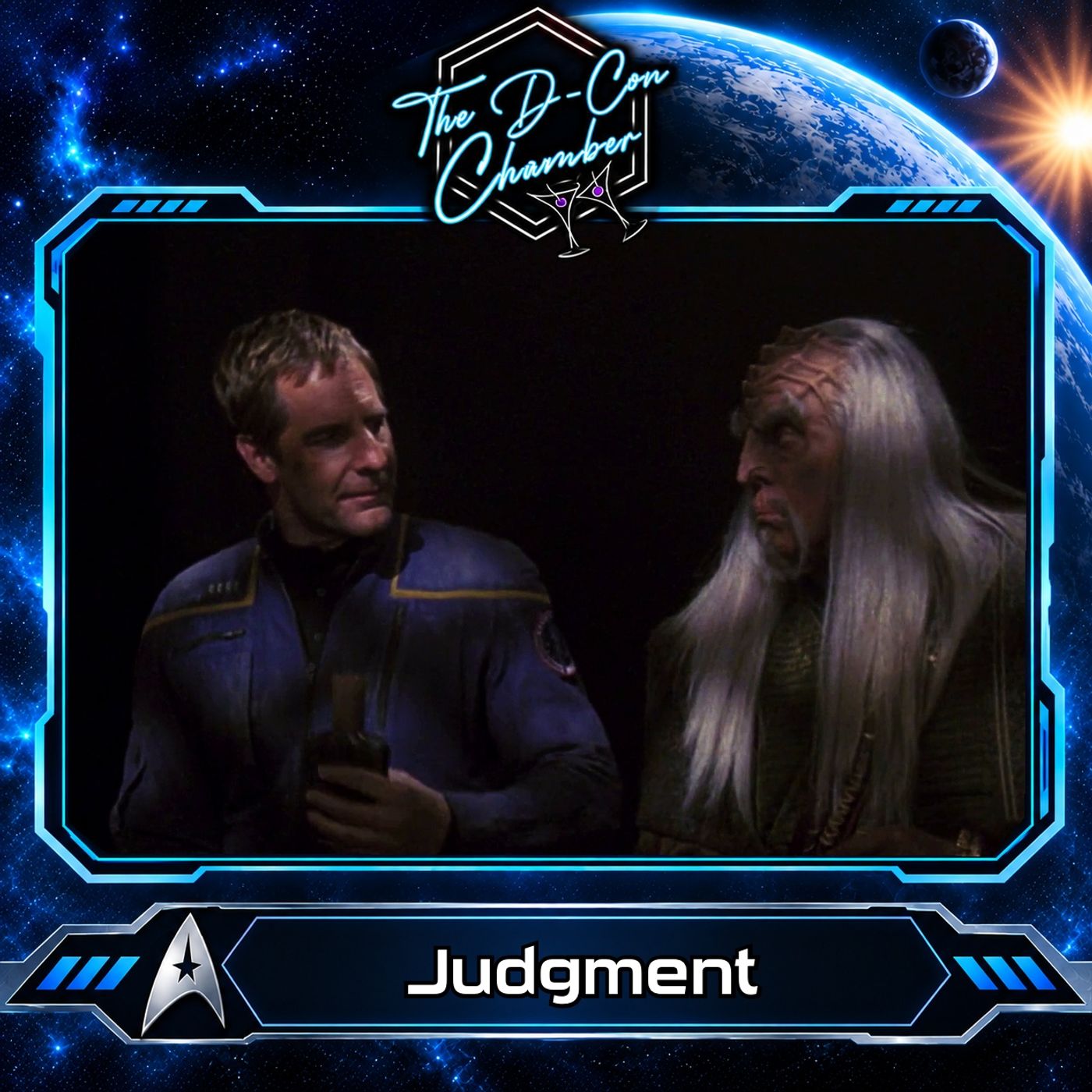
Enterprise "Judgment" watch party | S02 E19
Sonntag, 18. Oktober 2026 · 48 min
Kapitelklicken springt direkt hin
Shownotes
Connor Trinneer and Dominic Keating -- and special guest, director James L. Conway -- watch Star Trek: Enterprise's "Judgment".
Archer's arrest by the Klingons brings him face to face with Kolos, played by Deep Space Nine veteran ... J.G. Hertzler! This is Enterprise's homage to Star Trek VI: The Undiscovered Country, so if you guess what happens at the end, it just means you're an OG fan. At least no one gets kicked in the knee-genitals this time.
Each week in The D-Con Chamber, we boldly revisit Star Trek: Enterprise through behind-the-scenes stories, watch-along commentaries, and conversations with the people whose lives were forever changed by the franchise. Whether they are breaking down classic episodes or welcoming special guests from across the Trek universe and beyond, hosts Dominic Keating and Connor Trinneer mix laughs, insider perspective, and Trek appreciation in every episode.
📸 Instagram: @thedconchamber
🌐 Website: thedconchamber.com
🛍️ Shop: thedconchamber.com/shop
🌳 Linktree: linktr.ee/thedconchamber
Want more? Find us on Patreon for exclusive clips + fun bonus content! patreon.com/thedconchamber
Become a supporter of this podcast: spreaker.com/podcast/the-d-con-chamber--618142….
Transkriptvom Podcast bereitgestellt · Zeitmarken springen hin
The show has begun with connor and dumb it's the decon chamber ladies and gentlemen boys and girls trekkies and trekkers welcome back to another watch party episode of the decon chamber i'm your co-host dominic keating joined as always by my bestie and fellow co-host mr connor trenears in the house.
Hey yo And joining us, delighted to see Mr. James L. Conway, otherwise known as Jim to his friends, who directed this wonderful episode, Judgment, which is episode 19 of our season two of Star Trek Enterprise. Thanks for coming on, Jim. It's really good to see you now. This is a really good episode. It's terribly well written by David A. Goodman, a story by him, and a chap called Taylor Elmore, who...
Do you have any recollections of Taylor Elmore was Jim? I do not.
I do not. But, you know, David went on to become president of the Guild.
He did. That's right. Yeah. Yeah. Took them through a couple of strikes. Good man. The guest stars are fantastic performance from J.G. Hertzler playing Kolos, the advocate for Scott in the tribunal. Granville Van Dusen plays the Klingon magistrate.
Maybe the best name of any actor.
What a name, I mean, really.
It is really.
Granville Van Dusen, at your service, sir. John Vickery played the prosecutor Aurach very well. And Daniel Reardon plays the much beleaguered Duras, captain of the Bortas battlecruiser. And Victor Talmadge, lovely performance as the rebel, you know, rebel leader who's rescued by us.
But before we start, though, I just want to say.
Send. Oh, yeah. Hang on.
Lawyers, guns and money.
I wore the shirt for this.
Very good. The teaser we find, you know, God knows our captain found himself in so many scrapes. and once again, he's a prisoner, and we don't quite know why immediately, or how they got him. It's never really explained how they, you know, sequestered him.
It's never explained why they would have turned him over, knowing that he could have been sentenced to death. It was Klingons, after all. That's the only story thing that bumped me after I watched it. I said, wait a minute, why would they even let him go do that, or why would he go do that? But we're all right with that.
Yeah. Other than that, though, the teaser, we find him in this Klingon tribunal. It has echoes, of course. Did you know that it echoed back to the Star Trek six movie Undiscovered Country?
No.
Yeah. So Kirk finds himself in the dock. in that film, and it's a sort of retelling of that story. So yes, Archer is in the dock in the tribunal. He's accused of conspiring against the Klingon Empire. He'll have his day in court, but the likelihood is he's gonna be found guilty and sentenced to death.
And that's the only punishment, at least in the beginning, that we know that could happen.
So I want to ask you straight away, your man, Grandal Van Dusen, who plays the magistrate, has the gavel, which is a sort of Klingon glove claw thing. What was the practical? Because every time he slaps that down, sparks fly. Did you remember how that was done?
As I remember, there was a button on it that he would be, as he comes down, he hits it and that causes the spark on the, on the impact.
That was a nice touch.
It was a great idea.
Was that a Klingon thing? There to spend the rest of your natural lives. Is it in the movie, Dom?
Yes, it's in the movie. It's an established Klingon gavel, claw, glove, whatever. Very quickly, we're into act one. lovely CGI stuff of, uh, I thought it was going to be Kronos, but it's not. It's, uh, a place called Narendra three, which I think is where they take their, you know, um, prisoners to and, and try them before sending them off to, to either the didathium mines on, uh, Rura Penthe. Did you have much to do as a director with that CGI stuff, Jim?
No, not in that case. That was just something that they created that town, village, city, whatever. It was fantastic looking. So I get involved with things that are within the story and where the actors are involved, but something like a big set piece like that, no.
I mean, what was so impressive about that set? I mean, crikey knows they must've built that in about a week, maybe four or five days. And I mean, it was a big set, wasn't it? I mean, it looked like it was 50, 60 feet tall.
It looked very clean and very tall.
Very tall. Yeah.
Yeah.
Well, it was that big high shot looking down was CGI. I shot an angle from the practicals, the lights at the very top of the stage to give them that high angle. But they filled in everything around it.
Ah, did they?
Because I wondered... Did you I mean, how much did you shoot looking down actual, you know, I.
Shot a couple of angles from up there and then they would use them when they did. They always look fantastic. But it was CGI around everything that wasn't practical. And the other thing you have to remember is the number of Klingons equals the number of makeup people and hair.
They were there at three in the morning, man.
They were there, they had three shifts of makeup people because they had to start at like four and they didn't finish taking the stuff off to like midnight. There were so many Klingons. I've had a lot of Klingons in my life. That was probably the most for the longest time.
That was a tribe of Klingons. There must have been 20 of them at least. And you made it look like there were 50.
I think what we did is, as I remember, there was only one side. And in those wide shots, You'd see the 20 or the ones that were up on the rafters on that side. Then I'd move them over to this side and move them around. You'd never be able to recognize them and do them again. So we didn't have that total number of twice. It was the same number that I used twice. Very cool.
And it looked great. I mean, I have to say, and they were all, you know, invested in the show. They were brilliant. I mean, they really were. There wasn't a bum Klingon there.
Right. I have to say also, maybe I'm biased, but I kind of feel as though our version of the Klingons, aesthetically, seemed a little perfect. I agree.
I think so. Yeah, I agree.
They couldn't quite get there until our show. And then after our show, they went, no pun intended, to the moon and back.
Right.
Yeah.
Yeah, a little bit. And I think you're right. I mean, I think it's a really good rendition of a Klingon likelihood, you know, or what it might look like. And J.G. Hertzler is just so good in this show.
He's played many different.
He plays Mortok, mostly, who is an established Klingon with his buddy, Bob.
O'Reilly.
O'Reilly, thank you. They team up together always for the conventions. And yeah, they've made a... a very good living out of reprising their roles.
I will add something that, and maybe it might be my lack of knowledge about the Klingons themselves. Is there ever an episode or scenes where we see that it doesn't just look like, it smells as though it's a gym locker room and it's full of grease and how on earth could they possibly have the technology that they have?
That we just sort of assume that they are what they are.
That is a good point. I don't know, did you ever see the DS9 episode where a bunch of them become Klingons? They take a drug or a pill. I directed it. And they go and become Klingons and they're undercover on a ship. It's quite fun.
What's wrong, Ducat? Haven't you ever seen a Klingon before?
I have not seen that one.
So they have to act like, talk like, and act like Klingons.
When they're- Oh, yeah.
What's it called? Do you remember the episode name?
I don't. I'll look it up and send it.
Okay.
Check it out.
It's really fun.
So, yes. So the advocate, Kolos, says that he can't speak for himself, Archer, in the dock, that he will do all the talking for him. But clearly, you know, There's going to be no defense here. And this is just going to be, you know, railroaded through. And the likelihood is not looking good for the captain.
You mustn't speak during the tribunal. I'll speak for you.
There's not even the jury. They're just literally sort of, you know.
The rabble. The hoi polloi show up.
Yeah, in the penny seats are all shouting, you know, enemy of the state and... Poor old Captain Archer looks like he's done for, pretty good from the get-go. You've got some lovely angles in this first act, haven't you? I mean, do you know when you come to set what your angles are going to be, Jim, and the coverage you're going to take?
I visualise the entire script before we get there, and every angle is planned out, and that's why a lot of the shots you'll see one person walks and leads to another and somebody leads to this. It's all planned out. So I always been able to visualize the show and I would say 90% of every shot in there I knew ahead of time. Sometimes.
That's really quite a talent mate. And so you're editing literally as you're reading the script, and you kind of know.
When I read a script, I can see it.
Yeah.
You know, I read it once, and then I go back and I read it again, and I see it.
How does one learn that, Jim? How did you come to that?
It's just something I've always been able to do. I'm a writer as well, and I have an easy time visualizing the printed word. Some people don't. Some really good directors don't, but in my case, I'm able to do it.
Yeah, it's a real talent, mate. I mean, people ask us how we know how to act, and I go, ah, just been able to do it since I was 10. And what can I tell you?
I don't want to skip over the lovely scene with Phlox and Archer. I think that's a really... Oh, yes, when.
Phlox shows up. It's a lovely scene between the two of them.
How are you? I've been better.
I wasn't sure if I'd find you alive. Do you ever have to direct, Jim? I sort of half remember you directing once or twice, the actors. But generally speaking, are you pretty happy with, especially series regular cast, are you happy with what they're doing and you just go, okay, now it's just my job to shoot it?
For the most part. Occasionally you have to remind them what came before, what comes after or some other things. especially with with some actors who might not be in the previous scenes and you got to sort of just make sure that they're up to date on where it's all going but by the second season everybody knew what they were doing.
It's not pretty much did didn't we so it's a good note that you know knowing where you've come from where you're going to after and what you're doing and what you want in this scene yeah those are the basics you know yeah.
Then some obvious things you might remind them like uh Just remember a little sotto voce here because the guard's over there. Just little things they may forget or not be aware of. But in terms of the performance itself, it's almost always.
JG is just consummate and his voice is incredible. He's a really seasoned actor. Put him in the garb like that. It's like mask work and you can just fly.
And he can do, you know, he can show so much heart within all that makeup. I mean, to be able to put that much stuff on your face is remarkable.
Yeah, Phlox comes in and then the food's bad. Can't say I'm a big fan of Klingon cuisine.
Yeah, he's given a bone of targ. They like their meat underdone.
Yeah.
Do you remember, I have no idea, it looked like, I mean, it could have been, I mean, it was probably, you know, the knuckle of some sort of, you know, animal. Dorothy would have brought in.
A pig or something like that.
Yeah.
It looked pretty sickly though, didn't it?
Poor Dorothy was like, I don't want to put this out there, but I have to.
And Phlox advises them that the captain might have, what is it? Xenopolycythemia. There we go.
Got it.
Which is a highly infectious disease, which is reprised from, apparently Dr. McCoy had it in the original series.
He has one year to live at the most. is the ship's chief medical officer.
I love the fact that there's so much symmetry between all these different ships. There really is. And I like the fact that particularly with the legacy shows, they hearken back to the original series quite a bit. It's refreshing and rather nice. It gives flocks a reason to come down and give them the heads up that they're doing everything they can upstairs.
The flock has been there for two days and they won't let him see him. Archer's been sitting there And then we fall into the Tribunal again. Duras is stripped of his command.
Yes, for the battlecruiser Bortas. Did the accused have anything to do with your disgrace?
Yes.
They're ruthless, the Klingon command. And if you, you know, F up, he's now been demoted to, what is it, weapons second officer on the... Yes. on the defense perimeter of Trigorkor, I think it's called. Look at that, pulling that one out. And he's, you know, much humiliated. Anyway, he tells some sort of, you know, version of events that clearly, I love that version of events where Archer is sort of so combative on the screen. Fire one shot and you'll be joining your ancestors in the afterlife.
They had AI to be able to recreate a non-fiction version of events. So, I mean, yeah, I like that.
Well, it brings me to a question for you about like, you know, what were you thinking in terms of your inspiration for it? Because, you know, we get Inherit the Wind, we get 12 Angry Men, we get Rashomon, which are different stories about what actually occurred. Was there any inspiration to this story?
For you not a visual inspiration all of those parallels are true that you draw but it was fun to be able to shoot an evil version of archer i got to do it again in the last season the fourth season because i did that mirror version of yeah right you were all that way which was hysterical i really love.
That kind of hates that you know you know we've talked about it we did that one Cap'n Crunch strip.
No!
What?
No way! I was joking! It's... Honestly, that story comes up so many times, Jim, I can't even tell you. It does. Yeah, there's a lot. You're quite good at the close-up, Jim. I mean, more than quite. You're very good at the close-up. Do you know exactly which line... for which character you're going to really get in there with them?
Sometimes it's pretty obvious. I always shoot the close-up from beginning to end. And then when you cut.
Up at some point- Ah, then you just pick it.
Yeah, and then sometimes the camera will find its way to somebody just at that point. I always sort of know where it's supposed to go. I love tight close-ups.
When you say you shoot like that, do you worry that you're giving the editor way too much room in the edit suite to play with the episode for himself or herself?
Not really, because you get a director's cut, so they'll do an assembly, I'll put it the way I like it, then it would go to Rick, and then they would make changes, but they rarely made changes to any of my internal cutting, it.
Was more length. That's commendation, God bless. There's a lovely close-up of Duras in that scene, where he's doing his best to shuffle out of his humility, and that really jumped out at me. And then so then the story goes that, you know, we've rescued this group of rebels, the so-called by the Klingon Empire, who were just poor beleaguered, you know, another alien race that the Klingon Empire has taken for their own and annexed under the promise that they will be delivered goods and food and living supplies.
stuff that's unable to live, and then they just get abandoned. And when they come back, so they're now floating around in space, and we find them, they send out a distress call, and as is our want, we go to their aid.
And I found myself, I wasn't sure where the direction this episode was going to go into, because I don't think I'd seen it since it aired 20-some years ago, but the echoes of, I'm not going to presume your politics, Jim, but I'm going to assume them, You know, we have our immigrant situation. Yeah. Story could be that very same story.
Yes. Right now.
Yeah.
Jump right out of me.
I also like the storytelling devices used in this where you don't know what the hell's going on in the beginning. And then the first version you get of what went on wasn't the real version. and then you finally get the real version. And it's nice how it sort of unfolds for the audience in terms of what is going on here, what's the real story here. I like that just in terms of the script construction.
Agreed.
We should mention Billy Pete's in the lighting in these scenes. I mean, he does not miss a trick, does he? I mean, it's extraordinary. The shadow and light and.
Especially in the jail cells.
Yeah, the key lights in the jail cells are just on the money. I mean, you take a step forward.
And then when you're directing, you want to make sure that the right part of the face is in the light sometimes. And so it's kind of hard on the actors sometimes, but it was well worth it.
That's it is true. You're right. It's tricky as an actor to, yeah, to hit that mark and be comfortable literally to a half inch that if you lean even that much further forward, suddenly the lights down here and not in your eye. And it's all the difference.
That's a lesson I had to learn.
Yeah, likewise. And all the stuff in the.
Courtroom is all top light. So the lighting is just odd anyway. And it gives a nice mood to the whole thing.
I noticed you shot a lot up. particularly the captain, well, a lot of the characters in the tribunal, you used an upward shot. Is that because the light was coming down on them?
And the tie in the Klingons behind them.
And you're very good at that. I love the fact that you, and David Livingston was good at this too, having a character move in to bring the other character in so you didn't actually go to a two shot it arrived on itself and it's moving all the time the and because this is a static You know, it's a courtroom drama, really. It was never dull to look at.
It was always on the move. Kudos to me. Archer wants to defend himself, of course, and is denied. Denied, denied, denied. And we just don't know that this is going to go well for him at all. And I think we've come to the end of Act One. It's odd that his advocate, Kolos, is so reluctant to make any sort of defence in his favour. And that story's going to play out later in the episode.
It looks like a wake-up call.
It does, doesn't it? You can see the sort of chagrin in Collis' eyes early on. You can see he's fighting against the system he's working in. So, Act 2, we're.
Back in the cell.
Again, that was a great set too, wasn't it? It was, I mean, full marks to these guys when they built these sets. Yes, they were quick, like you say. Extraordinary. They did it in four or five days. A lot of work. Honestly, you'd leave Stage 9 and it would have been a waterfall on Friday night. And, you know, Tuesday morning, you go in there and it's a comet.
How soon, Jim, into your process of directing an episode, do you get to then carry your visual into a practical element of the set? Like, how soon do you get to determine what you're going to shoot and how you're going to shoot it?
Well, I have floor plans ahead of time of what they're going to build and what it's going to look like. So I can prepare from that. And then I wouldn't actually get into the set until... one or two days before because they'd be building it. But I'd have blueprints and floor plans and I can do everything from that.
Would you go on recces as they were building the sets?
Yeah, we would go in and look and I'd go with Marvin and we'd talk about lights and lighting and what the mood was going to be. They would build in the lights into the set as well when they could.
We're back in the cell. He's eating the targ.
It's a little underdone.
Yeah, I mean, basically he's been, Captain Arch has given the choice to give up the rebels. and he will be met with leniency, but that doesn't sit well on the captain's shoulders at all.
And we also find that Kolos says that he got into this in different times than he's living now.
The courts were more willing to miss him.
You should remind them of those different times.
I like the fact that they discuss the legal system together and they start to bond as you see this subtle bonding happening and an understanding. of one another. And it's a really quite a moving scene. So we're back in the dock at the tribunal. Archer wants to testify. He passes on the magistrate's offer of giving up the rebels, the so-called rebels. Does he get to testify straight away?
Well, he does.
He gets to sit.
He does, but he doesn't because the prosecutor is the one who starts asking loaded questions. and just keeps going at him and going at him.
Do you admit, Captain Archer, that you gave aid and comfort to a vessel fleeing the Empire? The story starts to unfold that we just responded to a distress call from these people. They were starving. Their life support system was completely down and they were about to fall to their end. And then we meet, I guess, the leader or one of the leaders of the so-called rebels in sickbay.
They're all in a pretty bad way and Phlox is doing what he can to help them.
Several years ago, our colony was annexed.
By a species we had never seen before.
And then we're in the ready room with T'Pol and Archer and she discuss what they're going to try and do with said rebels.
Some of the crew will have to double up, but I think we can accommodate all of them.
And then all of a sudden we're back on the bridge and we're met with a Klingon battle cruiser and we go to battle stations.
Cut their ship loose. And go to tactical alert.
Which in the court, in the tribune, of course, is considered a complete act of war.
This human is guilty of more than inciting rebellion.
He has committed an act of war.
Hey, everyone.
Conor Trenere here.
Hey guys, Dominic Keating here. We want to thank you all for tuning in to our Star Trek podcast, The Decon Chamber.
We've officially opened our merch shop and we wanted to show you some of the t-shirts you can get there right now.
There are many designs, including these two wonderful ones. I went to Ryza and all I got was tied up in a basement with him. And let me tell you, this is just the beginning. We've got so much more to come.
If you want to check them out, head to thedeconchamber.com slash shop.
And if you are a Patreon member, you get a discount on all of our merchandise.
It's a great way to support the show and rep the Decon Chamber at the same time.
No, no, no. Yeah, act three. We're in the Situation Room and Malcolm discusses how best to diffuse the whole situation. We can't outrun them. We don't have the warp power to do that. But we could find our way into the gas giant and find our way into the asteroid belt and escape them that way. And we've come up with a dastardly plan. If we shoot a torpedo at just the right time, we're going to ignite the plasma cloud and blow the battlecruiser Boras out of the sky, which we do.
You've got about one minute to rig it all up, I remember.
Yeah, how long? How long do I have?
The Klingon ship will be here in less than 11 minutes. Get moving.
How much time do we have?
It's a nice look that Malcolm has there, isn't it? That's a nice little scene in the situation room there. I was... Because, you know, you could... Scenes like that for an actor, you could... You know, as they say, there are no small parts. And you're either in it or you're not in it. And you've got to believe every second of every, you know, every... Line you've got, it's got to be, this is for real. And yeah, you can always tell when an actor is not quite there.
It just takes you out slightly. Anyway, I'm giving myself some kudos.
Well, it's your show, you might as well.
Might as well. So yes, we blow them out of the water, so to speak.
You're not able to see, like, I imagine it was this. It was Ron Moore coming in with his notepad. and talking about what they could do digitally. For instance, I have a note that says, disrupt the rings, Reed.
If we could ignite the plasma in those rings, would it disrupt their sensors for a few seconds?
Do you know what you're seeing?
No, not usually.
You never know?
Sometimes you do. Sometimes there's a prop that they'll give me that I can show the actors if it's something they need to understand. But like that whole sequence, I was amazed at how good it looked and how good it held up for something that was 20 years old.
Yeah, no kidding.
And you're very trusting- as a director because crappy visual effects ruin an episode. I don't care how good the script is, how good the acting is, the minute you get a bad piece of visual effects, it takes you right out of it. And that was never the case on Star Trek. I mean, it was always top-notch work.
And I mean, I was so impressed to think about how long ago that was and how good that all looked and how much it must have cost.
Yeah.
We've talked about this before that, for instance, if you were to look at, I won't count the original series, but Next Generation, you've got to accept a few things about their digital quality, about what's going on. I think that you got much, much better with DS9 and Voyager. And then in our show, it hit a sweet spot of high quality digital, acceptable digital that went along with your story.
Yeah, I think technology finally caught up to what we were doing. Because in the early days, it was so primitive. We were at the cutting edge in Next Generation. We were at the cutting edge of visual effects. There was nothing digital. It all had to be practical. When we did a shot where they were looking at the view screen, they had to lock down the camera, nail it down, have a four-pin registration in the camera. Actors couldn't move.
It was so restrictive. And to think where we would have got to by the end of Enterprise.
Yeah, and then I would... add that they fell in love a bit with the digital aspect of what you could do for Star Trek post maybe Enterprise. That's why I'm saying it kind of sits in the sweet spot between quality digital and storytelling.
When did you first sort of start your relationship with Star Trek? Because I know we've talked about, we've had you on before, but I forget. Because you were a spelling man for, you know, decades.
Well, at the same time I was working in spelling, I was working other places, including Paramount. I directed a lot of MacGyvers. And while I was doing MacGyver, they developed Next Generation. So very first season of Next Generation, I met with Rick and I met with Gene.
Gene.
I met with Gene and Ron, and they hired me and I directed episode five of the first season. And I directed the season finale of the first season of Next Generation.
Okay.
And so I'm the only director who directed from the very first season of Next Generation to the very last season of Enterprise.
Wow.
18 years span. Now I would come and go during that time because I was doing many other things. But it was nice to be part of that family from the beginning to the end.
I bet.
Really.
Yeah, really. In a life, in a career, I mean, it's a lovely sort of accent.
Yeah.
And very different from the other shows that you would have been involved in over at Spelling particularly, you know. A very different affair.
Yeah.
You say the Bortas fired first. Yes.
So this is basically the real telling of what actually happened. We didn't go after them after the fact.
Not necessarily, Dom, because it is, again, one of these two interesting things about what happens in court, I've heard. The narrative that each party delivers, whether or not you believe that, is the one that wins. So we're taking on Archer's story, disbelieving the Klingon version where Archer is combative with you guys. And then they have to determine the legal elements of that.
Yeah, it comes out in the wash that, you know, this is not Archer's first introduction to the Klingon Empire. And of course, we go back to the pilot that you directed, Broken Bow. We help them there with their Sulaban issue. And then again in Sleeping Dogs. And I guess they decide that they're going to be somewhat lenient with this man that he's not actually because we could have destroyed the battlecruiser after blowing them out of the water with the plasma ignition. And we didn't because that's not the business we're in.
Captain Juras is not my enemy.
And if anything, you know, Captain Archer is just a nuisance to the Klingon Empire and nothing more and should be treated as such. And then we have a lovely scene again back in the jail cell where his advocate, Kolos, played by JG, comes back in and they share blood wine together.
What's it the blood of?
Really intimate and really nice. You know, the measure of an actor like JG, that he can come in and just, you know, nail a big part like this. He's such a stand-up guy. Yeah, that's a lovely scene, isn't it? When, you know, my father was a teacher, my mother was a biologist. They advocated that I should read law. You didn't believe all Klingons were soldiers. We weren't all the warrior class. And then you get into this, the first time i've ever seen klingon culture sort of you know delineated like this and that you know in in in recent decades or whatever their time schedule is on klingon uh the warrior class the hawks have just taken over and it's you know every young klingon now just wants to take up arms and uh and take over you
know the universe as it were and that's not how it used to be And it was rather refreshing to see that they weren't all, you know, blood, wine, you know, marauding maniacs.
Yeah, there was an actual, like, you know, status-level culture and education. And that's what I was saying earlier about, like, that I've never seen episodes that detail what... could have created a Klingon society. Yeah.
No, I haven't. No, this was the first time.
Like a Warp 5 universe.
Well, it's very much like Germany when the Nazis took over. They took a country from one thing to another and became warlike.
And it happens. Yeah, it does. And it's a quick slide if you don't watch out. Yeah. Yeah, we're seeing that happen as we can, from our little spot here.
Every 17 years show up out of the middle of nowhere and create havoc.
Yeah, that's right.
I read that somewhere.
As a director, Jim, at least at this point in time in our series, this is a particular one-on-one. This is Archer, right? and Kolos, and this is a trial. How much of the arc of that are you paying attention to or focused on as you're shooting it? Are you just trusting the actors to have that in their bag or are you, what are you doing, nuancing it?
I'm very aware of where it begins and where it ends and the twists and turns and the subtleties of performance that have to change from when he's sort of cold and hard in the beginning to when we see him soften towards the end. With actors of that caliber, I'm sure we discussed this at some point beforehand, and then they just delivered. But it's something I'm always aware of in tracking. You don't want to give away in the earlier scenes if there's any way that he's going to suddenly do a turnaround later on. But you also don't want to say that would never happen because of who he was in the beginning. So you have to have enough humanity in the character the first time you see him to understand why he can make that change
later on.
So instead of being found guilty and sentenced to death, he's still found guilty.
I therefore find the accused guilty as charged.
They never agree that his version is right. The only reason they offer any kind of leniency is because of his past service to the.
Clint Eastwood This tribunal cannot ignore his actions assisting the Klingon people. And sentenced to, I think it's life, isn't it? In the dilithium mines of Rura Pente. You are condemned to the dilithium mines on the penal colony of Rura Pente for the remainder of your life. Which basically is a death sentence. No one seems to survive longer than six months to a year. in this Siberia of the Klingon Empire, and it's not looking good for the captain.
And that's the end of Act Three. We get to Act Four, and we're looking at trying to rescue the captain now, and T'Pol is coming up with a plan that there may be another way. She's got some inroad to the high command of the Klingon Empire, and she's going to start using those contacts. I've dealt with several Klingon bureaucrats in the past. Some of them have can be persuaded.
I had been head-butted the previous episode and had seven stitches in my right eyebrow.
Really?
Yeah. And you can see it in this episode if you're paying attention.
You can.
My right eyebrow is just so swollen and full of seven stitches. Yeah.
You got headbutted during the show or you got headbutted in a bar?
No, I, yes, I got hit during the show. There was a scene where we're all affected by something and I had a fight with Phlox's son. And I remember this so clearly, you know, there are rules to stage combat. And like, if you're going to headbutt someone, you never break your elbow because you can never actually reach them.
And I, and you also look at somebody's eyes. That's how you know what's going on. And this guy's eyes disappeared. And he just whapped into me with the brim of the EV suit.
The visor of the helmet. I mean, it was always bad.
David Livingston had said, listen, he had three cameras going and had said, listen, two of these are going to be egg. And then one of these are going to look good. And I was like, okay, great. And then he yelled, cut. And he was like, we got them all. And he looked at me as I went like, he was like, oh no.
It's that waterfall of blood. Oh yeah, we got it.
Looked great. Harry Howard took me to Cedars ER and stitched me up.
Yeah.
Those head wounds bleed like crazy.
They sure do.
Yeah, I noticed that in this episode that you were still nursing that one.
Yeah.
So where are we? We're in the dilithium mines. And I love the fact that we must have used those rock sets over and over again. I half remember that there's just the configuration of them. You're like, yeah, I remember that one. That was in Terra Prime. And they spray painted it white to make it look icy. But they look good. I have to say the mine look great.
I love that opening shot you've got. You're very good. I tell you, I noticed one thing, Jim. You never start a scene just static. It always arrives at something, doesn't it? Is that one of your trademarks? Yeah, kind of.
Yeah. I like to keep the camera moving whenever I can.
Yeah, like the light in the jail cell, you come down from the light to find the captain and then in walks Kolos. I really studied this one because it was like, you know, I'd love to have directed, but another time, another life, maybe.
The one thing I wish we had in the, in the minds was breath, you know, breath. I wish that.
Yeah. Yeah.
You know, they did, I think it was the, was it the enterprise or next generation where they froze, they got that stage really cold.
Shuttle pod one. That was our episode when we're stranded in space. Right. And they created a, basically a, you know, an ice, igloo that they put the shuttle pod in and we had six industrial air conditioning units dry ice packed everywhere we shot that literally from the minute we powered down the shuttle pod we shot that in 15 second increments because you'll be like cut can't see the breath Yeah. Now they just added in exactly. And, uh, but then it was going to be super expensive, but it's a lovely set. Uh, the, the dilithium mine, the massive big fight with the guard, love the cattle prod stuff.
And then a great line, you know, on earth as humans, we never kick a man when he's down.
Yeah. I wrote that down.
Yeah. have a saying on earth, you don't kick a man when he's down. It's the sort of hallmark of the show really, isn't it? And the ethos of Star Trek.
I won't get into the likelihood that this could have happened this way. I mean, we're talking about Klingons and a penal colony and you can go in take out a few guards and get them out of there.
So it's a little convenient, but it is convenient. I mean, say on this show, it's a TV show.
It's a TV show. Yeah. I was once asked at one of my early conventions about the photon torpedoes by a complete nerd on the front row. And I went, mate, They're made of wood and they're spray painted grey. That's as much as I can tell you about. I really don't know at this stage. I know a little bit more now, but back then that was as much as I did know. And then we see the new arrivals, fresh fish, the fresh meat coming in. Magistrate Aurach's been busy apparently and the new arrivals come. And one of them is very suspiciously hooded like a Capuchin monk. And he's got a big old axe with him. And I like the fact that you follow him into Archer in a rather sinister way. I don't suppose that was scripted,
was it? Was that your telling of it that, you know, let's bring? Yeah, and it's so nice because you think he's going to do, you know.
Well, you think he's an assassin, don't you?
Yeah, you do. And it turns out to be handsome man, Mr. Malcolm Reed. Sarah watched it with me, my wife.
She went.
Lovely shot there darling your eyes look fabulous you did you got me good Jim anyway yeah I've come to the rescue this was I think this this was about the sort of time where they reinvented Malcolm Reed on the show as the action man and the guy that came in and rescued the captain not every week but certainly every other week from whatever you know stripe he got himself into And this was the beginning of a new day for me on the show. And I rather enjoyed it, I have to say.
Yeah, I agree.
You did it very well. I mean, it was very convincing.
Thank you. So, yeah, because, you know, I love the fact that he's I get introduced to Kolos and I'm not his best mate right away. You know, he's still the enemy. But Archer extends the hand and says, you know, come with us. Really lovely. I love this part of the show.
Yeah. I love this part of the show when he says, no.
You told me that on your world, a few courageous people made a difference.
I'll do no good. I'll do no good fleeing and being on the lam for the rest of my life. My place is here and I will see this out, one hopes. And it's left ambiguous. And that's a nice sort of note too.
You sort of hope that somehow he survives and can make a difference.
And it is. And it's got the end of the show as I lead the captain out and like, come on, sir, we got to go now. And then you leave JG there in the corridor of the mine and then you pull back and it's just left rather hauntingly. We don't know what's going to happen to this man and his future. It's got a somber, you know, tinge to it. It's a very.
It's unlike any episode we had done prior to this, hands down.
Yeah, no kidding. Yeah, I agree. Do you have any other remembrances, Jim, that you would like to share?
Just how much I enjoyed shooting this episode. You know, there's some times when I do these podcasts and there was one particular one for Enterprise. I did one per year after the pilot because I was busy doing spelling and, uh, One of them I watched before we did a podcast. I didn't remember a single shot in it. For some reason, the script didn't touch me. I had no memory of even making that episode, though I did. When I watched it, I sort of did. This one, I remembered everything about it because I love the script so much. I love the set so much. I love the actor so much that it was a real meaningful three weeks when I made this episode. So, yeah, this was a stellar episode for me.
It really, really holds up. I think, you know, it stands up as an important episode in today's, you know, world politics and politics.
Yeah.
We've said this a lot about quite a lot of our episodes that we've reviewed in the last year or so. It's extraordinary and sort of sobering at the same time that the message still is relevant.
And more than ever.
No kidding. How's your writing?
I'm not doing any writing anymore. Um, I did, they did three novels and four kids books. And, uh, that was sort of done. If anyone watching wants to check me out, jameslconway.com, you can check out the, uh, the writing part. You'll see the books there. You know, my, I, I go through different obsessions. Writing was an obsession. Then I, I, after, uh, COVID I decided I was going to really concentrate on photography and traveling. And I basically went around the world for three years, been just about anywhere I'd ever wanted to go. And now I've sort of drifted back into pool and I'm obsessed with, with pool tennis and pickleball and golf a little bit. I'm going to be tired too, which is why I have all this time.
You're still playing golf?
A little bit.
Yes.
I'm playing Friday, but I used to play all the time. Now I just play maybe once every three weeks.
Nice. Tell me, does the ball travel that much further in Colorado?
No, not that I can tell. I keep waiting for that extra 10%, but it doesn't. It still goes left, right, up, down. That's where I want it to.
Bloody game, eh? It's been lovely seeing you, pal. You too. Thanks for coming on the show and remembering this wonderful episode that you directed.
Jim, really well done. Really well done.
Yeah.
To you and your talent.
No kidding.
Episode.
Yeah.
I really enjoyed making it and I enjoyed talking about it.
Thank you, pal. Yeah, you're a craftsman. All right. All the best to you, mate. And maybe down the road we'll give you a shout back and come and talk about another one if you don't mind, if you fancy. That'd be great.
Sure, sounds good.
All the best to you, pal. Thanks.
No, no, no, no.
Thank you.
