

The D-Con Chamber· Staffel 5
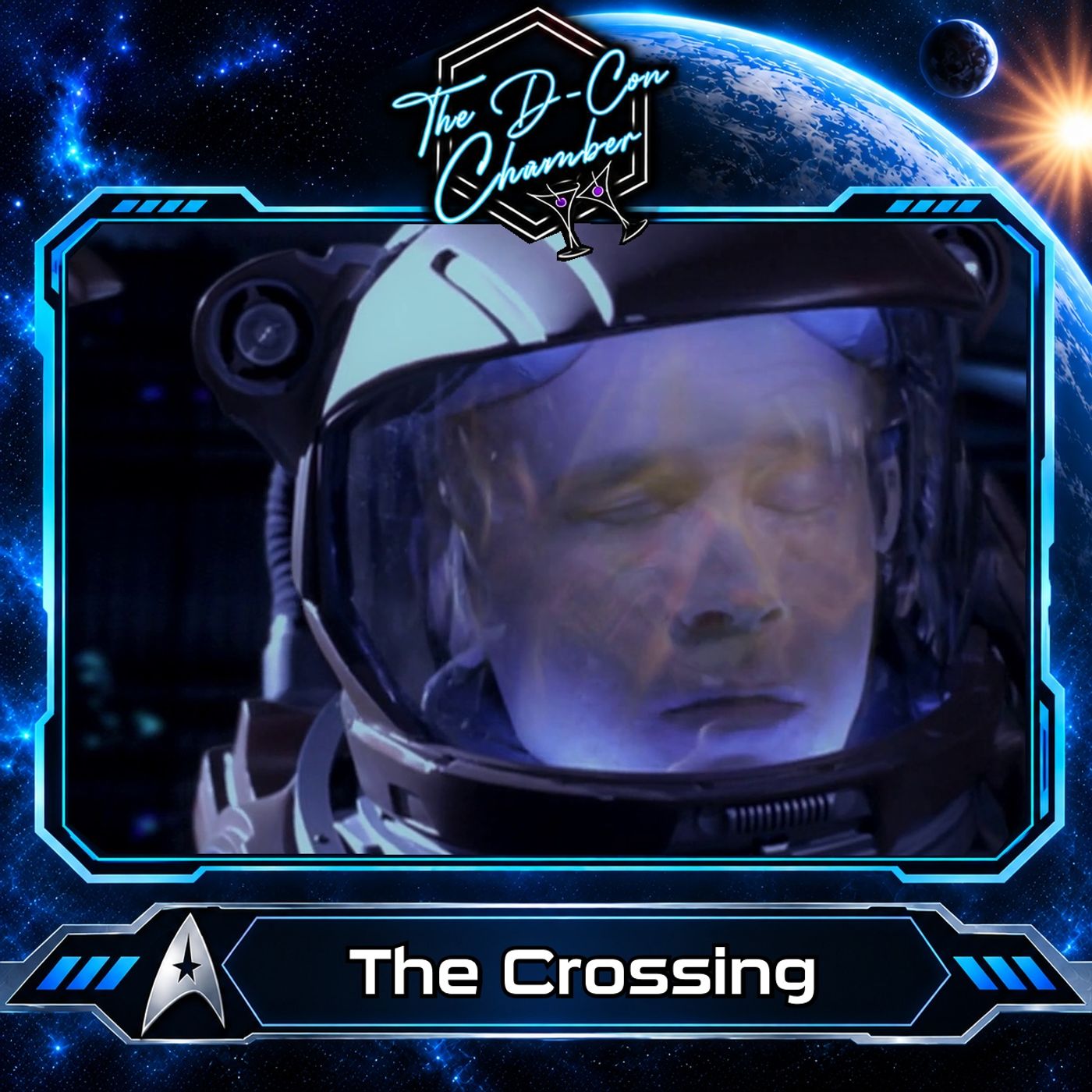
Enterprise "The Crossing" watch party with DAVID LIVINGSTON | S02 E18
Sonntag, 11. Oktober 2026 · 53 min
Kapitelklicken springt direkt hin
Shownotes
Connor Trinneer and Dominic Keating -- and special guest, director David Livingston -- watch Star Trek: Enterprise's "The Crossing".
Enterprise gets swallowed whole by a massive alien ship whose incorporeal inhabitants start taking the crew for joyrides. Wisp-Malcolm is on the prowl for a meaningful experience, while Wisp-Trip gets the best meal of his life. Time is ticking until First Contact becomes First Assimilation!
Each week in The D-Con Chamber, we boldly revisit Star Trek: Enterprise through behind-the-scenes stories, watch-along commentaries, and conversations with the people whose lives were forever changed by the franchise. Whether they are breaking down classic episodes or welcoming special guests from across the Trek universe and beyond, hosts Dominic Keating and Connor Trinneer mix laughs, insider perspective, and Trek appreciation in every episode.
📸 Instagram: @thedconchamber
🌐 Website: thedconchamber.com
🛍️ Shop: thedconchamber.com/shop
🌳 Linktree: linktr.ee/thedconchamber
Want more? Find us on Patreon for exclusive clips + fun bonus content! patreon.com/thedconchamber
Become a supporter of this podcast: spreaker.com/podcast/the-d-con-chamber--618142….
Transkriptvom Podcast bereitgestellt · Zeitmarken springen hin
The show has begun with Connor and Dom, it's the Decon Chamber!
Ladies and gentlemen, boys and girls, trickies and trickers, welcome back to another watch party of the Decon Chamber. I'm your co-host Dominic Keating, joined as always by my bestie, my fellow co, Mr Connor Schoeniers in the house.
Heyo!
And we are delighted to have us joined again by Mr. David Livingston, director in the house, because this is episode 18 of our season two. It is the crossing, uh, a very interesting episode and, uh, and dear David directed it. So thank you for joining us, David. Good to see you again, pal. Yeah.
I didn't get to go to the convention this year. Um, I get to do the cruise next year, though.
Oh, good for you.
Yeah.
We're going out of New Orleans.
New Orleans. Are you going?
Yeah. Cool. I don't know yet. I don't think so. We'll see.
Oh, okay.
Well, bug Lolita. I've been bugging Lolita for years to get me on, and she finally got me on. Good for you.
You'll have a fantastic time.
That's what I've heard. I'm really looking forward to it. I hope Dorothy can go.
That's amazing. Yeah.
Well, fingers crossed. We'll see. I know Michael Dorn is going to be on the ship because he's premiering his movie, Life 2.0, which I had a small part in. So I think he's, you know, seeing if they can. He's got all the other cast members are on.
That's terrific.
Yeah, get me in. So, um, yeah, episode 18, uh, this was a story by, uh, well with help from Andre Bomanis, uh, and Rick and Brannon and the teleplay by Rick and Brannon, um, and directed by your good self. Um, it's, uh, uh, it's, uh, it's one of the motifs as you sent in a text to me earlier, David, uh, first contact, um, which is a true sort of, you know, um, touchstone for Star Trek episodes. And, um, And this harks back, in your text, you mentioned that this harks back to one of your early directorial tryouts with Star Trek.
Yeah, the second episode that I ever directed, it was a TNG episode called Power Play, in which Troy, Data, and O'Brien get inhabited by these little light creatures. very similar to what happens to you guys. And they are escapees from a penal colony and they are attempting to take over the enterprise and free up all of their buddies from prison so that they can get away. And eventually we are able to dispel them from being possessed.
So it's very similar. structure and plot line to the crossing. And not so ironically, Brandon wrote part of the script in the original TNG episode.
You know, I really want to ask you a question before we get really deeply into this. What relationship do you have with, like, say, Ron Moore would show up with the clipboard and talk about, like, you know, what we could do digitally and what have you. What did you know about how, say, the wisps might look? The ship looks like a whale shark.
Oh, it's beautiful. Episodic directors have no control over what happens in post-production. Once the director's cut is turned in, you're done. So I had no input into what the ship was going to look like, what the wisps were going to look like. All I knew is that they said they're going to put something there and it's going to go over, it's going to fly over there and go into Connor's head. And then it's going to go over there and fly into Dominic's head.
That's amazing. You literally had no other idea besides like sparkle here, sparkle there.
Not a clue. And in fact, the visual effects people probably didn't know at that point either. because they are going week to week just trying to keep their head above water. So they're thinking about it, but they don't even know what they're going to get until they see the script. And by then, it's hurry up time.
Well, this goes back to our teaser in the sense that we see this giant manta ray whale looking thing. That's sort of sucking, drawing Enterprise in. And as a director, you don't know what that looks like. You have no clue. Is that right?
There's a line in the script that says that this ship swallows us. You know, it's the biblical tale of.
Jonah and the whale.
Jonah and the whale.
And.
that that's all I know. I don't know what it's going to look like or whatever. And I have, again, I have no input into visually what's going to happen.
Yeah. It's coming at us at some speed to warp six. It's 500 meters across per reads readings. And it's mouth just gigantically opens. And suddenly we're in the belly of the beast.
Kudos to the visual effects people, because it's extraordinary. It's a, It's great visual effects. And in fact, I think it was nominated for an Emmy for visual effects.
It was nominated, along with two other episodes of our show. And we lost out. I mean, I actually asked my wife, Sarah, because these shows are nominated all the time. And I go, who did we lose out to? We lost out to Firefly. Joss Whedon's sci-fi show.
Nine episode ethos.
Yeah, which was big at the time. And yeah, I guess little old Star Trek. This is an interesting time for Star Trek, isn't it? Our show, really, because it's just another show at this point, if I may say that. Well, in so much that it's another, you know, it's another show coming in the in the wake of another Star Trek show after another Star Trek show. And I, you know, things have changed since then. Now, you know, there's this delineation line between legacy Star Trek and new Star Trek.
And there's a there's a definite sense, I think, now that maybe Star Trek's a forever thing. uh and that you know despite the fact that there's not a show on and this is our 60th anniversary uh that's not a problem i think when we got cancelled i don't think anyone knew that you know is this going to continue um it was a bit up in.
The air oh no well dom there there was a good call it five to.
Seven years before discovery yeah no that's no small amount of time yeah Well.
To me, Enterprise is very similar to the original Star Trek on NBC because it got canceled. And how many years did it take before.
It was featured? Yeah, a good 15 maybe.
Well, you had the animated show.
Yeah, but okay. Yes, that's true. That's true. So it was always sort of in the consciousness, but... Yeah, it's what a crazy ride. Come on, guys.
What a crazy ride.
I want to ask you about the relationship that a director has with editing, digital work, and how that all operates. So you direct an episode, then you go into the editing bay, I imagine. And then you've got Ron Moore. You've got who else?
Dan Curry. Dan Curry.
Dan Curry. And you've got everybody else putting their two cents in and to create an episode. And this one in particular has such a, you know, the Wisps are such a, well, they're the main character in the episode, the main guest star. How, when you edit the show, like when you do your, do you do your director's cut and then they do theirs or how does this work for you?
Episodic directors at that time got four days under a DGA contract. So I'm in the editing room for four days. After that, I'm done. Then Rick looks at the cut along with the supervising film editor and makes the changes that he wants. Once that's done, then it goes to the post-production people and they start doing their work. So I am detached from visual effects as soon as my cut has finished. Now, I have designed the shots to incorporate what I know is gonna be needed, for instance, for the wisps, but I don't know what they're gonna be.
But I do, by the shots that I choose, I am choosing which ones are gonna need a visual effect. So that's my control over it. But Rick can change that.
Have you been given any sort of design No.
At all?
No.
I have to say though that the WISP, are unbelievably beautiful in the episode. When I did the Next Generation wisps, they were just kind of flashy lights and stuff and weren't very exciting. So your wisps are infinitely more interesting. But once I've done my director's cut, I'm done. Rick then gets it. I oftentimes did not look at my shows on the air because I had issues with the changes that Rick would make. So I always felt that if I wanted to see what I had done, I would reference my cut. If you want to call that ego, you can.
But- David, your cut would include what? Nothing digitally?
No, because it's all created after the fact. Again, the progression is I edit, Rick edits, then it turns over to Peter Lauritsen, who is the head of post-production. And then he has whatever visual effects people he wants assigned to that particular episode. They then start. So that process is weeks after I have left. All right. Yeah, it's the nature of the beast. Episodic directors are, I've referred to them as pond scum in terms of the hierarchy of directing. Well, hey, pond scum.
Yeah, true.
And thank you for the residuals. But at least when I'm on the stage, I get to make, the director gets to make the decisions. That's the one.
You have to know, David, also that, how many episodes of our show did you direct? I don't know, the most. I think it's 13. Yeah, so then Voyager. Your fingerprint sits in the existence of our show.
Yeah, without a doubt.
And I'm very grateful. I'm very grateful for that. And my tool was the camera. That's the one thing that I got to use that nobody else could take away from me. If Rick didn't like a shot I did, he could cut it out, but I did that shot. And I thought about very carefully, not only about the shots, but how they would all fit together. That was my job to make sure that I told the story with the camera. The camera was my character. You guys have a character. My character was the camera. And in deference to you guys and no offense, but my character was more important than your characters. Because I am telling the story.
It is my point of view. It is my character. And I relish being able to exercise my character.
Well, the medium itself is director, editor dominated.
It's not actor.
It's director and editor dominated.
Well, actually, in television, and episodic as a writer, because we can't do anything without the work. And I have great respect for that whole process. But in terms of the visualization, yes, you're right. The director is the one, although you're kind of, you're dismissing the actor's Connor, I never directed. Did I ever give you a note? Never. Dominic, did I ever give you a note?
Never.
No, but David, what I'm saying is that ultimately when something is locked, it's detailed by the director and the editor. And as you're saying in TV as the writer, the actor has no control over what take is used. Now, yeah, we're all part of the big family here, but- You know, for instance, in the theater, it's the actor. It's on stage.
Director leaves. Stage manager manages the whole thing. In film and television, you do the work.
And then in.
Post-production, it goes to the director, the editor, the writer, the EP. And the actor, unless you're Tom Cruise, doesn't have any Any control over like, well, I like to take one.
Right.
There's no pushback there.
Yeah.
Yeah. I'm often amazed at sometimes what you thought you did on the day and then you see the episode and you're like, that's what they saw.
Exactly.
Okay.
I'm just wondering what you guys are talking about because you have to make choices. You have to decide what the given circumstances are and what your quote unquote motivation is. And if you bring that to the table, all the director has to do is wait until that moment happens to the most that you think it's going to be.
And then you stop and you print. And then in my case, I print and do one more. But that's another story.
I love the fact that you gave one for free.
Well, you never, the magic is that you never know what's going to happen because sometimes, I've taken a lot of statics or took a lot of static about doing a lot of takes. But to me, sometimes it was freeing to the actor, because at some point, all the artifice went away. And they're just saying, F you, David, I'm just going to plow through this and do it.
And that may sound perverse from my point of view, and I didn't do extra takes to create that. But at some point it becomes liberal. You tell me as actors, does it become liberating at some point or is it frustrating or is it both?
I can answer for myself that I can't really say that my. Because I would ask for an extra take all the time if I could get one and you would you would give it to me. I can't say that my extra take was awesome. It was better. No, I don't know. But I do know that the freedom to sort of explore is this sort of minute element that we get to have in film and TV that I've experienced, which is, you know, let's do one for free and see what happens. And I don't know how many of those were used or not. But the freedom of that I think blows up your balloon in your creativity of that you get to have that opportunity. And so that was always so appreciated from you, especially.
It's a creative medium and we're not making widgets. We all are trying to tell the story as dramatically and as moving as possible. Every scene... Every moment, every shot has to be life and death. Otherwise, why are we doing this? And that's the magic of being on a soundstage or out on a location. It's magical because you're creating something out of whole cloth. And what the actors do is they bring the life to it. So don't put yourself on a different level than, than the entire process.
And I can understand.
I've always thought that my role as an actor was to tell the truth as best I could.
Perfect.
I've got another shot at that for free. You know, I don't know. Try something else. See whatever truth you can find.
Perfect way to put it. Thank you.
Yeah. I always, I learned to trust if they said it was good, moving on rather than, you know, second guessing myself and, um, going for another one. It's very rare come season two that I would, if, if they said it was good, I'm good too. You know, I learned to trust that and, um, took a while.
Yeah.
I would always ask for a freebie cause I was probably sure I was getting fired. Yeah.
I don't know where that came from. I mean, I must say I had no thoughts of being fired whatsoever. Anyway, we should knock on a bit with the, uh, actual episode cause we've barely talked about it. Um, I got a very good close-up in the teaser.
What the hell is that?
Thank you, David. Right at the end. One of my largest ones I can think of in the show.
I used to do a lot of large close-ups, that's for sure.
I noticed, I'll tell you one thing I noticed in the teaser. You've got a nice sort of side medium close-up of Hoshi. And she's wearing, I don't ever remember seeing that A-piece ever again.
Never before.
Did you check that out? Where did that come from?
I don't know, but it was cool. And it's great to, you right away know that she's the communications officer.
Well, I don't ever recall seeing that before or after. I'm going to look for it in future episodes.
Okay.
Yeah, that came and went.
Really interesting.
Hang on.
We find out that there's nothing in the Vulcan database about this ship. We know nothing about them.
Weapons are down. Life support systems are okay. But the engines are down. The warp engine's gone offline.
It neutralized us.
There's no biosigns, so we don't know what the species might be that is running this ship.
There doesn't even seem to be a warp signature.
It's something of a ghost ship and a bloody big one at that. We have a dorsal cam, which we then have a look at inside the top of it when we see these wisps of light.
It's like a Petri dish.
Yes, exactly. It is just like a slightly luminescent Petri dish. And that's as much as we know. And then I think the captain orders that we're going to go down and take a look at this a bit more closely. So we jump in the shuttle pod, EV suits at the ready, and a nice CG shot of the pod landing down on the surface of the inside of the beast.
A little man stepping out. That wasn't me.
How much of the, I know that you had a different position like with TNG and in your producing element, you know, how much did you know about what you could do with say a scene like us coming out and in terms of cost?
I had to, as a producer, I had to be responsible for the cost, but whenever I.
Was directing, I, The cost be damned.
Exactly.
I forgot about that. And I had to do that in order to do the job that I was hired to do, because they're two separate, two separate jobs.
Was Brad Jacobian you, for you, as it were, when you were directing? Was he, was he you being line producer?
It was Brad. And Mary. And Mary and Bobby Della Santina and, Yeah, there were- You.
Had people calling you up going, this is gonna cost too much.
But I played the hand I was dealt and that was that since I was a producer on the show, I took advantage of it. And Rick always had my back.
That's nice to know.
Yeah, I would take a lot of static from various departments, from the studio, from the writers. from the actors, from the production staff. But Rick always backed me because he knew I wasn't going to leave anything on the floor.
All right.
Talent attracts talent.
Yeah. So we step out into this ship. Before we know it, I think it's Trip notices that the atmosphere that was Helium and Xenon is now changing to an oxygenated atmosphere, nitrogen and oxygen. Thank you. And it's 18 degrees. Florida in November. Florida in November, I think was a good, nice line. I like that. And just as we're sort of, you know, getting our feet, one of these wisps comes careening off the ceiling. And now, did you decide that this was the action that you would take it back, you'd take it in? And then when you when it goes out, you go forward. That must've been discussed at some point that this was the action that was gonna be the inhale and exhale of said wisps.
I don't remember, but it works perfectly. And Connor played the heck out of it. I have to be honest with you. I don't remember shooting any of that stuff on the planet. And I'm wondering if that was done second unit after I left, because that all had to be done blue screen.
So to pause, for our audience, we would shoot episodes. And probably around this time, we're what? 18.
18.
You know, we'd get backed up. And we would shoot the bulk of our episode. And then we would go into a new episode. And then we would all come to work doing what's called second unit. Which was we would go then shoot other episodes. scenes that were required to finish off an episode. And that's possible that, you know, we went into stage eight or nine to do one of those things.
Technically, I'm supposed to be invited back to do that work. Maybe I wasn't available or maybe I did end up shooting it. I have no recollection of it. I do remember.
You might have been shooting first team.
Huh?
You might have been shooting first team and we had to pick it up or you were gone. And I mean, we had to pick it up. Yeah. Yeah, it's feasible.
For the blue and green screen stuff, we would shoot those. Those would be second unit.
And that would be Doug?
Yeah.
Doug now. Yeah.
Bless him. He passed away, you know. God bless him.
I went to film school with Doug.
Did you really? We got back. Where? Here in LA?
Yeah, USC.
Well, I never. So Tripp's been, what's the word? Overtaken.
Yeah, he's been wisped.
He's been wisped. But for a minute there, he thinks he was back in Tarpon Springs and hanging out with his, I guess his early love, Lisa. I don't ever remember there being an early love, but yeah.
I was in Tarpon Springs too, swimming with Lisa.
She was afraid it was getting too dark.
She popped up.
It's a telling element to what these wisps are doing.
Yeah, it is. Initially, they seem benign and no threat. The captain's not so sure. Scott maintains a pretty healthy skepticism throughout this episode, actually, about the motivation of these non-corporeal beings.
They're holding my ship hostage. seems kind of hostile to me.
I think it's quite telling that, you know, he's actually on the war footing quite early on. And that tells us a lot about, you know, us as a species that, you know, we have a reactive quality to us that's not necessarily always, you know, our best.
Well, in a literary sense, he's the only one that recognizes, and this episode is basically the belly of the beast.
Mm-hmm.
And he is the only one who recognizes that we are in it.
So we check you out. You're taken to the decon chamber, our namesake, and you're in there. And then the three of us have to say, David, I've never looked more handsome than in that scene. I don't know how you did it, mate.
Dom, I got to say, in season two, you had really great hair.
My hair was fantastic. LAUGHTER Yep. That was a good hair day. I was rocking it. Um, I wrote down in my notes, handsome Dom exclamation mark. Um, so yeah, we, we check you out and you seem fine. And, uh, and we think that's going to be an end on it.
You're clear commander free to go.
And then to Paul and the captain have a scene, um, And this is where Captain Archer is a lot more wary and hostile towards these non-corporal beings than we might have expected.
I've got to get them out of here.
So when Trip gets whisked again in engineering, the other co-star in the episode, Joseph Will.
Joseph Will playing Rostov. This is Rostov's last appearance in the show.
He was the other guy testing.
For you.
Me that's right whoa i'd.
Forgotten that that must be hard man that's uh can you imagine that's that's a tough no no wonder he he probably went you know what that's enough for me this this is this is rough watching this guy plot his way.
Through my past we actually talked about it because he had done something on voyager i believe and they had him sort of tagged for auditioning for Trip and then I got the part and he showed up and Susie Diaz very good friends with him had informed me of this and you know we had a bit of a conversation about that a really great guy but it was interesting to I haven't seen this episode since it aired until now and well god damn it they got it right laughter.
Laughter And I guess, you know, I think I think ultimately, yeah, you lent yourself more to what they were looking at. I mean, it would be interesting to see his audition tape and see what he was doing with the part.
Who cares?
Yes, actors are such fucking assholes. Hey, everyone.
Connor Trenere here. Hey guys, Dominic Keating here.
We want to thank you all for tuning in to our Star Trek podcast, The Decon Chamber.
We've officially opened our merch shop and we wanted to show you some of the t-shirts you can get there right now.
There are many designs, including these two wonderful ones. I went to Ryza and all I got was tied up in a basement with him. And let me tell you, this is just the beginning. We've got so much more to come.
If you want to check them out, head to thedeconchamber.com slash shop.
And if you are a Patreon member, you get a discount on all of our merchandise.
It's a great way to support the show and rep the Decon Chamber at the same time.
No, no, no, no.
So you get whispered. I'll tell you one thing of note, and I don't know whose idea this was. That elevator in engineering that was if we used it once other time in the entire four years i don't know that.
We did oh no we used it quite a lot did.
We use it a bit i it jumped out at me when you suddenly took the elevator up to the platform and.
A fair amount and it was dangerous it was dangerous yeah that you could get your fingers trapped in that bar yeah yeah it was a.
It was literally an HR issue waiting to happen. Anyway, it was of notes that you used the elevator, which I thought was rather cute. And yeah, you get, you get wisped again. And then I think we're, yeah. And then Rostov recognizes that you're not yourself and alerts the captain.
He was confused and seemed to think I was a superior officer.
And before we know it, we're in the mess hall where Dorothy, God bless her, rest her soul too, cooked up, must've spent hours cooking your plate full of, your table full of food. And there you are, you've been totally taken over by this.
I remember this scene very clearly. And David, I wanna ask you about this because when you're directing an actor in a series regular who's asked to be other than, how do you approach that as a director? Because I was asked to be something different.
I watched the rehearsal and it was perfect. Why you made a choice that was immaculate. And what am I.
Going to say? Shoot.
And the same thing with Dominic. Same thing with Dominic. The most delightful part of this episode was seeing both of you do your shtick. And I say shtick in a good way. Both playing... very disparate characters, but nailing what the intention of that character was. Your wonderment and delight in experiencing bread is absolutely delightful.
Have you ever tried this? It's called bread.
My kudos to both of you because I never directed serious regulars because they knew their characters better than I ever would. So why would I say anything? Now, in this case, you guys had to come up with something different. And in both cases, you nailed it. So what am I going to do?
I've got a feeling I watched Connor play because obviously I must have seen him do the mess hall scene. I think we did that probably first. And I was like, well, I got to come up with something here.
Well, you both did. And kudos to you both. As I said, it's my favorite part of the episode.
As a director, do you have this notion of like, well, here's the regular cast. Here's our cast in other world. How do we operate in the truthfulness of the other cast doing that? Is there a balance there? Is there an observation there?
I trusted you guys to come up with something. And also, episodic directors don't have the time to really mess around. Everybody has had to make choices before. before they get to the set. You don't improvise. You don't play around. You don't try stuff. It doesn't happen. You don't have the time.
Yeah, agreed.
I expect, I've done my homework. I expect that you come in with what you have determined is the best approach to this other character. If it hit me as totally bizarre or out to lunch or something, then I maybe would say something. But when I'm sitting there watching you, Connor, and I'm cracking up, and I'm delighted, what am I going to say to you? Well, let's make it more clever, or let's do this, or let's do that. No, not necessary.
No, you played it very well, Con. It was lovely, delightful, in fact.
Likewise.
And it sets up the episode well, because initially we think that this is just an interesting, you know, they're all so, They explain through you that they're also explorers, but in the subspace realm.
It's been a long time since we've encountered corporeal beings.
We think it's benign.
Yeah, and they encourage us to open our minds to all possibility.
You claim to be an explorer, Captain.
We're in Act Two.
I was riding right alongside Hopalong Cassidy.
Yes, you've just come back from hanging out with Hopalong Cassidy. This is extraordinary, some of the stuff they dreamt up here.
Some of the shit that came out of my mouth was unbelievable.
Yeah, it was. It was very Brannan, I have to say. That is a very Brannan take.
To an extent, Trip was a trope for the 1950s America.
Yeah, yeah, a little bit. Yeah, he was.
Not always, not always. But occasionally, he had these kind of like, really? Hop along fucking- You will leave it to Beaver.
Yeah.
Exactly.
I was Wally.
Yeah, you were. Some of the dialogue, I will say, actually, in this beginning of Act Two, I did notice some of the dialogue was a bit clunky. Did you notice that, David, watching the episode? The captain has a line, smells a bit funny.
Something smells funny.
I mean, I don't know. Maybe it's my... It jumped out at me. There were the odd line here and there, and I thought it was a bit hokey. We get to the captain's log.
Non-corporeal beings. That's got to be a first for Starfleet.
Actually, in the lore of Star Trek, because we're the precursor to the original show, this is the first contact with a non-corporeal being in the history of Star Trek. Is it really?
Yeah, it is.
A little bit of trivia for you. And then Phlox arrives and says he's been entered.
He's entered me. Right here.
It came in and went out. As fast as it came in, it went nothing for me here.
I didn't mind it. I didn't mind it.
I didn't look around. It was spacious, but nowhere to sit down. And then we're with Malcolm in the armory. Yeah, my ladder dismount. I'm pretty sure I did that dismount, the fireman's ladder. I think I did that.
I think you did too, and you did a great job on it.
Yeah, I did a good job and it was nicely cut and edited too. It really looked like I was coming down the staircase with a plumb. Yeah, I've been chased for my life by one of the wisps. And before I know it, I have been possessed. And obviously this is when Malcolm's possessed and his first encounter with a female crew person in the turbo lift is weird.
You are a female. I'm a male.
How you doing? How you doing?
Where you going? Five. I'm going to five. How about that? I'm surprised he doesn't just turn around and kick him in the crutch, frankly, because he certainly goes all the way.
There seem to be a number of anatomical differences.
And Dominic, what you do in T'Pol's quarters is absolutely reprehensibly wonderful.
Oh, it's creepy as hell.
Are you aware that you are the most attractive woman on board this ship?
Well, a bit disconcerting was one line from Connor after being whisked the second time and Rostov knows immediately that he's not the same person. Goodbye, sir.
Rostov to Captain Archer.
And Jolene, as to Paul, goes, Have you been drinking? Have you been drinking? a bit on the nose frankly.
And then you kept going and going it was a.
Lot of fun playing uh playing lecherous reed i have to say creepy to do reed yeah it was a lot of fun and before i know it after my encounter with to paul i am shackled and carted off to my quarters as fake Reed, where I sit the rest of the episode out for the most part. We're back in engineering, and again, Trip figures out within a second that something's not right with Rostov.
Did you have any luck priming the pumps? I have no idea how to do that.
And the captain tries to figure out who is absorbed by this and who is not. Start working on a way to figure out who's themselves and who's not.
That becomes the goal. is to figure out a way to find out who's been possessed and who hasn't. Phlox thinks he can do that with acetylcholine, elevated acetylcholine. If you test for that, it tells us whether you've been possessed or not, and he can do that.
Ensign Cole and crewman Rossi.
I guess we've got to act three already, have we? Yeah. Travis realizes that the Wisp can't make it through the osmium alloy in the catwalk. and that that might be a protectorate against these beings.
The catwalk's reinforced with osmium alloy, but it's hard to say if that would do it. Travis thinks it will.
And I think the captain then charges him to set up a remote bridge, as it were, in the catwalk, hoping that this will be a safe space for us to still stay in control of the ship, despite our being captive in the larger bedrock of the big beast ship. We're now in the catwalk. And I thought that those three light prong touch, it was a nice touch to add to that. I remember that distinctly. Was that your idea?
Would that be Billy Pete's idea to put that in, David? The three-ended light prong that sort of denoted that something electrical was happening.
I don't know how that came about, but I liked it because it gave you information in the foreground, so it woke up the frame.
It's a nice... It makes what otherwise was an ordinary-looking three-shot actually look quite sort of, you know, happening.
Exactly.
Yeah, and visceral. T'Pol thinks she can withhold a whispering because of the superior Vulcan mindset and discipline of the brain.
If a life form attempts to exchange its consciousness with mine, I believe I can prevent it.
And then in the meantime, Hoshi, because she's been taken back to her quarters having been whisked too, hasn't she?
I understand how you may be frightened by all this.
And then there's a good scene between her and Phlox. I like that fight scene. And there's a lot of grit in her face and she's fending him off.
Yeah.
But he gets the hypospray in there and she's subdued. And then, yes, and then T'Pol is whisked. And I'm not sure I noticed this, but is there a slight teary moment for her?
The reality is, is that we don't know that she has been controlled by this, but she's been.
Paused. Right.
And then Phlox gives her the hypospray. And then she says... Their.
Ship is deteriorating and they have no way to repair it.
They're bad. We've got to figure this out.
Yeah, that's right. It all comes to light that they have very nefarious motives for taking over us. They've lost their ship and they need to find corporeal bodies to inhabit it. in order to survive as a species. And then another hokey moment here where Travis is running around the ship trying to find Trip. Is that the only way we can find you on a spaceship?
Has anyone seen Commander Tucker?
No, sir. Phlox comes up with an idea, per the captain's charging, that one way to immobilize these non-corporeal beings is to kill the crew members, as it were, us, just long enough that they have to vacate the carcass, but not long enough that we all die. And the way that we could do this is by increasing the carbon dioxide level within the ship, just long enough.
We'll have to purge the carbon dioxide within 20 seconds of respiratory failure.
But not long enough that we die. So that's the plan.
Plock starts to go in. He's been told by the captain that he's got a certain amount of time to put the EV suit on, get in there and do something.
When he comes creeping through the first door, you can tell he's not worn that suit much. He's slightly tottery, isn't he? Bless him. A little bit out of his comfort zone, I think.
That was what was so delightful about John's performance, the physicality, and then the fumbling around, and the comedy in that stuff gave some relief to the rest of the story.
I thought- Yeah, he pulls the panel off onto himself.
I thought John played the hell out of it.
I did too.
I thought he was delightful in it.
And then there's a nice reveal for Trip there when you're stood at the back. It looks like you're in the shower when we reveal bad Trip. is now on the prowl. We found him, and suddenly it's a sort of wipe, isn't it? It's a real horror story wipe.
Right.
That was my favorite shot.
Is it?
Yeah?
You like that?
Yeah, it's a trope.
It is, yeah. It's a good one.
There's something I have to say. John dressed up in his EV suit, and Trip shows up. In real life, it was me and John's stunt double.
Uh-huh.
Oh, this is when you got hit, isn't it?
Yeah. Yes. I remember because here's the rule in stage combat. If you're going to headbutt someone, you lock your elbows. There's no way you can hit them. And this gentleman wearing the whole EV suit, I could see it in his eyes. You can also tell when you're working with someone in stage combat, fight combat, for film and TV and stage, you can, it's an eye contact thing. It's all you're doing. Yeah, I know what you're doing. You know what I'm doing. And he grabbed me and I could see it in his arms. He had broken his elbows.
He wasn't doing this. And he head-butted me with the rim, the visor of that EV suit. And you had said, David, before we even started the scene, We might've had, I'm sure it was two cameras. It might've been three cameras, but at least two cameras. And you said, listen, one of these is going to be egg. Egg meaning it won't work. We did the scene. Wham. And you said, cut.
Oh my God. It worked on all the cameras. I was looking down and I was just like, I was bleeding like a stuck pig.
No, come on. Are you serious?
Yeah.
That's why the rest of the episode, I have that thing. I got like five or seven stitches. I had to go straight to the ER. Mary Howard, bless her heart, was like, you know, I was like, oh, he got me. And I was like, oh, he got me. And then we went straight to the ER. I got stitched up. I think I came back to work. And the rest of the episode, I have this.
Yeah, you've got a bloodied eyebrow.
I have no recollection about that. I know directors have the conscience of a rattlesnake. That's horrific that I don't remember that.
Oh, you can't. I got the shot three times.
David, I've been waiting for this episode for two and a half years.
My apologies so many years later.
You know what? Listen, I like scarves.
I guess I've not noticed, but is it in the hairline as a scar?
On my eyebrow, yeah.
The crossing.
I get residuals for it.
I get residuals for that.
You needed a stunt adjustment.
You know, and, you know, to get to, not to jump to the end of the episode, but the fact that we destroy that ship, was that the first time we'd done something like that?
I mean, we took that thing up.
It's pretty shocking. We know that Archer sees something nefarious here, but usually the captain would come up with a creative way to preserve the alien species. In this case, that's not the case. Kate did it on Voyager once in an episode where she blew up... uh, the bad guys as well, but it's, it's few and far between. Usually we're looking for some way to preserve the alien species.
Agreed.
Oh, certainly a big moment for Archer.
Yeah. Yeah, it is.
I mean, it's, uh, it's no small thing when we, you know, fire off the half camons and, and blow that ship to smithereens and, uh, and then we're out of there. Um, sayonara. There's one shot that, uh, puzzled me, um, David, when Travis is in and out of the Jefferies tube and closing the hatch, there's one where I think it looks like a lock off. Was that a reason? Was there?
I think it was that it just stays static for like a half second. Nothing's moving, if you will. Do you remember that?
I don't know, but maybe something bounced and we did a freeze frame for a couple of frames.
Yeah, I mean, we at the catwalk, we suddenly were in, you know, the catwalk episode part two, aren't we? where it's the Blitz. And it's a nice, there's a nice sense of unity between those that haven't been inhabited and those that are now, you know, stowed away in storage. I like those catwalk scenes, I have to say. I think they've got a good sense of camaraderie.
I think this episode was, you know, coming off the heels of Canamar. You know, we had done so well I think up until this point, in terms of sending a trajectory of what our show was meant to be. You know, we picked that up again in spades with The Crossing. David, you did such a fine job with this episode. You know, every time I watch an episode of yours, I have two things occurring. One, the realization of your art, which was, I want to get my shot right. And that sometimes took a number of takes.
And then when watching the episode, the seamlessness of what your storytelling accomplished. And I marvel at your gift as a director.
Thank you. That's so generous. I don't know what to say other than thank you. I tried my hardest on everything. I looked at all these shows as a gift. And I was not about to look a gift horse in the mouth. I was given something that I always wanted to do and I got to do it for 10 years and I'm forever grateful for that opportunity.
We both feel the same way as actors too, you know, to have had that experience, to be on a long running show like that and to go to work every day for years and years.
And, you know, and ultimately... what comes across is, uh, what is the proof in the pudding? Every episode you directed was so well done. And I, I, I, I, I'm so glad you're on this show, uh, when we can get you to talk about these episodes, but you know, as I've gone along in my career, man, I loved working with you.
Thank you. You guys were always a delight. You were wide eyed and willing to do anything.
And, uh, Things have changed.
Well, it's a family. We have our personal families and then we have our work families. We're all there to climb a mountain, to be engaged that way, and to make something out of whole cloth that's going to entertain and move people. What a gift that is to all of us, to be able to practice our craft and be able to have an impact that's still going on decades later and being rediscovered. Enterprise is being not only rediscovered, but discovered. It got lost in the shuffle there. That's one reason it got canceled.
And to be a workaday person with you was a gift. And I'm so thankful for it.
Yes, David. Thank you for coming on our show again and talking about the episode.
You're welcome. It's been a pleasure. Thrilled to do it. Thank you for the invite.
All right. Well, listen, another good episode. We march on. We'll look for the next one you're directing, David, and have you back, mate.
I'd love to do it.
Anytime.
Thank you.
All right.
Okay.
Nanu nanu.
Cheers.
Long live Prosper.
Bye. Ciao.
Ciao.
Thank you.
