

The Gradient: Perspectives on AI
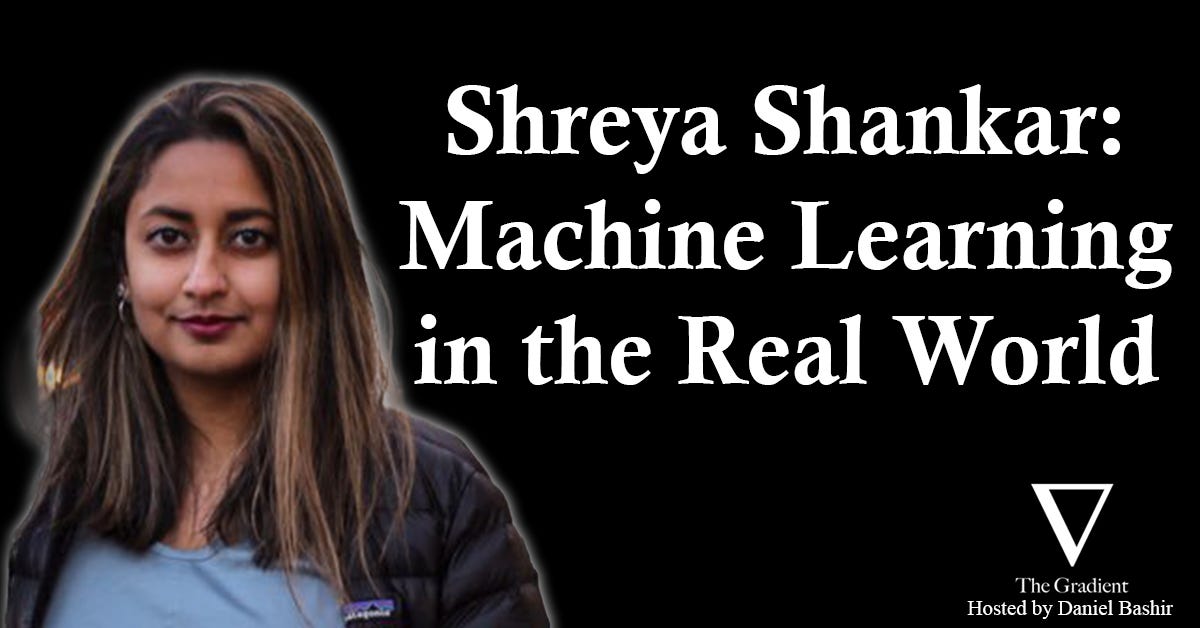
Shreya Shankar: Machine Learning in the Real World
Donnerstag, 7. September 2023 · 1 h 17
Kapitelklicken springt direkt hin
Shownotes
In episode 89 of The Gradient Podcast, Daniel Bashir (twitter.com/spaniel_bashir) speaks to Shreya Shankar (twitter.com/sh_reya).
Shreya is a computer scientist pursuing her PhD in databases at UC Berkeley. Her research interest is in building end-to-end systems for people to develop production-grade machine learning applications. She was previously the first ML engineer at Viaduct, did research at Google Brain, and software engineering at Facebook. She graduated from Stanford with a B.S. and M.S. in computer science with concentrations in systems and artificial intelligence. At Stanford, helped run SHE++, an organization that helps empower underrepresented minorities in technology.
Have suggestions for future podcast guests (or other feedback)? Let us know here (forms.gle/YNKGko9LCGNp1rhU7) or reach us at editor@thegradient.pub
Subscribe to The Gradient Podcast: Apple Podcasts (podcasts.apple.com/us/podcast/the-gradient-pod…) | Spotify (open.spotify.com/show/6onNcSqsP6hEEqmZ6TU2g8) | Pocket Casts (pca.st/itunes/1569777340) | RSS (api.substack.com/feed/podcast/265424/s/1354/pr…)Follow The Gradient on Twitter (twitter.com/gradientpub)
Outline:
* () Intro
* () Shreya’s background and journey into ML / MLOps
* () ML advances in 2013-2016
* () Shift in Stanford undergrad class ecosystems, accessibility of deep learning research
* () Why Shreya left her job as an ML engineer
* () How Shreya became interested in databases, data quality in ML
* () Daniel complains about things
* () What makes ML engineering uniquely difficult
* () Being a “historian of the craft” of ML engineering
* () Levels of abstraction, what ML engineers do/don’t have to think about
* () Observability for Production ML Pipelines
* () Metrics for real-time ML systems
* () Proposed solutions
* () Moving Fast with Broken Data
* () Existing data validation measures and where they fall short
* () Partition summarization for data validation
* () Small data and quantitative statistics for data cleaning
* () Streaming ML Evaluation
* () What makes a metric actionable
* () Differences in streaming ML vs. batch ML
* () Delayed and incomplete labels
* () Operationalizing Machine Learning
* () The difficult life of an ML engineer
* () Best practices, tools, pain points
* () Pitfalls in current MLOps tools
* () LLMOps / FMOps
* () Thoughts on ML Engineering, MLE through the lens of data engineering
* () Building products, user expectations for AI products
* () Outro
Links:
* Papers
* Towards Observability for Production Machine Learning Pipelines (arxiv.org/abs/2108.13557)
* Rethinking Streaming ML Evaluation (arxiv.org/pdf/2205.11473.pdf)
* Operationalizing Machine Learning (arxiv.org/pdf/2209.09125.pdf)
* Moving Fast With Broken Data (arxiv.org/pdf/2303.06094.pdf)
* Blog posts
* The Modern ML Monitoring Mess (shreya-shankar.com/rethinking-ml-monitoring-1)
* Thoughts on ML Engineering After a Year of my PhD (shreya-shankar.com/phd-year-one)
Get full access to The Gradient at thegradientpub.substack.com/subscribe?utm_medi…
