

The Gradient: Perspectives on AI
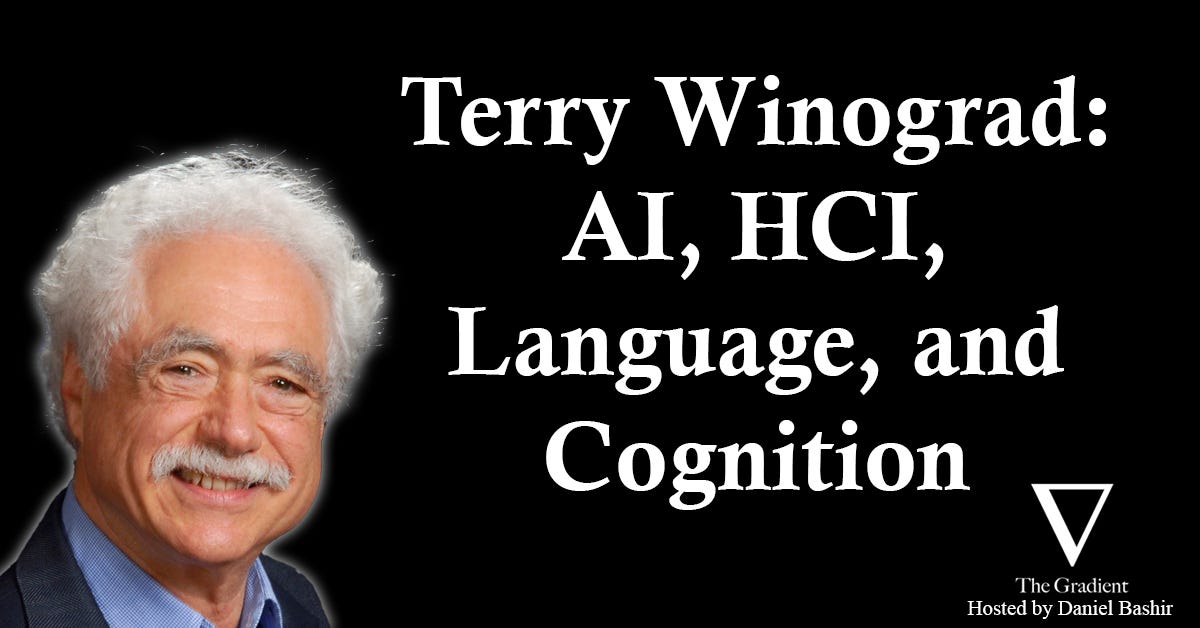
Terry Winograd: AI, HCI, Language, and Cognition
Donnerstag, 24. August 2023 · 1 h 33
Kapitelklicken springt direkt hin
Shownotes
In episode 87 of The Gradient Podcast, Daniel Bashir (twitter.com/spaniel_bashir) speaks to Professor Terry Winograd.
Professor Winograd is Professor Emeritus of Computer Science at Stanford University. His research focuses on human-computer interaction design and the design of technologies for development. He founded the Stanford Human-Computer Interaction Group, where he directed the teaching programs and HCI research. He is also a founding faculty member of the Stanford d.school and a founding member and past president of Computer Professionals for Social Responsibility.
Have suggestions for future podcast guests (or other feedback)? Let us know here (forms.gle/YNKGko9LCGNp1rhU7) or reach us at editor@thegradient.pub
Subscribe to The Gradient Podcast: Apple Podcasts (podcasts.apple.com/us/podcast/the-gradient-pod…) | Spotify (open.spotify.com/show/6onNcSqsP6hEEqmZ6TU2g8) | Pocket Casts (pca.st/itunes/1569777340) | RSS (api.substack.com/feed/podcast/265424/s/1354/pr…)Follow The Gradient on Twitter (twitter.com/gradientpub)
Outline:
* () Intro
* () Professor Winograd’s background
* () At the MIT AI Lab
* () The atmosphere in the MIT AI Lab, Minsky/Chomsky debates
* () Blue-sky research, government funding for academic research
* () Isolation and collaboration between research groups
* () Phases in the development of ideas and how cross-disciplinary work fits in
* () SHRDLU and the MIT AI Lab’s intellectual roots
* () Early responses to SHRDLU: Minsky, Dreyfus, others
* () How Prof. Winograd’s thinking about AI’s abilities and limitations evolved
* () How this relates to current AI systems and discussions of intelligence
* () Repetitive debates in AI, semantics and grounding
* () The concept of investment, care, trust in human communication vs machine communication
* () Projecting human-ness onto AI systems and non-human things and what this means for society
* () Time after leaving MIT in 1973, time at Xerox PARC, how Winograd’s thinking evolved during this time
* () What Does It Mean to Understand Language? Speech acts, commitments, and the grounding of language
* () Reification of representations in science and ML
* () LLMs, their training processes, and their behavior
* () How do we coexist with systems that we don’t understand?
* () Progress narratives in AI and human agency
* () Transitioning to intelligence augmentation, founding the Stanford HCI group and d.school, advising Larry Page and Sergey Brin
* () Chatbots and how we consume information
* () Evolutions in journalism, progress in trust for modern AI systems
* () Shifts in the social contract, from institutions to personalities
* () AI and HCI in recent years
* () Philosophy of design and the d.school
* () Designing AI systems for people
* () Prof. Winograd’s perspective on watermarking for detecting GPT outputs
* () The politics of being a technologist
* () Echos of the past in AI regulation and competition and learning from history
* () Outro
Links:
* Professor Winograd’s Homepage (hci.stanford.edu/winograd)
* Papers/topics discussed:
* SHRDLU (hci.stanford.edu/~winograd/shrdlu)
* Beyond Programming Languages (dl.acm.org/doi/pdf/10.1145/359131.359133)
* What Does It Mean to Understand Language? (hci.stanford.edu/courses/cs047n/readings/winog…)
* The PageRank Citation Ranking (eecs.harvard.edu/~michaelm/CS222/pagerank.pdf)
* Stanford Digital Libraries project (diglib.stanford.edu:8091)
* Talk: My Politics as a Technologist (youtube.com/watch?v=ZXgQ2QbtPr0)
Get full access to The Gradient at thegradientpub.substack.com/subscribe?utm_medi…
