

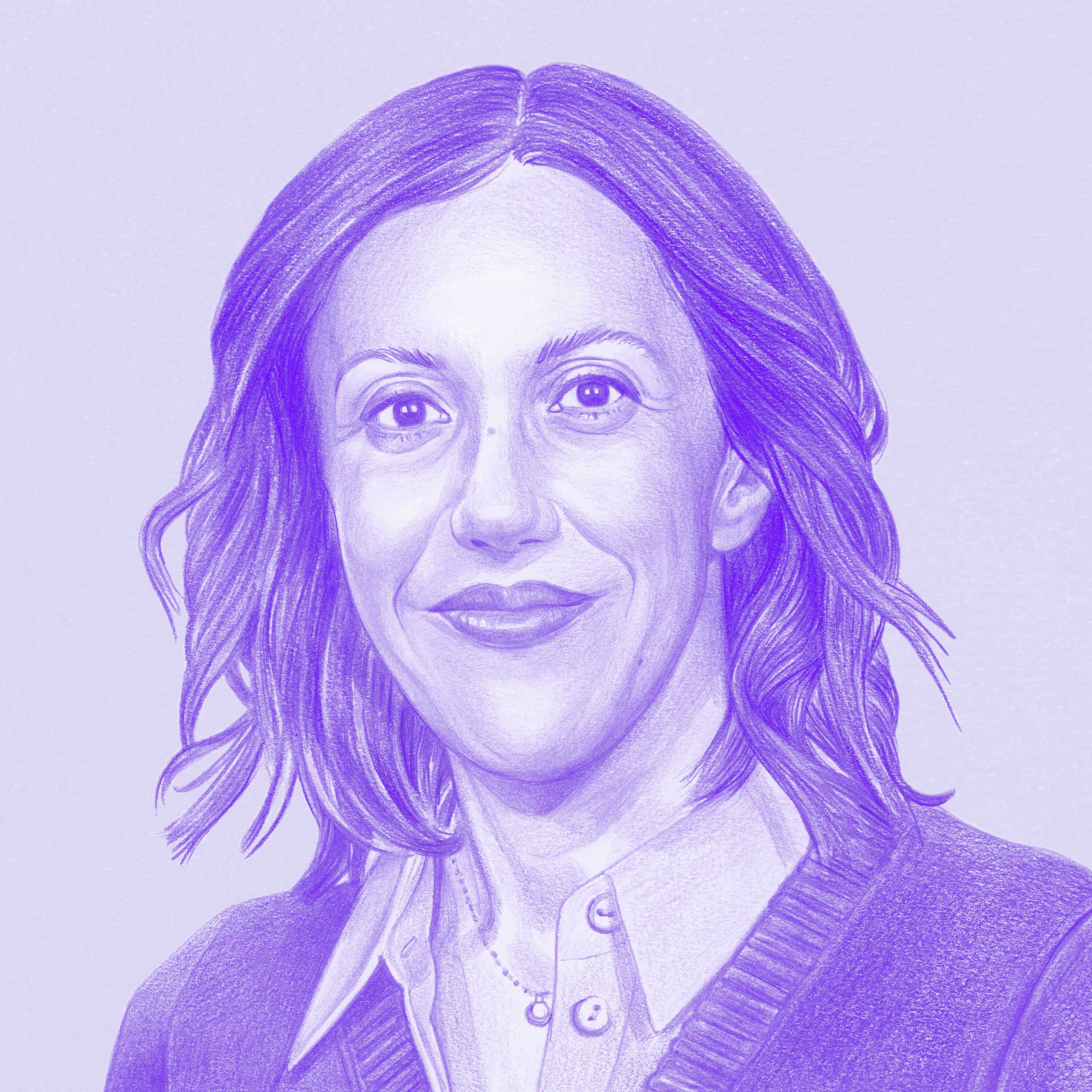
Melania, Soft Power & the Iran War with Writer Azadeh Moaveni
Freitag, 9. Oktober 2026 · 38 min
Kapitelklicken springt direkt hin
Shownotes
As US journalist Azadeh Moaveni was writing her latest book, ‘The East Wing’, a history of America's first ladies and their staff, President Donald Trump’s demolition of that very part of the White House was underway.
Moaveni presents her book as a “parallel women’s history,” tracing how the wives of US presidents, who traditionally had offices in the now-vanished annex, helped shape alliances at home and abroad.
Moaveni, a journalism professor at New York University, is a longtime reporter on Iran and the Middle East. She explains in her conversation with Mishal Husain how when she took on the project, Iran seemed unusually quiet. Then the US and Israel attacked. Here, she reflects on a seismic year in the US and around the world.
Contact The Mishal Husain Show mishalshow@bloomberg.net
Subscribe today on Apple Podcasts and Spotify.
See omnystudio.com/listener for privacy information.
Transkriptvom Podcast bereitgestellt · Zeitmarken springen hin
Bloomberg Audio Studios. Podcasts.
Radio. News. I took this job in the States and I thought, well, what are the wives of the big powerful men doing here? First ladies learned that they needed to try to be apolitically political. There had to be a whole narrative about what they were doing that made it seem about.
Soft power, about values. Azadeh Moaveni, known for her journalism on the Middle East and now turning her eye to Washington. Melania Trump, do you have a sense of her being a different first lady in this second chance she has at the role?
I think she is partly misunderstood. And I don't think that the public really has a sense of the things that she is committing her time to that have actually been quite significant.
From Bloomberg Weekend, this is The Mishal Husain Show. I'm Mishal Husain. I've known of Azadeh Muavani's work for a number of years, first from her memoir of growing up Iranian-American and later going to Tehran to work as a journalist, and then her wider reporting and writing on the Middle East, including writing about the women of ISIS. She is, I think, the only person who has really examined the stories of the women who made that choice, what attracted them and the consequences. Given all of that expertise, I was intrigued to discover that her forthcoming book is about the United States and specifically about women living close to the heart of power in Washington and indeed exercising it themselves. The
book is called The East Wing, about the first ladies of the last 90 years and the women who worked for them, helping to shape their role as well as their image and therefore the impact they could have. From Eleanor Roosevelt all the way to Melania Trump, this is a tale of influence and international affairs. And one that takes us from Washington right around the world and from the Cold War all all the way to today's Iran war.
As ever, my written notes are a place where you can find the context beyond this conversation, and there is a link to those in the show notes. Azad and I were both conscious as we spoke that the actual East Wing, the place where First Ladies have traditionally had their offices, has now been bulldozed to make way for President Trump's new ballroom. And you will hear us talk about that early on. So, Let's dive in. Here's what happened when Azadeh Moaveni came into the New York studio to talk to me. So, of course, Azadeh, I'm interested in your broader thoughts, obviously, at a moment like this, because this has been such a seismic year.
It has. It has, yes.
I actually took on this book project because I thought, oh, well, Iran is very quiet. Let me explore a different milieu for my themes and got started on this.
And then, of course... It turned into a big area. Turned into like the big next war.
Yeah. What first got you interested in the stories of the first ladies and their staffers? Was it one of those that's percolating for a long time or was there a particular moment that started you off?
You know, it was not a particular moment so much as working on that exact same approach, but in a different context. Before I was working in Lebanon, writing a report about how the UN had a plan to try and diffuse the conflict in Lebanon by bringing together the wives of all the big political leaders and warlords and all the big sort of sect leaders. So it was very much focused on the wives, recognizing them as influential.
And then I took this job in New York and I landed, you know, in the States and I needed to work on something that was U.S.
Based.
And I thought, well, what are the wives of the big powerful men doing here? And then actually saw that they're not really written about in a very sort of political way. They're sort of covered as celebrities or there's biographies of them, of course, but sort of looking at them as almost in the way that we would look at the queen mother and monarchial systems. They have a lot of power through their familial linkage to the throne.
They're in the presidency and in the key place. And I also like the way you foreground the staffers as well, because they are really even more hidden, if you like, behind the scenes.
They're completely, I believe, unobserved in history, even though the chiefs of staff of the president are superstars, there are documentaries about them, there are books about them, and there's a lore about the chief and the chief is this and, you know, he's handed down and they get together and they're so the object of attention as the kind of engine that runs the presidency.
And they generally wanted the credit as well. They've like claimed their influence, which I think the women around the first ladies, you say early on that they're much less likely to do that.
They shun it.
It was very hard to interview many of them and to ask them whose idea was this? This was a breakthrough. This was a diplomatic coup in the Cold War. And they were they were They would, well, you know, it was me, but it was really they want to credit the principal. They're very discreet in a way that, yes, the chiefs of the White House are not at all.
And is some of that because in the earlier period you're talking about, they are hired as social secretaries and their job is seen as ceremonial or glossy rather than political or diplomatic?
Well, that's certainly an element of it because their titles don't reflect the influence that they.
Wield and really what they do.
Even the social secretary is still called the social secretary, even though it's really a job that is fundraising and political and diplomatic. So their titles obscure their influence, certainly. And It took them a long time to be able to fight in the 60s and 70s to be able to have this role in the executive and sit on the team with the president, the Domestic Policy Council. There was that arc of trying to be a part of the running of the executive, get the titles to align with what they were doing. But even then, I think there is a built in deference, protectiveness and discretion amongst the women who work for the first lady.
But now we have a female chief of staff to the president, right? Susie Wiles in a uniquely powerful position.
It's extraordinary.
It's extraordinary that she is the first and that she is the first in this presidency that is breaking all of these democratic norms and battling.
Down these guardrails.
But yet she is the most effective chief of staff that Trump has ever had. but doesn't really see herself as there to advance any kind of women's agenda, which is the chiefs and the staff of the first ladies for many decades felt that that was part of why.
They were there.
So, of course, Azadeh, I'm really struck by the fact that your book is called The East Wing, and it comes out at exactly the moment when the actual East Wing, the bit of the White House that is home to the first lady's office, is a pile of rubble.
It was quite a shock for me as I was writing this book that that happened, because certainly I was not expecting it. And I set out to interview all the very elderly, wonderful ladies who had worked for these first ladies over the years, going back to the Kennedy era and the era of Lady Bird Johnson, never imagining that the East Wing itself as a structure would be in any jeopardy. I saved that for the very end of my research, and it was demolished completely. October 20th of last year without any notice.
Are you one of those who saw that as something bigger than the plan for the White House ballroom, who saw it as a slight on the role of the First Lady herself?
I think many of the women who worked for First Ladies in the past certainly felt that that was, they felt that way. They felt slighted because the East Wing is synonymous with their office. And it has been a sea of women's history. We found out later that the White House Historical Association, which is charged with looking after the White House since the era of Jackie Kennedy, had gone around and taken pictures and preserved in an almost archaeological way all of the offices where they had worked.
But I believe that the way that it was done, not announced, without public consultation, no one knew. I mean, the public learned when these shocking images of the bulldozers, you know, crashing into the building surfaced on social media. So there was a sort of, there was almost a violence to the way that the public learned of it that seemed... insensitive to the profound importance of this place in the history of the White House for women.
Do we know if it was run past Melania Trump? What's your sense of whether she is fine with this, is happy for her office to be elsewhere?
It has been.
Reportedly been revealed or acknowledged that she was unhappy with it. But that's all. She hasn't come out in defense of it, not even once, not in a way that would suggest that she understands the need for the ballroom and she supports the president's plan. She hasn't lent her support and her credibility to the project.
Do you have a sense of her being a different first lady in this Second chance she has at the role, like how present is she even in Washington? I mean, I think it took quite a number of months for her to really take up. residence.
I think her second term is completely different than her first. And she acknowledges it herself.
Like it is for everyone in the White House. Indeed. Indeed.
In her documentary, Melania, she's actually very self-aware about the importance of her second term being different. She interviews on camera women for her East Wing office and asks them, you know, with a kind of raised eyebrow, how do you think that my second term office should be different than my first? So she's not in residence much, we understand, but she actually is much more deliberate. She has more serious staff. She has a small staff, but she has serious staff.
Doing what?
Well, she... came in with actually a real, with a real win.
She helped push through the Take It Down Act, which was a bipartisan bill in Congress that criminalizes deepfake and revenge porn, which is something that's certainly impacting young women. And I think it's been a very long time since the First Lady's been able to push through a really critical piece of legislation in Congress. So I think she is partly misunderstood. I think she shuns the attention of what she would call the mainstream media because she thinks that it slights her and doesn't take her seriously. And I don't think that the public really has a sense of the things that she is committing her time to that have actually been quite significant.
The story you tell in The East Wing is, of course, a much longer one, over 125 years, and you cast it as a parallel women's history, not only the first ladies themselves, but the women working for them. And I guess going back to the beginning, it is really Eleanor Roosevelt in the 1930s who. Strikes out in a new way and is the first lady that no one can ignore?
She's the one who really creates the role as this influential partner to the president, this interpreter of America's maladies, this mirror to the nation. She's a peace activist. She's a diplomat. She's the envoy for FDR. She is a champion for women. She institutes these women's only press conferences because she wants women reporters to be able to get on the front page and to be taken seriously in newsrooms.
So she trailblazes. But she does that, you know, completely on her own, essentially, with the with the aid of one staffer, Malvina Thompson, who's an important character in this because they're a team. you know, how did Eleanor Roosevelt manage to be Eleanor Roosevelt? And that's when the office story begins. She has a profound international legacy. You know, she's part of the international post-World War II, a shaper of that whole order.
It's interesting, though, that 60 years later, when Hillary Clinton is coming into the White House as First Lady, she, I mean, Eleanor Roosevelt is her big role model. She kind of thinks that she can act in that image. And it's like, America's not really ready for that in the 90s.
America was not ready for that in the 90s.
Maybe it still isn't ready for it, arguably.
It may not still be ready for it. I mean, Eleanor Roosevelt was of her time, of course. I think the Second World War and what the country was going through with the Great Depression.
I think in.
The 90s, you know, Hillary Clinton went about her life incredibly politically ambitious health care agenda in a way that was perhaps not as anticipatory of the way that Americans expected the first lady to essentially hide and soften her political ambitions and value, even on behalf of the president's agenda.
So she went too fast.
I don't know if she went too fast. I think that she was perhaps too explicit.
I think what first ladies learned after that whole experience of Hillary Clinton's with health care is that they needed to try to be apolitically political.
It had to be softened.
There had to be a whole narrative about what they were doing that made it seem.
About soft power, about values. There had to be a story.
You know, Michelle Obama, I think, is the sort of the successful version of a first lady who wanted to transform in even a legislative way an aspect of Americans' health care, childhood obesity, but went about it seeming as though she was planting a White House garden and carrying the nation along with just a different, more healthy way to live. But it's still a.
Safer issue, isn't it? Like, you know, eating healthily. is a safe issue compared to actually health care and tackling that system in America. And that has been the theme. I guess in that sense, you can see Melania Trump is probably being a bit braver.
She is a bit braver, I would say, in some ways. I mean, up to the Reagan era, first ladies in a kind of bipartisan way, Republican first ladies, Democratic first ladies could take on projects and politics that related to women's equality and women's rights and the role of women in this country in a way that was not dangerous to their husbands' electoral prospects. I mean, Betty Ford supported the Equal Rights Amendment. Pat Nixon was critical to getting more women appointed into the federal government. In the 90s, America was changing and we had the rise of evangelical Christianity and religion, traditional gender roles became an element in politics in a way that it hadn't before. And so that really constrained what the first lady could focus on
and attempt to do in terms of her projects and her politics.
So there was a shrinking.
So they always have to operate in the context of their times. I want to pick out another very famous first lady, because I think you portray something that is not really recognized about her. Jackie Kennedy is known, of course, for her style, her charm, her love of the arts. But you do show that she too has diplomatic achievements.
She is such a superstar of her time and is remembered as such a queen of America, of Kamala. Yes, her incredible diplomatic ambition and sensitivity and shrewdness is sort of, I think, almost lost to her story. She worked closely with the social secretary, press secretary, Tish Baldrige, who was also wanted to be a diplomat. But she couldn't go into the diplomatic corps at the time because it was the 60s. So between the two of them, in this incredibly subtle way, they turned their political entertaining into an element of the Kennedy administration's foreign policy during the Cold War.
Particularly in relation to India and Pakistan at the beginning of the 60s.
She turned around America's relationship, certainly with India, because Prime Minister Nehru was very... distant towards the Kennedy administration. He felt that Kennedy was a young sort of debonair, perhaps, you know, he didn't take him terribly seriously. But he was really drawn to Jackie Kennedy and her sister. And so Jackie gets dispatched by the U.S. government as essentially the envoy to India and Pakistan. And she goes and she has this mesmerizing tour that's covered around the world.
And Nehru keeps a picture of her in his office forever after. So she does. She's sort of the one who's able to seal the relationship.
Interesting. And I was also, I have a bit of a personal connection to one thing you write about, which is that before Jackie Kennedy goes to India and Pakistan, there's this very high profile visit of Ayub Khan, the president of Pakistan, to Washington. And there's a big dinner at Mount Vernon. And Ayub Khan's first lady was, was his daughter. She acted as his first lady in that time.
And I looked up the pictures of this dinner at Mount Vernon and there is Yubhan's daughter Naseem in her sari. My grandmother was the person who taught her to wear a sari. So helped prepare her for her role as the first lady of Pakistan.
It is remembered by historians and scholars of first ladies. It is par excellence, the most iconic, elaborate, creative, of state dinner ever. I mean, they sailed down the Potomac River to Mount Vernon at dusk. They had orchestras on the banks. I mean, it's unparalleled. There's been nothing like it.
It's extraordinary. I'd love to talk a bit about Your lens on all of this is an Iranian-American, Azadeh, because you've written about your own heritage. You've reported from and on the Middle East for 25 years. There is a moment when I think your worlds intersect in this book because Jackie Kennedy at one point was nearly outshone by the Empress of Iran when she came to the White House.
Yes.
But managed to hold her own.
She managed to hold her own.
Empress Farah at the time was, after Jackie or perhaps alongside Jackie, the most sort of celebrated, sophisticated royal or.
First lady in the world.
So when the Shah and the Empress came to Washington, it was a sort of style showdown for the two of them. And the President Kennedy teased Jackie, you know, you should get your jewels out. You need to make sure that, you know, the Empress doesn't outshine you. So it was fun to see how both of them in their own times, quite tremendous in their roles, but being watched on the world stage to see who for the sort of glory of their nation was the most sparkling, you know, woman on the stage.
Obviously, it was a different time for Iran. So then bring us up to the present day and this extraordinary year between Iran and the United States. I mean, you must feel it as well as have to analyze it. What do you think you have learned in the course of seeing what has played out this year that you didn't expect?
I didn't expect Iranians to turn out in January.
Against the regime.
Against the regime in the way that they did. I mean, I've been covering Iran for, I mean, it's getting close to 30 years now. And of course, they've been frustrated and impoverished and angry for many, many years now and have managed to, you know, carve out space for themselves to have more civil liberties and social liberties through their own kind of civil disobedience campaigns, the Women Life Freedom Movement that really sort of ended dress codes in Iran.
But I didn't expect them to respond to the call of Crown Prince-in-Exile Reza Pahlavi, because for years we've covered him, you know, those of us who covered the Iraq War and saw that the role of the diaspora can be overimagined by politicians and it can be very risky to put any hopes on a diaspora leader to be part of an agenda, military or otherwise, for change, you know, in their home country. I didn't expect them to turn out you know, in the way that they did filling the streets of these cities across the country.
And then, of course, the war began. So what are your conclusions now about what that movement in January could have grown into in different circumstances?
It's a very, it's a very good question, because the few weeks in between, I think we almost forget about them, that Iran went quite rapidly from a massacre, like a terrible massacre, I think, in 48 hours. The numbers are disputed, but even the accounts of five, six, 7,000, I mean, these are tremendous killed.
By the regime.
I think that had there been any kind of military intervention or the assassination of the Supreme Leader or any kind of sort of move towards war much earlier, I think that the Islamic Republic might have really teetered because people.
Were on the brink. They were on the edge and it looked like things could collapse.
But the weeks in between, you know, people came to understand the scale of of the atrocities that frightened them. you know, this is a country that went through this profound trauma of these massacres that have no precedent in living memory and was coping with that and figuring out how to, you know, even countenance or think about its relationship with the system and the aftermath of that and then this war.
Because President Trump did say at the time of those protests, help is on the way. You're suggesting that the mood changed then in the intervening weeks, although you still have the The reality that however much people feel against their own government, being bombed by outsiders can just be something that is then beyond the pale for people.
Both of those things.
I mean, he promised the help was on the way and it was not on the way. People were not aided or assisted. You know, whether they ultimately would have would have wanted that, I don't know. Because to have your regime change or your system change through an assault and through a foreign intervention is something that people, I think, everywhere would be deeply ambivalent about. But there were many people who saw no other way, who saw no other way for things to move, that the Islamic Republic's security apparatus holds so much power and is so repressive that without some kind of outside help, there would be no way to dislodge it and to get the country moving.
out of its current impasse. But then the war didn't turn out to be just a war of decapitation, striking military sites and targets of the regime. It very quickly became a war against all of Iran. There were civilian infrastructure hit.
There was a school in Minab that was hit.
So many of those people who at the outset thought, oh, well, perhaps, you know, this will save us, saw that this was not against, not just a war against the the regime, but a war against the whole country.
So when you were there recently, did you feel that the regime was stronger than the last time you were there?
I think people's willingness to sort of continue to give the system credit in the way that they did in the aftermath of April and May, I would say is.
On the wane.
You know, when the war was against Tehran, those 40 days when Tehran was being bombarded, I think there was a real kind of seizing up of nationalism, of a sense that this was a system for, you know, everything else that it had done was defending the country. It kept the country secure. It kept the capital secure. It kept the borders relatively secure. And I think that it softened people's attitudes or it gave them a sort of gratefulness.
But that has really started to evaporate because they were relieved that this memorandum of understanding was signed by the U.S., And now.
Watch what the regime is doing.
They see that it started firing on ships in the Persian Gulf, that it was sort of seeking out provocation again. So I think now the mood has shifted once again towards anger and frustration. You defended us well. You know, now go back to the negotiating table, make some concessions. You know, we want this war to end. People are exhausted of no war, no peace. And this regime seems like it can you know, deliver some war, but it can't deliver peace.
Do you think Reza Pahlavi could still be the one? Do you think he could be a future leader or has that moment passed?
The moment passed. The moment passed.
There was much hope in him and he performed really badly.
Because? He was never able to.
Walk the line of being a nationalistic protector of the country. He was never able to say, I don't want my country to be attacked. I am worried for the state of my country. I mourn when my compatriots are killed. in US attacks.
He was, he.
Allied himself in such a crude way with the Israelis, I think, in a way that worried people and turned them off.
He was just never really able to seize.
The moment and have the kind of charisma and leadership and empathy that people were looking.
To him for.
And so I think he was seen as someone who was just abetting the destruction from the outside.
So I'd love to know your thoughts about the region more widely, because you've not only reported from Iran, but you've seen the aftermath of the Iraq war in the early 2000s, the so-called Arab Spring. The Rise of ISIS, you wrote a book about the women who joined ISIS. How would you characterize the development or otherwise of women in the region, I guess, from the period of the Islamic Revolution, when women were part of bringing Ayatollah Khomeini to power in Iran?
Women have been really at the forefront of all of these movements of the last decade. 50 years, even the very violent and seemingly quite fundamentalist movements, sort of seeing in this kind of anti-Western embrace of orthodox Islam, a sort of language or a style of resistance to the West. And often that's been in sort of backlash or reaction to secular dictators who've used women's rights and secular codes for women. You know, that has been seen as part of their authoritarian ethos.
I'd love you to explain that a bit more, because I think it's really striking that you're thinking about places like Tunisia or Bashar al-Assad, who are leaders who are Muslims, but secular, but political rights don't stem from that.
No, exactly.
So... Whether it's Iran in the late 70s.
Under the Shah.
Under the Shah or Tunisia under the Ben Ali dictatorship, which was, you know, the secular dictatorship that was overthrown by the revolution in Tunisia during the Arab Spring. Bashar al-Assad, even the Egyptian order that was challenged by the Muslim Brotherhood, the Tahrir revolution, the Arab Spring revolution. women were very much at the vanguard of those protests. And they embraced Islamism, jihadism eventually, and this very regressive, uninclusive spirit in order to bring them down. And that's partly because, I mean, perhaps, you know, this is now becoming very nerdy, Michelle, but place to place, women became part of these militant movements, imagining that once they succeeded, they would be included and
that they would have a place at the table and that they would be part of the new order. And that did not come to be the case, which is why women in large numbers from the Arab world joined the Islamic State.
And women from the Western world. That perhaps is harder to explain, including some very young women, people like Shamima Begum, who was 15 when she left the UK. So what is the attraction there? I'm conscious that, and you bring this out in Guesthouse for Young Widows, that there are many complex circumstances. And sometimes women are leaving their husbands and escaping to Islamic State. And sometimes there are all kinds of other reasons. But how do you explain people like Shamima Begum, who've grown up with every possibility of succeeding on their own terms in the West?
I think these young women from European countries, from Western countries, were groomed and trafficked. Because They didn't go in huge numbers, ultimately. So this wasn't sort of about the domestic politics of France or the United Kingdom. I think that ISIS was very skillful and spent a lot of money and resources in its propaganda directed country to country, trying to prey on the racial and cultural insecurities of second generation Muslims.
So it really devoted this kind of bespoke propaganda to schoolgirls in London who were the daughters of conservative you know, Muslim origin families who didn't feel like they belonged, who felt like their parents didn't understand them, who felt that they were not accepted in British society. And this group came in cunningly with a strategy for them. I mean, it was so specific. You could sort of imagine, you know, a very polished marketing outfit creating that for them. And then they surrounded them with people on the ground in East London, in Bradford, in Luton, wherever, who were also able to be part of what was essentially a whole grooming agenda.
So the caliphate becomes like a promised land almost.
The caliphate to them became a promised land.
It was a place where they could be active as women, but they could also wear their hijabs and they could be religious and they wouldn't be looked down upon. They wouldn't be frowned upon as backwards. They would fit somewhere and they would make a difference. So these were teenagers, I think, being seduced to join this kind of utopian place where they would have a role.
Let's just to close, like talk about the Middle East and the US more broadly, Azadeh, because there's a lot of discussion and debate about the future of the US presence in the region and what happens to bases, but more widely, the extent to which the US is going to stay involved. I mean, Donald Trump was a president who said no more wars. And he is the one who has taken the US into another war in the Middle East. So what do you think the future looks like?
for the relationship between the U.S. and the region?
The relationship between the U.S.
And the region will be fundamentally altered in ways that we might not see in an immediate one to two year horizon, because I think all of the big regional players sort of see that they have to wait out this Trump presidency because he's taken America into a war that he cannot extricate the country from. But I think fundamentally within the region, you know, big players, Saudi Arabia, Qatar, Turkey.
the Persian Gulf monarchies who believed that they could rely on the U.S. security umbrella, now see that they cannot and that also that this war, the Israeli-American war, has destabilized their economies, it's destabilized their growth models. And so there will have to be And there is talk of it already between the Gulf countries, Iran and Turkey, looking to a whole new regional paradigm where these countries, because of their geography, have to come to a new kind of security alignment or posture or accommodation with one another that will not make them vulnerable to the old setup.
Because the old setup was meant at very high cost to deliver security to the Arab countries of the Gulf, but has actually just made them terribly vulnerable. So now they see Iran as a neighbor that they must somehow accommodate in terms of security.
So do you think the push will come from them, from those Gulf countries, like, you know, the big bases in Qatar and Bahrain, in Saudi Arabia. Do you think that they will want those to come to an end rather than the US decide it doesn't want to have that kind of presence?
Well, maybe it's mutual. Maybe it is mutual. I mean, the bases have been shown to be very hard to defend. And for these countries, you know, what is the utility of these bases if they are actually making Qatar vulnerable, if they're making.
The UAE vulnerable?
From the other side, though, I mean, to extricate themselves from this relationship with the United States is also extremely costly because, you know, these are countries that are you know, client states, essentially. I mean, they don't hold elections. They are not representative. They rely on the United States in many ways to sort of keep them in power.
And they also obviously want the economic relationship with the United States.
They do want the economic relationship, but they buy arms, you know, buy the billions, arms that don't, I mean, they're not using these arms to protect themselves. So they pay protection money and aren't being protected anymore. And having these bases, you know, in the case of the UAE, endangers their entire sort of stability expat oasis model. So I think we're in a time of tremendous transition. You know, will we see the bases dwindle, disappear? Will we see demands made? I think all of these countries are sort of refining and thinking through how they can accommodate being squeezed between Iran and the US in a way that they never expected to find themselves.
And what have these months of the war been like for you as an Iranian-American? We had Vali Nasser on the show right at the beginning of the war, and he said it's just, there are such deep fractures in the diaspora community. He actually said that the community was eating itself. I think he meant Iranian-Americans, but probably those elsewhere in the world. What's your sense of it? Um.
It has been a very painful time because I think, you know, the Iranian diaspora is no exception. Many diasporas, you know, become so out of touch in ways with the story of or the experience of the suffering of people back in the homeland that their politics almost detach and become a politics specific to that diaspora. Maybe Cuban Americans are similar. So it is terribly divided. I mean, people, families falling out. I think most Iranians inside Iran are angry at the United States for attacking their country, but they do not see the United States as a reason for why Iran is in the dreadful, dreadful hole that it's in. They blame the Islamic Republic. They hold the Islamic Republic accountable. But when you sort of read and
circulate in the diaspora, I mean, they're just like American leftists. They're anti-imperial. They're angry at the United States. I mean, the United States is not ultimately responsible for the welfare of Iranians.
The Iranian leaders.
Are responsible for the welfare of Iranians.
Azadeh Moavani, thank you so much. Congratulations on the East Wing.
Thank you. Thank you, Mishal.
It's been good to talk to you.
It's been wonderful. Thank you.
And that's where we left it. But if you'd like to know more about Azadeh's wider work and indeed read my own reflections on the conversation, don't forget those written notes, which you can find at bloomberg.com forward slash Michelle. We publish them with every episode. And so to the team, the show's producers are Jessica Beck and Chris Martlew. The video, because you can watch this conversation in full, is produced and edited by Andy Hayward. Guest booking is by Elan Bird.
Social media by Alex Morgan. Production assistance from Indira Ray. Our music is by Bart Warshaw. And the executive producer is Louisa Lewis. For this episode, Cale Brooks was running the studio in New York. And at Bloomberg Weekend, thanks to Brendan Francis Newnham and our executive editor, Katherine Bell.
Until the next time, goodbye.
