

The Piano Pod - a global hub for innovation, education, and connection in classical piano music· Staffel 7
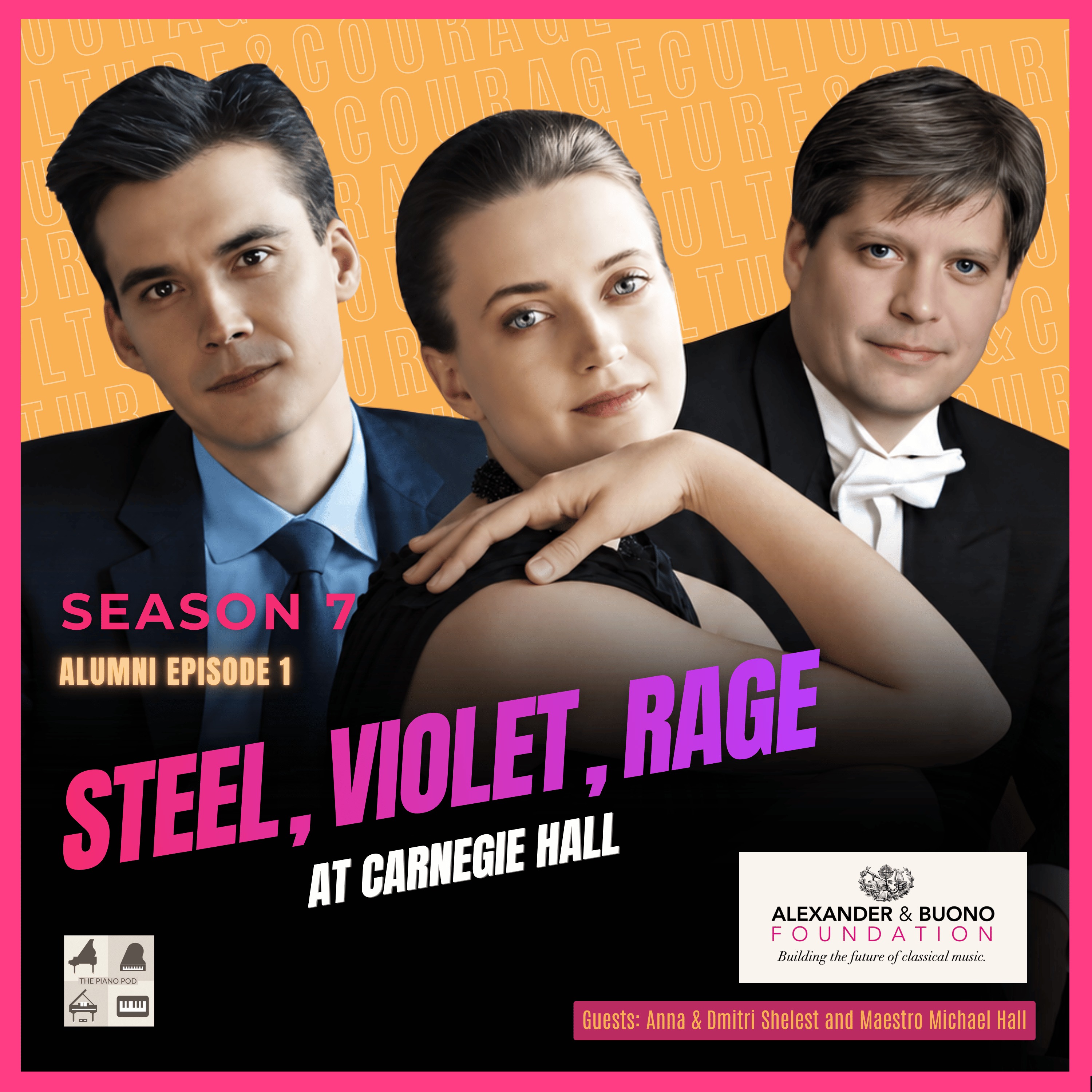
Steel, Violet, Rage at Carnegie Hall - SEASON 7 ALUMNI EPISODE 1
Mittwoch, 7. Oktober 2026 · 46 min
Kapitelklicken springt direkt hin
Shownotes
Got something to say to this podcast? Send a voicemail, and you might hear yourself on the next episode! (rss.com/podcasts/the-piano-pod/voicemail)
This episode is brought to you by the Alexander & Buono Foundation, a nonprofit organization dedicated to helping promising classical musicians launch and sustain their careers while cultivating new audiences for classical music.
Learn more (alexanderbuono.org)
Pianists Anna and Dmitri Shelest of the Shelest Piano Duo join Maestro Michael Hall, Artistic Director of the Brandywine Valley Symphony, for a conversation about music, collaboration, and the upcoming U.S. premiere of Ukrainian composer Oleh Bezborodko’s Steel, Violet, Rage.
On October 18, the Shelest Piano Duo will perform with the Brandywine Valley Symphony Chamber Orchestra at Weill Recital Hall at Carnegie Hall. The concert opens Razom for Ukraine’s fourth annual Ukrainian Cultural Festival, taking place across New York City from October 18 through November 6.
The program also features Valentyn Silvestrov’s The Messenger, Philip Glass’s Tirol Concerto, and Samuel Barber’s Adagio for Strings.
In this episode, Anna, Dmitri, and Maestro Hall discuss the ideas connecting these works, the unusual demands of performing a concerto for piano four hands and orchestra, and what music can preserve and communicate during a time of war.
This episode is presented with the support of the Alexander & Buono Foundation.
CONCERT INFORMATION
Sunday, October 18, 2026, at p.m.
Weill Recital Hall at Carnegie Hall
🎟️ Get Your Tickets (carnegiehall.org/calendar/2026/10/18/shelest-p…)
PERFORMANCE EXCERPTS
• Leonard Bernstein: Overture to Candide, arranged for piano four hands by Charlie Harmon (youtu.be/OfztrsAEZzY?si=dKBraTMyMfimOEe7) — Anna and Dmitri Shelest
• Valentyn Silvestrov: The Messenger, piano solo version (youtu.be/P-NC3di80Ls?si=RfMrsgw7b7U7Wwn9) — Anna Shelest
• Oleh Bezborodko: “Steel” from Steel, Violet, Rage — Anna and Dmitri Shelest
• Philip Glass: Truman Sleeps from The Truman Sho (youtu.be/9C12SqJFLdM?si=IaZtM5zf-9lVG_ov)w — Anna Shelest
Please note: Truman Sleeps is included as an additional performance excerpt and is not part of the October 18 concert program.
LEARN MORE
🎹 Anna Shelest and the Shelest Piano Duo: HERE (annashelest.com)
🎻 Brandywine Valley Symphony: HERE (bvsymphony.org)
🇺🇦 Ukrainian Cultural Festival 2026: HERE (razomforukraine.org/ucf2026)
🇺🇦 Razom for Ukraine: HERE (razomforukraine.org)
FOLLOW THE PIANO POD
📩 Subscribe to The Piano Pod newsletter and receive our free PDF, 12 Lessons from Season 6: HERE (the-piano-pod-with-yukimi-song.kit.com/b24ee97…)
🌐 Visit The Piano Pod: HERE (thepianopod.com)
If you enjoyed this conversation, please subscribe to the channel, share the episode, and tell us what stayed with you in the comments.
#ThePianoPod #ShelestPianoDuo #UkrainianMusic
Transkriptvom Podcast bereitgestellt · Zeitmarken springen hin
This episode of The Piano Pod is brought to you by the Alexander M. Buono Foundation, an organization dedicated to supporting classical musicians through performance opportunities, recordings, and artistic development. Welcome back to The Piano Pod, everyone. I am your host, Yukimi Song. In this special Season 7 Alumni episode, we are looking ahead to a major concert taking place at Carnegie Hall on October 18th. If you are in the New York City area, mark your calendar. You may remember Anna Shellust. who joined us just a few months ago during Season 6. Today, she returns with her duo partner, Dimitri Shellest, and maestro Michael Hall to give us a glimpse into the music, collaboration, and ideas behind this upcoming performance. The
Shellest Piano Duo, Anna and Dimitri Shellest, will join the Brandywine Valley Symphony Chamber Orchestra, led by artistic director, maestro Michael Hall, for a program featuring the U .S. premiere of Ukrainian composer Ole Wysbrodko's Steel Violet Rage, a concerto for piano four hands and orchestra. The concert opens the fourth annual Ukrainian Cultural Festival presented by RASM for Ukraine. Running from October 18th through November 6th, the festival brings Ukrainian music, film, theater, literature, and visual art to audiences across New York City. This special episode is presented with the support of the Alexander and Buono Foundation. Before we begin, if you enjoyed conversations like this, please
subscribe to The Piano Pod, follow us on your favorite platform, and share this episode with someone who might enjoy it. Here is our Season 7 alumni episode featuring the Shelless Piano Duo and maestro Michael Hall. Please enjoy the show. You are listening to The Piano Pod, where we talk to the brightest minds in the industry about how they are bringing the piano into the future and thriving in a complex, ever -evolving world. Anna, Dimitri, and Maestro Hall, welcome to The Piano Pod. Thank you so much for being here. And Anna, it feels like only a... like a few weeks ago that you and i sat down for an in -depth conversation last season i learned so much about your commitment to bringing greater
attention to ukrainian composers women composers and music that deserves a wider recognition and we also talked about you know this upcoming carnegie hall concert and at the time it was still like felt so far away but now here we are it is like a few weeks away so then dimitri it's been a really long time we first encounter you know connected many years ago through the piano world here in new york so it's wonderful to reconnect with you now in this very different context and maestro hall welcome it is truly an honor to welcome you to the podcast so thank you all of you for joining us but How are you guys feeling as the concert gets closer? How's the prep going?
Well, you're exactly right when you said how quickly time flies because, you know, concerts like this, they get planned for a long time and you're thinking, you're dreaming about it. And then it's sort of, it's just next month. So, yes. We were excited and now I'm so excited we can speak together about this program because as we get closer to the event, you realize it is this program bringing many people together.
So that's kind of a wonderful thing. Exciting. I know you mentioned next month, but this episode will come out in October. So it's only a few weeks, really a few weeks away, right? Yeah. Yes. It's great. And Maestro Ho. Would you like to continue? Yeah, well, we're extremely excited about this. The repertoire, which we'll talk about in a little bit, is just so incredible.
It covers so much emotional territory. It's just an incredible journey, I think, from first to last. And we're very excited as the Brandywine Valley Symphony. We have not performed in Carnegie Hall before. So this is a debut for us. It's just a great opportunity to show what we can do and to have this wonderful collaboration with these great artists. Anna and I have worked together with the orchestra. I think it was last year we performed. Was it the Schumann, Anna? It was the Schumann. It was the Greek. The Greek, yeah.
So that's wonderful. So we've had an opportunity already to play together and to, you know, just to get to know each other a little bit musically. And so now the opportunity to work. with Anna and Dimitri and the orchestra in Carnegie is just a thrill. Yeah, wonderful. Dimitri, would you like to add anything? Yeah, I think it starts as a very exciting creative journey when the concert is still in the conception stages and you're brainstorming about repertoire ideas and you're throwing thoughts back and forth among the various people involved in it. and then yeah when it's uh just a couple of weeks before the concert you know now you're feeling a little bit of pressure to make sure that everything
comes out just as you envisioned it from day one and that's i think the the most important part of the final stretch is to really make sure uh things work out your way that's right yeah it's exciting But at the same time, I know the pressure, but it's part of that journey. Right. Great. So before we turn to the concert itself, I'd love to begin with the Ukrainian Cultural Festival, which is now in its fourth season upcoming.
Yes. Right. So great. And so for listeners who may be discovering the festival itself for the first time, could you introduce to us, you know, who is actually. behind this festival? And then also, how did it begin? What kinds of programs do they offer? And also, what is the larger purpose? So Ukrainian Cultural Festival is organized by Ukrainian charity Razum for Ukraine. And it started as a kind of umbrella for many different art forms. An idea is really to introduce Americans to broad Ukrainian culture and show many facets of it. Because of that, you have all different art forms. There are films, there are theater productions, there are music concerts. And I got involved with the festival, just offering
them kind of one of the events initially a couple of years ago. And since then, each year, the festival has been growing. This year, we are opening... at Carnegie Hall that it's a really incredible honor and also a big deal for us. So it's been wonderful to see as a festival really growing from kind of this grassroot movements where artists from different fields were coming together and just showcasing. brought Ukrainian culture and this year it offers you can go on the website and see the events that they offer but you can really get the taste of the range of Ukrainian culture and also get a sense of different audiences because of course you know somebody who comes to classical concert versus
to film It could be a little bit different audiences, but it's fun to kind of mix those things together and find common ground with people with different interests. Wonderful. And then this year's festival, actually, your performance is the opener, right? That's correct. Yeah. Yes. And we thought when we all kind of were talking with the festival and. brainstorming about the program, I didn't realize we would be the opening act. But I think it's there is beautiful symbolism in it because our program is Ukrainian and American. So, you know, having it in New York, kind of showing two cultures, I think kind of a great way to open it to everyone and kind of see the two cultures side by side. And just I think it's a nice meaning
behind it. I think it's really quite wonderful. Like I said, the breadth of the repertoire, the importance of the repertoire and the idea. So it's going to be a string orchestra accompanying the piano. And it's remarkable how just with the palette of a string orchestra, how many different colors and different moods you can achieve throughout this concert from something very ethereal. to something very rhythmically driven, to something quite brutal in its conception. So we're looking forward to, as the orchestra, to really delve into these different sounds and these different moods that this whole program is going to show.
So we're very, again, very excited about this wonderful musical collaboration and to really, for me and for the orchestra, to discover. some of these pieces. It's wonderful. Great. So then I hear that there's like the piece, the U .S. premiere of Ukrainian composer, pianist Oleg Bezborodko. Am I pronouncing his name correctly?
Oleg Bezborodko. Yes, that's correct. Oleg Bezborodko. Okay, I'm going to work on this. So his piece titled Steel Violet Rage, right? So, but before... Talking about the specific piece, I'd love for you to maybe tell us exactly what program you're performing. So there are several pieces, right? Yes, I guess I could give you a glance. So the first half of the program is made up of works.
by established composers who actually happened to be born in the same year, in 1937. And that is Silvestrov and Glass. And what makes them unique in their own way is that each of them created their own musical language. And they sort of, I think, became associated with the music of their country. Because Valentin Silvestrov is probably the most prominent and famous composer living in Ukraine today. And the same thing with Philip Glass. If you ask somebody, who's the modern American composer? I think many people would say his name. And this was sort of actually coincidence. We weren't looking for this connection.
But when we chose the repertoire, it happened to be kind of this wonderful. coincidence that people of the same age and also it's interesting thing how you first I always first think about the music and how pieces would work together and then when you start looking into like the history of the music and the meaning behind it sometimes you strike struck how there are certain symbolisms that really works for this program, but I actually wasn't looking for it when I went searching for the program. So the first piece by Valentin Silvestrov is called The Messenger, and it's a beautiful work of about 10 minutes, which kind of bridges... To me, the past and the present, the world of living and the world
of those past, he wrote it to commemorate the passing of his wife. So this idea of the messenger, it's almost like this entity between the world that shifts and it's like you can communicate with the souls, with the spirits, with the memory of the people that left. Also, his style of music, it's so peaceful and serene and lyrical and beautiful.
To me, it's music of comfort. A contrast with the opener, we will have Philip Glass' first piano concerto. And to me, his music is associated with the urban rhythm, with urban life, and all the different characteristics of... what that life is, the rhythm, the pacing, the certain business of that, and him being a New Yorker and us living in New York, I think there are certain connections that it's just hard to escape.
And then the second half, we will have Barber's Adagio for String, and it's a piece that... i think such a comforting piece uh it's always when you think of any event where people need music to kind of soothe them that that's i think the piece that always um is so meaningful and the last piece on the program will be american premiere of a lapis barotka concerto and this will be I think it's the most dramatic piece on the program and something that I think will really have the emotional impact that we hope to make. Right. I have a question. So the first piece, The Messenger by Silvestro. is for the string orchestra? Yes, string orchestra and piano solo. Oh, concerto. Oh, I see. Yes, as a concerto,
correct. But just about the messengers, yes, it has very interesting, I wouldn't even describe it as a concerto because the piano is so integrated into the orchestra and I'm so looking forward to our rehearsal, how to make it work because it's really, you have to almost communicate on this. metaphysical level, even like with the tempos, you have to really become as one, like all of us. So in terms of ensemble, I think it would be really fascinating to experience this piece. Yeah, exactly. And it's music that kind of evokes the past in a dreamy sort of way. You'll hear it and you'll even wonder if there's little examples of... the music of Mozart, for example, but these are all, these are, these are all created
by the composer, but there's this, as Anna said, the sense of the past and the sense of how the past influences how we feel today. And so you have these little moments in the music where it's strictly, you know, late 18th century music that sort of, you know, appears and disappears. quickly and subtly and so this this as anna says this this symbiosis between the orchestra and the string players and the piano uh is is something that we're really going to enjoy delving into and discovering and the different ways certainly that the violins and the strings can play the different techniques that they have that can help express this feeling of Again, as I said, the messenger from one realm to another, this
really wonderful sense of that process. In fact, the composer even writes to Anna's point about it's not really a concerto. He suggests that the piano lid stays closed as the piece is played to emphasize this. equality, I suppose, between the solo instrument and the string orchestra. So it's incredibly evocative, this music. I think it's a wonderful opening piece in terms of it's almost born out of silence. And when, you know, it's just the logistics of a concert, the audience comes in, there's some, you know, noise talking, people sitting down and it takes time. and then i think what's so wonderful about opening the program with this piece is that it forces you to sharpen your ears to get used to the silence
and to hear this music born out of silence from very far it doesn't really hit you in in a direct way immediately but it's worn out of nowhere in a way which i think is a beautiful way to force the audience to focus. The Alexander and Buono Foundation is a nonprofit corporation with a mission to identify the world's most promising classical musicians and help them launch and sustain careers. Co -founders Barry Alexander and Cosmo Buono draw on more than half a century of combined experience in performance, marketing, publicity, and career development to help the artists they support. We are pleased to announce that on Sunday, October 18, 2026, at 1 o 'clock p .m. in Weyer Recital Hall at Carnegie Hall,
we will be presenting Anna and Dimitri Schellest in concert with the Brandywine Valley Symphony Chamber Orchestra under the baton of Maestro Michael Hall for a concert of works by Philip Glass, Samuel Barber, Valentin Silvestrov, and the United States premiere of Steel Violet Rage by Ole Bezborodko. This concert marks the start of the fourth annual Ukrainian Cultural Festival, which runs through November 6 and is presented by Razum for Ukraine. We look forward to you all joining us to share in what promises to be an afternoon of great artists, great composers, and truly great music. Tickets are on sale now at the Carnegie Hall box office and carnegiehall .org. Thank you. What a way to set the stage
and then continue and then ending with the bang, right? I mean, let's really turn now to the centerpiece of this concert. So, Steel Violet Rage. You know, I watched the video performed by someone else and whoa just mind -blowing the pieces and then you know piano obviously this is the piano duo concerto this is where Dimitri comes in and then Anna and then you are and Dimitri are on the piano and then the string orchestra back behind well together it's not behind but then so tell us about this concerto the back story? Well, this concerto has been premiered just last year in Kyiv, in Ukraine, and the composer Oleg Bezborodka, who we hope will be at the concert in New York.
So we're working on bringing him to the festival. So I hope he will be in attendance. He's also in rehearsal, will give us some of his notes. um but um this piece it's uh uh essentially music that is written in ukraine today it's it all of it is influenced by war it's uh artist uh reflection uh response um to what what is happening around and um each movement of the concerto there are three movements of titled steel violet rage And each movement carries very painful and very significant emotions and meanings to Ukrainians.
So the whole concerto is dedicated to Azovstal defenders of Mariupol. And this is a very tragic event in the Russian war in Ukraine. when in 2022 the city Mariupol was assaulted and many civilians and soldiers, they took shelter in this huge plant. It's a huge steel plant called Azovstal. So steel in Ukrainian style immediately for Ukrainians would carry this association.
But of course, even if you do not know that and you... reads this word in the program still and you hear this music, it's very much evocative of this very brutal and something quite violent is taking place. And this movement is the longest one in the concerto and it kind of really sets the stage and expectations from the audience and from what is going to take place. The second movement is a short, beautiful movement called Violet. And this is really the heart of the concerto, where you have, it's really the imagery of this little flower, which is trying to kind of take root and blooms amidst all of this terrible destruction around. And the imagery and inspiration for it came from a poem, the last poem by Ukrainian
soldier and artist Maxim Krivtsov. And this poem kind of describes him thinking how his body, which is destroyed by war, it's going to bloom into violets that out of his... bones the flowers will bloom so it's very tragic but at the same time it's a very beautiful image kind of image of hope um and it's very prophetic because it was his last poem he he did was killed in the war and the fact that he wrote this um kind of prophecy for himself and i think also for ukraine you know that amidst all of this the terrible destruction and death there is hope and but but it's a very delicate and um there is such a contrast from the uh first movement in in this it's it's a little bit of of a place of of sunshine in
the concerto and the last movement uh entitled rage uh which is really uh you could think of people's reaction to to what war brings, to the rage about the terrible loss, the injustice, the things that we do not know will people get justice for this war. So this war, it's a shorter movement than the first, but it's so incredibly impactful. I think when you hear it, it helps you understand certain things that just from maybe imagery of war you don't quite get. So to me, it's just extremely powerful music. And I think the reason what's so unique about this piece is us. playing together. It's a very unique combination to have two pianists and the chamber orchestra. I know in Ukrainian music, this is
the only concerto for such ensemble. And actually, I wasn't able to find any other concerto for this instrumentation. But I think for... these sounds and this kind of special effect that the composer came up with, you need two people on the piano because to express this brutality and war, it's like one person is not enough. And there are a lot of things that we're going to be doing with kind of creating sounds, playing on the strings and covering the strings and creating sounds that you... don't normally associate with academic music in the concert hall. So I think it kind of bridges this gap between reality and concert experience. And I think it's going to be very powerful. Dimitri, you've been duo since
for a long time. And then I've watched so many videos of you two performing together. But this is next level. Dimitri, what do you think? Yeah, I think that, you know, I want to commend the composer for really taking advantage of the availability of the four hands on one keyboard because he is, even if I haven't heard him play, I would assume that he was a great pianist because we could say these things about composers of the past who wrote so well for the piano. And in this case, he wrote so well for the piano four hands where... he really takes advantage of the hands on and off the keyboard. So there is not an overwhelming sense of, you know, there's just so many notes happening because you have 20 fingers
instead of 10, but you have things going on as far as using the strings, using the plucking, using the harp -like techniques inside of the piano. to create absolutely beautiful special effects that could be one person in charge and the other person would be doing some things on the keyboard. And so he really, I think, views it beautifully, not only between the two pianists on one keyboard, but how that integrates with the whole orchestra. And I think, yes, it's a very unique format for piano four hands and a string orchestra, but I think it's really going to... work out beautifully as an ensemble. Can't wait to hear it now, Maestro Hall. So from your point of view as a conductor and a music director,
what do you think about this piece and how you are approaching to the score? Yeah, to me it's so powerful and when we talk about music and composers and the the ability of music to make you feel a certain way. And I think as an audience member and as a performer in this piece, there is such a visceral immediacy to what's happening, both in the violence of the last movement and the beauty of the second movement. It really takes you as much as you can as a listener into the feelings and the frustration and the sadness that this music portrays. And it's really something very special to be a part of. And, you know, even in the string orchestra, there are certain effects. For example, what we call a Bartok pits,
which is when you pull the string and it rebounds back against the fingerboard and makes a slapping sound. So there's, again, it's a very aggressive sort of approach to the string instruments. And even as far as how they play with their bow. This is what music can do. This is the power of music to transport us and to make us think in a way that we maybe hadn't thought of before.
So this is where I think the power lies in this wonderful. And as Anna and Dimitri said, done so wonderfully. The range of emotion that he can. and the beautiful stillness, for example, of the second movement and the way that, you know, one pianist is playing the keyboard, the other was doing something in more of a different sound world. It just is something that's very immediate. And I think it'll be very effective for an audience to listen to. So, you know, this season, seventh season of the piano part is centered on the theme. culture and courage, which feels deeply connected to what we have been talking about. And then, am I pronouncing correctly, Razom for Ukraine? Is that how you pronounce
it? Yeah, Razom. Yes, absolutely. Razom, okay. So Razom means together. Together, yes. Oh, wow. Together for Ukraine. So it's a Ukrainian -American non -profit that you just, you know, explained to us, but supports Ukraine through, you know, humanitarian aid and so on. I think the organization said that investing in culture is essential, not optional. So at a time when Ukraine is struggling and fighting for survival, what can music preserve or communicate that news reports or political discussions can't? Yes, absolutely. I think when...
If you follow the news from Ukraine, which sadly, the death tolls, the daily rocket assaults, they haven't stopped in the fifth year into the war. But when you think of our American news cycle, you don't really see Ukraine anymore on the first. pages. But I think it's important for us as Ukrainian Americans with Dmitry to be part of conversation about Ukraine and reminding people that the war is going on and just because it's been going on for a long time doesn't make the suffering and injustice normal. It's still terribly wrong and evil. And one interesting thing about Ukrainian culture is that it's under assault as much as any other part of Ukrainian society. Just in the last two months, Russia destroyed 10 million
Ukrainian books. It actually was targeting publishing houses. And you might think, well, why do that? Why spend millions of dollars sending these rockets to destroy books? But it's a very strategic thing on their part because culture... If there is no culture, there is no people, right? This is how we let the world know about us, that we exist, that there is culture. So I think when you work, myself as a musician, sometimes we kind of take for granted certain things because, yes, we're musicians, I always have it, always have an opportunity to play. playing concerts, but when these things are under assault, they begin to mean something different. And one thing I want to mention about Ukrainian resilience is that to me it's just
absolutely astonishing just being in contact with Ukrainian musicians and particularly with a composer that they live in such terrible circumstances. For example, many nights people cannot sleep. Because most of the missiles, they come at night. Sometimes people have to go into subway to spend the night. And I'm imagining as a New Yorker, what if I had to take blankets and take my kids and go spend time on the subway station? Just kind of imagining yourself in the situation.
How would they feel in the morning? Would they want to wake up and practice or play the piano? What would be my state of mind? I have no idea how I would react, but to me that people want to create and it's so important to them and it's important for the world to hear what they have to say. I think we who are blessed to live in peaceful countries, we can really gain different appreciation of what art can do. I think this is very inspiring to me and something that I always want to remind people who, if I have a chance, that, you know, this is very special, like Ukrainian, especially the music that's being written today. It's like, unlike anything else, because artists work in very dramatic, very violent
circumstances. And for us to have a chance to kind of hear their response. what capacity of humans to create, what it can do, and what it communicates to others. It's incredibly powerful. And for me, it was actually quite eye -opening as a musician. Well, Beds Barako comes from a great tradition of composers who need to speak about the situation they're in. And, you know, from... Shostakovich to Sibelius and you name it there's so many composers that this is their way of of communicating what is happening in their in their world and so I think this is why it's very powerful and I think for me having it happening in the present this is not something that we perform and we think back and go boy
that was a tough time and now we're doing this this is this is a real window artistically into the situation right as it happens now. So I feel, and I'm sure we all do, quite a responsibility to try our very best to be faithful to what the composer is trying to communicate. Dimitri, would you like to add anything? Yeah, I mean, it is so beautifully said, but the main, I think, takeaway is regardless of how things appear in the news and how tired or used people might become to the constant tragedies, I think music and art form in general is such a beautiful way to keep reminding people of someone's existence. without necessarily evoking the tragic feelings. We're coming to an end of our conversation. It went
by so fast, like five seconds. But before we close, I would love to hear from each one of you briefly when audiences leave Carnegie Hall on October 18th after the concert. So what do you hope they will feel, remember, or understand differently? Let's start with Anna. I think music has a power to move people. And I don't think I have like a specific agenda or emotions that I want people to feel. I think as an artist, you have a very strong connection with the piece that you're performing, that you're working on, that you're trying to be as truthful as you can.
And then I think if you do your job, it will have an impact. on the listener and it will make that impact that maybe that listener need in their life at the time because we will take from this concert what we need and I hope this will be meaningful to those who listen. Wonderful. Dmitry? Yeah, I think that I'm really happy about how the program turned out because I remember way back when this was still an idea, a conception.
And when the format was presented, it was gonna be a piano, it was gonna be string orchestra, so everyone was thinking of repertoire to fit into that format. And I just couldn't be happier that these pieces were discovered, that the length is perfect, the messenger was... 10 minutes or less duration is a wonderful opener in so many ways. Then the Philip Glass Concerto, which is more of a standard setting, three movements, etc. Then, you know, people listening to Dazhova strings that they've heard and loved for a long time. And then it culminating to the U .S. premiere of the Bezborodko Concerto, which most no one has heard just yet. I think the arch of the program is so beautifully conceived that my hope is that
at the end, when people leave after the last piece, especially from the last piece, it may be the piece that people love or don't love, but I can't imagine someone walking out of that hole, or at least I hope that no one will. walk out of the hall with a feeling of indifference that they just heard this music and let's move on with with our lives because i think that program is built in such a way that this music is something that's gonna be very evocative or maybe even provocative as far as what will stay in people's minds and hearts after hearing music that really hits you sometimes in a gut like that. So I think overall, it's a beautiful construction of a program that should leave people moved first and foremost.
Wonderful. Maestro Hall. Yes, that's very well put. And I agree with all that. I think that the art of the program is wonderful. I hope that people, you know, as artists, we... focus a lot on the technical side of things because in doing that is the best way that we can communicate what the composer has in mind. So really our focus a lot is just trying to do it justice.
But I hope that people, especially with the world premieres or the American premiere, they come to a little more realization. As Anna says, it can be a little bit on the back burner. And I think this can in the way that... has written this, it can have a visceral feeling within the audience that makes them think a little more, perhaps, of the situation now than they might have otherwise in this wonderfully artistic communication.
And I do think the barber is a wonderful addition to this. I mean, it was not written as a funeral piece at all, but it's become that. And so I think... The ideas behind the barber, as it's now understood, fits completely well with everything else on that program. This feeling of personal loss, this feeling of beauty. These are the things I think the whole program is showing. So, yeah, I'm very excited about what we're hoping to have happen as far as the feelings of the audience.
I look forward to it. I will be there. So, Anna, Dimitri, Maestro Hall, thank you so much for joining me for giving us a glimpse into this extraordinary program. And bravo to you already. I think it's going to be a fantastic concert. And to everyone listening, the Schelles Piano Duo will perform with the Brandywine Valley Symphony Chamber Orchestra, led by Artistic Director Maestro Hall. Michael Hall on Sunday, October 18th at Carnegie Hall at 1 p .m. 1 p .m., right? Yeah.
And the tickets are already available on Carnegie Hall's website. I'll make sure to put the link in the show notes. The concert opens Razum for Ukraine's fourth annual Ukrainian Cultural Festival and features the U .S. premiere of the piece Steel Violet Rage. If you enjoyed this conversation, please Hit the subscribe button and share the episode and follow the PianoPod for more conversation from season seven, Culture and Courage. Anna, Dimitri, Maestro Hall, I look forward to seeing you, all of you at the Carnegie Hall. Thank you again for being here. Thank you. My pleasure.
Thank you.
