

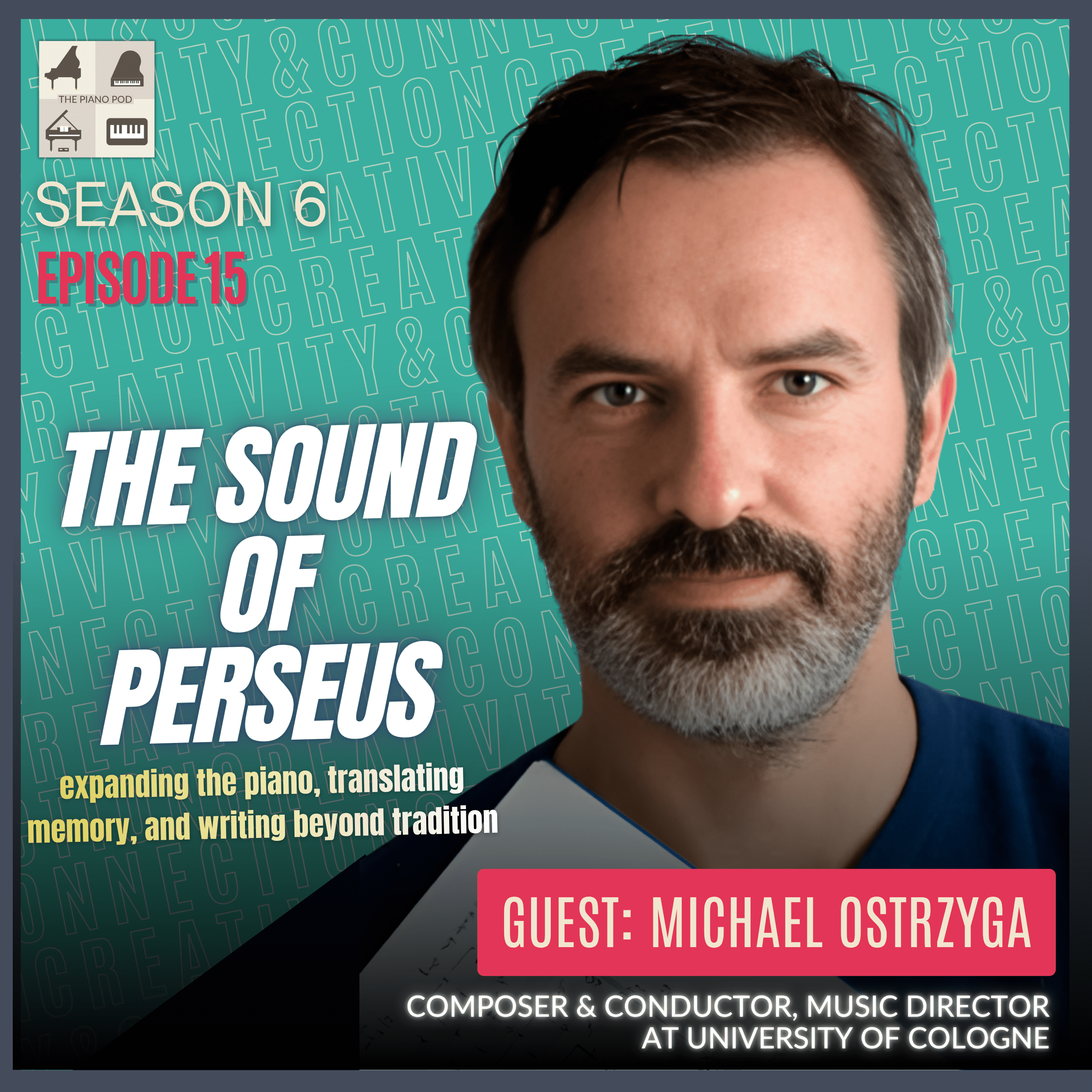
The Piano Pod - a global hub for innovation, education, and connection in classical piano music· Staffel 6· Folge 15
The Sound of Perseus feat. Composer & Conductor Michael Ostrzyga
Mittwoch, 8. April 2026 · 1 h 27
Kapitelklicken springt direkt hin
Shownotes
Got something to say to this podcast? Send a voicemail, and you might hear yourself on the next episode! (rss.com/podcasts/the-piano-pod/voicemail)
In this episode of The Piano Pod, we are joined by composer, conductor, & Music Director at Univeristy of Cologne, Michael Ostrzyga
His work spans composition, conducting, editorial scholarship, and large-scale projects — but this conversation centers on his piano writing, especially his recent solo album Perseus.
Together, we explore how music begins — whether from structure, memory, or sound itself — and how these ideas shape a body of work that moves between tradition and exploration. We also discuss his pedagogical work Der singende Wind, his early musical formation, and his recent arrangement of Beethoven’s Mass in C for four-hand piano and harmonium, commissioned by the Harvard Choruses.
This episode offers a deeper look into the relationship between structure and intuition, and how personal experience finds its way into music.
• 📖 Read our blog (open.substack.com/pub/thepianopod/p/meet-our-g…)
• 🌐 Michael Ostrzyga — Official Website (ostrzyga.com)
• 🎧 Listen to his music (Spotify (open.spotify.com/intl-de/artist/3m1nlG5yrNw6bv…)):
• 💿 Album — Perseus (spektral-records.de/alben/perseus-pianoworks-b…)
• 📘 Der singende Wind (breitkopf.com/work/8755/der-singende-wind) - the Singing Wind (Breitkopf & Härtel):
• 🎼 Beethoven Mass in C arrangement - article (classical-scene.com/2026/02/16/arrangement-mas…)
• 🎥 Harvard performance of Beethoven's Mass in C (youtu.be/0oY17l8Hwf8?si=EEPjxCX_TwLtWOQo)
[THE PIANO POD]
• 💖 Become a VIP Member / Unlock Exclusive Content (thepianopod.substack.com)
• 🎵 Season 6 Piano Playlist (youtube.com/playlist?list=PLeBrJAY2RQ_uqBAHXTk…)(piano music mentioned in Season 6)
• 📫 Join Our Newsletter (thepianopod.substack.com/subscribe)
• 🌐 Website (thepianopod.com)
• 📱 Follow The Piano Pod• Instagram: instagram.com/thepianopod
• Facebook: facebook.com/thepianopod
• TikTok: tiktok.com/@thepianopod
• 🔗 All Links: linktr.ee/thepianopod
Transkriptvom Podcast bereitgestellt · Zeitmarken springen hin
Welcome to another episode of The Pianapod, everyone. This season, we are exploring creativity and connection, highlighting artists who are rethinking what it means to create, perform, and live as musicians today. Today's guest is Michael Ostryga, composer, conductor, and music director at the University of Cologne. His work spans choral music, orchestral writing, and editorial scholarship.
But in this episode, we focus on his piano writing, especially his recent album. Perseus. This is not an album you just follow from beginning to end. It's something you spend time with. It moves through structure, memory, and sound, sometimes very precise, sometimes very open, almost suspended. And what I found especially compelling is that behind all of that is something very human. During the recording of this album, Michael went through a deeply personal moment in his life. and some of the music we hear actually comes out of that experience. So in this conversation, we talk about how music begins, whether from structure, from memory, or from something we can't quite explain. We also talk about expanding the piano,
writing for different kinds of performers, and what it means to stay connected to tradition while still creating something new. Thank you, as always, for being here and for supporting The Piano Pod. Here is Season 6, Episode 15 with Michael Ostriega. Please enjoy the show. You are listening to The Piano Pod, where we talk to the brightest minds in the industry about how they are bringing the piano into the future and thriving in a complex, ever -evolving world.
Michael, welcome to the PianoPod. It's a pleasure to have you with us today. Thank you so much for being here. Thanks for having me. And before we begin, may I ask where you are joining from today? I'm in Germany, in Cologne. I'm based in Cologne and also in Munich, but now I'm in Cologne in my home. Wonderful. So today we're going to focus primarily on your piano writing, especially your recent solo album, Perseus, and your ongoing primes cycle. Am I correct saying?
Primes, yes. Primes, yes. And then while still acknowledging the broader artistic world that surrounds it. So your work spans composition, conducting, editorial scholarship, choral music, and your role as a... music director at the University of Cologne, and all these threads inevitably shape the way you think about sound and structure and the piano itself, I'm sure. So with that in mind, I would love to begin with this first question. With all that you do, what is the core artistic impulse or purpose or mission that connects everything you do? That's an interesting question.
I think, you know, there's this saying, I think it's attributed to Arnold Schönberg, which is Kunst kommt nicht von Können, aber von Müssen. So it's art is not derived from to be able to do something or to, yeah, to can literally, but it's derived from to have to do something. So that you are, actually, you must do something.
I, from early age on, music was sort of my refuge, my sanctuary, my very own thing. And later it became much more a shared thing. But what I kept, I think, is the sense of discovery or exploration and also a sense of play. I think for us musicians, that's very important. We have to make sure that we don't lose this aspect of playing and this sort of very naive, open -mindedness to explore things we do not know yet. And I think that's one of my core motivations. And what's interesting maybe is that all these... roles i play um like conducting like composing like doing editorial work you know sometimes um these roles are interfering with each other so when i'm more in a conductor's mindset i am not a good composer and when i'm
in a composer mindset i'm not a good conductor because it's different thinking yeah you know when you conduct you do like um very very split second decisions you do a lot of uh many things simultaneously in your head so you you guide the music but in the same time you do run diagnostics what's going on how can i what why are they doing it like this and not like that what can i say and do to to bring the vision i i want to want to um realize with with the music and so it's a lot of things are going on and then When you cut off, you have to be very clear and very short.
In very short time, you say, we do this and that. And then it goes on. So there's a flow of this rehearsal and in a concert as well, of course. And that's a very psychologically different situation compared to composing. When I compose, I can think about two notes half an hour. And nothing happens. And I need it also. So my conductor's mind is too quick for my composer's mind and vice versa. Wow. So then when you begin a new work as a composer, where does it truly begin?
Is it, you know, your music engages with natural, technological, astronomical, historical. logical ideas, but in the moment of creation, when the idea begins to form, does it come with an image or concept or sound itself? That's different and I don't know really. Sometimes it's just a memory. I have a memory like when I visited a certain place or when I experienced something like, it could be nature that I visit a very beautiful, but also a very inspiring place. And this sometimes is looming in the back of my mind for years. And then there's a situation which makes this pop up again. And then I feel the...
need to translate this into a piece of music. It also can be like with my cycle's primes, which is about numbers. It also could be something like constructions or architectural ideas. You could do like configurations, figure out configurations of certain structures. And then this intrigues me. And then I try to translate it. Often it's, usually I have much more ideas than I have time to deal with them. Yeah, sure. Wow. It actually makes sense because I've been listening to your piano album, the recently released album, Perseus.
And so there was, it's a portion of Journey you mentioned, you know. and places and so on, and also different inspirations. So let's talk about Perseus, right? So I, first of all, I just wanted to say thank you. When you, you know, emailed me at the, for the first time and you introduced me to your album and it just opened my ear, opened my eyes. It's like, wow, piano can do this. You know, I thought, you know, we, we. heard it all we've you know explored it all but even then there's more to it it's just an amazing instrument but also amazing uh album so for those who are listening uh to this episode this is truly a must listen album and the link in the show notes but the title perseus uh where does that come
from it's the last track of the album right Thank you, Yukimi, for saying this about my music. I feel very honored and thank you very much. I'm grateful that you like it. It happened that the pianist who plays on the album at one occasion told me, because we were recording on the Bösendorfer Imperial, which has the additional low keys, he actually said to me, you need to write about Perseus. And I said, what are you talking about?
And he said, yeah, you know, there's, I have seen this in a TV show that they actually recorded sounds from a black hole in the Perseus galaxy cluster. So it's a galaxy cluster somewhere out there. And in the center of this galaxy cluster, there's a, there's a black hole and, and the, and they recorded, recorded sounds, which can be heard. there because there's gas in the galaxy.
So you know this tagline in space, nobody hears you scream from the movie Alien. But actually in this galaxy, you can hear something because there's gas everywhere. And so they recorded this. And actually somewhere in the internet, you can easily find it. They actually... had to manipulate the recording and put it like 50 octaves higher so that you actually can even hear it because it's so low we can't hear so it says something like 50 octaves higher and then it's forced very very low and very disturbing in a way and i listened to that and then i thought yes i could I could create a sort of a travelogue going to that galaxy in a way and in my music translate it in a actually very formally speaking
in a very traditional way because I have of course I have these modern effects like playing inside of the piano I devised that but then I also have something like a recitativo part in it where I felt this is this is like in an oratorio or opera where we have actually like a scene going on which is happening right there and where where the black hole is described or something like that of course it's very very there's there are no words describing it or explaining it it's not explicitly said but that was my idea to have sort of these traditional Western ideas of our music, how we illustrate things in our nature, like Haydn's The Creation or pieces later on, Programmusik, you know, this like Beethoven's
Sixth Symphony. So there's sort of this idea of illustrating what we see there in musical terms. dive into Perseus inside. So take us through the pieces. So first piece is Personare. Is that how you pronounce it? It's so meditative. Yeah, Personare. That's actually a piece written in space notation, so there's no real rhythms. It's just like relatively notated. Every performer who plays this will have to come up with his or her own vision to realize it. Because he needs to, because of the space notation, he needs to find his or her own approach. And so it's different all the time. It's also different when you play it next week or in four weeks, because this all influences it. And that's what I find. Yeah,
particularly interesting also because it explores the inner world, the most inner world of yourself. And that's why it's in the beginning of the album. It was sort of like starting within, in your own heart or your own soul, in your own being. And then from there, it goes out and explores the outer world. You mentioned, so the notation is. What do you say? Space? Space notation. Yeah, that's notation. Right. Yeah, that's when you don't use real bar lines and rhythmic precise designations, but you just use like on the five system, five line system, you use, of course, pitches and notes. But the space between the notes is informative when the next note will come. And also I used like very small notes,
smaller notes and bigger notes. And also I used grace notes. That was the only thing I also added. Grace notes as very fleeing, like very short, elusive tonal events. So it really depends on, like you said, the day, depends on the person who plays, how you interpret the space or the time is different, right? Right. Yeah. So it could be very long, a long piece. It could be very short. And also this has the sense of play again then, because you need to like play or discover the material, discover what your own mood and mindset is at the moment. Wow. Interesting.
Wow. You can sort of tell what kind of personality this person has too, right? Yeah, it's like a Rorschach test. Yeah, yeah, yeah, yeah, yeah. Wonderful. So then followed by two pieces, primes from primes. So primes five and seven. Yeah, it's, you know, primes, of course, like two, three, five, seven, 11, and so forth, like these numbers. What you mentioned about five is correct.
In this case I used a pattern of five notes and I actually have had that pattern go through different bars. So the bar is different than the pattern, the length of the pattern. And also like that's a minimal music conception, actually. I changed or I put on this pattern of five notes, I put different patterns on it or below it, which have like three notes or four notes. And this changes all the time. But the five -note pattern is...
present all the time so it's like like the same uh but different these these numbers are uh very inspirational for me because it's um of course there are a lot of structural ideas behind that how you can combine these things but also they have like you know like um cultural dimensions or also in our collective consciousness there's something like dance going on with or patterns in nature like inhale exhale or the cosmic things like the planets going in certain intervals and that is something which already Bach was inspired by and was used and you know also Bach for example has this numerals in his pieces sometimes that is like 14 numbers because that is his name.
And so this sort of cultural implications also, that's something I was inspired by very much. Interesting. And then, so then tell me about the prime seven. So first it's seven parts, the pieces in seven parts. And you hear that very, very clearly. And secondly, there is very often this seventh interval. And of course, on the piano, we can only play like four notes in seventh.
You know what I mean? Because I think even Rachmaninoff couldn't play or Horowitz couldn't play more than a fifth one because it's just so stretched out. Then I thought, no, I want to have actually all seventh on the entire keyboard. And I made this possible with grace notes so that the pianist has a grace note at the beginning and then switches to a higher chord in a way, a seventh chord.
And that was interesting also psychologically. That's something I'm interested in. that the pianist then needs to come up with a solution ergonomically, how to do that in a very soft dynamic and in a very soft manner, because I specified it to be like pianissimo and very slow and very, yeah, the atmosphere is like an awakening in the beginning. And so, you know, this movement has to be very quick, but in the same time, It has to be quick because actually I wanted to appear at the very same time all these notes, but you can't play them in the same time and he has to move very quick, but the expression of it should be that it's very calm. And this is sort of a contradicting process going on.
because I wanted it to be translated as a very, very calm movement, but it has to be very quick, actually. that is something well just mind -blowing i actually have to see this you know score again and then you know listen to what you said again but now before we go any further i know that you're developing your solo piano cycle primes right yeah that's true i've started with five and seven because that that was just the first things which took off in my mind and in the beginning I didn't know I wanted to do the other ones too and then it became quite quickly clear to me that I wanted to have a set of pieces and also that is the prime like five or seven movements.
Of course. But the particular one, like in five, the five is much more present, of course. And, you know, there's, yeah, what I hinted at, there's then this, there's a lot of things you can do with the number. Like in seven also, there is a section where I use scales because a scale is seven notes. So I use scales. But I use different scales all the time. And then I jump to another octave to a note which was not in that scale, present in that scale. And then I could start another scale from there. And then again, I could jump to another note in another octave to a note which was not present in the previous. So it's like a serial way of composing, but with tonal materials and not with atonal with like dodecaphonic
material, but with tonal material. And that was, you know, I'm very interested in recombining tonal material or traditional material in ways which are new. You know what I mean? And the numbers are sort of like an... Yeah, like a jump off point to find a lot of structural ideas. And then also, yeah, what I said is the, you know, the cultural dimension or the, what I added, it's just not about the numbers because that would be boring, wouldn't it? When you just have the numbers. But I also tried to like encapsulate a certain mood with every of these movements.
So the five movement is sort of like a computer playing around with figurations very quickly or like a mosaic of lights appearing and repeating in certain ways. So it's sort of like an imagery which is present and you could probably easily translate this to like a movie where something like this is happening, like flashing lights going on. And seven then is completely different.
It's more like a very sinister mood, you know, like the seven sins or like, yeah, I don't know if it's only an European tradition, but the seven is sort of like the number of bad luck. And, yeah, we say, for example, we say when you are married. the seventh year is the so it's the wicked seventh year or the you know yeah and so I used it sort of like a diabolic music also in that very violent also in some moments how interesting so you're using number not only the structural purposes but also like putting sort of like um i don't know different elements to it like uh right superstitious and you know some some things are obvious like three has of course of course the trinity you know in the in the
early music the the three uh the the tempus perfectum was like the division in three And so there's a lot of cultural implications already coming with a number and I can allude to it and change it a bit or follow it. And that's what interests me very, very much. Thank you for sharing that. So let's get back into the Perseus again. So we were at just finished talking about Prime.
So that's track number three. From track number four and on, there's a series of North Sea, how do you say, tag book? Yes, it's diary in English, yes. Diary, yeah. And so it's a North Sea journal or diary in English. Yeah. So tell us about these compositions. Yeah. So I spent a lot of time on vacations, actually, at North Shore Islands.
You know, we have this. islands in the North Sea. And they are sort of like microcosmic places, literally. They are islands, very small islands. And also like of the community is also a microcosm, cosmos. The nature there is quite unique for Germany because, of course, there's the very rough sea. The North Sea is quite a very interesting sea also because the difference between the high tide and low tide is a big difference. Sort of like in Canada, you know, on the Canadian coast, also there are some regions where there's a big...
difference in the tides. And yeah, there are certain things I discovered there or I experienced there which just never left me in my memory. And then I thought of putting them to music in a very aphoristic way. Maybe here, to give one example, there's this piece called Windflüchter. These Windflüchter are plants or like trees which are exposed to the wind all the time and for that reason they grow in a certain direction.
because the wind is coming all the time from a certain direction and so they lean to this direction and they there's then usually a group of trees somewhere which are leaning to one direction and i in this this case i translated this into a music which was also leaning all the time upward and on the keyboard to the right so so to say the wind comes from the left of the player and it moves to the right and um and i use different planes of the same rising little gesture and in different tempos and so it's very simple and it's just one minute long i think and um what What is interesting here for me, too, is that, of course, it's also a metaphor for human experiences or for human behavior or for human development.
Because when we are born, we are also exposed to a lot of wind coming from the same side and maybe differently than you or me. But we are exposed to certain things constantly. and this shapes our leaning into a certain direction and that's what yeah what inspires what inspired me here also and so you can in all these pieces find find these um these inspirations and how they are translated to the piano but also see like metaphors for our human experiences we all share also as mankind, because I believe very much that we have a collective, of course, that's a common concept. We know there's a collective memory, a collective consciousness, subconsciousness.
And I believe that music is sort of the language of that. And it harkens back to the days when... when music was not known as music but as everyday life. As far as I know there are still cultures on earth where civilizations couldn't interfere so far and they have not a word for music, they have just a word or more than one word for song or for dance or for morning prayer. And that implies everything, music, dancing and sharing and community. And, you know, this sense of, yeah, this sense of that music strikes something in us, in our inner collective memory. That's something I believe very much in. Now, then the album followed by the piece called Walks, then followed by Sweet Four. Prepared Piano. I mean,
I'm sorry, I can't quite pronounce the language, but it's correct, right? Yes. Yeah, it's correct. And then followed by Far Side of the Moon and then Erste Sterne Stern. Erste Sterne, right? Yeah, that's the first star. Yeah. So all these titles are beautiful. And Impulsar, Toccata for Piano. That must be really difficult to play.
Oh, yeah. It is. I can't play it. It's an incredible piece. And then ending on the Perseus. So can you tell us briefly about all these amazing pieces? Yeah, sure. You know, Wox is just a very short contemplative piece. And the suite for Prepare Piano, that's one of my earliest pieces, actually. And, you know, the pianist playing on the album, Christoph Schnackertz, it was his idea that in the album sequence of pieces, the suite would be like the turning point or the frontier or the pivot where you go from earth into space.
And so everything we hear before that is... experiences on on here in our on our earthly surroundings and then after it it deals with heavenly phenomena And the suite is, yeah, it's an for piano is, of course, you think of John Cage when you hear this. But I was also thinking of Bartok and and also Debussy in a way and of organs, because on an organ you have you can play on different keyboards at the same time. And and sometimes I use the preparation. to have like an additional keyboard with a special sound going on another plane. And also in the suite there's a quote of a fugue by Bach in the slow movement. But actually, you know, because it's prepared piano and also Perseus, I... I was inspired in these
two pieces by George Crumb. You certainly know him, Yukimi. I met George Crumb personally in Italy. You met him, yeah. And that was fantastic to meet him. And I am very haunted by the music of George Crumb. It's something which follows you when you have... It pops up in my mind sometimes because it's such a special music. It's so unique.
So I actually it's actually my quote of Bach is actually a quote of crumb quoting Bach. Wow. Lots of name dropping. Yeah. So there's even more like an inter -referential or super -referential plane to this. And yeah, that's in the suite. Are these the only ones that are sort of quote unquote prepared piano? Yeah, this is the only one prepared. I never did this again also. I don't know why. Yeah, I don't know why. I did write something for detuned pianos, like two pianos which are a quarter tone apart, which is very interesting because you can write something like glissando in a way because you hear it like glissando. The mind, like a mind completes a circle when it's incomplete. The mind, when you
hear like a quarter tone scale, you hear it almost like a glissando. That's interesting. It is interesting. Wow. This is like a completely different language. Like really, totally. Like your mind works like an engineer. Yeah, exactly. Yeah. And the other movements following the far side of the moon is just, it's also inspired by Bach because it alludes to a certain piece by Bach for organ, one of the trio sonata movements I played as a young teenager. Then is Erste Sterne, the next one. Erste Sterne is indeed a very special memory of a certain situation. I still have very vividly in my memory. Yeah, and then it's Impulsar, which is like a play on, the title is a play on words, like Pulsar, these very fast rotating. objects
in the sky and impulse and impulse and impulse and also pulls pulses in there. So it's a play on word. And then there's Perseus, the last one where also have the pianists play inside of the piano. That's of course something which owns a lot to George Crumb because he did that so beautifully so often. That's right. Wow. Well, thank you for showing us your piece. Is this album available on Spotify and Amazon Music and iTunes and so on? Yeah, it is. There's also a CD out there with a beautiful booklet and a lot of text in there about the pieces. And a lot of beautiful artwork also. But you can listen to it on streaming services, yes. But if you want to actually purchase a copy of the CD, is it available on Amazon or should we visit your
website? It's not on my website. I think it's on Amazon, I'm pretty sure. But you can also just browse the website of the label. It's Spektral. I have a booklet here. Spectral. Oh, beautiful. Yes. This is, yeah, you know, this is a picture of the Perseus, a part of the Perseus galaxy. Yeah. Oh, wow. Okay. Right. And on the website, you can purchase it there, for example. But I'm sure it's on Amazon as well and also available from other retailers. Thank you. You know, as much as I love discussing concepts and, you know, compositional ideas, but this season of The Piano Pod is centered on creativity and connection.
And for me, music is always most powerful when we understand the human moment behind it. So I'd love to shift our lens now to something more personal in the recording process. So you mentioned that in the guest form, you know, during the recording period for Perseus. An unexpected technical incident forced rescheduling. On top of that, you had some personal family issues that you were dealing with at the same time. So if you don't mind sharing the story. Yeah, sure. So we had on the second day of recording, I got a call from the tuner. the guy tuning the piano.
And he said to me that the low C string snapped when he tuned the piano. And one of the pieces we wanted to record on that day was my toccata, the Impulsa piece. And it's full of the C. There is a lot of these, exactly this note in it. So we had to reschedule then because we couldn't. And then the next, it turns out in the end that the next recording day, everyone was available.
The pianist, the sound guys and me and the hall also, the instrument was then four weeks later or five weeks later, I think. And on the very same day, because then I had off the day, I decided to visit my father. And with my kids, with two of my kids. And I tried to reach my father that day. And I couldn't reach him. And he also didn't text me back. And that was unusual. And I tried to reach him. And yeah, what was strange then that his phone was like switched off. But then again, it was turned, was switched on. later because i could get through but he didn't take the call and then it was off again it was on again so i thought it it should be okay because when he has the phone on and off he's obviously
just there she's he's moving somewhere and or he turned it on and off again so he's okay but it turns out that in later that day so in the and also the police and the emergency, where you can place an emergency call, etc. So I called there, and when I had the second hospital on the phone, they said to me, yes, your father is here. And then I thought, okay, he's there, he's okay, but he's there because he will take the call now from his room. But then there was a nurse. coming in the line. And she said to me that my father had a heart attack and had to be reanimated for almost half an hour. That's terrible. It is, it is. And, you know, then it was a weird serial call because she just listed all what happened like you would do to another
doctor or something. It was like a report, very, very... rational report of what was going on. And then the doctor took the phone and he even explained to me things I didn't understand, like medical terms. And I was like completely overwhelmed, of course, and didn't know what to do. And the next day I drove to the hospital and then I was actually every day there. He was in a coma. They had him, but not an artificial coma, you know.
It was not that he, they let him sleep because he needed to like heal, his lungs needed to heal and his heart and everything. And so it was like, he was really on the verge of fading. It was really like very, very critical. but in the end like he was in a coma for three weeks i believe and i was like sitting there and also playing music for him all the time of course not myself but on an uh on an mp3 player or something i was playing music and um in the end he came back and um yeah i was in in that time that's maybe weird but in that time I actually composed two pieces which are now on the album and weren't even meant to be on the album because they didn't exist at all so for the original recording session
we planned these pieces weren't there and you know somehow in dealing with the tragedy I was somehow drawn to write music, sort of like an escape from facing all these things which I didn't know will happen or won't happen. So would I have to say goodbye to him and never speak a word to him again? quite tough and then there's you are switching between hope and despair and sometimes not know and also you're like in a managing mode because you're talking to the to the doctors and saying yeah they they ask you can we do this can we do that and also you you make new connections to to the person personal uh working there so you you get to know them quite well because you are every day there so there's a lot of things which changed in my life
and were different than before. And somehow music draw me to it. The music draw me to music, if that makes sense. And then I wrote these pieces. And one of them is Far Side of the Moon. That was, of course, my father being in a coma. But also it was like, you know, when I remembered how my life was with him, there's an aspect of childhood, fatherhood. I am now a father. I know the other side also, which is like a very huge distance between a father and his child or a mother and his child. You are connected, but also in a way, there is something you don't understand and you think he... there in in this and this sense he or she is on the far side of the moon and that is what my piece is somehow about it
circles about this idea that we are connected but also disconnected in the same time yeah and perseus of course is then the piece we talked about already uh the piece about the black hole and this also came to me it just came to me it was just there and i i wrote it maybe quicker than any other piece I wrote. It just was there.
I work on the piano often and I just play like improvising. And then I feel, okay, you have something here. And then I explore it further. And Perseus was just really one of the pieces where I didn't reconsider and reconsider again what I often do. But here I decided very quickly, you know, composing is like, also performing playing piano is like making decisions all the time isn't it like and and sometimes you can do it very quickly sometimes you need a lot of time and you are not like in a mood where you can make decisions one after the other and in this case i could do it very very fast and then the piece was there and we recorded it in the in the remaining recording sessions And so they both made it onto the album. Wow. What a story.
You know, I get to interview a lot of composers, too. And then they said, oh, my music tells a story. Yes, but sometimes it's nice to hear the backstory, too. Just gives a different, I don't know, dimension to this. whole entire work. You know what I mean? So I appreciate you for sharing your really personal story here and that you're a good storyteller, by the way. Oh, thank you so much. Thank you. So once again, for my audience, please listen to Michael's amazing album called Perseus available on streaming services. So, you know, you are also an educator. work in a college or university right now, but you used to teach young students too. So 10, 20 years ago, so correct, right? And then you wrote this
method book, Der singende Wind. Singende Wind, right? Yeah, yeah, yeah. So tell us more about this book, please. Der singende Wind, which is the singing wind. That is a... collection of very short pieces I wrote for my piano teaching. And it also introduces the very young students into techniques of the 20th and century. There's also, it starts with very aleatoric notation.
So that's very, a lot of things are free. It's like relatively notated. And then there are pieces which are actually later on like 12 -tone music in a way, but in a very special way, very simplified in a way. And then there is a lot of minimal music in there also. So it's like an introduction to modern music in a way. And also it's full of imagery, like Debussy. wrote in his preludes or also like Liszt sometimes wrote or these character pieces by Dvořák where it's a certain also like certain topos, certain topoi, like there's in The Old Castle or Edvard Grieg, you know, these lyrical pieces by Edvard Grieg, the dancing pieces or these wedding pieces. So that's like a certain...
imagery, which is in the tapestry of our Western music history for kids. And I also used this in that album. And yeah, it sort of was like the summary, in a way, of my teaching activity, because when this came out, I was already... I already stopped being a piano teacher because I then was appointed as a music director at Cologne University. And this music is sort of like, this album is sort of like a testament or my legacies, if that is not too preposterous, of my piano teaching in terms of modern music. I would love to purchase that. Is it available? It is. It's available from the Breitkopf and Tertel publishing house. But I believe you can get it on Amazon and everywhere, I think. It was quite a success.
It got very good reviews. I was happy about this, of course. It's always nice when your work is recognized, of course. And I was very happy. And still today, sometimes people write me and they say I'm really... i'm i'm really uh so happy i found this this album that's great and they love it and um it's it's nice that this part of my career um of my musical life somehow is still in a way there you know i feel sometimes when this pops up again it feels like a letter from from a former self you know what i mean because it is it's i didn't teach piano for maybe 15 years or maybe even more. Yeah. Except now for my own kids. So sometimes I teach them. They have a piano teacher, which is not me because
I'm struggling to teach my own kids. It's hard to teach your kids. Yes. Isn't it? So they have a piano teacher, but not everyone, but some of them. But I practice together with my, for example, with my youngest daughter. And then. and then this is this is fun also it's sometimes not fun because when you are so close you are also like i'm sure i know and and and very open and very uh yeah so um so my so this album i i i see it like in like a letter from my from a person i once was uh also and um yeah i'm happy it's there it's it's always always nice you know that's the the beautiful thing as a composer because you create something which which stays here and so it's uh it documents it documents something
you created Could you take us back to your early musical life? Do you play any other instruments besides piano? I played a recorder, actually. I had lessons in playing the recorder when I studied music in Cologne. But apart from that, I don't play all keyboard instruments. So I play like organ. like an organ nerd when I was young.
And sometimes I was in the church before school and played in our organ music. Then how was this composition, the desire to compose, was introduced or came to you? I think it very much came from my organ teaching because what my organ teacher also did was... that i had to learn all these cadences and all these sequences all these harmonic patterns you know and in every key so i i had this um this training in in playing all these things in every key and that sort of brought my mind to think in this harmonic rivers and harmonic oceans and to swim in this. And when I was listening to music, I started also to hear it in this way. So I was listening and thinking, ah, he's going from this chord to that chord,
or he's going from this scale excerpt to this scale. And also that started in a way my interest for music theory, because I'm also a music theorist. I teach today music theory at the university. And that started there because I was thinking music in structures very much and learning these structures. And from young age on, then also came the desire to somehow not only improvise, play freely on the keyboard, but also write something down. There is also this element of being proud of having written something, of course. You know, like, I have accomplished this. This is my piece.
And back in the day, when there wasn't a computer and wasn't software you could use to write notes, you had to do everything by hand. And so sometimes I find my early fair copies of my compositions, and then I myself am quite... I'm wondering, oh, you did write this and this so carefully and beautifully, actually. And, yeah, this element of being proud to have something done, which is there, certainly played a role. And then somehow all these trades going on in my life. Like playing on piano, playing on organ, playing in choral rehearsals. I played a lot in choral rehearsals, which trained me to play Prima Vista, you know.
Prima Vista is a sight reading. Right, right, right. So when I was 14, I was playing in a choral rehearsal and the conductor said, we are going to do these pieces right in front of the rehearsal. So he gave me three pieces and I'd never saw them before. And then I was like quickly looking at them and then I had to accompany the chorus.
So it was like, and there was no pressure. That was good. There was no pressure when I couldn't do it because he knew you can help or connect help, just play with us, give us the pitches and so forth. So I learned to sight read in a very... in a very friendly atmosphere where I could make mistakes a lot and so forth. And all these traits, playing keyboard instruments, listening to music in a different way. Also, when I started to study, I studied actually in the beginning to become a teacher at school, at a normal school.
That was my first thing because I didn't know what to do. I wanted to do something in music. I wasn't good enough to become a real concert pianist. So my technique was not good enough for that. Also, when I practiced too much, I had problems in my fingers, like a pain going on. So I couldn't practice so much. I couldn't become a concert pianist. And in all this journey...
Where I didn't know where I would be at some time, composing was there all the time. Sometimes more, sometimes less. And I'm actually quite happy that I did this like 20 or 25 years, 30 years ago. Because in those days, you had really to do it by yourself, like write it on a paper. You know, there's a lot of good things when it comes to computers and so forth. And, and, and K I also that, um, AI, uh, also that, but, um, I think when you have to do it and everybody has to do it, uh, by himself, not having this tools there's for me, it was a good thing because I could like figure out it by myself, like discover it in my own tempo. And. yeah composing stayed with me all the time and to the to this very
day and i'm happy about this very much because it's you know with composing you can express yourself you can communicate you are also it's like a therapy in a way sure Yeah, then you got to study with Peter Dickenhart. Is that how you pronounce his last name? And that's George Crumb's student? Yes, he studied with George Crumb a lot and he introduced me to George Crumb's music.
Peter was fantastic. He was really a very inspiring teacher. and especially interested in modern music and also in jazz, for example. So we played a lot of jazz and listened to a lot of jazz music. He was very much advocating that we need to cross all these borders we have, like between pop music and jazz music and classical music and contemporary music. And he advocated. that very much and um yeah i was i actually i learned a lot about jazz from him just the pieces that they are there for example he listened to so much jazz music and um and then also um also for us pianists they're one of the greatest pianists were actually jazz pianists weren't they i mean like oscar peterson and what what a piano technique uh incredible
And Peter also introduced me to George Crumb, yes. And I miss Peter. He died a couple of years ago. Strangely, you know, it's another very strange story. I had a dream that Peter Degenhardt was somehow with me at a place. I don't know what happened. I don't remember. And the next day, a friend of mine wrote me an email that Peter had died. So I believe that Peter just said goodbye to me in that night. Wow. Yeah, it's true. You couldn't make this up. What a story. And I think all these people who influenced you and gave you wings, gave you roots and wings, you know this saying for sure. And I'm very happy for so many. so many personalities which accompanied me in my life and gave me inspiration and strength
and somehow guided me to have a life with music. And today I'm happy that I can give it back, so to say, when I do my rehearsals and also compose. particularly when I work at a university where there are young, very young, beautiful souls there coming and want to do music together. And I can help them experience beautiful music and community and share this. And I am very honored and very privileged to have this job I have at the university. It gives me the opportunity to give something back. I know you also write, you're known for writing choral works and other ensembles as well. So the recent one you just told me about this, you were commissioned by the Harvard Choruses and the Massachusetts American Choral Directors
Association to arrange Beethoven's Mass in C for forehand piano. with harmonium. So it's a large orchestral work, but they told you to write for four hands. So can you tell us more about this? You know, there's the tradition of having a big choral repertoire arranged for piano, for four -hand piano, or for two pianos. Beethoven's mess, first mess, when Harvard When I was asked to arrange it, actually, the original commission was to arrange it for just piano forehand. And immediately I said, and harmonium. And they said, yeah, great idea. And so I arranged it for piano forehand and harmonium. And, you know, harmonium also is. Today, it's not that present, but in the 19th century, the harmonium was one of the
major instruments in the US and also in Europe. It was in churches, in schools, because there was no electricity, you know, and it was an instrument you could easily tune, not like a piano. It was in tune and you don't need anything but just the instrument. It was much cheaper than an organ. So it was everywhere. And it has this unique sound atmosphere. So I wanted to have these colors in this arrangement. You know what happened?
I arranged the entire thing very quickly. And I was playing everything myself, like the two players myself. And then I played the inner hands. So the left hand from the Primo and the... right hand from the second part, if it works. So I played this. And then I had a lot of crossing hands devised because I somehow believed, yeah, I don't know, this was better, but yeah. Then we had a rehearsal and we played it and I found out it didn't work. Because I was thinking as a conductor who plays a score with four hands, that was what I was thinking, like one person.
having four hands and playing the score and you know like and this of course would work if there would be a person with four hands and then and then i rewrote this and had in mind i need to write this as a pianist not only as one pianist but as a piece for two pianists who who share this in spirituality but also in the space they have and And I changed this completely and then it worked. And the harmonium is the third personality.
So I needed to recalibrate what I was thinking I was doing. And I was then rearranging it in a way that it's for three people, three shared minds or hearts who play together. But each of these individuals has... her or his own space and can move in that space without struggling to to collide with the other one with the other hand So this Beethoven's Mass in C for four -hand piano is available as a score? It will come out from Bärenreiter Publishing House in this summer.
Because next year, you know, it's a big Beethoven year. It's the 200th anniversary of his death. And the score will come out. And yeah, you know, this came completely out of the left field. this commission and i was really i was like at first i thought oh this is a lot of work do do i want to spend this much time of my life to this project because then i can't do other projects but then immediately i thought no that's such a fantastic opportunity to delve into this music and also to explore the piano in a way I haven't before, because I never did this before. I wrote for two pianos and for piano forehand. I did that, but my own music and I never arranged it. And there's this rich tradition like Carl Czerny
wrote a lot of this forehand works by Beethoven. There is actually a forehand version by Czerny of the Beethoven Mass. But you can't combine it with the chorus because it has all the chorus already in. You know what I mean? It's like the full score with all the forces is already translated. So the soloists are in the foreground, the chorus is in the foreground. So when you put the chorus now back in, in reality, it doesn't really work because the balance is different and the materials are not, it's not structured in the right way.
But it was interesting to see all these pieces by Czerny, how he did that, how he translated the music which was much larger. For example, what he did was that he often added a dissonant note, like a seventh, to a chord which was not there in the original. And I believe he did that to... to compensate that you don't have all the orchestra resonances and all the sonorities of the orchestra. So he needed a note more in the chord to give that impression that there is more resonance. I believe it, at least. And that was very interesting. Once it's published, I can't wait to check out this Beethoven chorale. And also, I want to talk about your Mozart Requiem, right? Tell us. Yeah, Mozart Requiem is, yeah,
you know, that's a holy cow. And as we all know, he himself didn't finish it, but Süssmayr did finish it. And yeah, that was something I more and more discovered, you know, like when I experienced, I remember to this very day that I, for the first time, noticed. or recognized, okay, this is not entirely by Mozart. That was, I think, when I was 18 or 19 years old. And then I noticed like five years later, oh, there are different completions because I listened to a completion and I was in the Lacrimosa in bar nine. It was like, oh, different music. It's not Mozart. And then I learned, okay. There are different completions.
And then the next step was that when I started conducting, some of the classes for the church musicians had on the desk one of the modern completions. And so I learned to analyze this completion and compare it to the Zussmeier and so forth. And yeah, the end of it is that I tried my own completion. by studying Mozart, analyzing Mozart's scores very very thoroughly and then try to come up with what I think is within the space in which Mozart would have written it. So of course it's not what Mozart would have written because Nobody can know this, but at least it's inside the stylistic framework, which you can figure out by comparing all the scores. Is it available as a recording?
Yes, it's on Spotify. There are two recordings. And it's interesting because for some of the movements, I made alternatives. So there's a reason for this. I can't delve into this. This would take too much time. But there's a certain reason that I found out that from Sanctus and Benedictus could be in Mozart's style in two very different keys, for example. And so I realized both versions and the conductor needs to decide which versions. he's going to perform. And one of the recordings on Spotify has one scenario and the other one has another scenario. So that's great. So you, meaning you, you created two versions.
Only of two movements. Oh, I see. Okay. Okay. Yeah. You know, and, and so what I, what I was actually, it's like the next step in this history of completing the piece that I involved the performers in deciding. how the final version of the piece will appear in the concert. It's been so much fun talking about your music. I have just a few couple of more questions regarding more philosophical, if that's okay. You talk about responsibility early, contributing without expecting immediate reward and remaining curious about the unknown.
What does responsibility look like for a young composer? performer today that's an interesting question because you know composing is like in a way creating worlds and um and creating provocations or creating reactions how we live and i think we need those reactions in in in in a cultural way it could also be a painting or it could also be a theater piece or a poem i believe we need this reaction to know who we are and to know where we want to go and what kind of community we want want to have and want to be and um I strongly believe that music makes us better humans.
Of course, I didn't invent this wording, but I strongly believe in this. I believe that we need to try to reinvent ourselves and our music constantly. Not that we have to discard what has come before. But for me, it's like necessary to have the complete picture because our lives are not a museum where everything is set and everything has been done and you can see it like behind glass and see it as something which is there and you are not able to interact with it.
And that's what I... is very important that we, as much as possible, can interact and being involved actively in modern arts. Also in sports. The same for me in sports. And it's not only because of the music, but because of the community aspect of it, you know, because of the sharing. aspect of it because it's like it's communication it brings us together Steve Reich said an interesting thing when he when he he said something like when he started to become a composer everyone was supposed to write his own language because that was the definition of a composer to to invent his own language but then he said the next step for him was to to recognize that when each of us speaks his own language only, there can't
be a communication. It's actually like Babylon, you know, like the Tower of Babel, because nobody knows what the other one is wanting to say. And also, it imposes on the others, my language is more relevant than yours. But what I know... theoretically said in reality is very hard to grasp and very often I don't know how I would do it or I can do it but my compositional activity is sort of my humble attempt to seek out how I can do all what I just said and I think I appreciate other composers very, very much and appreciate when they find it sometimes in very often in ways much better than I can ever do. And maybe it's important for you to just don't give up when you feel this. You know, I very often feel
I can't compete with what I just heard or with that other composers have written so far. But then on the other hand, that's not the reason why I write to compete. The reason is that I communicate what is inside me and wants to be said. And that's what I think is sort of the authentic aspect of it, that it needs, of course, to be in your own language, but put in a way that others can react to it and can be involved.
Now, so what's coming up for you? What's next? I'm sure you're working on next few projects and maybe you have an exciting collaboration coming up. Can you tell us as much as you can? So I'm preparing the Bärenreiter edition of my arrangement that will take time to the summer. Then I will be... editing um i will i'm the editor of a new urtext edition of a german requiem and i'm yeah i'm working on this for a long time already actually for more than a year already and this will come out this year so this will take a lot of time to to prepare everything uh it is it is almost finished the preparation but still there's so much going on to make sure it is everything is correctly printed and so forth
and prepared and yeah and then there are some commissions for choral music this year also i will i will give a master class in choral conducting for the first time actually a choral composing sorry choral composing a new format here. And also I'm working on the next North Sea diary, North Shore diary on the next one. Okay. Volume three. And then there's this prime cycle coming also next year. So there's a lot of project.
You know, the older I get, the harder it is to switch. from from one thing i do to the next so often there is a day i just want don't want to switch and i just work on one thing but actually i need to work on another thing so what i do is i do like um is that the word in english procrastination With my own projects, I do a procrastination from my other projects. Well, you know, with experience, each project you do becomes really so profound that it's very hard to switch around, you know? Yeah, that's true. And maybe that's one of the differences when we get older and more focused on one profound project we are working on. Yeah, that's true. Because you know what you want, you know? True, yes. Yeah. So what's
the best way for my listeners to stay connected with you? Your website, ostriga .com? Yeah. So everything which is happening is on that page. There's also an archive and a list of my composition on that page. But also I have an Instagram account and Facebook and also on Spotify. I believe there's the playlist. done by Spotify. But if you want to be in contact, that is possible via the homepage.
Great. So that's Ostriga .com. O -S -T -R -Z Y -G -A .com. Wow. It's been a wonderful conversation. But before I let you go, we have one more thing to do. It's called the PianoPod Rapid Fire Questions. And we take this segment very seriously. The questions are quite silly, but each answer will give our listeners a glimpse into who you truly are. So let's do this. Now, please answer each question with the shortest response possible.
No explanation is necessary. So question number one. What is your comfort food? Pasta. Yes, that's a good one. How do you like your coffee in the morning? With milk, no sugar. Cappuccino, but also just a plain German, we say filter coffee, which is just the old machine where you put the water in and yeah. Cats or dogs? Cats. I have a cat. Oh, cute. Sunrise or sunset? That's hard.
Oh, I can't choose. That's good. Summer or winter? Summer. What skill have you always wanted to learn but haven't had a chance to? Flying. Oh, that's a good one. Yes. What is your word or words to live by? It's like carpe diem. She's a day. Yeah, right. Because I often work too hard. You have to live in the moment. Right.
Favorite venue you have ever performed in? I think it's Cologne Philharmonie because it's great. But you said no explanations. Okay. What is the most important quality you look for in other people? It's honesty. Name one piece in your current playlist that's hard. But try your best. I don't care if the genre is like hip -hop or pop music or classical. That is John Williams' film music. Last question. Fill in the blank.
Music is blank. Everything. Music is everything. Perfect. Michael, thank you so much for joining us today, for sharing your artistry journey and reflections. It's been a really pleasure and honor to have you here. And to our listeners, I encourage you to explore Michael's album. Perseus, his ongoing prime cycle, and his recent Beethoven Mass in C arrangement. Please visit ostriga .com to learn more. You can also find links to his recordings, publications, and upcoming projects in our show notes. And to everyone listening, thank you for spending your time with us. And if this episode resonated, please like this video.
And I also... Love to hear from you. Share your thoughts, leave a comment, and tag us at The Pianopod. We'll see you next time on The Pianopod. Michael, thank you so much. Thank you so much for having me. It's my pleasure, my honor to be here. Thank you. Thank you.
