

Kapitelklicken springt direkt hin
Shownotes
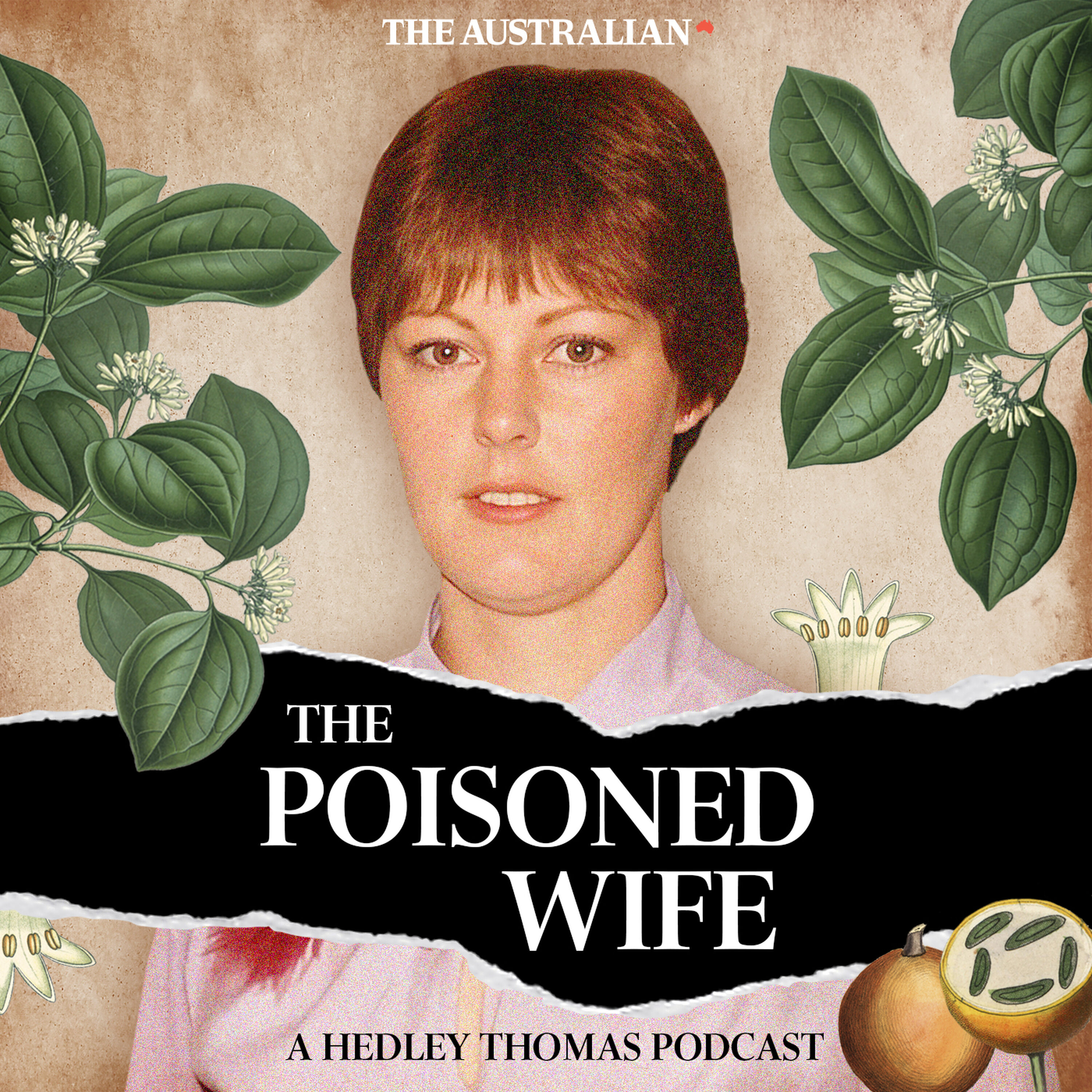
Hedley, Karina and Rex reunite in Melbourne for a podcast live event for listeners.
Some of Rosslyn’s relatives are in the audience, along with her close friends Wendy, Jillian and Lisa.
Many new connections are made and new information comes to light.
The morning after the event, Rex reflects on the podcast investigation and shares what the future might hold for the case.
Listen atthepoisonedwife.com (theaustralian.com.au/topics/the-poisoned-wife-…), in The Australian’s app or search for The Poisoned Wife on Apple Podcasts to connect your subscription.
Join the conversation and hear more from Hedley Thomas inThe Poisoned Wife Podcast Official Discussion Group (facebook.com/groups/thepoisonedwifepodcast) on Facebook
Do you know more? Contact the team at thepoisonedwife@theaustralian.com.au
See omnystudio.com/listener for privacy information.
Transkriptvom Podcast bereitgestellt · Zeitmarken springen hin
Listeners are advised that this podcast contains coarse language and adult themes. The Poisoned Wife is a podcast investigation brought to you by me, Hedley Thomas and The Australian. Subscribers to The Australian hear episodes first on The Australian's app at thepoisonedwife.com and Apple Podcasts.
Every single piece of paper I got about this case, you have now got.
He would have known that she would have died a really painful death.
She always wanted to be a mother.
Always.
I didn't do it.
I had nothing to do with Rosalind's death. I was a 16-year-old girl who had a crush on an older married man. I just think it's all so cruel.
How would you have been trying to protect him? In the previous episode of The Poisoned Wife, we spoke a lot about strychnine and we heard from experts who focused on the ghastly and devastating effects it can have on those who consume it. But this week we are doing something very different. I'm talking from a Melbourne hotel room on a bright spring afternoon. It is the day after our podcast live event and our friend, our special guest, Rex Bakes, made the journey from Barmara. Rex has been very unwell recently. It's great to see him on the mend.
Our colleague and friend Claire Harvey was our host, and we are going to share parts of this live event with you. We were joined by listeners from far and wide. Some of Roz's relatives and her close friends came, and we met and spoke to people who heard about Roz for the first time from listening to The Poisoned Wife.
You are going to hear from some of these people in this episode, and of course from the indefatigable Rex. To all of our colleagues and friends and those who came, thank you. It was a privilege to have a special evening of talk and connection about Ros McQueen, and we gleaned new information about her life and the lives of those she touched. Our young colleague Mo Al-Farez walked around the room with a microphone and spoke to some of the people who came to our event.
So Roslyn is my cousin once removed. So my father's cousin is Roslyn who passed away. So it's got a bit of a family thing to it and I just listened to the podcast recently and just sort of become invested in it and I really want to find out more about the truth about what happened. So I always listen to True Crime but Because it's a family.
Thing, it's just been a real experience.
My father had mentioned it. He'd just seen a video of the Australian come up on his Facebook and sent it. And then I watched it and I've sent it and all of us have been following it and now it's a big talk among our family. And we're really happy that it's been brought up again.
It means a lot to everyone.
We were good friends at high school. I left high school before she did. And then she was my bridesmaid in my first marriage. Gillian was the one that told me about the podcast. It brought up a lot of emotion that I didn't realise was there. I'm still finding it difficult. The emotions are very high at times, but, yeah, I just want something to happen positive for her, you know.
He's been out there walking around for 40 years, over 40 years, free, and she didn't get to live her life.
I'm from Swan Hill and my family's from Bendigo.
So, you know, like a huge suitcase full of notes from Rex and just how you even like start to like go through that process and how you determine like the narrative way that you tell that story and how do you get the right people and approaching those people after so long. You know, it feels like it could have been almost yesterday, like the way that they've so vividly been able to be recalled.
I just like listening to true crime.
I love the idea of working towards finding an answer.
The detail is quite amazing and factual.
It's a pity that it takes so much to get something that their job should have been done properly in the first place and that there was all these pointers and people asked for the police to investigate and nothing was done in the first three months really is such a shame.
I'm Maggie Marriott.
And where did you come from tonight?
East Gippsland. East Gippsland's quite a drive.
Raymond Island. And particularly with the boys and wife, that's really given me an insight into my own events. So, like, I'm 68 now. And Donna, in this boys and wife, that's who I was. But I was eight. And now I'm just learning... the things that happen in my life from listening to the podcast and I think with Karina Burge's input that's made it more in depth. I've been listening to podcasts for seven years and it's just like a litany of police not doing their job properly and I still think they're not doing their job properly and because I'm the same vintage so I know where Beulah is and Bendigo and They're all country people. They're just like people you know. I just think the way the Australian's doing everything is really professional and makes it easy
to be part of it. It feels so authentic and genuine. I never watch the news. I'm not interested in world events, but this fits my little niche.
Hi, everyone.
I'm Claire Harvey. I'm the editorial director of The Australian. I'm the host of our daily news podcast, The Front. And most importantly, for tonight's context, I'm someone who works in the background to help Hedley and Karina bring the poisoned wife to life. We're very grateful to have you guys here. You are the most important part of the story of The Australian. You're the reason we can make the kind of journalism that we do. It's difficult, it's expensive, it's time-consuming, and we can't do it without the support of our dedicated listeners and especially our subscribers. I'd like to acknowledge the Wurundjeri, Woiwurrung and Bunurong peoples of the Kulin Nation on whose lands we're meeting tonight. And without
too much ado, welcome to the stage, Hedley and Karina. Well, there are some very familiar faces in the audience tonight and I almost wish we had some of you guys up on the stage so I could ask you some of the questions that are burning in my mind after listening as a fan and working as a colleague with Hedley and Karina. The Poison Wife is one of the most remarkable stories we've ever told at The Australian. We always come into these projects with the goal that we are going to solve a crime. I always ask Hedley when we're in the early stages of planning one of these investigations whether this can be solved, and he always says yes. And, of course, Hedley has the.
Runs on the board.
Many of you will have listened to The Teacher's Pet, and, of course, you know that that resulted in the conviction of a man for the murder of his wife. Hedley, The Teacher's Pet case is remarkably similar to the case that we see in The Poisoned Wife, the case of Rosalind McQueen. I think it's important just to start this conversation with an acknowledgement of who Roslyn was and what happened on the 1st of April 1986. What did Vin McKenzie find when he walked into the McQueen house on the.
1st of April? Yeah, thank you, Claire. And thank you, everyone, for coming. Pleased to see several of our lawyers here as well. I don't think they're charging tonight. I think this is a freebie. Thank you, guys. So on the... morning of April 1 1986 and you know it's 40 and a half years ago Vin McKenzie a neighbour of Ros McQueen was asked by Ros's husband Ray to check on Ray's wife he said that he was trying to ring Ros from his office and she wasn't picking up so Vin went down and you know he walked into what was a terrible scene um Ros was slumped over a kitchen chair and facing up in a really unusual position that I think if a forensic pathologist had seen it, knowing that it was extremely unusual for a very healthy
30-year-old woman, five and a half months pregnant, a mother above all, with a toddler aged two in the house, that this was extraordinary. But sadly, there was an abysmal initial police investigation, atrocious investigation, There was no crime scene declared. There were no witness statements taken. There were no photographs taken.
When police, three months later, realised that it was Strychnine that had killed Ros, there was a very concerted response from homicide squad detectives who came from Melbourne and rushed to Bendigo and did a thorough job. But they were up against it at that stage. Almost certainly foul play. But the investigators were on the back foot because the uniformed police... saw a really suspicious scene and did nothing about it. Basically just took Roz's body off to the mortuary and then moved on.
Karina, you've spent much of your career before you came to join us as a producer at The Australian, working in the law and latterly in the coroner's court. Does the failure of the police at that initial crime scene shock you or surprise you? Or is that something that unfortunately does happen in crime scenes in Australia?
I would be really shocked to see the same thing happen again today. I think it would be treated as a probable homicide until police could prove otherwise. I'm convinced that the coroner that I worked for in Canberra would declare a crime scene, have forensics on site, take photos, search for strychnine immediately, be out in the garbage bin, be interviewing neighbours. They would be taking all sorts of steps to try to figure out what happened to this person.
One of the things, Hedley, you've explored since The Teacher's Pet and you've made really your life's work in this medium, audio, the investigation of violence against women, is the, I suppose, sexism or bias that law enforcement officials have had over the years about crimes against women. I think that you could fairly say that that was the case in the Dawson matter, that police were like, oh, well, sorry, mate, your wife seems to have vanished. Do you think that that was a factor here, that sexism or dismissal of domestic violence was part of the problem?
Claire, every case is different. In the Dawson case, you had two brothers, both of whom were celebrities as rugby league footballers. They were high school teachers with a following amongst the school community and the footballing community. And And I reckon that that celebrity appeal, star sportsmen, charismatic male models, that went a long way in terms of immunising them from proper scrutiny in the early stages. But in this case with Roz in Bendigo, Ray was a relative unknown.
You know, he had been a farmer and then he was a bus driver and he was selling life insurance. And the commitment that the police, and they were all male detectives who came up from the homicide squad in Melbourne three months after Roz's death. That commitment that they made to the investigation was really strong and genuine and had nothing to do with gender. We can look at cases from the 80s, 90s and noughties and say there was a factor there in relation to misogyny or in relation to protecting the male because he's famous, he's a star, he's a celebrity. I don't think it happened here. I think at the start it was just a shocking act of incompetence. And a senior constable and a constable, in
my view, should have known better. They should have said, this scene is very unusual. The husband's telling us that his wife died of cancer, but she doesn't look cancer-ravaged. She doesn't look sick. And why is she in this unusual position over a chair? And as many listeners will now know, the position could have been directly attributable to the terrible effect that strychnine has on someone who is in death throes. It literally causes them to form what's known as a London arch. They end up in a banana shape because of these horrific muscular contractions where they hyperextend and they can't control the contractions which are occurring while they're fully conscious. It's a terrible way to go.
The question that we've been asking is, was she put onto the chair from, say, the floor to disguise that position? Was she moved after her death so that the position wouldn't look so troubling, so alarming to the first responders who went to the scene?
I think it's important to say that Ray McQueen has always denied any wrongdoing and still does to this day. Our colleague Liam Mendez went and found Ray and spoke to him at his place of work now on the outskirts of Melbourne. Ray is absolutely insistent that he had nothing to do with the death of Ros. But when Liam spoke to Ray, Karina, Ray raised something that I don't think we had been considering up to that point, that perhaps there had been a giant forensic stuff-up Was that something you were surprised to hear from Ray McQueen?
Yeah, I was really surprised to hear that. And we've since spoken with people about the likelihood of a forensic science stuff-up happening in the mortuary and in the coroner's court in Melbourne at that time. Because through Hadley's work, we do know that things can go very wrong at times in labs. And Shandi's story has illustrated that. But we wanted to know more about Roz's particular samples that were tested. And the information that we've received is that the likelihood of a stuff-up happening is just negligible. Multiple samples were taken from Rosa's body and were tested. They all had two unique identifiers. A particular pathologist was assigned responsibility for them. So for things to go wrong, they
would have had to have gone so badly wrong. It's almost impossible that that occurred. Ray raised another possible cause of Rosalind's death.
He said, well, maybe it wasn't strychnine.
I've been told that it was inflammation around the heart and other problems with her heart and had nothing to do with strychnine at all. He's sort of posited these two theories. It was either another cause of death altogether or a mix-up.
Ray had also been talking to people, apart from Ros's supposed cancer diagnosis, about Ros seeming to be depressed or spending a lot of time in bed, not being happy. Have you found any evidence that that was the case?
No solid evidence. There's one witness who was Ray's friend and Ray's employer at National Mutual, and his name is John, and he has said that Roz seemed to him to be quite down and he claims that Roz had told him she had cancer. But we've talked to so many of Roz's friends, some of whom are here tonight. Wendy, thank you for coming. And we've been through the police brief of evidence with a fine-tooth comb. Every witness who talks about their connection to Roz, and it was a very deep connection compared with Ray's boss, say that Roz was so looking forward to having her baby. She had no concerns at all about any cancer. She knew that her GP and her gynaecologist had advised her about a minor abnormality that would be easily managed. And Karina has
talked to me about this at length. It's a common issue that is so far removed from the C word. and has nil mortality, that it's just hard to imagine that Ros or anyone would have been concerned about it. But Ray had told people that he was concerned that he was going to lose his wife. And he told these people, please keep it in the vault. I remember one of the first things that Rex Bakes told me Has anyone heard of Rex Bakes, by the way? Rex, it's great to see you wearing a bow tie all the way from Barmah. He flew Rex Airlines to get here from Mildura. Rex told me early in the piece, you've always got to look for the suspect who's building an alibi. And that's what Rex sees the cancer story as,
alibi construction prior to an unusual, unexplained death And if that's what happened, bearing in mind that Ray has always denied wrongdoing, then you're hoping that the police will be as incompetent as they turned out to be and that they will accept this claim that his wife had cancer and must have died of it, and that's why she's ended up on the chair with a two-year-old running around.
And then she's buried a couple of days later and nothing happens.
Rex Bakes is, of course, here in the room. He's the retired private investigator who has never let go of this particular case. I like to think of Rex as the guardian angel of the podcast and of Ros. But this room is full of people who knew and loved Roslyn as a real human being. Later on, we'll get Rex to come up to the stage and you'll have your opportunity to ask him some questions along with Hedley and Karina.
I was just thinking about your question about whether Ros had depression. And it's really fascinating because the only other witness... who was adamant that Ros was very depressed, was Ray's.
Mother, Beryl McQueen.
And Claire is actually voice acting Beryl McQueen for the podcast. So very soon she'll be doing a whole lot of lines for an upcoming episode where this issue will be ventilated.
Yeah, if you've ever met Hedley, you are a voice actor in one of his podcasts. And they have these ballooning casts of hundreds of roles, which my audio team at The Australian has to find actors for usually. So Henley actually sacked my daughter from a voice acting role in Sick to Death because he didn't think she sounded young enough.
No, no, we reserved her for a future ride.
Don't worry, I'm not bitter about that. Yeah, I've had family members sucked as well. My mother-in-law, which was very awkward, and my stepdaughter. You're in good company, Claire.
Thanks.
That is very awkward.
On the weekend before Ros died, she and Ray went away to Mildura. It was the Easter weekend and they went to visit family friends.
It may have been a perfectly... innocent family trip. Ray went with Roz, the daughter Jodie that he'd had with Roz, she was only two and a half, and Ray's first wife's children. His first wife was Jeanette and he had two children with Jeanette. And they stayed with a couple, Boams. In fact, I've got correspondence from Roz's mum, letters that she wrote to Wendy. And Wendy has kept these letters for 40 years. They're letters that they exchanged after Roz's death.
In one of those letters, Roz's mother, Joy, she describes a photograph that she'd seen that was taken of Roz on that trip. And she said her daughter looked so happy, radiant. There was absolutely zero chance that her daughter had wanted to end her life and the life of her unborn baby. And so suicide was just the most ridiculous proposition that she'd ever heard. They got back on the Sunday evening, it's Easter, They went to a Monday procession in Bendigo.
It was a regular thing that folk of Bendigo would go to. And Ray says that his wife was really tired when they got home. On Monday evening, Ray has gone to play tennis at the Lockwood North Tennis Club. Paul and Debbie Weigart are here tonight and they were regulars at the Lockwood North Tennis Club. Ray was playing tennis there with the family friend of the McQueens, Donna Manalik, and she was only 16. She had a teenage interest in Ray and she's pretty candid about saying, I loved him and I was in love with him. And she's talked to us very courageously for the podcast. But she was playing tennis with him as she did several times a week. He had offered to coach her in tennis.
I believe that he was and had been grooming her for a year prior to Ros's death. He clearly had a very strong affection for her. It was obvious to Ros Roz's friends, to Roz's mother, to members of the tennis club, Paul and Debbie and others. Donna was talking to Roz a lot. Roz liked Donna, but Roz also knew that her husband was infatuated with this girl. And she had asked Donna to stay away in the nicest possible way a couple of times, but then she would say, oh, no, come back. And I think that was about her being a fearful wife. Donna had said to Ray at tennis on the Monday night, that Roz had told Donna she's really worried you're going to get divorced and you know you need to tell her you love her and put
your arms around her and Donna says that Ray told her I couldn't possibly afford another divorce that's ridiculous Ray had had a very expensive divorce from his first wife Jeanette money was tight in the marriage with Roz you know he was looking after three children, two from his first marriage. And, of course, Ros died the following morning.
MUSIC Karina, we really threw you in the deep end of journalism by sending you down to find, not only find, but then doorknock Donna Manalik and ask her out of the blue to tell us about what must have been one of the most painful experiences of her life. She was regarded with some suspicion by the police investigating the death of Ros. She's tried to live a quiet life ever since. It's been an eventful life. Tell me about that experience of knocking on Donna's door.
It was really incredible. We didn't know what sort of reception we would get. We didn't know for sure that Donna still lived in the same house, so we took a really big gamble, travelling quite a long way. And when we first knocked on the door, Donna wasn't at home, but her husband, Kevin, was. And he didn't answer for quite some time, and we thought, oh, we'll have to go away and come back. But eventually, Kevin came to the door.
And he was lovely and.
Invited us in straight away. We explained who we were and what we were doing. We were very candid about everything. And he said he would pass all the information on to Donna and that she could get back in touch with us if she had any questions or wanted to meet with us. And we left our names and numbers.
And Hedley and I actually took off. We had a little mulled wine in a pub. And before long, Hedley's phone rang and we thought, oh, it might be go time. We didn't recognise the number. And it was Donna. And she told Hedley she was very anxious. And we said, well, why don't we come over right away and we'll just tell you what's going on. So that was what we did.
And we spent a few hours that night with Donna and Kevin at their kitchen table, just going through everything, asking Donna questions, all off the record. We just wanted to have a very frank discussion with her first. She made a lot of comments to us about things, asked us questions. And then at the end, we were just wondering, what would she do? Would she want to go on the record and publicise her story 40 years later? A very personal, touching story that she felt didn't paint her in a very good light. And she decided that she wanted to do it for Roslyn. And she was encouraged by other really strong women in particular who have participated in the podcast too. And she decided that she would
sit down with us the next day. So we went back. following morning and you might have heard he had these excruciating three or so minutes when we were standing at the front door knocking and no one was coming and we thought they've taken off like it's off. We've misread this completely but they were just at the back feeding their ducks and then the interview went for about four hours and it was pretty emotional and gruelling I think for everybody. She was learning about things that she hadn't known about before and piecing things together and sometimes you could sort of see her brain firing and working things out.
It was a really incredible experience and we've stayed in touch with her and with Kevin since then and we check in just to see how they're going and actually just today I was emailing Kevin because we received a beautiful message of support from a listener in Ireland who said to us if you can possibly pass this on to Donna, I'd be really grateful. So we've sent that off to Kevin and he was going to read it out to Donna so that she knows how people are feeling about her because she didn't want the publicity. It just wasn't a driver for her at all. She just had really altruistic motives.
One of the saddest things I've heard throughout this whole investigation was said by Donna that day she had lost her own daughter in a terrible accidental drowning at home in the bath and She had come to believe that it was a punishment of her, an act of karma, because her connection to Ray when she was 16 had led to Roz and Roz's unborn baby dying. And she believed that this was fate catching up with her. It had been a terrible burden for a long time, even though it obviously is nothing to do with her.
I have slowly developed a kind of interest in karma, I guess, and different things that have not been great that's happened in our life I felt could be a karmic debt paid because I did this to her. Our daughter was 14 months old when she died.
In Donna's mind, the universe has somehow punished her for the death of Roz. and Roz's unborn baby, Christopher.
And I felt that was a penance because she lost her child.
At this point, I'll ask Rex to make his way up to the stage. Rex, come up and join us.
Come on, Rex.
Now, I've forgotten.
I'll move one seat down. Hedley, do you remember your first ever conversation with Rex? Do you remember ever getting a phone call from an unknown number.
Yeah, I do remember it because I was having a very pleasant, peaceful evening at home with my wife. It had been a really gruelling several months and it was a public holiday and I finally had a bit of a break from all the work and some guy who sounded like this bloke had come through on my mobile and was talking to me about a case that he wanted me to start investigating and... I was on leave and I probably had three glasses and I was like, sorry mate, who the frig are you? How did you get my mobile and why are you calling me on a public holiday? And that's how I first got word from Rex Bakes. Do you remember that night, Rex?
I remember and you were grumpy. And so I gave him a bit of a spiel and he said, write me a letter.
Or did he say, send me an email?
Yeah, it was an email. Oh, you guy.
So he probably thought, this will get rid of this peanut. And so I wrote him a letter, probably six or seven pages. I posted it off. And on the bottom of the letter, I taped a key to a tiny padlock. And I said, my file will follow. And he probably thought he was getting a manila folder or something. And so that's where the famous suitcase comes into it. Anyway, I let the letter get a head start. And I went down to the Barmara post office. And they had the audacity to charge me about $ 50 to post the suitcase.
And so that's when the real reliefs began. I didn't have to worry any more about it, and I didn't until about two months later.
And this bloke rings up and says, decided to take the case on, but you'll have to help a bit because I won't be able to find all these goat tracks that you've driven down.
And so... The rest is history.
Did you not think at any point, Rex, that our security guards might blow up the suitcase or dispose of it?
No, people don't do that.
Well, apparently not.
When I got that suitcase, Claire, in fact, I got a call from my colleague, Sarah Elks, at the Australian's office in Brisbane, and she said, we've got this pretty weird package for you. In fact, it's a whole suitcase. She was a little bit concerned and I coaxed her to open it because I was miles away.
That was very courageous of you.
Well, you're good at delegating too, Clive. So she opened it and she got to the bottom of it pretty quickly. She was able to interpret the documents in there and thousands of pages, mostly Rex's workings, but there were some documents that set out the case and she said this is what it's about and I was like oh that's pretty interesting can you put it in a taxi and so came home and I started going through it when I had a little time and quickly became deeply intrigued by it and called Rex. Rex agreed that I could record that call and the subsequent calls I had and that was four years ago and I had to explain to Rex I couldn't commit to it yet but I would like to stay in touch with him check in
and telephone him and record our conversations. When I got a chance, I'd go to Adelaide and I went to Adelaide. We met in the hotel and Rex came to Brisbane, met Karina and Tom Williams, who became a volunteer researcher for us. We had to conclude Shandy's story. We had to start and finish the Bronwyn investigation. But Rex has been very patient. He's been an amazing help to us through this. Rex has told us A lot of stories that are just so unique and interesting.
OK, ask us some questions, please. I think we might have a roving mic that will come to you if you want to put your hand up.
Yeah, hello.
I'm Lisa. Ros and I were very close friends at high school and she was my bridesmaid.
Hello, Hedley.
When I was interviewed by Mick Furlong, who was one of the detectives at the time, he said to me that with a death like this, hers, it would have been very messy. There's been no mention only about the spasming and the arch.
And it could be that the first responders, for example, just did not cover that in their statements. There was mention that one of the first responders did wipe Rosalind's mouth because she had a bit of a discharge coming from her mouth. But I was going to say too that we don't have access to her full autopsy We've received a redacted version, which is very common. Coroners are reluctant to disclose these for obvious reasons. So maybe there's more at play that's in the autopsy report about the state of the body that we don't know.
I've been reading your statement again recently, Lisa, and we're going to reflect some of it in an upcoming episode and our interview. So thank you for that. Thank you.
It's a great question, Lisa, and I think it comes back to that crime scene and all the mysteries that are there at the crime scene. Alan Strawn raised a good point, Rex, which was if Ros killed herself, where was the strychnine? Why would she hide the means of her own suicide?
She was a pregnant wife looking forward to the birth of a son, Christopher. Jodie, the child, was probably adjacent to where she was sitting. No suicide note. It just doesn't add up that Rosalind would have taken her own life. And I still feel that way. I'm not angry that the anger has left years ago, but I'm annoyed that this case has taken so long to get to this point.
The wheels of justice... turn very slowly but once they turn they're very difficult to stop and I think that's where we are now.
A question for Rex mostly as a private investigator years on your biggest reason to fight for this case and have it investigated.
I hope that I'm doing a job properly and if I don't do it who else is going to do it and I still think that way today.
Was there something different about this particular case that stood out to you from any of the other things that you've investigated as a private investigator?
Yes.
I've worked between 25 and 30 serious cases. Two of those were rape and the rest were murder. And I used to get this work from one location and that was the Public Solicitor of Victoria. and I would be given a file, and they would bid me farewell, and off I'd go, and I would do what I thought, and that would involve bringing a ballistics expert from Sydney.
It would involve surveyors, weather people, all sorts of people, no questions asked, and I tried to do a good job. I knew there was something wrong And I only used to work in the country. Because I worked in the country, I got to know people. And I got to know this fellow in Bendigo named Alan Strawn. And one day I thought, must go and see Alan and have a cup of tea and tell a few lies.
Anyway, so that happened.
And having the cup of tea, he said, you know a bloke named McQueen?
Well.
And Alan Strawn started this. And that's why we're here today. Boy, oh boy, what a journey.
I've got no connection to the case, just a subscriber and a great fan of this type of investigatory journalism. So just really interested to know what got you into this, Hedley, and what's kept you in it all these years. And second part, after so many years of investigating these types of cold cases, would you say there's anything pattern or any generalisable insight as to why the system fails?
Thank you. My first case and my first podcast was The Teacher's Pet in 2018. By then I'd been a journalist for more than 30 years, so I had covered a lot of crime, corruption, politics. But when I started doing the investigation for the murder of Lynne Dawson, who we now call Lynne Sims, and I started delving into the police brief of evidence and appreciating what had gone on, the strength of the circumstantial case, the failure of the police in the early stages, I became quite angry at multiple failures by people who should have known better. Police, prosecutors who repeatedly refused to run cases a murder case against Chris Dawson, and this was after the original police investigation, was replaced by a really thorough one. It was knowing
that Lynn's case couldn't have been a one-off. There must be so many other unsolved cases of women who have been murdered in Australia and never got justice because the system failed them. Realising that those cases could still be reignited as Lynn's case was at the end of the teacher's pet series. I just thought, well, what better role could I play as an investigative journalist who had the experience, had the backing of the Australian, the incredible support of our lawyers, JP and Justin and the team from Thomson Gear, because we have to take huge risks with these stories. Now, the diffomation concerns are enormous. You could only do it with the sort of backing we have. But I realise that we can actually change the way not only the
listenership perceives these cases... But we can influence the way police and prosecutors look at unsolved cases because a lot of those people in those agencies are also listeners and they are not wanting to see themselves highlighted for incompetence or poor judgment in the next podcast series. It's a virtuous cycle. People say, oh, does it scar you? It must have some kind of impact. But I meet great people.
I meet people like Rex, the likes of Paul and Debbie Weigart, I meet Wendy. I go to country regions. I go to other cities, get an insight into how the criminal justice system works at a really granular level. And that's enormously satisfying. And I can make a difference. Karina has been a great ally and colleague. And we've been working together for about two years. If I make an error in a draft, she's on it. She'll spot it.
Hi, Hedley and team.
Hi, Sarah.
Lovely to see you both again. Lovely to meet you, Rex. The famed Rex, you have a wide fan base. I'm sure wider than you, you know. Hedley, I've heard you mention that you're not a great multitasker of all your many talents and that is because you consume yourself so entirely in the case that you're working on. Rex had to wait four years before the wheels of this case started turning and knowing particularly of this era, how many similar cases there must be of unsolved crimes and victims who perhaps don't have an advocate as fiery as Rex, who are so persistently trying to get a case in front of you. What plans does the Australian have to clone you? How do you hope to be able to cover more cases at a bigger volume, knowing that you
get approached daily?
Because these investigations... are really expensive and they are long-term and we do take these risks and there aren't other journalists at The Australian doing these long-form true crime unsolved murder podcasts. I think it's going to be really difficult for us to do much more than I'm currently doing.
What I hope will happen is that other media organisations will do more of them. When I did The Teacher's Pet in 2018, one of the reasons it was probably listened to so widely was because there wasn't a lot of it happening. It became a catalyst for a lot more effort and commitment by other journalists. In an era when journalism is being buffeted and is being questioned by a number of people who wonder, do I need this?
Is it all clickbait? No, it's not. But there's an opportunity for the leaders of other media organisations to say, let's win back the trust that we've always deserved from our consumers by committing more funds and resources and effort to making a difference with these unsolved cases. The unsolved homicide squads in the states of Australia, they have many, many more resources, of course, than we do. Plus they have the incredible powers to tap phones and execute search warrants, search homes and so on. But they have very, very long lists of cases that they're probably never going to get to either. they're under the pump too. For the better off media organisations in this country, if they're not
committing journalists to trying to uncover and make a difference with these cases, uncover new information, new witnesses, and possibly put unconvicted wife killers in front of a jury, then they're not doing their job. They're failing.
I'm going to say thank you again for supporting the journalism that The Australian does. We couldn't do it without you. And please ask us some more questions next door with a glass of champagne in your hand and a canapé. Thank you very much.
I think one of the most surreal things is how many people that supported Ros and loved Ros were in the room.
And it kind of gives.
You shivers seeing the impact, seeing... Some of these people, how passionate they are about keeping Roz's story alive. It kind of gives you chills.
The power of the podcast, you know, how many people have come forward now and feeling the podcast has given them permission to now tell their story after perhaps they've not felt like they could for so many years. I just think that it's taken a lot of weight off their shoulders, the people that we've seen here today. I think they see that justice will be served.
It was such a lovely evening to get to meet the people in real life who you hear from, in your ears, in such an intimate setting, but to see them really talking about something they're so passionate about with an audience who was just captivated and many people who actually know Roslyn was very meaningful, very special. As we've seen with The Teacher's Pet, the power of investigative journalism and investigative podcasting to really... bring about leads and information and witnesses who perhaps weren't unearthed the first time and change the course of history for the better, I hope that enough momentum gets created by what the team are doing to perhaps come to a better conclusion.
It's been lovely to see all these people that we've interviewed in the audience and to meet new subscribers and people who are listening. We're nine episodes in. We've probably got another four or five to go. It's a bit of an unknown because we do keep on hearing from people who've heard about the podcast or who've been listening to it themselves who are contacting us and providing new information.
And then we're following up with new interviews and we just never know where that will lead. Hopefully the police... And some prosecutors are listening and taking it all on board and who knows where things might end up.
Just being here tonight, after all the work that you guys have put in through, I mean, what's your overriding feeling?
I'm really pleased to be telling Rosalind's story. Even if there isn't a renewed investigation, I feel that we've generated a lot of interest. Her memory is being kept alive. And hopefully people are asking questions and interrogating some of these really interesting questions that arise in her case.
It's the morning after. How are you feeling?
Secondhand. It was such an adrenaline rush. I didn't want to go to bed.
You were larger than life at the event and I saw you in conversation with many listeners. What were they asking you?
It was just sort of a slap on the back and, good job, mate, and thanks for doing it. I just sort of said, well, it's been a pleasure and who else was going to do it? That's what I've tried to do as an investigator, give it 100%. I can't write properly. I've had pins and needles here and there's something not right. I'm glad I was fit enough to get here.
We don't know where it's going to end up.
No.
What are your expectations from here?
I've tried to do my best and I've failed in the past and if nothing becomes of it in the future, I know I've done my best. I feel very privileged that it's come to this and hopefully there is something going on behind the scenes. If I was a copper, I wouldn't show my hand what I was up to, but surely... Having listened to the podcast and seen what we've all done, the coppers must feel obliged to want to do something, surely.
In the next episode of The Poisoned Wife.
And when he left, I just said to Dad, it was the weirdest thing ever. He sat there, oh, he was just creepy.
He was creepy.
The Poisoned Wife is investigated and written by me, Hedley Thomas, and Carina Berger. Police statements and some other material have been voice acted in the episodes in this podcast series. Anyone with information about the death of Rosalind McQueen can contact me confidentially at thepoisonedwife at theaustralian.com.au. Our editorial director is Claire Harvey. Audio production for The Poisoned Wife is by Wasabi Audio and Slade Gibson. Special thanks to Tom Williams, Sean Callinan, Andy Taylor, Greg Brown, Rowan Williams, Brittany English and the Content Division, Adelaide Kennedy, Tani Strohet, Sophie Renee, Liam Mendes, Sarah Elks, Erica Rutledge, Lydia Lynch, Chloe Barr, John Paul Cashin, Will Sightum, Liliana Molina, Lara Kaminos, Suze Rolf,
Chantelle Love, Patrick McKee, Byron Wilder, Stefania Di Nicola, Kushi Chandani, Jonathan Barclay, And, of course, to the Australian's Editor-in-Chief, Michelle Gunn, and the editor, Kelvin Healy, for affording us the time and resources to tackle these important stories.
Thank you.
