

Kapitelklicken springt direkt hin
Shownotes
Former Bendigo resident Max Miles comes forward to reveal that Ray McQueen asked him troubling questions about autopsy testing in the days immediately after Rosslyn's death.
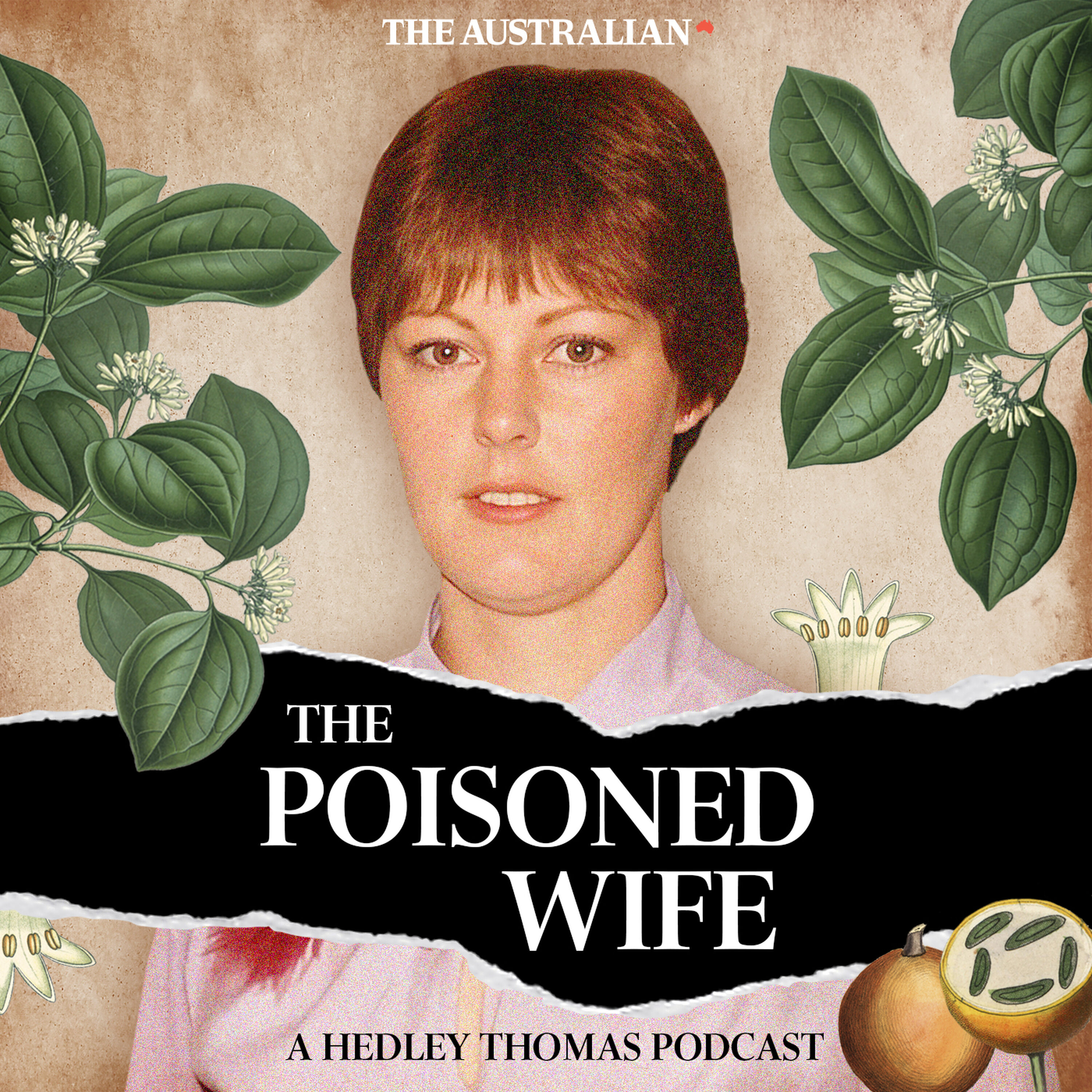
Hedley and Karina delve into strychnine, the toxic farming poison that killed Rosslyn.
With help from experts like toxicologist Adjunct Professor Dimitri Gerostamoulos, and historical and modern poisoning accounts, they unpack how the "very nasty poison" can produce violent convulsions in someone who ingests it.
Because if Rosslyn died experiencing back-arching convulsions often caused by strychnine poisoning, is it likely that she would have ended up lying across the kitchen chair after her death? Police suspect she was placed there after she died. We talk to experts to tackle these questions.
Listen atthepoisonedwife.com (theaustralian.com.au/topics/the-poisoned-wife-…), in The Australian’s app or search for The Poisoned Wife on Apple Podcasts to connect your subscription.
Join the conversation and hear more from Hedley Thomas inThe Poisoned Wife Podcast Official Discussion Group (facebook.com/groups/thepoisonedwifepodcast) on Facebook
Do you know more? Contact the team at thepoisonedwife@theaustralian.com.au
See omnystudio.com/listener for privacy information.
Transkriptvom Podcast bereitgestellt · Zeitmarken springen hin
Listeners are advised that this podcast contains coarse language and adult themes. The Poisoned Wife is a podcast investigation brought to you by me, Hedley Thomas and The Australian. Subscribers to The Australian hear episodes first on The Australian's app at thepoisonedwife.com and Apple Podcasts.
Every single piece of paper I got about this case, you have now got.
He would have known that she would have died a really painful death.
She always wanted to be a mother.
Always. I didn't do it.
I had nothing to do with Rosalind's death.
I was a 16-year-old girl who had a crush on an older married man. I just think it's all so cruel.
How would you have been trying to protect him? This episode is going to largely revolve around strychnine, how it affects the movements and behaviour of a victim. And one of the reasons for this approach can be traced to a retired forensic scientist, John Marshall. In 1986, the then police sergeant in Victoria's Forensic Science Laboratory went to the McQueen House in Lockwood. and he searched the property for strychnine or for anything that might have held or administered this deadly poison. The crime scene specialist with a degree in applied science sketched a house plan. He took carpet fibre samples from the dining room and a sheepskin rug.
He made a statement about all of this to the coroner. You heard some of that evidence from four decades ago in episode three. But now, as the Poisoned Wife series unfolds, John is only too willing to share some new ideas he has, along with his recollection of events from 1986.
I went and got my old diaries out and read through them. It took me a little while to read my notes, so a lot of it's come back. Success would have been finding crystals or some item, a bottle or something with residue in it that allowed us to do some sampling of The idea of taking carpet fibres from various rooms in the house is to try and determine whether she'd become deceased in another room and laying on those fibres and then moved into the kitchen. It's very dangerous to ever look at one set of forensic results and draw conclusions, but it might have gone part of the way to suggest the body may have been moved.
Every touch leaves a trace. Yeah, that's Lockhart's Law from 1910.
It's the godfather of all crime scene examiners. His theory was that when two objects come into contact, there is always a transfer. And nowadays it's more fluid for us with DNA, blood, other body fluids, fingerprints.
John Marshall understands the severity of the convulsions that affect many victims of strychnine poisoning before they die.
The contractions of the muscles are so strong, spasming, horrible, horrible muscular contractions. Your head goes back and your heels are on the ground and the rest of the body is arched off the ground because of the strength of the spasms, what they call a London arch.
Forensic science has come a very long way since Roslyn's body was found slumped over a kitchen chair. One of the catalysts for a major improvement in forensic science standards occurred in the 1980s as a result of a disastrous interpretation of purported evidence of a baby's blood. It was the case of Azaria Chamberlain, the baby daughter of Lindy and Michael Chamberlain. The prosecution's case against the couple relied in part on so-called blood found in the family car.
Azaria's throat, according to prosecutors, had been cut, resulting in a fine spray of blood which was then detected by a diligent forensic scientist.
The ABC's Tony Eastley has followed the case from the start.
The prosecution says that here, Lindy Chamberlain cut the throat of her baby and husband Michael helped cover up the homicide.
This was later shown to be hopelessly wrong. John Moushel was involved at an early stage of his forensic science career in vitally important work which ultimately proved that Azaria's blood was not in the car. It looked like dried blood to other scientists and they had testified that it was blood, but in fact it was sound deadening material which had been applied in a Holden Tarana factory when the car was being built. Lindy Chamberlain was wrongfully convicted and jailed after terrible forensic evidence was given at her trial.
She became one of Australia's most hated mothers, but she was completely innocent. As she and her husband Michael had always insisted, a dingo took their baby from their campsite at Uluru. This miscarriage of justice was a searing lesson for the criminal justice system and for forensic scientists.
You cannot make assumptions. You have to really look at the facts. It's getting the physical evidence and then having the investigator ask the right questions and that's when the forensic evidence becomes quite valuable. It is a dangerous precedent if you ever convict on forensic evidence alone.
After John first spoke to me near the start of this series, he kept thinking about Roslyn's case and later he emailed me some of his ideas. I asked John to read what he wrote.
I have not been able to stop thinking about this case since we spoke. It has disturbed me that I may have missed something critical. I woke early this morning as it struck me that the final positioning of the body on the chair would be near impossible from the recent article abstracts on the physiological intensity of the spasms.
The intensity was something that I.
Was not aware of due to the limited number of strychnine poisonings in Australia and observations of live patients that have been poisoned. Logically, Rosalind could not end up in that position during the violent spasms of her body balanced on the chair. It suggests that the body had to be placed in that position after final rigour set in and thus involve another person. Levitity marks on her back where she rested on the chair compared to the rest of the back may show post-mortem movement. Any photos of the levitity on her head, neck or back and buttocks may assist a pathologist with a fresh set of eyes to determine if the body was moved.
But if, hypothetically, Rosalind's body was moved onto a kitchen chair after death, what would be the motive? Why would that be a preferable location for her to be found if she had died, for example, on the floor? We wondered about this. If the perpetrator was, as the police and coroner concluded, her husband Ray McQueen, would he have wanted his wife's body to be a little farther away from his toddler daughter? Alternatively... If Roz had died on the floor in a rigid position known in this strychnine-related literature as London Arch, her murderer might be concerned that this appearance was so alarming it would lead to suspicion and closer examination by police. To a well-trained forensic pathologist
familiar with how victims of strychnine poisoning can die with their face pointing up, their legs extended with feet on the floor, and their hands stretched over their head and also on the floor, the highly unusual, rigid position might be identified at an early stage as the possible result of strychnine poisoning. But a body slumped over a kitchen chair could disguise the arch. Adjunct Professor Dimitri Jarostomoulis is no stranger to journalistic and media interest. As one of Australia's leading toxicologists... His work with that of other scientists at the Victorian Institute of Forensic Medicine is integral in the criminal justice system.
Hey, tell us about your job because it's a pretty interesting one.
Oh, it can be.
From friendly interviews with ABC Breakfast Radio in Melbourne to sometimes fierce cross-examination by defence lawyers in murder trials, Dimitri sees it all.
The laboratory, the institute, looks after all... the drug testing for the state coroner and also for Victoria Police. So we're involved in murders, in suicides, in drug deaths, trying to determine what drugs people have taken and whether they've actually contributed or caused their death. What drug is in someone's blood sample or urine sample or whatever else is collected at post-mortem, and that includes solid tissues like liver or drugs in stomach contents.
How long have you been working in this field, in this particular job, and how much change have you seen?
Well, I started there in 1990. When I started, the techniques were fairly simple, but these days there's equipment now that can measure parts per trillion.
In 2025, Dimitri and the highly sophisticated equipment delivered damning evidence about the beef Wellington meals prepared by the death cap mushroom triple murderer, Erin Patterson.
Miss Patterson has pleaded not guilty to killing three of her estranged husband's relatives.
Alexandra Alvaro joins us now from the Latrobe Valley Magistrates Court.
We're currently hearing about the toxicology results. Dr. Drostomoulos has agreed.
That age, weight and health might influence how someone reacts to the toxins and what their tolerance might be.
Perhaps the biggest bombshell this week came from Victoria's chief toxicologist who told the jury the death cap mushroom toxins were found in both the leftovers from the lunch Erin Patterson served at her Leangatha home and also in the food dehydrator she dumped at a local tip.
Dr Geris Demoulas told the court how much death cap mushroom matter would constitute a lethal dose, saying it was 0.1 milligrams of mushrooms per kilogramme. or about three tablespoons for a 70 kilo adult.
You're just on mute, Hedley.
Thank you. Hello. How was your trip? Exhausting. When Karina emailed Dimitri in the hope that he could answer our questions for the poisoned wife, Dimitri was overseas for an annual meeting in Chicago of the International Association of Forensic Toxicologists. The timing was tight, Dimitri kindly agreed to talk to us at the first opportunity on his return to Melbourne, one week before the release of this episode. We explained some of the background to the case. The unfortunate death of a woman in 1986. She was five and a half months pregnant. She died from strychnine poisoning and she was found slumped over a chair in the usual position of a strychnine victim in that so-called London arch or banana shape. However, when... first responders first went to the scene,
they didn't recognise that position as something that might be connected to strychnine poisoning. They just thought she died slumped over a chair.
And she died very unexpectedly and initially police didn't think that her death was suspicious and she was taken to the mortuary and an autopsy was done. And three months later, toxicology results came back from the coroner's court and strychnine was identified in some of those results.
Karina told Dimitri the concentrations of strychnine that were measured in June 1986 in Roslyn's blood, liver and stomach. And he said that typically those would indicate recent consumption. How would we define recent consumption?
It could be within a few hours. It could be up to six hours, even earlier than that. It might be within a couple of hours.
We noticed that the highest concentration of strychnine was in her stomach, equivalent to 22 milligrams.
It's important to make something clear from the outset. Dimitri told us that while he could answer our questions about the deadly poison and its effects on the unfortunate souls who have ingested it, He would not be able to provide an opinion on the particular evidence in Roslyn's case.
20 milligrams is equivalent to essentially a fairly heaped tablespoon. It really doesn't matter what the concentration is. It just should not be there. The mere detection of strychnine in someone's blood or stomach is of concern. There are not too many of these cases in the literature. And in Victoria, over the journey that I've been here, which is... at least 35 years now, we've probably had 15 deaths related to strychnine poisoning.
It's a horrible way to die. Would one teaspoon be sufficient to cause death?
It may, depending on the individual. There's no safe dose for strychnine, whether that's a few milligrams or 100 milligrams.
As someone who has dedicated decades of his life and career to studying some of these terribly toxic poisons and substances. Where do you put strychnine?
It's an awful poison. I mean, most poisons are, but strychnine is quite high on the list in terms of some of the toxic effects of the poison on an individual who consumes this, either knowingly or unknowingly. It's difficult to obtain. It usually is leftover poisons which have been used by farmers over decades and It's quite tightly regulated these days, but we know that there is still strychnine in some farms and some sheds across the country. And from time to time, unfortunately, we do have fatalities associated with this very nasty poison. So it can cause convulsions and seizures. It leads to muscle rigidity, sometimes spasms. It leads to excruciating pain. And I know that because I've been involved in cases where we've had recordings of individuals
who have ingested this poison, and I've heard some of those recordings.
Audio recordings of Victorian man Anthony Mooney when he was dying from strychnine poisoning in 2008 were heard as a result of an inquest by a Victorian coroner. When the victim's son and stepson arrived at Anthony Mooney's house... They heard his screams and they found him lying on the bed, apparently convulsing, with his arms and legs rigid. He urged them to hold his arms and legs down and one of them called triple zero. Coroner Jacinta Heffey's findings state that the triple zero operator was.
Clearly concerned about the yelling he could hear in the background. as he asked if the deceased was violent and indeed subsequently arranged for police to attend with the ambulance crew.
Mr Mooney could be heard screaming out, No, hold my legs down tight. An expert witness, Professor Olaf Drummer, gave evidence that strychnine is one of the bitterest substances known and that if it is to be used surreptitiously... the bitterness would need to be disguised with flavour in a drink or in food with strong flavours. But if put in a capsule and swallowed, the bitterness would not be detected at all. Those recordings that you referred to must have just been so difficult to hear.
Oh, they're awful. Convulsions associated with strychnine toxicity are very painful. They can often result in screaming pain, and they can be quite violent.
We wanted to understand if the research and the case studies over decades show whether all or most people in the throes of strychnine poisoning suffer from the convulsions, or do some die without having convulsed?
Not all of those toxic symptoms appear in someone who's ingested strychnine. It is described as a convulsive poison. It doesn't mean that convulsions occur necessarily all the time. But again, it'll depend on an individual, how sensitive they are to that particular poison. Some people can tolerate higher doses of the poison. It leads to cardiorespiratory arrest. Ultimately, that's the mode of death. They're no longer able to breathe. People who die as a result of strychnine are often found on their own. They're not found usually in the presence of another person.
The evidence that we have from the police brief shows that when she was found deceased in her home, her body was over a kitchen chair and she was facing upwards with either her back or her buttocks on the seat of the chair. Her head was down touching the floor and her arms were over her head. and her feet were on the other side of the chair. So she appears to have been in quite a bent or arched position over a kitchen chair. We're interested to know whether someone who has died from strychnine poisoning would likely end up in a position like that over a kitchen chair.
It may be as a result of the sort of muscle rigidity or early rigor mortis that sets in with deaths associated with strychnine. But I really can't comment on whether the way that Roslyn was found is typical of people who are found with strychnine poisoning.
You don't want to be commenting directly on Roslyn's case. I'd just like to understand the convulsions that we've heard can be violent. while someone is in the throes of strychnine poisoning, a physical writhing or a physical spasming. Hypothetically, somebody convulsing and writhing and spasming, would someone going through that remain on a chair? Not likely.
Whilst I'm not commenting on Rosalind's case, I don't know whether that's consistent with someone who's had strychnine and ended up on the chair in the position you've described.
And your expectation is that if someone is convulsing, then they would be unlikely to remain on a chair?
Yes, it's unlikely that that's the case. That's where we rely on investigators. and other observations and other circumstantial evidence that may be helpful to form a better opinion about whether that's likely to be the case or not. In a case where all you've got is someone found deceased, there's a concentration of a particular poison, it does not allow you to really interpret that with a great deal of certainty other than to say that The poison's been found.
This person is slumped over a chair in an unusual manner, which may be as a result of taking the poison. It may not.
At an early stage of someone's poisoning, that is when ingestion may have only occurred minutes earlier perhaps, are the symptoms immediately obvious but not intense and then they build up?
Effects usually occur within the first five minutes. It may be 15 to 30 minutes to an hour by the time their poison is fully absorbed, maybe longer depending on how much has been consumed, and those symptoms progressively get worse.
And does the person usually remain conscious for some of this time, Dimitri?
Yes, usually conscious and in excruciating pain.
And would you expect a person suffering from strychnine poisoning to recognise the symptoms and appreciate that they're in trouble and then possibly be able to take action in response, such as calling 000 or calling out for help to someone else in a house, for instance?
Someone might be able to call 000. They may not, depending on the level of pain in which they're in. The effects are happening. You can feel that they're happening. Sometimes you're not able to do anything about those because they're so pronounced. Once someone has ingested strychnine, they've got a limited timeframe to actually get to hospital or get help.
So most of the cases that involve strychnine here at the Institute are usually suicide. There are very few deliberate poisonings involving strychnine.
Are they actually in rigour at the time of death?
Yes, usually early rigor associated with strychnine poisoning. That's been described.
Is that why people or bodies can remain in that arch because of the stiffness? They're not being supported by anything. They're just in an arch on the carpet, for example.
Yes, that's entirely possible. But the only way that you can actually determine that that's the case is by confirming the presence of strychnine in a blood sample, in a stomach sample or in liver.
For example. Toxicologist Norman Ellis did much of the testing for strychnine in Roslyn's blood, tissues and organs in 1986. Dimitri worked with Norman Ellis four years before he retired and Dimitri has also had a lot of professional contact with Byron Collins, a forensic pathologist from whom you'll hear in an upcoming episode. He gave evidence about Roslyn's case at the 1987 inquest.
They'd measured it in blood. they've measured it in liver, and they've also measured it in the stomach. That gives an indication that it's been orally absorbed, it's been consumed, and there is at least 22 milligrams remaining. So there has to be more that has been consumed, which results in a blood concentration of 4.6 milligram per litre.
When Ray McQueen spoke to our colleague Liam Mendes... Ray doubted that Roz had even died of strychnine, and he spoke of the possibility of a forensic science stuff-up, the kind of stuff-up, according to Ray, in which a woman who might have died of natural causes was instead found to have died from strychnine poison.
Are you able to comment on the likelihood of a forensic science mix-up back in 1986? For instance, is it possible that. Strychnine toxicology results belonging to one person could be mixed up and attributed to another deceased person?
It's very unlikely that there's been a sample mix-up. And the reason I say that is because you've got detection in a blood sample, you've got a detection in a stomach sample and the stomach contents, and you've got a detection in the liver sample. It's detected in the urine, detected in the bile, and they would have had two unique identifiers. They'll have a case number and they'll have a name and then there'll be a pathologist assigned to that who's taken those samples.
There's nothing pointing to a mix-up. No one credible has suggested there's a mix-up.
It's very, very unlikely.
MUSIC Early in their investigation, homicide detectives were dubious about the position of Roz's body. In Episode 5, you heard Detective Senior Sergeant Ron Blackshaw challenge Ray McQueen about this. In mid-August 1986, so that's seven weeks after the toxicology testing showed strychnine had killed Roz, the detective Ron Blackshaw wrote to Dr Byron Collins, a forensic pathologist at the coroner's court in Melbourne. We've got a copy of the letter.
In it, the detective described the position of Rosalind's body lying backwards over the chair, and he asked Dr Collins to provide an opinion as to the probability of the body coming to rest in this position. He asked the forensic pathologist to take into account the probable quantity of strychnine ingested by Ros based on what was found in her stomach and her blood. Ron Blackshaw invited Dr Collins to comment on the possibility of Rosalind's body being moved to the position in which it was discovered after death.
Dr Collins was a relatively young medical doctor and pathologist in 1986 and He is still giving expert evidence 40 years later in 2026 and we've been in touch with him. Before giving his evidence on day two of the inquest in 1987, Dr Collins had read the relevant literature in a number of toxicology books. He had talked with the toxicologists, Norman Ellis and Mr Albert Frank, about the results they'd reported in Roz's case. Because of our focus now in this episode on the kitchen chair and Roslyn's position, you are going to hear the 1987 evidence of Dr Collins rather than later in one of the upcoming inquest episodes.
The Crown Prosecutor at the inquest, Nigel Parkinson, narrowed his questioning to the position of Roslyn's body. Dr Collins said that it had been put to him that it was the typical position of someone who had been through the strychnine-related convulsions, and Dr Collins didn't disagree with that. But his evidence, essentially, was that while the position might have been caused by strychnine-related convulsions, and he named the very hard-to-pronounce medical term for these, Roslyn's position might have been due to something else.
It is in fact a position of opisthotonous, but it was my opinion that if somebody were to go into the classical muscular contractions, which one does usually after the ingestion of this poison, then if somebody were experiencing those on a chair, they would be unlikely to remain on the chair.
The coroner, Geoffrey Hoare, spoke up. Doctor, I would like to pretend that I knew what opisthotonous was, but I will be humble enough to ask.
Is that a classical condition reached after muscular spasms where one has the arching of the back because the back muscles overpower all the other muscles?
Yes, it is.
I thank your worship that you did not ask me to spell it as well. But certainly they do arch their back and they are classically supposed to be in the position where the heels are touching the ground at one end and the head at the other and the body is arched rather like a banana.
So even without the chair being there, if one took the classical case of strychnine poisoning, the muscle spasms would invariably produce in the final throws that arching of the back where a person's head would be on the ground and the feet and arching over the floor.
It tends to. The Crown Prosecutor at the inquest had photographs of Detective Sergeant Mick Furlong in the same position. It was an effort by police to reproduce something close to what Vin McKenzie and the police officers who attended at the scene and the ambulance officers saw on April 1, 1986. Dr Collins agreed in his evidence that it was the classical position.
I suppose it is, yes. But again, there are cases on record where the muscle spasms are fairly mild or do not occur at all.
And again, this would be the small case example.
Yes.
And classically, the position in which Mr Furlong was is the classic whatever it is called position?
Yes.
You say you would have expected that she would have fallen to the floor?
Yes. The coroner was keenly interested.
And if, inferentially, she's found in that position, you pose the view that she was placed there by some person?
No, I'm not, Your Worship.
I find it conceivable that somebody sitting on a chair feeling weak, particularly in a pregnant state, it may be more comfortable for somebody to sit on a chair side on rather than in the normal position and then merely faint and fall backwards. So as far as I'm concerned, the finding of the deceased on the chair helps me neither one way or the other as to the ingestion of the poison.
Nigel Parkinson, the Crown Prosecutor, asked about the iron capsules They were known by their brand name of FIFOL.
It's a long time ago since I've prescribed iron for pregnant women, but from memory, yes, they do take it once a day. I would imagine it would dissolve within half an hour or so in the stomach.
Ray McQueen's barrister, Joseph Toll, swung into action and Dr Collins agreed with him that someone experiencing mild convulsions would be more likely to remain on the chair. whereas someone having what Mr Toll called a cataclysmic convulsion would be more likely to fall off the chair. Turning to the photographs from the reconstruction effort, Dr Collins compared the position of the police officer with the position of someone in the typical position of strychnine poisoning.
It does mimic it, yes, in that the back is arched by the chair.
And the pathologist's oral evidence was similar to what he had put in a written statement responding to Detective Ron Blackshaw's request for an expert opinion.
The position in which the deceased's body was found is unusual, but in my opinion, could be produced if the deceased were sitting sideways on the chair and due to weakness, the upper part of the body fell to the opposite side. I do not believe that the deceased's position necessarily represents the condition of and if a person were undergoing severe muscular spasms while seated, I think that the most likely terminal position would be somewhere off the chair on the floor.
Karina and I also spoke with forensic pathologist Professor Johan de Vlo. He has done thousands of autopsies in Australia over the past 40 years, although he has never encountered a strychnine-related death. Professor DeFlo told us the position of Rosalind's body was unlikely to be the smoking gun in this case, and that's because finding a body in the somewhat unusual position may or may not be of relevance.
A person might fall and land over a chair for different reasons, he said. One reason might be because they were convulsing from strychnine poisoning. But, he said, it was impossible to say whether that was the reason Rosalind was found lying across the chair. Professor Duflo summarised the two possibilities succinctly. Rosalind died in the position in which she was found, or she was put in that position after death. But, unfortunately, he does not believe that her ultimate position can determine which of those two possibilities is correct. Karina found a harrowing historical account written by one of the rare survivors of strychnine poisoning. It was published in a book called Bitter Nemesis, The Intimate History of Strychnine by John Buckingham,
but the original account was published in an 1895 edition of a medical journal by the survivor, Dr. Harris. Dr Harris had been taking a dose of a tonic containing what he described as a fair dose of strychnine for a few weeks. One day he poured an ounce and a half into a measuring glass, added some water and drank it.
I at once noticed a much more intensely bitter taste than was usual. Fifteen minutes elapsed and I began to feel very restless. An indescribable nervous sensation came over me. as if there were rope pulleys running down to my extremities, which were gradually being drawn tight. I had to make an effort to prevent my mouth closing too soon as I spoke, and to dig my pen into the paper and write thick, while a contraforce in my arm strove to dash the pen to the floor.
Dr Harris was trying to do his hospital rounds of the male ward.
My limbs were throwing off the control of will and moved erratically. When I wished to go on, my legs stopped, and when, by a violent effort, I forced them to proceed, I could not pull up to a standstill without walking against a bed to steady myself. What I said or did I cannot remember, but I managed to get along somehow, though, feeling as if head, hands and legs belonged not to me, but to three separated individuals. like a mechanical doll that has had all its limbs pulled with a jerk of the string. I said to Dr. Considine, I am really very ill. I feel sure I am suffering from strychnine poisoning.
I had taken six-tenths of a grain. I remembered that half a grain had caused death. I must prepare to die, to die fearfully, to die soon. The simple fact to a man that he is to die is a heavy blow for the strongest will or the stoutest heart. The thought was horrible. Latent under the guise of a harmless-looking crystal, but more death-dealing than dagger or dynamite, the deadly drug seems to revenge its former subjugators when once it gets the upper hand.
His colleague, Dr Considine, had also once taken an overdose of strychnine, and he'd used tobacco as the only known antidote at the time. Dr Considine urged his friend Dr Harris to urgently take a sedative and hypnotic, and then to go into a room to smoke hard if he could manage it.
I got down the passage, lay on the couch and tried to smoke, but there was no rest possible. Every touch sent a titanic convulsion through me.
Dr Harris described feeling a trembling of the whole frame and impending suffocation. After some time, he was able to lie down.
The chloral was taking effect, not as a hypnotic, for I was never more wide awake, but I could feel it coursing through the narrow straits and alleys of the body with a gentle glow. and the spasms were abating.
He wrote that once the poison was eliminated, he was tired, but otherwise fine. As the author John Buckingham wrote in his book about strychnine, by the end of the 19th century, the poison had a completely undeserved reputation as a useful medicine, and even qualified doctors erroneously believed that they should take it themselves.
You used to see on the old Western shows on TV, a bloke would arrive in town with a horse and cart, spruiking about this wonder medicine.
Rex Bakes is recalling one of his first experiences with strychnine. His experience came from watching the television. Rex had embraced the technology of the telly at an early stage and he got right into the old Westerns.
And they always had a touch of strychnine in them which would spark you up. Coughs, colds, sore throats, ingrown toenails, pimples, hair loss. Very interesting for a bloke like me.
Beneficial uses of strychnine are rare. In 1914, there was a successful case of strychnine being used to re-stimulate a patient's fading pulse in the wake of an overdose with what was a widely used sleeping pill and sedative at the time. Athletes have also used it for its stimulating properties, though it is now among the illicit drugs banned in the sporting world. Agatha Christie's first mystery novel, published in 1920 and titled The Mysterious Affair at Stiles, follows Detective Poirot as he investigates the murder of Emily Inglethorpe. Emily dies by strychnine poisoning in her daily medicine. She's killed by her husband, Alfred, who's in cahoots with her paid companion, Evelyn.
Alfred and Evelyn are, of course, romantically involved and they seek to reap Emily's estate through her will after she dies. Agatha Christie wrote dozens of stories about mysterious poisonings and she was often quoted as having said, give me a decent bottle of poison and I'll construct the perfect crime.
Strychnine is a poison with a long history. In Australia, it is used to kill pests like mice and foxes. In Western Australia, it is used against emus which have a high tolerance to the more commonly used 1080 poison. The European Union bans strychnine outright in 2006 deeming it too toxic and dangerous to use even in industrial or agricultural situations. It comes from the family of plants called strychnos and most commonly the Strychnos nux vomica tree, or vomit nut. The tree can be found growing in Sri Lanka, India, Southeast Asia and Australia. It produces small orange fruits with a tough outer shell, about the size of a peach, and light green flowers that emit a foul, fenugreek smell.
The seeds of its fruits naturally contain strychnine, It was scientifically classified in 1818 by two French chemists. From the plant, they obtained a crystalline and perfectly white form of strychnine. When they tested the strychnine on animals, the outcomes were shocking and rapidly deadly. One single grain is a pharmaceutical measurement equaling about 64 milligrams. In the testing, half a grain of strychnine was fed to a rabbit. Within two minutes, convulsions began. After five minutes, the rabbit was dead. These experiments were repeated with smaller dosages, just quarter grains of strychnine. Rabbits, pigs and cats died within 20 to 60 minutes. If a victim of strychnine poisoning doesn't asphyxiate, they can still
die of acute kidney failure or overheating. The extended and uncontrolled muscle activity can cause hypothermia, an abnormally high body temperature. Another cause of death from strychnine is tachycardia, the medical term for an abnormally fast or racing heart rate. Outwardly, strychnine shares many symptoms with tetanus. back arching, seizure of respiratory muscles and elevated heart rate are all signs of a severe case of tetanus. The difference lies in the time frame. Tetanus usually takes days if not weeks to progress to lethality whereas strychnine can kill in minutes. Between 1860 and 1920 recorded deaths from poisoning in Australia were overwhelmingly caused by strychnine. One of the first known cases
occurred in 1871 when a servant called Ellen Ryan tried to poison her employer Agnes Denny and the Denny household in the town of Bathurst. Ellen laced the evening's roast dinner with strychnine. Mr Butterworth was the local chemist and his assistant George Giddy sold the poison. Ellen told Giddy that she needed it to send to a friend to kill native cats. Peter Gibbons, another employee of the Denny household, ate some of the roast.
I was seized by a fit about half an hour after dinner. I felt my limbs begin to shake and my hands and arms stiffened. While I felt a dizziness in my head, I took another fit. I lost my sight and fell down. My hands partly doubled back and I felt a twitching sensation in my limbs.
Agnes Denny's three children refused to eat the poisoned food. which Agnes described as being inedibly bitter. She gave evidence in her former servant's criminal trial.
I asked her to taste the meat.
I believe she did so, as she commenced laughing and spitting something out of her mouth. I ordered the prisoner to give the meat to the dog. I saw the animal in convulsions and, in a minute or two afterwards, it died.
Another close call occurred in 1916 when Leslie Thompson, a 14-year-old student in Victoria, tried to poison his schoolmaster, John Ward. Leslie first laced the Ward's milk with strychnine, but its bitter taste ruined John's cup of tea and he threw it away. Leslie then tried the porridge. Again, the bitterness gave away the strychnine. The porridge was thrown to the pets, killing a dog and a pig. Finally, Leslie tried poisoning the tips of John's pens, which he was known to chew on. The only thing that saved John was him forcing himself to vomit after realising he had been poisoned.
Four years later, in 1920, a tragic family poisoning occurred in Riney, an hour north of Adelaide. Muriel Lee and her three children, Ina, Walter and Ray, aged three, five and six respectively, died from poison in their home. Muriel's brother, Charles Glenn, was with the family the night before and he said Muriel was having fights with her husband, Alexander.
Alexander was said to have declared.
Throw out the twins, they don't belong to me anyway.
Alexander's eight-year-old daughter, Amelia, testified against him at his criminal trial. A report of the evidence stated.
Her father came into the room. He had a drinking glass in his hand. There was something brown in the glass. He gave a little drop of it to Ray. Later that night, her brother Ray woke her up by making a funny noise. Her brother Walter then woke up and cried.
Early on the morning of April 1, Muriel, Ina, and Ray were dead. Walter was near death. He didn't make it. Alexander Lee was hanged at the Adelaide Jail in July 1920 for the murder of his wife and three children.
I just thought he'd been charged and he was going to go to jail. I couldn't see any other way out of it. I just didn't keep up with it.
Imagine this. You are happily retired with your wife on the Gold Coast. Your home since late 1987 when you left a job in Bendigo, sold the house in Kangaroo Flat and headed north to raise a family. You rarely thought of a bloke called Ray McQueen after Bendigo disappeared in your rear vision mirror. Ray was just a salesman with whom you had once worked briefly at the National Mutual Insurance Office in a city made prosperous by Australia's Great Gold Rush. You knew that police had charged him with the murder of his wife, Ros McQueen, in 1986, and you assumed that Ray went to trial in the majestic Supreme Court building in Bendigo and got sentenced to life.
In August 2026, you discover that those last two outcomes did not actually happen. Your long-time assumptions that Ray was convicted and jailed were wrong.
I had three kids and a wife and so I just shelved it as I do a lot of things and thought, he's gone, he's in jail, great.
It was irrelevant after that. I thought, I've got him and that's all. You are hearing from Max Miles. He's 71, two years younger than Ray McQueen. Max is about to describe his recollections of events of the first week of April 1986. when Ray McQueen's work friends took it in turns to spend time with him at the house in Lockwood in the days after Ros had died. Max believes that it was Wednesday night or Thursday night, April 2 or April 3, that he went to Lockwood to be a good work friend and keep Ray company so soon after the death of Ros.
He said to me, look, I'm probably going to move, I reckon. I don't know if I could stay here having had Ros... And I said, oh, fair enough. He goes, you reckon I'll do an autopsy on Ross? And I said, Ray, don't worry about.
That, mate.
Whatever it is, it's, you know. Because I thought he was saying to me, you think they'll cut her up.
She'll be cut up, my beautiful wife.
That's what I thought he was doing, but he wasn't. He said, you reckon I'll check the poison when they do an autopsy?
I said, Ray, don't worry about it. Just forget about it. What will Bill be, mate?
So anyway, a couple minutes later, he goes, Do you reckon they do check the poison when they do an autopsy? And I just went pretty cold. I thought, what the freak are you on about? When he asked awkward questions and he didn't just do it once. And I'm a salesman through and through, always have been, and I know when people are concocting or lying to me. I know when they're telling me, I can't afford it.
Of course you can't afford it. Of course you can't.
And he was trying to work out a way to make himself feel better. Do you reckon when they did this autopsy, do you reckon that they checked the poison? Well, as soon as he said that, the first time it went clang, I just became convinced that.
Did you confide to people you knew what Ray had told you?
First thing I did, I went over to my wife and said, what do you reckon about this, Kerry? She went, oh, shit. I said, it's freaked me out, Kerry, and I never went back. I probably saw him at work a few times, but I don't think.
He stayed there very long. I suppose there's a couple of different ways that someone could express that question. you know they could say oh shit do you think they'll test for poison like in a really apprehensive way or it could be oh maybe she died of poison hopefully they'll test for that nothing like that.
The way he asked the question was so confronting to me so it out there for me that I immediately had a clanging bell going off in my brain like, what.
Did he ask that for?
When he asked me a second time in a kind of slightly different way, I went, there's a real freaking problem here.
I'm not liking this.
And then when he asked me another time, at least he asked me that night before I left, I.
Thought, shit. Max's wife, Kerry, told me that she and her husband went to the funeral. Early in this podcast series, News 24 host Shari Markson spoke to me about Ros McQueen's case.
Hadley, I've got to ask, why did the prosecution abandon the trial?
Because initially there was a finding by a coroner that the husband was responsible.
For the poisoning.
Kerry and Max were watching. I thought, my God.
I just couldn't believe it because I thought he'd already been convicted, gone to jail.
Our daughter's upstairs and she just shouted out, Mum, you told us about the story over the years.
We have mentioned it to them.
His auntie and uncle lived in the court that we lived in, in Kangaroo Flat.
They believed he was innocent.
Max said that he telephoned police in Bendigo and he named Ray McQueen as someone that police should be looking at more closely.
I rang the cops and said, look, I don't know if you're looking at this guy as a potential person who did it. Some cop I spoke to said, he's bugging us every day. He's coming in asking questions about the autopsy. He keeps coming in almost every day and asking questions that we think are strange.
And I said, well, that's what I'm telling you.
He asked me a question that nobody should ask.
Lamentably, there was no police investigation on foot in April... May and for most of June. On June 25, 1986, detectives finally went to Ray's home in Lockwood for the first time because toxicology tests, many weeks after the autopsy, showed that Roz had died from strychnine poisoning. Before those test results were known, Max had got nowhere with his call to Bendigo Police. Melbourne Homicide Squad Police, led by Detective Senior Sergeant Ron Blackshaw, would not become involved until the end of June, when strychnine was identified.
And then it was all on, and I just said to my wife, no joining.
Once they charged him, which was early July, it was a very public event that he'd been charged. Why at that point, when there are detectives in Bendigo, didn't you go and tell them what you knew?
As far as I knew, it was cut and dried. I'd worked out what had happened. I thought, well, these cops must have been able to work it out as well.
In the next episode of The Poisoned Wife.
I would be really shocked to see the same thing happen again today. They would be taking all sorts of steps to try to figure out what happened to this person. Declare a crime scene, have forensics on site, take photos, search for strychnine immediately, be out in the garbage bin, be interviewing neighbours.
The Poisoned Wife is investigated and written by me, Hedley Thomas, and Carina Berger. Police statements and some other material have been voice acted in the episodes in this podcast series. Anyone with information about the death of Rosalind McQueen can contact me confidentially at thepoisonedwife at theaustralian.com.au. Our editorial director is Claire Harvey. Audio production for The Poisoned Wife is by Wasabi Audio and Slade Gibson. Special thanks to Tom Williams, Sean Callinan, Andy Taylor, Greg Brown, Rowan Williams, Brittany English and the Content Division, Adelaide Kennedy, Tani Strohet, Sophie Renee, Liam Mendes, Sarah Elks, Erica Rutledge, Lydia Lynch, Chloe Barr, John Paul Cashin, Will Sightum, Liliana Molina, Lara Kaminos, Suze Rolf, And,
of course, to the Australian's Editor-in-Chief, Michelle Gunn, and the editor, Kelvin Healy, for affording us the time and resources to tackle these important stories. MUSIC music music
