

The Projection Booth· Staffel 1· Folge 796
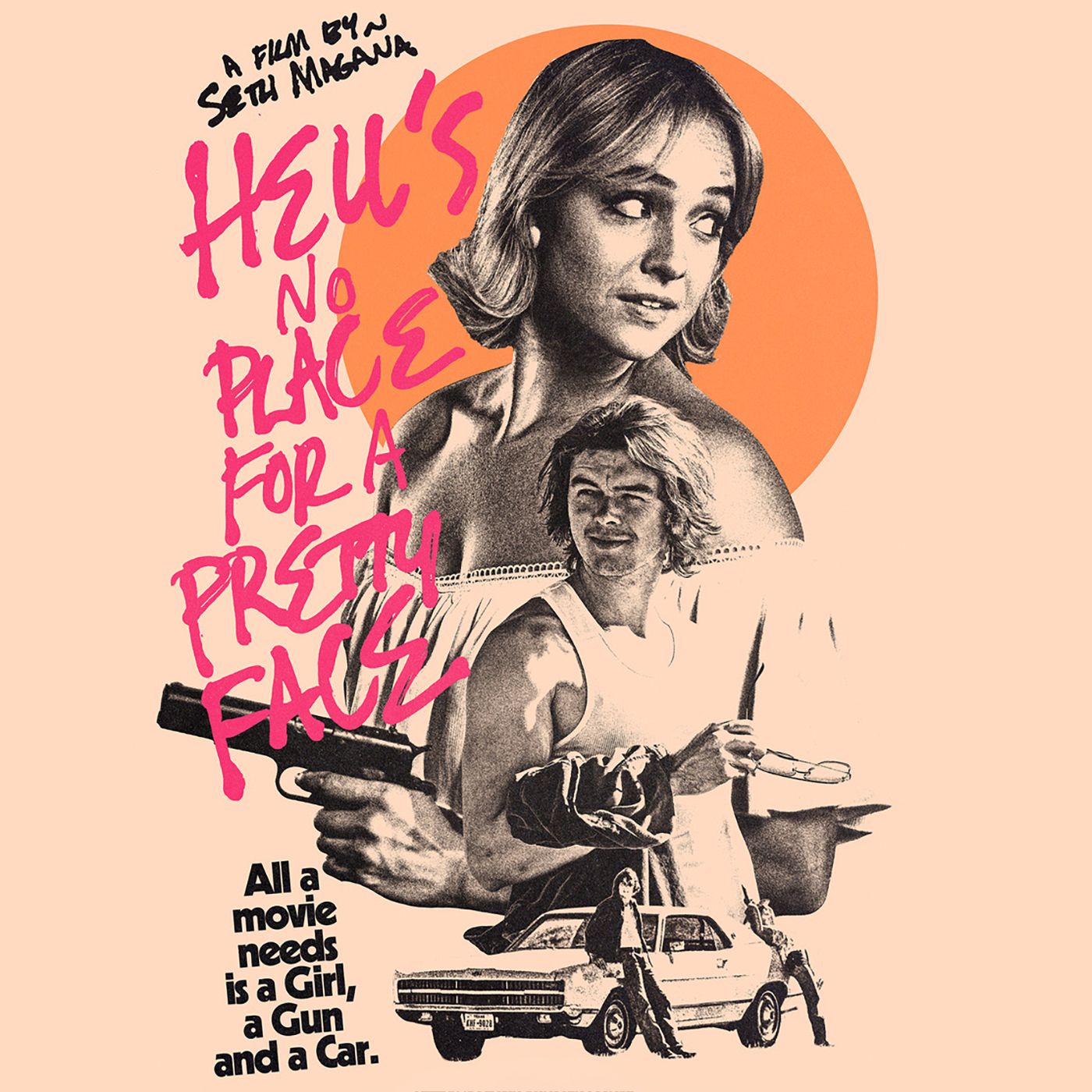
Special Report: Hell's No Place for a Pretty Face (2026)
Dienstag, 27. Oktober 2026 · 26 min
Kapitelklicken springt direkt hin
Shownotes
Two adult film stars run a cross-country crime spree, robbing porn theaters to fund a getaway to France, and the real question isn't whether they survive but whether they stay together. Hell's No Place for a Pretty Face (2026) is a new Texas-made road romance from writer-director Seth Magana, shot on one lens with his own money and headed for a November 17 premiere at Laemmle NoHo 7 before a theater-by-theater tour. Seth joins Mike to talk about why Bonnie and Clyde (1967), True Romance (1993) and Queen & Slim (2019) left room for a love story, the Warren Oates Dillinger (1973) soundtrack inside the film's theaters, lessons from The American Friend (1977) and Sam Peckinpah, a shootout co-directed by the still photographer, and a two-week editing trip to France.
Follow 42nd Street Pictures on Instagram (instagram.com/42nd_street_pictures) and get tickets for the November 17 premiere (laemmle.com/film/hells-no-place-pretty-face).
Become a supporter of this podcast: spreaker.com/podcast/the-projection-booth--551….
Become a supporter of The Projection Booth at patreon.com/projectionbooth
The Projection Booth is part of the Weirding Way Media podcast network. Explore more of our shows at weirdingwaymedia.com.
Transkriptvom Podcast bereitgestellt · Zeitmarken springen hin
Hold your ears, folks.
It's showtime.
People pay good money to see this movie.
When they go out to a theater, they want cold sodas, hot popcorn, and no monsters in the projection booth.
Everyone pretend podcasting isn't boring.
Turn it off.
Turn it off!
Turn it off!
Gas?
Gas.
All right.
It's your money and your life, mister. I'm taking one of those.
Dylan? How do.
You think.
They'll remember us?
What do you mean?
You're all like Bonnie and Clyde.
Do you think they'll remember us as Dylan and Nora or Nora and Dylan? I don't know, pretty lady.
Maybe they don't remember us at all. I'll make sure they do.
They'll remember us.
I can't forget.
She can't forget. She can't forget. She can't forget.
You should watch Army.
Hey, folks.
Welcome to a special episode of The Projection Booth. I'm your host, Mike White. On this episode, I am talking with Seth Magana all about his 2026 film Hell's No Place for Pretty Face. It stars Meg Bush and Nathan Leonard, and it is a terrific little thriller, kind of a modern take on gun crazy with porn stars and just this kind of Southern baked desert noir kind of thing.
I had a lot of fun watching this. So I hope you have a great time listening to this interview.
Enjoy.
Tell me a little bit about you. How did you get involved in filmmaking?
I've been, I guess, unprofessionally doing it for about 10 years now. I started in high school and then progressively each short film became a little more professional, which led to a feature, which led to opportunities opening up. I did two years at the BFI in London and then came back down and continued here in Texas. Yeah, no, it's honestly a pretty straightforward. It's just one short film after the next until we sort of get into the feature game, which is, it's been fun, but just once.
That's fantastic. What even got you interested in being a filmmaker?
That was, so again, being in Texas, It gets very hot here, so you tend to do, your activities are limited to whatever you can do in the AC. As a kid, I was watching movies a lot. My dad put me onto a lot of stuff. And then I, me and my brother would constantly go out and just find himself. The circle of friends I had would, we would gravitate towards trying to find the craziest thing we could watch. And then I guess that just morphed into the goal of making movies and progressively.
And tell me a little bit about your short films. What do you gravitate towards without.
So I'd say like my two home genres that I've always ended up bouncing back and forth between was like western and noirs I those are like the things I really love and mainly with the shorts they tended to be more noirs because I could do that with one light and limited resources right so we did what is it I'd say the first professional short film I did was called big red the big red white and blue and it was Very simple. It was a one-day shoot.
It was about two guys who meet in a hotel room. Essentially, as the conversation goes along, you realize they orchestrated the JFK assassination. It did really well for us. It took us to an awesome film festival and to a bunch of other festivals. That was the first one that got us some recognition. That one really helped kickstart a lot of the more professionalism and the stuff.
That we made. That's fantastic. You were involved with one co-directed, I believe, called Streets of Fire. Was that a remake of the Walter Hill musical?
No. Okay, so that's a funny one, actually. So technically, I guess, that would be considered the first feature that I shot, but never got made, really, or never went anywhere. I was a junior in high school, and my friend, who is still one of my best friends today, he's older than I am, He had this idea for a movie and it was about race cars and it was about street racing and stuff like that. And he would literally pick me up from school and we would go and shoot after school for me. And that was probably some of the best film school I ever did because we did every single thing incorrectly. And that really put us on the things not to do for future reference.
It was a lot of fun. I love that we got a cool trailer out of it. That was what we were very proud of. We'll still show that to you today.
That's awesome. So tell me the story of Hell's No Place for a Pretty Face, because it's, I just want to say this up front, it's a great movie. I had a really good time watching it. Awesome.
Well, that's awesome to hear, because right now it's very limited of people who've seen it. So hearing that is super awesome, especially from this podcast. Man, that's awesome. Yeah, no, so it's essentially a Bonnie and Clyde kind of story. The logline that we use is, what is it? It's two porn stars driving cross-country, robbing porn theaters. And it's essentially just a functional logline to pull in people's attentions because I think it's an attention-grabbing hook, I believe. But essentially, we wanted to make a romance movie. I think that's one of the things that is lacking from that subgenre.
You have Bonnie and Clyde, True Romance. What was the other one? Recently, Queen and Slim. You have this whole subgenre, and I love that genre. And the thing is, with that category of movies is that they tend to revolve around a couple of does they meet, they accidentally kill someone in self-defense or find a briefcase full of money and then they're being followed and they have to run.
And they always end up in Mexico or dead. 0.2 options. And the thing is, the main conflict of those movies tends to be whether they're going to make it out alive. And since we don't have the budget for big shootouts and stuff, we're relying on the question is, are they going to stay together? I think focusing on the romance aspect of a story like that is infinitely more interesting and doable. So that was kind of the goal. So it blossomed from that idea. Essentially, we wanted to make a road movie and just include a lot of imagery that we like, right? So just cowboy hats, cool cars, desert, movie theaters, just morph a story around that imagery.
What movie audio am I hearing when they go into theaters?
Dillinger.
The Warren Oates movie? Yeah.
All right. I thought I recognized the voice, but I could not place it for whatever reason.
So, all right.
Thank you.
Yeah, we were going to use Bonnie and Clyde, but that was a little too on the nose, so.
Yeah, granted. I totally understand that. Tell me about how you put this together. Once you come up with the idea and start to write this, where do you go from there?
I have like a core group of people that I tend to work with going all the way back to some of the early short films, including the guy who used to pick me up from high school and make that when we made that short film or that feature. So I wrote the movie while I was in London. I knew that it was something I got, I ended up getting very passionate about while I was up there.
And I ended up ending my BFI course a lot earlier than I should have. And I moved back down here and just got it off the ground and started finding it myself. And essentially that's like, once I got my main three people, Mason Hunsucker, who was the DP, Jaffe Velasquez, who's my AD, and RJ, that my essentially that core group They really help push each and every aspect forward, right? And then again, just because we try to write something as doable as we could, right? We shot it in, I'm not going to say our backyard because it's a good couple hours west of Texas, but it's using places and imagery that we know and we're pretty well associated with. So it was like we knew the lay of the land ahead of time. And because
of that, things started to roll a lot more fluidly. And also because the last feature film that we did was one called The Hard Good Night. Same case scenario, every single dollar of that budget comes out of my pocket, essentially. And you try to learn how to stretch every dollar and where to put every dollar to its best use, right? So, utilizing a very small crew, utilizing one camera, we only shot in one lens. We never changed out the lens.
Minimizing the cast, it's just trying to lend ourselves an easier time to make the movie.
Absolutely. And yeah, talk about your cast because these two lead actors that you have are terrific.
Oh, awesome. Thank you. They're going to be pretty happy to hear that. Yeah, so we... Man, we lucked out big time with our lead. So Nathan, who plays Dylan Campbell, he's the Clyde half of that couple. He... We worked together briefly a couple years ago on a feature film. We enjoyed working together a lot, so much so that essentially when we wrote the script, it was already written for him. And then for the female part, the Bonnie half of that couple, that was... We had to throw a wider net out there. We... I was working on a couple of those vertical shorts that are starting to become a lot more popular, opening myself up to that aspect of production. It's essentially a big, gigantic pool of good-looking actors who want to be in a bigger project
and who are really good, who are very good. So we essentially tapped into that pool of actors until we found Meg. Meg Bush, she... Her audition was pretty much on point with exactly what we were looking for. It was awesome. She came in. It was one of the easiest and most gratifying director-actor relationships I've ever had because she just, she fell right into it. She essentially just played herself. And that's what I really wanted to, right?
A big part of the movie is trying to encapsulate that honeymoon aspect of a relationship. So it was having fun. I think having fun is a very difficult thing to convey on camera. I'd say almost more so than crying or anger or anything like that, which she does throughout the movie, but having fun is a very important aspect of the movie. And she killed it. Her and Nathan, they just gelled real together really well. And they only met two days before the actual shooting of the movie.
We really lucked out with the chemistry aspect.
I imagine that on a low-budget film like this, you didn't have a lot of time for rehearsals and just, yeah. The film has a great look. You mentioned your DP. Can you talk about how you figured out how you're going to go with this look, especially towards the end of the film when you start using some still images and the black and white? From frame one, though, it is very captivating the way that this is shot.
I appreciate it. Yeah, that's Mason Hunsaker. He was the DP for the movie. And essentially, he's my right-hand man on any project I've done within the past six years. He's been the guy. We have a very deep love for 70s and 60s cinema. We will non-stop just nerd out over The American Friend or any early Vin Vendor stuff.
My personal guy is always Sam Peckinpah. That's my hero through and through. Everything is by the gospel, Sam Peckinpah. So we tend to watch a lot of those movies and we tend to pull ideas from those. Our biggest thing when it comes to production, is practicality. How can we practically shoot something and not burn a hole in our wallets? Or how can we convey this to the most of it, to its maximum effect, still do it, not under budget, but cost-effectively? So we watched something like The American Friend, and one of the biggest lessons we take from that movie is each scene is almost like maybe three shots top. There is, not rarely, but there's a lack of camera movement through a lot of it.
It just makes sure that every frame counts. Every single frame pushes the story forward and it doesn't need to be flashy, but it just needs to be competent. So we go off of that mentality where whatever we do, let's frame it correctly. Let's frame it as nicely as we can. We don't need to do a lot of camera movement. We don't need a lot of tricks or anything like that. We just need to focus the story within the frames. Because of that, I think it does end up inadvertently lending a certain style to the movie i hope i think it gives us a certain look if that it gives us a uniform look that we really like and then for something like the shootout because again the on a practical sense it's very difficult to
do a shoot it out we made photography a constant theme throughout the movie and this one will go to our second unit photographer sarah farenkova She was the main photographer for all the stills that are taken throughout the movie. And she essentially helped co-direct that whole shootout sequence. And that was just a really effective way to make a unique shootout and also push the story forward and also keep it under budget. So I think we always go in with the idea of being practical.
Absolutely, yeah. The use of sound in the movie is fantastic too. You get some of those things like the shootout, even when your main character shoots near the cop and probably deafens him. That's all done through audio. It's really smart.
I appreciate it. Again, yeah, it's all a matter of we don't have a lot of time or money, and that drives a lot of the creative decisions. And I really am very grateful and very happy that I think they ended up paying off. Because we were taking a gamble on not getting a lot of coverage for almost most of the scenes we weren't shooting for coverage we're shooting for just let's get it and get to the next scene so i think it did lend itself to a creative.
Look absolutely when did you actually shoot.
This we shot this in october of last year so actually a year ago today we were like on day three or four shooting.
And tell me about your post-process post-process took me man forever i'm so terrible i dragged my feet like crazy i cut the first draft of the movie eight And we finished in October.
I think I was too scared to touch the movie until January. I had a cut by May, and I hated it. And I ended up essentially scrapping the whole cut. And then I met some guy named Marcus Aviles, who's now one of my best friends, who we clicked really well together. We ended up falling in love with the same movies. We had a language that we spoke. Took a crack at editing the movie. I think the first couple of days of editing, we realized, okay, this is a really good lockstep process. So what we ended up doing was we actually, in August, we went to France and we stayed out there for two weeks. And he cut the entire movie while we were there. And we also went and got supplemental footage because France does end
up playing an aspect of the movie. So we try to maximize the effectiveness of being in France. And yeah, it was awesome because we came out with, a cut, and a lot of really cool footage. And yeah, no, the post-process got very easy and fun once Marcus got brought onto the project.
That's wonderful. And how about your music? Music?
Okay, so that's our guy, Grant Locklear. So, similar thing. We met by coincidence maybe like a week or two before the actual shooting. He actually came to visit the set a couple of times. And then... Once we've got the cut, me and him started working together, and we have completely opposite hours. He's a night owl, and I like to go to bed at 8 p.m. So while I'm knocked out, he would be at his place, and he would send me drafts at 3, 4 in the morning, and I'd wake up, and this is great. No, he's great.
A similar thing, I think we had a process of learning how to work with each other, because this is the first time that I work with a professional composer. Now, I think I'm more equipped for the next one, which... God willing, it'll be again. But I had such a cool time working with Grant because music, it's not a second thought in the back of my head, but it's not something that is on the absolute forefront. So when Grant came in, he had a lot of really cool ideas and a lot of directions where it was a very trustworthy relationship where he can take the ball and run with it.
Wonderful. Did you show this to friends to get feedback or do any sort of test screenings to hone this?
We did one test screening. Okay, so half a test screening and half a showing it to some friends. Because we played it here in Austin at the Hyper Real Film Club. And we got a lot of people who we never met or never had no relations whatsoever, but they came in. And we got a lot of really good feedback. It was awesome. It was really, really promising to hear the reactions, especially during the shootout. That was awesome because we get very visceral gasps and oh shit moments.
Next month, on the 17th in LA, we're going to be premiering the film at the Lamley, Noho 7, what is it? And that'll be our big premiere. So that's the one that we're gearing up for.
Oh, that's wonderful. Are you doing like festivals and stuff as well?
No, so this is, we're not going to be doing that. Instead, what we're doing is we're going to be taking it on the road ourselves, essentially theater by theater across the country. The Noho 7 premiere, that's going to be essentially our kickoff. And then from there, we move it to Austin, to New York, and then expand outwards from there. I'd love to take it back to London because I have a lot of friends and a lot of... I went to a lot of movie theaters out there. I'd love to be able to bring it back home in a certain sense.
But no, we do want to treat this like a on-the-road production or distribution model, right? Because I have... This was meant for an audience that isn't just... festival going filmmakers and things like that i would love to bring it to as many eyes as i can so right now it is an experiment we're trying it out i'm very excited for it and as we get closer to it we're gonna have the dates release and all that stuff so Oh.
That's wonderful. And where can people find out where these dates are? Do you have an Instagram or website or anything?
Yeah, yeah. We have both. We have an Instagram and a website. If y'all look up 42nd Street Pictures on Instagram and also on just Google, you'll come across the page for the movie, the trailer, all that stuff. That's where we're going to be releasing all the details about where we're going to be, where it's playing, the times, all this stuff. And yeah, no, it's essentially the idea.
And then We're going to be gearing up for our next movie, which I'm very excited for. But yeah, no, it's been a process. I'm happy to see that we're finally here. Oh, yeah.
No, I imagine it was obviously more than a year since that's when you were shooting, but when did you actually come up with the idea? It must have been quite a few years ago.
Yeah, so I think the idea came around two and a half years ago. That's when I started writing or jotting it down on napkins and stuff like that. And then... two years ago I think is when we had the script and then from there we just started just trying to move forward as effectively as we could so.
That's awesome and I know that this tour is going to take up a lot of mental energy but you said you're getting prepped for your next one what is the next one going to be.
So the next one I'm not going to be directing it I'm producing it and writing it it's going to be from my friend Jafet Velasquez who he's he's an LA guy it's a horror movie so that's that's something that me and him essentially bonded over just trying to out-crazy each other's movie pick. So this is finally like, okay, let's really sit down and come up with our own crazy horror movie. So right now it's called Psychosomnia. And a quick little backstory. So the way I funded my first movie, I did the Robert Rodriguez style. I went to the medical studies and I did that for a year.
I hate those. They're the worst things in the entire world. I was in there for a year just getting poked and prodded. So essentially we're making a movie about that about these like let's do a come up with the craziest medical study and just put some people in there and just give them the worst time ever so.
Wow that's wonderful oh man what a great journey and I'm so excited to see what you do next thank you appreciate it.
Me too I'm very excited to see what we do next I hope we keep on going.
Well congratulations on the film and I just I hope the best for you because I had such a fun time and I really look forward to other people being able to experience this as well.
It's very gratifying. I am very proud of the project. I am very excited to show as many people as I can. I'll get the reactions and see what that's going to look like.
Thank you. Thank you.
Thank you. Thank you. do do do
