

The Projection Booth· Staffel 1· Folge 785
Special Report: The Long Way Home (1989)
Donnerstag, 22. Oktober 2026 · 27 min
Kapitelklicken springt direkt hin
Shownotes
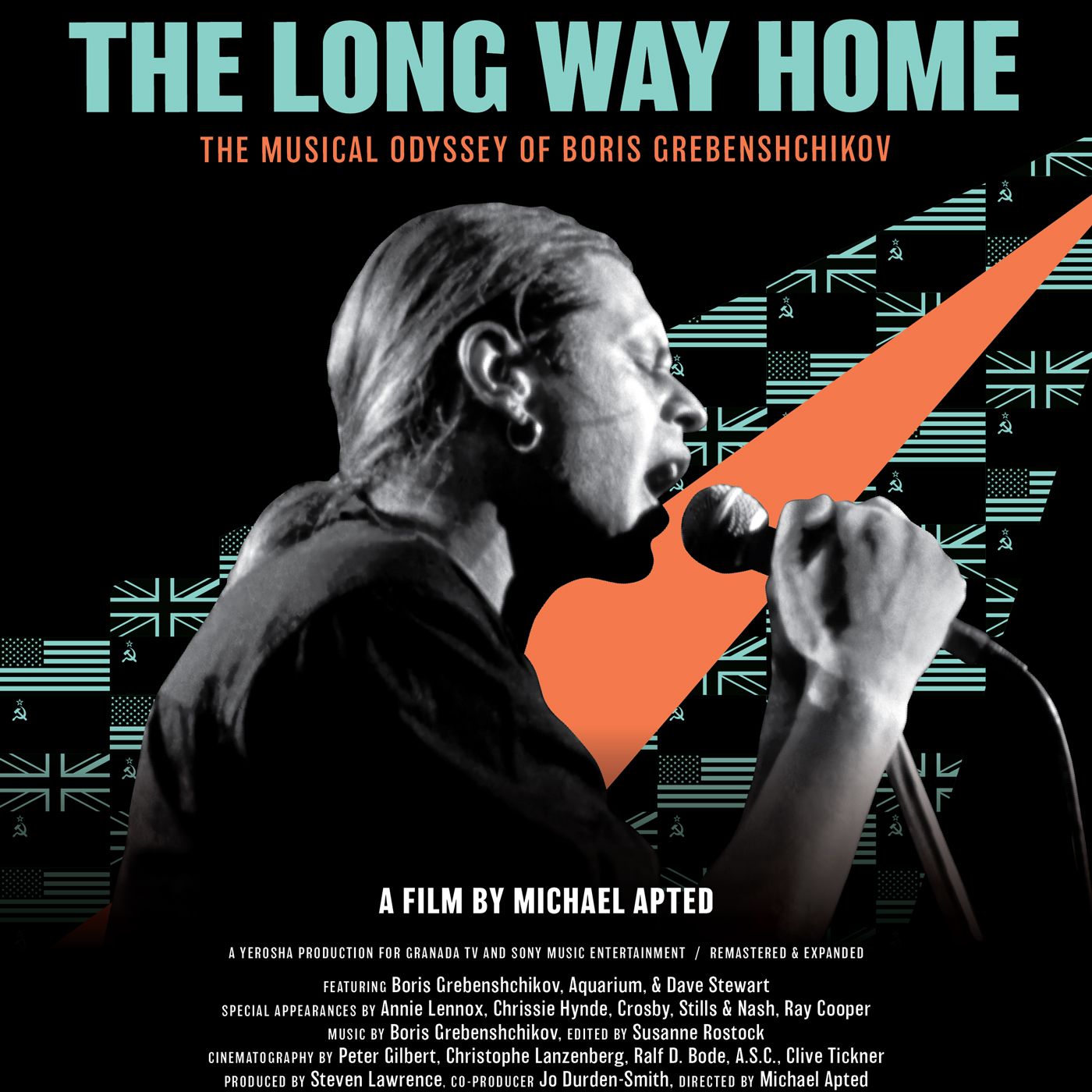
In 1988, a Soviet underground rock hero flew west to record an album for CBS, and Michael Apted's cameras went with him. The Long Way Home (1989) follows Boris Grebenshchikov and his band Aquarium from studio sessions in New York and Montreal back to a Leningrad where glasnost was still a hope, with Dave Stewart, Annie Lennox, Chrissie Hynde, and Crosby, Stills and Nash along for the ride. Now it's back: a 4K remaster built from the only surviving 16mm print premiered at the Museum of Modern Art in January 2026, with a new epilogue on Grebenshchikov's exile.
Mike talks with producer Steven Lawrence about bringing the film back to the screen. Lawrence got his start in New York public-access television, filmed CBGB bands in the 1970s, produced long-form programming at MTV, and co-founded Link TV. He and editor Susanne Rostock supervised the remaster and co-directed the new ending.
Become a supporter of this podcast: spreaker.com/podcast/the-projection-booth--551….
Become a supporter of The Projection Booth at patreon.com/projectionbooth
The Projection Booth is part of the Weirding Way Media podcast network. Explore more of our shows at weirdingwaymedia.com.
Transkriptvom Podcast bereitgestellt · Zeitmarken springen hin
Hold your ears, folks. It's showtime. People pay good money to see this movie.
When they go out to a theater, they want cold sodas, hot popcorn, and no monsters in the projection booth.
Everyone pretend podcasting isn't boring. Turn it off.
I'm gonna tell you the story about Boris, whether you like it or not.
All about the land of the USSR, it's the land that he's forgot. The fact that you are one of the biggest rock stars in Russia, that's going to be the first thing they're going to grab onto.
People are already clamoring to talk to Boris.
To make a record in the West, with Western musicians, by a Russian, without censorship.
Here with something new, something exciting.
BELLS CHIMING.
I know Boris is searching all his life for something interesting, something not ordinary. The songs are not working for Boris.
No one really understands what he wants exactly.
I have pressure from you, I have pressure from Dave, I have pressure from my own self, which is much bigger than any other pressure. I think no matter where Boris travels now, he's already made the longest journey.
It's the best Gryffindor concert I've ever seen.
We've found something that nobody ever has found before.
I could never have predicted that I would still be alive at 71.
After criticizing the Ukraine invasion, his music was blacklisted.
Most probably I will wind up in jail.
For speaking out against the war. I don't think the need to rebel will.
Ever go away.
Hey folks, welcome to a special episode of The Projection Booth. I'm your host, Mike White. On this episode, I'm talking with Stephen Lawrence. He is the producer of the film The Long Way Home, as well as being responsible for the remastered and expanded version of The Long Way Home. That was a documentary that came out back in the 80s by Michael Apted. Made a big splash back then and then kind of disappeared. We'll hear more about that as we talk about The Long Way Home. Thank you so much for listening, and I hope you enjoyed the interview.
Can you tell me, how did you get involved in show business and making movies?
It goes way back to my youth. When I was 19, I got hired by the local cable TV company in Manhattan, New York City, to coordinate their public access channels, public access to cables like the YouTube of its day. I had already been making kind of... independent underground short films on my own. And I was fascinated with video and storytelling.
And I got really excited about documentary making. So there I was teaching the public how to make their own TV for the first time and doing a lot of that myself. I got to study with one of the great masters of documentary, Ricky Leacock. and with some other people subsequently at NYU. And that was the origin of my interest in filmmaking, and filmmaking is part of showbiz. Eventually, I was hired by MTV as one of the people to help launch the channel. So I had a strong interest in music and film at the same time, and I was also part of a group, co-founder of a group called Metropolis Video, that filmed a lot of the early punk and new wave bands at CBGB in 1975.
This is all to say that my interest in film and music goes way back to my early days.
I can only imagine how great those videos of some of those early groups at CBGB are.
They are, and we hope they're going to get released later this year. We can talk about them when they come out. Hopefully we can do another interview.
When it comes to music and documentary kind of crossing the streams. I mean, it feels like a lot of your work, especially in the early days, were very inspired by that. But then also politics. I mean, artists against apartheid, going behind the Iron Curtain or behind the wall or after the wall crumbles. There was so much stuff going on in the 1980s, and I'm curious how you kind of found your way into some of these groups.
It was always an interest. I inherited a strong moral compass from my dad, who was an immigrant to America, managed to go to West Point, the United States Military Academy, so he had this very strong ethical and moral code, even though he was in the U.S. military and fought in World War II. My interest in art and politics and the intersection of those two world was just ingrained in me from the beginning. And so when I started making films and doing stories about musicians, I was often drawn to people and places, artists and places, where there were challenges, where there was repression, where there were human rights issues and violations, and the artists were faced with not only making music, which is the core of what
musicians do, but had this responsibility to their audiences to speak out, to use that position where you're in front of thousands and sometimes millions of people to make a difference. And sometimes that comes at great risk It can be at risk to your life, to your freedom, to your homeland. And that is the case with Boris Krebenshikov, who no longer lives in Russia because he spoke out against the war in Ukraine. And if he were to go home, it would be to face a very stiff prison sentence.
Well, how did you originally get involved with The Long Way Home?
It goes back to 1987. At that time, I was working for MTV. And I had learned about the Soviet underground rock scene about a year or a year and a half before that. And I was fascinated by it because here you had these artists who could not distribute their music legally. They had to do it in an underground fashion on audio cassettes. They couldn't make a living at all with their music. And it was the opposite of what I was mostly doing at MTV, which was telling the stories of very successful, often very wealthy rock stars. And, you know, take nothing away from them. So many of them are just brilliant artists and have given the world so much. But given who I was, I was just fascinated with these Soviet underground musicians, and I started to
learn about them. initially through a woman named Joanna Stingray, who released an album, I think it was in 1985. I think it was called The Red Underground, which is a compilation of Soviet underground groups. One of them was Aquarium, Boris Grabenchikov's group. And then I started to collect video. People were bringing back videotapes from the Soviet Union, and I was connecting to everyone who was doing that and watching everything I could get my hands on. To try to make a long story short, eventually I convinced MTV management to let me go to the Soviet Union in 1987 to make a film about this underground rock scene.
It was called Tell Tchaikovsky the News, Rock in Russia. And on that trip, I was able to meet Boris and film with him for the first time. And around that time, two very smart and ambitious people Americans, Kenny Schaefer and Marina Albee, were working to get Boris a record contract in the West. And they got, eventually they were able to get a deal at CBS Records, which later became Sony. The head of CBS at that time was a guy named Walter Yetnikoff, who loved Boris, and said, okay, if you can negotiate it, we're going to do this album.
Boris will be the first Soviet artist to make an English-speaking album in the West. So as soon as I heard about that, I signed up. I said to Kenny and Marina, I want to make this film. And when Boris came to America for the first time in 1987, I... did some filming with him to document that initial exposure.
And from that material, we made a demo tape. I did this with my collaborator, Suzanne Rostock, who edited The Long Way Home and also was the editor and co-director of the epilogue in the new film. Anyway, around the same time, Michael Aptead, brilliant British director who I so admired, heard about Boris through a colleague of his in London, who said, you've got to meet Boris. He's amazing, and he's going to make this album. Michael flew to Leningrad, met Boris, got incredibly excited, called me up soon thereafter, and he said, Stephen, we've got to meet. I want to make this film. And so we met up in New York, and I thought, fantastic for Michael to direct the film, and we made an agreement that I would
produce it and do Second unit directing, additional directing is needed. And we had this fantastic collaboration, and he allowed me to bring part of my team, Suzanne Rostock and cinematographer Peter Gilbert, into the project. And it was just a fantastic experience. You'd have to ask Boris how it was for him, being surrounded by cameras and under so much pressure to leave his country, write an album in English, and deliver it to a major record label with all this hope weighing on him. My God, that he did it with such grace, it still astounds me.
How did the other musicians get involved?
There are Russian musicians involved in a smaller way than the Western musicians. Boris, on his first trip, met Dave Stewart, of Eurythmics, and he had been a big fan of the group, and he decided that he wanted Dave to produce the album. And so once he started working with Dave, Dave brought in the other artists, Annie Lennox, Chrissy Hine, Ray Cooper, and other members of what was then the Eurythmics band. Patrick Seymour, Ali Romo, I'm not going to remember all the names, Dave's wife at that time, Siobhan Fahey, who had been part of Bananarama, was one of the backup singers on the concerts that eventually happened in Leningrad between Boris and Eurythmics. Boris's group, Aquarium, worked on one track,
and then Sasha Titov, uh, Boris is brilliant bass player and kind of the, the musical director for the band, um, played on most of the tracks. And he eventually came to LA to do recording sessions, uh, late in the process of the project. And that's documented in the film. That was kind of a, a crisis moment because there were very few days left and Boris and Sasha were under tremendous pressure to, to finish the album. uh, Anyway, you have to see the film to understand and to witness the drama of it all and how they all came together eventually in Leningrad to rehearse the meeting of Eurythmics and Aquarium to rehearse and perform two concerts at the largest sports complex in Leningrad, which is now St. Petersburg,
of course. So those... amazing concerts are the climax of the film. Well, there is the film itself, which comes out in 1989. What happens with it then, and why are we talking about it in 2026? Well, the film was tied to Boris's career as a recording artist, and there was great hope that he'd be a smash hit, that he'd be one of these crossover stars that we we see today, like Shakira as an example of many.
But it didn't happen that way. There were some great songs on the album, but CBS wasn't able to sell it. I think Boris feels that perhaps the promotion wasn't as much as it could have been or done as well as it could have been, but that's water under the bridge. The album did not become a hit, although Boris got a lot of attention for being the first Soviet artist to record in the West and make an album at this level. And gradually the film just disappeared, as Boris disappeared from the American media landscape. Although journalists continued to write about him, he wasn't recording in English. He decided to stop working in English and devote himself to his Russian audience. And there was this renaissance for him of
doing better and better and more interesting work.
So he.
Went back to Russia, and the film pretty much disappeared after a home video release, which I think happened in 1991 on VHS. And there are probably still VHS tapes kicking around. But by the turn of the century, No one was thinking about The Long Way Home, even though it was a Michael Apted film. And after Michael died in 2021, I decided, hey, I'm getting old. Boris is getting old. This is one of Michael Apted's best documentaries.
It's an incredible time capsule of a moment in history when there was great hope for change and for democracy in Russia. Let's bring this back. Let's make it available so that young people can see that time capsule. And then my collaborators, Suzanne Rostock and I decided, okay, let's do an epilogue. Let's bring Boris's story into the present so people understand what happened between 1989 and 2025, 2026.
And Boris graciously agreed to let us do some filming with him in London and on the road. He was touring. And that material became the basis for a 14-minute epilogue, which is part of the Long Way Home remastered and expanded. And the title tells you all. It's a remastered version of the original film and this new chapter. And the whole thing is a tribute to Michael Aptett. And part of that tribute is the way that we made the epilogue, using the kind of longitudinal storytelling style that he used so well and so famously in the Up films, the seven Up films, where we flash back to the past from the present as part of the way of telling Boris's story in 2025, 2026.
What was it like going back and revisiting this, and what was the state of the footage when you were able to get your hands on it? The state of the footage was not good because.
unfortunately, and nobody knows exactly how this happened, the rights holder for the film had lost or thrown out the negative, the sound mix, the dailies, you know, hours and hours of fantastic material because not all the good stuff ends up in a short film. You know, you have 80 minutes, but we shot easily 100, 150 hours, I would think. But, I had kept a 16mm print in my basement for many years. We made a few prints for film festivals, because back in those days, that's the only way you could show a film at a festival. And the print was sitting there. I had an old analog tape that had a good stereo mix on it. And between those elements, we were able to remaster. It was a technical challenge.
But fortunately, we picked the right time to do it because there are a lot of new tools that allow you to take something that looks grainy and contrasty and to remove a lot of the noise and restore a film to looking very much like it would have if we had remastered from the negative. So it looks really darn good. We had a great sound mixer, John Bowen, who took the original stereo track and made a brilliant 5.1 mix from it. So nobody would know the origins of these funky materials. But, you know, I feel lucky that we did it in this moment, because if we had done it five years ago, gosh, it would not have looked good.
I know the movie has shown at a few film festivals and had some other screenings. What's going on with it now?
The film is going to be released next week, the week of October 19th. And it is pretty much a global streaming release, digital release. So it'll be available on demand on Amazon Prime, on Apple TV, Google Play, an independent platform called Kinema. It's also available in multiple languages. We have subtitles in Russian, in Ukrainian, French, German, and Spanish.
So it's going to be available to millions of people. And we're really pleased with this, because if you release a film in theaters, you know, that's great. Everybody loves to see their film on a big screen, and it's a better experience for the audience, but very few people actually get to see it. This way, really, anyone can.
By offering it in multiple languages, the ones that are especially important are Russian and Ukrainian because hundreds of thousands of Russians have left the Russian Federation because they do not want to live under a dictatorship and be part of this horrible thing that's going on in Ukraine. Then, of course, there are Ukrainians who are the victims of Putin's murderous onslaught on a sovereign state. And so we especially wanted to make sure that Ukrainian fans of Boris's, and there are many, have access to the film.
Is there a good place for people to go and keep up with this and keep up with you? Follow us on our social channels. The main one is Instagram, thelongwayhomedoc. And then we have a website, thelongwayhomefilm.com. And all the details about the film's availability.
And future screenings will come to you through our social channels and through the website. And there will probably be some additional screenings that happen that are special events. I want to just make sure people know that Boris is very active. He's doing a tour right now. In fact, he's in the Baltic states. He has a big concert in Vilnius over the weekend. And one of the things that's wonderful about seeing Boris now is that he has the band of his dreams. This is a just brilliant, brilliant band. Sometimes he calls them BG +, sometimes he calls them Aquarium. I can't explain why. But if you get to see this band, it will be an incredible treat, even if you don't understand Russian, because the music is
at such a high level. and the spirit is so fantastic. So please see The Long Way Home, learn about Boris Grabenchikov and his remarkable odyssey, and the fact that he's still going strong and making some of the best music of his life at age 72. Mr.
Lawrence, thank you so much for your time. This was so great talking with you.
Great. Okay, I really enjoyed it, Mike. Thank you so much, and I look forward to speaking to you Speaking with you about another project. Maybe those CBGBs.
Suddenly it feels like a new.
Year Like a million miles away from here I can see some kind of light here But oh, I can't name it But I.
Can talk about a moonlight I can talk.
About a wild child And all that real wild love Dancing alone in the middle of the world See the tales about silence, about radio silence, of some kind of a silence in the middle of the empty.
Field full of strangers.
Tales about silence, about radio silence, of some kind of a silence in the middle of the empty field full of strangers. It's strange to feel like I'm a stranger I feel like I belong here Feel like I've been waiting for a long time enough And I can give you some silence Some radio silence Or some kind of a silence Like a million miles away from here I can see some kind of light here Oh, I can name it I can talk about moonlight I can talk about a wild child You know, that real wild one Dancing on in the middle of the world Spinning tales about silence About radio silence There's some kind of else that I feel below I can't give you some silence I can't give you some radio silence I can't give you some kind of advice I'm in the middle of
the empty field if you want it
Thank you.
