

Kapitelklicken springt direkt hin
Shownotes
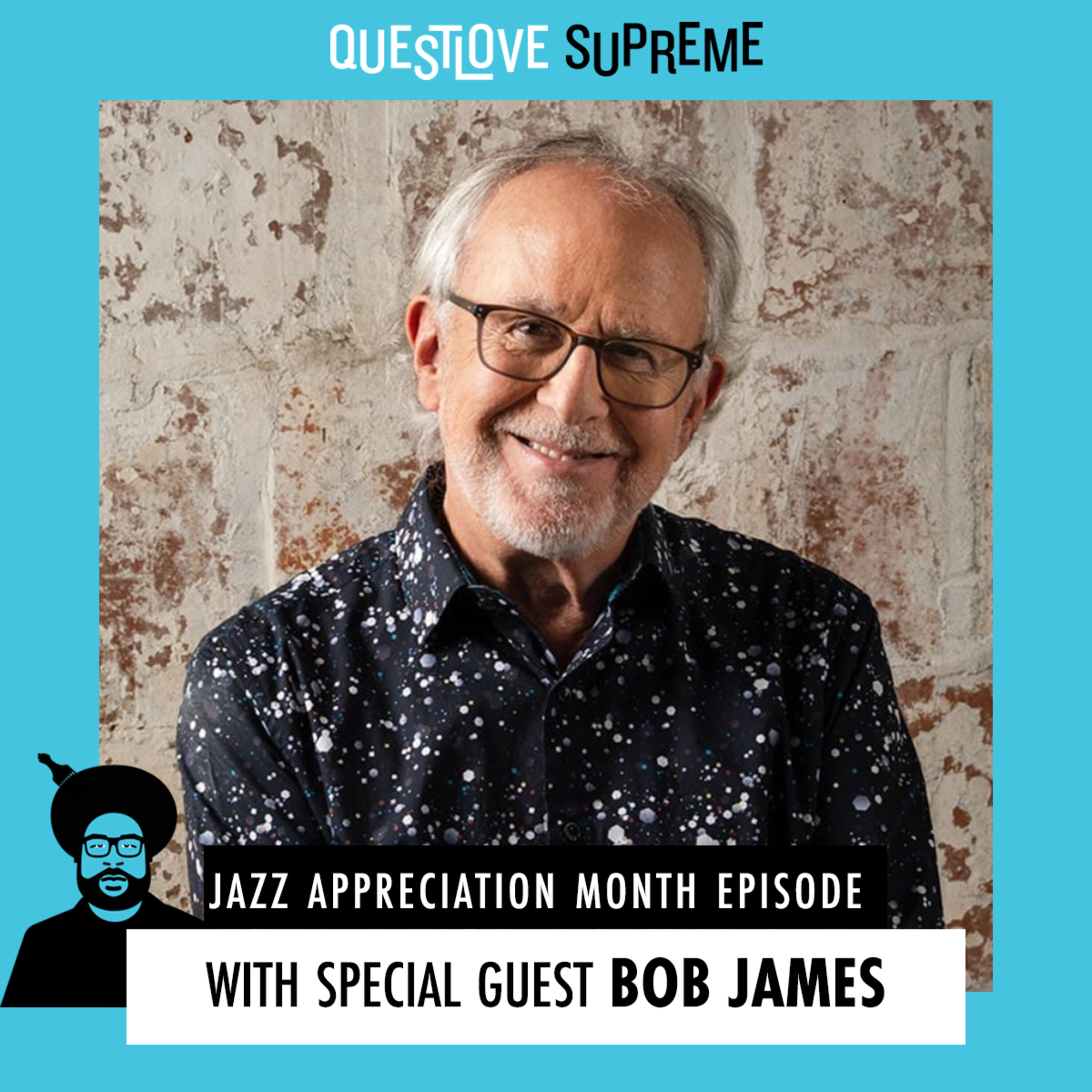
One of our most-played and most-beloved episodes of 2023. For Jazz Appreciation Month, Questlove and Team Supreme sat down with a living legend of the genre. Bob James recalls his incredible journey and his intersections with Sarah Vaughan, Creed Taylor, Idris Muhammad, and others.
He also discusses becoming a beacon for hip-hop DJs and sample-based producers—and how he went from being a source to a collaborator with artists such as RZA, Talib Kweli, and, yes, still, Questlove.
See omnystudio.com/listener for privacy information.
Transkriptvom Podcast bereitgestellt · Zeitmarken springen hin
Questlove Supreme is a production of iHeartRadio. People, people, what's up?
It's Questlove giving you another classic episode of Questlove Supreme. This one is from April 2023. We talked to the great Bob James. We talked about his incredible career in jazz, some of the records that became keystones of hip-hop, Bob's relationship with sampling, and his work with foreplay. Since this interview, Bob has continued to release music and tour. And yes, I still want to do something together with him. I love his energy, his wisdom, and of course, his incredible groove.
This was a great episode of QLS, and I'm pleased to put it back atop your podcast feed. So I want you to enjoy Bob James on Questlove Supreme.
Classic.
Wait a minute is that a dx7.
That is a dino chorus patch on my uh montage.
Okay we got it nice nice ladies and gentlemen welcome to another episode of what's love supreme i don't know uh steve and why we might need a Another superlative.
You know, like James Brown has the famous flames.
I think we should be like the legendary supreme or, you know, something.
Even more exciting.
You dropping legends.
That's right.
Yeah, you know, because I feel like every episode is yet another kind of bucket list that we didn't know that we wanted to check off.
Steve, I feel like.
This is going to be the- Your time to shine, bruh.
Yeah, this is the Steve MVP episode. Not to put any pressure on you.
I've handled some episodes. I think I had one of the top five episodes of last year, if you want to check the numbers. Nah, I'm just saying.
Like, this is sort of like, you know, we had expectations for LeBron to be the guy back when in high school.
All right, well, I want you to do your intro, but yeah, I was just telling, honestly, before we started the show, I was telling Bob and Sonny that I do have a radio show on WKCR, Columbia University's radio station. And the show that we do is about jazz labels. And each episode we cover a different label. And quite recently, a couple months ago, we did a three-hour episode about Tappan Zee Records, which is Bob's label under Columbia in the late 70s and 80s and into the 90s, I believe. Well, as part of Warner. But Tappan Zee went on for a bit and I'm dying to talk directly to the man who started the label and who was, it was such an influential label and it's getting a little lost.
So I want to refresh our listeners with some albums.
Like the most he's said in like 20 episodes.
I know, this is amazing. This is amazing. I might just skip the intro. Anyway, Fonte, Laia, you guys cool?
Yeah, yeah, yeah, we good.
Living the dream. What's going on, man? What's happening?
So, I will basically say that our guest today, of course, is a legendary jazz musician, but I don't think we could just reduce him to jazz. Yeah, his music is smooth, but we dare not call him smooth jazz. His music is hip hop, but, you know, we can't call him hip hop. But I think probably the most unique character trait of our guest today is probably just or not my, our inability to pinpoint what is he exactly? Is he an avant-garde artist? Is he a musical provocateur? Is he the godfather of smooth jazz?
I don't know.
I will say that probably when the smoke clears and we start taking a toll of the artists that fall under the jazz umbrella, and there's many categories under that, I will say that as far as the scope of hip-hop, and yes, we kind of come from a hip-hop scope because of our age and whatnot. We get to know a lot of these artists through the power of sampling.
I will say that our guest is probably at the top of the list. I think hands down, he's the king of textures, which is something that you don't necessarily hear someone describe another musician, but listening under a hip-hop context, texture means everything. I also think that our guest is probably one of the kings of The perfect four-bar capture, the ability to transform your new creation into something else, that's just how adventurous he is, cut to cut to cut to cut from album to album. And I will say that probably one of the best engineered artists under the contemporary jazz umbrella, just as sound speaks to probably everyone in my generation and beyond. Because, of course, a lot of his music is the foundation for some of
the best hip hop that I've ever known, that we've ever known. And you, the listener, you've heard his music, whether you knew it or not. He is, you know, multi-nominated, underappreciated, loved, worshipped, always in demand, an absolute legend. This is the Bob James episode of Questlove Supreme, finally.
Man i hope that was recorded so i can uh.
I cut it in half like because i could really.
Yeah this for 18 minutes you mentioned the best engineered did you mean engineered or did you mean like him engineering it uh a concept i mean to i i'm trying to bring up the name joe jorgensen No, George Orton and Rudy.
For me, it's the perfect texture of compression and natural sounds to me that I think is what attracts my generation to his music.
There's two ways to take in music.
We come from a generation where you go digging, you take the records home. With the notable exception of Primo and Dilla, I don't know many hip hop producers that actually listen and absorb the records, like listen to it over and over and over again until they actually absorb it. And, you know, cause a lot of us just skip, put it on 45. Nope, Nope, Nope, Nope, Nope. Oh, that's something, you know, and you skip around. But to me is, is one of the, some of the best engineered music for, for the purpose of sampling. But, you know, again, it's like, you can listen to his music under different scopes, not just like, Oh, from a sampling perspective, but, That's the thing.
You can't categorize it.
One more thing before maybe we let the guests speak.
Right. Let's have a whole episode where he just doesn't talk. Good thing you brought your keyboard, Bob.
I'm smiling.
I'll just sit here and listen.
So I think the word that you were missing in your intro and why it's so hard to describe what he did and what he does is fusion. I think that what he did was basically just another version of fusion jazz.
But I feel like Any description for a jazz artist is almost like a four-letter word.
But fusion, you know, includes obviously whatever, many different things that are being fused.
Well, let's ask him. Bob James. Welcome to the show, finally. 19 minutes later.
You know that's how we do it.
If all is said and done, and without sort of, you know, oftentimes artists will, and I'm guilty of it, like sort of ducking and dodging the accolades. What would you like us to know you as in describing your artistry?
I don't know that I'd probably be the right person because so busy doing it, I never could stay in one category for very long. Maybe I was just too restless or something. But at one point earlier in my career, my wife advised me that We were having a conversation about, I thought I was spreading myself too thin and I should focus more on one thing and make up my mind whether I wanted to be an arranger or pianist and in what genre, classical jazz or whatever. And she said, stop worrying about it.
Just do what you do.
And that may be what sets you apart or makes you different from other artists is that you do a lot of stuff. So I've kind of stayed with that and not attempted to categorize myself or go too far into one direction because I love the variety and the challenge of it. Right now I'm trying to meet hip hop head on rather than have it happen off to the side. where they take a chunk of me while I'm not there in the room to be able to defend myself. It might be good to get in there and say, well, wait a minute, wait a minute, before you chop me up, let's see if we can go from beginning to end.
Every now and then.
Okay, so Bob James, he does a lot of stuff.
The reason why I said fusion, though, Bob, is because I feel like Tappan Zee Records and lot of what you've done in your career was was not only fusing different types of music together but also really incorporating the the place and the time period into your into your music like new york city in the late 70s and early 80s and and you know, the city and the time period, did that play a lot into the music?
I absolutely always have thought that one of the things about jazz, since it's improvised, so you're giving your feeling right at that moment on that day in that city, wherever you are, that it definitely does represent the time period and what's going on. It should, anyway, if we're being honest, we're reflecting our time and that changes constantly.
So I've resisted when people try to make a definition of what jazz is because it changes. It changes along with everything else that's going.
On around it.
Bob, what was your first musical memory?
Getting fired from being pianist at a tap dance class in my hometown. I think I was 12 or something like that. And I couldn't keep the beat. So the tap dancers were tripping and the Finally, well, actually, the reason why I got hired in the first place is that I think I was the only pianist in the town that they could use to play for this tap dance class. I guess it's my earliest memory of trying to learn what keeping the beat meant.
Who would have the gumption to fire a 12-year-old?
Yeah, that was pretty cold.
I don't exactly remember that, but I may have defined that too harshly. They may have nicely told me to go home to my mom.
Passive-aggressive firing, okay.
You couldn't keep up. Was it with a simple kickball change of it all? Is it one of those kind of classes of beginners?
I was just curious. Damn, why are you with the tantrums?
I mean, come on, you know I'm a Heinz girl.
Was there music around your house growing up?
Not a whole lot.
My father was a lawyer, and I lived in small town in Missouri, where what I did hear was mostly country music. And my parents didn't really have that many records that came close to jazz either. I started hearing a little bit and getting intrigued, high school, maybe. And I remember kind of liking that feeling that it was improvised as opposed to what I perceived classical music being too much practicing. And jazz represented, at that time, escape from practicing because you could just make it up, anything that came into your head. And it's only been in more recent years that I decided that practicing even somewhere in relationship to jazz was a good thing and not.
A bad thing.
So around what year was that when you discovered jazz?
It was the 1950s, mid-1950s. And I do remember that that was pretty much the highlight of the West Coast jazz because I do remember Chet Baker, Jerry Mulligan, Dave Brubeck. Those names formed or the style of it, the West Coast style, was intriguing to me. Only in college did I kind of get more, tried to.
Get more deep I know there's this famous story of was it a talent show or something, some kind of competition where the bands were being judged by Henry Mancini and Quincy Jones.
How about that for a panel to be judging?
Yeah, it was a very pivotal time in my life. I was at that time, I just graduated from the university of Michigan and there was a kind of big avant-garde group of musicians that I became associated with because they needed performers who were willing to be really daring and do crazy things. The avant-garde world was really out at that time. And so I was incorporating some of those avant-garde things into my jazz trio. And I decided to take the trio down to Notre Dame where this jazz festival was being held. And it was very conventional.
We were expected to play bebop and I kind of deliberately went up against that and started playing some crazy stuff along with some bebop. And they caught, Quincy's here especially, I kind of don't remember whether Henry Mancini was into what we did, but Quincy definitely buzzed and they put a smile on his face. gave me a chance to meet him. And we kind of prevailed in the winner's circle at the festival, and Quincy signed me to record deal.
So it gave me confidence to move to New York and go into the jazz business.
Did you finish school?
Yeah, I got a master's degree in composition, mostly classical training. My jazz training was extracurricular. I'd go into Detroit from Ann Arbor, look around for a place to sit in.
Yeah.
And so Quincy assigned you to, was it Mercury?
Yes.
And we recorded the album in Chicago. He was living there, I think, at that time. And that's where Mercury was based in Chicago.
And so this is like the early 60s, right?
Yes.
63, 62, 62, 63. And so.
I know that at the end of this small part of the conversation, Quincy eventually recommends you or leads you to Cree Taylor and that gets you to CTI. But what happens in between there in the mid-60s?
Another big pivotal time was when I got the job with Sarah Vaughan, her music director, pianist, 1965. I had learned that her pianist, Ron L. Bright, had left And she was looking around and indirectly Quincy was involved in that too, because where I learned that Sarah was looking for a pianist was at this music copy service in Manhattan, where I used to hang out and watch all the arrangers come in with their charts that music needed to be copied. This was before the computer era where the copyists were still copying out the parts for the musicians in ink. So anyway, yeah, I learned about this possible job and I had actually met Sarah very briefly once when I was playing with Maynard Ferguson's band at Birdland
in New York. And Sarah came in to the club and Maynard asked her to come up to sing. And of course she didn't have any arrangements with her, so she couldn't do anything with the big band. And that's when my nerves kicked in because the pianist always kind of gets the responsibility to have to play the chords.
And once she calls out a song, you better know it because she wouldn't have come in with any music even for the pianist. And I got really, really lucky that night because she said, do you know the sweetest sounds? And I was able to say fairly quickly, yeah, what key? This, in the jargon of that time, lets the person who asks you about it know that you're prepared. And at that time, there was a Broadway musical that had just opened up, and The Sweetest Sounds was one of the songs in that musical.
It was a brand new song by Richard Rodgers.
And... But anyway, I was kind of a fan of musical theater and it's just complete coincidence that I knew this song. I just barely, Sarah was one of the first cover artists to sing it out of the Broadway show.
And so it made an impression on her.
And it was at least a year or two after that, that I responded when she was looking for a pianist and she remembered that night and I got the job.
I have to ask a real amateur jazz question. Now, you know, my tenure in school was like in the 80s and 90s. So, of course, I'm in a generation that grew up with having access to what they would call a fake book. Was there any sort of cheat sheety fake books of that level back in? Well, you know, those songs were also being written in real time. But how does a musician.
Learn these repertoires like you would just have to go to the store and just buy all the sheet music to everything or were there fake books out back then.
Yeah in my memory there were fake books uh that that kept getting bigger as a as a tool you know now we we have it in our phone we could look look up any song and a similar kind of a fake book thing that we could do but at that time i'm reasonably sure that this song was so new that it wouldn't have been in a fake book anyway because it just came out and in Maynard's band, the only thing I would have had on the piano was his charts that I was playing with him. And so when she came in unannounced and surprised that, that, uh, if I hadn't known that song might've changed my life and I probably wouldn't have gotten the gig later.
I see.
Now, every time we have a jazz artist on the show, uh, the first thing they want to do is sort of dispel, not only dispel the myth, but sort of dispel it in a, kind of a stick to a pinata way. Now, in general, if you're moving to New York City looking to make a living playing this music, jazz in particular, you pretty much have to be a wizard at reading music, correct?
I wouldn't say you have to. Oh my God, what's up with y'all? Well, you know, there were two different approaches to it.
In my case, I think I was pretty clearly thinking that the more training you had, the better. And that just increased your odds of getting a gig. And some of the gigs were not necessarily going to be a jazz gig. You might get a gig playing for a wedding or whatever. And certain kind of gigs, if you couldn't read, you wouldn't get that gig. But certain jazz gigs, it didn't make any difference whether you read or not, because we all know that the the greats that were not readers. And that's just a particular way. And I felt also to happen for me with Creed Taylor, he was a very much, his style with his label had a lot of production values and he was adding strings and woodwinds and various things to start out with a
basic jazz group and then give it the same kind of production details that pop artists had. So he needed a ranger to do that. And it's turned out that he, he learned that I was qualified to do it after having been introduced to him by Quincy Jones. So I got that job because of my training and, and it helped me get the job.
All right.
Let's take Valley of the Shadows, which may be our, audience might know that as a group homes, uh, the realness now Valley of Shadows, which has so much like stop on a dime, you know, just like all this arrangement stuff.
So mine, I believe like Steve Gadd.
Or Idris Muhammad were given these charts and knew exactly when the, the, like the, the starts and stops were because I'm imagining that you guys can't live in a studio. Like I come from a place where like, I've written complete albums inside the studio. Whereas like, I'm assuming that jazz musicians have to have this stuff prepared ahead of time.
You just go to studio and you knock it out real quick.
You don't waste time doing 15 takes, 20 takes or whatnot. So like, do they just study the music or do you give them a cassette of the arrangement ahead of time and they just commit it to memory?
It was all variations of that over many years. You mentioned Idris Muhammad. In my memory of working with Idris has been a long time, but Idris may have been able to read some simple chart, but he was not what we would call reader. And so I was going to hire Idris. I wouldn't put a big complicated chart in front of him because even if he did, it would change his approach to playing. And what I wanted from him was his, his own loose, uh, non obedient.
Reading a chart. kind of style.
So in some cases, we were deliberately trying to move away from a kind of written approach to the rhythm section at the basic tracks, because we had started during that era of overdubbing and not having everybody in the room at the same time. So for the most part, most of those CTI records, we would record the rhythm section first, and the production part of it would come afterwards.
So I could work with two different kinds of musicians. I could go in on the rhythm section date and do a very loose with minimum kind of chart. And then once I had that basic track, I'd take that home and score the more complex stuff or the stuff for the larger orchestra.
And so I guess we did it both ways.
And for a piece like Valley of the Shadows or Night on Mall Mountain, some of those things that were adaptations of classical music, it definitely required a chart and a musician that could read. So I hired them on the basis of that. And it wasn't categorical because the next day I might want to do something that was totally loose and just play some blues or whatever. And then reading would take that music in the wrong direction.
Got it.
In developing your initial sound, who were you idolizing?
Yeah, I wasn't too different from most other aspiring jazz pianists in that I listened a lot to Oscar Peterson and Bill Evans, maybe the two that I listened to the most. Of course, I tried to listen to everybody, Errol Garner and Art Tatum and on and on and on. But But I usually came down to thinking that three of those pianists influenced me the most when I was trying to break into the field. And I would add Count Basie to Bill Evans and Oscar Peterson. Count Basie, just because his minimalism of playing only a couple of notes every eight measures, but he knew.
Exactly when to play them. And I loved that.
Of not playing too much.
He was sort of the opposite of Oscar Peterson.
And Oscar Peterson had so much chops that I knew I could never do that anywhere close to the way he did it.
So I better try to find some other approach.
Is Bill the.
Is he partly responsible for why the Fender Rhodes became your signature sound or was just.
No.
As a matter of fact, I didn't like the way either Bill Evans or Oscar Peterson played the Fender Rhodes. And they only played it occasionally. And it always seemed to me to sound like they either had to do it or experimented with it and ended up not liking it. If you look at their overall recorded repertoire, you won't find very many Fender Rhodes tracks from Bill Evans or Oscar Peterson. And when I heard them play it, both of them, I hope I'm not being sacrilegious, but they hit it too hard. They hit the keys too hard.
They wouldn't change their technique.
They played it like it was an acoustic piano.
Yeah, you can't play that instrument that way because the acoustic piano has so much more dynamic range. And I don't know, it formed my style. at that time because I was asked to do it. I hadn't gone out and found Fender Rhodes on my own. Rudy Van Gelder had one in his studio and I started being asked to play it. And to my ear, I had to change my technique to make it sound good.
Was it, like now it's so commonplace, but in the early 60s when they're developing this instrument, like was it foreign?
Was it like a, like?
I mean, the way that we look at probably the way that we're looking at AI technology right now, like was it sort of a thing to marvel or something to master?
Like what were your feelings on it?
It was a gig to me. I wasn't even really– I.
Was playing it because I had to. That was my assignment on that particular gig because they wanted roads. when my heart was still with the acoustic piano until I began to realize that I was getting identified with it and that I had some kind of approach that people were hearing that almost forced me to take it more seriously when my album, the first solo album that I made for CTI had Feel Like Making Love on it.
And there was a sound that I had used Fender Rhodes on Roberta Flack's cause I played piano for her on, on her version too. So that sound became very much identified. That was what 1974, I guess. In some ways I felt limited by it because it just had, no matter what you did, there was only one way that I could make it sound authentic or good. Okay.
So, um, uh, kind of want to start in your discography. The period in between the first album, the Bold Conceptions that Quincy produced, and your second album.
Explosions, which really doesn't get discussed enough.
Because if it got discussed too much, I might not have a career.
The night and day of those two records. I mean, in 1965, like I know by, you know, I know by like 59, 60, like there was, there was avant-garde jazz and whatnot, but your version of it is way beyond like, you know, Coltrane's thing was more spirituality and, then, you know, like the stuff with the Shape of Jazz to Come and all those things, like, which I think they're being avant-garde with notes, but, you know, you're kind of taking at least listening to those records. I mean, if I could be bold to say, and, you know, notwithstanding the early, like, electronic records of the 60s, which were more like demonstration records or that sort of thing.
But like, dare I say, like that might've been one of the very first electronica records, like just in terms of you using different frequencies and, and, and whatnot, like what made you go from night and day from like bowl conceptions to explosions?
Well, it, it, it actually, in my memory was not totally night and day because they were kind of all related and, And there were some elements in the Explosions album that I had already been experimenting around and that had gotten Quincy's attention. The two classical avant-garde composers that participated in the Explosions album were Robert Ashley and Gordon Mumma.
And they were both exploring different versions of what at that time was called electronic music, but it was, it was a combination of what was called music concrete. And that was taking just natural sounds like a train engine or birds or whatever, and then manipulating them with tape machines. There was no personal computer digital way. We look at electronic music now didn't exist at that time. There was a lot of tape manipulation. And they did have oscillators.
So there were some very, very primitive, what we now call synthesizers, that were just beginning to be put together.
And what I tried to do.
With explosions is, I guess you could say it was similar to the way artists use backing track more recently. So this electronic tape of.
Or sampling.
Or sampling. Wink. Or something. Yes.
So that's the sample plays or the backing track plays. And then we would improvise over the top of it in a more conventional jazz way. And so the two different elements would clash with each other. And that created the conflict or the avant-garde-ness. And it seemed to be all about pushing boundaries. What are the limits of what could be called music? Sound, organized sound, chaos. And different people use the different approach. Sometimes it was anger and thumbing their nose at the audience. The idea of making an audience happy in the conventional sense or making them fall in love. they wanted to do the opposite. They wanted to make them so angry that they'd walk out of the theater. So there was all variations of that
and debate about it and what's meaningful or what isn't. So you had the people that loved it, but you had as many or more people that hated it and thought it was noise. So in my youth, I was fascinated by it. I actually loved it sometimes. And I always felt during that time that I had the power to change it because I could play conventional.
Jazz.
I liked to surprise my audience that just when they thought we were just playing some conventional bebop, all of a sudden the electric electronic sounds would come in.
And then we were suddenly.
In a completely different world where, where I'd be stroking the strings with my hand or getting a mallet and.
Playing, beating on the side of the piano.
And so we were part of the time seducing the audience and part of the time confronting them with.
Surprise and making them deal with it.
At that point, were you familiar with artists of the time, like a Raymond Scott or the Tonto guys, or just any of those experimental synthesizer records?
Yes, I was. Those two names, I don't remember.
But I was more influenced by the people in the classical avant-garde world, like John Cage and Stockhausen and those people. It was a different kind of experimentation. In the jazz world, Don Ellis, the trumpet player, was also very involved in avant-garde music at that time. And There were the Moog guys, when the Moog synthesizer came into being a little bit later.
Actually, by that time, I was sort of losing interest, frankly.
The idea of making the audience hate me started to be so severe.
That I thought, well, I'll never be able to make a living if I make my audience hate me.
You're saying that you were going for more of like a Stravinsky, make the audience hate me thing, or just.
No, because Schoenberg might be a better example. Because Stravinsky's music, people realized fairly quickly that it was just great.
They also rioted.
It had melody. It had all of the things.
And it survived as a real classic, even though the dissonance shocked people a little bit at the time. But it was cinematic. I never viewed him as avant-garde. It was more, what do we say about it?
It was a provocateur, musical provocateur.
He had come out of the Impressionist era, when the Romantic era of the 19th century was Gradually, they began to get tired of tonal music and the tonal and conventional dissonance. And so the impressionist era of Ravel and Debussy, it was a blur. And where's the tonic? So by Stravinsky's time, he was going further in that direction and more dissonance and a less... conventional tonality, but still making the attempt to, maybe I'm wrong, but I don't think he wanted his audience to hate him like we were sort of doing at that time.
It was fun and a.
Temporary interest for me just trying to learn what were the limits. And I learned just for myself that the limits that I wanted to go back to were far more conventional. And I wasn't really the, the getting the, it wasn't reaching my heart. The avant-garde side of it was a curiosity from my brain, but I more and more started to like the romantic side. And probably those four years I spent with Sarah Vaughan, she certainly wouldn't have.
Let me play in the avant-garde. Right. Yeah.
I was trying to imagine that.
Yeah, I had to really.
Play all the, learn the standards and not only learn them, learn the great voicings and everything so I could inspire her.
And that became my life.
So why did it take almost a decade for you to get to your third album, your run of your period, which, you know, for most collectors believe that one is your They seem to think that's your first record, even though it's not. But just as the Bob James, as we know, why did it take you to 1974 to start your part of the story?
From the after explosions and after I kind of was thinking that it was a dead end for me, it was immediately after that that I got the job with Sarah Vaughan. That was a four-year thing. And by that time, I had given up... any notion of being a leader. When I first came to New York, I sort of came as the Bob James Trio. I thought of myself as a jazz pianist and was thinking about trying to make a solo career. But I really liked the job with Sarah, being an accompanist. And I started getting arranging jobs as a result of it. And I liked that.
It provided a steadier income in New York and I was starting to get arranging jobs. And by the time I got to 1970, when I got the job to play on Quincy's album, Walking in Space, which was my introduction to Creed Taylor, uh, uh, That gave me the opportunity for Cree Taylor to see what I could do, that I could write for large ensembles. And still, by that time, I was not thinking of myself as a solo artist, and I didn't even think I was going to pursue it.
How musical was Cree Taylor?
Well, he definitely wasn't one going out and playing an instrument or conducting or arranging. He did have some training that I heard about only by reputation. I never saw him do it. I think you could describe him as a visionary. He had a definite idea of, of how to, he wanted his label to have a style, a sound and a look, even his packaging and his choice of covers and everything about it. He had a very strong producer vision. And so his, the style of, the one element of it that he talked to me a lot because he wanted me to be one of the ones helping him.
Realize his vision.
He was a very, very passionate fan of the music and he had his favorites. He had his taste and that, that formed his choices that he made throughout those years.
But, but, but does he allow you to really have say, like, I know that you started producing after the four out like by yourself, but, Like, are you allowed to have say in these first four records?
Definitely did. I had a lot of say.
And you mentioned Valley of the Shadows right off the bat, which was completely me going as almost as avant-garde as I would have a project of his where he was a producer, but he gave me a lot of leeway and the arrangements. The basic thing that, gave me that job early on working with him was that one of his stylistic things was to take a classical theme that he thought that people would recognize and then convert it into having jazz performers reinterpret it. And that became such a trademark for him almost. And when he saw that I was able to work with classical music and rearrange it and all that, that's led me down that path with him.
Okay, so take something like Night on Bald Mountain, which, you know, if you're a Disney fan, you know that from Fantasia. I'll admit that I met Night on Bald Mountain because it was on side three of Saturday Night Fever.
You know, I was also like seven years old when it came out.
But when you're doing these interpolations of classical music into jazz.
One, are you doing all the arranging?
And how many man hours does it take for you to write each part? Because I'm assuming that you're doing these arrangements for your brass section, your string section. For one song, how many man hours does it take for you to write these arrangements out?
A lot. I was fast. And you kind of had to be.
Grew up watching the great arrangers and, and Quincy had told me about that music copying service that I mentioned about earlier.
And I would go in there and watch how they would work.
And there were people like Billy Byers and there were the people that got a lot of the jobs and I saw how they did their scores and, and how they set up the scores so that would make it easier for the copyists to copy the parts and well organized and everything, because very often there were, deadlines and we had to deliver half a dozen charts overnight and for the session the next day. So I learned to be fast and I definitely wasn't the fastest, but I could put something together pretty quickly.
And I had studied in college.
So the part of that whole process was getting to know the range of the instruments and the kind of ways that you could write for an instrument that would make that player sound better if you kept it in the right range, lots and lots of stuff like that. And I was, the fact that I could do it allowed Creed Taylor to give me directions, depending upon what classical piece he wanted me to reinterpret. He'd give me some ideas about it, but then he'd leave me on my own to execute it. And the Night on Bald Mountain chart that I did and Steve Gadd played the drum part, it was all about featuring him at that time.
I just kind of know him and I knew he could read whatever I put in front of him, but keep it in the spirit of free-flowing jazz playing.
And even with.
That arrangement, we went in first with the rhythm section and recorded that. And I refined my score after that, somewhat based upon the fills that Steve would play. I used to like to do the reverse. Rather than give Steve all the notes with all those hits on it, you know, the syncopation things, he would just play loose.
And I would build around him.
Yeah. And when he would hit those fills, I would make that the brass notes and make it sound like he was, He was answering the brass arrangement when actually, and some of that stuff, he wrote it and it was tight in version, end version because.
The way he was playing it was loose. You know what I mean?
I knew Steve Gadd was a monster, but in my mind, okay, now it makes total sense that you do your rhythm section first and then you build around what your rhythm section does and then.
Yeah.
In order to do.
That arrangement that way, there had to be a pretty specific chart too, because it wasn't just a simple lead sheet for Steve and the bass player, Gary King, all that. On that particular piece, a lot was written out. But within that, since we didn't have the whole brass section in the studio, there was a kind of flexibility that we could use to get the groove happening and to make so that it wasn't too tight too tight and too conservative in the way we played it. So my memory of what we were trying to do was have both.
Have it be a very specific chart, but also the feel of a loose, improvised jazz performance.
Your personnel reads like a who's who of just monsters. Of course, they're monster musicians now, but back then, I'm assuming that They were just, you know, dudes.
That played music.
How did you go about gathering the personnels for your record?
Because, like, it's... The cast, it's just... And leading into Tappan Zee, it's just... Yes. It's so much about who's around you. So, yeah, ask your question, please.
Sorry. Yes.
So how did you come across, like, the Ralph McDonalds of the world, the Grover Washington Juniors of the world, the Wayne Andre.
Yeah.
Steve, Gary, can you?
I don't think it's any different from what your world is now. New York is a great place. And that's where maybe not quite as dominant as it was in the 1970s when I was doing my thing. But everybody comes to New York, too. And that's where most of the gigs were. And by word of mouth, you start to learn who are the best people there. once I got onto Creed Taylor's list, he had his favorites, but the, everybody was available to you. You could get George Benson to play guitar on your day. You could get Ray Brown to play bass and you could get whoever you want because it was New York. And then it just became a matter of casting. And I loved that whole aspect all through my life. I love, the conversations about
who's the new guy or gal and who's gonna inspire you. And so you keep searching and every month we would find some new name that.
Got in the door and you'd wanna use them.
And the best of them became the people that we're talking about now as a result of that.
Did you and David Matthews ever collaborate at any time?
No.
The other David Matthews? The doomed David Matthews.
Not the David Matthews band, but the arranger David Matthews. It was one of those things like Don Sebesky. I rarely was around him. If he got the job, I didn't. And if I got the job, he didn't. So there was usually only one of us on any particular project. I did get hired as a pianist for some of Don Sebesky's stuff, so I got to know him. But the other arrangers, Robert Friedman, I remember, and some of these other people that I knew them by reputation, but rarely had a chance to be working on the same project.
All right, just the sequencing of your first album is just off the chain. And I got to know, whose idea was it to make such a radical version of In the Garden? Because when I hear In the Garden, it's either used for wedding purposes. It's always the pre-song that's played right before Here Comes the Bride or whatever.
So I totally... wasn't expecting. It's almost like three things in one. Like, you know, it's part rockabilly-ish bluegrass, but it's also jazzy and it's avant-garde.
Like, can you just tell us the genesis of that? Or was it just like, roll the tape? I got an idea.
Well, thank you for describing it that way. And even.
Thank you for remembering it because for I do sort of remember the day that I came into Cree Taylor's office and talked about wanting to do that composition. And we had already discussed a lot about his basic theory that if a jazz artist took a classical theme, they would turn it into something else.
And that was part of his stylistic thing.
The real classical name, which is also, I'm drawing a blank on it now, that I ended up calling In the Garden, came from a very well-known classical piece. And at that time I was using Hugh McCracken a lot, the really great studio guitarist, but who had a.
He did Dueling Banjos, right?
Yes.
Yeah.
From Deliverance, yeah.
Deliverance. Yeah.
So he played banjo, guitar, and he was very authentic in those styles. So I knew that I could get a kind of raw, almost country kind of sound out of him and make that piece eclectic. We didn't know exactly where we were going with a lot of experimentation in the studio. And Cree Taylor gave me the flexibility to experiment with that and to come up with something Unique.
It's almost like, you know, what... That in particular, if a jazz artist had a public enemy... Like, that's the thing. Like, you're so hip-hop without... The only other person I could describe that way was Prince. Like, before Prince purposely started rapping, everything about Prince was hip-hop in terms of, like, drum programming and all that stuff. But, I mean, just the fact that you're mixing all these genres in one before.
It actually gets a home or some sort of identity is, you know, is kind of mind blowing. I mean, at the time were you nervous or worried about what critics were going to receive this as your, your downbeats, your, you know, whatever the, the, the gods of critics of jazz critics were like, if you're not following a certain mold of, of what is, deemed acceptable status quo are you nervous about this or was the shield of cti enough to i.
Think i can safely say that i was not nervous about it if anything i was not reluctant to be confrontational and to not give critics any easy thing to talk about and and i guess i always had a little bit love hate relationship with them and i got more hate than i did.
Love to.
I ended up saying, who cares? And I go, it's my job to do it and their job to say what they think about it. And I was not concerned about that at that time, even forget about critics. I was not that concerned about Cree Taylor. He was my boss, but I wanted to confront him too, and not necessarily come in with exactly what he expected. bravery, I guess, has always been something that I feel like you have to stay with your vision, no matter whether people will agree with it or not. And on the one album we were talking about, I was not thinking at that time as that as a solo career album for myself.
I didn't think I would have one.
And Creed said it was time because I'd done so many projects for him with Grover Washington and various other artists. I felt my identity at CTI was arranger. And by doing a whole bunch of different eclectic kind of stuff, I was hoping to use that as like an audition to get more arranging jobs and the more variety that I could show as an orchestrator, I could present it to other clients. And it was my good fortune that I had some commercial success with it that I was almost forced into considering a solo career after that. Can I share with you a little bit about Nautilus on that same album?
Yeah, it was next.
Talking to so.
Many people about it and actually confronting with Wu-Tang Clan guys and various people about why. I kept asking the question, why did Nautilus gets sampled by so many people. What was it? And I was able to share the story on that same one album. You asked about the sequencing. Nautilus was the last cut on side B kind of deliberately because it was almost a throwaway and Creed Taylor knew that the other cuts would get the attention at that time. So traditionally with the LP, you always made the put your weakest cuts on the center of the last cut on the side of an album because the grooves were narrower.
You know, you've got your.
Best bass sound on the outside cuts. So nobody paid attention to Nautilus. And then over many 10 or 15 years later, I started hearing back that the hip hop producers were grabbing onto it. And I could not, I knew it had a good baseline, And Idris Muhammad playing drums, the groove was there. So I got that, but it just seemed like there had to be something else about it that made it just keep showing up over and over.
And it still does, even to this day. So in a conversation with RZA on an interview that he was doing, suddenly something clicked in for me that I had kind of not been paying attention to at all. But it wasn't just a simple rhythm section groove that Idris and Gary King were laying down. I had written a pretty elaborate string arrangement for fun. Creed let me do it.
There was enough budget that I could hire a string section and write the arrangement. And there was this kind of mysterious ethereal kind of sound that permeated that track. And if anything, I would have thought it would have made it less commercial because it didn't fit in with the other standard funk type of a string arrangement that I might've written. But as I've recently talked to the people in the hip hop community that.
Keep talking about that as being.
One of the essential tracks that have been sampled the most, I think it might be a combination of that groove And this almost classical, blurry orchestration that's over the top of it.
Texture.
Yeah, texture.
Thank you.
That's what I say. You're the king of textures.
And I can't describe it, but.
Somehow you manage.
I know you don't intentionally say, OK, let me create a song that somehow in six years will hit another generation. Like, no one thinks that. Like, maybe a musician like me now will think that, like, okay, what I do now, maybe 20 years from now, it'll be in vogue. But, you know, I think at the end of the day, you caught a compelling performance with musicians that just were tightly locked. And the fact that you didn't plan it even makes it better because some of the best success stories in music all come from people that aren't calculating, here's lightning in a bottle. you know, like Michael Jackson trying to follow up thriller. Like I'm going to sell a hundred million albums. Like you can't, you can't capture
lightning in the bottle that way. It just happens or it doesn't happen.
So, you know, I totally believe it.
And that's why I've always, uh, tried to just enjoy the process of doing it. and let whatever comes out of that happen. If you're passionate and if you're trying your best to get the best people, write the best arrangement, play the best solo, just do your best and keep trying to make the level higher in that way, then you're still enjoying that even if it isn't successful. You've had that pleasure and privilege to make music and go through that process.
You know, around 87, when, you know, Peter Piper is coming out the gate, which, you know, I'll probably, I mean, you would say, Fonte, that's probably one of the first out-the-gate Bob James samples.
Peter Piper, right?
Peter Piper, yeah, yeah.
Yeah, so.
86, 87, yeah.
Yeah, so when this is coming out in 86, 87 and whatnot, what is your immediate thought.
Of what's happening?
I believe my first memory was Jazzy Jeff and the Fresh Prince and they, they took my song Westchester Lady and the way they did it at that time, because I wasn't following what was going on in hip hop at all. But I found out about it after the fact and I listened to it and yes, I was shocked. So what the heck, you know, because it was just my record that played. It wasn't even a loop or a chunk. And you could hear my melody, my composition, and suddenly I look at this album and it has a new title.
They made it into a new.
Song and they called it something else. And I'm thinking, wait a minute, you know, this is not right. What's going on here? And one of the first things back then that came into my mind is what hey, if they can do that, if Jazzy Jeff and Will Smith could just rap over the top of my record, well, I'll go out and get myself a Frank Sinatra record, and I'll play some piano over the top of it, and I'll change the title of it from I Left My Heart in San Francisco, I'll call it Bob James something or other, whatever.
And I knew you could.
Ghostface does that, by the way.
Times have changed.
But that was my first reaction. And also.
But in your mind, you didn't think like some 14-year-old or 15-year-old is hearing that and now looking at their parents' record collection like, wait, I have that.
And then now you have new fans?
Not yet.
OK. Eventually, you know, there's a lot of conversation about it. And if it had been just a fluke, I would have considered it more as a legal matter. And because throughout my sort of music business knowledge career, I have felt that copyrights and the protection of them.
Are our most powerful weapon against big business. Okay.
The copyright itself, the ownership of it, the control of it, so that you have some control over your destiny was a very big deal for me.
I fought for it in all of my contracts. And the only way that.
You can protect it is by going to bat for it and not let people plagiarize or fraudulently steal it.
So.
So that was really basic before I even was aware of.
What was going on in the hip hop world.
Okay.
And the whole structure of the legal thing hadn't happened yet where you, where you could figure out a reasonable fair way to license and all those.
It was the wild west.
So, so yeah, exactly. So you hear that happening and I owned my recording of Westchester Lady and and the compositions so I had to fight for it and I did and that sort of started me off in this world that at that time I thought it was a one-off thing and that I would just have to try to do my best to be compensated properly and then go on about my business but it proved that it wasn't an isolated thing and not only did the field get bigger and bigger but the sampling of my music kept happening. So I had to make a decision about how to handle that. And eventually, yes, it became a very amazing deal that my own music got heard a lot more as a result of my name being associated in the hip-hop community. So I ended up being very
grateful for it, but always mixed feelings.
Did you notice an immediate... paradigm shift and reaction.
Whereas like if you start the intro to Nautilus back in 1974, it probably wouldn't elicit the screams of, oh shit, like that. I'm certain that happened at Blue Note last week when you played there.
Yes.
And it's drastic change has happened. I have so much appreciation and new respect for new desire to confront this whole phenomenon. I want as a copyright holder and as a composer who has fought hard to keep the rights to my music, I want to be one of the people in the music community that educates young people to learn about that, to learn about the business, to learn that these creations need to be protected and they need to be identified in the right way and, and entered into the legal part of the music business in a legitimate way. Uh, so I've, I've kept fighting for that, but as I have learned more about the sample usage, I confronted RZA and I sort of, I actually confronted DJ Jazzy Jeff too. And, and, uh, there's a new
cut on my album that'll be coming out in the spring that is a collaboration with DJ Jesse Jeff, where it's.
Like, let bygones be bygones.
We're not only friends, we're in bed together with a track, you know, we collaborated. And I'm very happy that we're able to do that in a way that demonstrates that we're all in the music business together. But, in attempting to actually confront this issue for me, which is when they took Nautilus or Take Me to the Mardi Gras and redid it or used it, it was my creativity that was in this chunk or in this recording. And I was not in the studio to defend myself artistically.
And as I began to hear my music being sampled more and more, The chunks of it were taken in all kinds of different ways, manipulated more drastically, tempo changed, speed sped up, slowed down, distorted.
Kind of like explosion.
Kind of like.
Explosion, only I didn't have any control over the creativity.
Right, right.
I'm not there, so they do whatever they want. So I began to think if I could be in the same room doing my thing while they did their thing, a different result could come out of it where I would actually at least be able to say, well, wait a minute, don't change this or something like that. So for five days, two weeks ago, I was in Riz's studio and we did pretty much exactly that. He did his thing and I did my thing. And a couple of times I would do a kind of conventional jazz melodic thing or a baseline thing or something like that.
And he would hear, some very small chunk of it. And he would ask his engineer, stop right there and take just these two beats. And suddenly my conventional melody had become some completely new rhythm that I wouldn't have thought of in a million years. And now we're confronting each other. Either I have to be strong enough to say, you know, stay away from that or.
Go along with it.
Yeah.
Fonte, are you thinking about the Guitar Center beat right now?
Oh, man.
I hope it's not that. I think it's not going to be that.
But yeah, the Guitar Center beat, that's a whole other thing.
For me, for me, a person who takes that and makes, I feel like someone's going to flip it, like either vitamin D or something.
You make it hard, yeah.
It's a long inside joke.
Oh, yeah.
It's one of RZA's most unorthodox creations I've ever heard in my life. So when I heard you two were collaborating, the first thing I thought about was, OK, the guitar center.
Beat.
OK.
Bob, do you remember the reasons why you cleared Daytona 500, but you didn't clear the Flowers record for Ghostface?
Do you remember the reason for that?
I do remember in those days, we were trying to create a kind of formula which almost never worked because every new creation is different and every circumstance is different. But I tried to identify it in the amount of my actual recording that was used. And if it was just a little chunk that only occupied 10%, I tried to base the licensing fee on the prominence of my music in the track. And if my baseline or my melody was prominent all the way through the track, it's essentially my composition that I own.
I own that copyright. And then using it from beginning to end, I.
Always was pretty firm and rigid about, no, I'm not giving that up. And I don't think any composer who's proud of the ownership of their creation would ever want to give that up and just say.
When you say not giving it up, you mean not giving up any publishing on it or just not letting them use it, period?
Well, either version, yes.
Not letting them use it, period, unless they license it properly. If they license it and to get a license to change my music when they use it from beginning to end, why?
Why would I. Why would any of you agree to do that? So here, here, you've got this.
Yeah, I think, yeah. Well, you asked the question, why would any of us agree to do that?
I think definitely it has to be, it has to be, you know, you have to be compensated and the business has to be worked out. I just know for me as a hip hop fan, there are so many records that I never would have listened to if it were not for hip hop. Like I never would have went, and listen to, you know, your first four, well, not first four, but your.
Albums, one, two, three, and four. You know what I'm saying?
Like, I never would have went back to those records had I not heard them in this context now.
You know what I mean?
So for me now, I look at it as just, you know, kind of just planting that seed and putting it in a context that we may not understand, but the generation after us, they may hear it and, you know, it goes, you know, it's pretty much, I look at what sampling was back for us back then. It's like what meme culture is now in the internet.
You know what I'm saying?
Like my son, you know, he, you know, watched The Wire and all because the gif, there's a gif of Weebay that's like being used as a meme a million times.
Right.
But to him, it was just, oh my God. So that's where that came from. Like, you know, this is a 17 year old meme.
Oh, that's right. That is the new sampling. That is crazy.
In defense of the way this thing started to come together in the legitimatizing of licensing and all of that, many of the biggest samples of my music, such as Peter Piper, I didn't find out about until even two, three, four years later, was too late. And I suffered, even if I wanted to confront the statute of limitations prevented me from really being able to do what I wanted to do in some of the cases to protect my copyright.
Couldn't do it. Questlove called it the wild west.
And yes, it was during that time you fend for yourself and you don't know the history of how it's.
Going to turn out. If I had known that I would.
Have had so much respect from the whole hip hop community and they treat me with so much dignity and It makes me so happy and proud that I'm a part of it and I know that I have gotten a lot from the fact that it historically happened. But when it was the Wild West, when all that stuff was going on, I had no idea and I was fighting for my own image as a jazz artist and had a hard enough time with that, let alone have a hard time holding on to my own compositions.
I understand.
Are there certain songs that you favor like of your usage like for me i feel like dj premiere is probably the most ideal person to have utilized your work where it's not just straight up jacking it but it's like the way he does it is is amazing but like for you do you have favorites of like oh that was clever or that sort of thing a little.
Bit uh by the way i really loved meeting him last week he had come a year ago, but finally had a chance to, to meet him and talk with him a little bit last week at the blue.
Yeah.
Such a cool guy. And, and I am embarrassed in some ways to admit that I still don't listen to that much hip hop music.
I don't guess what neither do we.
I'm not well versed to talk about it, but because of the opportunity to, to be up on the stage with Talib Khali, And his other guests, finally, I got some very great insight into the performance of, of rap and hip hop and the way that it feels like jazz when I'm up on a stage and the, the skill and the, the, the.
Spirit of it that I had not paid attention to and listening to the recordings, but being there with them was fantastic.
Wait, let me, let me explain to our listeners. So, um, Basically, Mr.
James did a residency, a three night residency at the Blue Note in New York City with Talib Kweli.
Black Thought was there. Rakim was there.
Yeah.
Like just basically, you know, is this the first time that you finally had a meeting of the minds between yourself and hip hop emcees and a band that knew how to make this happen?
I did the same thing with Talib last year. That was the only other time. And I really liked that in a way of getting to know in real time. The music's happening, the tune starts, and I'm playing right along with him. And when Rakim was playing his version where he had sampled my piece, Shambhuzi, And it made me smile because I remember a percussion player that I used to work with all the time, Doc Gibbs. And Doc Gibbs had given me the title, Shambuzy, which was kind of part of his vocabulary. And it just brought back a whole bunch of memories. And this, again, this, this, that was just the intro for me, the melody or the main part of that song. Rakim didn't use it at all. It was just those chords in the intro. Nevertheless,
I loved the way he performed on stage with such confidence and charisma. And it made me proud, happy, and smiling that he had chosen my, you know, as something to create a new piece.
Out of it.
What were your thoughts on everyday people or people every day by Arrested Development?
Because I thought that was just a genius, like taking that little piece. To me, that was a genius. What were your thoughts on it?
Very, very complicated from the business end of it. And actually, even from, it was another example of something that I was not paying attention to, know that my sample had even been used until way after the fact.
Oh, wow.
Way after it had become a big hit. So it came to me late in the game. And what had happened was People Every Day had been released as the.
Single without my sample on it.
The first release didn't have my recording on it and kind of didn't go anywhere. And they kept working with it, did a new mix, which ended up being called a metamorphosis mix. We did add my sample and that became a big hit. And so quite clearly, I knew that my sample had made a difference in that record. But what we did not know at the time and until it got litigious and kind of got a little bit ugly, shall we say.
Serious. Right.
And this may or may not have had anything to do with their management, but more the record company's management. When the royalties came in, they somehow or other got channeled into the other version of, did.
Not have my sample in it.
So the royalties did not come my way.
Wow.
And after a long period of time, and it was a very significant difference.
So that's why they had to identify the Metamorphosis remix every time I see it used in public.
Yeah, but even though they did, some, unbeknownst to me, and if I don't know, couldn't prove it anyway.
Right. It got channeled wrong and it took us a long time.
Before we even figured out, well, why is this statement for the other version so huge? And the statement for metamorphosis makes nothing.
Because no one wants to write metamorphosis.
I assure you, yeah, I assure you 99% of the time, if someone's playing.
That song, they're definitely playing your version.
And all the GP appearances and everything else, that was the version that became a hit. But I probably shouldn't even be talking about details of this because there was a settlement that we finally reached and it was not particularly good. So I don't have good memories about that. Let's put it that way.
You have good memories about Taxi, Angela? Angela's theme.
Well, of course, that's all good news for me. I could have never anticipated how that would become such a signature piece for me. And I thank the producers of that series, which is still in syndication. But the most weird, but it turns out to be very celebratory, sample usage of it turned out to be CeeLo Green when he used it on a tune called Sign of the Times. recently, and he just kind of sang over it, redid it, added a lyric to it. And at first it was a little bit shocking when I first found out about it because they hadn't come to me in advance about it either. But when I first heard it, I loved it so much that I just couldn't be anything but happy about it. And we ended up with a really fair and nice licensing arrangement. And it has led to
me being able to meet him in person in a similar way that I confronted Rizzo recently, but CeeLo and I did some stuff together. And we wrote a song together that's going to be on the same new album. If you haven't heard Sign of the Times by CeeLo, it's my taxi piece reinterpreted by him. Wow.
Okay. Well, wait, you mean the Sign of the Times that Rod Timberton worked on?
Oh, that's my Sign of the Times.
So Sign of the Times, right, that Rod Timberton worked on is on my album. The CeeLo version, which he called Sign of the Times, has his lyric that has Sign of the Times in the lyric.
I see.
So you have another version, another song called Sign of the Times that's not related to the Timberton version.
There are several versions.
Sign of the Times songs, but his Sign of the Times has my taxi melody and a very, very cool but very specific reinterpretation of it that it was a great opportunity for me to meet him and collaborate.
I want to ask about your gear. I know that as a creator who.
Since the Explosion record, you've been experimenting with electronic sonics and whatnot. But I do know a lot of those early synthesizers that were available in the 70s were monophonic, which kind of makes it limiting for you to play chords or anything.
You've got to play one note.
But I know around 76, 77, when they were making polyphonic synthesizers, which allows you to make chords, are monophonic. sort of manufacturers, the Yamahas of the day or the electronic makers of the day, are they courting you? Are you getting endorsements?
Are you sort of in that Stevie Wonder way.
Where they go to him and Herbie Hancock with all this new gadgetry and like, here, use our stuff. More specifically in the 70s, early 80s, not now where, of course, now we use that every day, but In the late 70s and 80s, what was the recording system like with Keyboard Makers and you?
I don't remember.
Exactly when I got the endorsement from Yamaha, but I've been affiliated with them for many, many years now. Specifically, the Disclavier, the acoustic piano that has MIDI capability that I use all the time.
I love it.
And I have a montage and motif, whatever. I use a lot of Yamaha gear and I am affiliated with them. Most of the rest of my gear throughout has been, I pay for it. I go to the music store and buy it, whatever.
Oh, okay.
You were talking about the polyphonic synthesizer. I can remember the early stages of that when it was very primitive by today's standards and Oberheim was the company that I remember that had the polyphonic synthesizer that had separate oscillators for each sound. So the Oberheim 8 voice was the one I used a lot that you could play polyphonically on it, but each note in the chord was going to it through a different oscillator and manipulated very differently than the way the more recent.
Polyphonic synthesizers are.
So that gave it a character that each oscillator, you could kind of tweak it. And there was a thickness about it that they gave that Oberheim eight voice where I made a lot of records using that. But, and I remember that they were also funky in a sense that.
Yes, you could play four, six, eight.
Note chords, but the synthesizer was trying to catch up. If you tried to do anything too fancy or too fast, changing, it didn't behave like a piano would.
Okay.
So if you held the notes down, you could do a string pad or something like that. But if you tried to do something really, really technically fast with it, it was clumsy.
I was just going to ask, I wanted to make sure we got any questions about foreplay.
I used to do my homework to those records in school, in high school.
So I specifically just wanted just the Between the Sheets album and Elixir, like those, like I played those records, like, you know, back and forth. Wanted to ask, one, how did all you guys come together? And specifically, if you have any memories of recording Why Can't It Wait Till Morning with Phil Collins, what that session was like?
That's my shit.
Many, many, many great memories from those years.
In 1991, I think it was, I was headed out to Los Angeles working on an album of mine. That album ended up being called Grand Piano Canyon. And I had brought Harvey Mason to New York many, many times to play with me because most of my sessions were being done in New York at that time.
But I had also.
Lee Rittenhour had used me on a project of his, and we were dealing with wanting to do reciprocal.
So if I do something for you, play for you, I want you to play on my album, whatever.
Lee owed me a reciprocal, and since he was L.A.-based, I thought it might be more interesting for me to go to L.A. and use both Lee Rittenhour and Harvey Mason on my albums. So I planned it and didn't know who to hire on base. Wasn't that familiar with the LA scene. So I asked both Lee and Harvey, who should I use on base? And separately, both came up with the same answer, Nathan East, who I had not met, never had worked with him before. And I found myself in the studio with those three other guys, Nathan, Harvey, and Lee. And it, something clicked and all four of us could just feel it wasn't.
Like a regular recording session.
The combination of our backgrounds, our things that we had worked on, different projects, whatever.
It just felt really special.
And on a break, we had a conversation about the idea of how do groups get formed? How did Weather Report get formed? How did the Modern Judge Quartet get formed? When did they decide put a name on it and be a group rather than an individual.
And one thing led to another.
I had an A & R job at Warner Brothers Records and I was able to go to a meeting there and say, will you give us a budget to experiment and do a project? Never thinking about it becoming a full-time long thing.
It was at that time, maybe just one project was all we were, thinking about. But the first song.
Of Restoration, my composition, on my album, was what we remember as being.
Kind of like the first idea of a foreplay sound.
Okay, so speaking of Warners, I always wanted to know this. I'm not asking this because you're categorized in a certain type of jazz, but I always wanted to know You know, in 1977, when Tommy La Pluna and George Benson create the Breezin' record, which was such a breakthrough album in terms of the multiple nominations that it got for Grammys and whatnot, you know, people were pretty much ready to dismiss George Benson. Not dismiss him, but, you know, even he said, like, well, I'm at the end of my rope.
Let me make this last record real quick and then retire.
And then suddenly.
reason blows up but did you see the embracing of that album as a victory for the type of jazz that you were doing the type of instrumental music that you were doing the fact that that album was um somewhat uh embraced by the mainstream community and given all those accolades all those grammy uh nominations and whatnot.
Yes uh I was experiencing it from a distance, having done some collaborating with George when he was at CTI. And I was a little bit familiar with the complicated exit from CTI when he went over to Warner Brothers and the sort of transition from just being a guitar player to a singer and watched what was in George's mind and what he really wanted to do. And somewhat later after he went to Warner Brothers, I also got the job of producing one of his records. And at that time, the big bosses of Warner Brothers gave me the assignment of wanting him to play more guitar. But as I started to work with him, his heart was in singing more. And I could see that that has always been a conflict. And a lot of people, jazz fans,
just are aware of the genius that comes out of his fingers when he plays guitar that nobody else.
Can do it.
But the whole other part of his personality felt that talent that he had as a singer too. And in the Breezin' album, both were happening. Both, of course, Masquerade. And every time I hear Breezin', that tune, The same thing happens to me. There's no bridge, which for us at that time was unusual. It's just the same. It's the same key, and it just keeps repeating. It was eight bars. It's just simple. It never goes away from it.
Some of us who have all these things we think.
About, Stay with the hook. Don't go away from the hook. Don't get too cute.
Don't get too complicated because the fans want to hear that melody. And the way that that record was produced was so clearly on the money in terms of drive home that hook, drive home the uniqueness.
It just made me want to go back to the drawing boards.
I want to try to do that. I want to try to do something different. but then you realize it's not easy to find that magic.
I think a lot of our fan base might not know that Reason was written by Bobby Womack. It's actually a Bobby Womack cover, which I did know. I just recently found the Bobby Womack original, and I tend to forget that Bobby Womack was actually a good guitar player. So that was an instrument on one of his records in 1971.
And I'm getting to know Questlove as a musicologist, too.
Nah, we're just music nerds, man.
I should be taking notes.
Because I knew that sort of in my distant memory, but I don't think I ever heard Bobby Womack's version.
Yeah.
No, it's interesting.
Damn near the same song, just with a harder... Well, when we say harder, more like a... Hip-hoppers should jump on it. It's actually amazing. The drums are more cracking on the Womack version. What were you going to ask, Steve?
Well, we kind of breezed right over it. The time period that I wanted to talk about... I mean, Bob James had the coolest... one of the most iconic jazz labels of all time with Tappan Zee records. And I'm, I'm a little curious about the, the timetable because you were A & Ring at Columbia. Was that during the CTI years when you were arranging and also playing on CTI records?
I kind of had reached the end of my CTI, uh, After my four solo albums, that ended up around 1977, and there were some problems with CTI in the business world, too, and then the lack of payment of royalties, et cetera, which necessitated me litigating there. I'm beginning to make it sound like I'm litigating. I hope I wasn't in the long version of that, but there have been times when I've had to protect. And in this case, I'm glad I did because I ended up with the ownership of my four records, which, which made it possible for me to make many, many things happen. So I left in 1977, negotiated with Columbia and signed there where Bruce Lundvall was the president and, And he did give me the opportunity
to start a small custom label with the idea that I could do a continuation of sort of the CTI approach in which I had done enough in this role of a ranger conductor for Cree Taylor that my intention was to not do exactly what Cree Taylor did, but my version of it and to try to develop my own style, but influenced by him. And very early tonight, you mentioned Joe Jorgensen for many, many memories. I wanted Joe Jorgensen to be my Rudy Van Gelder because Rudy Van Gelder was a very unique engineer for Cree Taylor and his style of engineering, the sound of those records were very different from anything else that was out there.
And in my experience of doing studio work in New York, Joe was the guy that I thought had the most interesting ears, that the two of us could collaborate on trying to come up with our own sound.
Would Rudy pre-mix the stuff? Or would you guys track first, then mix afterwards?
That's a very good, funny question, because Rudy was extremely secretive about any of his techniques. And he did not like sharing. He did not like anybody asking him any questions about it.
You knew what my next question was. It was like, share the secrets.
So I got the job of writing these arrangements on where we'd have the basic tracks and all Rudy would be willing to give me was this rough of two track from the basic sessions. And I would take that home and listen to that to make my arrangements. And the mix on those roughs that he sent me were the worst, most crude, no reverb, no ambience.
Nothing, because he didn't want to let anything out.
Of his studio that could even possibly be released. And so that memory of his mixing is so completely different from the way anybody else worked.
Wait, do you have a dry, rooty, flat mix in your possession?
Well, I have many, but if I could find a reel-to-reel player that would play them.
I'm begging you to make a compilation of just dry... Because the thing.
Is, until.
Steve really got me into listening to... Steve's obsession with CTI... And I'm sorry for really carjacking this interview, Steve. Steve is a CTIcologist. So the thing is that when I started studying... Rudy's mixing thing. I never was a fan of compression because I never liked being squeezed, but somehow on your, on your records, on Grover's records, like certain CTI product, there's, there's kind of a, I don't know.
I can't, I don't have the proper eloquence to say the right words that describe Rudy's texture and his relationship with reverb and compression, but Yeah, that's the secret sauce that I'm dying, Cause I feel like that is the, the apex of seventies production that I can't master just yet.
Go to his studio. It's still open. Let's go.
And still unscathed and still.
Yeah.
It's exactly the same.
I'm in the same boat as you, even though I spent, it was almost like a full-time job, being there every day in that studio for five or six years. And I never learned much about the details of it either because he wouldn't talk about it.
He wouldn't share anything. Every one of his, all of his.
Gear, like his equalizers or compressor, anything like that that he had, he had taped over the manufacturers, the names of them.
So he didn't want you to know what they were.
That's hip hop. See, that's hip hop. That's hiding the labels. Like y'all don't even know that y'all, following a cycle.
So yeah hey guys bob james had one of the most iconic jazz labels of all time called tap and z records and yeah i just wanted to i found it really interesting what artists you chose to have leader albums on tap and z obviously you had so many of your own records on that label as well but I want to just run some names by you that might not necessarily be household names for our listeners or for us. And if maybe you could just give us just a brief blurb about them, because I'd be interested.
Wilbert Longmire.
Yeah, I found out about Wilbert through George Benson, actually. He and George Benson were friends, and George had heard him. And yeah, he sang and played guitar. And to get a recommendation from George Benson was about it. good as you could hope for. So that's the main reason why I signed Wilbur. And it was at a time when I was very much in the heat of wanting to be a good follow-up to the CTI sound, but my own version of it.
And that was the end result of it.
Okay.
Joanne Brackeen?
Very, very original pianist. Amazing She could not be produced in any kind of a way like some of the other artists that I had a chance to work with. She was completely her own person. So my role with her in some ways was to try to be like what I would want a producer to be with me if I just had complete authority to do whatever I wanted to do. And I, I knew that, that it would be a kind of simple production because she just wants to play jazz with a great rhythm section and make sure we have the best engineer for her, get the right sounds for her and let her do her own thing. And that was pretty much my, my goal with, with Joanne.
There was, um, an artist named Mark Colby that did a couple of records on Tappan Zee.
Yeah.
He toured with me a lot, played my band and, uh, I've always loved the power in his playing, and I could treat him similarly to the way I tried to treat Grover Washington, for example, another saxophone player for that label. Very fond memories of those records.
And Richard T., the piano player, did a leader album or two on Tappan Zee as well.
Yeah.
Well, Richard being a member of that stuff rhythm section that had Eric Gale on guitar and Gordon Edwards bass and Ralph McDonald percussion, they were a kind of quintessential top, top of the line R & B based rhythm section. And Richard T's unique kind of heavily church influenced combination organ and sometimes Fender Rhodes. I just loved everything about him.
I was trying to emulate some of his feel because I was alongside him on many sessions where some of Quincy Jones dates and a lot of New York studio dates, Richard would be on organ and I would be on piano or sometimes.
Trade off or whatever.
So getting to know him that way and realizing what a uniquely great artist he was, of course, he was an obvious one for me to try to sign.
And Steve Kahn, the guitar player, I think that was the first Tappan Zee record?
Might have been.
Steve was very determined that he wanted the Columbia identity on his album also.
So he allowed me to put the Tappan Zee logo on it.
But you wanted the red label, not the blue.
Kind of like that.
He didn't have enough prestige and that he needed a big name on there, too.
And he and I were friends. So being in.
Smaller budgets, I was somewhat limited to sign the people that were within my sphere that I either knew or that I knew that they were available.
Just a couple more. Mongo Santamaria.
Well, yes, and he came through the bigger label as well. Particular kind of sound, Latin American sound that I wasn't doing with anybody else, made it possible for us to make some pretty cool records with him.
And where did you come across Alan Harris?
Came to me through Columbia, through just the most unusual Tap and Zee project, I guess.
Mm-hmm.
And the one that I had the least influence over, I don't remember doing anything musically on it other than making it possible for him to do his thing and trying to treat him the way I would have wanted to be treated as a producer, make it possible for him to create his music.
Okay.
The last one, the one I want to know the most about it seemed to be kind of your partner at the label, which was Jay Chataway. Can you tell us a little bit about him?
Well, I think I had maybe originally found out about him through Maynard Ferguson because he had done a lot of arranging from Maynard. And I was in need of somebody that had the same kind of arranging background as me because I was not able to keep up with the requests that I was getting to do arrangements. So I started working with him in that way. I got to know him a little bit. And we hit it off and I knew he had a similar approach to sound production. And yeah, we had some really very good years and have remained friends. I just, he's a big sailor fan. He and his wife live on a boat a lot of times of the year and they take their boat to various places and just take up residence.
For a long time, he moved after he, after Tappazee stopped, he moved to LA. And I had a very successful career as a movie composer, and he was very involved in the Star Trek series.
Very, very talented guy.
Let me just wrap up the Tappan Zee thing, Amir. You did such an incredible job with that label. Really the best thing that a label can do, which is create this whole world unto itself. with all the beautiful continuity with the album covers, the beautiful gatefold album covers, and you really knocked it out of the park with Tappan Zee. I mean, you're welcome for all the rabbit holes folks out there with all those names, but all those Tappan Zee records are great.
Just a little short anecdote related.
Maybe not the Alan Harris record.
Well, I wasn't going to say that.
You said it now.
Short thing, since you mentioned Joe Jorgensen, I more and more think that there just aren't really any total coincidences in life, that some things just happen for a reason. Recently, I was contacted by Joe's son, Michael Jorgensen, who's interested in doing a biography on me, and he works with a video production company, and I've been starting up a project in which he's going to do a biographical thing.
He's a member of the group Wilco. But when he grew up, he was, when he was, I don't know, 10 or 12 years old, his father, Joe would invite him into the studio where we were making all those records during that period of time. And he formed his taste and everything else based upon listening to all of those records. And, So many, many years later, after he's gone into business as a keyboard player and has a lot of success with Wilco, now we're meeting again, and it gives me a chance to pay my respects and have such fond memories of all those great records that Joe did with me.
Yeah, you hear that, Amir? Stay on good terms with your engineer. It could pay off.
Yes, whatever, Steve.
Very important.
But your very first production was on another Creed Taylor label called Salvation with Gabor Zabo, the Hungarian guitar player. What was that like, your first production? And what was Gabor Zabo like?
1975.
The unique aspect of that for me was it was the only time that I was able to actually produce and do something without Creed Taylor being there. It was his label, but he gave me the flexibility to just do that project on my own.
And I went out to L.A.
And did it. And he was, Gabor was definitely a gypsy and he had his own style of approach, which I tried to keep that gypsy aspect, but to try to bring some of my own style into it, I wish I could have done more with him because he's kind of like an ideal artist for an arranger to produced because I want to have the tapestry surrounding him, but I want him to be able to stay within his own style.
And that's what I was trying to do. Wow.
Gary McFarland worked a lot with him in that regard.
Yes, definitely. I love Gary McFarland's work. In fact, I was very influenced by it.
I used to study his records to try to figure out how he made his choices. Yeah.
The sign of the times record.
Now, uh, I get the feeling I'm about to answer my own question, say Quincy Jones, but I'll ask you, how did you get involved with Rod Temperton working on that album?
Quincy introduced me to Rod, and he was in the studio on a couple of the records that I was involved with with Quincy, and I was a big fan and admirer, and Quincy put us together because he thought that we might hit it off, and even though Rod specifically with his talent was not a classical music that I didn't think that much of an influence, but as he, as I was working with him, he just had a whole cinematic classical way of talking to me and we hit it off. And I, I was trying to learn from him. I don't think Thriller had, I can't remember where he was.
He just finished out the wall and Thriller's about to come the next year.
Yeah, so big.
In other words, kind of out of my league and I was kind of shocked that he was even willing to spend some time with me, but at least I had a chance to work in studio with him. He had his own complete language of how he talked and how he put together his vocals and They were totally different from anything that.
I was aware of.
So it was very much a learning process. And the difference, I guess the main difference in the success there was that when he worked with me, he had Bob James. And when he worked with Michael Jackson.
He had Michael Jackson.
That kind of.
Says it all. That makes the difference in the success level.
I guess you co-scored one of my all-time favorite films. And I didn't realize it until maybe a year and a half ago during the pandemic that you created the King of Comedy score. So can you talk about working with Scorsese and Well, you're crazy.
Where do you get all these details? How do you know? You know more information than I do.
The pandemic happens, and trust me, the pandemic happens, you read all the fine print to keep yourself busy.
Gosh, I mean, I should have done a lot of homework before I did this with you, Questlove. You know so much. And I got to say, my memories of working on that were so great. vague in my mind now i'm not sure that i even remember how to talk about it very much.
You just threw it together and just gave it to them well no.
I mean i i know that i was treating it very seriously at the time but i haven't listened back to it in what it's been 20 25 years ago or at least 40.
And when you reach my.
Eyes my age, you know how hard it is to keep retaining a lot of those memories. I don't have much of a memory other than the way you described it as a weird film made a weird assignment for me to, to make music for it. That's, that's kind of about all I'd be able to say at this point, but.
Do another zoom.
I'll do some homework, listen to it again, and maybe I'll have something more intelligent to say.
No, I, you know, I watch it like maybe five times a year. So for me, Like, I like when dark films have light music scores because it makes it even darker.
It contributes to the power, I think.
Rather than everything be dark, it's too obvious. Right.
You're right.
This is sort of on the same level. So I used to work in a record store back in high school. And this is right when you and David Sanborn started your collaboration process i think this was maybe this is the double vision album but i just gotta know this you guys fade you guys fade algero's voice right when he's about to start scatting like a madman on since i fell for you and every time i hear it like i'm i'm now a collector of of pro tools and whatnot you know like i like hearing the original versions and it's dry state and see what happens after the fade but how long do you have any memory of how long that song goes on after the fade because right when the fade goes down that's when like algero just starts scatting out of his mind and i
always wanted to know what happens after that fade.
Well, I can say that I was probably not there on the mix and the choice. I don't remember being there. I didn't produce it. I mean, it was my albums, my name on it. But that fade, usually I would have been very involved and very specifically with the last thing that you want people to hear and you want.
It to be hot. You want it to be.
And I think the fade works just in the way you described it because it left you wanting more and it left it when.
It said it's most hot.
What I would say about that record to you is that, uh, I'm very proud of the pre-production arranging and scoring.
That I did, which is, uh, would have been a.
Conventional string orchestra and brass and whatever, but I chose to do it with my home studio equipment. And it's, it's all the strings, all the horns, everything else are me synthesizers. And I, and many people give me credit that when they hear it, it sounds like a full large orchestra production, but I, I had a, Otari 8-track, and this was in the era when you had the multi-track Studer or whatever in the studio, and then you had to bounce down in order to do the overdub.
So I took Bill Schnee, I guess it was, made a pre-mix bouncing down, and all of the basic tracks were on, he gave me four tracks or something like that to work with. And I created the woodwinds, the French horns, and strings and all that were synthesized. And the part that I love the most was in that exact section you're talking about where he, he goes, or.
Something like that.
And I, I scored it for the horns going in the French horns, echo that line. And because I had the rough mix that I, from, from that had his vocal already on it. When I was working on my scoring, I was able to actually write the orchestration after the fact, to make it sound like Al was responding to the orchestra.
Right, okay.
But those French horns were not there when he sang it. So I added the French horns before so it would make it sound like he was ad-libbing to my orchestration.
Sort of like Steve Gadd drumming.
See, now I realize.
Same exact approach, yeah. The power of post-production. Now that's the lesson I learned today. No, that was at the time when I was working at that record store. I think Moonlighting, Bruce Willis and Sybil Shepard's show, very popular show on ABC, had just started using that song. So suddenly a whole, that was back in the day when like a show like that could feature a song and then suddenly everybody's coming in requesting it. And yeah, when that came out, just the whole world just started asking for, since I, you know, fell for you that that uh that covers so i always want to do that.
Tables uh and ask you uh sure.
One question in this yeah absolutely.
Since i have the opportunity yeah this is a hypothetical only so since you nor i are kind of session players these days but if we were in New York session players.
Yes, let's do it.
And if there was a trio date that we were called upon to do.
You had me at a low.
Looking for a bass player, who would you recommend to do a.
Trio date with you? With you on piano and me on drums. I mean, the opposite.
Or we could do that. I would actually.
Derek Hodge.
Let's see.
Who?
Derek Hodge.
I would say either Hodge or... I would actually go with Pino.
Pino.
Of course, yeah. Pino.
I would go with Pino, Derek Hodge. We can go with Kristen McBride.
Or McBride, but Pino is, you know.
I like the idea of Pino.
I've worked with Pino a little bit many years ago, and Christian McBride I did an album with, so that could be that. But the Pino is more unusual, and since you've worked with them, let's go with that.
Are you committed to a label right now?
Tappan Zee. We'll do it on Tappan Zee.
I got to say, I'm sorry. I have to cut in here because I have my own jazz label here as well. Thanks partially to my love for Tappan Zee.
And.
And we can go co-on that if you're interested.
I was only joking about Tapasie. It's kind of dormant.
Let's bring it back, man. Let's bring it back. JMI slash Tapasie.
I'm signed to JMI for all my jazz stuff, so I got to ask my label.
President right here.
I think we're good for a Bob James Pinot Quest album. Yes, we'll sign on for that.
We are absolutely going to do that. And I'm not doing that like fake. You heard it here first, people. No, we're making it. I'm telling you, I got so much envy when I saw that clip at Blumenau. And, you know, I was working all week. So but now you're your favorite of mine. And, you know, I thank you for letting us nerd out on you for two hours. Yes, we will make this happen.
Yeah.
Yeah.
OK, I hope that was recorded.
Yes, it's absolutely recorded. You can sue me if I renege on.
This audio contract.
Let's do it soon because of the age factor.
Yes, I don't know if I have much time left. So yes, I will do it. You will be here forever.
Trust me. Steve, I'll leave you with the last question, then I'm signing out.
Yeah, last question. Whose idea was it to name the first four Bob James albums, 1, 2, 3, 4? Because we're modeling Ray Angry's catalog after that on our label. But was that preconceived, or did you just do that as it went along?
Definitely Creed Taylor's idea and the way he explained it to me at that time, because we were very aware of Chicago, the group Chicago had done. Oh, wow.
Okay.
Talking about it a lot. And the way I remember Creed... thinking about it strategically was that, and this was nice that he was thinking that I might have longevity, but if you name, if you name it that way, you get to your album five and the people are fans. They know that they got four that they have to collect.
So the more records you make. And I did have it happen to me that after I got up to 10 or whatever, that the avid fan, fans know what they have to look for that. Ooh, I don't have eight or I don't have. And I heard him talking about that, but that was, that was what was in his mind.
Oh my gosh. Thank you. Thank you for that.
Do we have time for me to tell you one more little thing?
Because when I encountered each other, when I came in the middle of your back and forth thing that you had going with Bismarck key, about the bells.
Damn.
I forgot about the bells.
Sure.
Now that he's no longer with us. Can you just release a copy of Peter Piper without the bells?
Well, here's what I wanted to tell you. I did a little round table at the blue node, uh, with some hip hop guys. And we had a surprise for them because my engineer, David, we, we had gone out to iron mountain to, to check out my master recordings, the multi-tracks. And so, uh, and got the multi-tracks from those sessions for that.
Album, Take Me to the Mardi Gras.
And we have an outtake of a different take of Take Me to the Mardi Gras that David made a rough mix and played it for these guys at the round table that nobody had heard before. And it's, it's got the bells on there, but I have the multi-tracks and I can do whatever I want. And when I went to Iron Mountain to, check them out to make sure that the multitracks were still in good shape. I was able to sit at the console and push the solo button and hear.
Boom, boom, boom, boom, boom, boom, boom, boom. Wow. And it's a little bit different groove.
And I played the melody differently, a different keyboard solo in the middle. And of course, it doesn't have any of the other production, any of the strings, all that other stuff because it was out.
I do have a question, just a bonus question.
You have a tendency to use a lot of sound effects on your records.
What's the purpose of that?
Because even with Take Me to the Mardi Gras and even with Alley of the Shadows, what was the purpose in using those sound effect records on top of the music?
Cinematic?
I don't know that we were even that specific about it. But the atmosphere, with Take Me to the Mardi Gras, we were trying to create the party New Orleans kind of atmosphere. So that one was pretty clear.
With animal sounds?
No, I don't know.
It sounds like a bunch of sheep in the background or something.
It sounds like they were just having fun is what it sounds like a lot on Tap and Z. They use a lot of sound effects on Tap and Z and it's just, you know, you can tell they're just having a blast.
We're going to have new sound effects that we'll be able to do.
Let's make it happen.
We're all analog, though, so bring your analog thoughts.
Yes, we'll do this.
So on behalf of Sugar Steve, Laia, Fon Tigolo, and Unpaid Bill, this is Questlove talking to the great, immortal Bob James, my future collaborator. And we're going to do this project and up your Grammy count. I'm calling it right now. This is Questlove Supreme. Dude, this is nerd's paradise right now.
And I'm happy. And I'll see you guys on the next go-round. Questlove Supreme.
See y'all.
Questlove Supreme is a production of iHeartRadio.
For more podcasts from iHeartRadio, visit the iHeartRadio app, Apple Podcasts, or wherever you listen to your favorite shows.
